ECU TOYOTA PASEO 1996 User Guide
[x] Cancel search | Manufacturer: TOYOTA, Model Year: 1996, Model line: PASEO, Model: TOYOTA PASEO 1996Pages: 165, PDF Size: 2.57 MB
Page 32 of 165
30
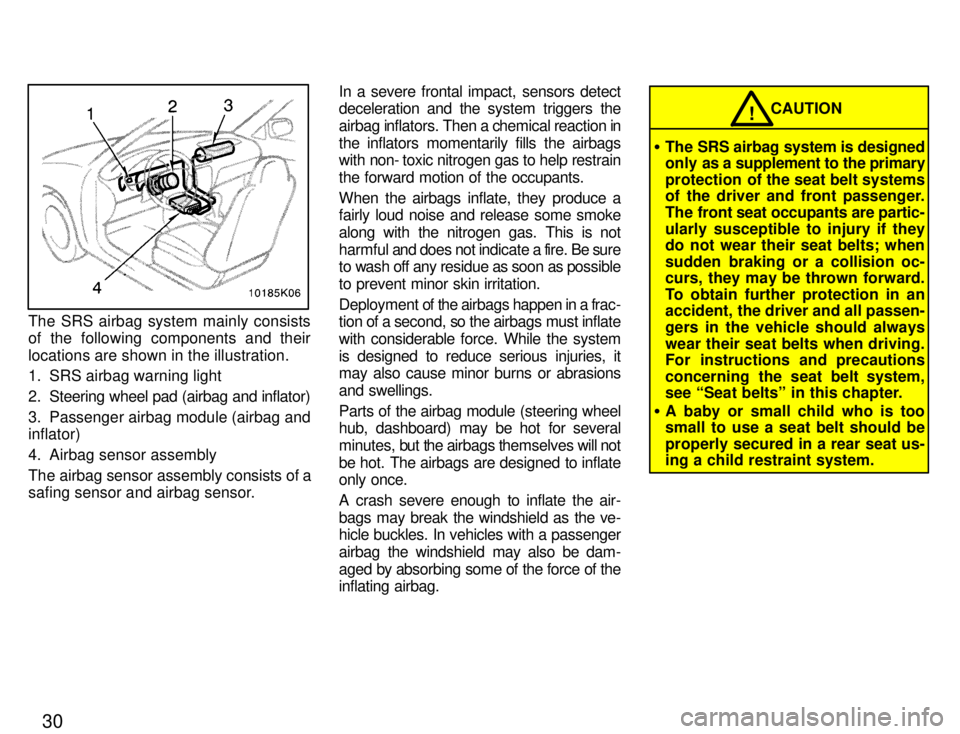
The SRS airbag system mainly consists
of the following components and their
locations are shown in the illustration.
1. SRS airbag warning light
2. Steering wheel pad (airbag and inflator)
3. Passenger airbag module (airbag and inflator)
4. Airbag sensor assembly
The airbag sensor assembly consists of a
safing sensor and airbag sensor.In a severe frontal impact, sensors detect
deceleration and the system triggers the
airbag inflators. Then a chemical reaction in
the inflators momentarily fills the airbags
with non- toxic nitrogen gas to help restrain
the forward motion of the occupants.
When the airbags inflate, they produce a
fairly loud noise and release some smoke
along with the nitrogen gas. This is not
harmful and does not indicate a fire. Be sure
to wash off any residue as soon as possible
to prevent minor skin irritation.
Deployment of the airbags happen in a frac-
tion of a second, so the airbags must inflate
with considerable force. While the system
is designed to reduce serious injuries, it
may also cause minor burns or abrasions
and swellings.
Parts of the airbag module (steering wheel
hub, dashboard) may be hot for several
minutes, but the airbags themselves will not
be hot. The airbags are designed to inflate
only once.
A crash severe enough to inflate the air-
bags may break the windshield as the ve-
hicle buckles. In vehicles with a passenger
airbag the windshield may also be dam-
aged by absorbing some of the force of the
inflating airbag.
CAUTION!
The SRS airbag system is designed
only as a supplement to the primary
protection of the seat belt systems
of the driver and front passenger.
The front seat occupants are partic-
ularly susceptible to injury if they
do not wear their seat belts; when
sudden braking or a collision oc-
curs, they may be thrown forward.
To obtain further protection in an
accident, the driver and all passen-
gers in the vehicle should alwayswear their seat belts when driving.
For instructions and precautions
concerning the seat belt system,
see Seat beltsº in this chapter.
A baby or small child who is too
small to use a seat belt should be
properly secured in a rear seat us- ing a child restraint system.
Page 41 of 165
38
A child restraint system for a small
child or baby must itself be restrained
on the seat with either the lap belt or
the lap portion of the lap/shoulderbelt.
The child restraint system should conform
to the size of the child and properly fit the
vehicle seat. For greater safety, the child
restraint
system should be installed in the
rear seat. According to accident statistics,
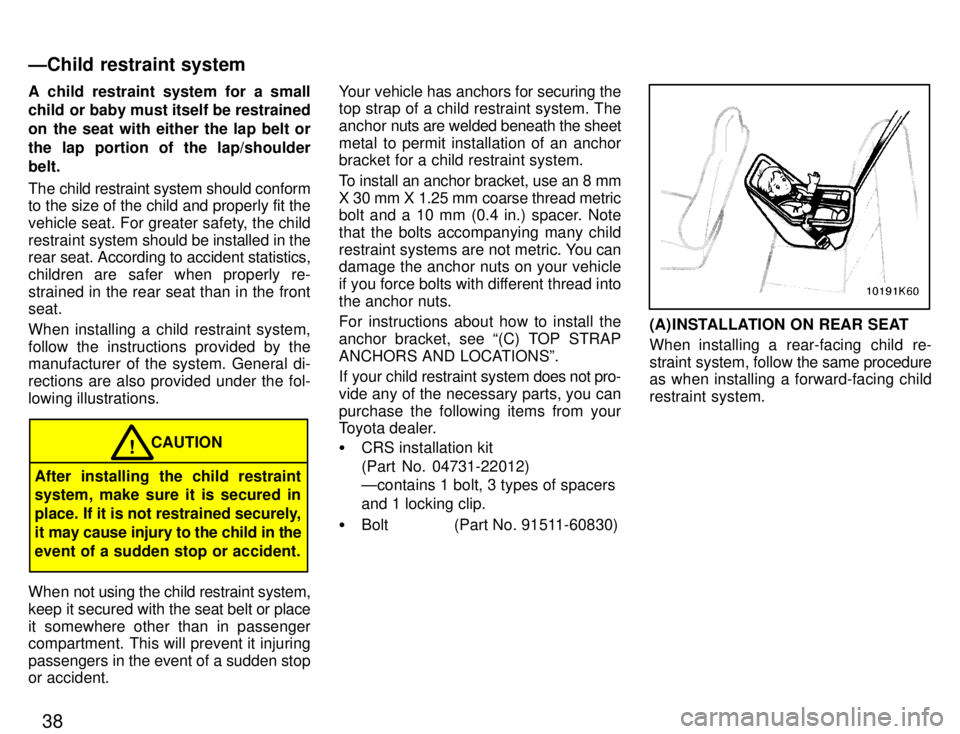
children are safer when properly re-strained in the rear seat than in the front seat. When installing a child restraint system,
follow the instructions provided by the
manufacturer of the system. General di- rections are also provided under the fol-
lowing illustrations.
CAUTION!
After installing the child restraint system, make sure it is secured in
place. If it is not restrained securely,
it may cause injury to the child in theevent of a sudden stop or accident.
When not using the child restraint system, keep it secured with the seat belt or place
it somewhere other than in passenger
compartment. This will prevent it injuring passengers in the event of a sudden stop or accident. Your vehicle has anchors for securing the
top strap of a child restraint system. The
anchor
nuts are welded beneath the sheet
metal to permit installation of an anchor
bracket for a child restraint system.
To install an anchor bracket, use an 8 mm
X 30 mm X 1.25 mm coarse thread metric
bolt and a 10 mm (0.4 in.) spacer. Note that the bolts accompanying many child
restraint systems are not metric. You can
damage the anchor nuts on your vehicle
if you force bolts with different thread intothe anchor nuts.
For instructions about how to install the
anchor bracket, see (C) TOP STRAP
ANCHORS AND LOCATIONSº.
If your child restraint system does not pro-
vide any of the necessary parts, you can
purchase the following items from your
Toyota dealer. CRS installation kit (Part No. 04731-22012) Ðcontains 1 bolt, 3 types of spacers and 1 locking clip.
Bolt (Part No. 91511-60830)
(A) INSTALLATION ON REAR SEAT
When installing a rear-facing child re-
straint system, follow the same procedure
as when installing a forward-facing child
restraint system.
ÐChild restraint system
Page 43 of 165

40
2. Fully extend the shoulder belt to put in the lock mode.3. Place the shoulder belt between the vehicle seatback and the child restraint
system and allow it to retract. To hold the
child restraint system securely, let the
shoulder belt retract as far as it will go
while firmly pushing down the child re-
straint system.4. If your child restraint system requires
the use of a top strap, latch the hook onto
the anchor bracket and tighten the top strap.
Page 44 of 165
41
CAUTION!
After inserting the tab, make sure
the tab and buckle are locked.
Do not insert coins, clips, etc. in
the buckle as this may prevent you
from properly latching the tab and buckle.
If the seat belt does not function
normally, immediately contact your
Toyota dealer.
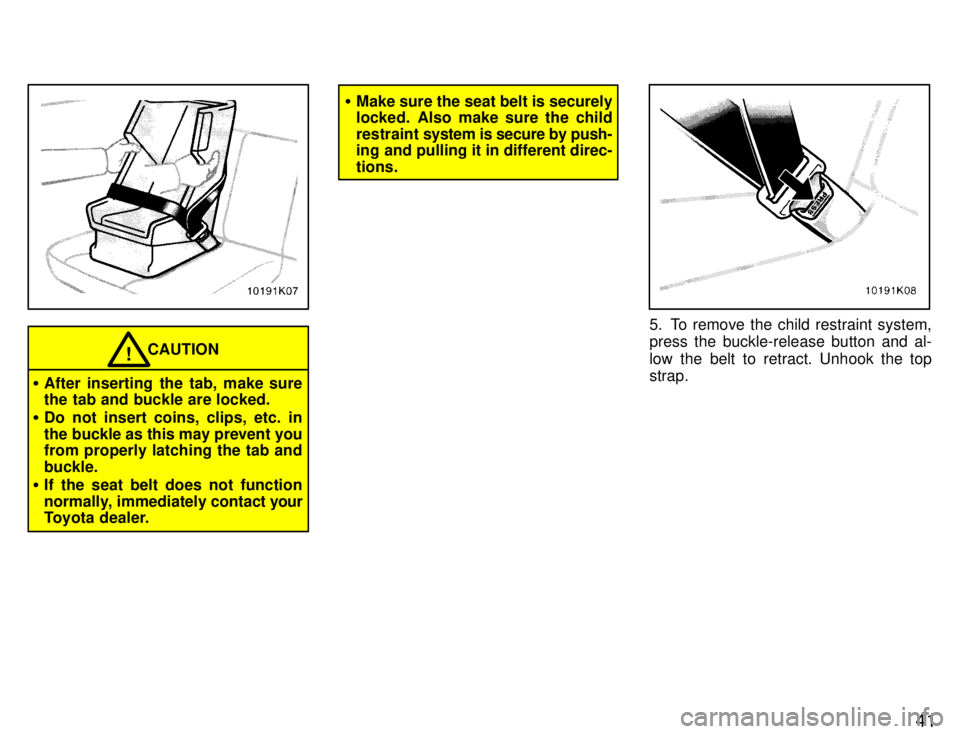
Make sure the seat belt is securely
locked. Also make sure the child
restraint system is secure by push-
ing and pulling it in different direc-tions.
5. To remove the child restraint system, press the buckle-release button and al-
low the belt to retract. Unhook the top strap.
Page 47 of 165

44
If the seat belt does not function
normally, immediately contact your
Toyota dealer.
2. Fully extend the shoulder belt to put in the lock mode.3. Place the shoulder belt between the vehicle seatback and the child restraint
system and allow it to retract. To hold the
child restraint system securely, let the
shoulder belt retract as far as it will go
while firmly pushing down the child re-
straint system.
Page 48 of 165
45
CAUTION!
After inserting the tab, make sure
the tab and buckle are locked.
Do not insert coins, clips, etc. in
the buckle as this may prevent you
from properly latching the tab and buckle.
If the seat belt does not function
normally, immediately contact your
Toyota dealer.
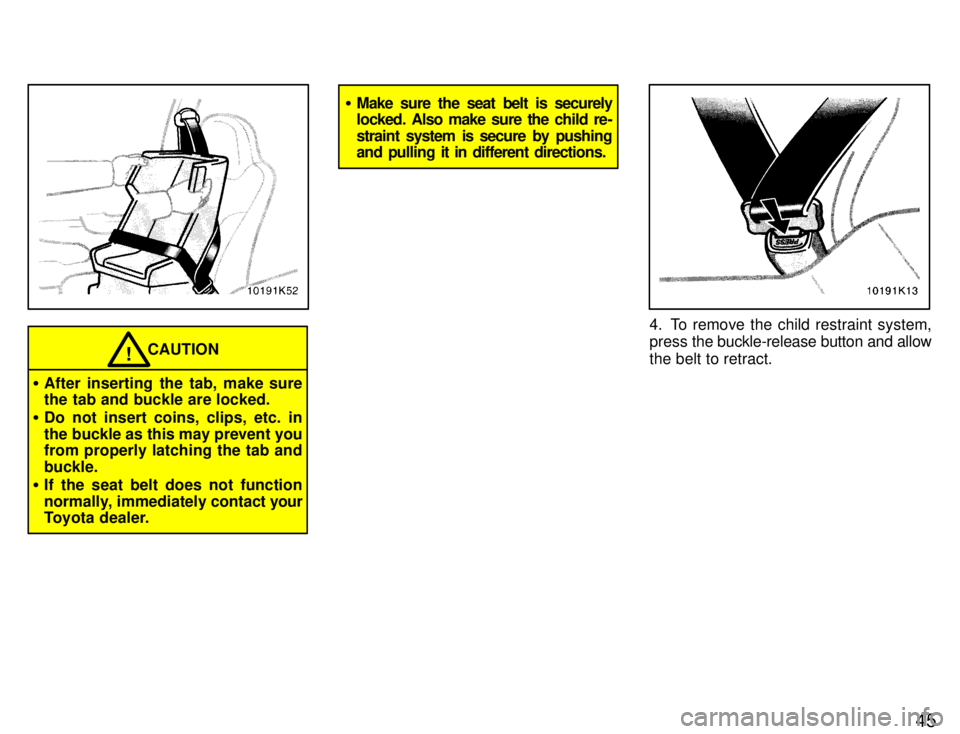
Make sure the seat belt is securely
locked. Also make sure the child re-
straint system is secure by pushing
and pulling it in different directions.
4. To remove the child restraint system, press the buckle-release button and allow
the belt to retract.
Page 65 of 165
62
NOTICE
Be careful not to overrev the en-gine. Watch the tachometer to
keep engine rpm from going intothe red zone. The maximum allow-able speed (approximate) for each
position is given above for yourreference.
Do not continue hill climbing for a
long time in the 2º or Lº position.
This may cause severe automatic transmission damage from over-
heating. To prevent such damage,use Dº position for hill climbingor hard towing.
(c) Backing up
1. Bring the vehicle to a complete stop.
2. With the brake pedal held down with your foot, shift the selector lever to the Rº
position.
NOTICE
Never shift into reverse while the vehicle is moving.
(d) Parking
1. Bring the vehicle to a complete stop.
2. Pull the parking brake lever up fully to securely apply the parking brake.
3. With the brake pedal pressed down,
shift the selector lever to the Pº position.
While the vehicle is moving, never
attempt to move the selector lever
into Pº position under any circum-
stances. Serious mechanical dam-
age and loss of vehicle control mayresult. CAUTION
!
(e) Good driving practice
If the transmission is repeatedly upshifted
and downshifted between third gear and
overdrive when climbing a gentle slope,
the overdrive switch should be turned off. Be sure to turn the switch on immediatelyafterward.
Always keep your foot on the brake
pedal while stopped with the engine
running. This prevents the vehicle
from creeping. CAUTION
!
NOTICE
Do not hold the vehicle on an upgrade with the accelerator pedal.
It can cause the transmission to overheat. Always use the brakepedal or parking brake.
(f) If you cannot shift the selector lever out of Pº position
If you cannot shift the selector lever from the Pº position even though the brake
pedal is depressed, use the shift lock
override button. For instructions, see Ifyou cannot shift automatic transmission selector leverº in Part 4.
Page 97 of 165
94ABSº warning light
This light comes on when the ignition key is turned to the ONº position. After about
3 seconds, the light will go off.
If either of the following conditions occurs, this indicates a malfunction somewhere inthe parts monitored by the warning light
system. Contact your Toyota dealer as
soon as possible to service the vehicle.
The light does not come on as de-
scribed above, or remains on.
The light comes on while driving.
Even if the anti-lock brake system should
fail, the brake system will still operate con-
ventionally. Have your vehicle checked
by your Toyota dealer as soon as pos- sible.
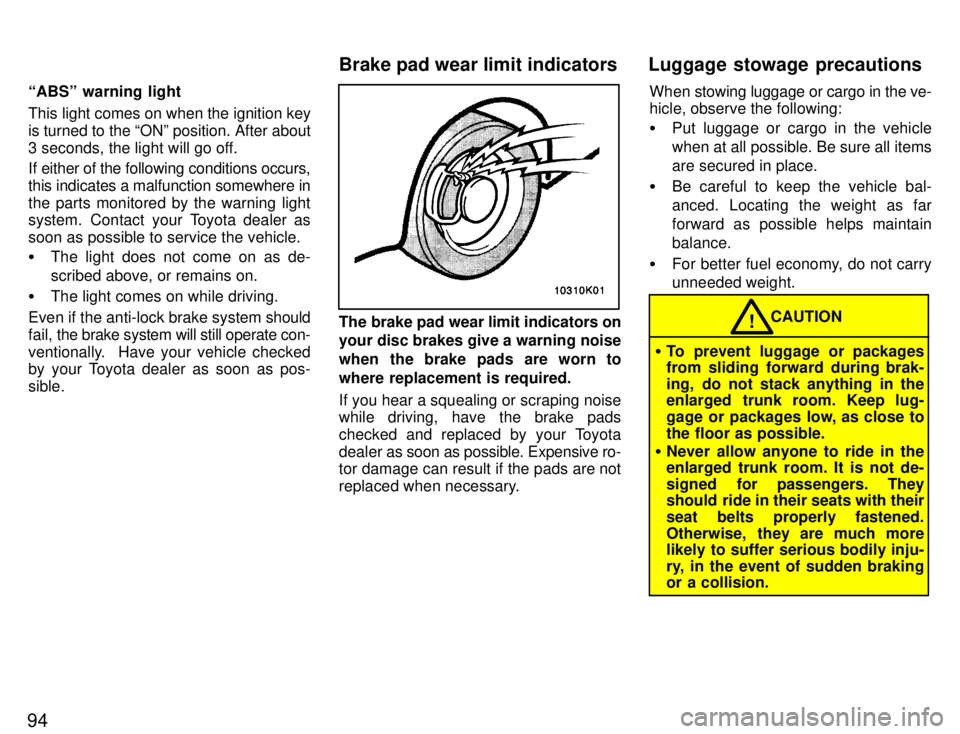
The brake pad wear limit indicators on your disc brakes give a warning noise
when the brake pads are worn to
where replacement is required.
If you hear a squealing or scraping noise
while driving, have the brake pads
checked and replaced by your Toyota
dealer as soon as possible. Expensive ro-
tor damage can result if the pads are not
replaced when necessary. When stowing luggage or cargo in the ve-
hicle, observe the following:
Put luggage or cargo in the vehicle
when at all possible. Be sure all itemsare secured in place.
Be careful to keep the vehicle bal-anced. Locating the weight as far
forward as possible helps maintainbalance.
For better fuel economy, do not carry
unneeded weight.
To prevent luggage or packages
from sliding forward during brak-
ing, do not stack anything in the
enlarged trunk room. Keep lug-
gage or packages low, as close to
the floor as possible.
Never allow anyone to ride in the enlarged trunk room. It is not de-
signed for passengers. They
should ride in their seats with their
seat belts properly fastened.
Otherwise, they are much more
likely to suffer serious bodily inju-
ry, in the event of sudden braking
or a collision.
CAUTION!
Brake pad wear limit indicators Luggage stowage precautions
Page 112 of 165

109
1. Get the required tools and spare tire.1. Wheel nut wrench
2. Jack handle
3. Jack
4. Spare tire
To prepare yourself for an emergency, you should familiarize yourself with the
use of the jack, each of the tools and their storage locations.Turn the jack joint by hand.
To remove: Turn the joint in direction 1 un- til the jack is free.
To store: Turn the joint in direction 2 until the jack is firmly secured to prevent it fly-
ing forward during a collision or suddenbraking.To remove the spare tire:
1. Remove the spare tire cover.
2. Loosen the bolt and remove it.Then t ake the spare tire out of the vehicle.
When storing the spare tire, put it in place with the outer side of the wheel facing up.Then secure the tire by repeating the
above removal steps in reverse order to
prevent it from flying forward during a col-
lision or sudden braking.
ÐRequired tools and spare tire
Page 116 of 165
11 3
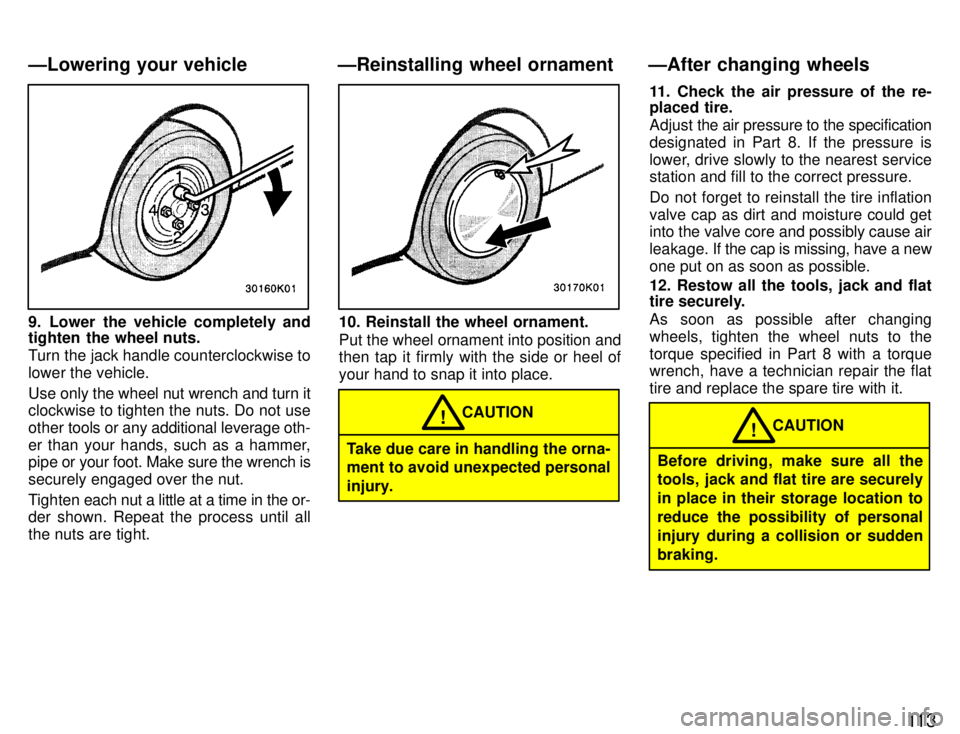
9. Lower the vehicle completely and
tighten the wheel nuts.
Turn the jack handle counterclockwise to lower the vehicle.
Use only the wheel nut wrench and turn it
clockwise to tighten the nuts. Do not use other tools or any additional leverage oth-
er than your hands, such as a hammer,
pipe or your foot. Make sure the wrench is
securely engaged over the nut.
Tighten each nut a little at a time in the or-
der shown. Repeat the process until all the nuts are tight.10. Reinstall the wheel ornament.
Put the wheel ornament into position and
then tap it firmly with the side or heel of your hand to snap it into place.
Take due care in handling the orna-
ment to avoid unexpected personal
injury. CAUTION
! 11. Check the air pressure of the re-
placed tire.
Adjust
the air pressure to the specification
designated in Part 8. If the pressure is
lower, drive slowly to the nearest service station and fill to the correct pressure.
Do not forget to reinstall the tire inflation valve cap as dirt and moisture could get into the valve core and possibly cause air
leakage. If the cap is missing, have a new
one put on as soon as possible. 12. Restow all the tools, jack and flat
tire securely.
As soon as possible after changing
wheels, tighten the wheel nuts to thetorque specified in Part 8 with a torque wrench, have a technician repair the flat tire and replace the spare tire with it.
Before driving, make sure all the
tools, jack and flat tire are securely in place in their storage location to
reduce the possibility of personal
injury during a collision or suddenbraking. CAUTION
!
ÐAfter changing wheels
ÐLowering your vehicle ÐReinstalling wheel ornament