steering TOYOTA PASEO 1996 User Guide
[x] Cancel search | Manufacturer: TOYOTA, Model Year: 1996, Model line: PASEO, Model: TOYOTA PASEO 1996Pages: 165, PDF Size: 2.57 MB
Page 103 of 165

100
Use a washer fluid containing an anti-
freeze solution.
This product is available at your Toyota
dealer and most auto parts stores. Follow
the manufacturer's directions for how
much to mix with water.
Do not use engine antifreeze or any
other substitute because it may
damage your vehicle's paint.
NOTICE
Do not use your parking brake when there is a possibility it could freeze. When parking, put the transmission into
Pº (automatic) or into first or reverse
(manual) and block the rear wheels. Do
not use the parking brake, or snow or wa-
ter accumulated in and around the parkingbrake mechanism may freeze, making it
hard to release. Keep ice and snow from accumulating
under the fenders.
Ice and snow built up under your fenders
can make steering difficult. During bad winter driving, stop and check under the
fenders occasionally. Depending on where you are driving,
we recommend you carry some emer- gency equipment.
Some of the things you might put in the ve-
hicle are tire chains, window scraper, bag of sand or salt, flares, small shovel, jump- er cables, etc.
Toyota does not recommend towing a
trailer with your Paseo. It is not designed for trailer towing.
Trailer towing
Page 104 of 165
101
Getting
more kilometers/mileage from a li-
ter/gallon of fuel is easyÐjust take it easy.
It will help make your vehicle last longer,
too. Here are some specific tips on how to
save money on both fuel and repairs: Keep your tires inflated at the cor- rect pressure. Underinflation causes
tire wear and wastes fuel. See Chapter
7-2 for instructions.
Do not carry unneeded weight in
your vehicle. Excess weight puts a
heavier load on the engine, causinggreater fuel consumption.
Avoid lengthy warm-up idling.
Once the engine is running smoothly,
begin drivingÐbut gently. Remember,
however, that on cold winter days this
may take a little longer.
Accelerate slowly and smoothly.
Avoid jackrabbit starts. Get into high
gear as quickly as possible.
Avoid long engine idling. If you have
a long wait and you are not in traffic, it
is better to turn off the engine and start
again later.
Avoid engine lug or overrevving.
Use a gear position suitable for the
road on which you are travelling.
Avoid continuous speeding up and
slowing down. Stop-and-go driving
wastes fuel.
Avoid unnecessary stopping and
braking. Maintain a steady pace. Try
to time the traffic signals so you only
need to stop as little as possible or take
advantage of through streets to avoid
traffic lights. Keep a proper distance
from other vehicles to avoid suddenbraking. This will also reduce wear onyour brakes.
Avoid heavy traffic or traffic jams
whenever possible.
Do not rest your foot on the clutch
or brake pedal. This causes needless
wear, overheating and poor fuel econ-
omy.
Maintain a moderate speed on highways. The faster you drive, the
greater the fuel consumption. By re-
ducing your speed, you will cut down
on fuel consumption.
Keep the front wheels in properalignment. Avoid hitting the curb and
slow down on rough roads. Improper
alignment not only causes faster tire
wear but also puts an extra load on the
engine, which, in turn, wastes fuel.
Keep the bottom of your vehicle
free from mud, etc. This not only
lessens weight but also helps prevent corrosion.
Keep your vehicle tuned-up and in
top shape. A dirty air cleaner, improp-
er valve clearance, dirty plugs, dirty oil
and grease, brakes not adjusted, etc.
all lower engine performance and con-
tribute to poor fuel economy. For lon-
ger life of all parts and lower operating
costs, keep all maintenance work on
schedule, and if you often drive under severe conditions, see that your ve-
hicle receives more frequent mainte-
nance (For schedule maintenance in-
formation, please refer to the separate
Owner 's Manual Supplement/Main-
tenance Scheduleº).
CAUTION
Never turn off the engine to coast
down hills. Your power steering and
brake booster will not function with-
out the engine running. Also, theemission control system operates
properly only when the engine isrunning.!
How to save fuel and make
your vehicle last longer, too
Page 109 of 165
106
If your engine stalls while driving
0
1. Reduce your speed gradually, keeping
a straight line. Move cautiously off the
road to a safe place.
2. Turn on your emergency flashers.
3. Try starting the engine again.
If the engine will not start, see If your ve-
hicle will not startº.
If the engine is not running, the
power assist for the brakes and
steering will not work so steering
and braking will be much harder
than usual. CAUTION
! If your engine coolant temperature
gauge indicates overheating, if you
experience a loss of power, or if you
hear a
loud knocking or pinging noise,
the engine has probably overheated.
You should follow this procedure...
1. Pull safely off the road, stop the vehicle
and turn on your emergency flashers. Put
the transmission in Pº (automatic) or neu-
tral ( manual) and apply the parking brake.
Turn off the air conditioning if it is beingused.
2. If coolant or steam is boiling out of the
radiator or reservoir, stop the engine. Wait
until the steam subsides before opening
the hood. If there is no coolant boiling over
or steam, leave the engine running andmake sure the electric cooling fan is oper-
ating. If it is not, turn the ignition off.
To help avoid personal injury, keep
the hood closed until there is no
steam. Escaping steam or coolant is
a sign of very high pressure. CAUTION
! 3. Visually
check to see if the engine drive
belt (water pump belt) is broken or loose.
Look for obvious coolant leaks from the
radiator, hoses, and under the vehicle.
However, note that water draining from
the air conditioning is normal if it has beenused.
When the engine is running, keep
hands and clothing away from the
moving fan and engine drive belts. CAUTION
!
4. If the engine drive belt is broken or the
coolant is leaking, stop the engine imme-
diately. Call a Toyota dealer for assis- tance.
5. If the engine drive belt is O.K. and there are no obvious leaks, check the
coolant reservoir. If it is dry, add coolant to
the reservoir while the engine is running. Fill it about half full.
Do not attempt to remove the radia-
tor cap when the engine and radia-
tor are hot. Serious injury could re-
sult from scalding hot fluid and
steam blown out under pressure. CAUTION
!
If your engine stalls while driving
If your vehicle overheats
Page 117 of 165

11 4
If towing is necessary, we recommend
you have it done by your Toyota dealer
or a commercial tow truck service. Proper equipment will help ensure that your vehicle is not damaged while being
towed. Commercial operators are gener-
ally aware of the state/provincial and local
laws pertaining to towing.
Your vehicle can be damaged if it is towed
incorrectly. Although most operatorsknow the correct procedure, it is possible
to make a mistake. To avoid damage to your vehicle, make sure the following few
precautions are observed. If necessary,
show this page to the tow truck driver.
TOWING PRECAUTIONS: Use a safety chain system for all towing,
and abide by the state/provincial and local
laws. The wheels and axle on the ground
must be in good condition. If they are
damaged, use a towing dolly.
(a) Using flat bed truck
Toyota recommends this as the best method for your vehicle. (b) Towing with wheel lift type truck
From frontÐ
Release the parking brake.
From rearÐ Manual transmission:
We recommend using a towing dolly
under the front wheels. If you do not
use a towing dolly, place the ignition key in the ACCº position and put thetransmission in neutral.
NOTICE
Do not tow with the key removed or in the LOCKº position when towing
from the rear without a towing dolly.The steering lock mechanism is notstrong enough to hold the front wheels straight.
Automatic transmission: Use a towing dolly under the front wheels.
NOTICE
Never tow a vehicle with an automatic transmission from the
rear with the front wheels on theground, as this may cause serious damage to the transmission.
If your vehicle needs to be towedÐ
Page 118 of 165
11 5
(c) Towing with sling type truck
NOTICE
Do not tow with sling type truck, either from the front or rear. This
may cause body damage.
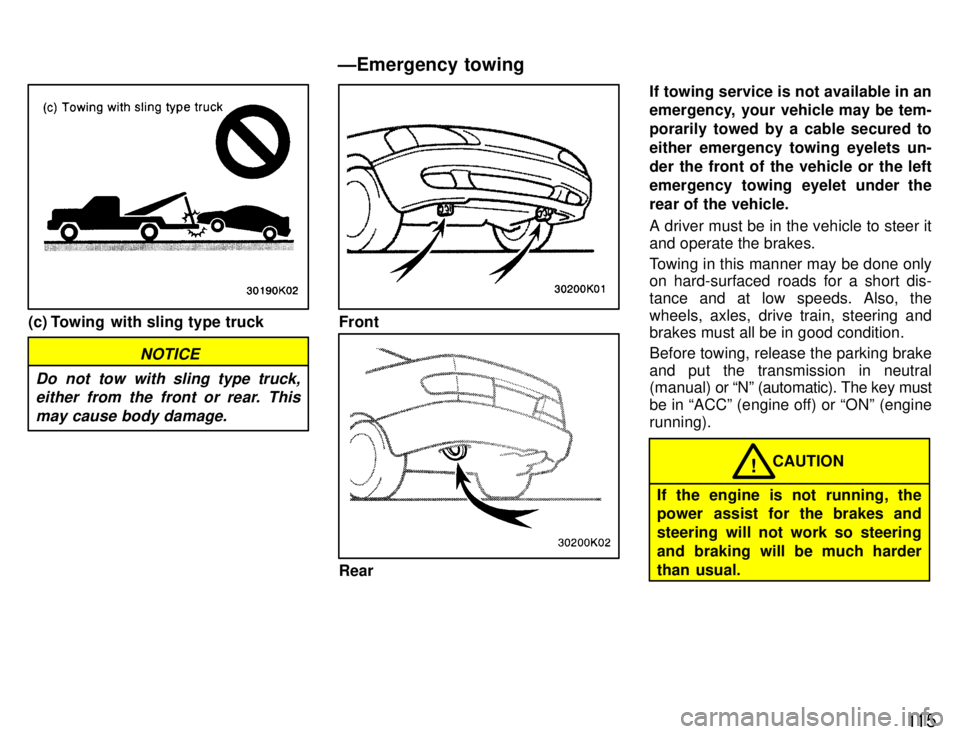
Front
Rear If towing service is not available in an
emergency, your vehicle may be tem-
porarily towed by a cable secured to
either emergency towing eyelets un-der the front of the vehicle or the left
emergency towing eyelet under the
rear of the vehicle. A driver must be in the vehicle to steer it and operate the brakes.
Towing in this manner may be done only
on hard-surfaced roads for a short dis-
tance and at low speeds. Also, the
wheels, axles, drive train, steering and brakes must all be in good condition. Before towing, release the parking brake
and put the transmission in neutral
(manual) or
Nº (automatic). The key must
be in ACCº (engine off) or ONº (engine running).
CAUTION!
If the engine is not running, the
power assist for the brakes and
steering will not work so steering
and braking will be much harder
than usual.
ÐEmergency towing
Page 128 of 165

125
Tire surface and wheel nuts Check the tires carefully
for cuts, damage
or excessive wear. See Chapter 7-2 for
additional information. When checking the tires, make sure no nuts are missing,
and check the nuts for looseness. T ighten
them if necessary.
Tire rotation
Rotate the tires every 12000 km (7500
miles). See Chapter 7-2 for additional in-formation.
Fluid leaks Check underneath for leaking fuel, oil, wa-
ter or other fluid after the vehicle has been
parked for a while. If you smell fuel fumes
or notice any leak, have the cause found
and corrected immediately. Doors and engine hood Check that all doors including trunk lid op-
erate smoothly and all latches lock se-
curely. M ake sure the engine hood secon-
dary latch secures the hood from opening
when the primary latch is released. INSIDE THE VEHICLE Items listed below should be checked
regularly, e.g. while performing peri-
odic services, cleaning the vehicle,etc. Lights Make sure the headlights, stop lights, tail lights, turn signal lights, and other lights are all working. Check headlight aim. Service reminder indicators and
warn-
ing buzzers Check that all service reminder indicators
and warning buzzers function properly. Steering wheel
Check that it has the specified freeplay.
Be alert for changes in steering condition,such as hard steering or strange noise. Seats Check that all front seat controls such as
seat adjusters, seatback recliner, etc. op- erate smoothly and that all latches lock
securely in any position. For folding-down
rear seatback, check that the latches lock
securely. Seat belts
Check that the seat belt system such as
buckles, retractors and anchors operate
properly and smoothly. Make sure the belt
webbing is not cut, frayed, worn or dam-aged. Accelerator pedal Check
the pedal for smooth operation and
uneven pedal effort or catching. Clutch pedal Check the pedal for smooth operation. Brake pedal Check the pedal for smooth operation and
that the pedal has the proper clearance. Check the brake booster function. Brakes
At a safe place, check that the brakes do not pull to one side when applied. Parking brake Check that the lever has the proper travel and that, on a safe incline, your vehicle is
held securely with only the parking brake applied.
Automatic transmission Parkº mech-
anism
Check the lock release button of the se-
lector lever for proper and smooth opera-
tion. On a safe incline, check that your ve-
hicle is held securely with the selectorlever in Pº position and all brakes re-leased.
Page 129 of 165

126IN THE ENGINE COMPARTMENT Items listed below should be checked
from
time to time , e.g. each time when
refueling.
Washer fluid
Make sure there is sufficient fluid in the
tank. See Chapter 7-3 for additional infor-
mation.
Engine coolant level Make sure the coolant level is between
the FULLº and LOWº lines on the see-
through reservoir. See Chapter 7-2 for
additional information. Battery electrolyte level Make sure the electrolyte level of all bat-
tery cells is between upper and lower level
lines on the case. Add only distilled water
when replenishing. See Chapter 7-3 for
additional information. Brake fluid level
Make sure the brake fluid level is correct. See Chapter 7-2 for additional informa- tion.
Engine oil level
Check the l evel on the dipstick with the en-
gine turned off and the vehicle parked on
a level spot. See Chapter 7-2 for addition-
al information. Power steering fluid level Check
the level through the reservoir. The
level should be in the HOTº or COLDº
range depending on the fluid t emperature.
See Chapter 7-2 for additional informa-tion.
Exhaust system
If you notice any change in the sound of
the exhaust or smell exhaust fumes, have the cause located and corrected immedi-
ately. (See engine exhaust cautions in
Part 2.) Be on the alert for changes in perfor-
mance, sounds, and visual tip-offs
that in-
dicate service is needed. Some important
clues are as follows: Engine missing, stumbling, or pinging
Appreciable loss of power
Strange engine noises
A leak under the vehicle (however, wa-
ter dripping from the air conditioning
after use is normal.)
Change in exhaust sound (This may
indicate a dangerous carbon monox-
ide leak. Drive with the windows open
and have the exhaust system checked
immediately.)
Flat-looking tire; excessive tire squeal
when cornering; uneven tire wear
Vehicle pulls to one side when driving straight on a level road
Strange noises related to suspensionmovement
Loss of brake effectiveness; spongy
feeling brake or clutch pedal; pedal al-
most touches floor; vehicle pulls to one
side when braking
Engine coolant temperature continual-
ly higher than normal
Does your vehicle needrepairing?
Page 133 of 165

1301. Power steering fluid reservoir
2. Engine oil filler cap
3. Engine oil level dipstick
4. Brake fluid reservoir
5. Fuse blocks
6. Windshield washer fluid tank
7. Battery
8. Engine coolant reservoir
9. Electric cooling fans
Engine compartment overview
Page 137 of 165

134Here is a list of parts and tools you will
need on performing do-it-yourself main-
tenance. Remember all Toyota parts are
designed in metric sizes, so your tools
must be metric. Checking the engine oil level Parts (if level is low):
Engine oil API SH, Energy-Conserv-
ing IIº multigrade or ILSAC multigrade
having viscosity proper for your cli-mate
Tools: Rag or paper towel
Funnel (only for adding oil)
Checking the engine coolant level Parts (if level is low): Ethylene-glycol antifreeze
Demineralized or distilled water
Tools: Funnel (only for adding coolant)
Checking brake fluid Parts (if level is low): SAE J1703 or FMVSS No. 116 DOT 3 brake fluid
Tools: Rag or paper towel
Funnel (only for adding fluid) Checking power steering fluid Parts (if level is low):
Automatic transmission fluid DEX- RON [
-II or-III
Tools: Rag or paper towel
Funnel (only for adding fluid)
Checking battery condition Non-maintenance batteriesÐ
Tools: Warm water
Baking soda
Grease
Conventional wrench (for terminal clamp bolts)
Maintenance type batteriesÐ Parts (if level is low): Distilled water
Tools: Warm water
Baking soda
Grease
Conventional wrench (for terminal clamp bolts)
Coin (for vent plugs)
Funnel (only for adding distilled water) Checking and replacing fuses Parts (if replacement is necessary):
Fuse with same amperage rating as original
Tools: Conventional wrench (for instrument
lower panel nut)
Adding washer fluid Parts: Water
Washer fluid containing antifreeze (for winter use)
Tools: Funnel
Replacing light bulbs Parts: Bulb with same number and wattage rating as original (See charts in Re-
placing light bulbsº in Chapter 7-3.)
Tools: Screwdriver
Parts and tools
Page 138 of 165
Part 7Checking the engine oil level
135
DO-IT-YOURSELF MAINTENANCEÐ
Chapter 7-2 Engine and Chassis
Checking the engine oil level
Checking the engine coolant level
Checking brake fluid
Checking power steering fluid
Checking tire pressure
Checking and replacing tires
Rotating tires
Installing snow tires and chains
Replacing wheels
Aluminum wheel precautions
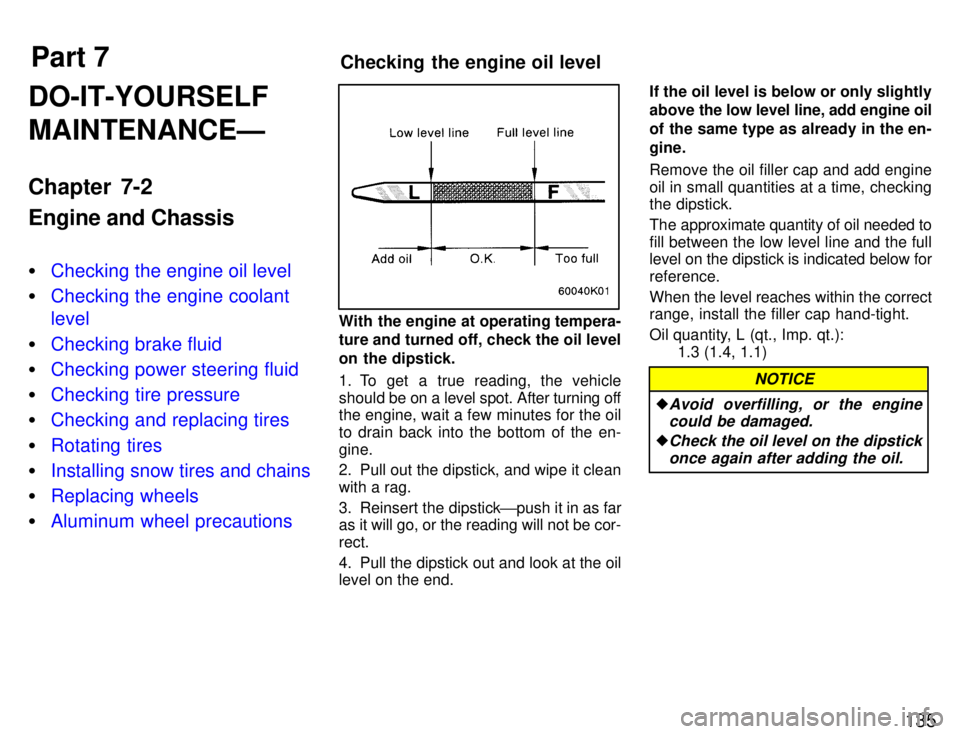
With the engine at operating tempera- ture and turned off, check the oil level
on the dipstick.
1. To get a true reading, the vehicle
should be on a
level spot. After turning off
the engine, wait a few minutes for the oil
to drain back into the bottom of the en-gine.
2. Pull out the dipstick, and wipe it clean with a rag.
3. Reinsert the dipstick 'push it in as far
as it will go, or the reading will not be cor- rect.
4. Pull the dipstick out and look at the oil level on the end. If the oil level is below or only slightly
above
the low level line, add engine oil
of the same type as already in the en- gine. Remove the oil filler cap and add engine oil in small quantities at a time, checking the dipstick.
The approximate quantity of oil needed to
fill between the low level line and the full
level on the dipstick is indicated below for reference. When the level reaches within the correct range, install the filler cap hand-tight.
Oil quantity, L (qt., Imp. qt.): 1.3 (1.4, 1.1)
Avoid overfilling, or the engine could be damaged.
Check the oil level on the dipstick
once again after adding the oil.
NOTICE