trunk TOYOTA PASEO 1996 User Guide
[x] Cancel search | Manufacturer: TOYOTA, Model Year: 1996, Model line: PASEO, Model: TOYOTA PASEO 1996Pages: 165, PDF Size: 2.57 MB
Page 111 of 165
108
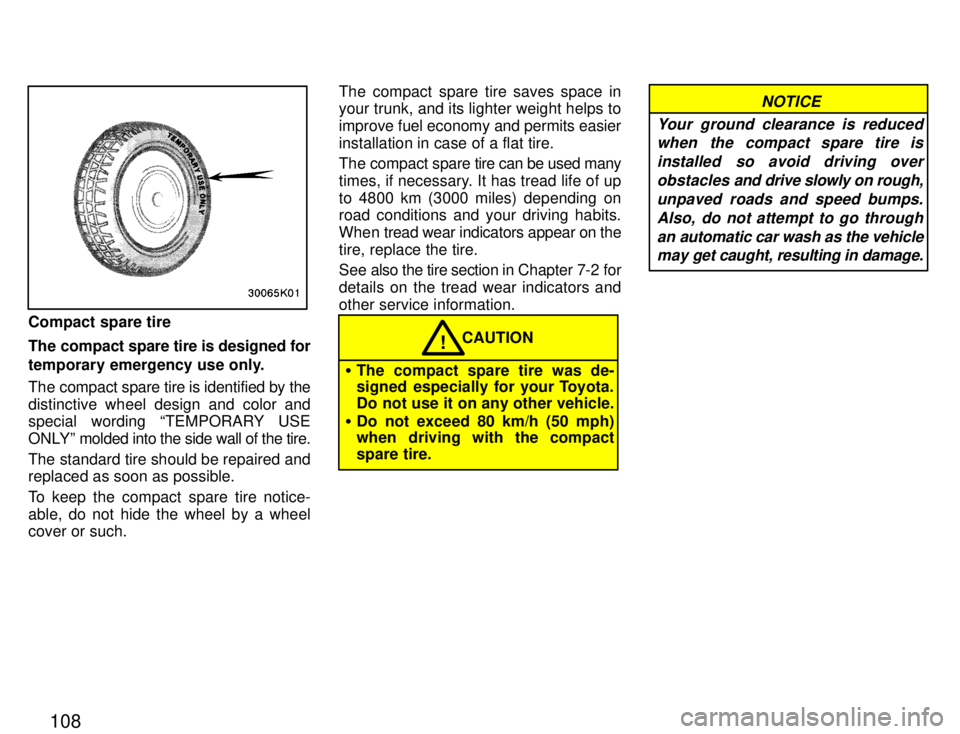
Compact spare tire
The compact spare tire is designed for
temporary emergency use only.
The compact spare tire is identified by the
distinctive wheel design and color and
special wording TEMPORARY USE
ONLYº molded into the side wall of the tire.
The standard tire should be repaired and replaced as soon as possible.
To keep the compact spare tire notice-
able, do not hide the wheel by a wheel cover or such.The compact spare tire saves space inyour trunk, and its lighter weight helps to improve fuel economy and permits easier
installation in case of a flat tire.
The compact spare
tire can be used many
times, if necessary. It has tread life of up
to 4800 km (3000 miles) depending on
road conditions and your driving habits.
When tread wear indicators appear on the
tire, replace the tire.
See also the tire section in Chapter 7-2 for
details on the tread wear indicators and other service information.
The compact spare tire was de-
signed especially for your Toyota.
Do not use it on any other vehicle.
Do not exceed 80 km/h (50 mph)
when driving with the compact spare tire. CAUTION
!
NOTICE
Your ground clearance is reduced when the compact spare tire is
installed so avoid driving overobstacles and drive slowly on rough,
unpaved roads and speed bumps. Also, do not attempt to go throughan automatic car wash as the vehiclemay get caught, resulting in damage.
Page 128 of 165

125
Tire surface and wheel nuts Check the tires carefully
for cuts, damage
or excessive wear. See Chapter 7-2 for
additional information. When checking the tires, make sure no nuts are missing,
and check the nuts for looseness. T ighten
them if necessary.
Tire rotation
Rotate the tires every 12000 km (7500
miles). See Chapter 7-2 for additional in-formation.
Fluid leaks Check underneath for leaking fuel, oil, wa-
ter or other fluid after the vehicle has been
parked for a while. If you smell fuel fumes
or notice any leak, have the cause found
and corrected immediately. Doors and engine hood Check that all doors including trunk lid op-
erate smoothly and all latches lock se-
curely. M ake sure the engine hood secon-
dary latch secures the hood from opening
when the primary latch is released. INSIDE THE VEHICLE Items listed below should be checked
regularly, e.g. while performing peri-
odic services, cleaning the vehicle,etc. Lights Make sure the headlights, stop lights, tail lights, turn signal lights, and other lights are all working. Check headlight aim. Service reminder indicators and
warn-
ing buzzers Check that all service reminder indicators
and warning buzzers function properly. Steering wheel
Check that it has the specified freeplay.
Be alert for changes in steering condition,such as hard steering or strange noise. Seats Check that all front seat controls such as
seat adjusters, seatback recliner, etc. op- erate smoothly and that all latches lock
securely in any position. For folding-down
rear seatback, check that the latches lock
securely. Seat belts
Check that the seat belt system such as
buckles, retractors and anchors operate
properly and smoothly. Make sure the belt
webbing is not cut, frayed, worn or dam-aged. Accelerator pedal Check
the pedal for smooth operation and
uneven pedal effort or catching. Clutch pedal Check the pedal for smooth operation. Brake pedal Check the pedal for smooth operation and
that the pedal has the proper clearance. Check the brake booster function. Brakes
At a safe place, check that the brakes do not pull to one side when applied. Parking brake Check that the lever has the proper travel and that, on a safe incline, your vehicle is
held securely with only the parking brake applied.
Automatic transmission Parkº mech-
anism
Check the lock release button of the se-
lector lever for proper and smooth opera-
tion. On a safe incline, check that your ve-
hicle is held securely with the selectorlever in Pº position and all brakes re-leased.