warning TOYOTA PASEO 1996 User Guide
[x] Cancel search | Manufacturer: TOYOTA, Model Year: 1996, Model line: PASEO, Model: TOYOTA PASEO 1996Pages: 165, PDF Size: 2.57 MB
Page 60 of 165

57
(a) Malfunction Indicator Lamp
This lamp comes on in the following cases.
a. The fuel tank is completely empty.
(See Fuel gaugeº in Chapter 1-5 for in- structions.)
b. There is a
problem somewhere in your
engine or automatic transmission electri- cal system.
If it comes on while you are driving in case
b, have your vehicle checked/repaired by
your Toyota dealer as soon as possible.
(b) Low Fuel Level Warning Light
This light comes on when the fuel level in
the tank becomes nearly empty. Fill up the
tank as soon as possible.
(c) ABSº Warning Light
This light warns that there is a problem
somewhere in your anti-lock brake sys- tem.
If the light comes on while you are driving,
have your vehicle checked by your T oyota
dealer as soon as possible.
The light comes on when the ignition key
is turned to the ONº position. After about
3 seconds, the light will go off. When the ABSº warning light is on (and
the brake system warning light is off), the brake system
operates conventionally but
without anti-lock function.
(d) Open Door Warning Light
This light remains on until both side doors
are completely closed.
(e) SRS Airbag Warning Light
This light will come on when the igni-
tion key is turned to the ACCº or ONº
position. After about 6 seconds, the
light will go off. This means the airbag
system is operating properly.
The warning light system monitors the air
bag sensor assembly, inflators, warning
light, interconnecting wiring and power sources.
If either of the following conditions occurs, this indicates a malfunction somewhere in the parts monitored by the warning light
system. Contact your Toyota dealer as
soon as possible to service the vehicle. The light does not come on when the
ignition key is turned to the ACCº or
ONº position or remains on.
The light comes on while driving. (f) Light Reminder Buzzer
The buzzer will sound if the driver's door is opened with the key removed from the
ignition switch and the headlight switch
left on.
(g) Key Reminder Buzzer
This buzzer reminds you to remove the
key when you open the driver's door with the ignition key in the ACCº or LOCKºposition.
CHECKING SERVICE REMINDER
INDICATORS
1. Apply the parking brake.
2. Open either side door.
The open door warning light should come on.
3. Close the door.
The open door warning light should go off.
4. Turn the ignition key to ACCº.
The SRS airbag warning light should
come on. It goes off after about 6 sec- onds.
Page 61 of 165

585. Turn the ignition key to ONº, but do not
start the engine.
All the service reminder indicators except the open door warning light and SRS air-
bag warning light should come on. The
ABSº warning light goes off after about 3seconds.
If any service reminder indicator or warning
buzzer does not function as described
above, either the bulb is burned out or the
circuit is in need of repair. Have it checked
by your Toyota dealer as soon as possible.
Page 69 of 165
66
If you need accelerationÐfor example,
when passingÐdepress the accelerator
pedal
enough for the vehicle to exceed the
set speed. When you release it, the ve-
hicle will return to the speed set prior to the
acceleration.
(For manual transmission)
While driving with the cruise control
on, do not shift to neutral without de-
pressing the clutch pedal, as this
may cause engine racing or overrev-ving. CAUTION
!
CANCELLING THE PRESET SPEED
You can cancel the preset speed by:
a. Pulling the lever in the CANCELº di- rection and releasing it.
b. Depressing the brake pedal.
c. Depressing the clutch pedal (manual transmission. If the vehicle speed falls below about 40
km/h (25 mph), the preset speed will auto-
matically cancel out.
If the vehicle speed drops 16 km/h (10
mph), below the preset speed, the preset
speed will also automatically cancel out. If the preset speed automatically cancels
out other than for the above cases, have your
vehicle checked by your Toyota deal-
er at the earliest opportunity.
RESETTING AT A FASTER SPEED Push the lever up in the RES/ACCº direc-
tion and hold it. Release the lever when
the desired speed is attained. While the
lever is held up, the vehicle will graduallygain speed.
However, a faster way to reset is to accel-
erate the vehicle, and then push the lever
down in the SET/COAST direction.
RESETTING AT A SLOWER SPEED Push the lever down in the SET/COASTº
direction and hold it. Release the lever
when the desired speed is attained. While
the lever is held down, the vehicle speedwill gradually decrease.
However, a faster way to reset is to de- press the brake pedal and then push the
lever down in the SET/COASTº direction. On vehicles with automatic transmission,
even if you turn off the overdrive switch with the cruise control on, engine braking
will not be applied because the cruise
control is not cancelled. To decrease the
vehicle speed, reset to a slower speed
with the cruise control lever or depress
the brake pedal. If you use the brake ped- al, cruise control is cancelled. RESUMING THE PRESET SPEED
If the preset speed is cancelled by pulling
the control lever or by depressing the
brake pedal or clutch pedal, pushing the
lever up in the RES/ACCº direction will
restore
the speed set prior to cancellation.
However, once the vehicle speed falls
below about 40 km/h (25 mph), the preset
speed will not be resumed.
CRUISE CONTROL FAILURE WARNING
If the CRUISEº indicator light in the in-
strument cluster flashes when using the cruise control, there is some trouble in the
cruise control system. Contact your Toyo-
ta dealer and have your vehicle inspected.
Page 95 of 165
92
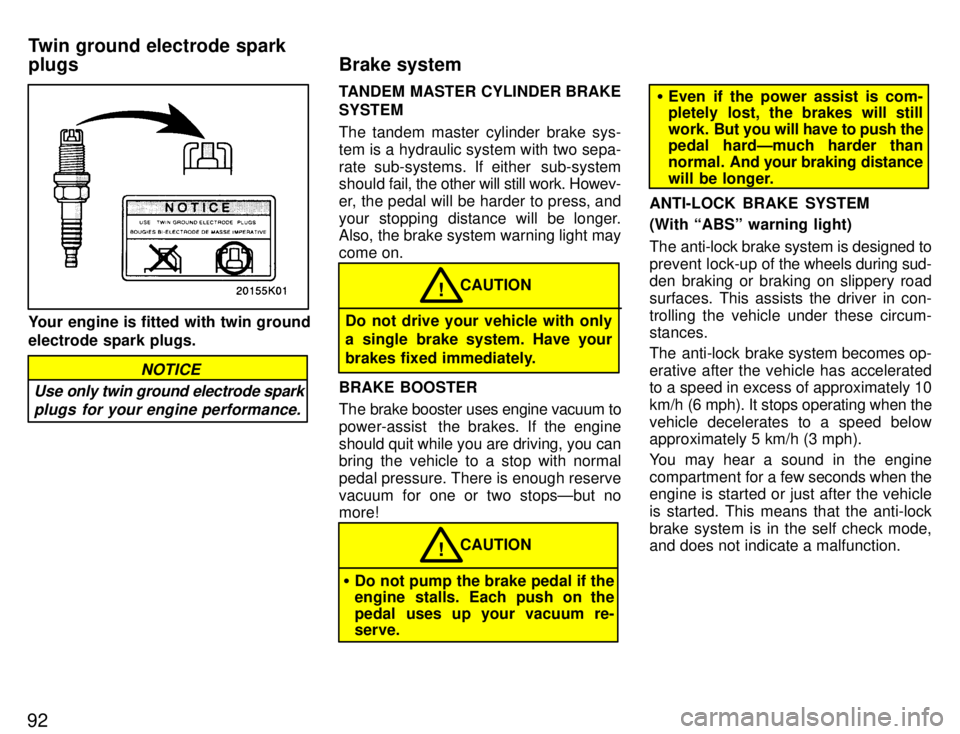
Your engine is fitted with twin ground electrode spark plugs.
Use only twin ground electrode sparkplugs for your engine performance.
NOTICE
TANDEM MASTER CYLINDER BRAKE SYSTEM
The tandem master cylinder brake sys-
tem is a hydraulic system with two sepa-
rate sub-systems. If either sub-system
should fa il, the other will still work. Howev-
er, the pedal will be harder to press, and
your stopping distance will be longer.
Also, the brake system warning light may come on.
CAUTION!
Do not drive your vehicle with only
a single brake system. Have your
brakes fixed immediately.
BRAKE BOOSTER
The brake booster uses engine vacuum to
power-assist the brakes. If the engine
should quit while you are driving, you can
bring the vehicle to a stop with normal
pedal pressure. There is enough reservevacuum for one or two stopsÐbut no more!
CAUTION!
Do not pump the brake pedal if the
engine stalls. Each push on the
pedal uses up your vacuum re- serve.
Even if the power assist is com-
pletely lost, the brakes will still
work. But you will have to push the
pedal hardÐmuch harder than
normal. And your braking distance
will be longer.
ANTI-LOCK BRAKE SYSTEM (With ABSº warning light)
The anti-lock brake system is designed to prevent lock-up of the wheels during sud-
den braking or braking on slippery roadsurfaces. This assists the driver in con-
trolling the vehicle under these circum- stances.
The anti-lock brake system becomes op- erative after the vehicle has accelerated
to a speed in excess of approximately 10
km/h (6 mph). It stops operating when the
vehicle decelerates to a speed below
approximately 5 km/h (3 mph).
You may hear a sound in the engine
compartment for a few seconds when the
engine is started or just after the vehicleis started. This means that the anti-lock
brake system is in the self check mode,
and does not indicate a malfunction.
Brake system
Twin ground electrode spark plugs
Page 97 of 165
94ABSº warning light
This light comes on when the ignition key is turned to the ONº position. After about
3 seconds, the light will go off.
If either of the following conditions occurs, this indicates a malfunction somewhere inthe parts monitored by the warning light
system. Contact your Toyota dealer as
soon as possible to service the vehicle.
The light does not come on as de-
scribed above, or remains on.
The light comes on while driving.
Even if the anti-lock brake system should
fail, the brake system will still operate con-
ventionally. Have your vehicle checked
by your Toyota dealer as soon as pos- sible.
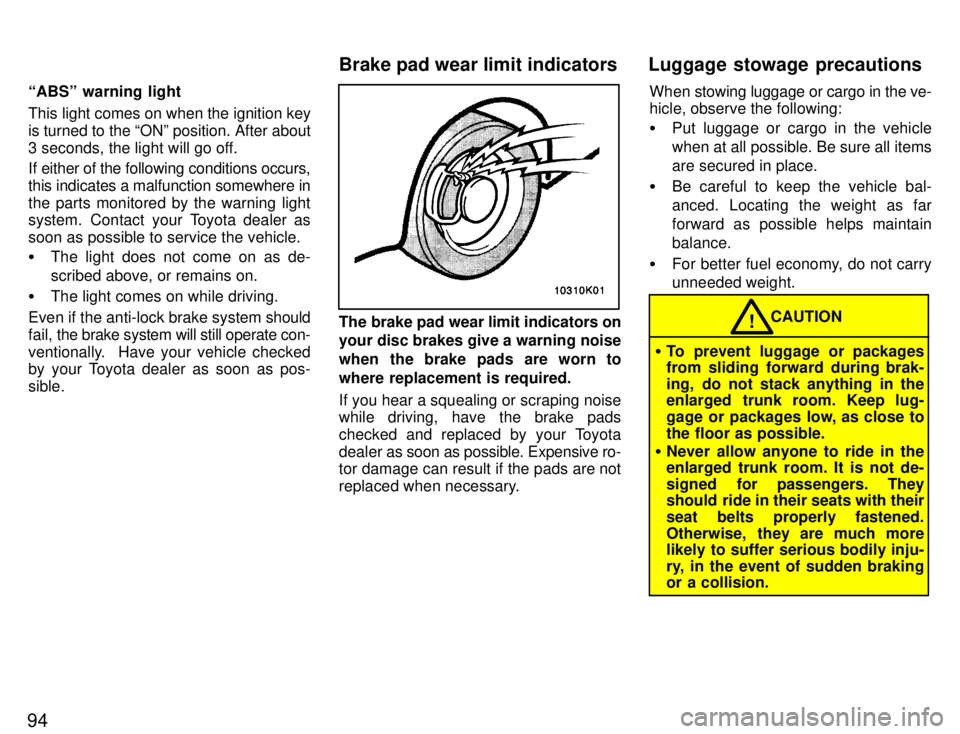
The brake pad wear limit indicators on your disc brakes give a warning noise
when the brake pads are worn to
where replacement is required.
If you hear a squealing or scraping noise
while driving, have the brake pads
checked and replaced by your Toyota
dealer as soon as possible. Expensive ro-
tor damage can result if the pads are not
replaced when necessary. When stowing luggage or cargo in the ve-
hicle, observe the following:
Put luggage or cargo in the vehicle
when at all possible. Be sure all itemsare secured in place.
Be careful to keep the vehicle bal-anced. Locating the weight as far
forward as possible helps maintainbalance.
For better fuel economy, do not carry
unneeded weight.
To prevent luggage or packages
from sliding forward during brak-
ing, do not stack anything in the
enlarged trunk room. Keep lug-
gage or packages low, as close to
the floor as possible.
Never allow anyone to ride in the enlarged trunk room. It is not de-
signed for passengers. They
should ride in their seats with their
seat belts properly fastened.
Otherwise, they are much more
likely to suffer serious bodily inju-
ry, in the event of sudden braking
or a collision.
CAUTION!
Brake pad wear limit indicators Luggage stowage precautions
Page 128 of 165

125
Tire surface and wheel nuts Check the tires carefully
for cuts, damage
or excessive wear. See Chapter 7-2 for
additional information. When checking the tires, make sure no nuts are missing,
and check the nuts for looseness. T ighten
them if necessary.
Tire rotation
Rotate the tires every 12000 km (7500
miles). See Chapter 7-2 for additional in-formation.
Fluid leaks Check underneath for leaking fuel, oil, wa-
ter or other fluid after the vehicle has been
parked for a while. If you smell fuel fumes
or notice any leak, have the cause found
and corrected immediately. Doors and engine hood Check that all doors including trunk lid op-
erate smoothly and all latches lock se-
curely. M ake sure the engine hood secon-
dary latch secures the hood from opening
when the primary latch is released. INSIDE THE VEHICLE Items listed below should be checked
regularly, e.g. while performing peri-
odic services, cleaning the vehicle,etc. Lights Make sure the headlights, stop lights, tail lights, turn signal lights, and other lights are all working. Check headlight aim. Service reminder indicators and
warn-
ing buzzers Check that all service reminder indicators
and warning buzzers function properly. Steering wheel
Check that it has the specified freeplay.
Be alert for changes in steering condition,such as hard steering or strange noise. Seats Check that all front seat controls such as
seat adjusters, seatback recliner, etc. op- erate smoothly and that all latches lock
securely in any position. For folding-down
rear seatback, check that the latches lock
securely. Seat belts
Check that the seat belt system such as
buckles, retractors and anchors operate
properly and smoothly. Make sure the belt
webbing is not cut, frayed, worn or dam-aged. Accelerator pedal Check
the pedal for smooth operation and
uneven pedal effort or catching. Clutch pedal Check the pedal for smooth operation. Brake pedal Check the pedal for smooth operation and
that the pedal has the proper clearance. Check the brake booster function. Brakes
At a safe place, check that the brakes do not pull to one side when applied. Parking brake Check that the lever has the proper travel and that, on a safe incline, your vehicle is
held securely with only the parking brake applied.
Automatic transmission Parkº mech-
anism
Check the lock release button of the se-
lector lever for proper and smooth opera-
tion. On a safe incline, check that your ve-
hicle is held securely with the selectorlever in Pº position and all brakes re-leased.
Page 146 of 165

143
WHEN TO REPLACE YOUR WHEELS
If you have wheel damage such as
bending, cracks or heavy corrosion,
the wheel should be replaced.
If you fail to replace damaged wheels, the
tire may slip off the wheel or they may cause loss of handling control. WHEEL SELECTION
When replacing wheels, care should
be taken to ensure that the wheels are
replaced by ones with the same load
capacity, diameter, rim width, and off-set.
This m
ust be observed on compact spare
tires, too.
Correct replacement wheels are available
at your Toyota dealer.
A wheel of a different size or type may ad-
versely affect handling, wheel and bear-
ing life, brake cooling, speedometer/
odometer calibration, stopping ability,
headlight aim, bumper height, vehicle
ground clearance, and tire or snow chain clearance to the body and chassis. Replacement
with used wheels is not rec-
ommended as they may have been sub- jected to rough treatment or high mileageand could fail without warning. Also, bent
wheels which have been straightened
may have structural damage and there-
fore should not be used. Never use an in-
ner tube in a leaking wheel which is de-
signed for a tubeless tire.
After driving your vehicle the first 1600
km (1000 miles), check that the wheel
nuts are tight.
If you have repaired or changed your
tires, check that the wheel nuts are still
tight after driving 1600 km (1000miles).
When using tire chains, be careful not
to damage the aluminum wheels.
Use only the Toyota wheel nuts and
wrench designed for your aluminumwheels.
When balancing your wheels, use only
Toyota balance weights or equivalent
and a plastic or rubber hammer.
As with any wheel, periodically checkyour aluminum wheels for damage. If
damaged, replace immediately.
Replacing wheels
Aluminum wheel precautions
Page 161 of 165

158
Engine compartment (U.S.A.) Fuses (type A)
1. HEAD (LH) 10 A: Left-hand headlight
2. HEAD (RH) 10 A: Right-hand head-
light
3. AM2 15 A: Ignition system, charging
system, multiport fuel injection system/
sequential multiport fuel injection system,
SRS airbag system, starter system
4. HAZ-HORN 15 A: Horns, turn signal
lights, em ergency flashers, theft deterrent
system
5. EFI 15 A: Multiport fuel injection sys-
tem/sequential multiport fuel injection sys-
tem, air conditioning systemEngine compartment (Canada)
6. DOME 10 A: Personal lights, open
door warning light, clock, car audio sys-
tem, anti-lock brake system, theft deter- rent system
7. OBD-II 7.5 A: On-board diagnosis sys-
tem
8. ALT-S 5 A: Charging system
9 . D R L 5 A: Daytime running light system
10. HEAD (RH-LWR) 10 A: Right-hand
headlight (low beam)
11. HEAD (LH-LWR) 10 A: Left-hand
headlight (low beam)
12. HEAD (RH-UPR) 10 A: Right-hand
headlight (high beam)Engine compartment (Canada only) 13. HEAD (LH-UPR) 10 A: Left-hand
headlight (high beam)
14. STOP 10 A: Stop lights, high mounted
stoplight, anti-lock brake system, shift lock control system 15. A/C 10 A: Air conditioning system
16. TAIL 15 A: Tail lights, parking lights,
license plate lights, instrument panel
lights, emergency flashers, air condition-
ing system, rear window defogger, car au-
dio system, cigarette lighter, clock
Fuses
Page 162 of 165

159
Instrument panel 17. GAUGE 10 A: Gauge and meters,
service reminder indicators and warning
buzzers (except discharge and open door
warning lights), back-up lights, rear win-
dow defogger
18. TURN 7.5 A: Turn signal lights, emer-
gency flashers19. WIPER 20 A: Windshield wipers and
washer
20. ECU-IG 5 A: Anti-lock brake system,
air conditioning system 21. CIG&RADIO 15 A: Cigarette lighter,
car audio system, clock, anti-lock brake
system, theft deterrent system, shift lockcontrol systemInstrument panel
22. IGN 5 A: Charging system, discharge
warning light, multiport fuel injection sys- tem/sequential multiport fuel injection
system, SRS airbag system 23. SRS 5 A: SRS airbag warning light
Fuses (type B)
24. CDS FAN 30 A: Electric cooling fan
25. RAD FAN 30 A: Electric cooling fan
26. HEATER 40 A: Air conditioning sys-
tem, A/Cº fuse 27. DIMMER 30 A: HEAD RH (Lo)º,
HEAD LH (Lo)º, HEAD RH (Hi)º and
HEAD LH (Hi)º fuses 28. MAIN 30 A: Starter system 29. DEF 40 A:
Rear window defogger
30. PWR 30 A: Power windows, power
door lock systemFuses (type C) 31. ABS 60 A: Anti-lock brake system
32. AM1 40 A: DEFº, WIPERº,
GAUGEº, ECU-IGº, TURNº, IGNº and
PWRº fuses
33. ALT 100 A: ABSº, STOPº, TAILº,
SRSº, DEFº, AM1º, WIPERº,
GAUGEº, ECU-IGº, TURNº, IGNº and
PWRº fuses
Page 165 of 165

162This
information has been prepared in ac-
cordance with regulations issued by the
National Highway Traffic Safety Adminis-
tration of the U.S. Department of Trans-
portation. It provides the purchasers and/
or prospective purchasers of Toyota
vehicles with information on uniform tire
quality grading.
Your Toyota dealer will help answer any
questions you may have as you read this information.
DOT quality gradesÐAll passenger
vehicle tires must conform to Federal
Safety Requirements in addition to these grades. These quality grades are
molded on the sidewall.
Treadwear ÐThe treadwear grade is a
comparative rating based on the wear
rate of the tire when tested under con-
trolled conditions on a specified govern-
ment test course. For example, a tire
graded 150 would wear one and a half
(1-1/2) times as well on the governmentcourse as a tire graded 100. The relative
performance of tires depends upon the
actual conditions of their use, however,
and may depart significantly from the norm due to variations in driving habits,
service practices and differences in roadcharacteristics and climate. Traction A, B, C
ÐThe traction grades,
from highest to lowest, are A, B, and C,
and they represent the tire's ability to stop
on wet pavement as measured under
controlled conditions on specified govern-
ment test surfaces of asphalt and con-
crete. A tire marked C may have poor trac-
tion performance.
Warning: The traction grade assigned to this tire is based on braking (straight
ahead) traction tests and does not include
cornering (turning) traction.
Temperature A, B, C ÐThe temperature
grades are A (the highest), B, and C, rep-
resenting the tire's resistance to the gen-
eration of heat and its ability to dissipate heat when tested under controlled condi- tions on a specified indoor laboratory test
wheel. Sustained high temperature can
cause the material of the tire to degener- ate and reduce tire life, and excessive
temperature can lead to sudden tire fail-
ure. The grade C corresponds to a level of
performance which all passenger car tires
must meet under the Federal Motor Ve-
hicle Safety Standard No. 109. Grades B
and A represent higher levels of perfor-mance on the laboratory test wheel than
the minimum required by law. Warning: The temperature grade for this
tire is
established for a tire that is properly
inflated and not overloaded. Excessive speed, underinflation, or excessive load- ing, either separately or in combination, can cause heat buildup and possible tirefailure.
Uniform tire quality grading