light TOYOTA PASEO 1996 Owner's Manual
[x] Cancel search | Manufacturer: TOYOTA, Model Year: 1996, Model line: PASEO, Model: TOYOTA PASEO 1996Pages: 165, PDF Size: 2.57 MB
Page 37 of 165

35
The SRS airbag is not designed to in-
flate if the vehicle is subjected to a side
or rear impact, if it rolls over, or if it is
involved in a low-speed frontal colli-sion.The SRS airbag system mainly consists
of the following components and their
locations are shown in the illustration.
1. SRS airbag warning light
2. Steering wheel pad (airbag and inflator)
3. Airbag sensor assembly
The airbag sensor assembly consists of a
safing sensor and airbag sensor. In a severe frontal impact, sensors de-
tects
deceleration and the system triggers
the airbag inflator. Then a chemical reac-
tion in the inflator momentarily fills the air-
bag with non-toxic nitrogen gas to help re-
strain the forward motion of the driver. When the airbag inflates, it produces a fairly loud noise and releases some
smoke along with the nitrogen gas. This isnot harmful and does not indicate a fire.
Be sure to wash off any residue as soon
as possible to prevent minor skin irritation.
Deployment of the airbag happens in a
fraction of a second, so the airbag must in-
flate with considerable force. While the
system is designed to reduce serious inju-
ries, it may also cause minor burns or
abrasions and swellings.
The steering wheel hub may be hot for
several minutes, but the airbag itself will
not be hot. The airbag is designed to in-
flate only once.
Page 39 of 165
37
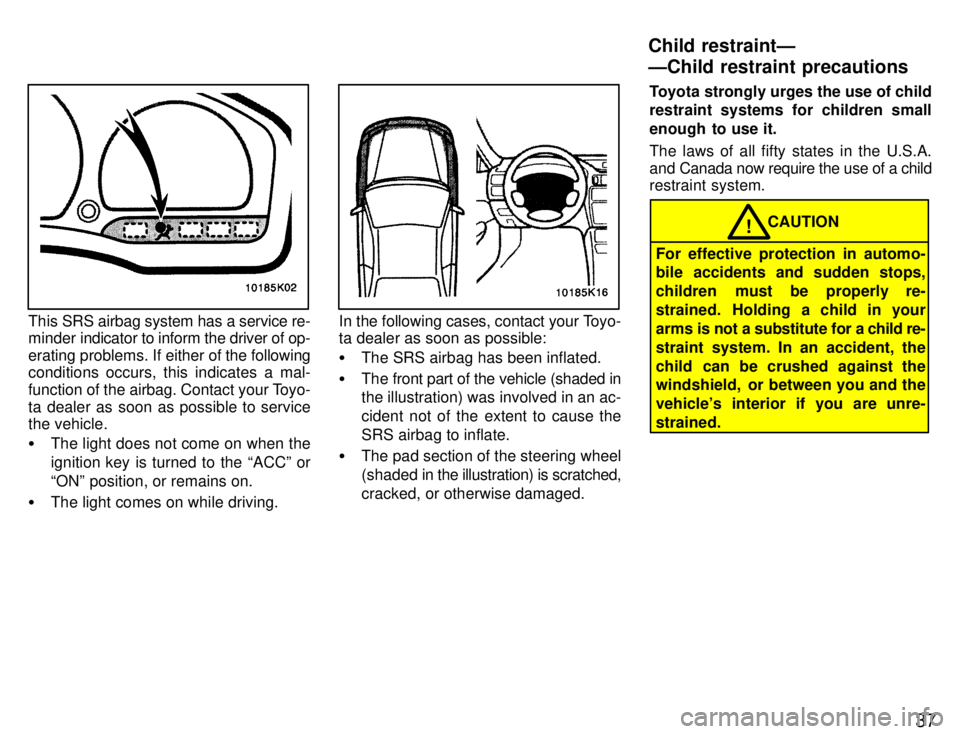
This SRS airbag system has a service re-
minder indicator to inform the driver of op-
erating problems. If either of the following
conditions occurs, this indicates a mal-
function of the airbag. Contact your Toyo-
ta dealer as soon as possible to service the vehicle. The light does not come on when the
ignition key is turned to the ACCº or
ONº position, or remains on.
The light comes on while driving.In the following cases, contact your Toyo-
ta dealer as soon as possible: The SRS airbag has been inflated.
The front part of the vehicle (shaded in the illustration) was involved in an ac-
cident not of the extent to cause the
SRS airbag to inflate.
The pad section of the steering wheel
(shaded in the illustration) is scratched,
cracked, or otherwise damaged. Toyota strongly urges the use of child
restraint systems for children small
enough to use it.
The laws of all fifty states in the U.S.A.
and Canada now require the use of a child
restraint system.
CAUTION!
For effective protection in automo-
bile accidents and sudden stops,
children must be properly re-
strained. Holding a child in your
arms is not a substitute for a child re-
straint system. In an accident, the
child can be crushed against the
windshield, or between you and the
vehicle's interior if you are unre-strained.
Child restraintÐ ÐChild restraint precautions
Page 40 of 165
37
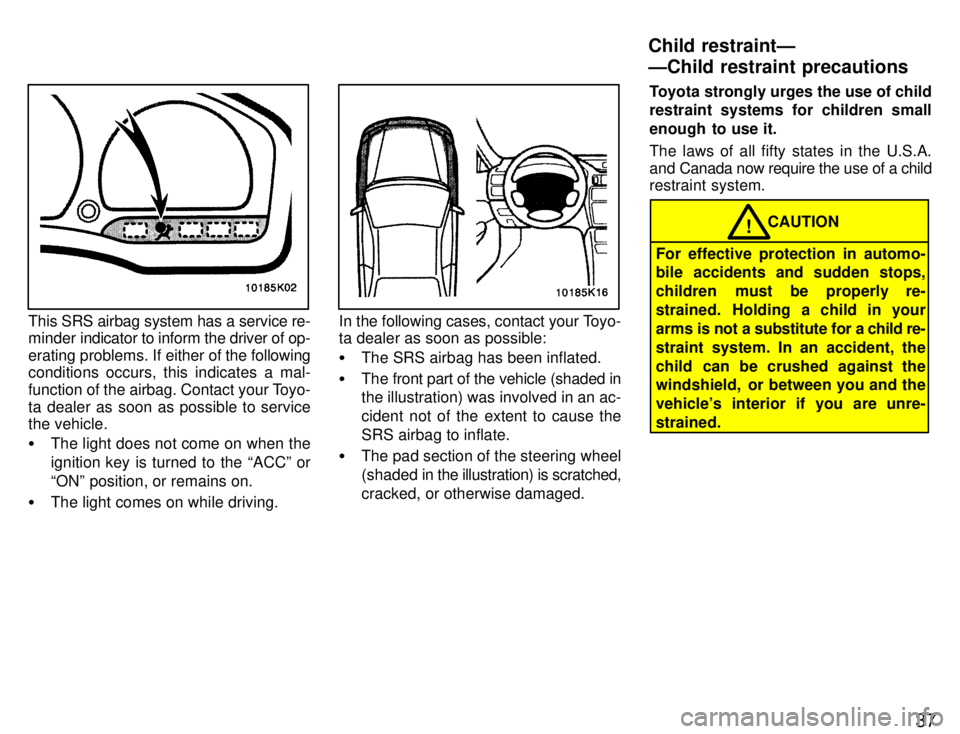
This SRS airbag system has a service re-
minder indicator to inform the driver of op-
erating problems. If either of the following
conditions occurs, this indicates a mal-
function of the airbag. Contact your Toyo-
ta dealer as soon as possible to service the vehicle. The light does not come on when the
ignition key is turned to the ACCº or
ONº position, or remains on.
The light comes on while driving.In the following cases, contact your Toyo-
ta dealer as soon as possible: The SRS airbag has been inflated.
The front part of the vehicle (shaded in the illustration) was involved in an ac-
cident not of the extent to cause the
SRS airbag to inflate.
The pad section of the steering wheel
(shaded in the illustration) is scratched,
cracked, or otherwise damaged. Toyota strongly urges the use of child
restraint systems for children small
enough to use it.
The laws of all fifty states in the U.S.A.
and Canada now require the use of a child
restraint system.
CAUTION!
For effective protection in automo-
bile accidents and sudden stops,
children must be properly re-
strained. Holding a child in your
arms is not a substitute for a child re-
straint system. In an accident, the
child can be crushed against the
windshield, or between you and the
vehicle's interior if you are unre-strained.
Child restraintÐ ÐChild restraint precautions
Page 49 of 165
46
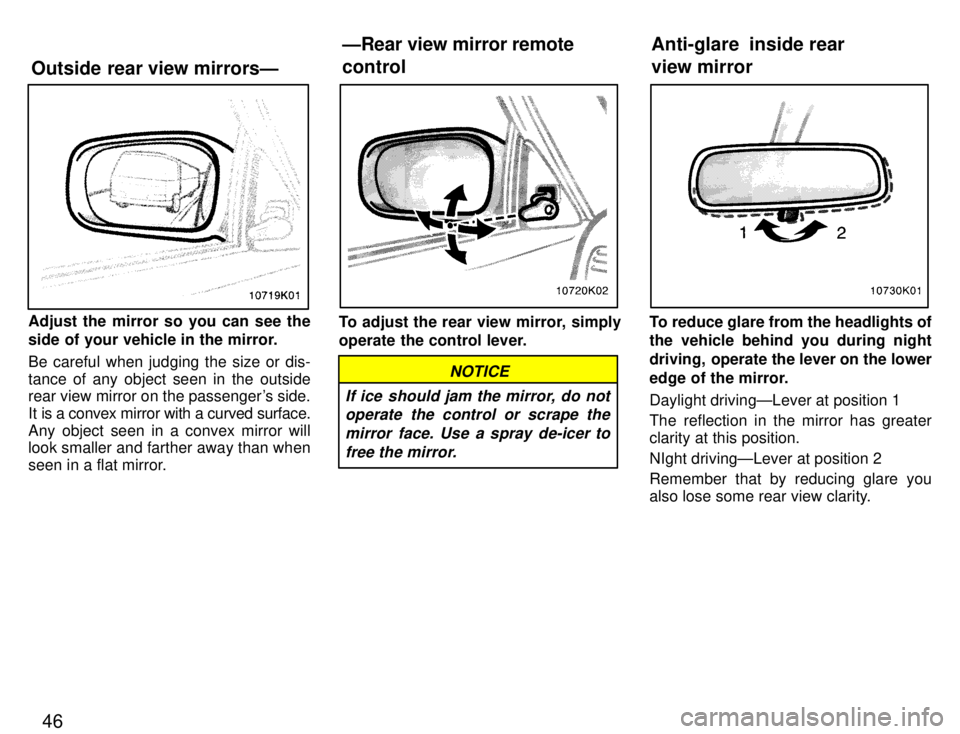
Adjust the mirror so you can see the
side of your vehicle in the mirror. Be careful when judging the size or dis- tance of any object seen in the outside
rear view mirror on the passenger's side.
It is a convex mirror with a curved surface.
Any object seen in a convex mirror will
look smaller and farther away than when
seen in a flat mirror.To adjust the rear view mirror, simply
operate the control lever.
NOTICE
If ice should jam the mirror, do not operate the control or scrape the
mirror face. Use a spray de-icer to free the mirror.
To reduce glare from the headlights of
the vehicle behind you during night
driving, operate the lever on the lower
edge of the mirror. Daylight drivingÐLever at position 1
The reflection in the mirror has greater
clarity at this position. NIght drivingÐLever at position 2 Remember that by reducing glare you
also lose some rear view clarity.
Outside rear view mirrorsÐ
ÐRear view mirror remote control
Anti-glare inside rearview mirror
Page 50 of 165
Part 1Headlights and turn signals
47
OPERATION OF INSTRUMENTS AND CONTROLSÐ
Chapter 1-4
Lights, Wipers and Defogger
Headlights and turn signals
Emergency flashers
Instrument panel light control
Personal lights
Windshield wipers and washer
Rear window defogger
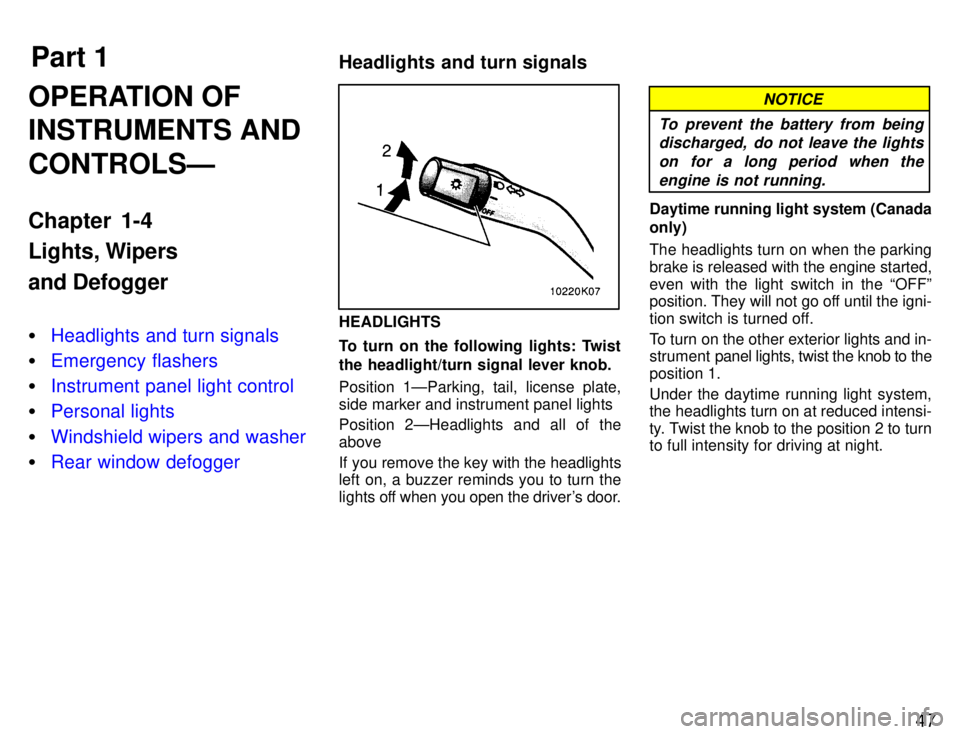
HEADLIGHTS
To turn on the following lights: Twist
the headlight/turn signal lever knob. Position 1ÐParking, tail, license plate,
side marker and instrument panel lights Position 2ÐHeadlights and all of the above
If you remove the key with the headlights
left on, a buzzer reminds you to turn the
lights off
when you open the driver's door.
NOTICE
To prevent the battery from being discharged, do not leave the lights
on for a long period when theengine is not running.
Daytime running light system (Canada only)
The headlights turn on when the parking brake is released with the engine started,
even with the light switch in the OFFº
position. They will not go off until the igni-
tion switch is turned off.
To turn on the other exterior lights and in-
strument panel lights, twist the knob to the
position 1.
Under the daytime running light system,
the headlights turn on at reduced intensi-
ty. Twist the knob to the position 2 to turn
to full intensity for driving at night.
Page 51 of 165

48
High-Low beamsÐFor high beams,
turn the headlights on and push the lever away from you (position 1). Pull the levertoward you (position 2) for low beams.
The headlight high beam indicator light
(blue light) on the instrument panel will tell
you that the high beams are on.
Flashing the high beam headlights
(position 3)ÐPull the lever all the way
back. The high beam headlights turn off
when you release the lever.
You can flash the high beam headlights with the knob turned to OFFº.TURN SIGNALS
To signal a turn, push the headlight/
turn signal lever up or down to posi-
tion 1. The key must be in the ONº position. The lever automatically returns after you make a turn, but you may have to returnit by hand after you change lanes.
To signal a lane change, move the lever
up or down to the pressure point (position2) and hold it.
If the turn signal indicator lights (green
lights) on the instrument panel flash faster
than normal, a front or rear turn signal bulb is burned out.To turn on the emergency flashers,
push the switch.
All the turn signal lights will flash. To turn
them off, push the switch once again.
Turn on the emergency flashers to warn other drivers if your vehicle must be
stopped where it might be a traf fic hazard.
Always pull as far off the road as possible.
The turn signal light switch will not work
when the emergency flashers are operat-ing.
Emergency flashers
Page 52 of 165

49
NOTICE
To prevent the battery from being discharged, do not leave the switch
on longer than necessary when the engine is not running.
To adjust the brightness of the instru-
ment panel lights, turn the knob.The personal lights operate separately
with each outer switch.
To turn on the light, push the switch on
your side. To turn the light off, push the
switch once again.
The center switch has the following posi- tions: DOORºÐTurn both lights on when both
side doors are opened. The lights remain
on for some time after both side doors areclosed.
OFFºÐThe lights are off unless you op- erate either outside switch.
Instrument panel light control Personal lights
Page 53 of 165

50
To turn on the windshield wipers, move the lever to the desired setting. The key must be in the ONº position.Lever position
Speed setting
Position 1Intermittent
Position 2Slow
Position 3Fast
To squirt washer fluid, pull the lever to-
ward you and release it.
If the windshield wipers are off, they will op-
erate a couple of times after the washer
squirts. For instructions on adding washer fluid, see
Adding washer fluidº in Chapter 7- 3.
In freezing weather, warm the windshield
with the defroster before using the washer.
This will help prevent washer fluid from
freezing on your windshield, which can
block your vision.
NOTICE
Do not operate the wipers if the windshield is dry. It may scratch the
glass.
To defog or defrost the rear window,
push the switch. The key must be in the ONº position.
The thin heater wires on the inside of the rear window will quickly clear the surface. An indicator light will illuminate to indicate the defogger is operating. Push the switch once again to turn the de-
fogger off.
With timer: The system will automatically
shut off after the defogger has operated
about 15 minutes.
Windshield wipers and washer
Rear window defogger
Page 56 of 165

Part 1Fuel gauge
53
OPERATION OF INSTRUMENTS AND CONTROLSÐ
Chapter 1-5 Gauges, Meters and Service reminderindicators
Fuel gauge
Engine coolant temperature gauge
Tachometer
Odometer and trip meter
Service reminder indicators and warning buzzers
The gauge works when the ignition
switch is on
and indicates the approxi-
mate quantity of fuel remaining in the tank. Nearly fullÐNeedle at Fº Nearly emptyÐNeedle at Eº
It is a good idea to keep the tank over 1/4 full.
This fuel gauge has a non-return type
needle wh ich remains at the last indicated
position when the ignition switch is turned
off. If the level approaches Eº, or the low fuel
level warning light comes on, fill the fuel
tank as soon as possible. If the fuel tank is completely empty, themalfunction indicator lamp comes on. Fill
the fuel tank immediately.
The indicator lamp goes off after driving several times. If the indicator lamp does
not go off, contact your Toyota dealer assoon as possible.
Page 59 of 165
56(a) Brake System Warning Light This light has the following functions: Parking brake reminder
If this light is on, make sure the parking
brake is
fully released. The light should go
off.
Low brake fluid level warning
If this light comes on and stays on while
you are driving, slow down and pull off the
road. Then stop the vehicle carefully.There may be a problem somewhere in
the brake system. Check the fluid level of
the see-through reservoir.
To make sure the parking brake has not
caused the warning light to come on,
check to see that the parking brake is fully
released.
If the brake fluid level is low...
At a safe place, test your brakes by start-
ing and stopping. If you judge that the brakes still work
adequately, drive cautiously to yournearest dealer or shop for repairs.
If the brakes are not working, have the
vehicle towed in for repairs. (For tow- ing information, see Part 4.)
It is dangerous to continue driving
normally when the brake fluid level
is low. CAUTION
!
If the brake fluid level is correct...
Have the warning system checked by
your Toyota dealer.
(b) Seat Belt Reminder Light and Buzzer
Once the ignition key is turned to ONº or
STARTº, the reminder light and buzzer
come on if the driver's seat belt is not fas- tened. Unless the driver fastens the belt, the light stays on and the buzzer soundsfor about 4 to 8 seconds.
(c) Discharge Warning Light
This light warns that the battery is being discharged.
If it comes on while you are driving, there
is a problem somewhere in the chargingsystem.
The engine ignition will continue to oper-
ate, however, until the battery is dis-
charged. Turn off the air conditioning,
blower, radio, e tc., and drive directly to the
nearest Toyota dealer or repair shop.NOTICE
Do not continue driving if the engine drive belt is broken or loose.
(d) Low Oil Pressure Warning Light
This light warns that the engine oil pres-
sure is too low.
If it flickers or stays on while you are driv-
ing, pull off the road to a safe place and
stop the engine immediately. Call a Toyota
dealer or qualified repair shop for assis- tance.
The light may occasionally flicker when
the engine is idling or it may come on brief-
ly after a hard stop. There is no cause for concern if it then goes out when the en-
gine is accelerated slightly.
The light may come on when the oil level
is extremely low. It is not designed to indi-cate low oil level, and the oil level must be checked using the level dipstick.
NOTICE
Do not drive the vehicle with the warning light onÐeven for one
block. It may ruin the engine.