lights TOYOTA PRIUS 2010 3.G Owner's Manual
[x] Cancel search | Manufacturer: TOYOTA, Model Year: 2010, Model line: PRIUS, Model: TOYOTA PRIUS 2010 3.GPages: 616, PDF Size: 10.45 MB
Page 207 of 616
207
2-3. Operating the lights and windshield wipers
2
When driving
PRIUS_U (OM47668U) U.S.A.
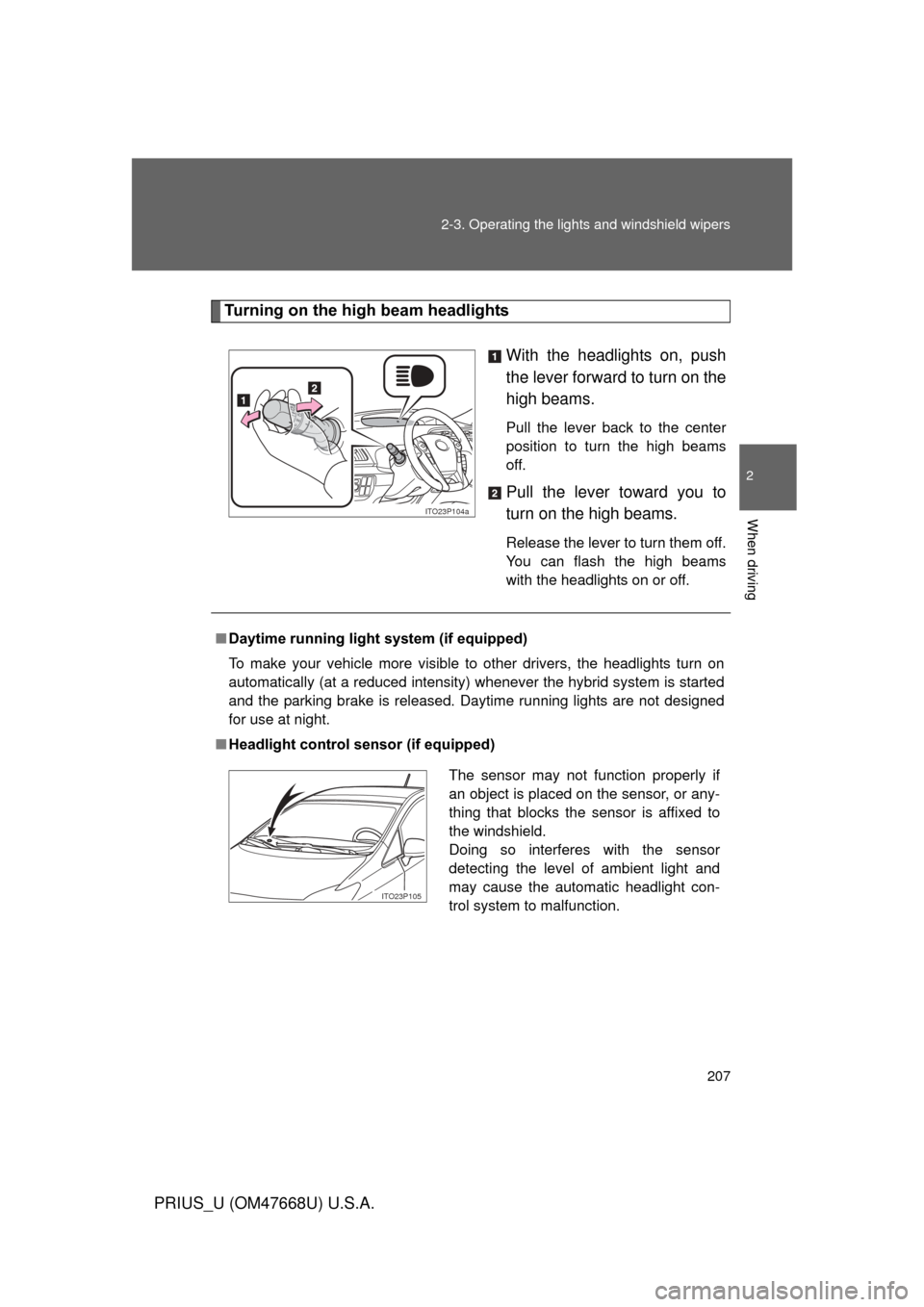
Turning on the high beam headlights
With the headlights on, push
the lever forward to turn on the
high beams.
Pull the lever back to the center
position to turn the high beams
off.
Pull the lever toward you to
turn on the high beams.
Release the lever to turn them off.
You can flash the high beams
with the headlights on or off.
ITO23P104a
■Daytime running light system (if equipped)
To make your vehicle more visible to other drivers, the headlights turn on
automatically (at a reduced intensity) whenever the hybrid system is started
and the parking brake is released. Daytime running lights are not designed
for use at night.
■ Headlight control sensor (if equipped)
The sensor may not function properly if
an object is placed on the sensor, or any-
thing that blocks the sensor is affixed to
the windshield.
Doing so interferes with the sensor
detecting the level of ambient light and
may cause the automatic headlight con-
trol system to malfunction.
ITO23P105
Page 208 of 616
208 2-3. Operating the lights and windshield wipers
PRIUS_U (OM47668U) U.S.A.
■Automatic light off system
● When the headlights are on: The headlights and tail lights turn off 30 sec-
onds after a door is opened and closed if the “POWER” switch has been
switched to ACCESSORY mode or OFF.
● When only the tail lights are on: The tail lights turn off automatically if the
“POWER” switch is switched to ACCESSORY mode or OFF and driver’s
door is opened.
To turn the lights on again, turn the “POWER” switch to ON mode, or turn the
light switch off once and then back to the
or position.
■ Automatic headlight leveling system (vehicles with LED headlights)
The level of the headlights is automatically adjusted according to the number
of passengers and the loading condition of the vehicle to ensure that the
headlights do not interfere with other road users.
■ If the indicator flashes... (vehicles with LED headlights)
It may indicate a malfunction in the system. Contact your Toyota dealer.
■ Customization that can be co nfigured at Toyota dealer
Settings (e.g. light sensor sensitivity) can be changed.
(Customizable features P. 587)
NOTICE
■To prevent 12 volt battery discharge
Do not leave the lights on longer than necessary if the hybrid system is not
operating.
Page 209 of 616
209
2-3. Operating the lights and windshield wipers
2
When driving
PRIUS_U (OM47668U) U.S.A.
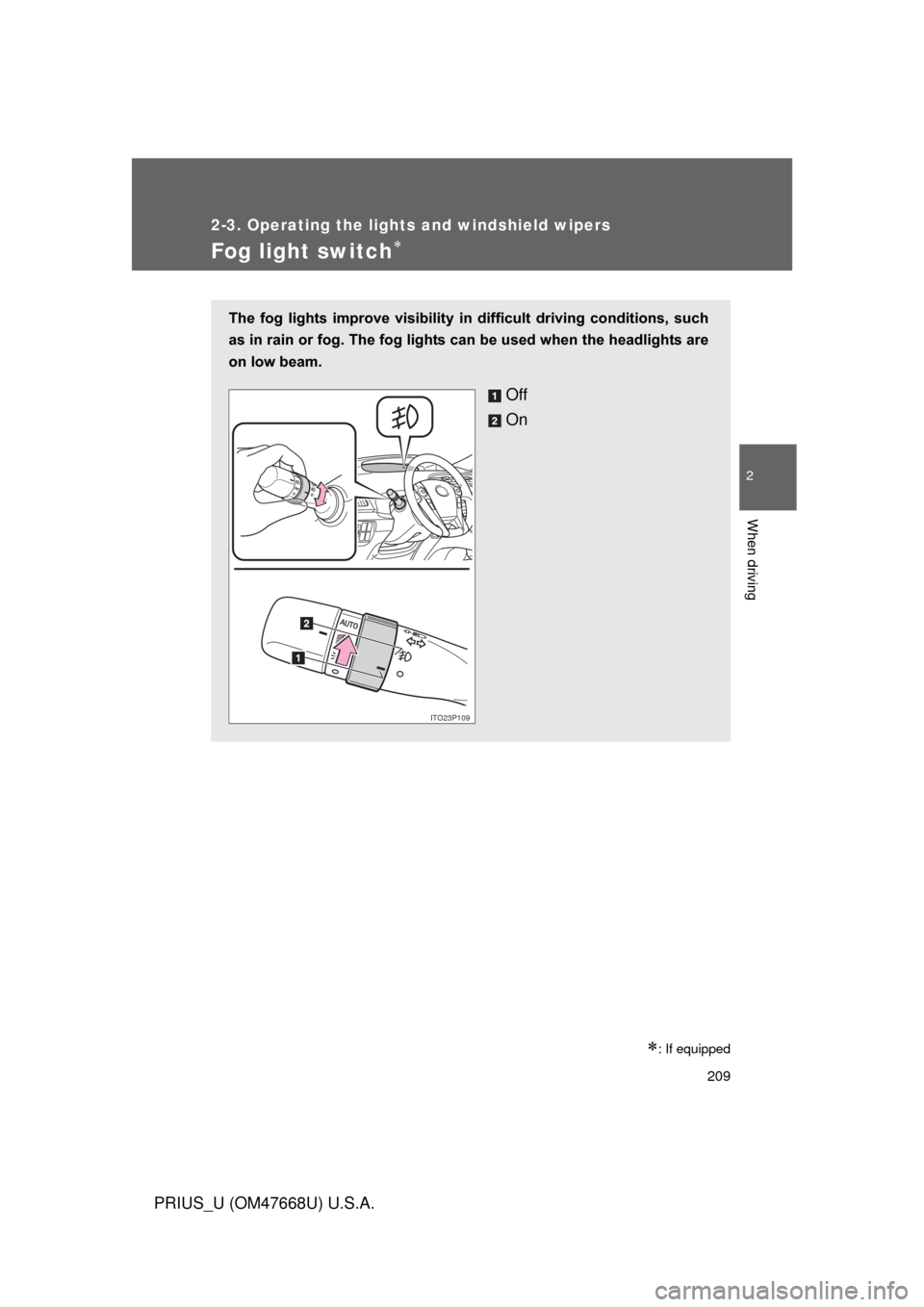
Fog light switch
: If equipped
The fog lights improve visibility in difficult driving conditions, such
as in rain or fog. The fog lights can be used when the headlights are
on low beam.
Off
On
ITO23P109
Page 210 of 616
210
2-3. Operating the lights and windshield wipers
PRIUS_U (OM47668U) U.S.A.
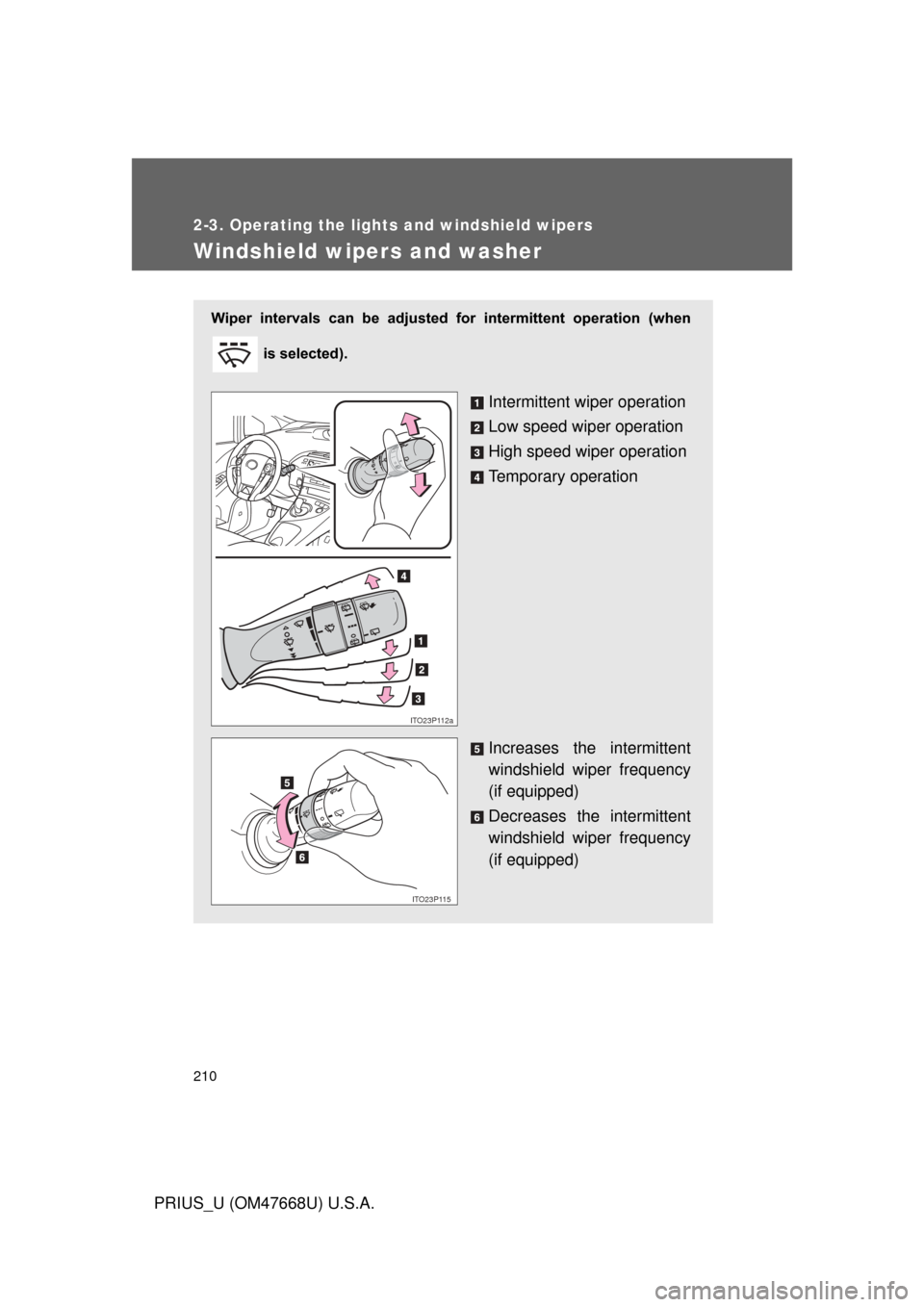
Windshield wipers and washer
Wiper intervals can be adjusted for intermittent operation (when
is selected).
Intermittent wiper operation
Low speed wiper operation
High speed wiper operation
Temporary operation
Increases the intermittent
windshield wiper frequency
(if equipped)
Decreases the intermittent
windshield wiper frequency
(if equipped)
ITO23P112a
ITO23P115
Page 211 of 616
211
2-3. Operating the lights and windshield wipers
2
When driving
PRIUS_U (OM47668U) U.S.A.
■
The windshield wipers and washer can be operated when
The “POWER” switch is in ON mode.
■ If no windshield washer fluid sprays
Check that the washer nozzles are not blocked if there is washer fluid in the
windshield washer fluid reservoir.
NOTICE
■When the windshield is dry
Do not use the wipers, as they may damage the windshield.
■ When there is no washer fluid spray from the nozzle
Damage to the washer fluid pump may be caused if the lever is pulled
toward you and held continually.
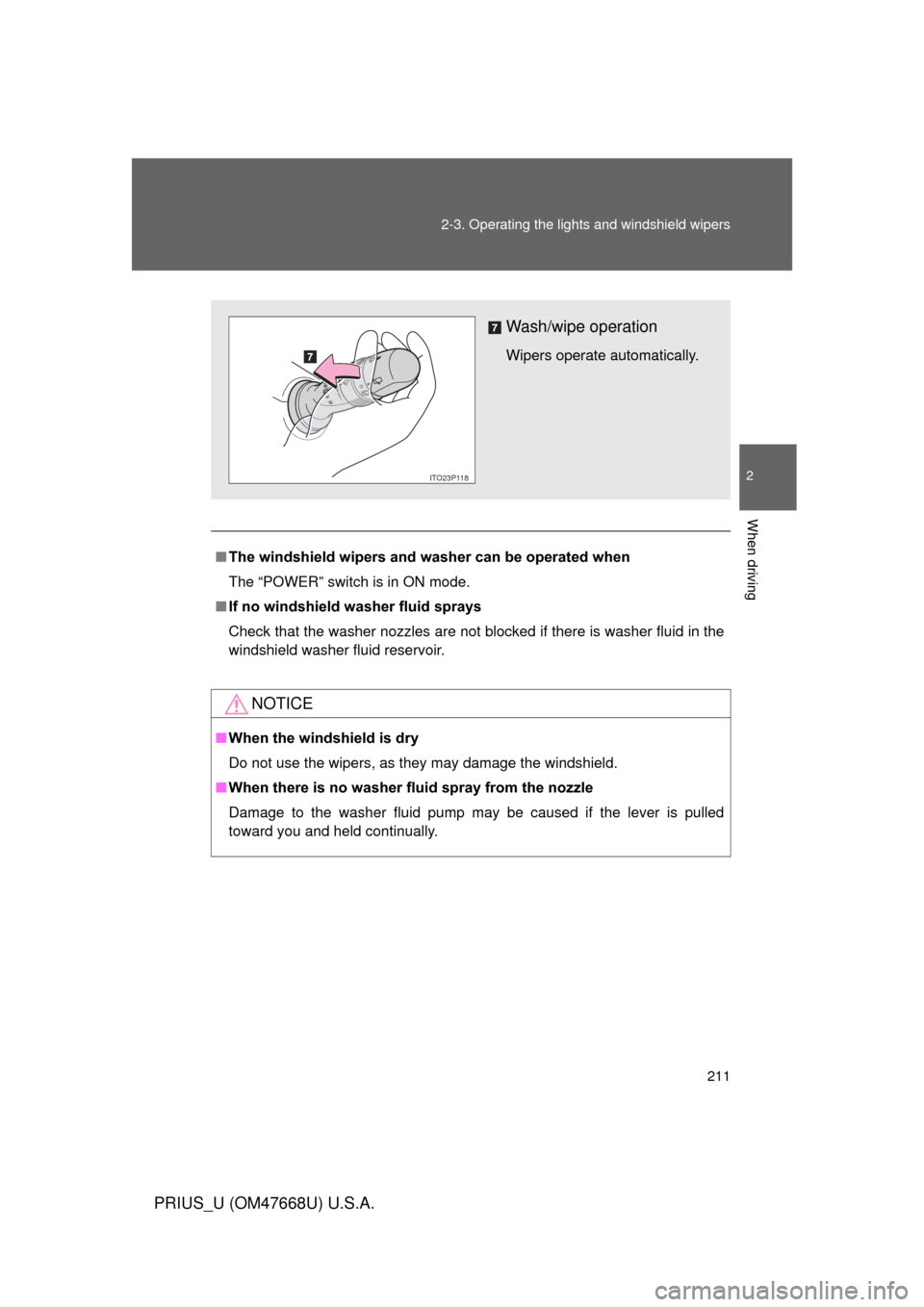
Wash/wipe operation
Wipers operate automatically.
ITO23P118
Page 212 of 616
212
2-3. Operating the lights and windshield wipers
PRIUS_U (OM47668U) U.S.A.
Rear window wiper and washer
: If equipped
■The rear window wiper and w asher can be operated when
The “POWER” switch is in ON mode.
NOTICE
■ When the rear window is dry
Do not use the wipers, as they may damage the rear window.
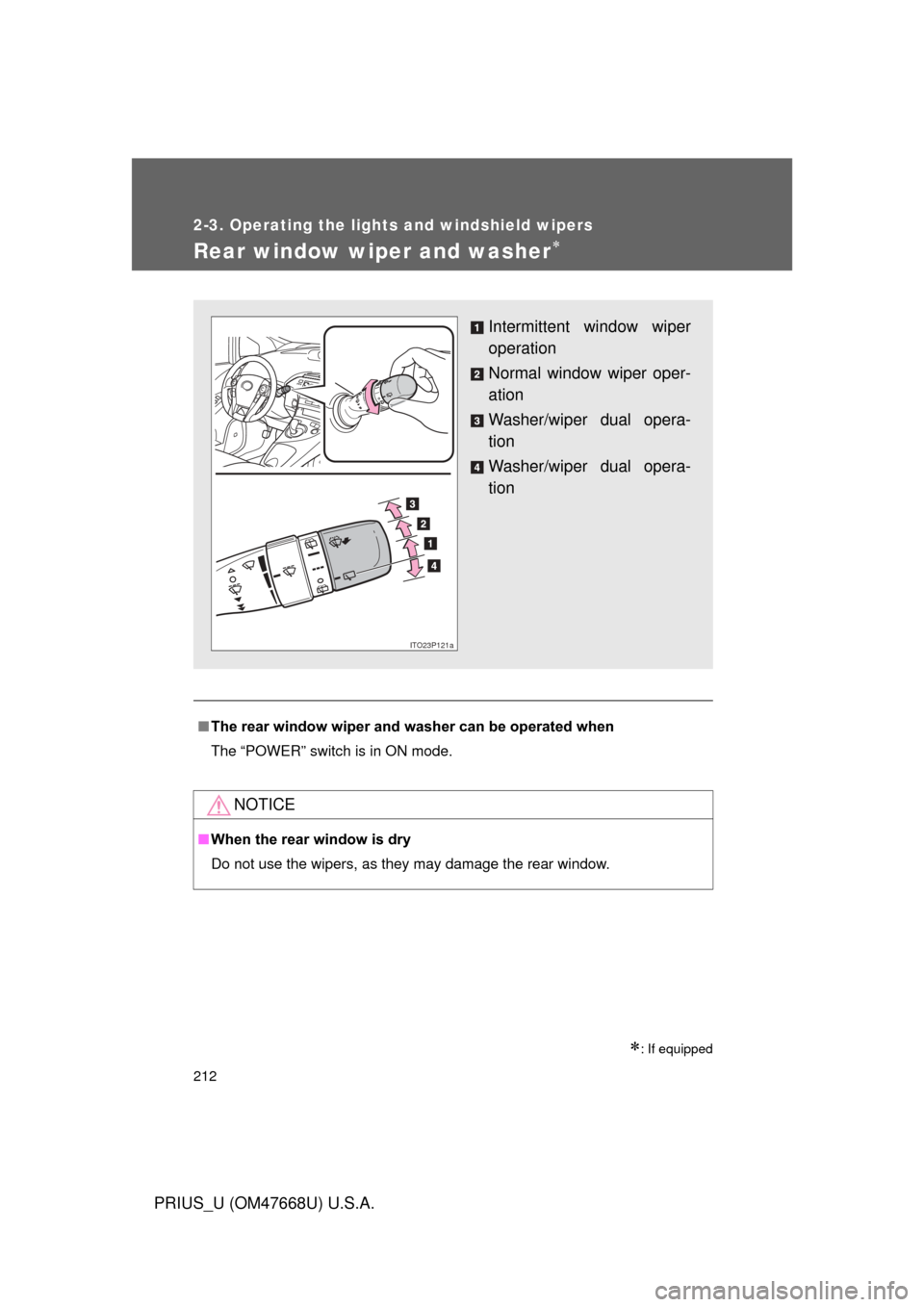
Intermittent window wiper
operation
Normal window wiper oper-
ation
Washer/wiper dual opera-
tion
Washer/wiper dual opera-
tion
ITO23P121a
Page 213 of 616
213
2-3. Operating the lights and windshield wipers
2
When driving
PRIUS_U (OM47668U) U.S.A.
Headlight cleaner switch
: If equipped
■The headlight cleaner can be operated when
The “POWER” switch is in ON mode and the headlight switch is turned on.
If equipped, the headlight switch is in the “AUTO” position and the headlight
is on.
■ Windshield washer linked operation
When the windshield washer is operated with the “POWER” switch in ON
mode and the low beam headlights on, the headlight cleaner will operate
once. ( P. 210)
NOTICE
■When the washer fluid tank is empty
Do not use this function when the washer fluid tank is empty. This may
cause the washer fluid pump to overheat.
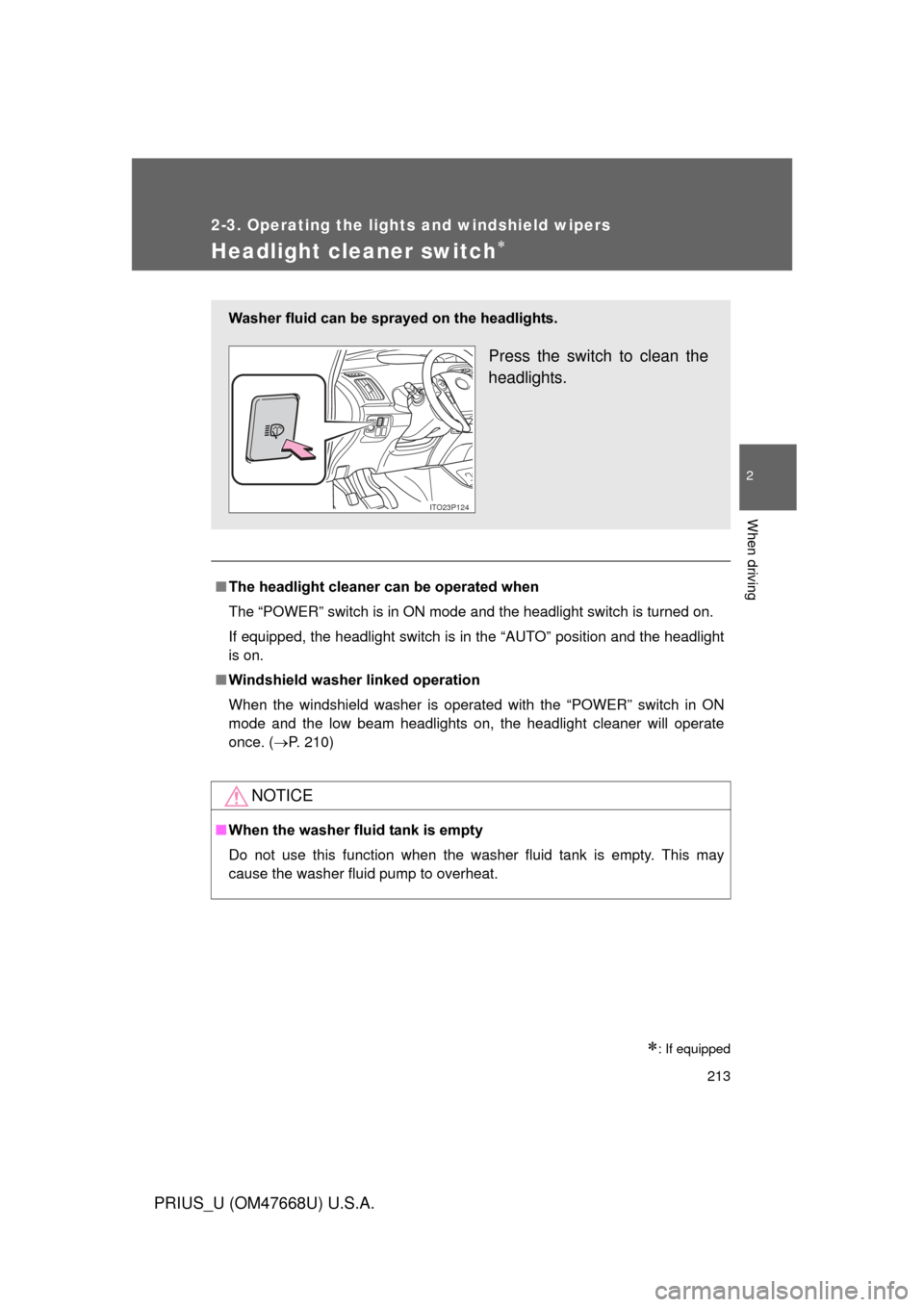
Washer fluid can be sprayed on the headlights.
Press the switch to clean the
headlights.
ITO23P124
Page 226 of 616
226 2-4. Using other driving systems
PRIUS_U (OM47668U) U.S.A.
■Automatic cancelation of constant speed control
The cruise control will stop maintaining the vehicle speed in the following sit-
uations:
● Actual vehicle speed is more than approximately 10 mph (16 km/h)
below the set vehicle speed.
At this time, the memorized set speed is not retained.
● Vehicle speed falls below 25 mph (40 km/h).
● Enhanced VSC is activated.
■ Vehicle-to-vehicle distance settings
Select a distance from the table below. Note that the distances shown corre-
spond to a vehicle speed of 50 mph (80 km/h). Vehicle-to-vehicle distance
increases/decreases in accordance with vehicle speed.
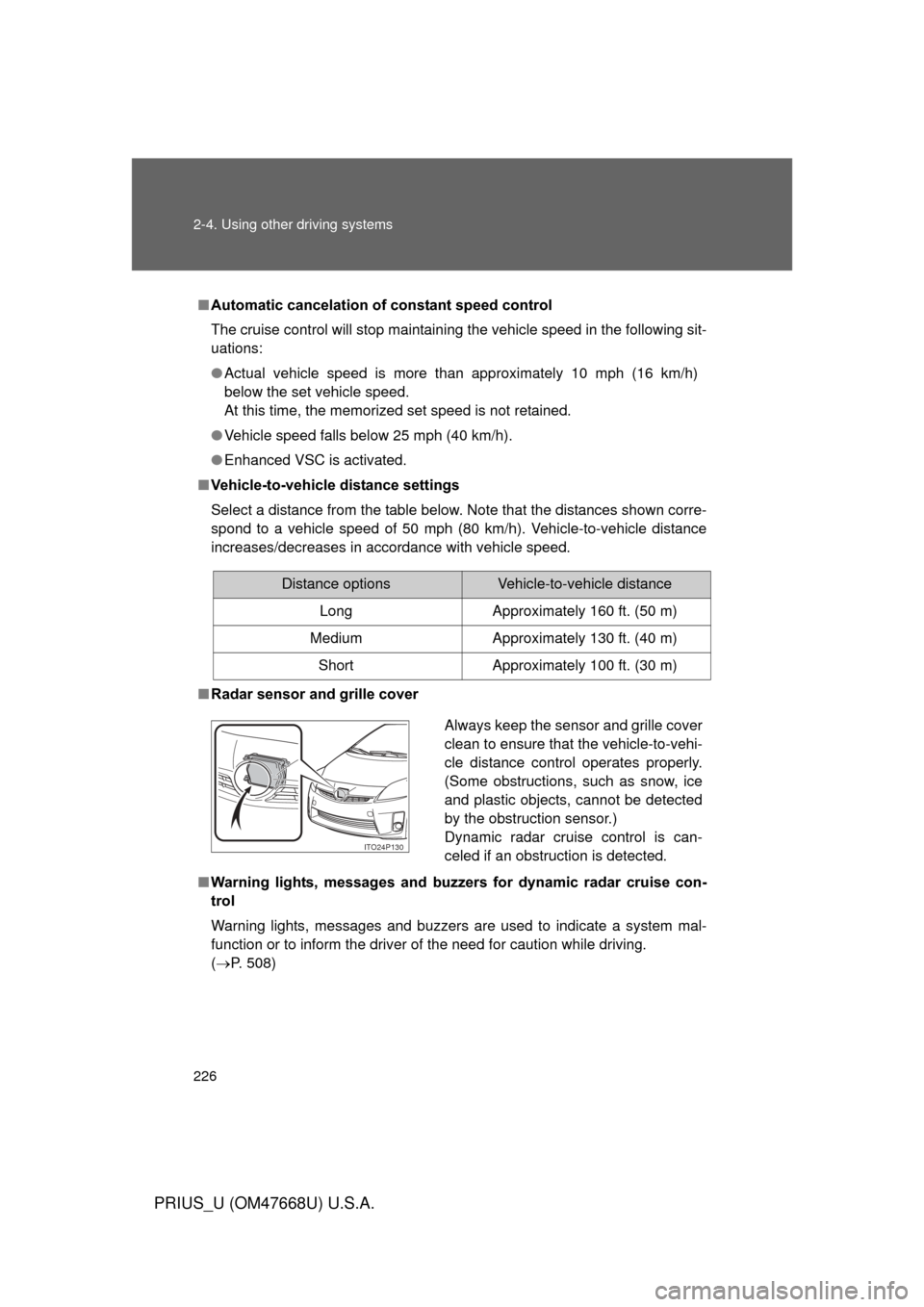
■ Radar sensor and grille cover
■ Warning lights, messages and buzze rs for dynamic radar cruise con-
trol
Warning lights, messages and buzzers are used to indicate a system mal-
function or to inform the driver of the need for caution while driving.
( P. 508)
Distance optionsVehicle-to-vehicle distance
Long Approximately 160 ft. (50 m)
Medium Approximately 130 ft. (40 m)
Short Approximately 100 ft. (30 m)
Always keep the sensor and grille cover
clean to ensure that the vehicle-to-vehi-
cle distance control operates properly.
(Some obstructions, such as snow, ice
and plastic objects, cannot be detected
by the obstruction sensor.)
Dynamic radar cruise control is can-
celed if an obstruction is detected.
ITO24P130
Page 233 of 616
233
2-4. Using other
driving systems
2
When driving
PRIUS_U (OM47668U) U.S.A.
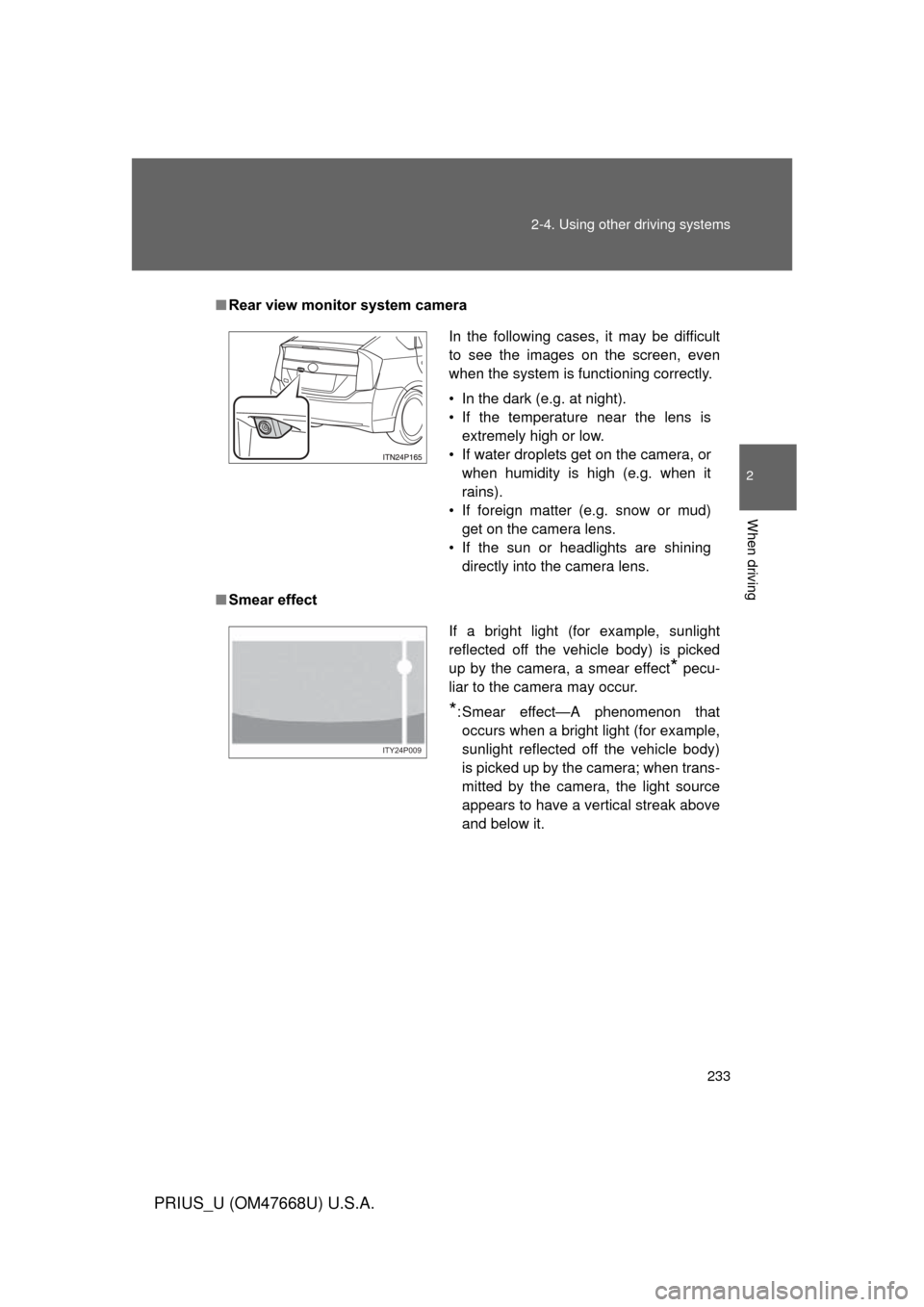
■Rear view monitor system camera
■ Smear effect
In the following cases, it may be difficult
to see the images on the screen, even
when the system is functioning correctly.
• In the dark (e.g. at night).
• If the temperature near the lens is
extremely high or low.
• If water droplets get on the camera, or when humidity is high (e.g. when it
rains).
• If foreign matter (e.g. snow or mud) get on the camera lens.
• If the sun or headlights are shining directly into the camera lens.
If a bright light (for example, sunlight
reflected off the vehicle body) is picked
up by the camera, a smear effect
* pecu-
liar to the camera may occur.
*: Smear effect—A phenomenon that occurs when a bright light (for example,
sunlight reflected off the vehicle body)
is picked up by the camera; when trans-
mitted by the camera, the light source
appears to have a vertical streak above
and below it.
ITY24P009
Page 241 of 616
241
2-4. Using other
driving systems
2
When driving
PRIUS_U (OM47668U) U.S.A.
CAUTION
■Situations unsuitable for the LKA system
Using the LKA system in any of the following situations may result in
improper operation of the system and could lead to an accident, causing
death or serious injury. Turn the LKA system off while driving in any of the
following situations.
● When it is difficult to see lane markings because they are dirty or not clear
● When it is difficult to see lane markings due to rain, snow, fog or glare
● When the headlights are not bright enough due to dirt on the lenses or if
the headlight aim is not adjusted appropriately
● When a lane marking is not present, such as before tollbooths on a free-
way
● When sudden changes in the light level occur repetitively
● When there are misleading lines such as shadows, lines of snow, wheel
ruts with rain collected in them, or lines that remain after road repairs
● When driving in lanes other than the driving lane or passing lane on free-
way or motor highways
● When there is a lane closure due to road repairs or when driving in a
makeshift lane
● When the lanes are narrow or wide
● When the distance from the vehicle ahead of you is short
● When the vehicle leans to one side an unusual amount due to a heavy
load or improper tire inflation pressure
● When driving on winding roads or on uneven roads
● When driving on slippery roads, such as those covered with rain, ice or \
snow
● The tires have been exchanged (including snow tires), or the suspension
has been modified