warning TOYOTA PRIUS 2013 3.G Owners Manual
[x] Cancel search | Manufacturer: TOYOTA, Model Year: 2013, Model line: PRIUS, Model: TOYOTA PRIUS 2013 3.GPages: 640, PDF Size: 11.67 MB
Page 524 of 640
524 5-2. Steps to take in an emergency
PRIUS_OM_OM47791U_(U)
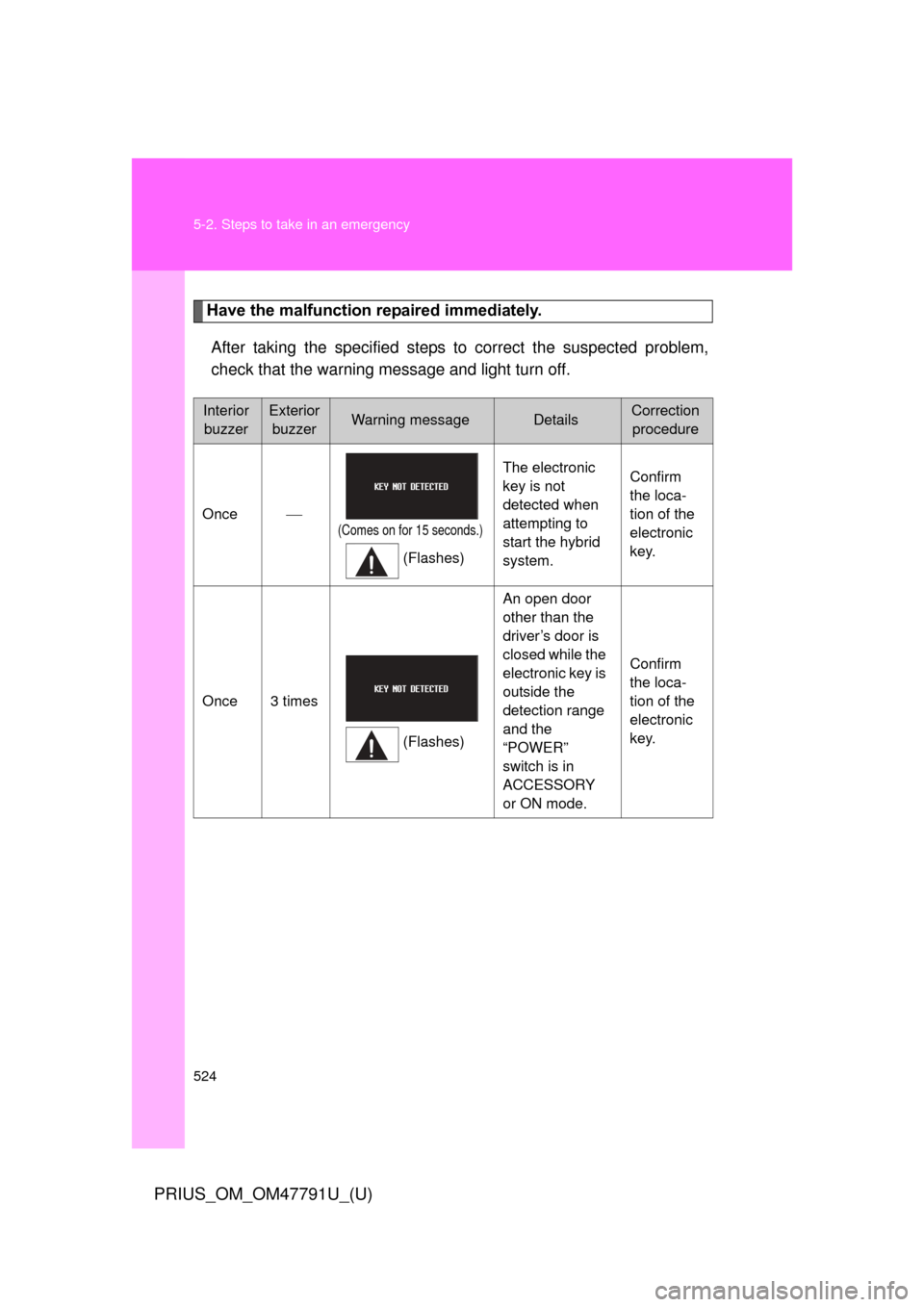
Have the malfunction repaired immediately.After taking the specified steps to correct the suspected problem,
check that the warning message and light turn off.
Interior buzzerExterior buzzerWarning messageDetailsCorrection procedure
Once
(Comes on for 15 seconds.)
(Flashes) The electronic
key is not
detected when
attempting to
start the hybrid
system.
Confirm
the loca-
tion of the
electronic
key.
Once 3 times (Flashes)An open door
other than the
driver’s door is
closed while the
electronic key is
outside the
detection range
and the
“POWER”
switch is in
ACCESSORY
or ON mode.
Confirm
the loca-
tion of the
electronic
key.
Page 525 of 640
5
When trouble arises
525
5-2. Steps to take in an emergency
PRIUS_OM_OM47791U_(U)
Interior
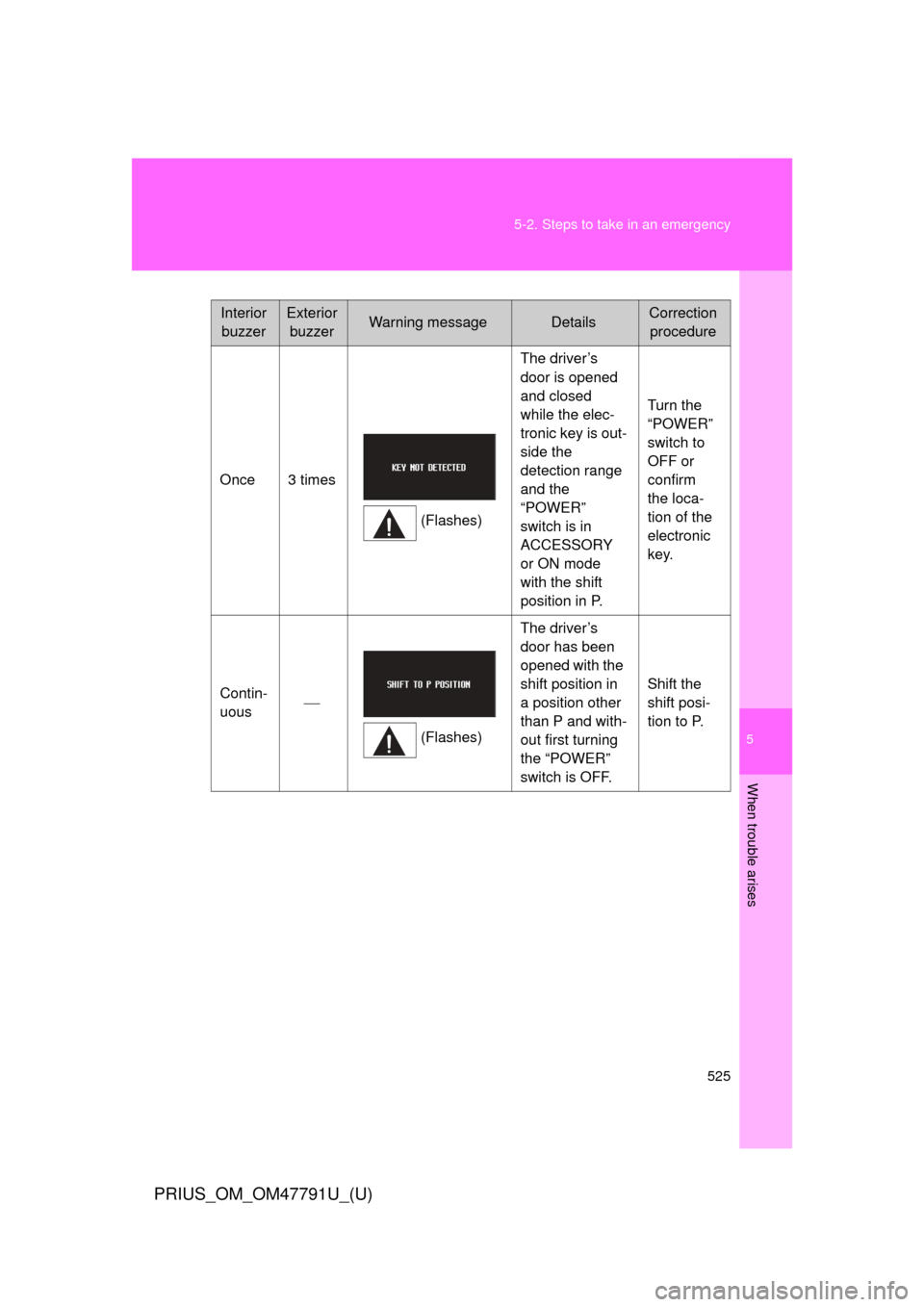
buzzerExterior buzzerWarning messageDetailsCorrection procedure
Once 3 times (Flashes)The driver’s
door is opened
and closed
while the elec-
tronic key is out-
side the
detection range
and the
“POWER”
switch is in
ACCESSORY
or ON mode
with the shift
position in P. Turn the
“POWER”
switch to
OFF or
confirm
the loca-
tion of the
electronic
key.
Contin-
uous
(Flashes)The driver’s
door has been
opened with the
shift position in
a position other
than P and with-
out first turning
the “POWER”
switch is OFF.
Shift the
shift posi-
tion to P.
Page 526 of 640
526 5-2. Steps to take in an emergency
PRIUS_OM_OM47791U_(U)
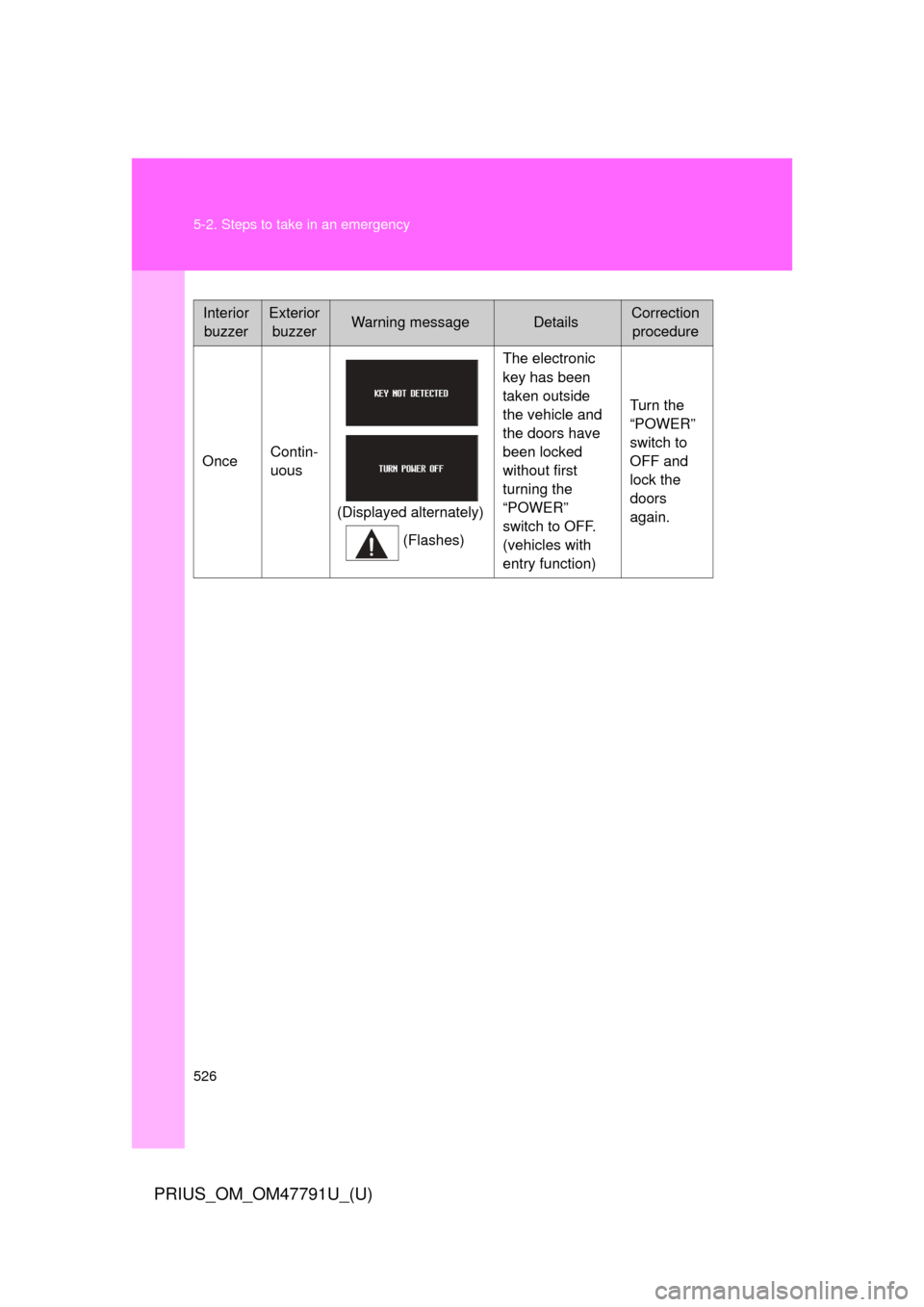
InteriorbuzzerExterior buzzerWarning messageDetailsCorrection procedure
Once Contin-
uous
(Displayed alternately)(Flashes) The electronic
key has been
taken outside
the vehicle and
the doors have
been locked
without first
turning the
“POWER”
switch to OFF.
(vehicles with
entry function)
Turn the
“POWER”
switch to
OFF and
lock the
doors
again.
Page 527 of 640
5
When trouble arises
527
5-2. Steps to take in an emergency
PRIUS_OM_OM47791U_(U)
Interior
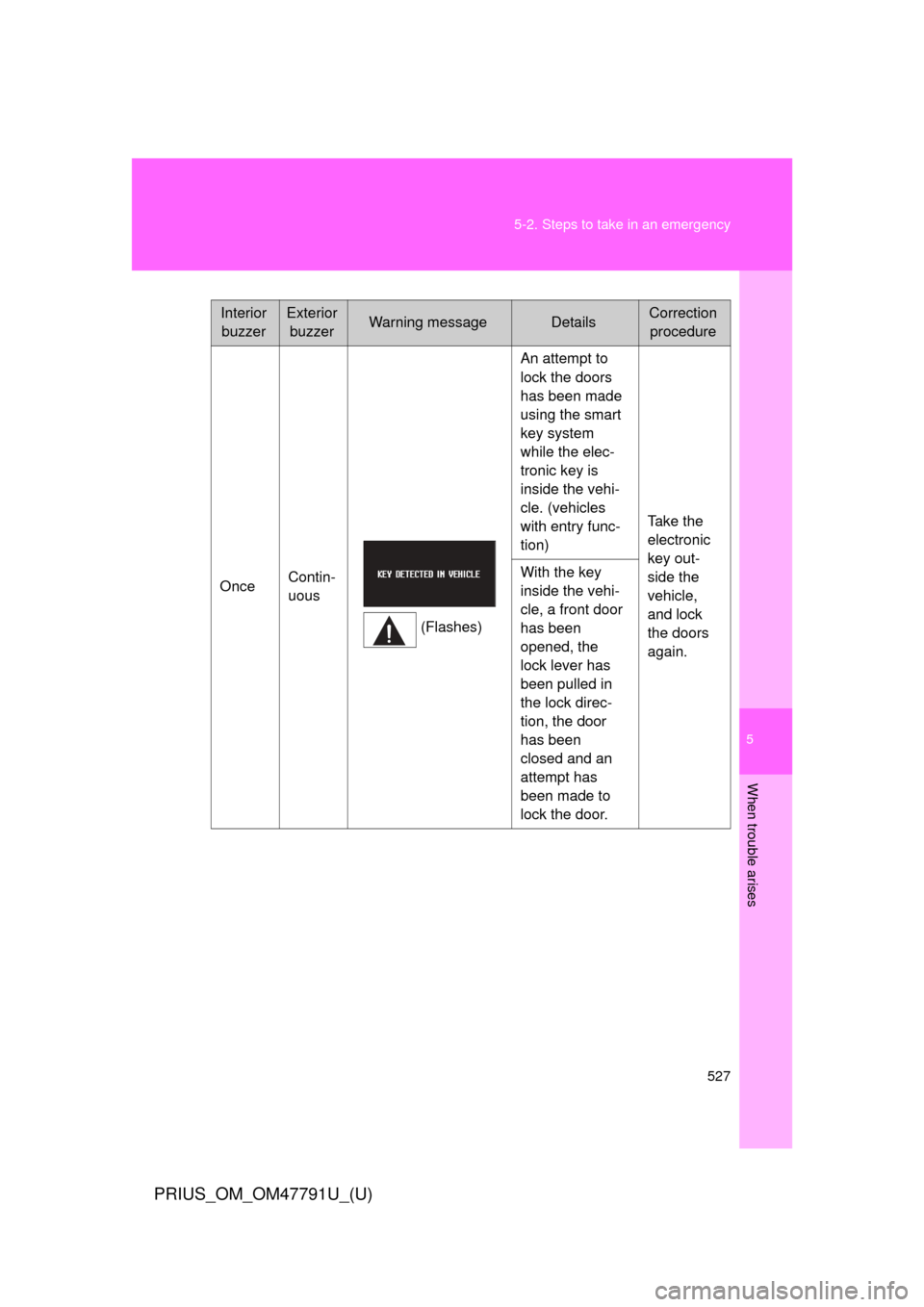
buzzerExterior buzzerWarning messageDetailsCorrection procedure
Once Contin-
uous
(Flashes)An attempt to
lock the doors
has been made
using the smart
key system
while the elec-
tronic key is
inside the vehi-
cle. (vehicles
with entry func-
tion)
Take the
electronic
key out-
side the
vehicle,
and lock
the doors
again.
With the key
inside the vehi-
cle, a front door
has been
opened, the
lock lever has
been pulled in
the lock direc-
tion, the door
has been
closed and an
attempt has
been made to
lock the door.
Page 528 of 640
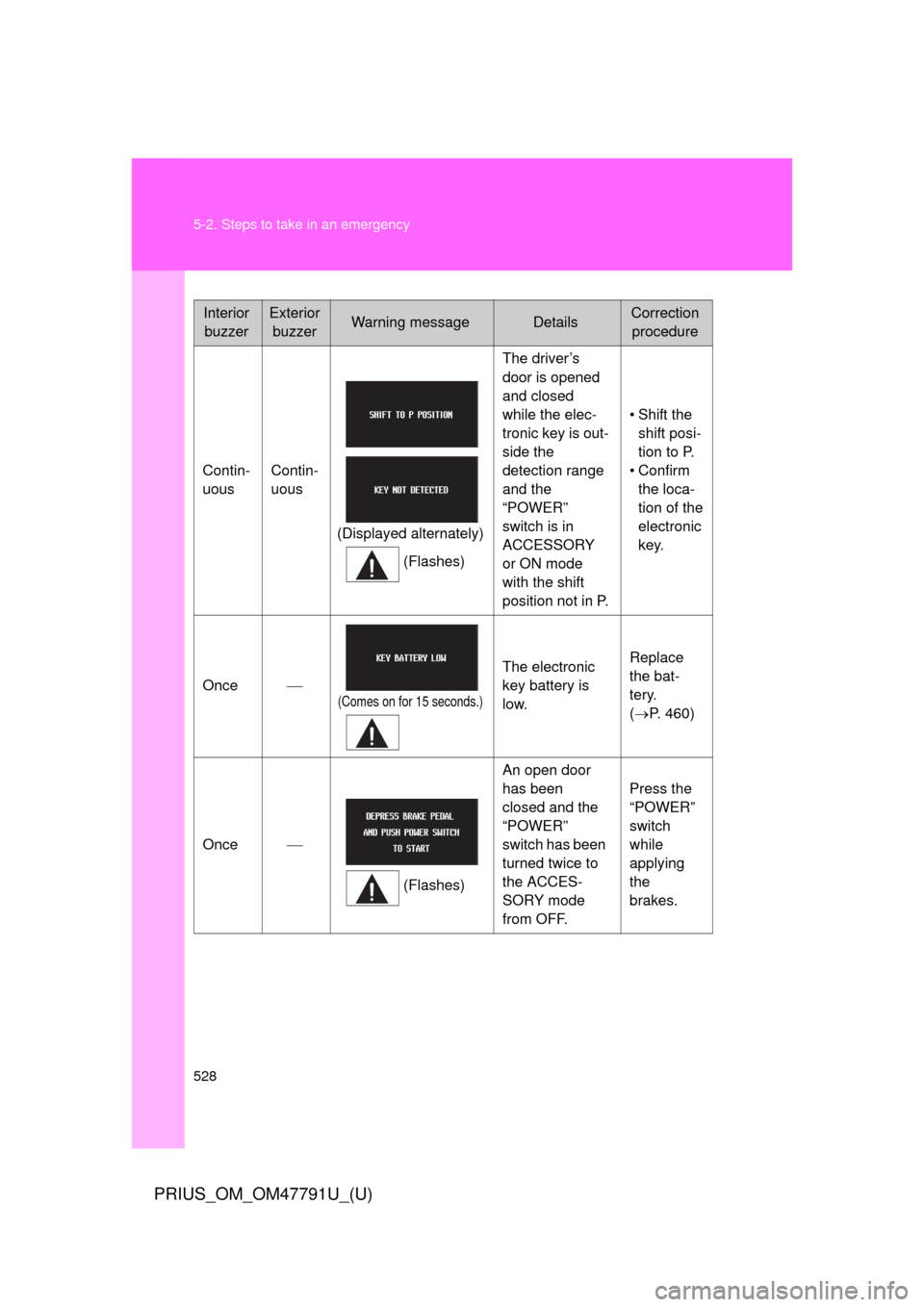
528 5-2. Steps to take in an emergency
PRIUS_OM_OM47791U_(U)
InteriorbuzzerExterior buzzerWarning messageDetailsCorrection procedure
Contin-
uous Contin-
uous
(Displayed alternately) (Flashes) The driver’s
door is opened
and closed
while the elec-
tronic key is out-
side the
detection range
and the
“POWER”
switch is in
ACCESSORY
or ON mode
with the shift
position not in P.
• Shift the
shift posi-
tion to P.
• Confirm the loca-
tion of the
electronic
key.
Once
(Comes on for 15 seconds.)
The electronic
key battery is
low. Replace
the bat-
tery.
(
P. 460)
Once
(Flashes)An open door
has been
closed and the
“POWER”
switch has been
turned twice to
the ACCES-
SORY mode
from OFF. Press the
“POWER”
switch
while
applying
the
brakes.
Page 529 of 640
5
When trouble arises
529
5-2. Steps to take in an emergency
PRIUS_OM_OM47791U_(U)
Interior
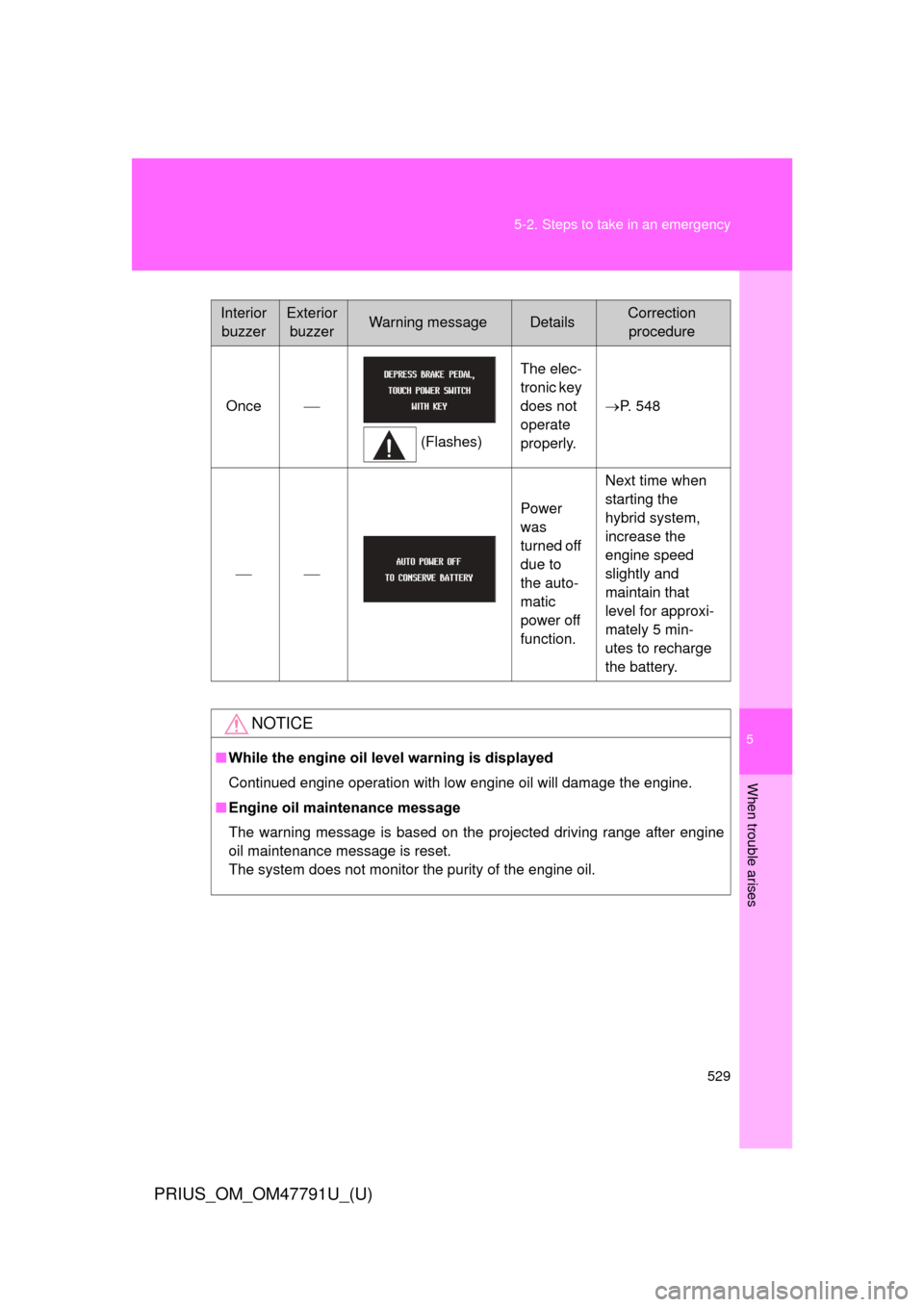
buzzerExterior buzzerWarning messageDetailsCorrection procedure
Once
(Flashes)The elec-
tronic key
does not
operate
properly.
P. 548
Power
was
turned off
due to
the auto-
matic
power off
function.Next time when
starting the
hybrid system,
increase the
engine speed
slightly and
maintain that
level for approxi-
mately 5 min-
utes to recharge
the battery.
NOTICE
■
While the engine oil level warning is displayed
Continued engine operation with low engine oil will damage the engine.
■ Engine oil maintenance message
The warning message is based on the projected driving range after engine
oil maintenance message is reset.
The system does not monitor the purity of the engine oil.
Page 539 of 640
5
When trouble arises
539
5-2. Steps to take in an emergency
PRIUS_OM_OM47791U_(U)
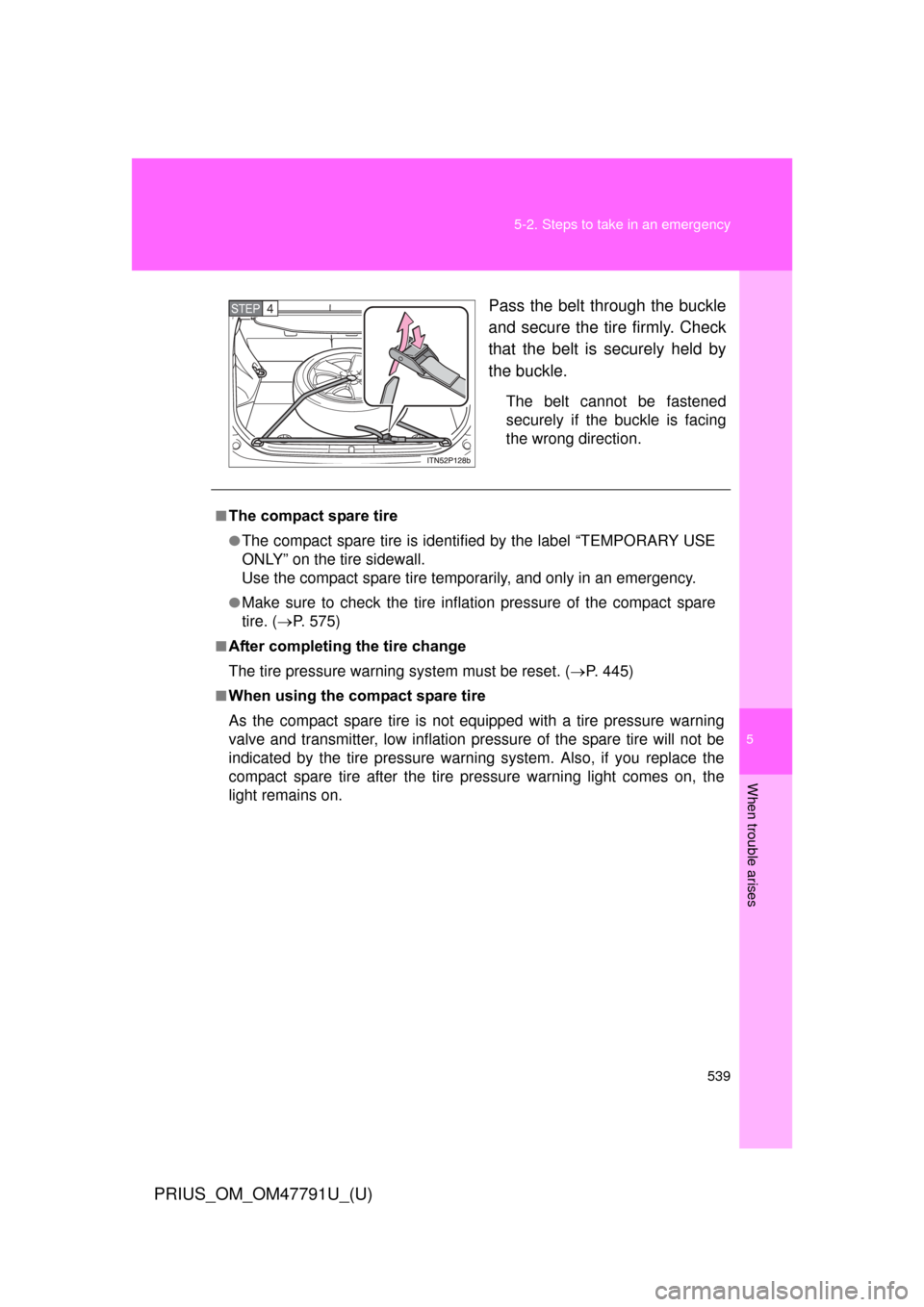
Pass the belt through the buckle
and secure the tire firmly. Check
that the belt is securely held by
the buckle.
The belt cannot be fastened
securely if the buckle is facing
the wrong direction.
STEP 4
■The compact spare tire
●The compact spare tire is identifi
ed by the label “TEMPORARY USE
ONLY” on the tire sidewall.
Use the compact spare tire temporarily, and only in an emergency.
●Make sure to check the tire inflation pressure of the compact spare
tire. ( P. 575)
■After completing the tire change
The tire pressure warning system must be reset. (P. 445)
■When using the compact spare tire
As the compact spare tire is not equipped with a tire pressure warning
valve and transmitter, low inflation pressure of the spare tire will not be
indicated by the tire pressure warning system. Also, if you replace the
compact spare tire after the tire pressure warning light comes on, the
light remains on.
Page 544 of 640

544 5-2. Steps to take in an emergency
PRIUS_OM_OM47791U_(U)
NOTICE
■Do not drive the vehicle with a flat tire
Do not continue driving with a flat tire.
Driving even a short distance with a flat tire can damage the tire and the
wheel beyond repair.
■Be careful when driving over bumps with the compact spare tire
installed on the vehicle
The vehicle becomes lower when driving with the compact spare tire
compared to when driving with standard tires. Be careful when driving
over uneven road surfaces.
■Driving with tire chains and the compact spare tire
Do not fit tire chains to the compact spare tire.
Tire chains may damage the vehicle body and adversely affect driving
performance.
■When replacing the tires
When removing or fitting the wheels, tires or the tire pressure warning
valve and transmitter, contact your Toyota dealer as the tire pressure
warning valve and transmitter may be damaged if not handled correctly.
■To avoid damage to the tire pressure warning valves and transmit-
ters
When a tire is repaired with liquid se alants, the tire pressure warning
valve and transmitter may not operate properly. If a liquid sealant is
used, contact your Toyota dealer or other qualified service shop as soon
as possible. Make sure to replace the tire pressure warning valve and
transmitter when replacing the tire. ( P. 444)
Page 556 of 640
556
5-2. Steps to take in an emergency
PRIUS_OM_OM47791U_(U)
If your vehicle overheats
Correction procedures■ If the high coolant temperatur e warning light comes on or
flashes
Stop the vehicle in a safe place and turn off the air condition-
ing system, and then stop the hybrid system.
If you see steam: Carefully lift the hood after the steam subsides.
If you do not see steam: Carefully lift the hood.
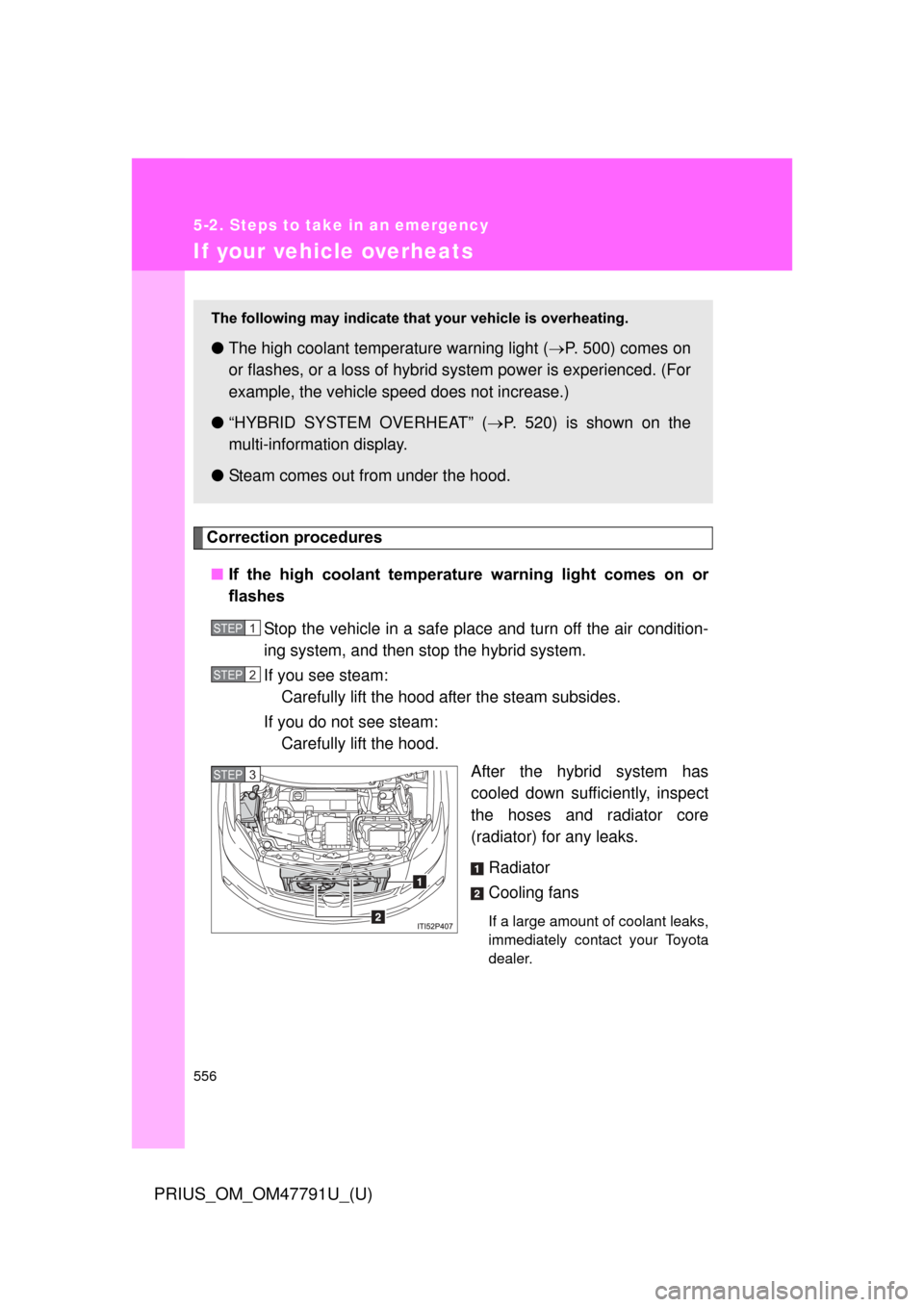
After the hybrid system has
cooled down sufficiently, inspect
the hoses and radiator core
(radiator) for any leaks.
Radiator
Cooling fans
If a large amount of coolant leaks,
immediately contact your Toyota
dealer.
The following may indicate that your vehicle is overheating.
●The high coolant temperature warning light ( P. 500) comes on
or flashes, or a loss of hybrid system power is experienced. (For
example, the vehicle s peed does not increase.)
● “HYBRID SYSTEM OVERHEAT” ( P. 520) is shown on the
multi-informat ion display.
● Steam comes out from under the hood.
STEP 1
STEP 2
STEP 3
Page 587 of 640

587
6-1. Specifications
6
Vehicle specifications
PRIUS_OM_OM47791U_(U)
■
Traction AA, A, B, C
The traction grades, from highest to lowest, are AA, A, B and C,
and they represent the tire’s ab ility to stop on wet pavement as
measured under controlled cond itions on specified government
test surfaces of asphalt and concrete.
A tire marked C may have poor traction performance.
Warning: The traction grade assigned to this tire is based on braking
(straight ahead) traction tests and does not include cornering (turn-
ing) traction.
■ Temperature A, B, C
The temperature grades are A (the highest), B, and C, represent-
ing the tire’s resistance to the generation of heat and its ability to
dissipate heat when tested under controlled conditions on a speci-
fied indoor laboratory test wheel.
Sustained high temperature can cause the material of the tire to
degenerate and reduce tire life, and excessive temperature can lead
to sudden tire failure.
Grade C corresponds to a level of performance which all passenger
car tires must meet under the Federal Motor Vehicle Safety Standard
No. 109.
Grades B and A represent higher levels of performance on the labo-
ratory test wheel than the minimum required by law.
Warning: The temperature grades of a tire assume that it is properly
inflated and not overloaded.
Excessive speed, underinflation, or excessive loading, either sepa-
rately or in combination, can caus e heat buildup and possible tire fail-
ure.