tire pressure TOYOTA PRIUS 2018 (in English) Owner's Guide
[x] Cancel search | Manufacturer: TOYOTA, Model Year: 2018, Model line: PRIUS, Model: TOYOTA PRIUS 2018Pages: 820, PDF Size: 15.63 MB
Page 680 of 820

6808-2. Steps to take in an emergency
PRIUS_OM_OM47B89U_(U)■
When the tire pressure warning light comes on
Inspect the appearance of the tire to
check that the tire is not punctured.
If the tire is punctured: → P. 691, 705
If the tire is not punctured:
Check the tire inflation pressure and adjust to the appropriate level. Initial-
izing the tire pressure warning syst em will not turn off the tire pressure
warning light.
■The tire pressure warning light may come on due to natural causes
The tire pressure warning light may come on due to natural causes such
as natural air leaks and tire inflat ion pressure changes caused by tem-
perature. In this case, adjusting the ti re inflation pressure will turn off the
warning light (afte r a few minutes).
■When a tire is replaced with a spare tire
Vehicles with compact spare tire: Th e compact spare tire is not equipped
with a tire pressure warning valve and transmitter. If a tire goes flat, the
tire pressure warning light will not tu rn off even though the flat tire has
been replaced with the spare tire. Repl ace the spare tire with the repaired
tire and adjust the tire inflation pr essure. The tire pressure warning light
will go off after a few minutes.
Vehicles with full-size spare tire: The spare tire is also equipped with a tire
pressure warning valve and transmitter. The tire pressure warning light
will turn on if the tire inflat ion pressure of the spare ti re is low. If a tire goes
flat, the tire pressure warning light will not turn off even though the flat tire
has been replaced with the spare tire. Replace the spare tire with the
repaired tire and adjust the tire inflation pressure. The tire pressure warn-
ing light will go off after a few minutes.
■Conditions that the tire pressure warning system may not function
properly
→ P. 6 2 4
■If the tire pressure warning light frequently comes on after blinking
for 1 minute
If the tire pressure warning light frequently comes on after blinking for
1 minute when the power switch is tu rned to ON mode, have it checked
by your Toyota dealer.
■ Warning buzzer
In some cases, the buzzer may not be heard due to being in a noisy location
or audio sound.
Page 681 of 820

6818-2. Steps to take in an emergency
PRIUS_OM_OM47B89U_(U)
8
When trouble arises
WARNING
■When the electric power steerin g system warning light comes on
When the light comes on yellow, the assist to the power steering is
restricted. When the light comes on red, the assist to the power steering is
lost and handling operations of the steering wheel become extremely
heavy. When steering wheel operations are heavier than usual, grip the
steering wheel firmly and operate it using more force than usual.
■
If the tire pressure warning light comes on
Be sure to observe the following precautions. Failure to do so could
cause a loss of vehicle control and result in death or serious injury.
●Stop your vehicle in a safe place as soon as possible. Adjust the tire
inflation pressure immediately.
●Vehicles with spare tire: If the tire pressure warning light comes on
even after tire inflation pressure adjustment, it is probable that you
have a flat tire. Check the tires. If a tire is flat, change it with the spare
tire and have the flat tire repaired by the nearest Toyota dealer.
●Vehicles with emergency tire puncture repair kit: If the tire pressure
warning light comes on even after ti re inflation pressure adjustment, it
is probable that you have a flat tire . Check the tires. If a tire is flat,
repair the flat tire by using emer gency tire puncture repair kit.
●Avoid abrupt maneuvering and braking. If the vehicle tires deteriorate,
you could lose control of the steering wheel or the brakes.
■If a blowout or sudden air leakage should occur
The tire pressure warning system may not activate immediately.
Page 682 of 820
6828-2. Steps to take in an emergency
PRIUS_OM_OM47B89U_(U)
WARNING
■Maintenance of the tires
Each tire, including the spare (if provided), should be checked monthly
when cold and inflated to the inflation pressure recommended by the
vehicle manufacturer on the vehicle placard or tire inflation pressure
label (tire and load information label). (If your vehicle has tires of a dif-
ferent size than the size indicated on the vehicle placard or tire inflation
pressure label [tire and load information label], you should determine
the proper tire inflation pressure for those tires.)
As an added safety feature, your vehicle has been equipped with a tire
pressure monitoring system (TPMS-ti re pressure warning system) that
illuminates a low tire pre ssure telltale (tire pressure warning light) when
one or more of your tires is significantly under-inflated. Accordingly,
when the low tire pressure telltale (tire pressure warning light) illumi-
nates, you should stop and check your tires as soon as possible, and
inflate them to the proper pressure. Driving on a significantly under-
inflated tire causes the tire to overheat and can lead to tire failure.
Under-inflation also reduces fuel effi ciency and tire tread life, and may
affect the vehicle’s hand ling and stopping ability.
Please note that the TPMS (tire pressure warning system) is not a sub-
stitute for proper ti re maintenance, and it is the driver’s responsibility to
maintain correct tire pressure, even if under-inflation has not reached
the level to trigger illumination of the TPMS low tire pressure telltale (tire
pressure warning light).
Your vehicle has also been equipped with a TPMS (tire pressure warn-
ing system) malfunction indicator to indicate when the system is not
operating properly. The TPMS (tire pressure warning system) malfunc-
tion indicator is combined with the lo w tire pressure telltale (tire pressure
warning light). When the system detects a malfunction, the telltale will
flash for approximately one minute and then remain continuously illumi-
nated. This sequence w ill continue upon subsequ ent vehicle start-ups
as long as the malfunction exists. When the malfunction indicator is illu-
minated, the system may not be able to detect or signal low tire pres-
sure as intended.
TPMS (tire pressure warning system) malfunctions may occur for a vari-
ety of reasons, including the installation of replacement or alternate tires
or wheels on the vehicle that prevent the TPMS (tire pressure warning
system) from functioning properly. Always check the TPMS (tire pres-
sure warning system) malfunction te lltale after replacing one or more
tires or wheels on your vehicle to ensure that the replacement or alter-
nate tires and wheels allow the TPMS (tire pressure warning system) to
continue to function properly.
Page 683 of 820

6838-2. Steps to take in an emergency
PRIUS_OM_OM47B89U_(U)
8
When trouble arises
NOTICE
■To ensure the tire pressure warning system operates properly
Do not install tires with different specifications or makers, as the tire
pressure warning system may not operate properly.
Page 702 of 820
7028-2. Steps to take in an emergency
PRIUS_OM_OM47B89U_(U)
■The compact spare tire (if equipped)
●The compact spare tire is identified by the label “TEMPORARY USE
ONLY” on the tire sidewall.
Use the compact spare tire temporarily, and only in an emergency.
●Make sure to check the tire inflation pressure of the compact spare tire.
(→ P. 752)
■When using the compact spare tire (if equipped)
As the compact spare tire is not equipped with a tire pressure warning
valve and transmitter, low inflation pressure of the spare tire will not be
indicated by the tire pressure warning system. Also, if you replace the
compact spare tire after the tire pressure warning light comes on, the light
remains on.
■When the compact spare tire is equipped (if equipped)
The vehicle height may become lower when driving with the compact
spare tire compared to when driving with standard tires.
■If you have a flat front tire on a road covered with snow or ice (vehi-
cles with compact spare tire)
Install the compact spare tire on one of the rear wheels of the vehicle.
Perform the following steps and fit tire chains to the front tires:
Replace a rear tire with the compact spare tire.
Replace the flat front tire with the tire removed from the rear of the vehi-
cle.
Fit tire chains to the front tires.
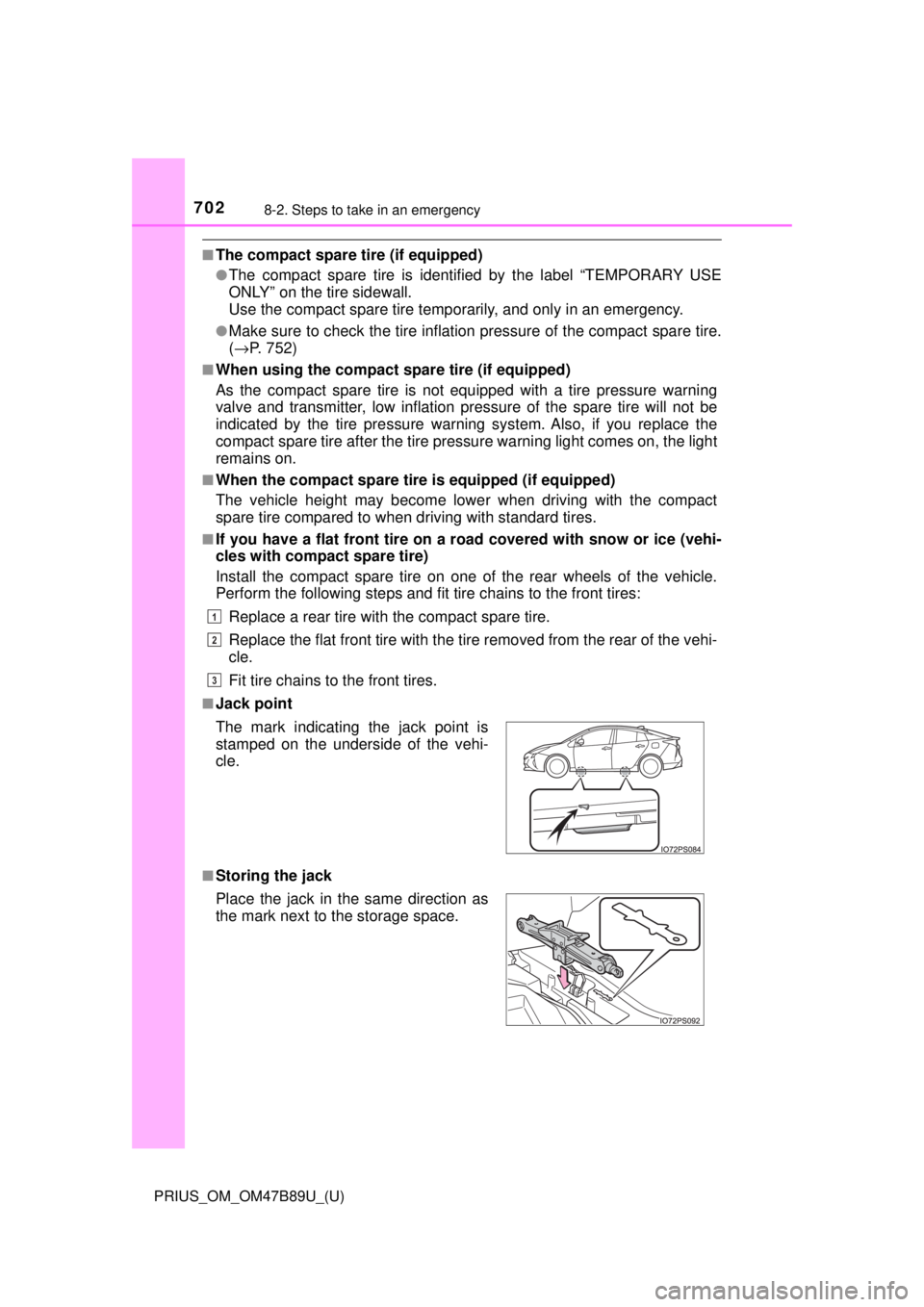
■Jack point
■Storing the jack The mark indicating the jack point is
stamped on the underside of the vehi-
cle.
Place the jack in the same direction as
the mark next to the storage space.
1
2
3
Page 704 of 820
7048-2. Steps to take in an emergency
PRIUS_OM_OM47B89U_(U)
NOTICE
■Be careful when driving over bumps with the compact spare tire
installed on the vehicle. (if equipped)
The vehicle height may become lower when driving with the compact
spare tire, compared to when driving with standard tires. Be careful
when driving over uneven road surfaces.
■Driving with tire chains and the compact spare tire (if equipped)
Do not fit tire chains to the compact spare tire.
Tire chains may damage the vehicle body and adversely affect driving
performance.
■When replacing the tires
When removing or fitting the wheels, tires or the tire pressure warning
valve and transmitter, contact your Toyota dealer as the tire pressure
warning valve and transmitter may be damaged if not handled correctly.
■Handling the decorative resin parts (for vehicles equipped with
17-inch tires)
→ P. 5 8 6
Page 706 of 820

7068-2. Steps to take in an emergency
PRIUS_OM_OM47B89U_(U)
●Stop the vehicle in a safe pl ace on a hard, flat surface.
● Set the parking brake.
● Shift the shift position to P.
● Stop the hybrid system.
● Turn on the emergency flashers.
● Check the degree of the tire damage.
A tire should only be repaired
with the emergency tire punc-
ture repair kit if the damage is
caused by a nail or screw pass-
ing through the tire tread.
• Do not remove the nail or screw from the tire. Remov-
ing the object may widen the
opening and make emer-
gency repair with the repair
kit impossible.
• To avoid sealant leakage, move the vehicle until the area of the
puncture, if known, is positi oned at the top of the tire.
■A flat tire that cannot be repaired with the emergency tire puncture
repair kit
In the following cases, the tire cannot be repaired with the emergency tire
puncture repair kit. Contact your Toyota dealer.
●When the tire is damaged due to driv ing without sufficient air pressure
●When there are any cracks or damage at any location on the tire, such
as on the side wall, except the tread
●When the tire is visibly separated from the wheel
●When the cut or damage to the tread is 0.16 in. (4 mm) long or more
●When the wheel is damaged
●When two or more tires have been punctured
●When more than one sharp objects su ch as nails or screws have passed
through the tread on a single tire
●When the sealant has expired
Before repairing the tire
Page 708 of 820

7088-2. Steps to take in an emergency
PRIUS_OM_OM47B89U_(U)
Emergency tire puncture repair kit components
Hose
Air release cap
Sticker Power plug
Air pressure gauge
Compressor switch1
2
3
4
5
6
Page 714 of 820

7148-2. Steps to take in an emergency
PRIUS_OM_OM47B89U_(U)
Check the specified tire inflation
pressure.
Tire inflation pressure is specified
on the label on the driver’s side
pillar as shown. (→P. 752)
Start the hybrid system. ( →P. 231)
To inject the sealant and inflate
the tire, turn the compressor
switch on.
11
12
13
Page 715 of 820

7158-2. Steps to take in an emergency
PRIUS_OM_OM47B89U_(U)
8
When trouble arises
Inflate the tire until the specified air pressure is reached.The sealant will be injected
and the pressure will spike to
between 44 psi (300 kPa,
3.0 kgf/cm
2 or bar) and
58 psi (400 kPa, 4.0 kgf/cm2
or bar), then gradually
decrease.
The air pressure gauge will
display the actual tire infla-
tion pressure about 1 to 5
minutes after the switch is
turned on.
• Turn the compressor switch off and then check the tire
inflation pressure. Being
careful not to over inflate,
check and repeat the inflation
procedure until the specified
tire inflation pressure is
reached.
• The tire can be inflated for about 5 to 20 minutes (depending on the outside temperature). If the tire inflation pressure is still lower
than the specified point after infl ation for 25 minutes, the tire is
too damaged to be repaired. Turn the compressor switch off and
contact your Toyota dealer.
• If the tire inflation pressure exce eds the specified air pressure, let
out some air to adjust the tire inflation pressure. ( →P. 718, 752)
With the compressor switch off, disconnect the hose from the valve
on the tire and then pull out the power plug from the power outlet
socket.
Some sealant may leak when the hose is removed.
Install the valve cap onto the va lve of the emergency repaired tire.
14
1
2
15
16