brake TOYOTA PRIUS C 2016 NHP10 / 1.G Quick Reference Guide
[x] Cancel search | Manufacturer: TOYOTA, Model Year: 2016, Model line: PRIUS C, Model: TOYOTA PRIUS C 2016 NHP10 / 1.GPages: 48, PDF Size: 1.49 MB
Page 3 of 48
OVERVIEW FEATURES/OPERATIONS TOYOTA SAFETY SENSE SAFETY AND EMERGENCY FEATURES
1
INDEX
1 Visit your Toyota dealer for information on customizing this feature.2 Programmable by customer. Refer to the Owner’s Manual for instructions and more
information.
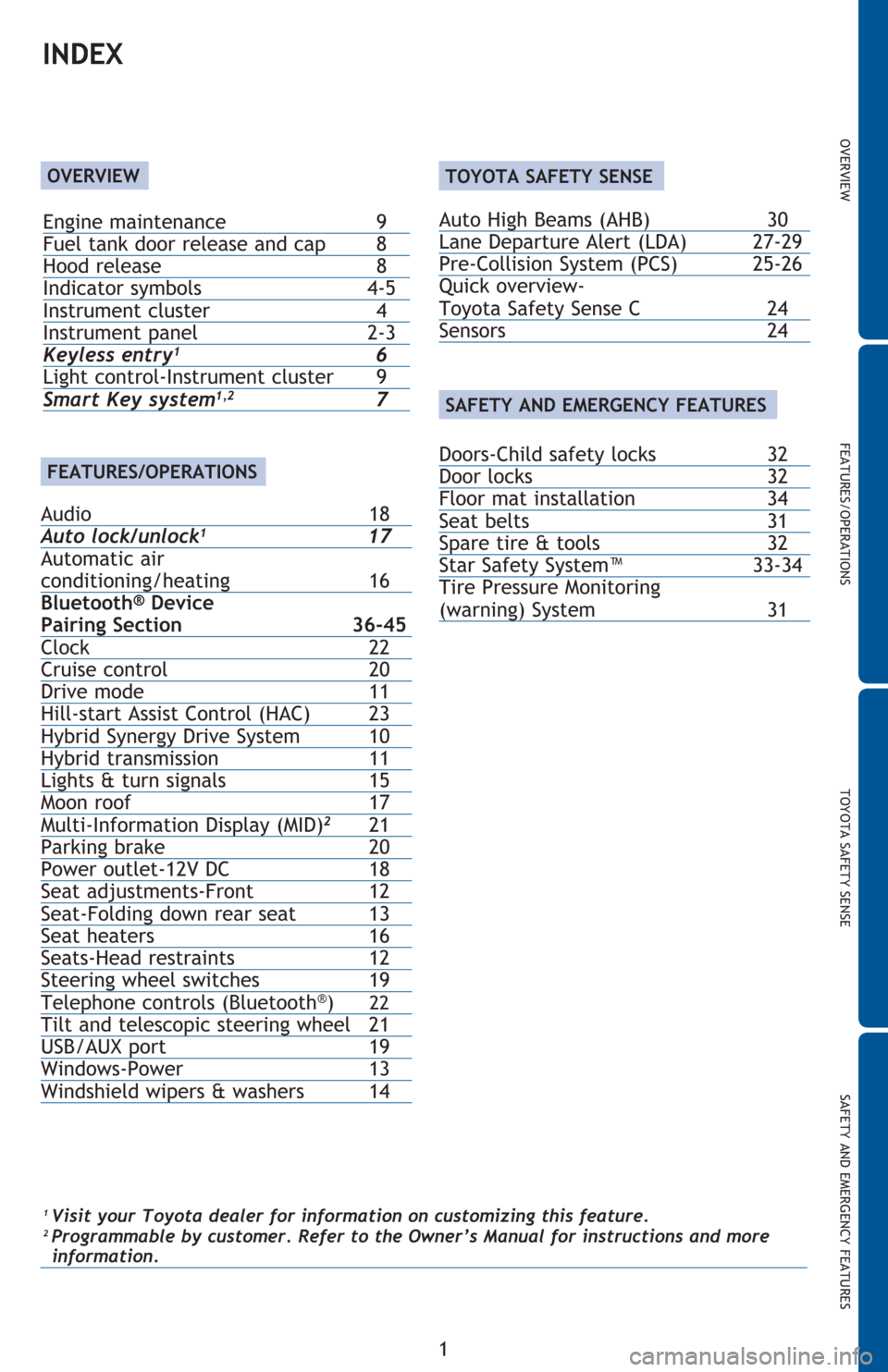
INDEX
Engine maintenance 9
Fuel tank door release and cap 8
Hood release 8
Indicator symbols 4-5
Instrument cluster 4
Instrument panel 2-3
Keyless entry
1 6
Light control-Instrument cluster 9
Smart Key system
1,2 7
OVERVIEW
FEATURES/OPERATIONS
TOYOTA SAFETY SENSE
Audio 18
Auto lock/unlock1 17
Automatic air
conditioning/heating 16
Bluetooth
® Device
Pairing Section 36-45
Clock 22
Cruise control 20
Drive mode 11
Hill-start Assist Control (HAC) 23
Hybrid Synergy Drive System 10
Hybrid transmission 11
Lights & turn signals 15
Moon roof 17
Multi-Information Display (MID)
2 21
Parking brake 20
Power outlet-12V DC 18
Seat adjustments-Front 12
Seat-Folding down rear seat 13
Seat heaters 16
Seats-Head restraints 12
Steering wheel switches 19
Telephone controls (Bluetooth
®) 22Tilt and telescopic steering wheel 21
USB/AUX port 19
Windows-Power 13
Windshield wipers & washers 14
Auto High Beams (AHB) 30
Lane Departure Alert (LDA) 27-29
Pre-Collision System (PCS) 25-26
Quick overview-
Toyota Safety Sense C 24
Sensors 24
Doors-Child safety locks 32
Door locks 32
Floor mat installation 34
Seat belts 31
Spare tire & tools 32
Star Safety System™ 33-34
Tire Pressure Monitoring
(warning) System 31
SAFETY AND EMERGENCY FEATURES
Page 6 of 48
4
OVERVIEW
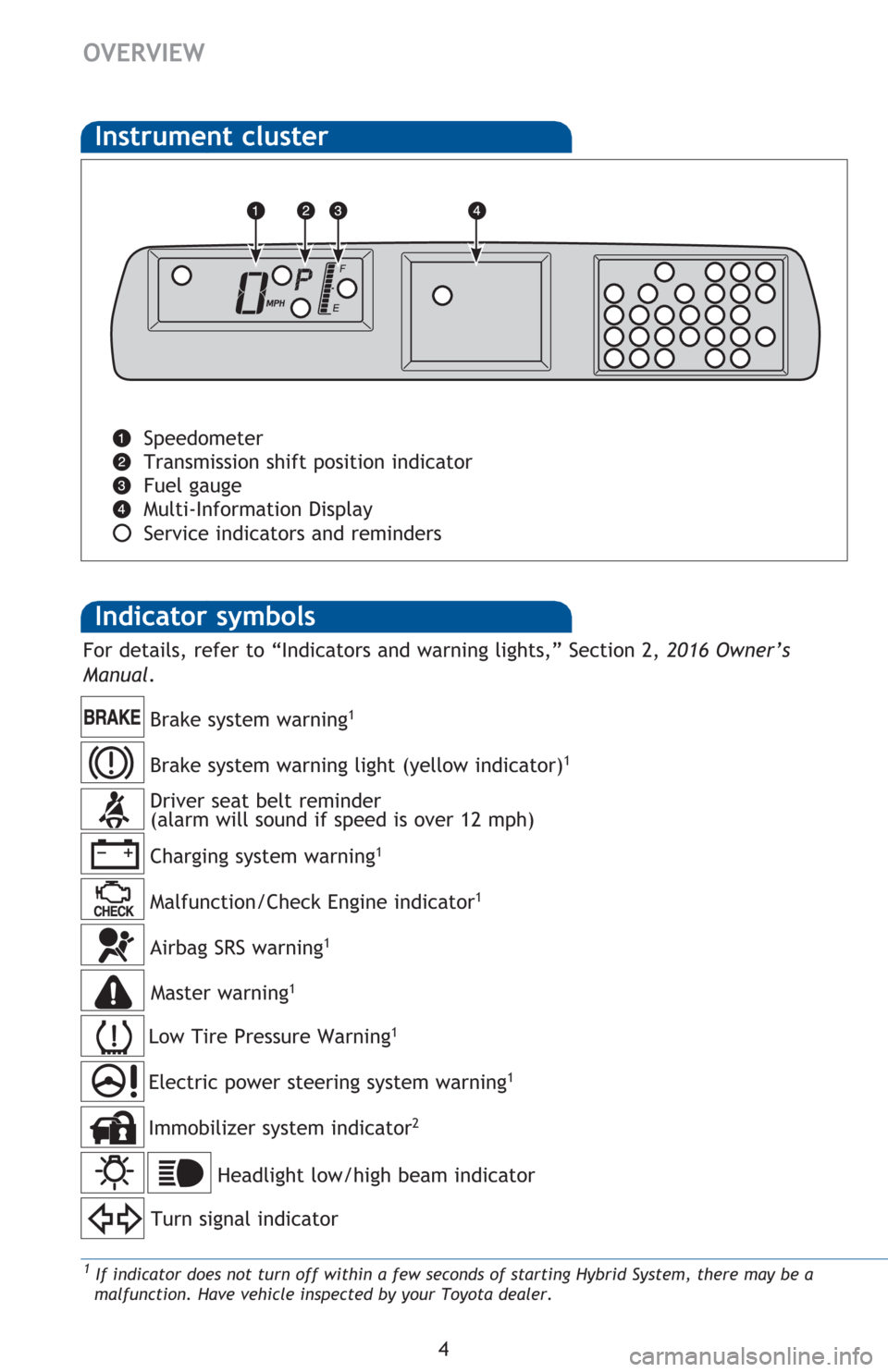
Indicator symbols
Instrument cluster
Speedometer
Transmission shift position indicator
Fuel gauge
Multi-Information Display
Service indicators and reminders
Charging system warning1
Brake system warning1
Headlight low/high beam indicator
Turn signal indicator
Low Tire Pressure Warning1
Immobilizer system indicator2
Airbag SRS warning1
Master warning1
Malfunction/Check Engine indicator1
Electric power steering system warning1
Driver seat belt reminder
(alarm will sound if speed is over 12 mph)
Brake system warning light (yellow indicator)1
1
If indicator does not turn off within a few seconds of starting Hybrid System, there may be a
malfunction. Have vehicle inspected by your Toyota dealer.
For details, refer to “Indicators and warning lights,” Section 2, 2016 Owner’s
Manual.
Page 7 of 48
OVERVIEW FEATURES/OPERATIONS TOYOTA SAFETY SENSE SAFETY AND EMERGENCY FEATURES
5
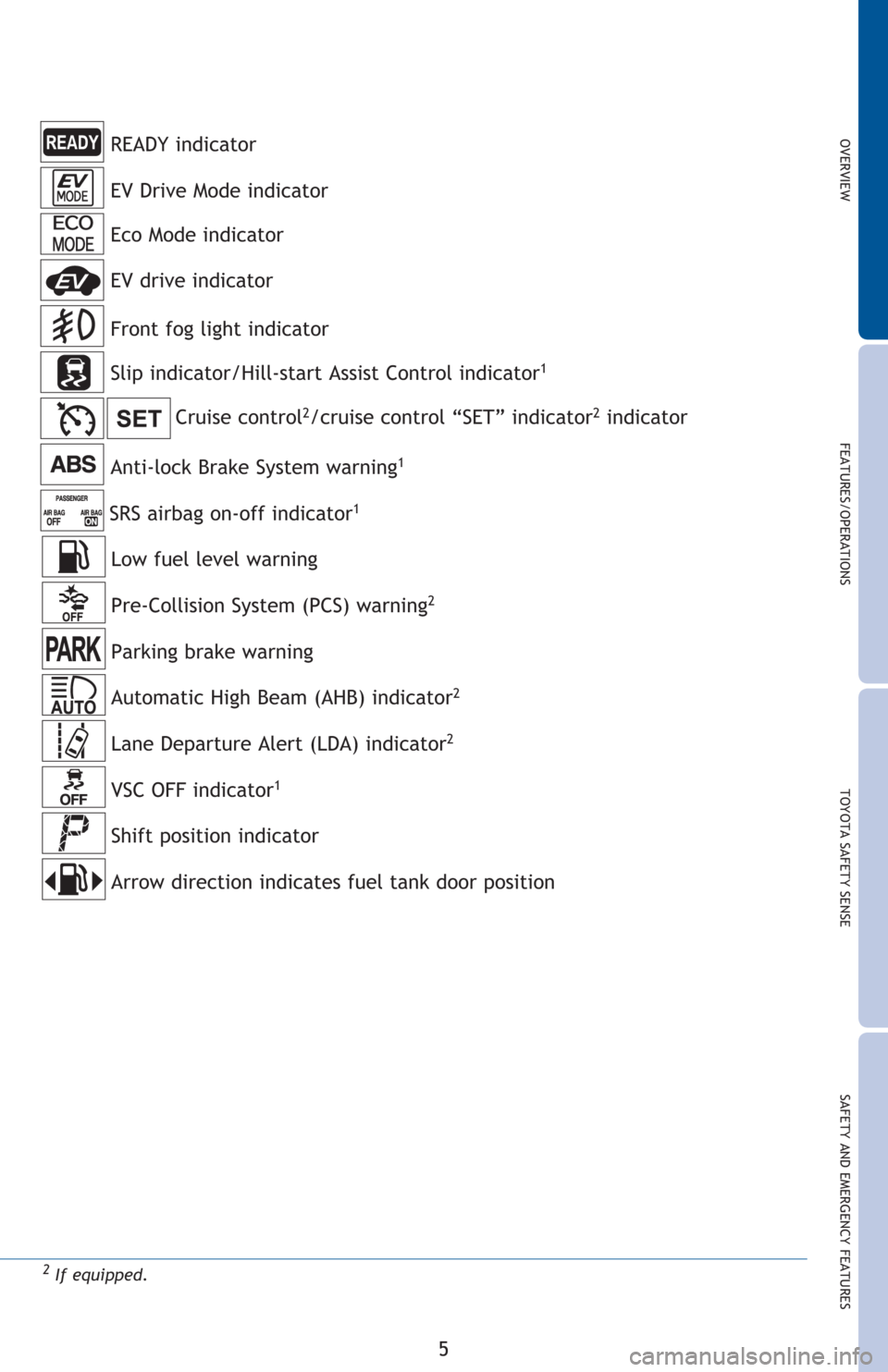
Anti-lock Brake System warning1
Slip indicator/Hill-start Assist Control indicator1
READY indicator
Front fog light indicator
Eco Mode indicator
EV Drive Mode indicator
2
If equipped.
Cruise control2/cruise control “SET” indicator2 indicator
EV drive indicator
SRS airbag on-off indicator1
Low fuel level warning
Automatic High Beam (AHB) indicator2
Pre-Collision System (PCS) warning2
Lane Departure Alert (LDA) indicator2
Shift position indicator
Parking brake warning
VSC OFF indicator1
Arrow direction indicates fuel tank door position
Page 9 of 48
OVERVIEW FEATURES/OPERATIONS TOYOTA SAFETY SENSE SAFETY AND EMERGENCY FEATURES
7
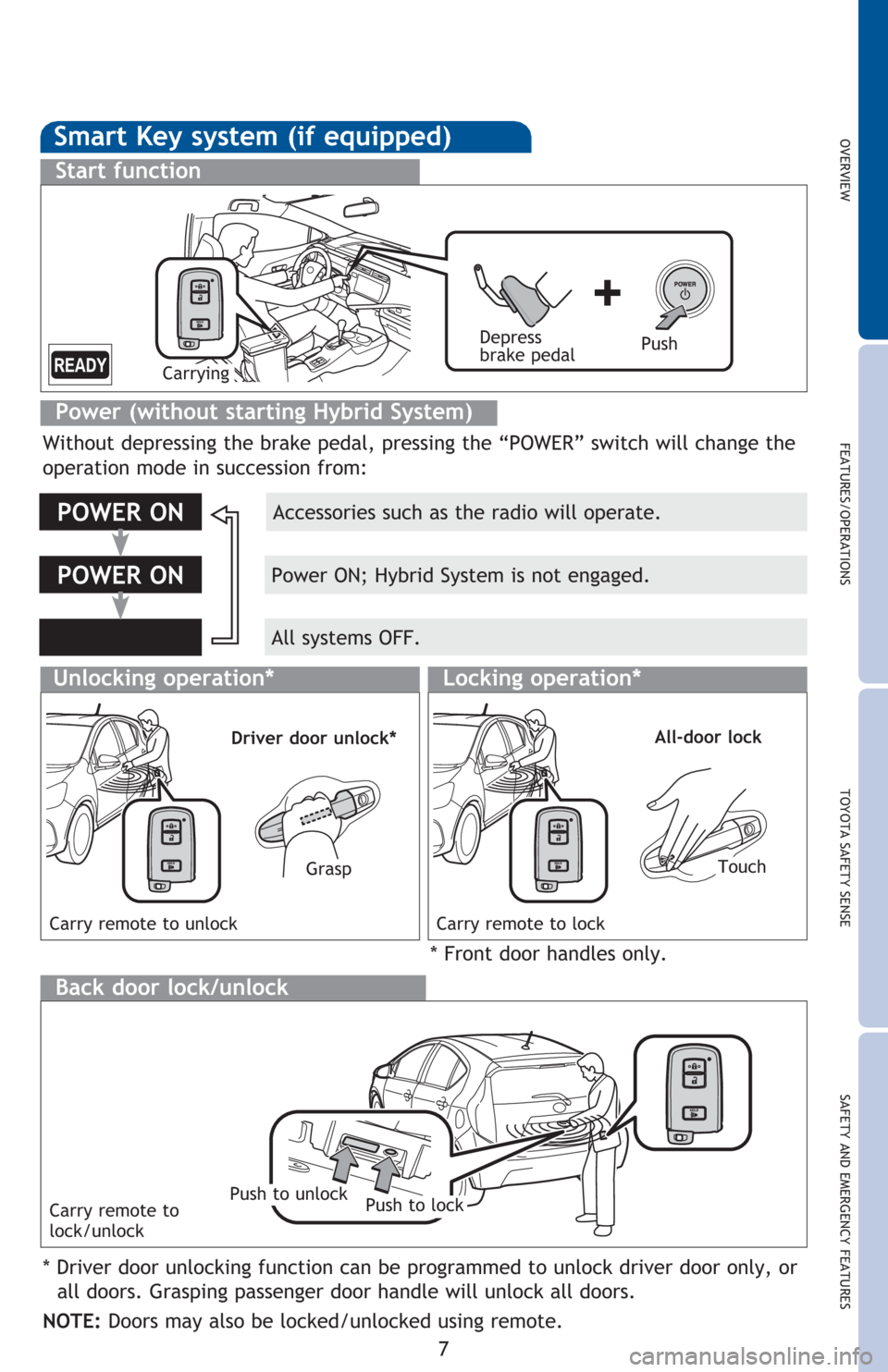
Smart Key system (if equipped)
Start function
Accessories such as the radio will operate.
Power ON; Hybrid System is not engaged.
All systems OFF.
POWER ON
POWER ON
Push Depress
brake pedal
Carrying
Without depressing the brake pedal, pressing the “POWER” switch will change the
operation mode in succession from:
Power (without starting Hybrid System)
* Driver door unlocking function can be programmed to unlock driver door only, or
all doors. Grasping passenger door handle will unlock all doors.
NOTE: Doors may also be locked/unlocked using remote.
Back door lock/unlock
Carry remote to
lock/unlock
Unlocking operation*
Carry remote to unlock
Driver door unlock*
Grasp
Push to lockPush to unlock
Locking operation*
Carry remote to lock
All-door lock
Touch
* Front door handles only.
Page 12 of 48
10
FEATURES/OPERATIONS
Starting the Hybrid System
The Hybrid Synergy Drive System utilizes a computer-controlled gasoline engine
and electric motor to provide the most efficient combination of power for the
vehicle. To conserve energy, when the brakes are applied the braking force
generates electricity which is then sent to the traction battery. In addition,
the engine shuts off when the vehicle is stopped. The benefits are better fuel
economy, reduced vehicle emissions and improved performance.
NOTE: Fuel consumption and energy information of the Hybrid System are
shown on the multi-information display or the Display Audio System.
Tips for improved fuel economy
-Ensure tire pressures are maintained at levels specified in the Owner’s Manual.
-When possible, link trips to reduce engine cold starts.
-Avoid driving at speeds that are higher than necessary, especially on the highway.
-When possible, avoid sudden stops to maximize regenerative braking energy.
-Minimize use of the Air Conditioning.
Hybrid Synergy Drive System
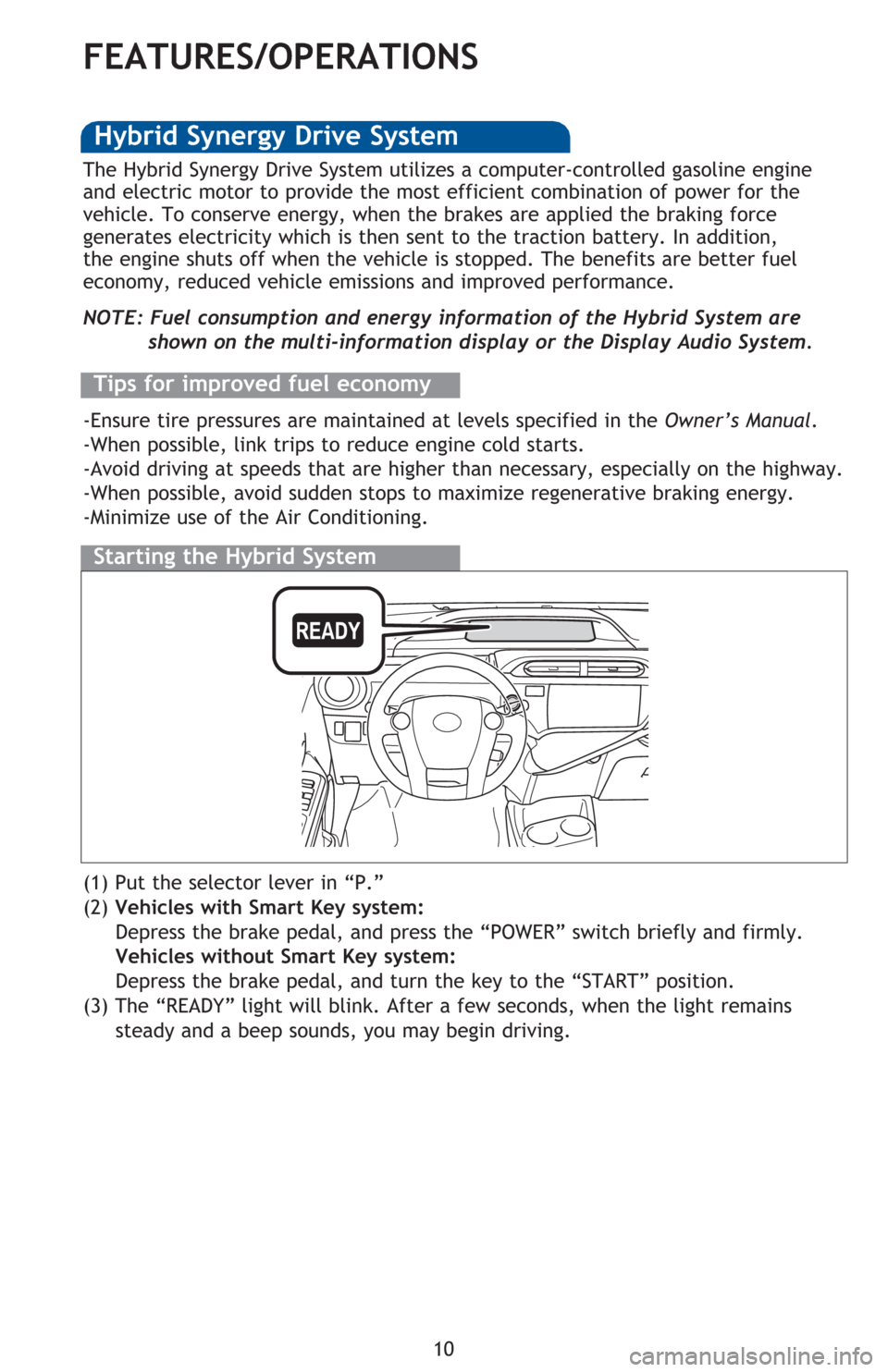
(1) Put the selector lever in “P.”
(2) Vehicles with Smart Key system:
Depress the brake pedal, and press the “POWER” switch briefly and firmly.
Vehicles without Smart Key system:
Depress the brake pedal, and turn the key to the “START” position.
(3) The “READY” light will blink. After a few seconds, when the light remains
steady and a beep sounds, you may begin driving.
Page 13 of 48
OVERVIEW FEATURES/OPERATIONS TOYOTA SAFETY SENSE SAFETY AND EMERGENCY FEATURES
11
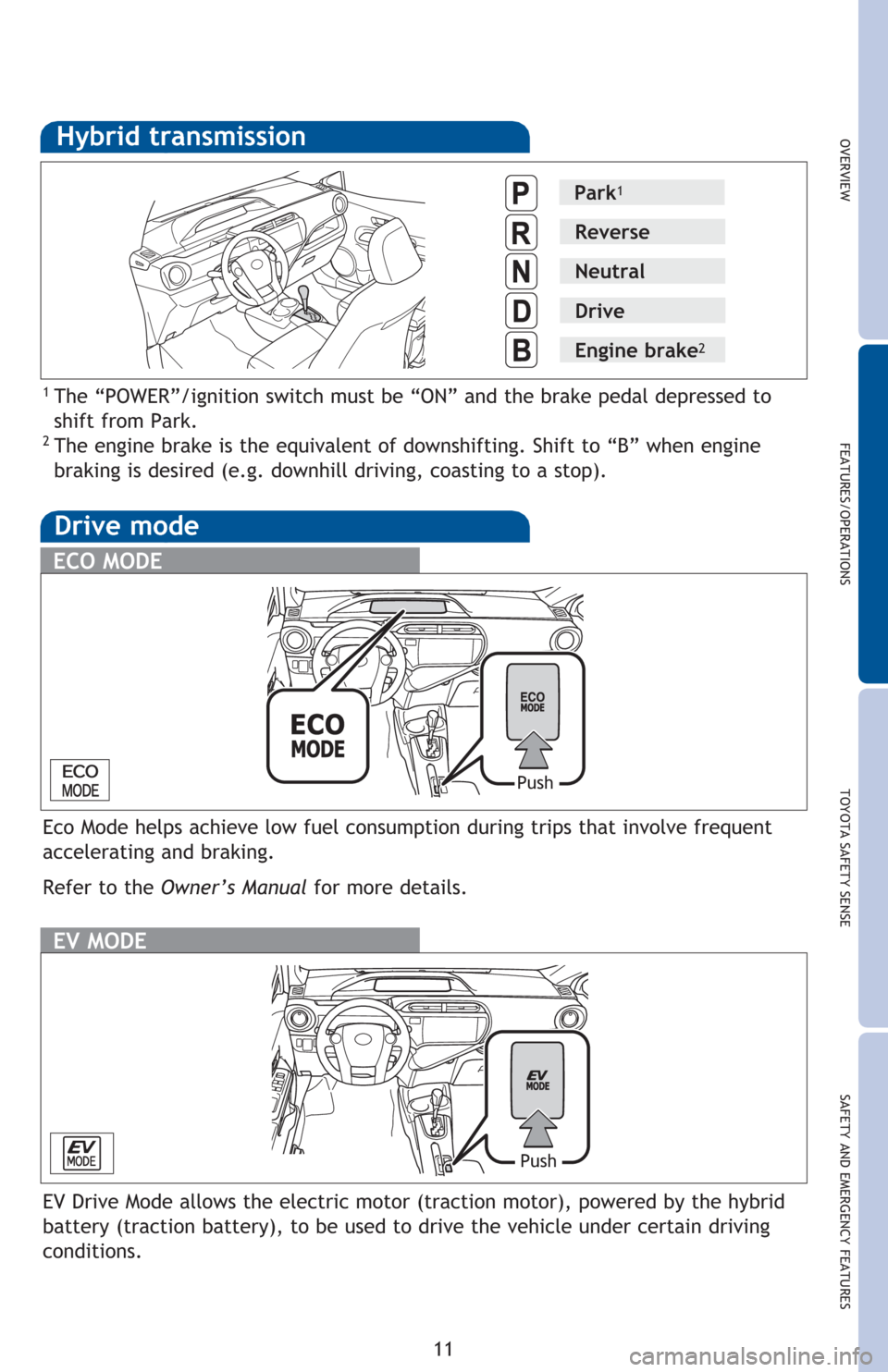
Hybrid transmission
1 The “POWER”/ignition switch must be “ON” and the brake pedal depressed to
shift from Park.
2 The engine brake is the equivalent of downshifting. Shift to “B” when engine
braking is desired (e.g. downhill driving, coasting to a stop).
ECO MODE
Park1
Reverse
Neutral
Drive
Engine brake2
Push
Eco Mode helps achieve low fuel consumption during trips that involve frequent
accelerating and braking.
Refer to the Owner’s Manual for more details.
Drive mode
EV MODE
EV Drive Mode allows the electric motor (traction motor), powered by the hybrid
battery (traction battery), to be used to drive the vehicle under certain driving
conditions.
Push
Page 22 of 48
20
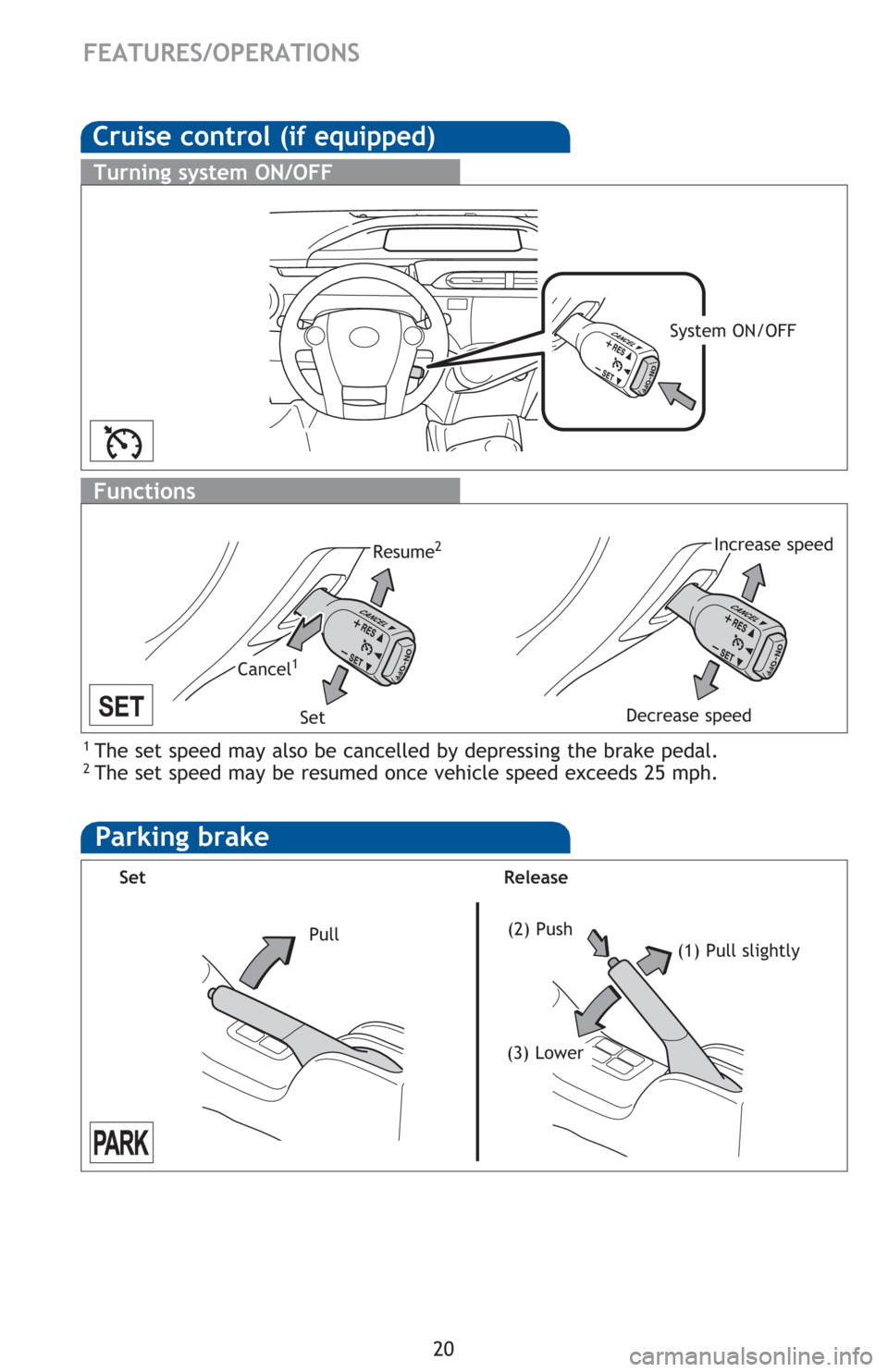
Cruise control (if equipped)
1 The set speed may also be cancelled by depressing the brake pedal.2 The set speed may be resumed once vehicle speed exceeds 25 mph.
Turning system ON/OFF
Functions
System ON/OFF
Increase speed
Decrease speed
Cancel1
Resume2
Set
FEATURES/OPERATIONS
Parking brake
Set Release
Pull(2) Push(1) Pull slightly
(3) Lower
Page 25 of 48
OVERVIEW FEATURES/OPERATIONS TOYOTA SAFETY SENSE SAFETY AND EMERGENCY FEATURES
23
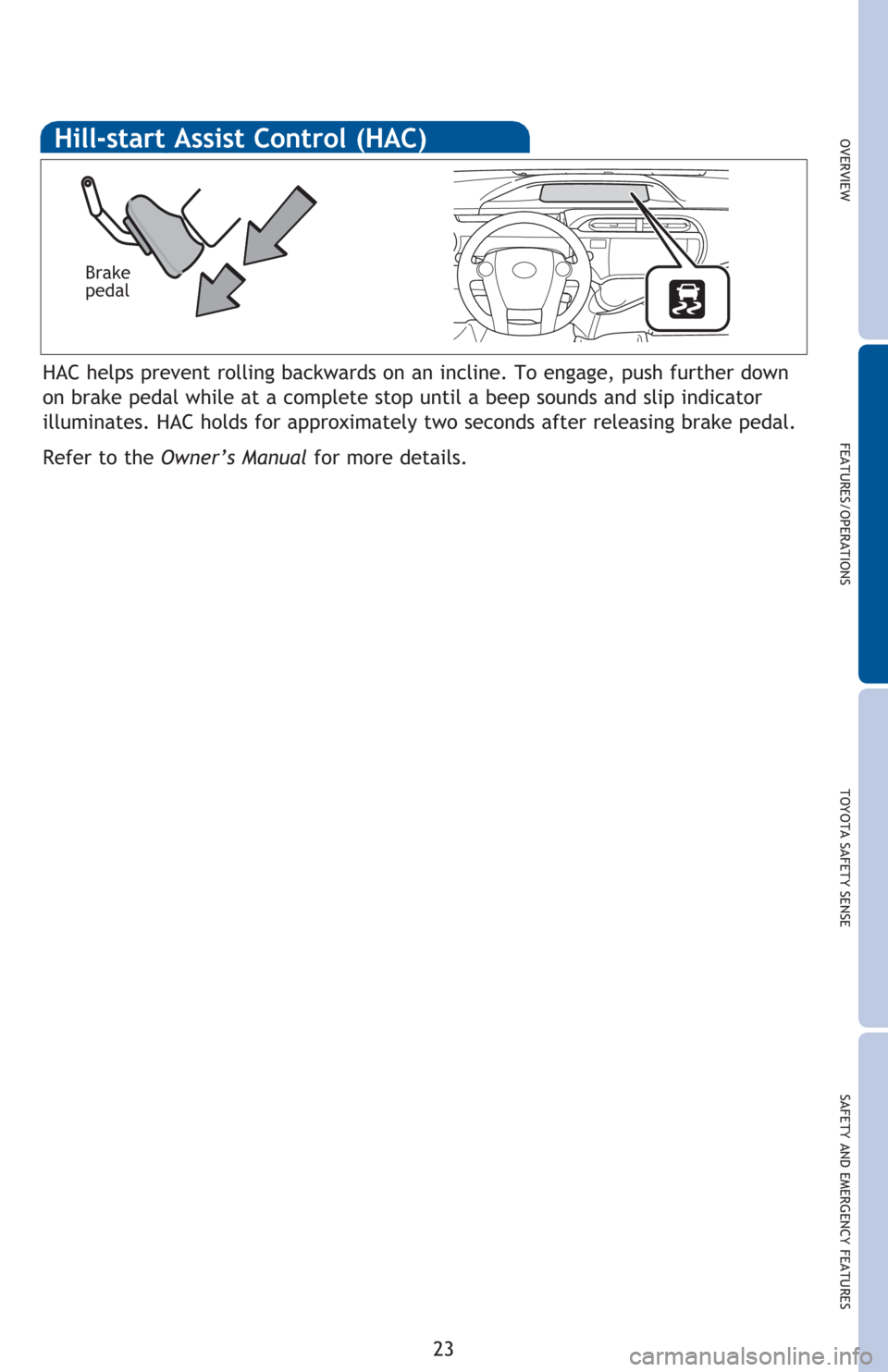
HAC helps prevent rolling backwards on an incline. To engage, push further down
on brake pedal while at a complete stop until a beep sounds and slip indicator
illuminates. HAC holds for approximately two seconds after releasing brake pedal.
Refer to the Owner’s Manual for more details.
Brake
pedal
Hill-start Assist Control (HAC)
Page 27 of 48
25
OVERVIEW FEATURES/OPERATIONS TOYOTA SAFETY SENSE SAFETY AND EMERGENCY FEATURES
Pre-Collision System (PCS)
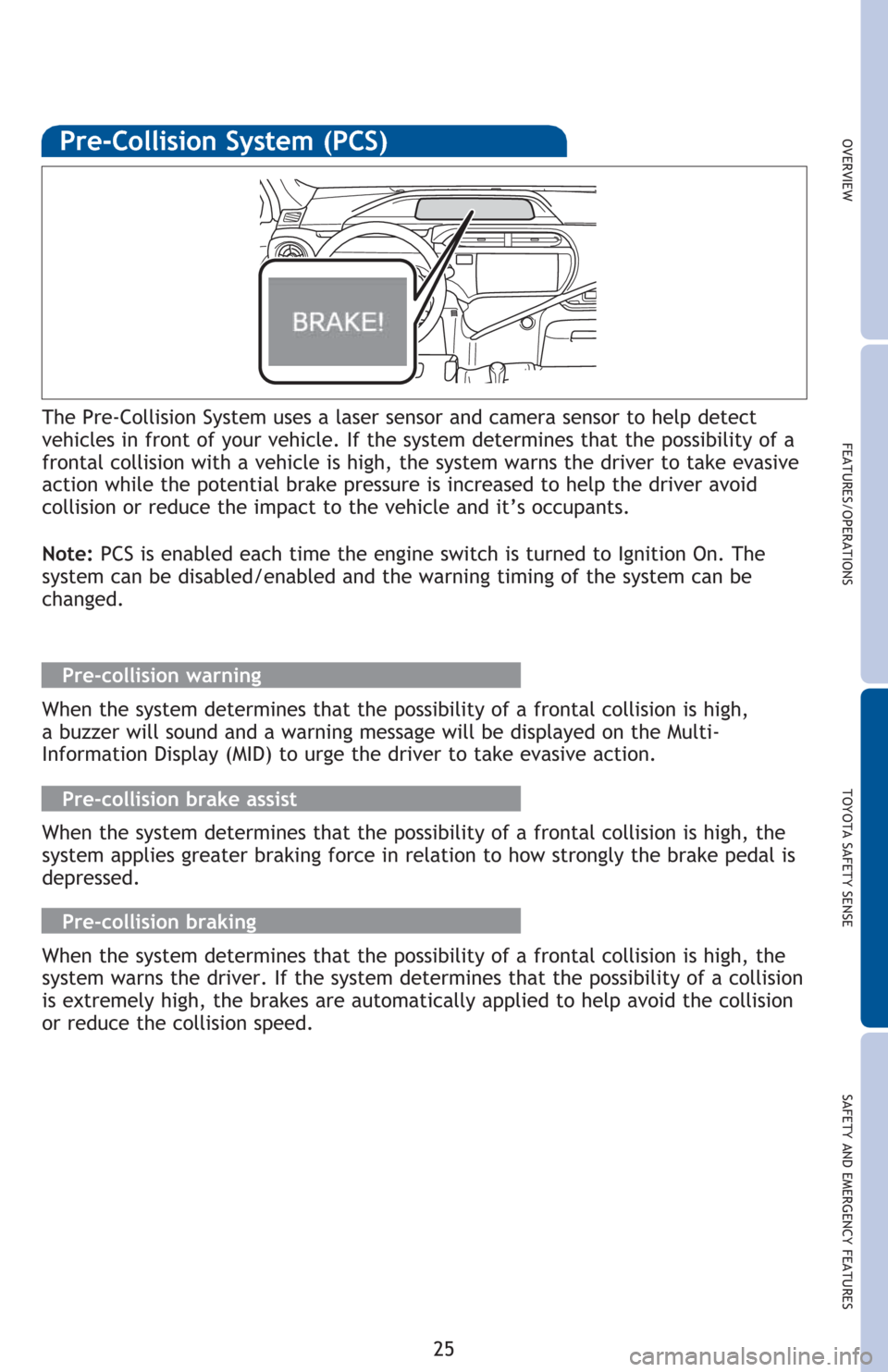
The Pre-Collision System uses a laser sensor and camera sensor to help detect
vehicles in front of your vehicle. If the system determines that the possibility of a
frontal collision with a vehicle is high, the system warns the driver to take evasive
action while the potential brake pressure is increased to help the driver avoid
collision or reduce the impact to the vehicle and it’s occupants.
Note: PCS is enabled each time the engine switch is turned to Ignition On. The
system can be disabled/enabled and the warning timing of the system can be
changed.
Pre-collision warning
When the system determines that the possibility of a frontal collision is high,
a buzzer will sound and a warning message will be displayed on the Multi-
Information Display (MID) to urge the driver to take evasive action.
Pre-collision brake assist
When the system determines that the possibility of a frontal collision is high, the
system applies greater braking force in relation to how strongly the brake pedal is
depressed.
Pre-collision braking
When the system determines that the possibility of a frontal collision is high, the
system warns the driver. If the system determines that the possibility of a collision
is extremely high, the brakes are automatically applied to help avoid the collision
or reduce the collision speed.
Page 35 of 48
OVERVIEW FEATURES/OPERATIONS TOYOTA SAFETY SENSE SAFETY AND EMERGENCY FEATURES
33
Star Safety SystemTM
VSC helps prevent loss of traction during cornering by reducing Hybrid System
output and applying brake force to selected wheels.
Toyota’s VSC monitors steering angle and the direction your vehicle is traveling.
When it senses that the front or rear wheels begin to lose traction, VSC reduces
Hybrid System output and applies braking to selected wheels. This helps restore
traction and vehicle control.
Vehicle Stability Control (VSC)
Anti-Lock Brake System (ABS)
ABS helps prevent brakes from locking up by “pulsing” brake pressure to each
wheel. This limits brake lockup and helps provide directional control for the
current road conditions.
Toyota’s ABS sensors detect which wheels are locking up and limits wheel lockup
by “pulsing” each wheel’s brakes independently. Pulsing releases brake pressure
repeatedly for fractions of a second. This helps the tires attain the traction that
current road conditions will allow, helping you to stay in directional control.
Brake Assist (BA)
Brake Assist is designed to detect sudden or “panic” braking, and then add braking
pressure to help decrease the vehicle’s stopping distance. When there’s only a
split second to react, Brake Assist can add additional brake pressure more quickly
than just the driver alone can. VSC helps prevent loss of traction during cornering by reducing Hybrid System
output, and Traction Control helps maintain traction on loose gravel and wet, icy,
or uneven surfaces by applying brake force to the spinning wheel(s).
Toyota’s TRAC sensors are activated when one of the drive wheels starts to slip.
TRAC limits Hybrid System output and applies the brakes to the spinning wheel.
This transfers power to the wheels that still have traction to help keep you on
track.
Traction Control (TRAC)
Electronic Brake Force Distribution (EBD)
Toyota’s ABS technology has Electronic Brake-force Distribution (EBD) to help
maintain control and balance when braking. Abrupt stops can cause a vehicle
to tilt forward, reducing the braking power of the rear wheels. EBD responds to
sudden stops by redistributing brake force to enhance the braking effectiveness of
all four wheels. All new Toyota vehicles come standard with the Star Safety System
TM, which
combines Vehicle Stability Control (VSC), Traction Control (TRAC), Anti-lock
Braking System (ABS), Electronic Brake-force Distribution (EBD), Brake Assist (BA)
and Smart Stop Technology (SST).