air condition TOYOTA PRIUS C 2017 NHP10 / 1.G Owners Manual
[x] Cancel search | Manufacturer: TOYOTA, Model Year: 2017, Model line: PRIUS C, Model: TOYOTA PRIUS C 2017 NHP10 / 1.GPages: 596, PDF Size: 10.05 MB
Page 5 of 596

5
1
9 8 6 5
4
3
2
PRIUS c_U (OM52J11U)
10
7
5-9. Bluetooth® Audio
(Multimedia system)
Listening to Bluetooth
®
Audio ............................... 329
5-10. Bluetooth
® phone
(Multimedia system)
Using a Bluetooth
®
Phone.............................. 331
Making a call ..................... 334
Receiving a call ................. 337
Speaking on the phone ..... 338
Bluetooth
® phone
message function ............ 342
Using the steering wheel switches ................ 347
Bluetooth
® phone
settings............................ 348
Contact/Call History Settings ........................... 350
What to do if... (Troubleshooting) ............ 360
5-11. Bluetooth
®
(Multimedia system)
Bluetooth
®......................... 364
5-12. Using the voice command system
(Multimedia system)
Voice command system............................. 369 6-1. Using the air
conditioning system
and defogger
Automatic air conditioning system ......... 374
Seat heaters ...................... 382
6-2. Using the interior lights Interior lights list................. 383
• Interior lights.................. 384
• Personal lights............... 384
6-3. Using the storage features
List of storage features ...... 386
• Glove box ...................... 387
• Console box .................. 387
• Auxiliary boxes .............. 388
• Cup holders ................... 389
• Bottle holders ................ 390
6-4. Other interior features Other interior features........ 391
• Sun visors ..................... 391
• Vanity mirrors ................ 391
• Outside temperature display ........................... 391
• Power outlet .................. 393
• Coat hooks .................... 394
• Assist grips .................... 395
• Luggage cover .............. 396
6Interior features
Page 6 of 596

TABLE OF CONTENTS6
PRIUS c_U (OM52J11U)7-1. Maintenance and care
Cleaning and protecting the vehicle exterior .......... 400
Cleaning and protecting the vehicle interior ........... 403
7-2. Maintenance Maintenance requirements ................... 406
General maintenance ........ 409
Emission inspection and maintenance
(I/M) programs ................ 412
7-3. Do-it-yourself maintenance
Do-it-yourself service precautions ..................... 413
Hood.................................. 416
Positioning a floor jack ...... 418
Engine compartment ......... 419
12-volt battery ................... 428
Tires .................................. 432
Tire inflation pressure........ 441
Wheels .............................. 444
Air conditioning filter .......... 446
Wireless remote control/ electronic key battery ...... 448
Checking and replacing fuses ............................... 451
Light bulbs ......................... 455 8-1. Essential information
Emergency flashers ........... 466
If your vehicle has to be stopped in an
emergency....................... 467
8-2. Steps to take in an emergency
If your vehicle needs to be towed ...................... 469
If you think something is wrong ........................... 476
If a warning light turns on or a warning buzzer
sounds ............................. 477
If a warning message is displayed...................... 486
If you have a flat tire .......... 501
If the hybrid system will not start ..................... 514
If the electronic key does not operate
properly ........................... 516
If the vehicle 12-volt battery is discharged ....... 518
If your vehicle overheats......................... 524
If the vehicle becomes stuck ................................ 528
7Maintenance and care8When trouble arises
Page 19 of 596

19Pictorial index
PRIUS c_U (OM52J11U)Turn signal lever . . . . . . . . . . . . . . . . . . . . . . . . . . . . . . . . . . P. 202
Headlight switch . . . . . . . . . . . . . . . . . . . . . . . . . . . . . . . . . . P. 204
Headlights/front parking lights/tail lights/
daytime running lights . . . . . . . . . . . . . . . . . . . . . . . . . . . . . . . P. 204
Front fog lights
*1 . . . . . . . . . . . . . . . . . . . . . . . . . . . . . . . . . . . P. 208
Windshield wiper and washer switch . . . . . . . . . . . . . . . . . P. 210
Usage . . . . . . . . . . . . . . . . . . . . . . . . . . . . . . . . . . . . . . . . . . . P. 210
Adding washer fluid . . . . . . . . . . . . . . . . . . . . . . . . . . . . . . . . . P. 427
Emergency flasher switch . . . . . . . . . . . . . . . . . . . . . . . . . . P. 466
Fuel filler door opener . . . . . . . . . . . . . . . . . . . . . . . . . . . . . . P. 217
Hood lock release lever. . . . . . . . . . . . . . . . . . . . . . . . . . . . . P. 416
Tilt and telescopic steering lock release lever . . . . . . . . . . P. 155
Air conditioning system . . . . . . . . . . . . . . . . . . . . . . . . . . . . P. 374
Usage . . . . . . . . . . . . . . . . . . . . . . . . . . . . . . . . . . . . . . . . . . . P. 374
Rear window defogger . . . . . . . . . . . . . . . . . . . . . . . . . . . . . . . P. 376
Multimedia system
*1. . . . . . . . . . . . . . . . . . . . . . . . . . . . . . . P. 281
Navigation system
*1, 2
Power outlet . . . . . . . . . . . . . . . . . . . . . . . . . . . . . . . . . . . . . . P. 393
*1: If equipped
*2: Refer to “NAVIGATION SYSTEM OWNER’S MANUAL”.
4
5
6
7
8
9
10
11
12
Page 47 of 596

471-1. For safe use
1
For safety and security
PRIUS c_U (OM52J11U)
■If the SRS airbags deploy (inflate)
●Slight abrasions, burns, bruising etc., may be sustained from SRS airbags,
due to the extremely high speed deployment (inflation) by hot gases.
● A loud noise and white powder will be emitted.
● Parts of the airbag module (steering wheel hub, airbag cover and inflat\
or) as
well as the front seats, parts of the front and rear pillars, and roof side rails,
may be hot for several minutes. The airbag itself may also be hot.
● The windshield may crack.
■ SRS airbag deployment conditions (SRS front airbags)
●The SRS front airbags will deploy in the event of an impact that exceeds the
set threshold level (the level of force corresponding to an approximately 12 -
18 mph [20 - 30 km/h] frontal collision with a fixed wall that does not move or
deform).
However, this threshold velocity will be considerably higher in the following
situations:
• If the vehicle strikes an object, such as a parked vehicle or sign pole,
which can move or deform on impact
• If the vehicle is involved in an underride collision, such as a collision in
which the front of the vehicle “underrides”, or goes under, the bed of a
truck
● Depending on the type of collision, it is possible that only the seat belt pre-
tensioners will activate.
● The SRS front airbags for the front passenger will not activate if there is no
passenger sitting in the front passenger seat. However, the SRS front air-
bags for the front passenger may deploy if luggage is put in the seat, even if
the seat is unoccupied.
Page 48 of 596
481-1. For safe use
PRIUS c_U (OM52J11U)■
SRS airbag deployment conditions (S RS side and curtain shield airbags)
● The SRS side and curtain shield airbags will deploy in the event of an
impact that exceeds the set threshold level (the level of force corresponding
to the impact force produced by an approximately 3300 lb. [1500 kg] vehi\
cle
colliding with the vehicle cabin from a direction perpendicular to the vehicle
orientation at an approximate speed of 12 - 18 mph [20 - 30 km/h]).
● The SRS curtain shield airbags will deploy in the event of a severe frontal
collision.
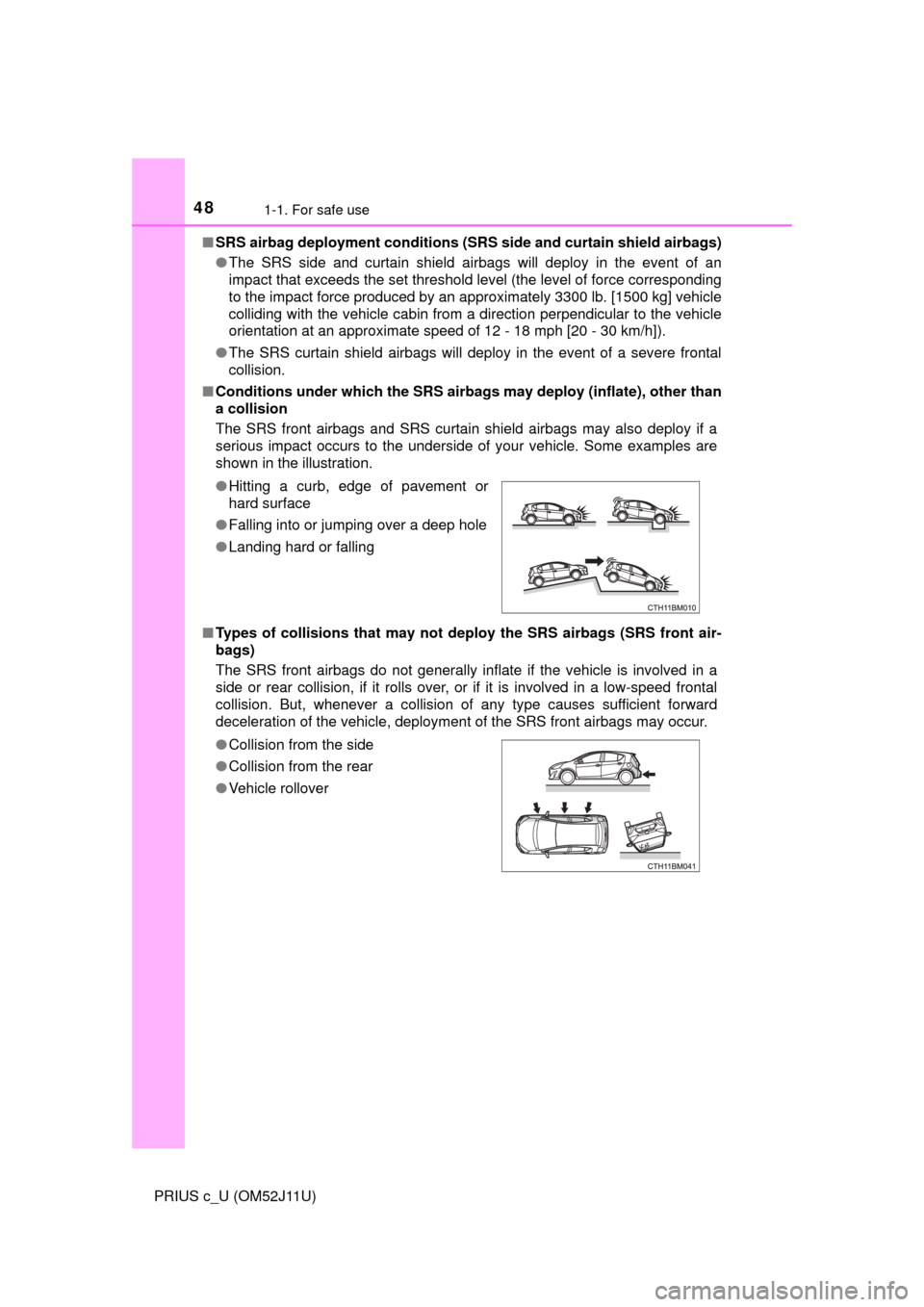
■ Conditions under which the SRS airbags may deploy (inflate), other than
a collision
The SRS front airbags and SRS curtain shield airbags may also deploy if a
serious impact occurs to the underside of your vehicle. Some examples are
shown in the illustration.
■ Types of collisions that may not de ploy the SRS airbags (SRS front air-
bags)
The SRS front airbags do not generally inflate if the vehicle is involved in a
side or rear collision, if it rolls over, or if it is involved in a low-speed frontal
collision. But, whenever a collision of any type causes sufficient forward
deceleration of the vehicle, deployment of the SRS front airbags may occur. ● Hitting a curb, edge of pavement or
hard surface
● Falling into or jumping over a deep hole
● Landing hard or falling
●Collision from the side
● Collision from the rear
● Vehicle rollover
Page 52 of 596
521-1. For safe use
PRIUS c_U (OM52J11U)
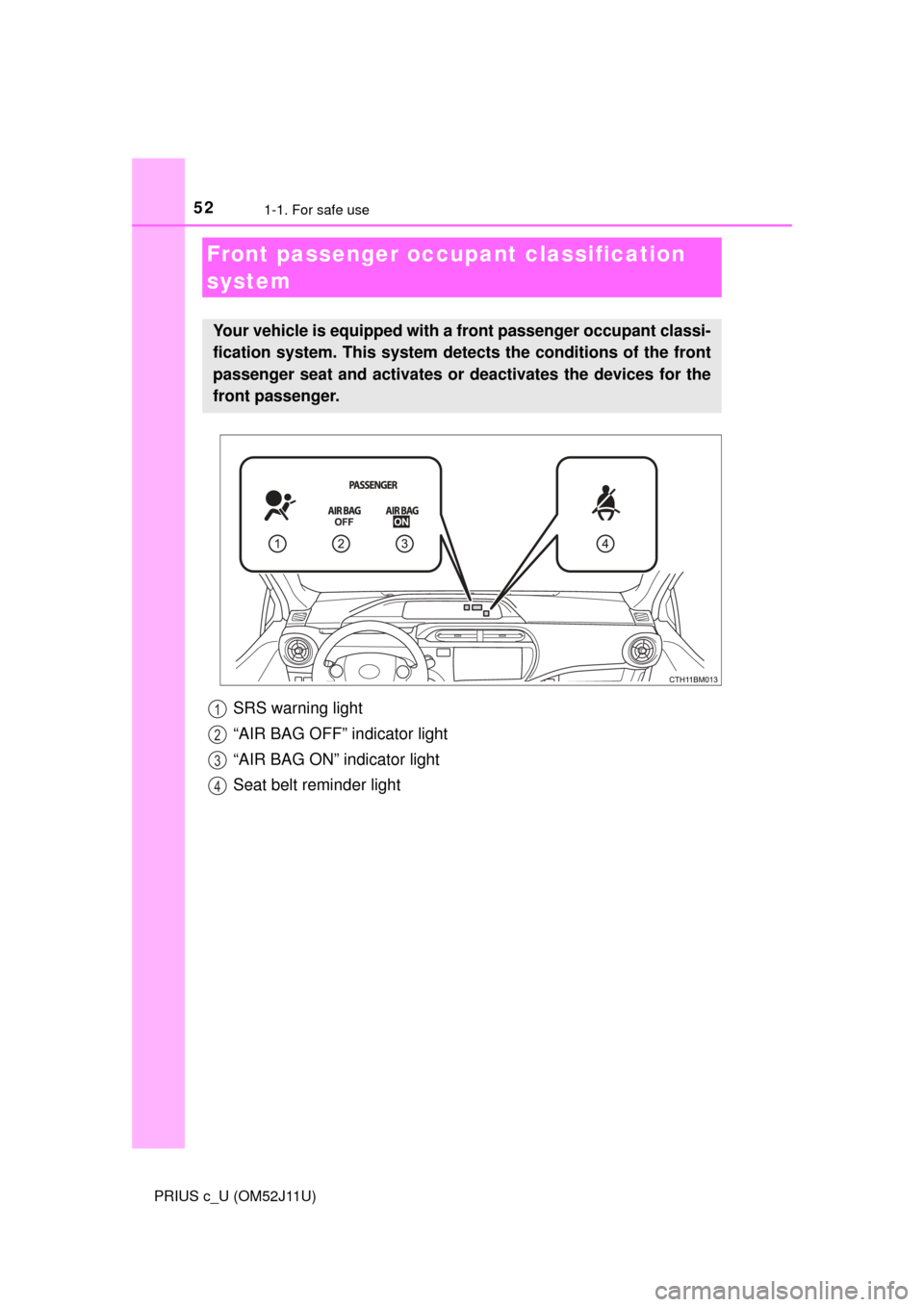
SRS warning light
“AIR BAG OFF” indicator light
“AIR BAG ON” indicator light
Seat belt reminder light
Front passenger occupant classification
system
Your vehicle is equipped with a front passenger occupant classi-
fication system. This system detects the conditions of the front
passenger seat and activates or deactivates the devices for the
front passenger.
1
2
3
4
Page 53 of 596
531-1. For safe use
1
For safety and security
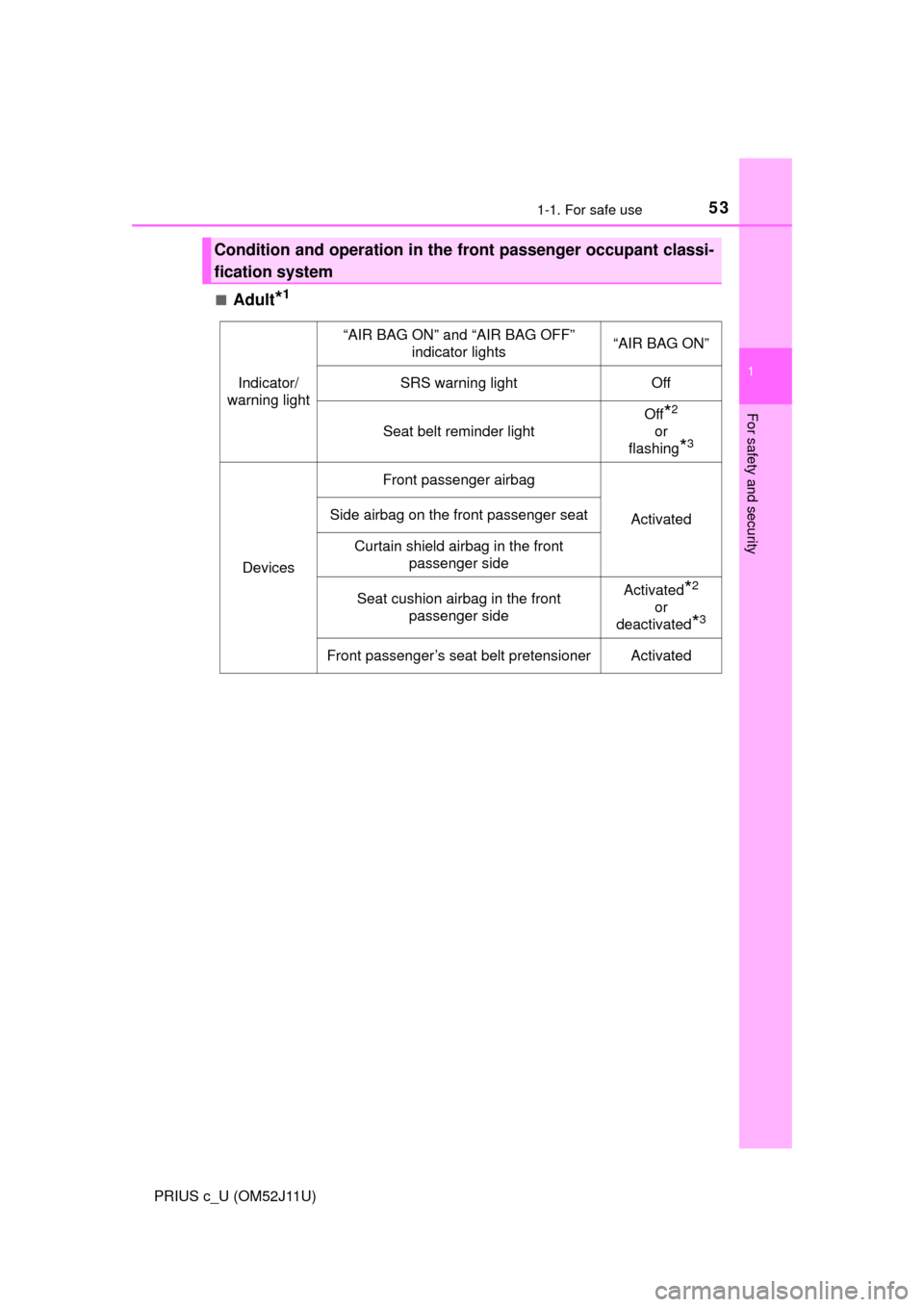
PRIUS c_U (OM52J11U)■
Adult*1
Condition and operation in the fr
ont passenger occupant classi-
fication system
Indicator/
warning light
“AIR BAG ON” and “AIR BAG OFF” indicator lights“AIR BAG ON”
SRS warning lightOff
Seat belt reminder light
Off*2
or
flashing
*3
Devices
Front passenger airbag
ActivatedSide airbag on the front passenger seat
Curtain shield airbag in the front passenger side
Seat cushion airbag in the front passenger sideActivated*2
or
deactivated
*3
Front passenger’s seat belt pretensionerActivated
Page 78 of 596
781-2. Hybrid system
PRIUS c_U (OM52J11U)
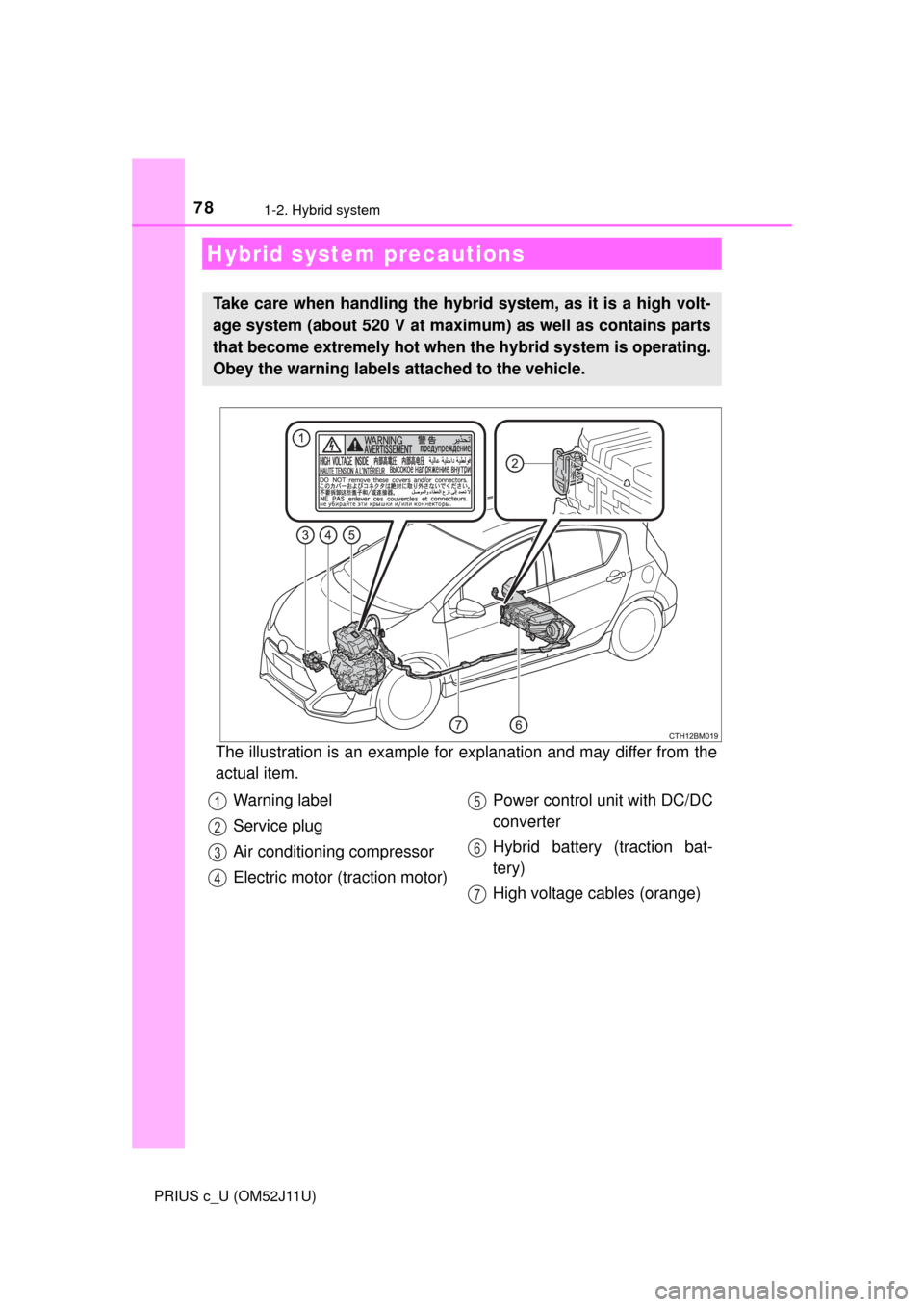
The illustration is an example for explanation and may differ from the
actual item.
Hybrid system precautions
Take care when handling the hybrid system, as it is a high volt-
age system (about 520 V at maximum) as well as contains parts
that become extremely hot when the hybrid system is operating.
Obey the warning labels attached to the vehicle.
Warning label
Service plug
Air conditioning compressor
Electric motor (traction motor) Power control unit with DC/DC
converter
Hybrid battery (traction bat-
tery)
High voltage cables (orange)1
2
3
4
5
6
7
Page 133 of 596
1333-2. Opening, closing and locking the doors
3
Operation of each component
PRIUS c_U (OM52J11U)
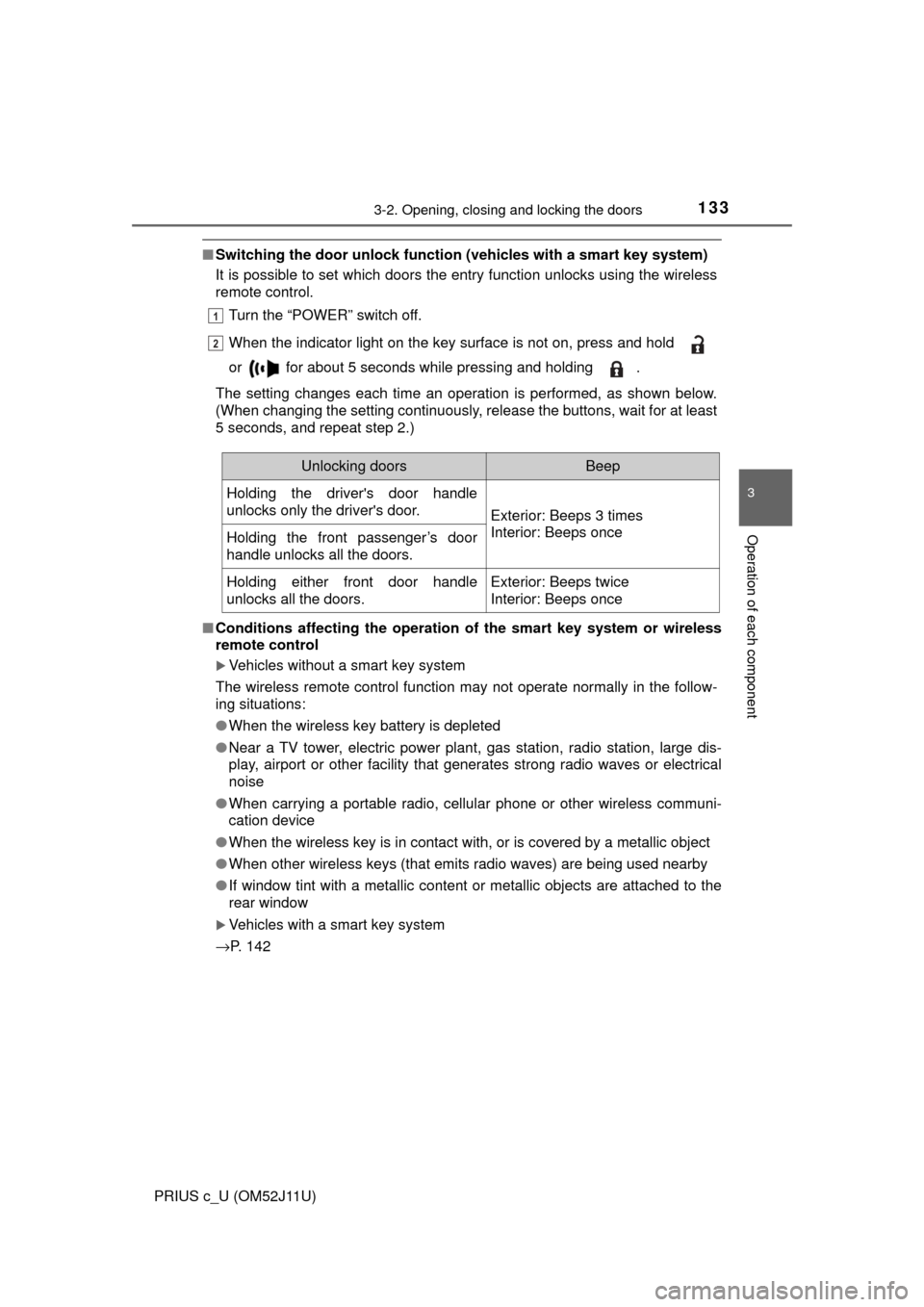
■Switching the door unlock functi on (vehicles with a smart key system)
It is possible to set which doors the entry function unlocks using the wireless
remote control.
Turn the “POWER” switch off.
When the indicator light on the key surface is not on, press and hold
or for about 5 seconds while pressing and holding .
The setting changes each time an operation is performed, as shown below.
(When changing the setting continuously, release the buttons, wait for at least
5 seconds, and repeat step 2.)
■ Conditions affecting the operation of the smart key system or wireless
remote control
Vehicles without a smart key system
The wireless remote control function may not operate normally in the follow-
ing situations:
● When the wireless key battery is depleted
● Near a TV tower, electric power plant, gas station, radio station, large dis-
play, airport or other facility that generates strong radio waves or electrical
noise
● When carrying a portable radio, cellul ar phone or other wireless communi-
cation device
● When the wireless key is in contact with, or is covered by a metallic object
● When other wireless keys (that emits radio waves) are being used nearby
● If window tint with a metallic content or metallic objects are attached to the
rear window
Vehicles with a smart key system
→P. 142
1
2
Unlocking doorsBeep
Holding the driver's door handle
unlocks only the driver's door.
Exterior: Beeps 3 times
Interior: Beeps once
Holding the front passenger’s door
handle unlocks all the doors.
Holding either front door handle
unlocks all the doors.Exterior: Beeps twice
Interior: Beeps once
Page 142 of 596

1423-2. Opening, closing and locking the doors
PRIUS c_U (OM52J11U)■
Conditions affecting operation
The smart key system uses weak radio waves. In the following situations, the
communication between the electronic key and the vehicle may be affected,
preventing the smart key system, wireless remote control and immobilizer
system from operating properly.
(Ways of coping: →P. 516)
● When the electronic key battery is depleted
● Near a TV tower, electric power plant, gas station, radio station, large dis-
play, airport or other facility that generates strong radio waves or electrical
noise
● When the electronic key is in contact with, or is covered by the following
metallic objects
• Cards to which aluminum foil is attached
• Cigarette boxes that have aluminum foil inside
• Metallic wallets or bags
• Coins
• Hand warmers made of metal
• Media such as CDs and DVDs
● When other wireless keys (that emit radio waves) are being used nearby
● When carrying the electronic key together with the following devices that
emit radio waves
• A portable radio, cellular phone, cordless phone or other wireless com-
munication device
• Another vehicle’s electronic key or a wireless key that emits radio waves
• Personal computers or personal digital assistants (PDAs)
• Digital audio players
• Portable game systems
● If window tint with a metallic content or metallic objects are attached to the
rear window
● When the electronic key is placed near a battery charger or electronic
devices