tire pressure TOYOTA PRIUS C 2018 Owners Manual (in English)
[x] Cancel search | Manufacturer: TOYOTA, Model Year: 2018, Model line: PRIUS C, Model: TOYOTA PRIUS C 2018Pages: 600, PDF Size: 10.14 MB
Page 6 of 600

TABLE OF CONTENTS6
PRIUS c_U (OM52G95U)7-1. Maintenance and care
Cleaning and protecting the vehicle exterior .......... 402
Cleaning and protecting the vehicle interior ........... 405
7-2. Maintenance Maintenance requirements ................... 411
General maintenance ........ 414
Emission inspection and maintenance (I/M)
programs ......................... 417
7-3. Do-it-yourself maintenance
Do-it-yourself service precautions ..................... 418
Hood.................................. 421
Positioning a floor jack ...... 423
Engine compartment ......... 424
12-volt battery ................... 433
Tires .................................. 437
Tire inflation pressure........ 446
Wheels .............................. 449
Air conditioning filter .......... 451
Wireless remote control/ electronic key battery ...... 453
Checking and replacing fuses ............................... 456
Light bulbs ......................... 460 8-1. Essential information
Emergency flashers ........... 470
If your vehicle has to be stopped in an
emergency....................... 471
8-2. Steps to take in an emergency
If your vehicle needs to be towed ...................... 473
If you think something is wrong............................... 480
If a warning light turns on or a warning buzzer
sounds ............................. 481
If a warning message is displayed ......................... 490
If you have a flat tire .......... 507
If the hybrid system will not start ........................... 520
If the electronic key does not operate properly ........ 522
If the vehicle 12-volt battery is discharged ....... 524
If your vehicle overheats......................... 531
If the vehicle becomes stuck ................................ 535
7Maintenance and care8When trouble arises
Page 17 of 600
17Pictorial index
PRIUS c_U (OM52G95U)Windshield wipers . . . . . . . . . . . . . . . . . . . . . . . . . . . . . . . . . P. 212
Precautions against winter season . . . . . . . . . . . . . . . . . . . . . P. 275
Fuel filler door . . . . . . . . . . . . . . . . . . . . . . . . . . . . . . . . . . . . P. 219
Refueling method . . . . . . . . . . . . . . . . . . . . . . . . . . . . . . . . . . . P. 219
Fuel type/fuel tank capacity . . . . . . . . . . . . . . . . . . . . . . . . . . . P. 540
Tires . . . . . . . . . . . . . . . . . . . . . . . . . . . . . . . . . . . . . . . . . . P. 437
Tire size/inflation pressure . . . . . . . . . . . . . . . . . . . . . . . . . P. 545
Winter tires/tire chain . . . . . . . . . . . . . . . . . . . . . . . . . . . . . P. 275
Checking/rotation/tire pressure warning system . . . . . . . . . P. 437
Coping with flat tires . . . . . . . . . . . . . . . . . . . . . . . . . . . . . . P. 507
Hood . . . . . . . . . . . . . . . . . . . . . . . . . . . . . . . . . . . . . . . . . . . . P. 421
Opening . . . . . . . . . . . . . . . . . . . . . . . . . . . . . . . . . . . . . . . . . . P. 421
Engine oil . . . . . . . . . . . . . . . . . . . . . . . . . . . . . . . . . . . . . . . . . P. 541
Coping with overheat . . . . . . . . . . . . . . . . . . . . . . . . . . . . . . . . P. 531
Headlights/daytime running lights . . . . . . . . . . . . . . . . . . . . P. 206
Parking lights/front turn signal lights . . . . . . . . . . . . . P. 204, 206
Side turn signal lights . . . . . . . . . . . . . . . . . . . . . . . . . . . . . . P. 204
Front fog lights
*. . . . . . . . . . . . . . . . . . . . . . . . . . . . . . . . . . . P. 210
Front side marker lights . . . . . . . . . . . . . . . . . . . . . . . . . . . . P. 206
Stop lights/tail lights/rear side marker lights/
rear turn signal lights . . . . . . . . . . . . . . . . . . . . . . . . . . P. 204, 206
Back-up lights
Shifting the shift lever to R . . . . . . . . . . . . . . . . . . . . . . . . . . . . P. 200
License plate lights . . . . . . . . . . . . . . . . . . . . . . . . . . . . . . . . P. 206
4
5
6
7
Light bulbs of the exterior lights for driving
(Replacing method: P. 460, Watts: P. 546)
*: If equipped
8
9
10
11
12
13
14
15
Page 20 of 600
20Pictorial index
PRIUS c_U (OM52G95U)
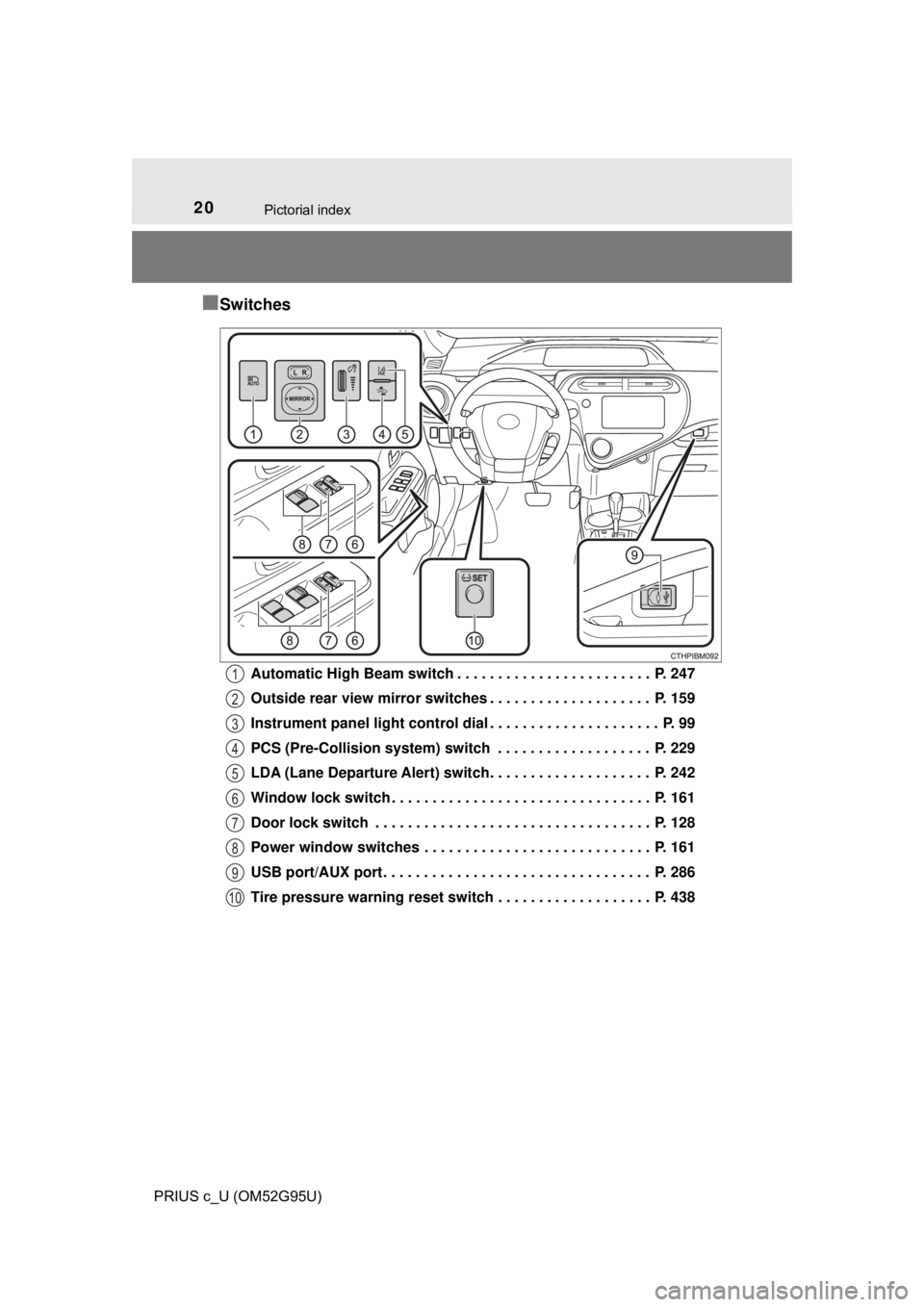
■Switches
Automatic High Beam switch . . . . . . . . . . . . . . . . . . . . . . . . P. 247
Outside rear view mirror switches . . . . . . . . . . . . . . . . . . . . P. 159
Instrument panel light control dial . . . . . . . . . . . . . . . . . . . . . P. 99
PCS (Pre-Collision system) switch . . . . . . . . . . . . . . . . . . . P. 229
LDA (Lane Departure Alert) switch. . . . . . . . . . . . . . . . . . . . P. 242
Window lock switch . . . . . . . . . . . . . . . . . . . . . . . . . . . . . . . . P. 161
Door lock switch . . . . . . . . . . . . . . . . . . . . . . . . . . . . . . . . . . P. 128
Power window switches . . . . . . . . . . . . . . . . . . . . . . . . . . . . P. 161
USB port/AUX port . . . . . . . . . . . . . . . . . . . . . . . . . . . . . . . . . P. 286
Tire pressure warning reset switch . . . . . . . . . . . . . . . . . . . P. 4381
2
3
4
5
6
7
8
9
10
Page 93 of 600
932. Instrument cluster
2
Instrument cluster
PRIUS c_U (OM52G95U)
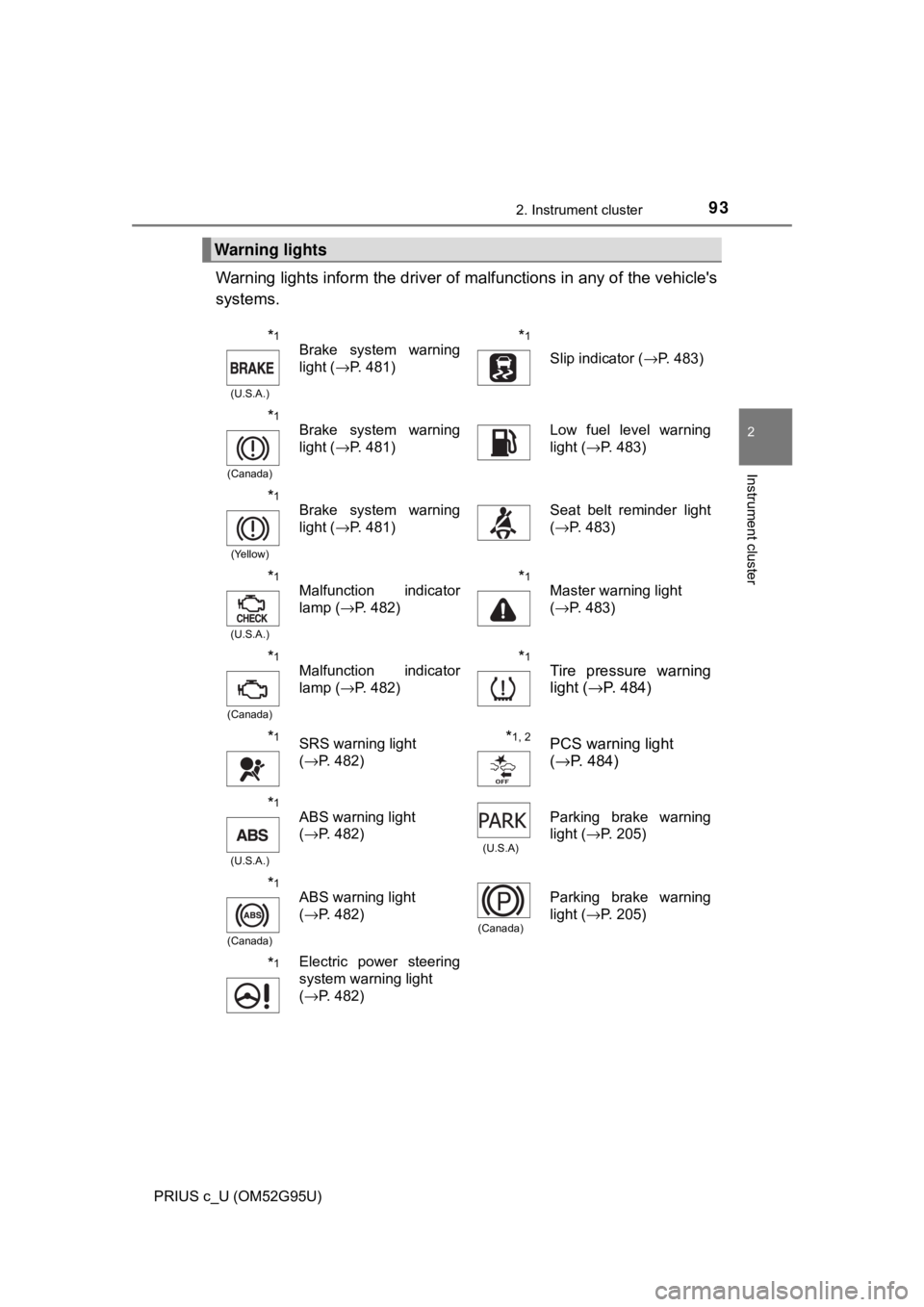
Warning lights inform the driver of malfunctions in any of the vehicle's
systems.
Warning lights
*1
(U.S.A.)
Brake system warning
light ( →P. 481)*1
Slip indicator ( →P. 483)
*1
(Canada)
Brake system warning
light (→P. 481)Low fuel level warning
light (→P. 483)
*1
(Yellow)
Brake system warning
light (→P. 481)Seat belt reminder light
(→P. 483)
*1
(U.S.A.)
Malfunction indicator
lamp ( →P. 482)*1Master warning light
(→P. 483)
*1
(Canada)
Malfunction indicator
lamp ( →P. 482)*1Tire pressure warning
light (→P. 484)
*1SRS warning light
(→P. 482)*1, 2PCS warning light
(→ P. 484)
*1
(U.S.A.)
ABS warning light
(→P. 482)
(U.S.A)
Parking brake warning
light ( →P. 205)
*1
(Canada)
ABS warning light
(→P. 482)
(Canada)
Parking brake warning
light ( →P. 205)
*1Electric power steering
system warning light
(→P. 482)
Page 240 of 600
2404-5. Toyota Safety Sense C
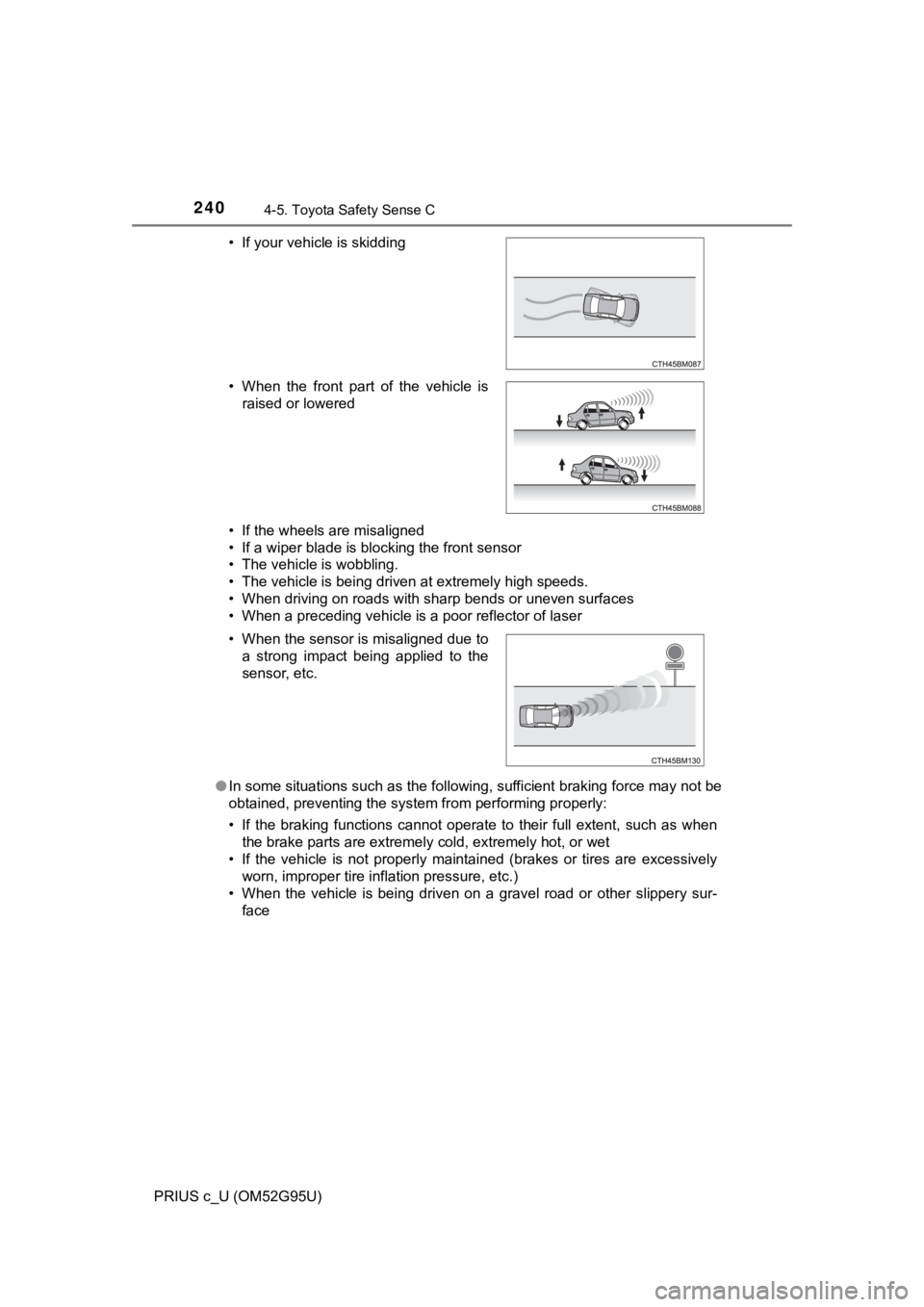
PRIUS c_U (OM52G95U)• If the wheels are misaligned
• If a wiper blade is blocking the front sensor
• The vehicle is wobbling.
• The vehicle is being driven at extremely high speeds.
• When driving on roads with sharp bends or uneven surfaces
• When a preceding vehicle is a poor reflector of laser
● In some situations such as the following, sufficient braking force may not be
obtained, preventing the system from performing properly:
• If the braking functions cannot operate to their full extent, such as when
the brake parts are extremely cold, extremely hot, or wet
• If the vehicle is not properly maintained (brakes or tires are excessively worn, improper tire inflation pressure, etc.)
• When the vehicle is being driven on a gravel road or other slippery sur- face
• If your vehicle is skidding
• When the front part of the vehicle is
raised or lowered
• When the sensor is misaligned due to a strong impact being applied to the
sensor, etc.
Page 246 of 600

2464-5. Toyota Safety Sense C
PRIUS c_U (OM52G95U)■
Conditions in which functions may not operate properly
In the following situations, the front sensor may not detect white (yellow) lines
and various functions may not operate normally.
●There are shadows on the road that run parallel with, or cover, the white
(yellow) lines.
● The vehicle is driven in an area without white (yellow) lines, such as in front
of a tollgate or checkpoint, or at an intersection, etc.
● The white (yellow) lines are cracked, “Botts’ dots”, “Raised pavement
marker” or stones are present.
● The white (yellow) lines cannot be seen or are difficult to see due to sand,
etc.
● The vehicle is driven on a road surface that is wet due to rain, puddles, etc.
● The traffic lines are yellow (which may be more difficult to recognize than
lines that are white).
● The white (yellow) lines cross over a curb, etc.
● The vehicle is driven on a bright surface, such as concrete.
● The vehicle is driven on a surface that is bright due to reflected light, etc.
● The vehicle is driven in an area where the brightness changes suddenly,
such as at the entrances and exits of tunnels, etc.
● Light from the headlights of an oncoming vehicle, the sun, etc., enters the
camera.
● The vehicle is driven where the road diverges, merges, etc.
● The vehicle is driven on a slope.
● The vehicle is driven on a road which tilts left or right, or a winding road.
● The vehicle is driven on an unpaved or rough road.
● The vehicle is driven around a sharp curve.
● The traffic lane is excessively narrow or wide.
● The vehicle is extremely tilted due to carrying heavy luggage or having
improper tire pressure.
● The distance to the preceding vehicle is extremely short.
● The vehicle is moving up and down a large amount due to road conditions
during driving (poor roads or road seams).
● The headlight lenses are dirty and emit a faint amount of light at night, or the
beam axis has deviated.
● The vehicle has just changed lanes or crossed an intersection.
■ Warning messages
Warning messages are used to indicate a system malfunction or to inform t\
he
driver of the need for caution while driving. ( →P. 490)
■ Customization
→P. 106
Page 263 of 600
2634-6. Using the driving support systems
4
Driving
PRIUS c_U (OM52G95U)■
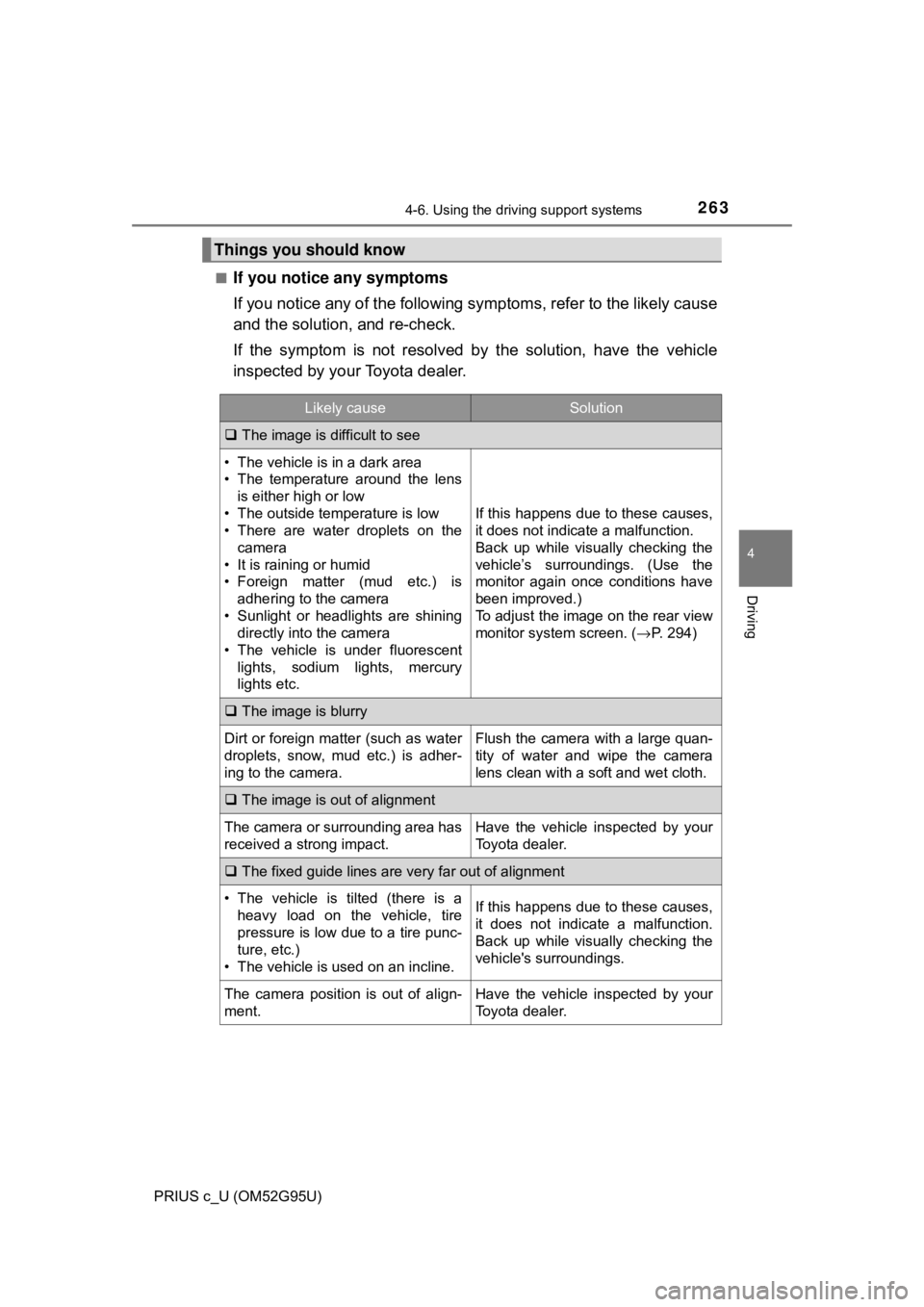
If you notice any symptoms
If you notice any of the following symptoms, refer to the likely cause
and the solution, and re-check.
If the symptom is not resolved by
the solution, have the vehicle
inspected by your Toyota dealer.
Things you should know
Likely causeSolution
The image is difficult to see
• The vehicle is in a dark area
• The temperature around the lens
is either high or low
• The outside temperature is low
• There are water droplets on the camera
• It is raining or humid
• Foreign matter (mud etc.) is adhering to the camera
• Sunlight or headlights are shining directly into the camera
• The vehicle is under fluorescent
lights, sodium lights, mercury
lights etc.
If this happens due to these causes,
it does not indicate a malfunction.
Back up while visually checking the
vehicle’s surroundings. (Use the
monitor again once conditions have
been improved.)
To adjust the image on the rear view
monitor system screen. ( →P. 294)
The image is blurry
Dirt or foreign matter (such as water
droplets, snow, mud etc.) is adher-
ing to the camera.Flush the camera with a large quan-
tity of water and wipe the camera
lens clean with a soft and wet cloth.
The image is out of alignment
The camera or surrounding area has
received a strong impact.Have the vehicle inspected by your
Toyota dealer.
The fixed guide lines are very far out of alignment
• The vehicle is tilted (there is a
heavy load on the vehicle, tire
pressure is low due to a tire punc-
ture, etc.)
• The vehicle is used on an incline.If this happens due to these causes,
it does not indicate a malfunction.
Back up while visually checking the
vehicle's surroundings.
The camera position is out of align-
ment.Have the vehicle inspected by your
Toyota dealer.
Page 271 of 600

2714-6. Using the driving support systems
4
Driving
PRIUS c_U (OM52G95U)
WARNING
■Replacing tires
Make sure that all tires are of the specified size, brand, tread pattern and
total load capacity. In addition, make sure that the tires are inflated to the
recommended tire inflation pressure level.
The ABS, TRAC and VSC systems will not function correctly if different tires
are installed on the vehicle.
Contact your Toyota dealer for further information when replacing tires or
wheels.
■ Handling of tires and the suspension
Using tires with any kind of problem or modifying the suspension will affect
the driving assist systems, and may cause a system to malfunction.
Page 273 of 600

2734-7. Driving tips
4
Driving
PRIUS c_U (OM52G95U)
◆Delays
Repeated acceleration and deceleration, as well as long waits at
traffic lights, will lead to bad fuel economy. Check traffic reports
before leaving and avoid delays as much as possible. When driving
in a traffic jam, gently release the brake pedal to allow the vehicle to
move forward slightly while avoi ding overuse of the accelerator
pedal. Doing so can help control excessive gasoline consumption.
◆Highway driving
Control and maintain the vehicle at a constant speed. Before stop-
ping at a toll booth or similar, allow plenty of time to release the
accelerator and gently apply the br akes. A greater amount of elec-
trical energy can be regenerated when slowing down.
◆Air conditioning
Use the air conditioning only when necessary. Doing so can help
reduce excessive gasoline consumption.
In summer: When the ambient temperature is high, use the recircu-
lated air mode. Doing so will help to reduce the burden on the air
conditioning system and reduce fuel consumption as well.
In winter: Because the gasoline eng ine will not automatically cut out
until it and the interior of the vehi cle are warm, it will consume fuel.
Also, fuel consumption can be improved by avoiding overuse of the
heater.
◆Checking tire inflation pressure
Make sure to check the tire infl ation pressure frequently. Improper
tire inflation pressure can cause poor fuel economy.
Also, as snow tires can cause larg e amounts of friction, their use on
dry roads can lead to poor fuel economy. Use tires that are appro-
priate for the season.
◆Luggage
Carrying heavy luggage will lead to poor fuel economy. Avoid carry-
ing unnecessary luggage. Installing a large roof rack will also cause
poor fuel economy.
Page 277 of 600

2774-7. Driving tips
4
Driving
PRIUS c_U (OM52G95U)
■Tire chain installation
Observe the following precautions when installing and removing chains:
●Install and remove tire chains in a safe location.
●Install tire chains on the front tires onl y. Do not install tire chains on the
rear tires.
●Install tire chains on front tires as tightly as possible. Retighten chains
after driving 1/4 ⎯ 1/2 mile (0.5 ⎯ 1.0 km).
●Install tire chains following the instructions provided with the tire chains.
WARNING
■Driving with snow tires
Observe the following precautions to reduce the risk of accidents.
Failure to do so may result in a loss of vehicle control and cause death or
serious injury.
● Use tires of the size specified.
● Maintain the recommended level of air pressure.
● Do not drive in excess of 75 mph (120 km/h), regardless of the type of
snow tires being used.
● Use snow tires on all, not just some wheels.
■ Driving with tire chains
Observe the following precautions to reduce the risk of accidents.
Failure to do so may result in the vehicle being unable to be driven safely,
and may cause death or serious injury.
● Do not drive in excess of the speed limit specified for the tire chains being
used, or 30 mph (50 km/h), whichever is lower.
● Avoid driving on bumpy road surfaces or over potholes.
● Avoid sudden acceleration, abrupt steering, sudden braking and shifting
operations that cause sudden engine braking.
● Slow down sufficiently before entering a curve to ensure that vehicle con-
trol is maintained.
● Do not use LDA (Lane Departure Alert) system.