fuel cap TOYOTA PRIUS C 2020 Owners Manual
[x] Cancel search | Manufacturer: TOYOTA, Model Year: 2020, Model line: PRIUS C, Model: TOYOTA PRIUS C 2020Pages: 600, PDF Size: 12.02 MB
Page 3 of 600

3
1
9 8 6 5
4
3
2
PRIUS c_U
10
7
4-1. Before drivingDriving the vehicle ............. 172
Cargo and luggage............ 181
Vehicle load limits ............. 185
Trailer towing..................... 186
Dinghy towing.................... 187
4-2. Driving procedures Power (ignition) switch (vehicles without a
smart key system) ........... 188
Power (ignition) switch (vehicles with a
smart key system) ........... 192
EV drive mode................... 199
Hybrid transmission........... 202
Turn signal lever................ 206
Parking brake .................... 207
4-3. Operating the lights and wipers
Headlight switch ................ 208
Fog light switch ................. 212
Windshield wipers and washer ..................... 214
Rear window wiper and washer ..................... 218 4-4. Refueling
Opening the fuel tank cap ........................... 221
4-5. Toyota Safety Sense C Toyota Safety Sense C...... 225
PCS (Pre-Collision System)..... 231
LDA (Lane Departure Alert)..... 241
Automatic High Beam ........ 246
4-6. Using the driving support systems
Cruise control .................... 251
Rear view monitor system ............................. 255
Driving assist systems ....... 265
4-7. Driving tips Hybrid vehicle driving tips ....................... 271
Winter driving tips .............. 274
4Driving
Page 17 of 600
17Pictorial index
PRIUS c_UWindshield wipers . . . . . . . . . . . . . . . . . . . . . . . . . . . . . . . . . P. 214
Precautions against winter season . . . . . . . . . . . . . . . . . . . . . P. 274
Fuel filler door . . . . . . . . . . . . . . . . . . . . . . . . . . . . . . . . . . . . P. 221
Refueling method . . . . . . . . . . . . . . . . . . . . . . . . . . . . . . . . . . . P. 221
Fuel type/fuel tank capacity . . . . . . . . . . . . . . . . . . . . . . . . . . . P. 538
Tires . . . . . . . . . . . . . . . . . . . . . . . . . . . . .
. . . . . . . . . . . . . P. 435
Tire size/inflation pressure . . . . . . . . . . . . . . . . . . . . . . . . . P. 543
Winter tires/tire chain . . . . . . . . . . . . . . . . . . . . . . . . . . . . . P. 274
Checking/rotation/tire pressur e warning system . . . . . . . . .P. 435
Coping with flat tires . . . . . . . . . . . . . . . . . . . . . . . . . . . . . . P. 505
Hood . . . . . . . . . . . . . . . . . . . . . . . . . . . . . . . . . . . . . . . . . . . . P. 419
Opening . . . . . . . . . . . . . . . . . . . . . . . . . . . . . . . . . . . . . . . . . . P. 419
Engine oil . . . . . . . . . . . . . . . . . . . . . . . . . . . . . . . . . . . . . . . . . P. 539
Coping with overheat . . . . . . . . . . . . . . . . . . . . . . . . . . . . . . . . P. 529
Headlights/daytime running lights . . . . . . . . . . . . . . . . . . . . P. 208
Parking lights/front turn signal lights . . . . . . . . . . . . . P. 206, 208
Side turn signal lights . . . . . . . . . . . . . . . . . . . . . . . . . . . . . . P. 206
Front fog lights
*. . . . . . . . . . . . . . . . . . . . . . . . . . . . . . . . . . . P. 212
Front side marker lights . . . . . . . . . . . . . . . . . . . . . . . . . . . . P. 208
Stop lights/tail lights /rear side marker lights/
rear turn signal lights . . . . . . . . . . . . . . . . . . . . . . . . . . P. 206, 208
Back-up lights
Shifting the shift lever to R . . . . . . . . . . . . . . . . . . . . . . . . . . . . P. 202
License plate lights . . . . . . . . . . . . . . . . . . . . . . . . . . . . . . . . P. 208
4
5
6
7
Light bulbs of the exterior lights for driving
(Replacing method: P. 458, Watts: P. 544)
*: If equipped
8
9
10
11
12
13
14
15
Page 171 of 600
171
4Driving
PRIUS c_U4-1. Before driving
Driving the vehicle ............. 172
Cargo and luggage ........... 181
Vehicle load limits ............. 185
Trailer towing..................... 186
Dinghy towing ................... 187
4-2. Driving procedures Power (ignition) switch (vehicles without a
smart key system) ........... 188
Power (ignition) switch (vehicles with a
smart key system) ........... 192
EV drive mode .................. 199
Hybrid transmission........... 202
Turn signal lever................ 206
Parking brake .................... 207
4-3. Operating the lights and wipers
Headlight switch ................ 208
Fog light switch ................. 212
Windshield wipers and washer ..................... 214
Rear window wiper and washer ..................... 218 4-4. Refueling
Opening the fuel tank cap .......................... 221
4-5. Toyota Safety Sense C Toyota Safety Sense C ..... 225
PCS (Pre-Collision System) .... 231
LDA (Lane Departure Alert) .... 241
Automatic High Beam ....... 246
4-6. Using the driving support systems
Cruise control .................... 251
Rear view monitor system ............................ 255
Driving assist systems ...... 265
4-7. Driving tips Hybrid vehicle driving tips ....................... 271
Winter driving tips ............. 274
Page 173 of 600
1734-1. Before driving
4
Driving
PRIUS c_U
Make sure that the parking brake is set and shift the shift lever to D.
Gently depress the accelerator pedal.
Release the parking brake.
■ When starting off on a uphill
The hill-start assist control will activate. ( P. 265)
■ For fuel-efficient driving
Keep in mind that hybrid vehicles are similar to conventional vehicles, and it
is necessary to refrain from activities such as sudden accelera tion. (P. 271)
■ Driving in the rain
●Drive carefully when it is raining, because visibility will be reduced, the win-
dows may become fogged-up, and the road will be slippery.
● Drive carefully when it starts to rain, because the road surface will be espe-
cially slippery.
● Refrain from high speeds when driving on an expressway in the r ain,
because there may be a layer of water between the tires and the road sur-
face, preventing the steering and brakes from operating properl y.
■ Restraining the hybrid system o utput (Brake Override System)
● When the accelerator and brake pedals are depressed at the same time, the
hybrid system output may be restrained.
● A warning message is displayed on the multi-information display while the
system is operating. ( P. 497)
■ Restraining sudden start (Drive-Start Control)
● When the following unusual operation is performed, the hybrid s ystem out-
put may be restrained.
• When the shift lever is shifted (from R to D, D to R, N to R, P to D, or P to
R) with the accelerator pedal depressed, a warning message appears on
the multi-information display. (D includes B position) ( P. 497)
• When the accelerator pedal is depressed too much while the veh icle is in
reverse.
● While Drive-Start Control is being activated, your vehicle may have trouble
escaping from the mud or fresh snow. In such a case, deactivate TRAC
( P. 266) to cancel Drive-Start Control so that the vehicle may b ecome able
to escape from the mud or fresh snow.
Starting off on a steep uphill
1
2
3
Page 221 of 600
221
4
Driving
PRIUS c_U
4-4. Refueling
●Vehicles without a smart key system:
Turn the power switch to the “LOCK” poison and ensure that all the
doors and windows are closed.
Vehicles with a smart key system:
Turn the power switch off and ensure that all the doors and win -
dows are closed.
● Confirm the type of fuel.
■Fuel types
P. 545
■ Fuel tank opening for unleaded gasoline
To help prevent incorrect fueling, your vehicle has a fuel tank opening that
only accommodates the special nozzle on unleaded fuel pumps.
■ If the malfunction indicator lamp illuminates
The malfunction indicator lamp may illuminate erroneously if re fueling is per-
formed repeatedly when the fuel tank is nearly full.
Opening the fuel tank cap
Perform the following steps to open the fuel tank cap:
Before refueling the vehicle
Page 222 of 600

2224-4. Refueling
PRIUS c_U
WARNING
■When refueling the vehicle
Observe the following precautions while refueling the vehicle. Failure to do
so may result in death or serious injury.
● After exiting the vehicle and before opening the fuel door, tou ch an
unpainted metal surface to discharge any static electricity. It is important to
discharge static electricity before refueling because sparks re sulting from
static electricity can cause fuel vapors to ignite while refuel ing.
● Always hold the grips on the fuel tank cap and turn it slowly t o remove it.
A whooshing sound may be heard when the fuel tank cap is loosen ed.
Wait until the sound cannot be heard before fully removing the cap. In hot
weather, pressurized fuel may spray out the filler neck and cause injury.
● Do not allow anyone that has not discharged static electricity from their
body to come close to an open fuel tank.
● Do not inhale vaporized fuel.
Fuel contains substances that are harmful if inhaled.
● Do not smoke while refueling the vehicle.
Doing so may cause the fuel to ignite and cause a fire.
● Do not return to the vehicle or touch any person or object that is statically
charged.
This may cause static electricity to build up, resulting in a p ossible ignition
hazard.
■ When refueling
Observe the following precautions to prevent fuel overflowing f rom the fuel
tank:
● Securely insert the fuel nozzle into the fuel filler neck.
● Stop filling the tank after the fuel nozzle automatically click s off.
● Do not top off the fuel tank.
NOTICE
■Refueling
Do not spill fuel during refueling.
Doing so may damage the vehicle, such as causing the emission c ontrol
system to operate abnormally or damaging fuel system components or the
vehicle's painted surface.
Page 223 of 600
2234-4. Refueling
4
Driving
PRIUS c_U
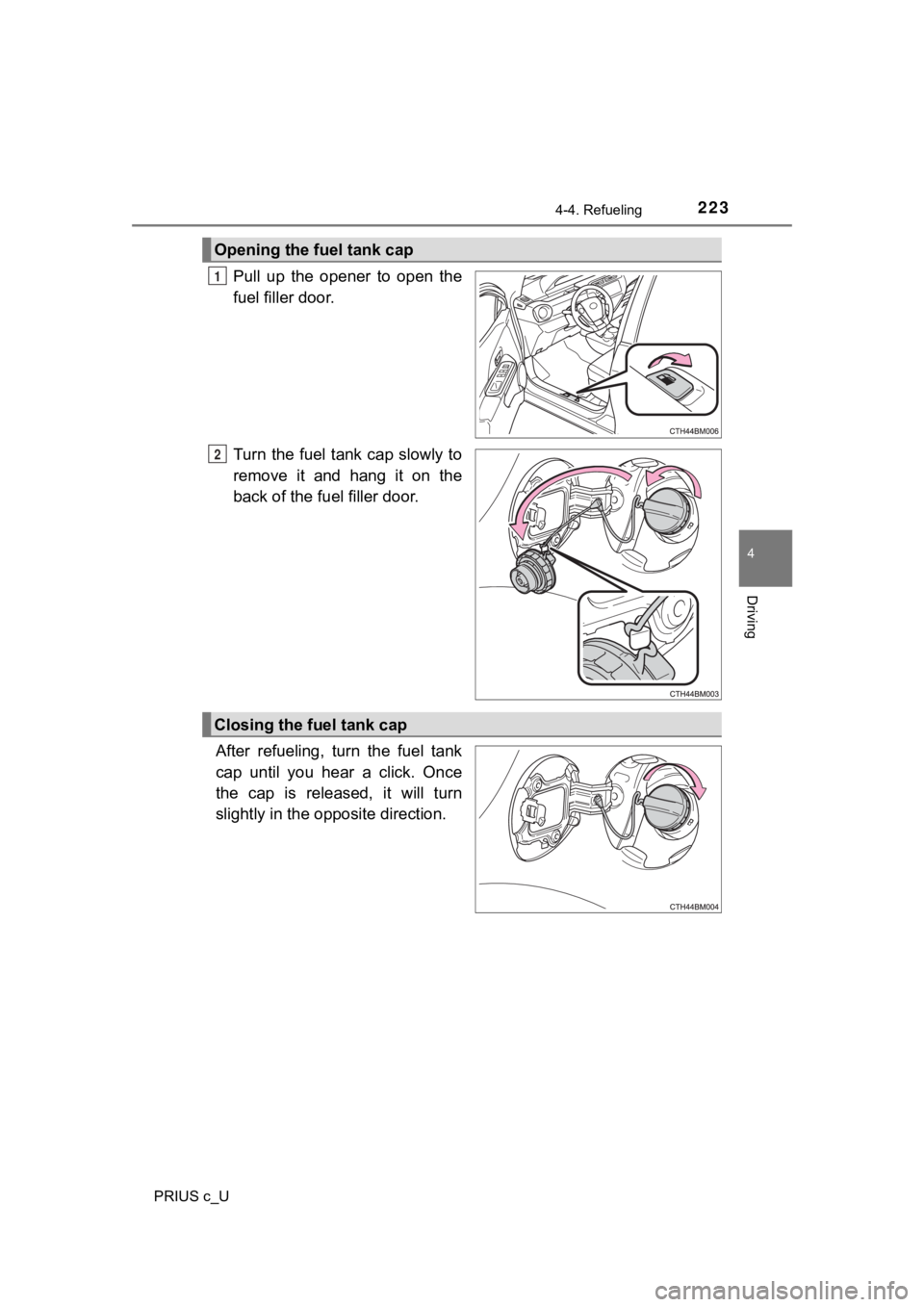
Pull up the opener to open the
fuel filler door.
Turn the fuel tank cap slowly to
remove it and hang it on the
back of the fuel filler door.
After refueling, turn the fuel tank
cap until you hear a click. Once
the cap is released, it will turn
slightly in the opposite direction.
Opening the fuel tank cap
1
2
Closing the fuel tank cap
Page 224 of 600

2244-4. Refueling
PRIUS c_U
WARNING
■When replacing the fuel tank cap
Do not use anything but a genuine Toyota fuel tank cap designed for your
vehicle. Doing so may cause a fire or other incident which may result in
death or serious injury.
Page 381 of 600
3816-1. Using the air conditioning system and defogger
6
Interior features
PRIUS c_U
■Operation of the air conditioning system in Eco drive mode
In Eco drive mode, the air conditioning system is controlled as follows to pri-
oritize fuel efficiency:
● Engine speed and compressor operation controlled to restrict heating/cool-
ing capacity
● Fan speed restricted when automatic mode is selected
To improve air conditioning perf ormance, perform the following operations:
● Adjust the fan speed
● Turn off Eco drive mode
■ Using automatic mode
Fan speed is adjusted automatically according to the temperatur e setting and
the ambient conditions.
Therefore, the fan may stop for a while until warm or cool air is ready to flow
immediately after is pressed.
■ Fogging up of the windows
●The windows will easily fog up when the humidity in the vehicle is high.
Turning on will dehumidify the air from the outlets and defog the wind-
shield effectively.
● If you turn off, the windows may fog up more easily.
● The windows may fog up if the recirculated air mode is used.
■ When driving on dusty roads
Close all windows. If dust thrown up by the vehicle is still drawn into the vehi-
cle after closing the windows, it is recommended that the air intake mode be
set to outside air mode and the fan speed to any setting except off.
Page 415 of 600
4157-2. Maintenance
7
Maintenance and care
PRIUS c_U
The OBD system determines that a problem exists somewhere in the
emission control system. Your vehicle may not pass the I/M test and
may need to be repaired. Contact your Toyota dealer to service the
vehicle.
● When the 12-volt battery is disconnected or discharged
Readiness codes that are set duri ng ordinary driving are erased.
Also, depending on your driving habits, the readiness codes may
not be completely set.
● When the fuel tan k cap is loose
The malfunction indicator lamp comes on indicating a temporary
malfunction and your vehicle m ay not pass the I/M test.
The error code in th e OBD system will not be cleared unless the vehi-
cle is driven 40 or more times.
Contact your Toyota dea ler to prepare the vehicle for re-testin g.
Emission inspection and maintenance (I/M)
programs
Some states have vehicle emission inspection programs which
include OBD (On Board Diagnos tics) checks. The OBD system
monitors the operation of t he emission control system.
If the malfunction indicator lamp comes on
Your vehicle may not pass the I/M test in the following situations:
When the malfunction indicator lamp still remains on after sev-
eral driving trips
If your vehicle does not pass the I/M test