battery TOYOTA PRIUS PHV 2012 Owners Manual
[x] Cancel search | Manufacturer: TOYOTA, Model Year: 2012, Model line: PRIUS PHV, Model: TOYOTA PRIUS PHV 2012Pages: 684, PDF Size: 12.16 MB
Page 595 of 684
5
When trouble arises
595
5-2. Steps to take in an emergency
PRIUS PHV_OM_OM47818U_(U)
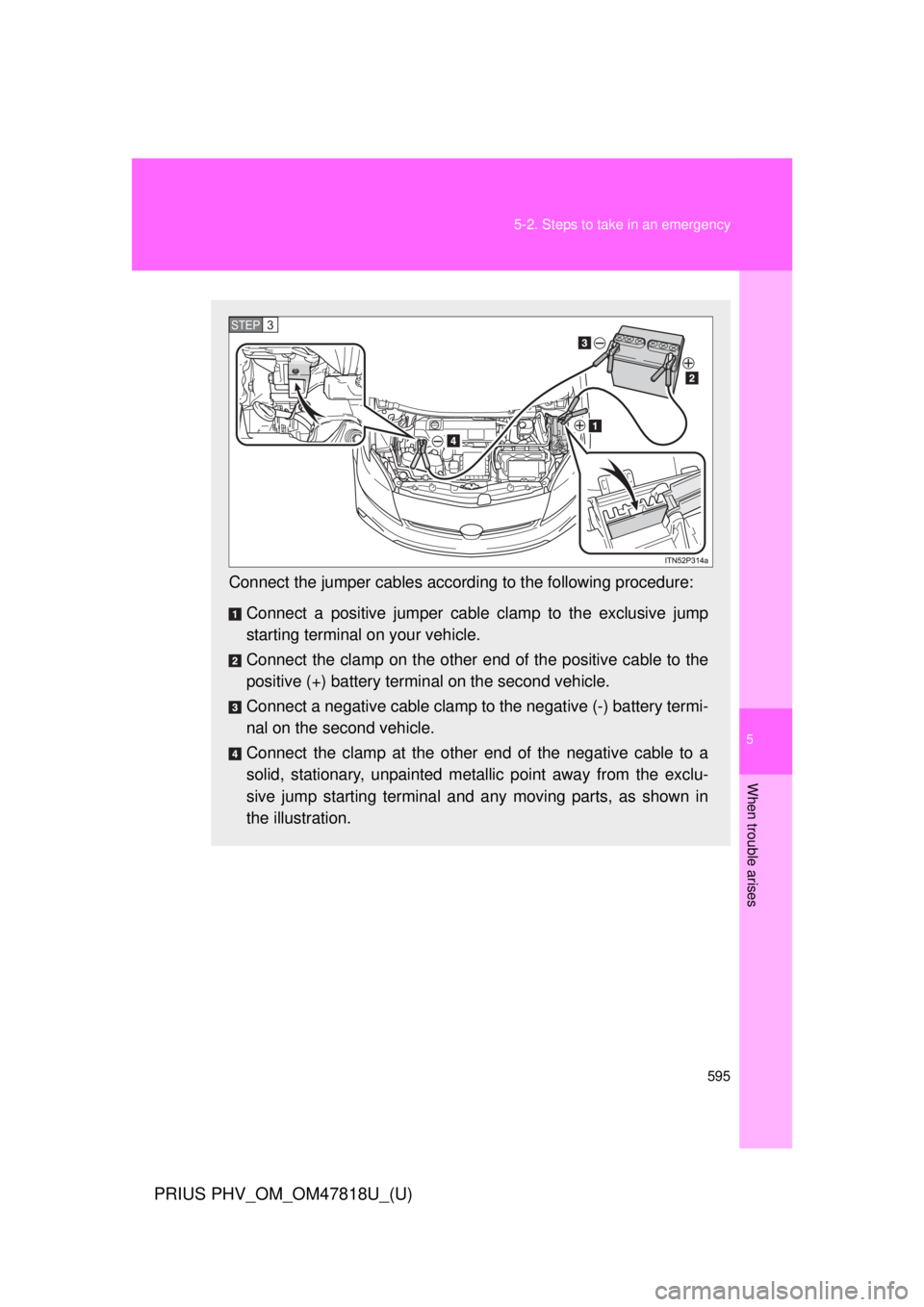
Connect the jumper cables accord
ing to the following procedure:
Connect a positive jumper cabl e clamp to the exclusive jump
starting terminal on your vehicle.
Connect the clamp on the other e nd of the positive cable to the
positive (+) battery termin al on the second vehicle.
Connect a negative cable clamp to the negative (-) battery termi-
nal on the second vehicle.
Connect the clamp at the other end of the negative cable to a
solid, stationary, unpainted meta llic point away from the exclu-
sive jump starting terminal and any moving parts, as shown in
the illustration.
STEP 3
Page 596 of 684
596 5-2. Steps to take in an emergency
PRIUS PHV_OM_OM47818U_(U)
Start the engine of the second vehicle. Increase the engine
speed slightly and maintain at that level for approximately
5 minutes to charge the battery of your vehicle.
Maintain the engine speed of the second vehicle and start
the hybrid system of your ve hicle by turning the “POWER”
switch to ON mode.
Make sure the “READY” indicator comes on. If the indicator
light does not come on, contact your Toyota dealer.
Once the hybrid system has started, remove the jumper
cables in the exact reverse or der from which they were con-
nected.
Close the exclusive jump starting terminal cover, and rein-
stall the fuse box cover to its original position.
When installing, first hook the fuse box cover onto the two rear
tabs.
Once the hybrid system starts , have the vehicle inspected at
your Toyota dealer as soon as possible.
STEP 4
STEP 5
STEP 6
STEP7
STEP8
Page 597 of 684

5
When trouble arises
597
5-2. Steps to take in an emergency
PRIUS PHV_OM_OM47818U_(U)
■
Starting the hybrid system when the 12-volt battery is discharged
The hybrid system cannot be started by push-starting.
■ To prevent 12-volt battery discharge
● Turn off the headlights and the audio system while the hybrid system is
off.
● Turn off any unnecessary electrical components when the vehicle is run-
ning at a low speed for an extended period, such as in heavy traffic.
■ When the 12-volt battery is removed or discharged
● The hybrid system may not start. ( P. 473)
● If the 12-volt battery is depleted with the shift position in P, it will not be
possible to shift the shift position other than P. In this case, the vehicle
cannot be towed without lifting both front wheels because the front
wheels are locked by the parking lock. ( P. 525)
● When the 12-volt battery is reconnected, start the hybrid system, depress
the brake pedal, and confirm that it is possible to shift into each shift posi-
tion.
■ Charging the 12-volt battery
The electricity stored in the 12-volt battery will discharge gradually even
when the vehicle is not in use, due to natural discharge and the draining
effects of certain electrical appliances. If the vehicle is left for a long time, the
12-volt battery may discharge, and the hybrid system may be unable to start.
(The 12-volt battery charges automatically while the hybrid system is operat-
ing.)
Page 598 of 684

598 5-2. Steps to take in an emergency
PRIUS PHV_OM_OM47818U_(U)
CAUTION
■Avoiding 12-volt battery fires or explosions
Observe the following precautions to prevent accidentally igniting the flam-
mable gas that may be emitted from the 12-volt battery:
● Make sure each jumper cable is connected to the correct terminal and that
it is not unintentionally in contact with any other than the intended terminal.
● Do not allow the other end of the jumper cable connected to the “+” termi-
nal to come into contact with any other parts or metal surfaces in the area,
such as brackets or unpainted metal.
● Do not allow the + and - clamps of the jumper cables to come into contact
with each other.
● Do not smoke, use matches, cigarette lighters or allow open flame near
the 12-volt battery.
■ 12-volt battery precautions
The 12-volt battery contains poisonous and corrosive acidic electrolyte,
while related parts contain lead and lead compounds. Observe the following
precautions when handling the 12-volt battery:
● When working with the 12-volt battery, always wear safety glasses and
take care not to allow any battery fluids (acid) to come into contact with
skin, clothing or the vehicle body.
● Do not lean over the 12-volt battery.
● In the event that battery fluid comes into contact with the skin or eyes,
immediately wash the affected area with water and seek medical attention.
Place a wet sponge or cloth over the affected area until medical attention
can be received.
● Always wash your hands after handling the battery support, terminals, and
other battery-related parts.
● Do not allow children near the 12-volt battery.
Page 599 of 684
5
When trouble arises
599
5-2. Steps to take in an emergency
PRIUS PHV_OM_OM47818U_(U)
CAUTION
■
After charging the 12-volt battery
Have the 12-volt battery inspected at your Toyota dealer as soon as possi-
ble.
If the 12-volt battery is deteriorating, continued use may cause the 12-volt
battery to emit a malodorous gas, which may be detrimental to the health of
passengers.
■ When replacing the 12-volt battery
P. 475
NOTICE
■When handling jumper cables
When connecting the jumper cables, ensure that they do not become entan-
gled in the cooling fans, etc.
■ Exclusive jump starting terminal
The exclusive jump starting terminal is to be used when charging the 12-volt
battery from another vehicle in an emergency. It cannot be used to jump start
another vehicle.
Page 614 of 684
614 6-1. Specifications
PRIUS PHV_OM_OM47818U_(U)
Electric motor (Traction motor)
Hybrid battery (traction battery)
Lubrication system
*: The engine oil capacity is a reference quantity to be used when changing theengine oil. Warm up the engine and turn off the hybrid system, wait more
than 5 minutes, and check the oil level on the dipstick.
Ty p ePermanent magnet motor
Maximum output 60 kW
Maximum torque 153 ft•lbf (207 N•m, 21.1 kgf•m)
Ty p eLithium-ion battery
Voltage 3.7 V/cell
Capacity21.5 Ah
Quantity 56 cells
Overall voltage 207 V
Oil capacity
(Drain and refill
reference
*)
With filter
Without filter
4.4 qt. (4.2 L, 3.7 Imp.qt.)
4.1 qt. (3.9 L, 3.4 Imp.qt.)
Page 618 of 684
618 6-1. Specifications
PRIUS PHV_OM_OM47818U_(U)
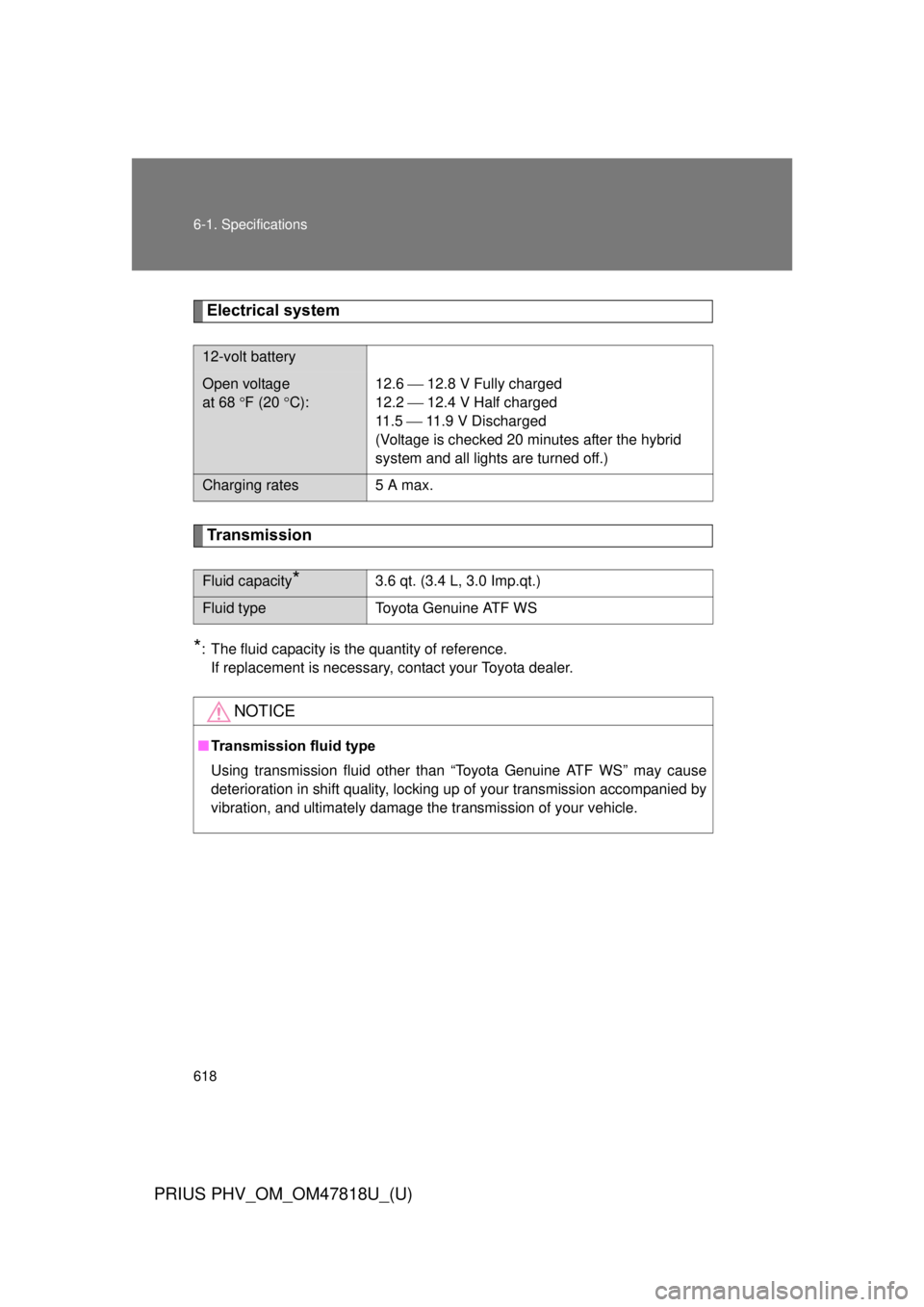
Electrical system
Transmission
*: The fluid capacity is the quantity of reference.If replacement is necessary, contact your Toyota dealer.
12-volt battery
Open voltage
at 68 F (20 C): 12.6 12.8 V Fully charged
12.2 12.4 V Half charged
11 . 5
11.9 V Discharged
(Voltage is checked 20 minutes after the hybrid
system and all lights are turned off.)
Charging rates 5 A max.
Fluid capacity*3.6 qt. (3.4 L, 3.0 Imp.qt.)
Fluid type Toyota Genuine ATF WS
NOTICE
■Transmission fluid type
Using transmission fluid other than “Toyota Genuine ATF WS” may cause
deterioration in shift quality, locking up of your transmission accompanied by
vibration, and ultimately damage the transmission of your vehicle.
Page 632 of 684

632 6-1. Specifications
PRIUS PHV_OM_OM47818U_(U)
Tire related termMeaning
Normal occupant
weight 150 lb. (68 kg) times the number of occupants
specified in the second column of Table 1
* that
follows
Occupant distribution Distribution of occupants in a vehicle as speci-
fied in the third column of Table 1
* below
Production options
weight The combined weight of installed regular pro-
duction options weighing over 5 lb. (2.3 kg) in
excess of the standard items which they
replace, not previously considered in curb
weight or accessory weight, including heavy
duty brakes, ride levelers, roof rack, heavy duty
12-volt battery, and special trim
Rim A metal support for a tire or a tire and tube
assembly upon which the tire beads are seated
Rim diameter
(Wheel diameter) Nominal diameter of the bead seat
Rim size designation Rim diameter and width
Rim type designation The industry manufacturer’s designation for a
rim by style or code
Rim width Nominal distance between rim flanges
Vehicle capacity
weight (Total load
capacity) The rated cargo and luggage load plus 150 lb.
(68 kg) times the vehicle’s designated seating
capacity
Page 669 of 684

669
Alphabetical index
PRIUS PHV_OM_OM47818U_(U)
Back door
Back door ............................. 140
Smart key system ... .............. 108
Wireless remote control........ 132
Back-up lights Replacing light bulbs ............ 507
Wattage ................................ 620
Battery Checking .............................. 471
If the 12-volt battery is
discharged ......................... 594
Preparing and checking
before winter ...................... 349
Bluetooth
®*
Bottle holders .......................... 390
Brake Fluid...................................... 619
Parking brake ....................... 255
Brake assist ............................. 328
Break-in tips ............................ 226
Brightness control Instrument panel light
control ................................ 260 Camera
*
Care
Exterior ..................................424
Interior ...................................428
Seat belts ..............................429
Cargo capacity .........................348
Cargo hooks .............................403
CD player
*
Chains .......................................351
Charging
Charging cable ........................74
Charging equipment ................73
Charging messages ..............562
Charging precautions ..............94
Charging procedure ................80
Charging timer function ...........86
Charging time will increase when.......................93
High voltage components........44
Information related to charging display ....................89
Maintenance..........................103
Power sources precautions .....79
Power sources that can be used ......................................77
Safety functions.................75, 91
When charging cannot be carried out .............................98
BC
GW Refer to
Page 670 of 684

670 Alphabetical index
PRIUS PHV_OM_OM47818U_(U)
Child restraint systemBooster seats, definition ........ 204
Booster seats, installation ..... 212
Convertible seats, definition ............................. 204
Convertible seats,
installation ...........................212
Front passenger occupant classification system ...........198
Infant seats, definition ...........204
Infant seats, installation.........212
Installing child restraint system with LATCH anchors ...........210
Installing child restraint system with seat belts ..................... 212
Installing child restraint system with top tether strap ............216
Child safety
Airbag precautions ................192
Back door precautions .......... 142
Child restraint system............204
Child-protectors ..................... 135
How to charge ......................... 80
How your child should wear the seat belt ........................159
Installing child restraints ........ 209
Power window lock switch..... 171
Power window precautions ...173
Remote Air Conditioning System precautions ............374
Removed electronic key
battery precautions ............. 494
Seat belt extender precautions .........................164
Seat belt precautions ............160
Seat heater precautions ........ 398
12-volt battery precautions ....474 Child-protectors ....................... 135
Cleaning
Exterior.................................. 424
Interior ................................... 428
Seat belts .............................. 429
Clock ......................................... 275
Condenser ................................ 466
Console box ............................. 387
Cooling system
Engine overheating ............... 600
Hybrid system overheating ... 600
Cruise control
Cruise control ........................ 308
Dynamic radar cruise control ................................. 312
Cup holders .............................. 388
Curtain shield airbags ............. 184
Customizable features ............ 639