inflation pressure TOYOTA PRIUS PHV 2012 Owner's Manual
[x] Cancel search | Manufacturer: TOYOTA, Model Year: 2012, Model line: PRIUS PHV, Model: TOYOTA PRIUS PHV 2012Pages: 684, PDF Size: 12.16 MB
Page 540 of 684

540 5-2. Steps to take in an emergency
PRIUS PHV_OM_OM47818U_(U)
■Electric power steering system warning light
When the 12-volt battery charge becomes insufficient or the voltage tempo-
rarily drops, the electric power steering system warning light may come on.
■ If the malfunction indicator lamp comes on while driving
First check the following:
● Is the fuel tank cap loose?
If it is, tighten it securely.
The malfunction indicator lamp will go off after several driving trips.
If the malfunction indicator lamp does not go off even after several trips, con-
tact your Toyota dealer as soon as possible.
■
When the tire pressure warning light comes on
Check the tire inflation pressure and adjust to the appropriate level.
Pushing the tire pressure warning reset switch will not turn off the tire
pressure warning light.
■The tire pressure warning light may come on due to natural causes
The tire pressure warning light may come on due to natural causes such
as natural air leaks and tire inflat ion pressure changes caused by tem-
perature. In this case, adjusting the tire inflation pressure will turn off the
warning light (after a few minutes).
Page 541 of 684

5
When trouble arises
541
5-2. Steps to take in an emergency
PRIUS PHV_OM_OM47818U_(U)
■If the tire pressure warning system is not functioning
The tire pressure warning system will be disabled in the following condi-
tions:
(When the condition be
comes normal, the system will work properly.)
●If tires not equipped with tire pressure warning valves and transmit-
ters are used
●If the ID code on the tire pressure warning valves and transmitters is
not registered in the tire pressure warning computer
●If the tire inflation pressure is 73 psi (500 kPa, 5.1 kgf/cm2 or bar) or
higher
The tire pressure warning system may be disabled in the following condi-
tions:
(When the condition be comes normal, the system will work properly.)
●If electronic devices or facilities using similar radio wave frequencies
are nearby
●If a radio set at a similar frequency is in use in the vehicle
●If a window tint that affects the radio wave signals is installed
●If there is a lot of snow or ice on the vehicle, particularly around the
wheels or wheel housings
●If non-genuine Toyota wheels are used (Even if you use Toyota
wheels, the tire pressure warning system may not work properly with
some types of tires.)
●If tire chains are used
Page 543 of 684

5
When trouble arises
543
5-2. Steps to take in an emergency
PRIUS PHV_OM_OM47818U_(U)
CAUTION
■If the tire pressure warning light comes on
Be sure to observe the following precautions. Failure to do so could
cause a loss of vehicle control and result in death or serious injury.
●Stop your vehicle in a safe place as
soon as possible. Adjust the tire
inflation pressure immediately.
●If the tire pressure warning light comes on even after tire inflation pres-
sure adjustment, it is pr obable that you have a flat tire. Check the tires.
If a tire is flat, repair the flat ti re by using emergency tire puncture
repair kit.
●Avoid abrupt maneuvering and braking. If the vehicle tires deteriorate,
you could lose control of the steering wheel or the brakes.
■If a blowout or sudden air leakage should occur
The tire pressure warning syste m may not activate immediately.
■Maintenance of the tires
Each tire, including the spare (if provided), should be checked monthly
when cold and inflated to the inflation pressure recommended by the
vehicle manufacturer on the vehicle placard or tire inflation pressure
label (tire and load information label). (If your vehicle has tires of a differ-
ent size than the size indicated on the vehicle placard or tire inflation
pressure label [tire and load information label], you should determine the
proper tire inflation pr essure for those tires.)
Page 544 of 684

544 5-2. Steps to take in an emergency
PRIUS PHV_OM_OM47818U_(U)
CAUTION
As an added safety feature, your vehicle has been equipped with a tire
pressure monitoring system (TPMS-ti re pressure warning system) that
illuminates a low tire pressure telltal e (tire pressure warning light) when
one or more of your tires is significantly under-inflated. Accordingly,
when the low tire pressu re telltale (tire pressure warning light) illumi-
nates, you should stop and check your tires as soon as possible, and
inflate them to the proper pressure. Driving on a significantly under-
inflated tire causes the tire to overheat and can lead to tire failure.
Under-inflation also reduces fuel effi ciency and tire tread life, and may
affect the vehicle’s handling and stopping ability.
Please note that the TPMS (tire pressure warning system) is not a sub-
stitute for proper tire main tenance, and it is the driver’s responsibility to
maintain correct tire pressure, even if under-inflation has not reached the
level to trigger illu mination of the TPMS low tire pressure telltale (tire
pressure warning light).
Your vehicle has also been equipped with a TPMS (tire pressure warning
system) malfunction indicator to indi cate when the system is not operat-
ing properly. The TPMS (tire pressure warning system) malfunction indi-
cator is combined with the low tire pressure telltale (tire pressure
warning light). When the system det ects a malfunction, the telltale will
flash for approximately one minute an d then remain continuously illumi-
nated. This sequence will continue upon subsequent vehicle start-ups as
long as the malfunction exists. When the malfunction indi cator is illumi-
nated, the system may not be able to detect or signal low tire pressure
as intended.
Page 576 of 684
576 5-2. Steps to take in an emergency
PRIUS PHV_OM_OM47818U_(U)
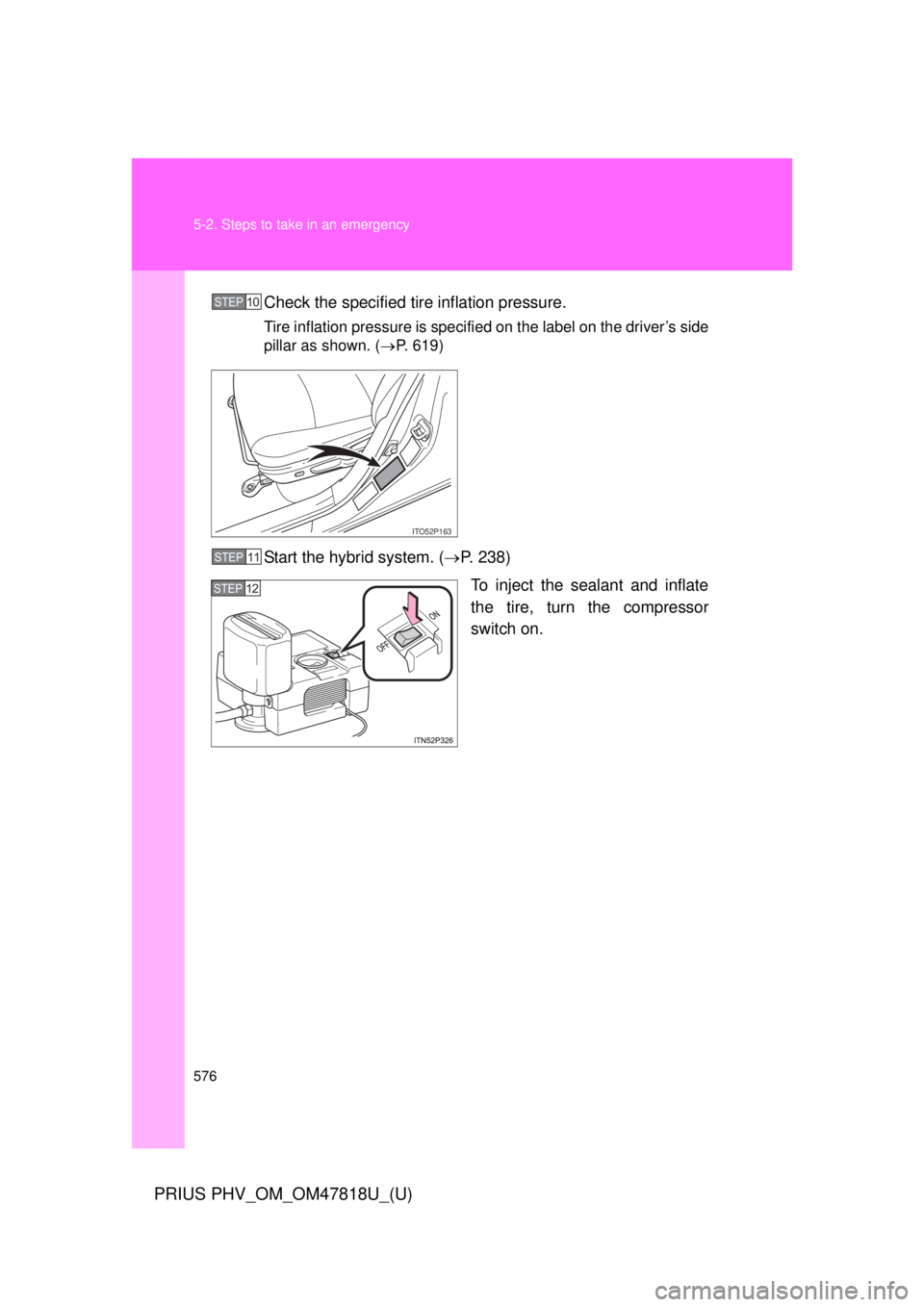
Check the specified tire inflation pressure.
Tire inflation pressure is specified on the label on the driver’s side
pillar as shown. ( P. 619)
Start the hybrid system. ( P. 238)
To inject the sealant and inflate
the tire, turn the compressor
switch on.
STEP10
ITO52P163
STEP11
STEP12
Page 577 of 684
5
When trouble arises
577
5-2. Steps to take in an emergency
PRIUS PHV_OM_OM47818U_(U)
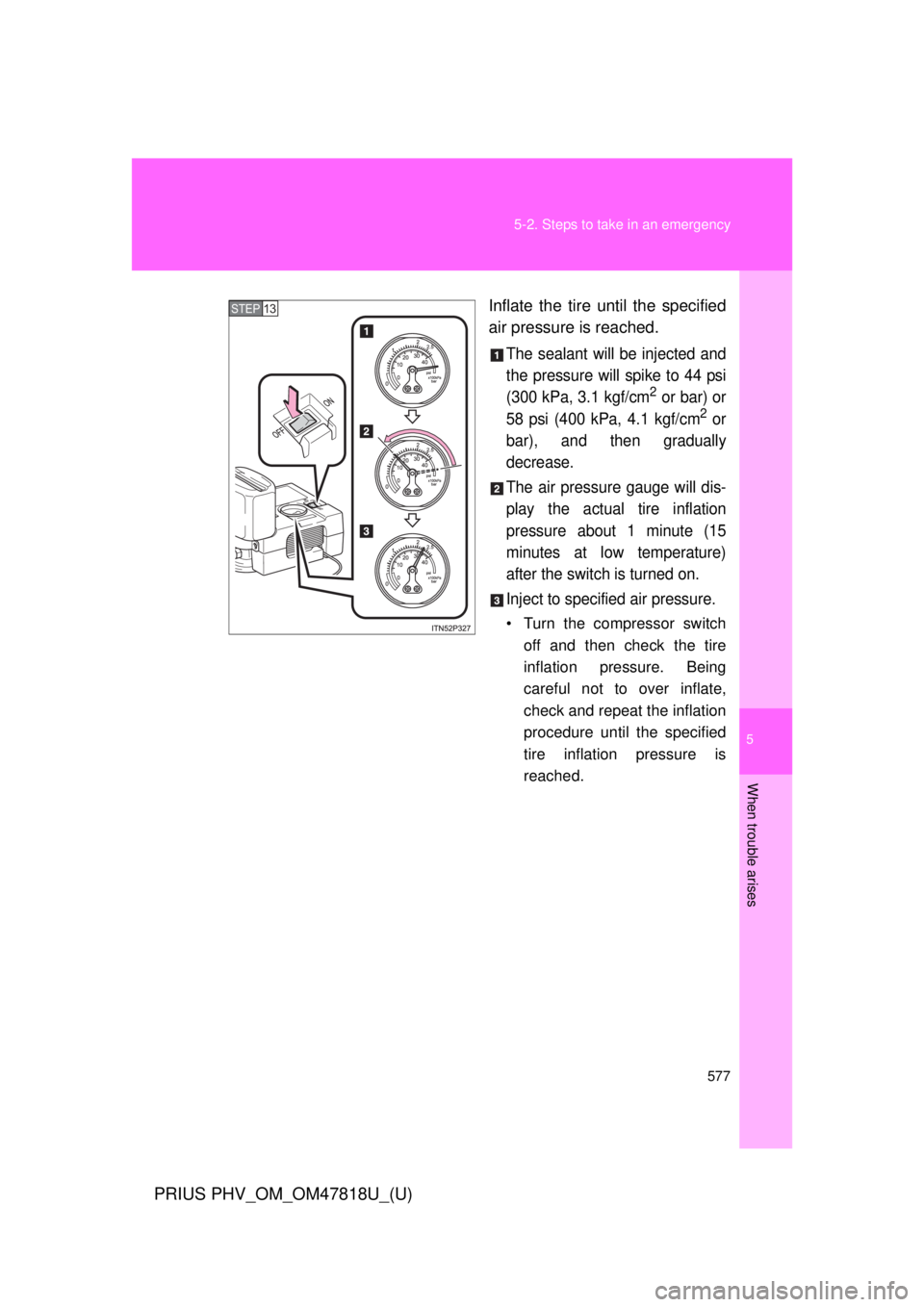
Inflate the tire until the specified
air pressure is reached.
The sealant will be injected and
the pressure will spike to 44 psi
(300 kPa, 3.1 kgf/cm
2 or bar) or
58 psi (400 kPa, 4.1 kgf/cm2 or
bar), and then gradually
decrease.
The air pressure gauge will dis-
play the actual tire inflation
pressure about 1 minute (15
minutes at low temperature)
after the switch is turned on.
Inject to specified air pressure.
• Turn the compressor switch
off and then check the tire
inflation pressure. Being
careful not to over inflate,
check and repeat the inflation
procedure until the specified
tire inflation pressure is
reached.
STEP13
Page 578 of 684

578 5-2. Steps to take in an emergency
PRIUS PHV_OM_OM47818U_(U)
• If the tire inflation pressure isstill lower than the specified
point after inflation for 10
minutes (40 minutes at low
temperature) with the switch
on, the tire is too damaged to
be repaired. Turn the com-
pressor switch off and con-
tact your Toyota dealer.
• If the tire inflation pressure exceeds the specified air
pressure, let out some air to
adjust the tire inflation pres-
sure. ( P. 582, 619)
With the compressor switch off, disconnect the hose from the
valve on the tire and then pull out the power plug from the
power outlet socket.
Some sealant may leak when the hose is removed.
Install the valve cap onto the valve of the emergency repaired
tire.
STEP14
STEP15
Page 580 of 684
580 5-2. Steps to take in an emergency
PRIUS PHV_OM_OM47818U_(U)
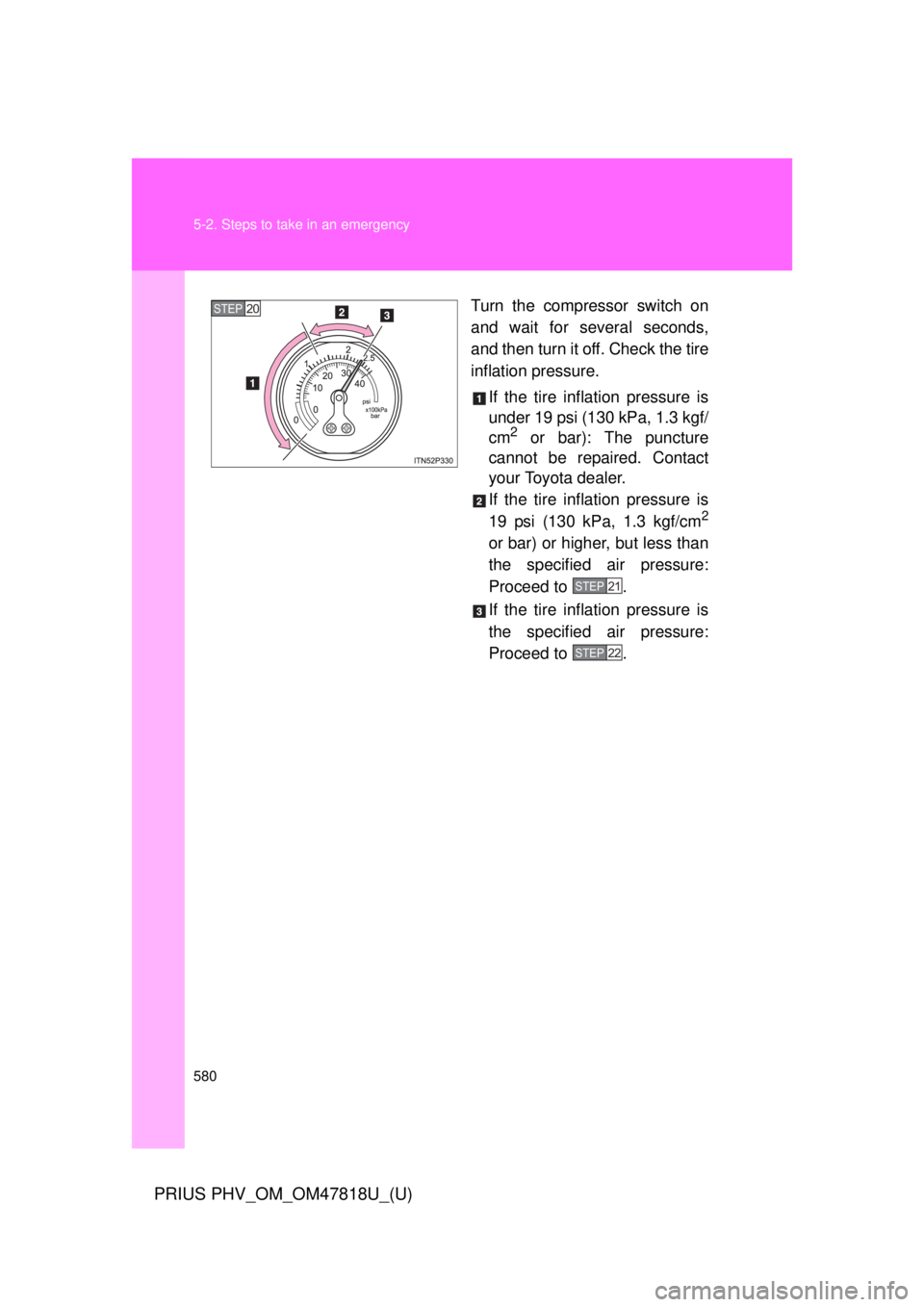
Turn the compressor switch on
and wait for several seconds,
and then turn it off. Check the tire
inflation pressure.If the tire inflation pressure is
under 19 psi (130 kPa, 1.3 kgf/
cm
2 or bar): The puncture
cannot be repaired. Contact
your Toyota dealer.
If the tire inflation pressure is
19 psi (130 kPa, 1.3 kgf/cm
2
or bar) or higher, but less than
the specified air pressure:
Proceed to .
If the tire inflation pressure is
the specified air pressure:
Proceed to .
STEP20
STEP21
STEP22
Page 582 of 684
582 5-2. Steps to take in an emergency
PRIUS PHV_OM_OM47818U_(U)
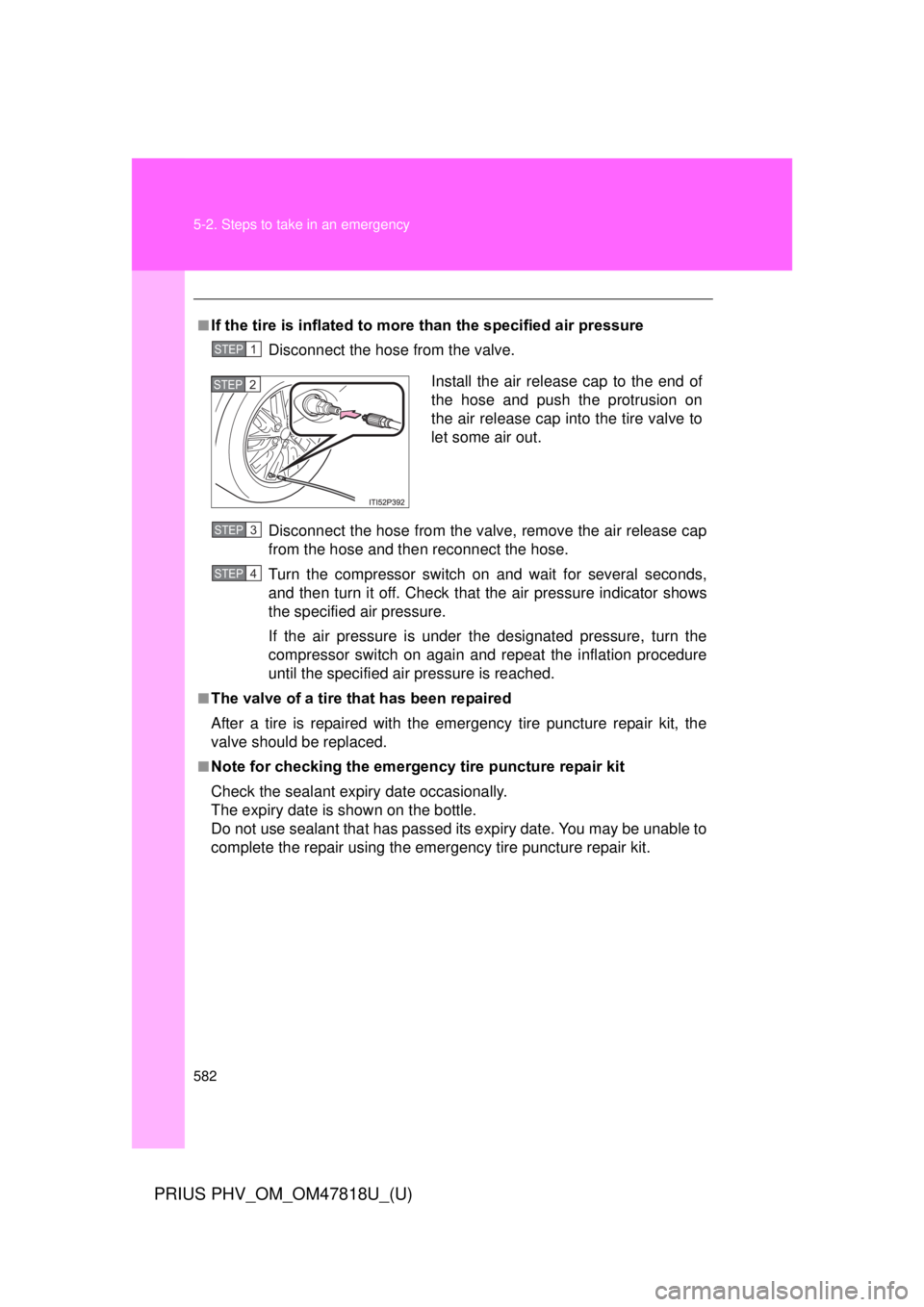
■If the tire is inflated to more than the specified air pressureDisconnect the hose from the valve.
Disconnect the hose from the valve, remove the air release cap
from the hose and then reconnect the hose.
Turn the compressor switch on and wait for several seconds,
and then turn it off. Check that the air pressure indicator shows
the specified air pressure.
If the air pressure is under the designated pressure, turn the
compressor switch on again and repeat the inflation procedure
until the specified air pressure is reached.
■The valve of a tire that has been repaired
After a tire is repaired with the emergency tire puncture repair kit, the
valve should be replaced.
■Note for checking the emergency tire puncture repair kit
Check the sealant expiry date occasionally.
The expiry date is shown on the bottle.
Do not use sealant that has passed it s expiry date. You may be unable to
complete the repair using the emergency tire puncture repair kit.
STEP 1
Install the air release cap to the end of
the hose and push the protrusion on
the air release cap into the tire valve to
let some air out.STEP 2
STEP 3
STEP 4
Page 585 of 684

5
When trouble arises
585
5-2. Steps to take in an emergency
PRIUS PHV_OM_OM47818U_(U)
CAUTION
■When fixing the flat tire
●Stop your vehicle in a safe and flat area.
●Do not touch the wheels or the ar
ea around the brakes immediately
after the vehicle has been driven.
After the vehicle has been driven, the wheels and the area around the
brakes may be extremely hot. Touching these areas with hands, feet or
other body parts may result in burns.
●Connect the valve and hose securely with the tire installed on the vehi-
cle. If the hose is not properly con nected to the valve, air leakage may
occur as sealant may be sprayed out.
●If the hose comes off the valve while inflating the tire, there is a risk
that the hose will move abruptly due to air pressure.
●After inflation of the tire has comp leted, the sealant may splatter when
the hose is disconnected or so me air is let out of the tire.
●Follow the operation procedure to repair the tire. If the procedures not
followed, the sealant may spray out.
●Keep back from the tire while it is being repaired, as there is a chance
of it bursting while the repair ope ration is being performed. If you
notice any cracks or deformation of the tire, turn off the compressor
switch and stop the repair operation immediately.