tires TOYOTA PRIUS PHV 2012 Owner's Guide
[x] Cancel search | Manufacturer: TOYOTA, Model Year: 2012, Model line: PRIUS PHV, Model: TOYOTA PRIUS PHV 2012Pages: 684, PDF Size: 12.16 MB
Page 541 of 684

5
When trouble arises
541
5-2. Steps to take in an emergency
PRIUS PHV_OM_OM47818U_(U)
■If the tire pressure warning system is not functioning
The tire pressure warning system will be disabled in the following condi-
tions:
(When the condition be
comes normal, the system will work properly.)
●If tires not equipped with tire pressure warning valves and transmit-
ters are used
●If the ID code on the tire pressure warning valves and transmitters is
not registered in the tire pressure warning computer
●If the tire inflation pressure is 73 psi (500 kPa, 5.1 kgf/cm2 or bar) or
higher
The tire pressure warning system may be disabled in the following condi-
tions:
(When the condition be comes normal, the system will work properly.)
●If electronic devices or facilities using similar radio wave frequencies
are nearby
●If a radio set at a similar frequency is in use in the vehicle
●If a window tint that affects the radio wave signals is installed
●If there is a lot of snow or ice on the vehicle, particularly around the
wheels or wheel housings
●If non-genuine Toyota wheels are used (Even if you use Toyota
wheels, the tire pressure warning system may not work properly with
some types of tires.)
●If tire chains are used
Page 543 of 684

5
When trouble arises
543
5-2. Steps to take in an emergency
PRIUS PHV_OM_OM47818U_(U)
CAUTION
■If the tire pressure warning light comes on
Be sure to observe the following precautions. Failure to do so could
cause a loss of vehicle control and result in death or serious injury.
●Stop your vehicle in a safe place as
soon as possible. Adjust the tire
inflation pressure immediately.
●If the tire pressure warning light comes on even after tire inflation pres-
sure adjustment, it is pr obable that you have a flat tire. Check the tires.
If a tire is flat, repair the flat ti re by using emergency tire puncture
repair kit.
●Avoid abrupt maneuvering and braking. If the vehicle tires deteriorate,
you could lose control of the steering wheel or the brakes.
■If a blowout or sudden air leakage should occur
The tire pressure warning syste m may not activate immediately.
■Maintenance of the tires
Each tire, including the spare (if provided), should be checked monthly
when cold and inflated to the inflation pressure recommended by the
vehicle manufacturer on the vehicle placard or tire inflation pressure
label (tire and load information label). (If your vehicle has tires of a differ-
ent size than the size indicated on the vehicle placard or tire inflation
pressure label [tire and load information label], you should determine the
proper tire inflation pr essure for those tires.)
Page 544 of 684

544 5-2. Steps to take in an emergency
PRIUS PHV_OM_OM47818U_(U)
CAUTION
As an added safety feature, your vehicle has been equipped with a tire
pressure monitoring system (TPMS-ti re pressure warning system) that
illuminates a low tire pressure telltal e (tire pressure warning light) when
one or more of your tires is significantly under-inflated. Accordingly,
when the low tire pressu re telltale (tire pressure warning light) illumi-
nates, you should stop and check your tires as soon as possible, and
inflate them to the proper pressure. Driving on a significantly under-
inflated tire causes the tire to overheat and can lead to tire failure.
Under-inflation also reduces fuel effi ciency and tire tread life, and may
affect the vehicle’s handling and stopping ability.
Please note that the TPMS (tire pressure warning system) is not a sub-
stitute for proper tire main tenance, and it is the driver’s responsibility to
maintain correct tire pressure, even if under-inflation has not reached the
level to trigger illu mination of the TPMS low tire pressure telltale (tire
pressure warning light).
Your vehicle has also been equipped with a TPMS (tire pressure warning
system) malfunction indicator to indi cate when the system is not operat-
ing properly. The TPMS (tire pressure warning system) malfunction indi-
cator is combined with the low tire pressure telltale (tire pressure
warning light). When the system det ects a malfunction, the telltale will
flash for approximately one minute an d then remain continuously illumi-
nated. This sequence will continue upon subsequent vehicle start-ups as
long as the malfunction exists. When the malfunction indi cator is illumi-
nated, the system may not be able to detect or signal low tire pressure
as intended.
Page 545 of 684

5
When trouble arises
545
5-2. Steps to take in an emergency
PRIUS PHV_OM_OM47818U_(U)
CAUTION
TPMS (tire pressure warning system) malfunctions may occur for a vari-
ety of reasons, including the installati
on of replacement or alternate tires
or wheels on the vehicle that prevent the TPMS (tire pressure warning
system) from functioning properly. Always check the TPMS (tire pres-
sure warning system) malfunction te lltale after replacing one or more
tires or wheels on your vehicle to ensure that the replacement or alter-
nate tires and wheels allow the TPMS (tire pressure warning system) to
continue to function properly.
NOTICE
■Precaution when installing a different tire
When a tire of a different specification or maker is installed, the tire pres-
sure warning system may not operate properly.
Page 570 of 684

570 5-2. Steps to take in an emergency
PRIUS PHV_OM_OM47818U_(U)
■In the following cases, the tire cannot be repaired with the emer-
gency tire puncture repair kit. Contact your Toyota dealer.
●When the tire is damaged due to driving without sufficient air pres-
sure
●When there are any cracks or damage at any location on the tire,
such as on the side wall, except the tread
●When the tire is visibly separated from the wheel
●When the cut or damage to the trea d is 0.16 in. (4 mm) long or more
●When the wheel is damaged
●When two or more tires have been punctured
●When more than 2 sharp objects such as nails or screws have
passed through the tread on a single tire
●When the sealant has expired
Page 583 of 684

5
When trouble arises
583
5-2. Steps to take in an emergency
PRIUS PHV_OM_OM47818U_(U)
■Emergency tire puncture repair kit
●The sealant stored in the emergency tire puncture repair kit can be
used only once to temporarily repair a single tire. If the sealant has
been used and needs to be purchased, contact your Toyota dealer.
●The sealant can be used when the
outside temperature is from -40°F
(-40°C) to 140°F (60°C).
●The repair kit is exclusively designed for size and type of tires origi-
nally installed on your vehicle. Do no t use it for tires that a different
size than the original ones, or for any other purposes.
●The sealant has a limited lifespan. T he expiry date is shown on the
bottle. The sealant should be replaced before the expiry date. Con-
tact your Toyota dealer.
●If the sealant gets on your clothes, it may stain.
●If the sealant adheres to a wheel or the surface of the vehicle body,
the stain may not be removable if it is not cleaned at once. Immedi-
ately wipe away the sealant with a wet cloth.
●During operation of the repair kit, a loud operation noise is produced.
This does not indicate a malfunction.
●Do not use to check or to adjust the tire pressure.
Page 584 of 684

584 5-2. Steps to take in an emergency
PRIUS PHV_OM_OM47818U_(U)
CAUTION
■Do not drive the vehicle with a flat tire
Do not continue driving with a flat tire.
Driving even a short distance with a flat tire can damage the tire and the
wheel beyond repair.
Driving with a flat tire may cause a circumferential groove on the side
wall. In such a case, the tire may explode when using a repair kit.
■Caution while driving
●Store the repair kit in the luggage compartment.
Injuries may result in the event of an accident or sudden braking.
●The repair kit is exclusively only for your vehicle.
Do not use repair kit on other vehicles, which could lead to an accident
causing death or serious injury.
●Do not use repair kit for tires that are different size than the original
ones, or for any other purpose. If the tires have not been completely
repaired, it could lead to an accident causing death or serious injury.
■Precautions for use of the sealant
●Ingesting the sealant is hazardous to your health. If you ingest sealant,
consume as much water as possible, and then immediately consult a
doctor.
●If sealant gets in eyes or adheres to skin, immediately wash it off with
water. If discomfort persists, consult a doctor.
Page 605 of 684
5
When trouble arises
605
5-2. Steps to take in an emergency
PRIUS PHV_OM_OM47818U_(U)
If the vehicle becomes stuck
CAUTION
■When attempting to free a stuck vehicle
If you choose to push the vehicle back and forth to free it, make sure the sur-
rounding area is clear to avoid striki ng other vehicles, objects or people. The
vehicle may also lunge forward or lu nge back suddenly as it becomes free.
Use extreme caution.
■ When changing the shift position
Be careful not to change the shift position with the accelerator pedal
depressed.
Changing the shift position to any positions other than P or N may cause the
vehicle to accelerate abruptly, causing an accident and resulting in death or
serious injury.
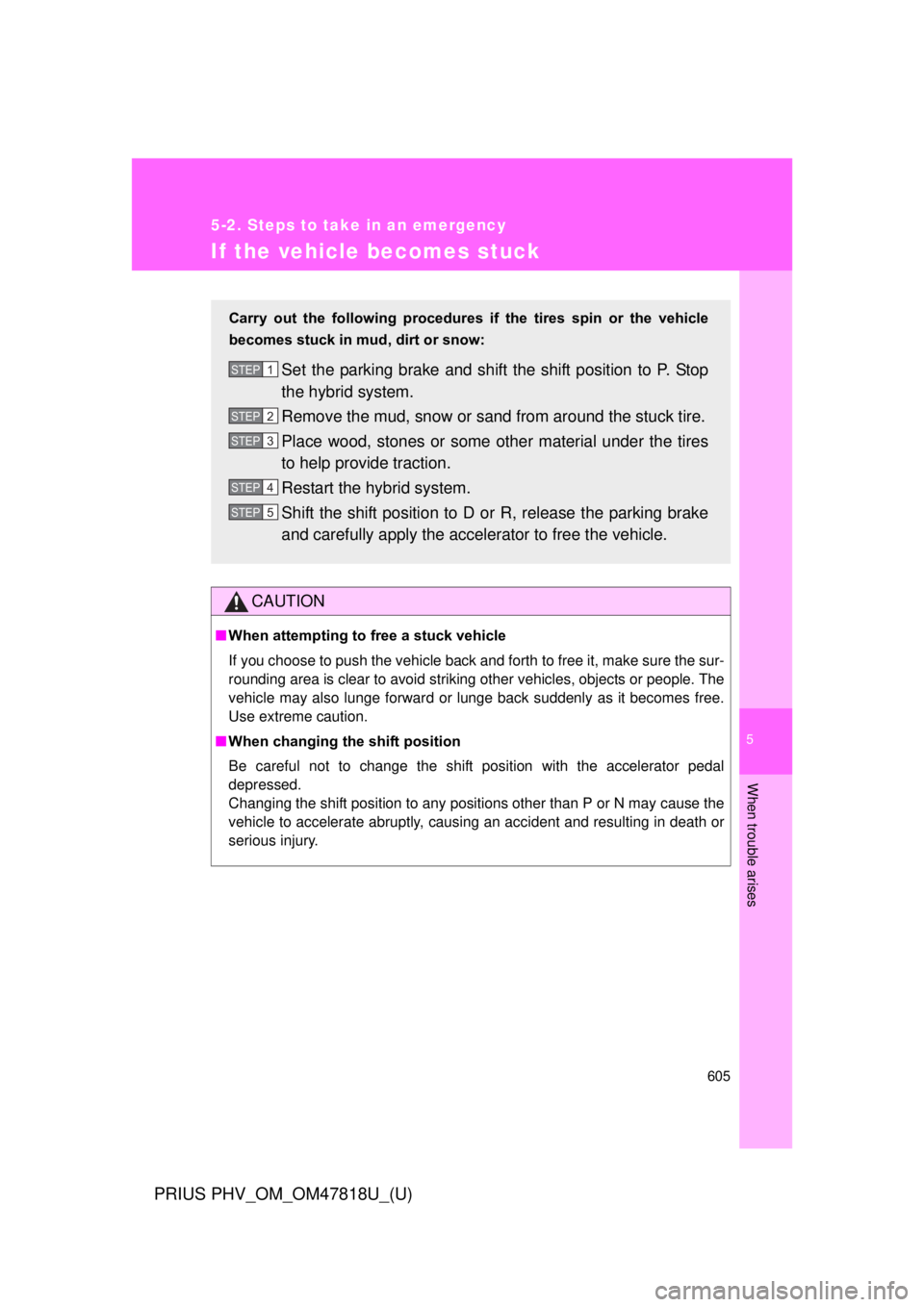
Carry out the following procedures if the tires spin or the vehicle
becomes stuck in mud, dirt or snow:
Set the parking brake and shift the shift position to P. Stop
the hybrid system.
Remove the mud, snow or sand from around the stuck tire.
Place wood, stones or some other material under the tires
to help provide traction.
Restart the hybrid system.
Shift the shift position to D or R, release the parking brake
and carefully apply the accelerator to free the vehicle.STEP 1
STEP 2
STEP 3
STEP 4
STEP 5
Page 619 of 684
619
6-1. Specifications
6
Vehicle specifications
PRIUS PHV_OM_OM47818U_(U)
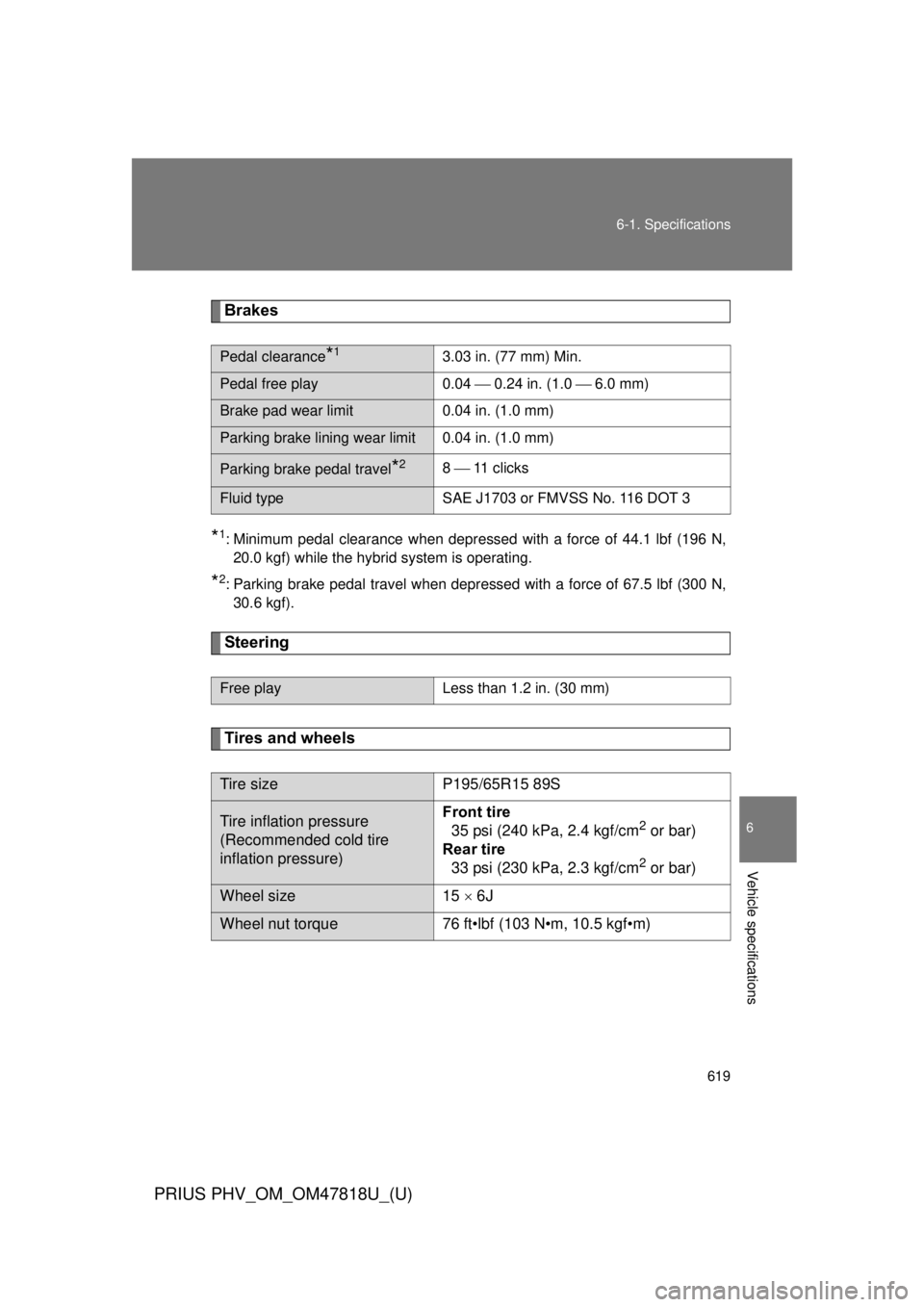
Brakes
*1: Minimum pedal clearance when depressed with a force of 44.1 lbf (196 N,
20.0 kgf) while the hybrid system is operating.
*2: Parking brake pedal travel when depressed with a force of 67.5 lbf (300 N,30.6 kgf).
Steering
Tires and wheels
Pedal clearance*13.03 in. (77 mm) Min.
Pedal free play 0.04 0.24 in. (1.0 6.0 mm)
Brake pad wear limit 0.04 in. (1.0 mm)
Parking brake lining wear limit 0.04 in. (1.0 mm)
Parking brake pedal travel*28 11 clicks
Fluid type SAE J1703 or FMVSS No. 116 DOT 3
Free playLess than 1.2 in. (30 mm)
Tire sizeP195/65R15 89S
Tire inflation pressure
(Recommended cold tire
inflation pressure)Front tire
35 psi (240 kPa, 2.4 kgf/cm2 or bar)
Rear tire 33 psi (230 kPa, 2.3 kgf/cm
2 or bar)
Wheel size 15 6J
Wheel nut torque 76 ft•lbf (103 N•m, 10.5 kgf•m)
Page 625 of 684
625
6-1. Specifications
6
Vehicle specifications
PRIUS PHV_OM_OM47818U_(U)
Tire infor mation
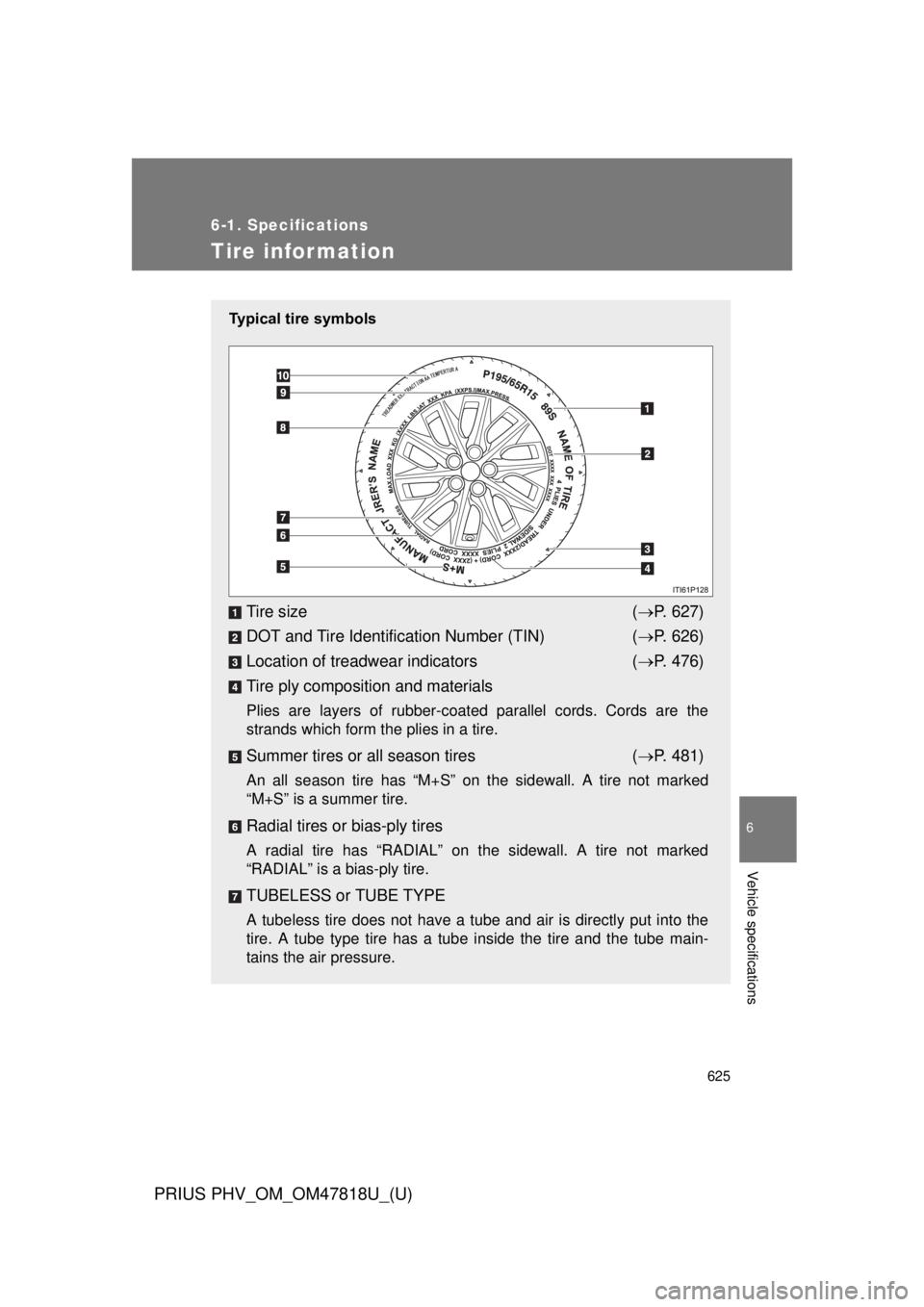
Typical tire symbols
Tire size( P. 627)
DOT and Tire Identification Number (TIN) ( P. 626)
Location of treadwear indicators ( P. 476)
Tire ply composition and materials
Plies are layers of rubber-coated parallel cords. Cords are the
strands which form the plies in a tire.
Summer tires or all season tires ( P. 481)
An all season tire has “M+S” on the sidewall. A tire not marked
“M+S” is a summer tire.
Radial tires or bias-ply tires
A radial tire has “RADIAL” on the sidewall. A tire not marked
“RADIAL” is a bias-ply tire.
TUBELESS or TUBE TYPE
A tubeless tire does not have a tube and air is directly put into the
tire. A tube type tire has a tube inside the tire and the tube main-
tains the air pressure.