engine TOYOTA PRIUS PHV 2012 Repair Manual
[x] Cancel search | Manufacturer: TOYOTA, Model Year: 2012, Model line: PRIUS PHV, Model: TOYOTA PRIUS PHV 2012Pages: 684, PDF Size: 12.16 MB
Page 534 of 684
534 5-2. Steps to take in an emergency
PRIUS PHV_OM_OM47818U_(U)
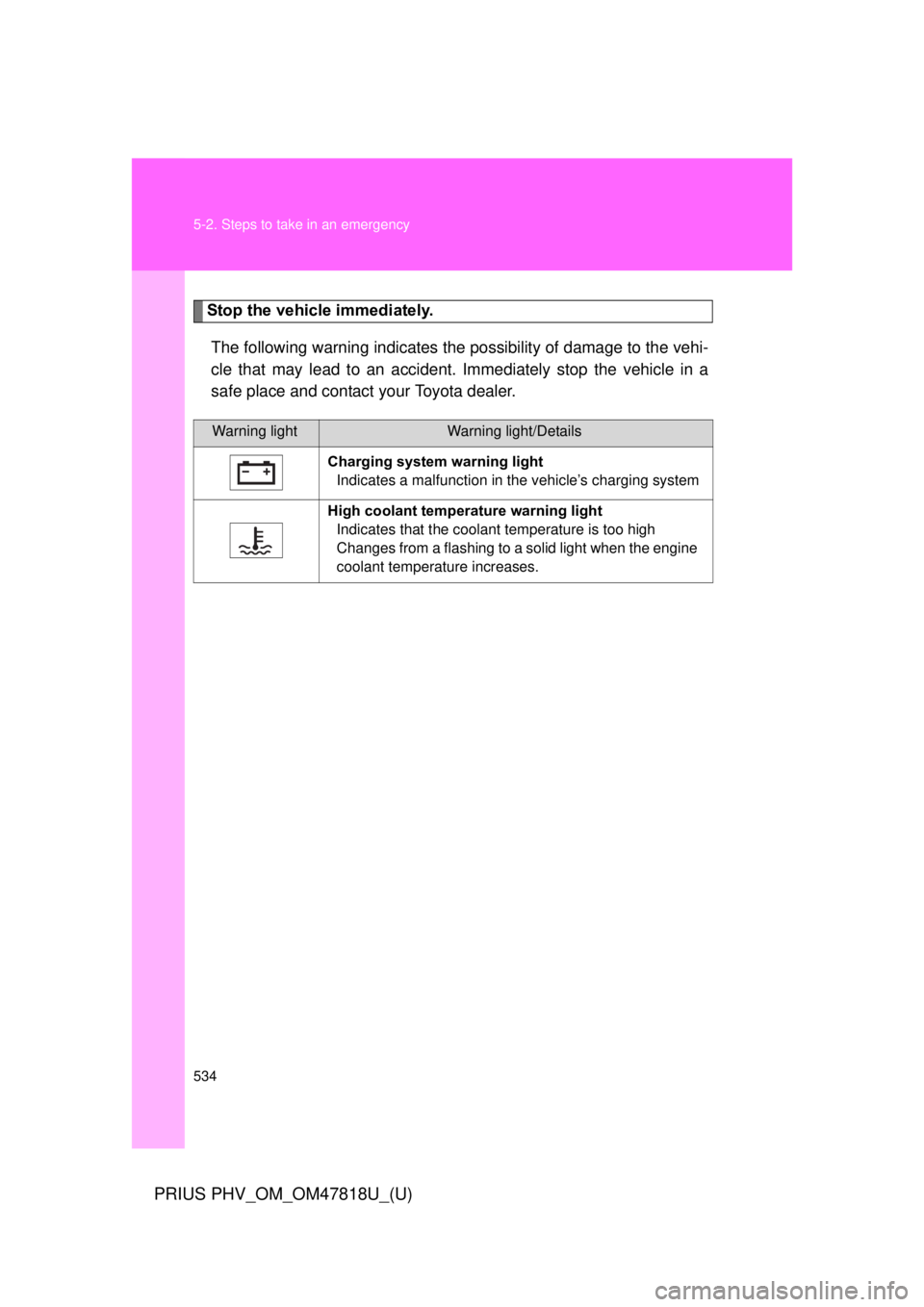
Stop the vehicle immediately.The following warning indicates the possibility of damage to the vehi-
cle that may lead to an accident. Immediately stop the vehicle in a
safe place and contact your Toyota dealer.
Warning lightWarning light/Details
Charging system warning light Indicates a malfunction in the vehicle’s charging system
High coolant temperature warning light Indicates that the coolant temperature is too high
Changes from a flashing to a solid light when the engine
coolant temperature increases.
Page 535 of 684
5
When trouble arises
535
5-2. Steps to take in an emergency
PRIUS PHV_OM_OM47818U_(U)
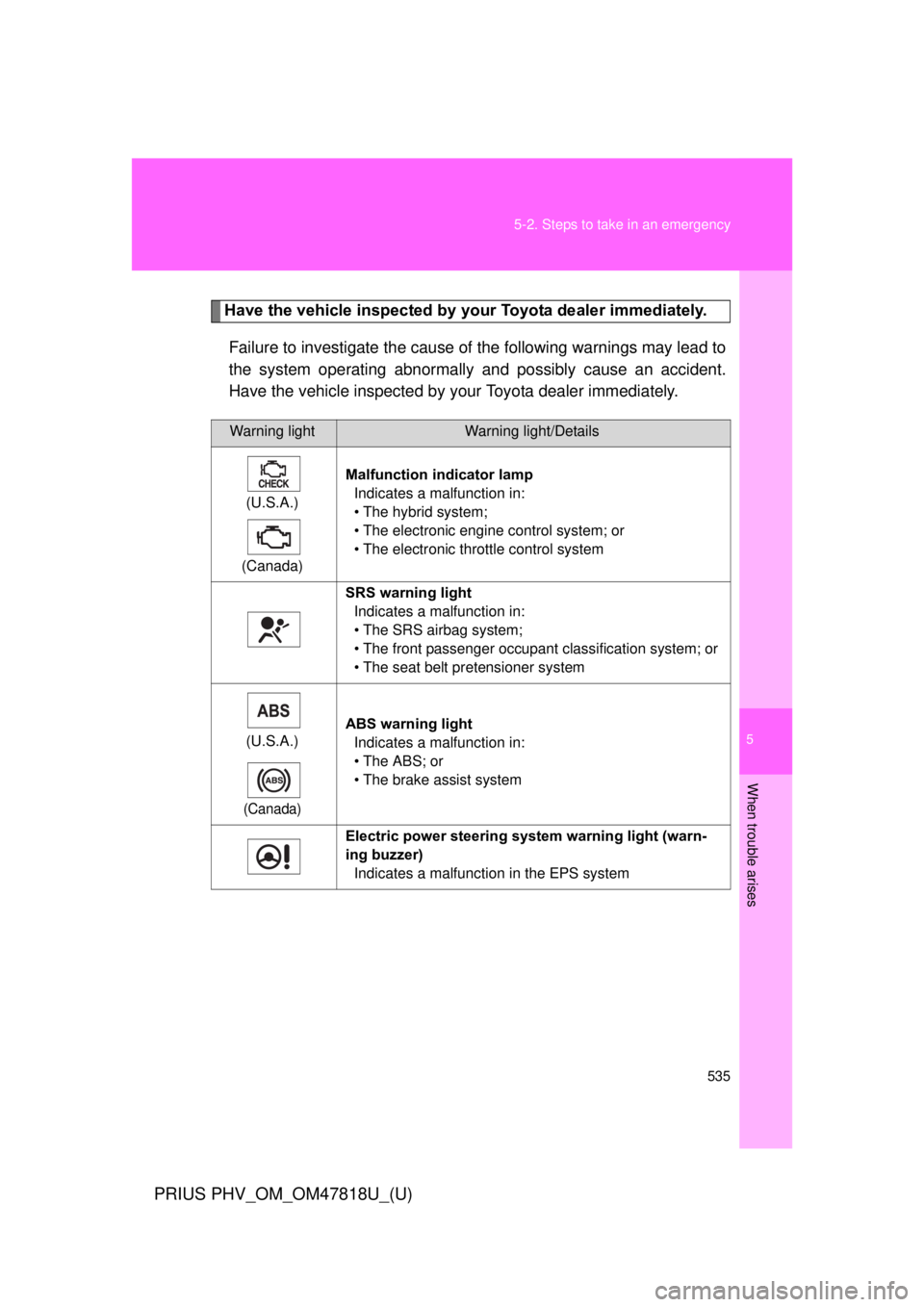
Have the vehicle inspected by your Toyota dealer immediately.
Failure to investigate the cause of the following warnings may lead to
the system operating abnormally and possibly cause an accident.
Have the vehicle inspected by your Toyota dealer immediately.
Warning lightWarning light/Details
(U.S.A.)
(Canada) Malfunction indicator lamp
Indicates a malfunction in:
• The hybrid system;
• The electronic engine control system; or
• The electronic throttle control system
SRS warning light Indicates a malfunction in:
• The SRS airbag system;
• The front passenger occupant classification system; or
• The seat belt pretensioner system
(U.S.A.)
(Canada)
ABS warning light Indicates a malfunction in:
• The ABS; or
• The brake assist system
Electric power steering syst em warning light (warn-
ing buzzer) Indicates a malfunction in the EPS system
Page 547 of 684
5
When trouble arises
547
5-2. Steps to take in an emergency
PRIUS PHV_OM_OM47818U_(U)
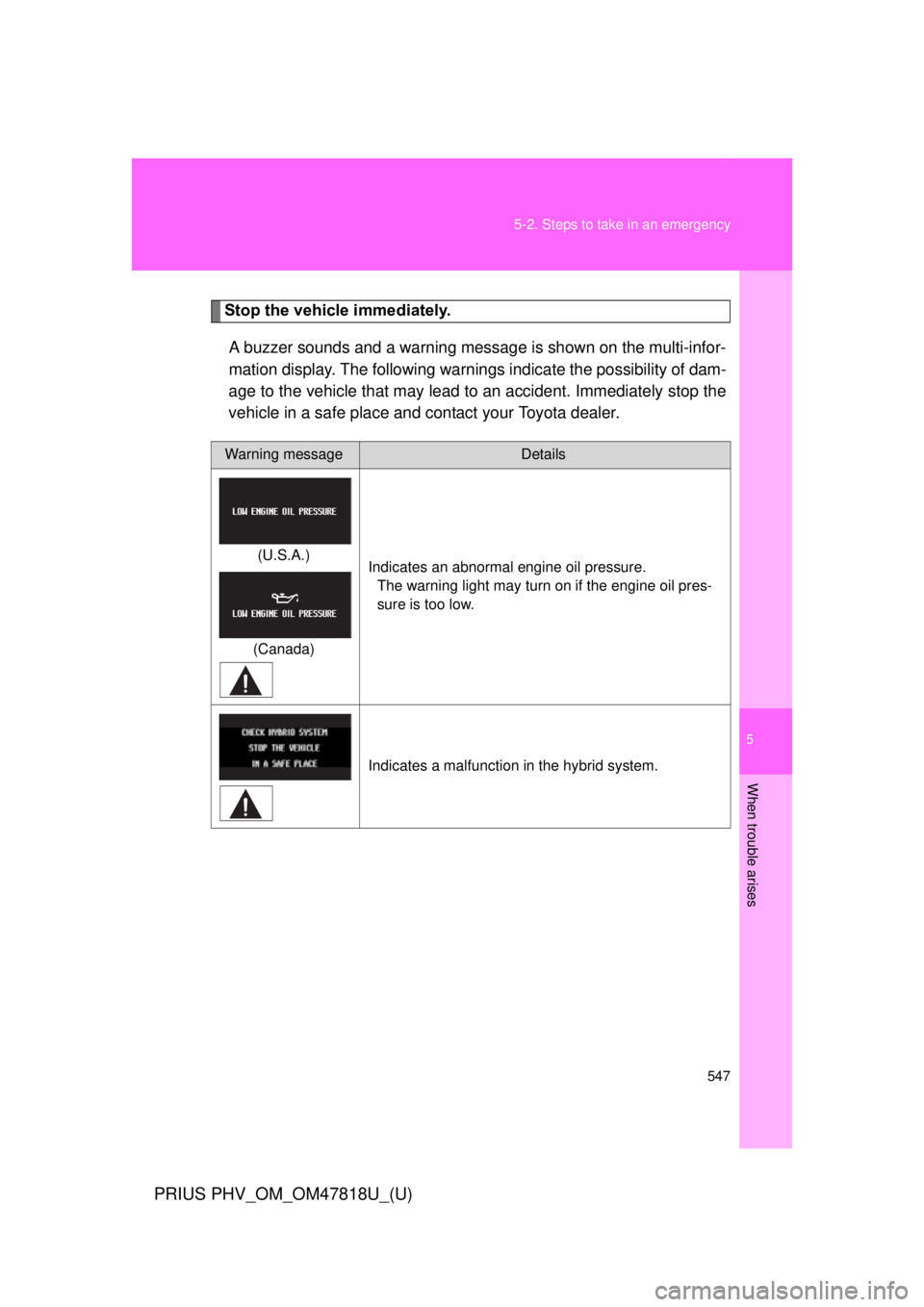
Stop the vehicle immediately.
A buzzer sounds and a warning message is shown on the multi-infor-
mation display. The following warnin gs indicate the possibility of dam-
age to the vehicle that may lead to an accident. Immediately stop the
vehicle in a safe place and contact your Toyota dealer.
Warning messageDetails
(U.S.A.)
(Canada) Indicates an abnormal engine oil pressure.
The warning light may turn on if the engine oil pres-
sure is too low.
Indicates a malfunction in the hybrid system.
Page 561 of 684
5
When trouble arises
561
5-2. Steps to take in an emergency
PRIUS PHV_OM_OM47818U_(U)
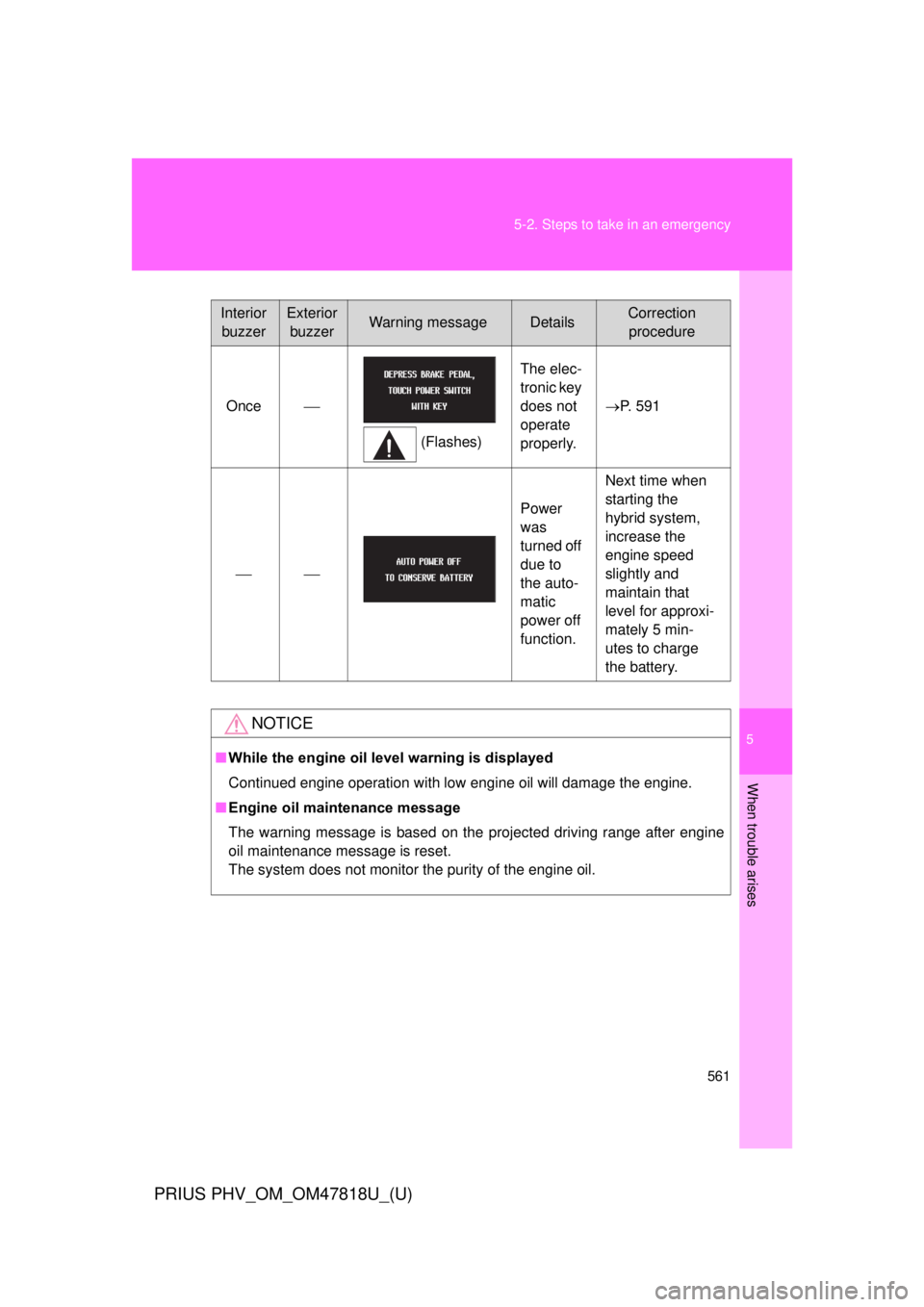
Interior
buzzerExterior buzzerWarning messageDetailsCorrection procedure
Once
(Flashes)The elec-
tronic key
does not
operate
properly.
P. 591
Power
was
turned off
due to
the auto-
matic
power off
function.Next time when
starting the
hybrid system,
increase the
engine speed
slightly and
maintain that
level for approxi-
mately 5 min-
utes to charge
the battery.
NOTICE
■
While the engine oil level warning is displayed
Continued engine operation with low engine oil will damage the engine.
■ Engine oil maintenance message
The warning message is based on the projected driving range after engine
oil maintenance message is reset.
The system does not monitor the purity of the engine oil.
Page 596 of 684
596 5-2. Steps to take in an emergency
PRIUS PHV_OM_OM47818U_(U)
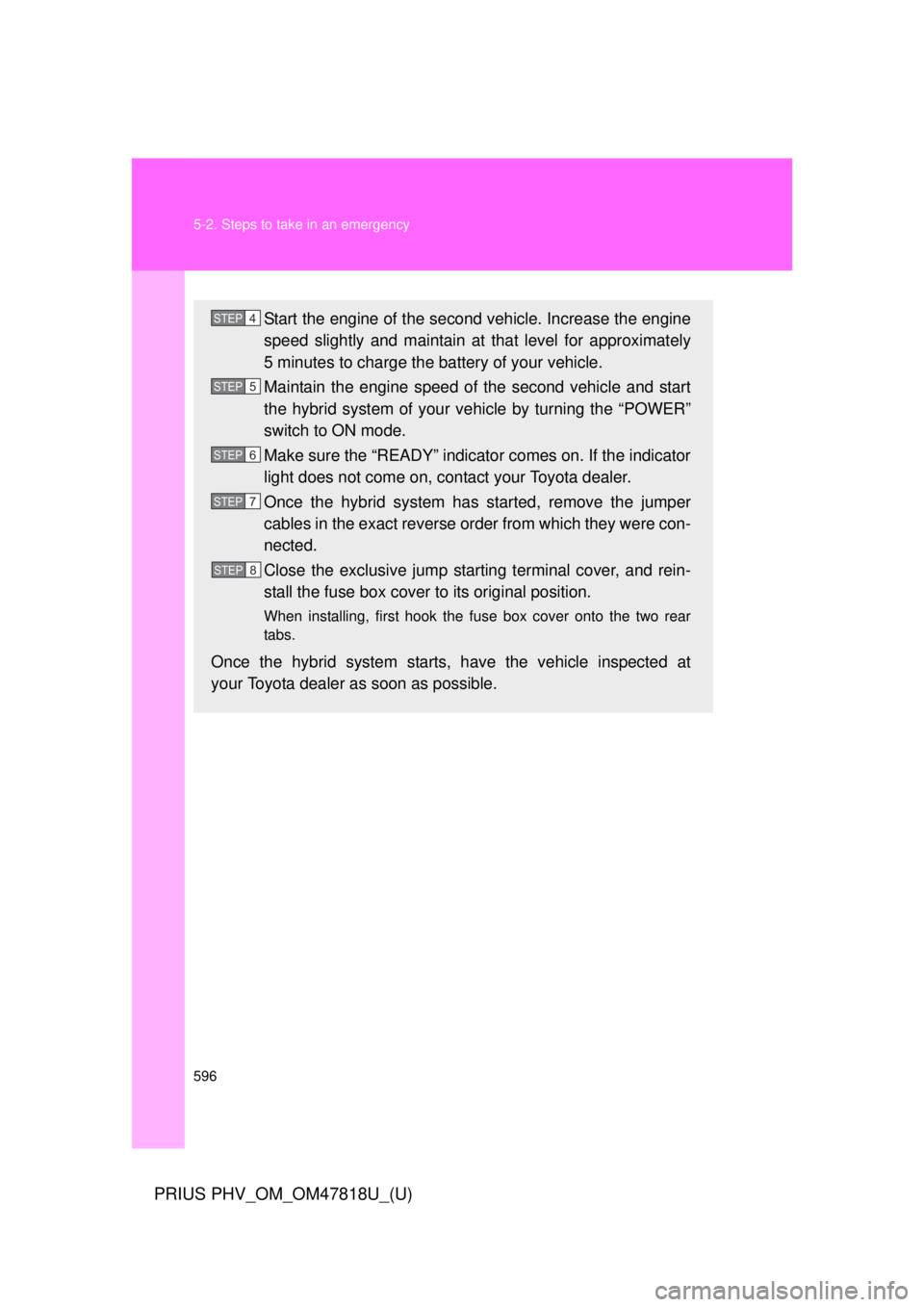
Start the engine of the second vehicle. Increase the engine
speed slightly and maintain at that level for approximately
5 minutes to charge the battery of your vehicle.
Maintain the engine speed of the second vehicle and start
the hybrid system of your ve hicle by turning the “POWER”
switch to ON mode.
Make sure the “READY” indicator comes on. If the indicator
light does not come on, contact your Toyota dealer.
Once the hybrid system has started, remove the jumper
cables in the exact reverse or der from which they were con-
nected.
Close the exclusive jump starting terminal cover, and rein-
stall the fuse box cover to its original position.
When installing, first hook the fuse box cover onto the two rear
tabs.
Once the hybrid system starts , have the vehicle inspected at
your Toyota dealer as soon as possible.
STEP 4
STEP 5
STEP 6
STEP7
STEP8
Page 604 of 684

604 5-2. Steps to take in an emergency
PRIUS PHV_OM_OM47818U_(U)
CAUTION
■To prevent an accident or injury when inspecting under the hood of
your vehicle
● If steam is seen coming from under the hood, do not open the hood until
the steam has subsided. The engine compartment may be very hot, caus-
ing serious injuries such as burns.
● Check that the indicator on the “POWER” switch and the “READY” indica-
tor are off.
● On hybrid vehicles, the gasoline engine may automatically start, or the
cooling fans may suddenly operate even if the gasoline engine stops. Do
not touch or approach rotating parts such as the fans, which may lead to
fingers or clothing (especially a tie, a scarf or a muffler) getting caught,
resulting in serious injury.
● Do not loosen the coolant reservoir cap while the hybrid system and radia-
tor are hot.
Serious injury, such as burns, may result from hot coolant and steam
released under pressure.
NOTICE
■When adding engine/power control unit coolant
Wait until the hybrid system has cooled down before adding engine/power
control unit coolant.
When adding coolant, do so slowly. Adding cool coolant to a hot hybrid sys-
tem too quickly can cause damage to the hybrid system.
■ To prevent damage to the cooling system
Observe the following precautions:
● Avoid contaminating the coolant with foreign matter (such as sand or dust
etc.)
● Do not use commercially available coolant additives
Page 612 of 684
612 6-1. Specifications
PRIUS PHV_OM_OM47818U_(U)
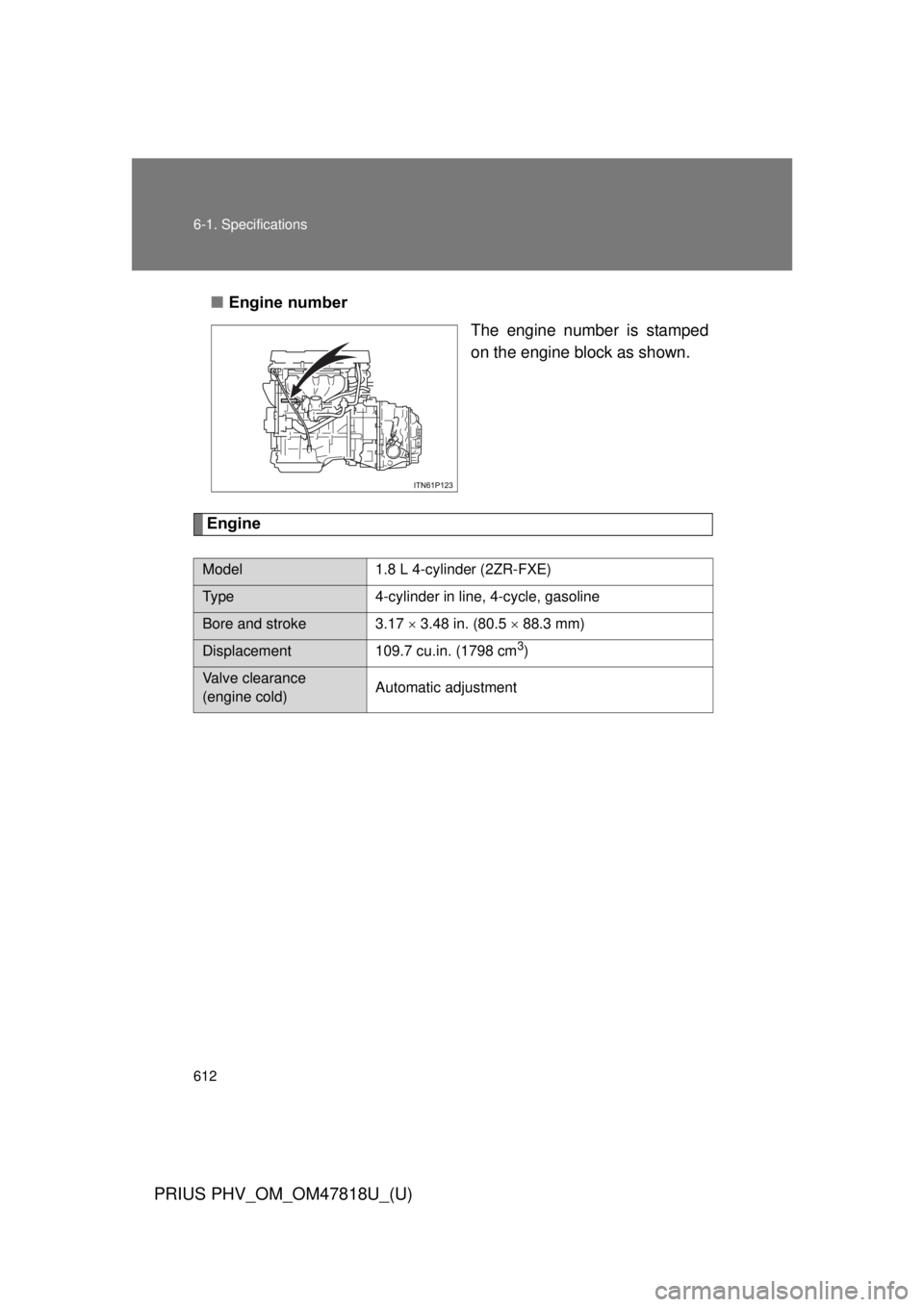
■Engine number
The engine number is stamped
on the engine block as shown.
Engine
Model1.8 L 4-cylinder (2ZR-FXE)
Type4-cylinder in line, 4-cycle, gasoline
Bore and stroke 3.17 3.48 in. (80.5 88.3 mm)
Displacement 109.7 cu.in. (1798 cm3)
Valve clearance
(engine cold) Automatic adjustment
Page 613 of 684
613
6-1. Specifications
6
Vehicle specifications
PRIUS PHV_OM_OM47818U_(U)
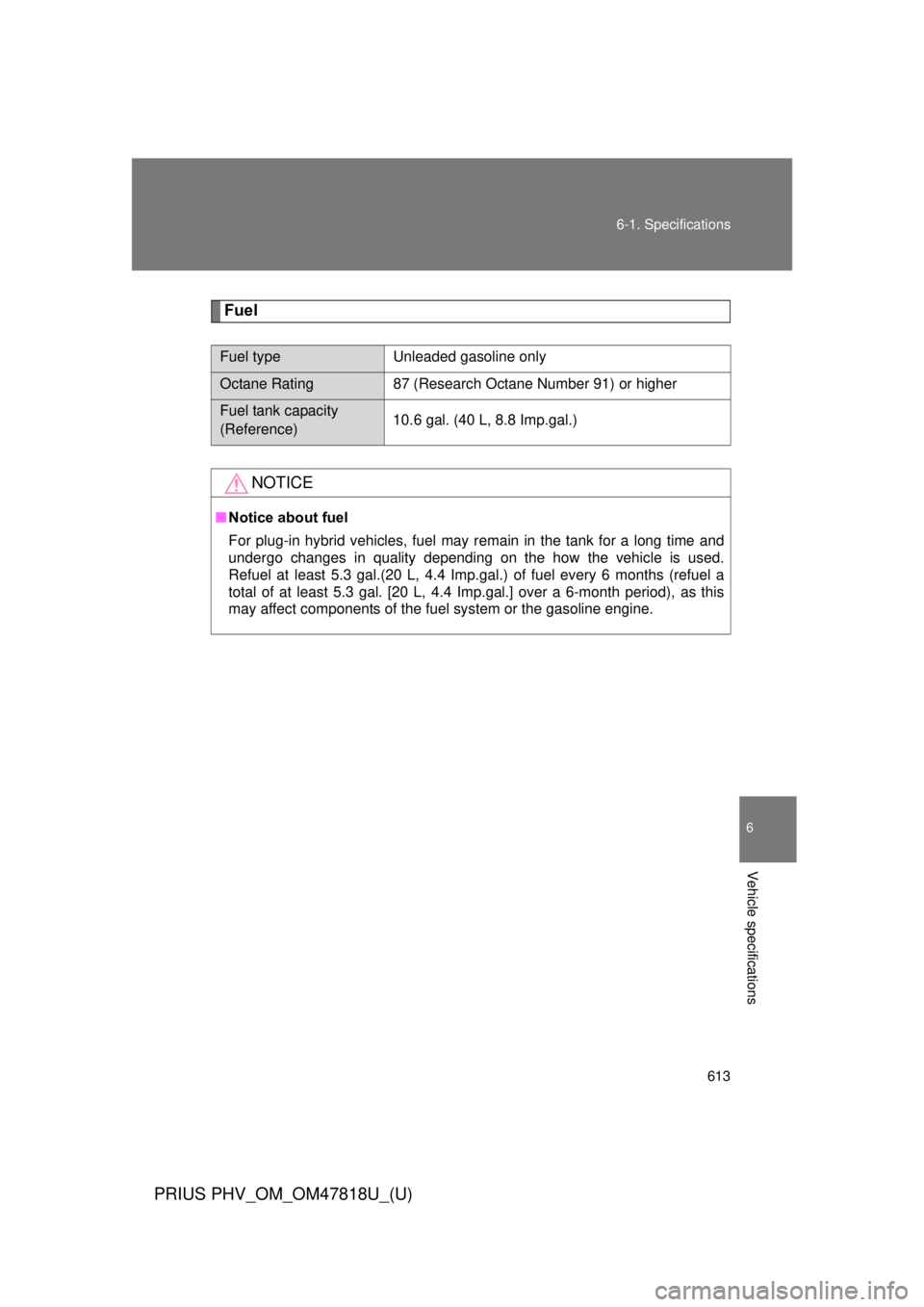
Fuel
Fuel typeUnleaded gasoline only
Octane Rating
87 (Research Octane Number 91) or higher
Fuel tank capacity
(Reference)10.6 gal. (40 L, 8.8 Imp.gal.)
NOTICE
■
Notice about fuel
For plug-in hybrid vehicles, fuel may remain in the tank for a long time and
undergo changes in quality depending on the how the vehicle is used.
Refuel at least 5.3 gal.(20 L, 4.4 Imp.gal.) of fuel every 6 months (refuel a
total of at least 5.3 gal. [20 L, 4.4 Imp.gal.] over a 6-month period), as this
may affect components of the fuel system or the gasoline engine.
Page 614 of 684
614 6-1. Specifications
PRIUS PHV_OM_OM47818U_(U)
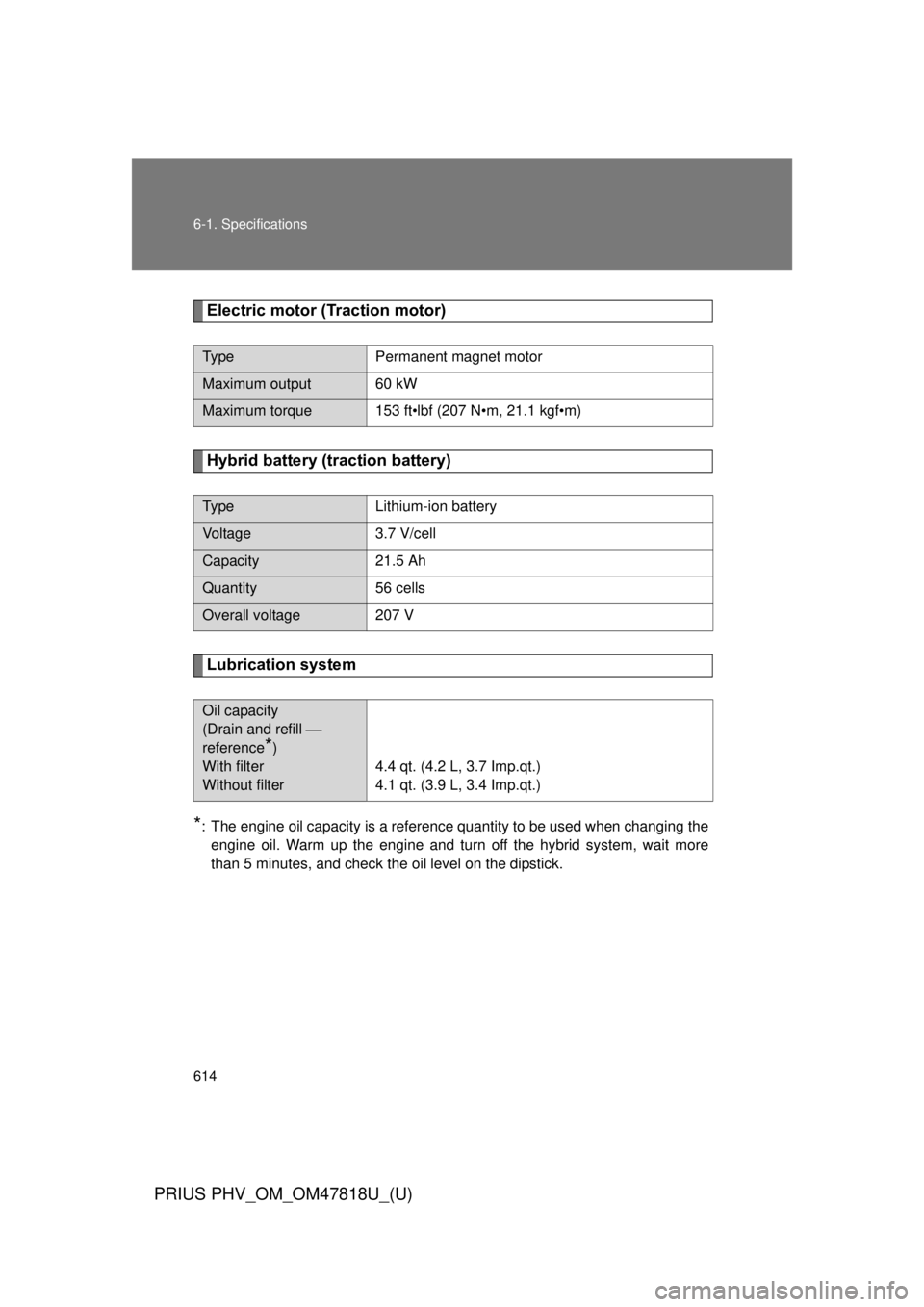
Electric motor (Traction motor)
Hybrid battery (traction battery)
Lubrication system
*: The engine oil capacity is a reference quantity to be used when changing theengine oil. Warm up the engine and turn off the hybrid system, wait more
than 5 minutes, and check the oil level on the dipstick.
Ty p ePermanent magnet motor
Maximum output 60 kW
Maximum torque 153 ft•lbf (207 N•m, 21.1 kgf•m)
Ty p eLithium-ion battery
Voltage 3.7 V/cell
Capacity21.5 Ah
Quantity 56 cells
Overall voltage 207 V
Oil capacity
(Drain and refill
reference
*)
With filter
Without filter
4.4 qt. (4.2 L, 3.7 Imp.qt.)
4.1 qt. (3.9 L, 3.4 Imp.qt.)
Page 615 of 684
615
6-1. Specifications
6
Vehicle specifications
PRIUS PHV_OM_OM47818U_(U)
■
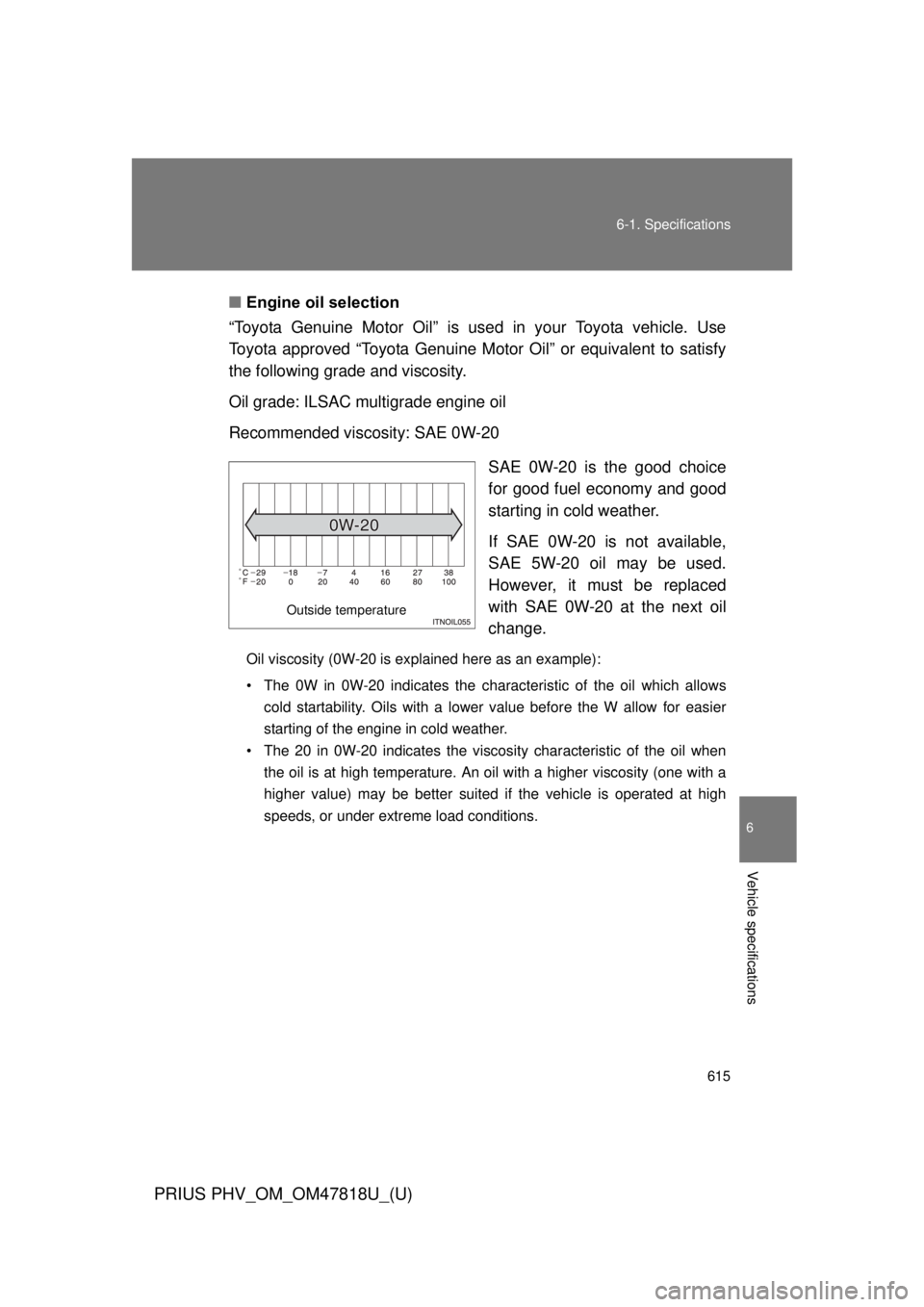
Engine oil selection
“Toyota Genuine Motor Oil” is used in your Toyota vehicle. Use
Toyota approved “Toyota Genuine Motor Oil” or equivalent to satisfy
the following grade and viscosity.
Oil grade: ILSAC multigrade engine oil
Recommended viscosity: SAE 0W-20
SAE 0W-20 is the good choice
for good fuel economy and good
starting in cold weather.
If SAE 0W-20 is not available,
SAE 5W-20 oil may be used.
However, it must be replaced
with SAE 0W-20 at the next oil
change.
Oil viscosity (0W-20 is explained here as an example):
• The 0W in 0W-20 indicates the characteristic of the oil which allowscold startability. Oils with a lower value before the W allow for easier
starting of the engine in cold weather.
• The 20 in 0W-20 indicates the viscosity characteristic of the oil when the oil is at high temperature. An oil with a higher viscosity (one with a
higher value) may be better suited if the vehicle is operated at high
speeds, or under extreme load conditions.
Outside temperature