engine TOYOTA PRIUS PLUG-IN HYBRID 2017 Repair Manual
[x] Cancel search | Manufacturer: TOYOTA, Model Year: 2017, Model line: PRIUS PLUG-IN HYBRID, Model: TOYOTA PRIUS PLUG-IN HYBRID 2017Pages: 744, PDF Size: 84.41 MB
Page 579 of 744
5797-3. Do-it-yourself maintenance
PRIUS PHV_OM_OM47A89E_(EE)
7
Maintenance and care
WARNING
■When adding washer fluid
Do not add washer fluid when the hybrid system is hot or operating as
washer fluid contains alcohol and may catch fire if spilled on the engine etc.
NOTICE
■ Do not use any fluid other than washer fluid
Do not use soapy water or engine antifreeze instead of washer fluid.
Doing so may cause streaking on the vehicle’s painted surfaces.
■ Diluting washer fluid
Dilute washer fluid with water as necessary.
Refer to the freezing temperatures list ed on the label of the washer fluid bot-
tle.
Page 619 of 744
6197-3. Do-it-yourself maintenance
PRIUS PHV_OM_OM47A89E_(EE)
7
Maintenance and care
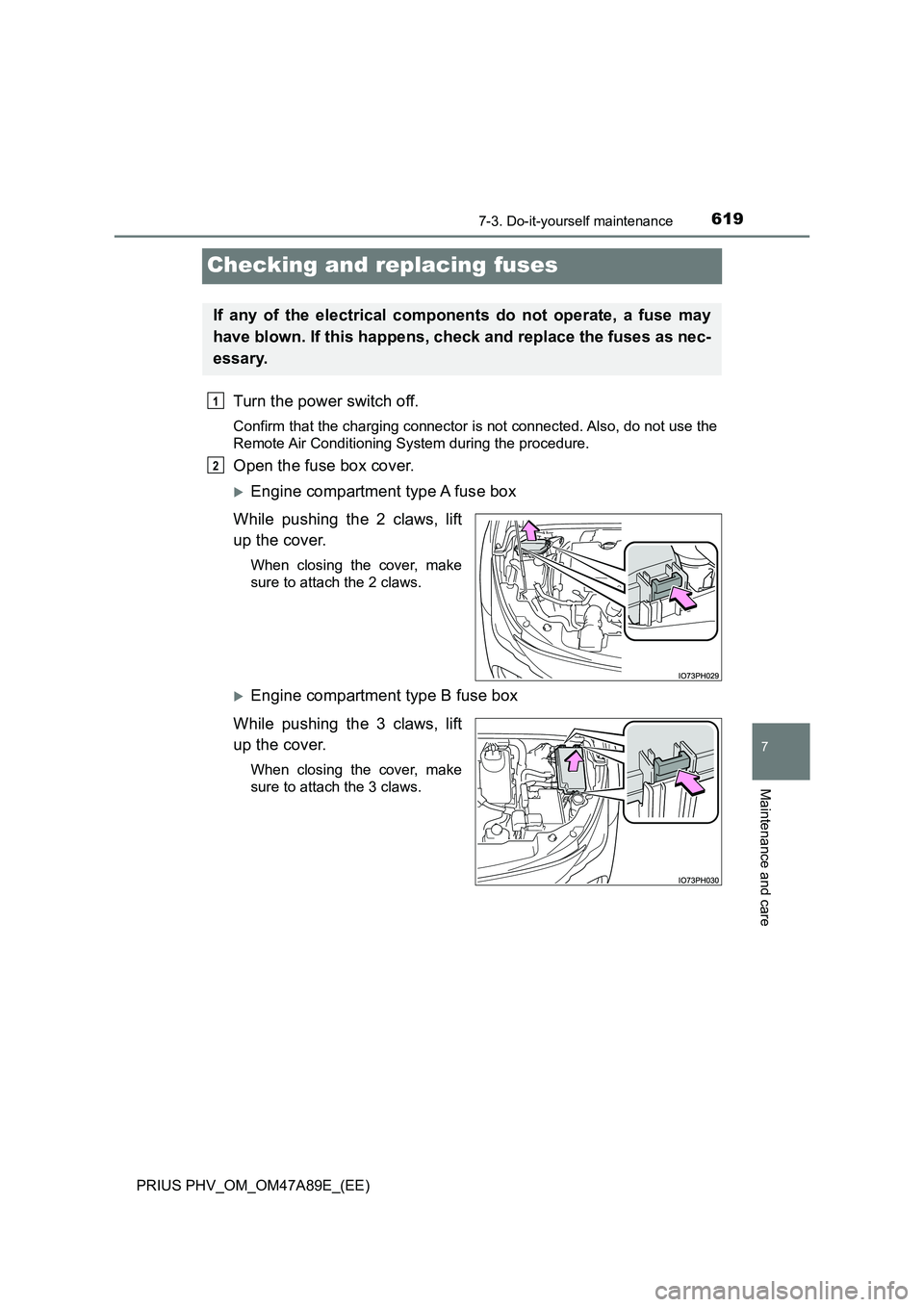
Checking and replacing fuses
Turn the power switch off.
Confirm that the charging connector is not connected. Also, do not use the
Remote Air Conditioning System during the procedure.
Open the fuse box cover.
Engine compartment type A fuse box
While pushing the 2 claws, lift
up the cover.
When closing the cover, make
sure to attach the 2 claws.
Engine compartment type B fuse box
While pushing the 3 claws, lift
up the cover.
When closing the cover, make
sure to attach the 3 claws.
If any of the electrical components do not operate, a fuse may
have blown. If this happens, check and replace the fuses as nec-
essary.
1
2
Page 640 of 744
6408-2. Steps to take in an emergency
PRIUS PHV_OM_OM47A89E_(EE)
If you think something is wrong
●Fluid leaks under the vehicle
(Water dripping from the air conditioning after use is normal.)
● Flat-looking tires or uneven tire wear
● High coolant temperature warning light flashes or comes on
● Changes in exhaust sound
● Excessive tire squeal when cornering
● Strange noises related to the suspension system
● Pinging or other noises related to the hybrid system
● Engine missing, stumbling or running roughly
● Appreciable loss of power
● Vehicle pulls heavily to one side when braking
● Vehicle pulls heavily to one side when driving on a level road
● Loss of brake effectiveness, spongy feeling, pedal almost touches
the floor
If you notice any of the following symptoms, your vehicle proba-
bly needs adjustment or repair. Contact any authorized Toyota
dealer or repairer, or another duly qualified and equipped pro-
fessional as soon as possible.
Visible symptoms
Audible symptoms
Operational symptoms
Page 642 of 744
6428-2. Steps to take in an emergency
PRIUS PHV_OM_OM47A89E_(EE)
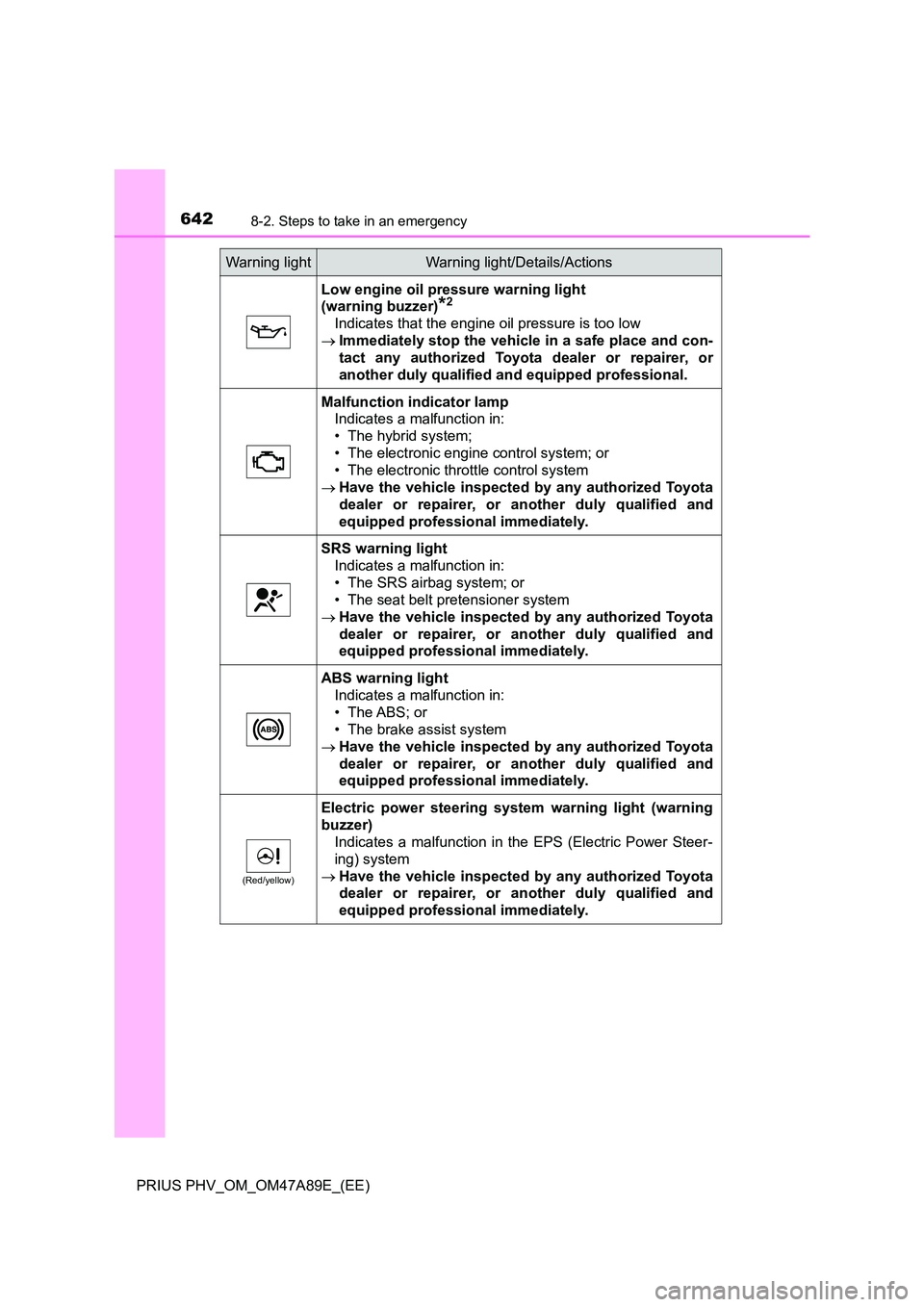
Low engine oil pressure warning light
(warning buzzer)*2
Indicates that the engine oil pressure is too low
Immediately stop the vehicle in a safe place and con-
tact any authorized Toyota dealer or repairer, or
another duly qualified and equipped professional.
Malfunction indicator lamp
Indicates a malfunction in:
• The hybrid system;
• The electronic engine control system; or
• The electronic throttle control system
Have the vehicle inspected by any authorized Toyota
dealer or repairer, or another duly qualified and
equipped professional immediately.
SRS warning light
Indicates a malfunction in:
• The SRS airbag system; or
• The seat belt pretensioner system
Have the vehicle inspected by any authorized Toyota
dealer or repairer, or another duly qualified and
equipped professional immediately.
ABS warning light
Indicates a malfunction in:
• The ABS; or
• The brake assist system
Have the vehicle inspected by any authorized Toyota
dealer or repairer, or another duly qualified and
equipped professional immediately.
(Red/yellow)
Electric power steering system warning light (warning
buzzer)
Indicates a malfunction in the EPS (Electric Power Steer-
ing) system
Have the vehicle inspected by any authorized Toyota
dealer or repairer, or another duly qualified and
equipped professional immediately.
Warning lightWarning light/Details/Actions
Page 644 of 744
6448-2. Steps to take in an emergency
PRIUS PHV_OM_OM47A89E_(EE)
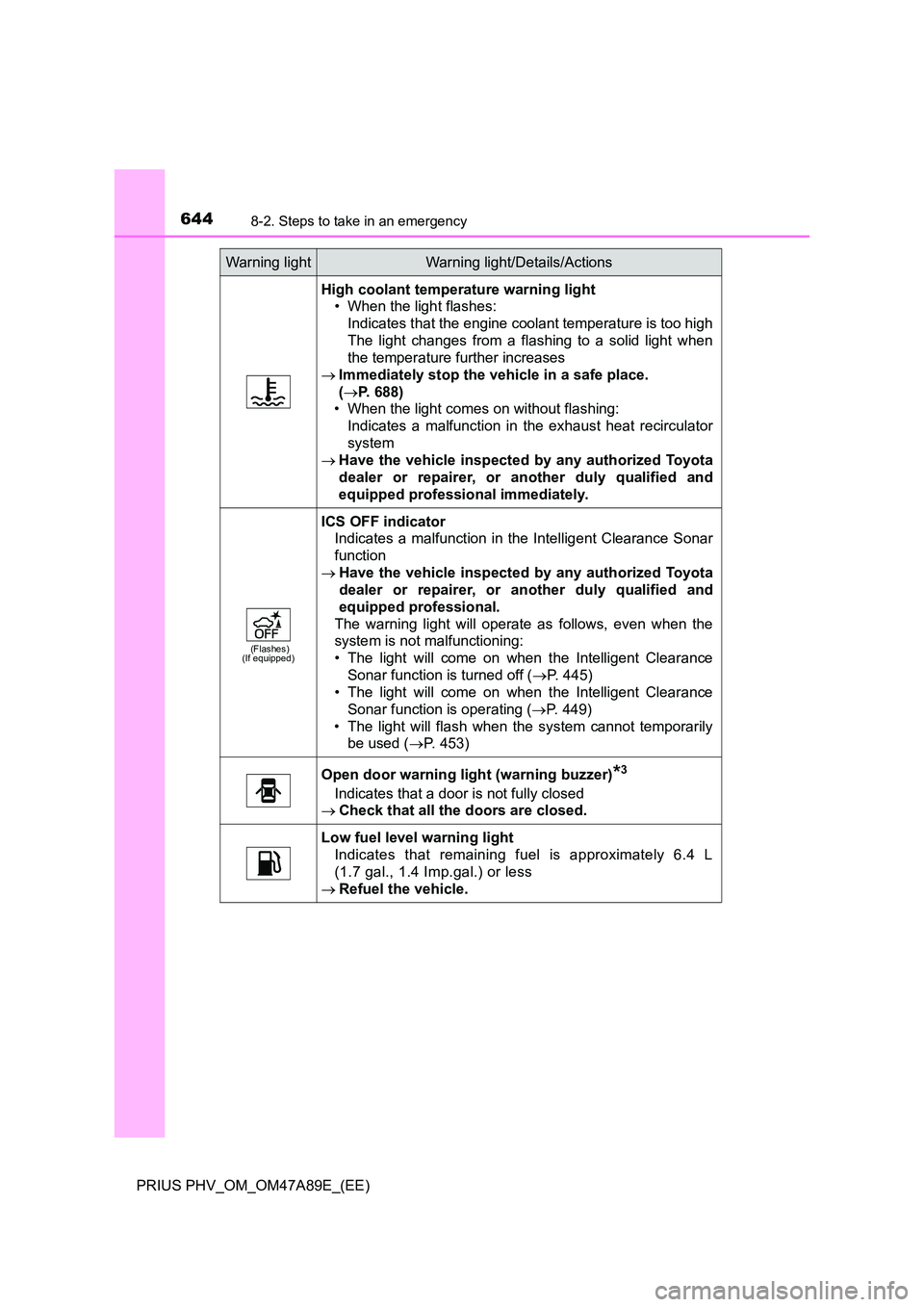
High coolant temperature warning light
• When the light flashes:
Indicates that the engine coolant temperature is too high
The light changes from a flashing to a solid light when
the temperature further increases
Immediately stop the vehicle in a safe place.
( P. 688)
• When the light comes on without flashing:
Indicates a malfunction in the exhaust heat recirculator
system
Have the vehicle inspected by any authorized Toyota
dealer or repairer, or another duly qualified and
equipped professional immediately.
(Flashes) (If equipped)
ICS OFF indicator
Indicates a malfunction in the Intelligent Clearance Sonar
function
Have the vehicle inspected by any authorized Toyota
dealer or repairer, or another duly qualified and
equipped professional.
The warning light will operate as follows, even when the
system is not malfunctioning:
• The light will come on when the Intelligent Clearance
Sonar function is turned off ( P. 445)
• The light will come on when the Intelligent Clearance
Sonar function is operating ( P. 449)
• The light will flash when the system cannot temporarily
be used ( P. 453)
Open door warning light (warning buzzer)*3
Indicates that a door is not fully closed
Check that all the doors are closed.
Low fuel level warning light
Indicates that remaining fuel is approximately 6.4 L
(1.7 gal., 1.4 Imp.gal.) or less
Refuel the vehicle.
Warning lightWarning light/Details/Actions
Page 647 of 744
6478-2. Steps to take in an emergency
PRIUS PHV_OM_OM47A89E_(EE)
8
When trouble arises
*1: Brake system warning buzzer:
When there is a possible problem that could affect braking performance,
the warning light will come on and a warning buzzer will sound.
*2: Low engine oil pressure warning buzzer:
A buzzer also sounds continuously for approximately 30 seconds at maxi-
mum in addition to the low engine oil pressure warning light when the
“READY” indicator is illuminated.
*3: Open door warning buzzer:
The open door warning buzzer sounds to alert one or more of the doors is
not fully closed (with the vehicle having reached a speed of 5 km/h
[3 mph]).
*4: Seat belt warning buzzer:
The seat belt warning buzzer sounds to alert the driver, front passenger
and rear passengers that his or her seat belt is not fastened. The buzzer
sounds intermittently for 30 seconds after the vehicle reaches a speed of
20 km/h (12 mph). Then, if the seat belt is still unfastened, the buzzer will
sound in a different tone for 90 more seconds.
*5: This symbol is displayed on the multi-information display.
■ Front passenger detection sensor, seat belt reminder and warning
buzzer
● If luggage is placed on the front passenger seat, the front passenger detec-
tion sensor may cause the warning light to flash and the warning buzzer to
sound even if a passenger is not sitting in the seat.
● If a cushion is placed on the seat, the sensor may not detect a passenger,
and the warning light may not operate properly.
■ Electric power steering system warning light (warning buzzer)
When the 12-volt battery charge becomes insufficient or the voltage tempo-
rarily drops, the electric power steering system warning light may come on
and the warning buzzer may sound.
■ If the malfunction indicator lamp comes on while driving
The malfunction indicator lamp will come on if the fuel tank becomes com-
pletely empty. If the fuel tank is empt y, refuel the vehicle immediately. The
malfunction indicator lamp will go off after several trips.
If the malfunction indicator lamp does not go off, contact any authorized
Toyota dealer or repairer, or another duly qualified and equipped professional
as soon as possible.
Page 653 of 744
6538-2. Steps to take in an emergency
PRIUS PHV_OM_OM47A89E_(EE)
8
When trouble arises
■If “See Owner’s Manual” is shown
● If “Braking Power Low Stop in a Safe Place See Owner’s Manual” is shown,
this may be a malfunction. Immediately stop the vehicle in a safe place and
contact any authorized Toyota dealer or repairer, or another duly qualified
and equipped professional. Continuing to drive the vehicle may be danger-
ous.
● If “Engine Oil Pressure Low” is shown, this may be a malfunction. Immedi-
ately stop the vehicle in a safe place and contact any authorized Toyota
dealer or repairer, or another duly qualified and equipped professional.
● If the following messages are shown, there may be a malfunction. Immedi-
ately have the vehicle inspected by any authorized Toyota dealer or repairer,
or another duly qualified and equipped professional.
• “Plug-in charging system malfunction.”
• “Hybrid System Malfunction”
• “Check Engine”
• “Hybrid Battery System Malfunction”
• “Accelerator System Malfunction”
• “Smart Entry & Start System Malfunction See Owner’s Manual”
■ If “Shift System Not Active Apply Parking Brake Securely While Parking
See Owner’s Manual” is shown
Indicates a temporary operation failure or malfunction in the shift control sys-
tem. Immediately have the vehicle inspected by any authorized Toyota dealer
or repairer, or another duly qualified and equipped professional.
When the message is shown, the hybrid system may not be started or the
shift position may not be changed normally. (Coping method: P. 656)
■ If “Shift System Malfunction Apply Parking Brake Securely While Park-
ing See Owner’s Manual” is shown
Indicates a malfunction in the shift control system. Immediately have the vehi-
cle inspected by any authorized Toyota dealer or repairer, or another duly
qualified and equipped professional.
When the message is shown, the hybrid system may not be started or the
shift position may not be changed normally. (Coping method: P. 656)
■ If “ Switch Malfunction Apply Parking Brake Securely While Parking
See Owner’s Manual” is shown
The P position switch may not operate. Immediately have the vehicle
inspected by any authorized Toyota dealer or repairer, or another duly quali-
fied and equipped professional.
When parking the vehicle, stop the vehicle on level ground and apply the
parking brake firmly.
Page 682 of 744
6828-2. Steps to take in an emergency
PRIUS PHV_OM_OM47A89E_(EE)
If the 12-volt battery is discharged
If you have a set of jumper (or booster) cables and a second vehicle
with a 12-volt battery, you can jump start your vehicle by following the
steps below.
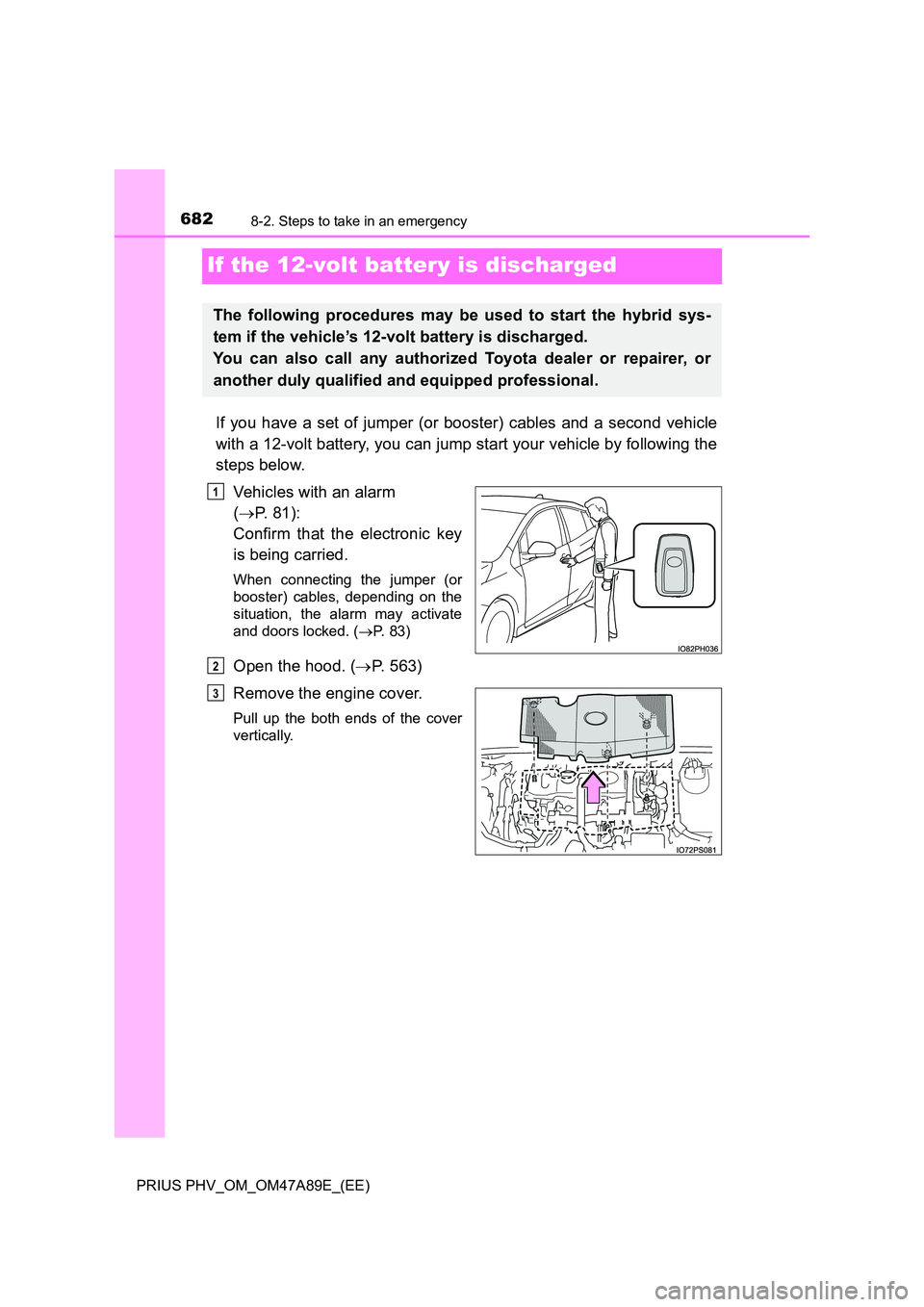
Vehicles with an alarm
( P. 8 1 ) :
Confirm that the electronic key
is being carried.
When connecting the jumper (or
booster) cables, depending on the
situation, the alarm may activate
and doors locked. ( P. 83)
Open the hood. (P. 563)
Remove the engine cover.
Pull up the both ends of the cover
vertically.
The following procedures may be used to start the hybrid sys-
tem if the vehicle’s 12-volt battery is discharged.
You can also call any authorized Toyota dealer or repairer, or
another duly qualified and equipped professional.
1
2
3
Page 683 of 744
6838-2. Steps to take in an emergency
PRIUS PHV_OM_OM47A89E_(EE)
8
When trouble arises
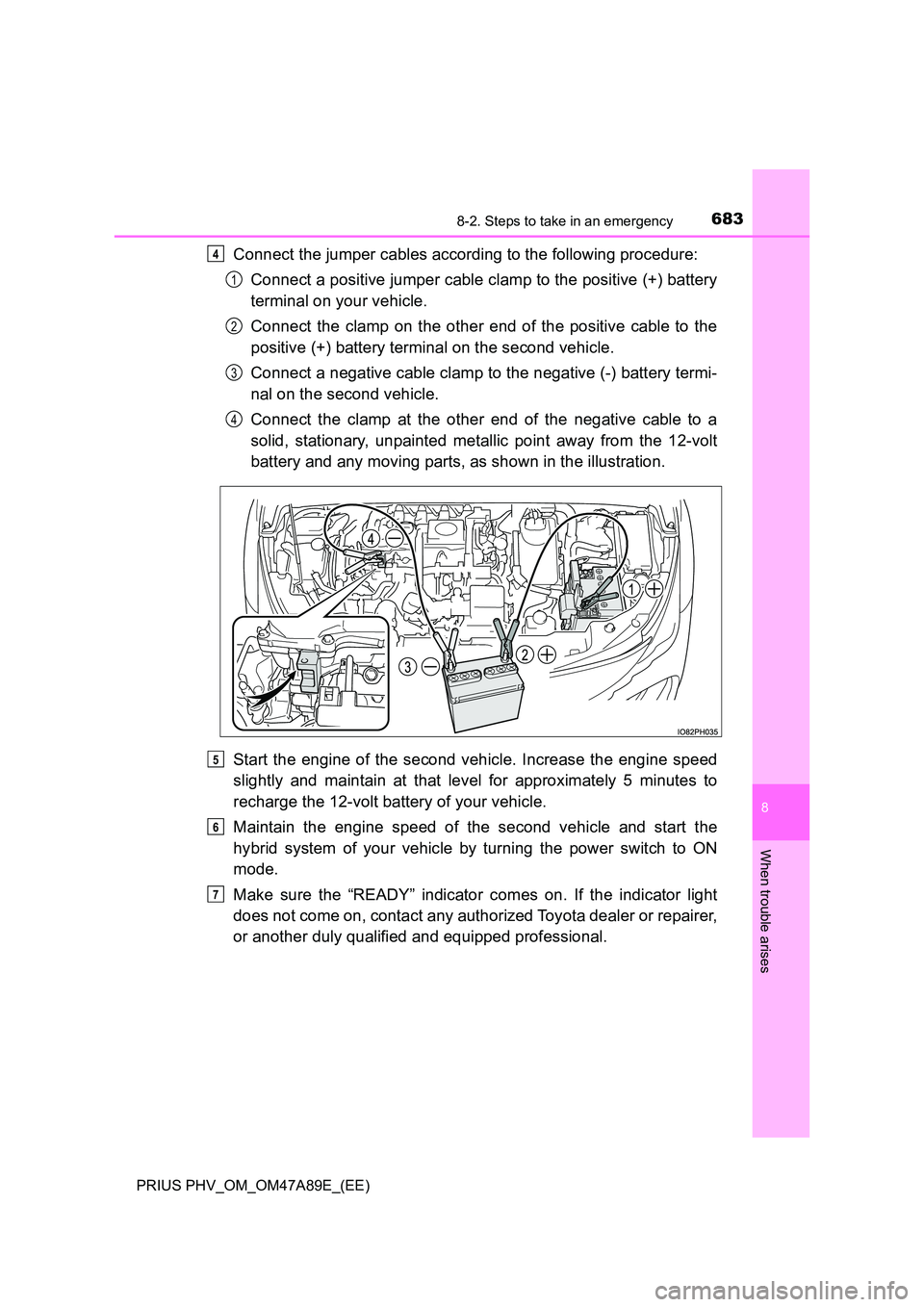
Connect the jumper cables according to the following procedure:
Connect a positive jumper cable clamp to the positive (+) battery
terminal on your vehicle.
Connect the clamp on the other end of the positive cable to the
positive (+) battery terminal on the second vehicle.
Connect a negative cable clamp to the negative (-) battery termi-
nal on the second vehicle.
Connect the clamp at the other end of the negative cable to a
solid, stationary, unpainted metallic point away from the 12-volt
battery and any moving parts, as shown in the illustration.
Start the engine of the second vehicle. Increase the engine speed
slightly and maintain at that level for approximately 5 minutes to
recharge the 12-volt battery of your vehicle.
Maintain the engine speed of the second vehicle and start the
hybrid system of your vehicle by turning the power switch to ON
mode.
Make sure the “READY” indicator comes on. If the indicator light
does not come on, contact any authorized Toyota dealer or repairer,
or another duly qualified and equipped professional.
4
1
2
3
4
5
6
7
Page 684 of 744
6848-2. Steps to take in an emergency
PRIUS PHV_OM_OM47A89E_(EE)
Once the hybrid system has started, remove the jumper cables in
the exact reverse order from which they were connected.
To install the engine cover, conduct the removal procedure in
reverse. After installing, check that the fixed pins are inserted
securely.
Once the hybrid system starts, have the vehicle inspected at any
authorized Toyota dealer or repairer, or another duly qualified and
equipped professional as soon as possible.
■ When opening the cover of the positive (+) battery terminal
P. 575
■ Starting the hybrid system when the 12-volt battery is discharged
The hybrid system cannot be started by push-starting.
■ To prevent 12-volt battery discharge
● Turn off the headlights and the audio system while the hybrid system is off.
● Turn off any unnecessary electrical components when the vehicle is running
at a low speed for an extended period, such as in heavy traffic.
■ When the 12-volt battery is removed or discharged
● Information stored in the ECU is cleared. When the 12-volt battery is
depleted, have the vehicle inspected at any authorized Toyota dealer or
repairer, or another duly qualified and equipped professional.
● Some systems may require initialization. (P. 717)
■ When removing the 12-volt battery terminals
When the 12-volt battery terminals are removed, the information stored in the
ECU is cleared. Before removing the 12-volt battery terminals, contact any
authorized Toyota dealer or repairer, or another duly qualified and equipped
professional.
■ Charging the 12-volt battery
The electricity stored in the 12-volt battery will discharge gradually even when
the vehicle is not in use, due to natural discharge and the draining effects of
certain electrical appliances. If the vehicle is left for a long time, the 12-volt
battery may discharge, and the hybrid system may be unable to start. (The
12-volt battery recharges automatically while the hybrid system is operating.)
8
9