warning TOYOTA PRIUS PLUS 2015 Owners Manual
[x] Cancel search | Manufacturer: TOYOTA, Model Year: 2015, Model line: PRIUS PLUS, Model: TOYOTA PRIUS PLUS 2015Pages: 496, PDF Size: 20.27 MB
Page 431 of 496
4317-2. Steps to take in an emergency
PRIUS +_OM_OM47B16E_(EE)
7
When trouble arises
WARNING
■ Do not drive the vehicle with a flat tire
Do not continue driving with a flat tire.
Driving even a short distance with a flat tire can damage the tire and the
wheel beyond repair.
Driving with a flat tire may cause a circumferential groove on the side wall.
In such a case, the tire may explode when using a repair kit.
■ Caution while driving
●Store the repair kit in the luggage compartment.
Injuries may result in the event of an accident or sudden braking.
● The repair kit is exclusively only for your vehicle.
Do not use repair kit on other vehicles, which could lead to an accident
causing death or serious injury.
● Do not use repair kit for tires that are different size than the original ones,
or for any other purpose. If the tires have not been completely repaired, it
could lead to an accident causing death or serious injury.
■ Precautions for use of the sealant
●Ingesting the sealant is hazardous to your health. If you ingest sealant,
consume as much water as possible, and then immediately consult a doc-
tor.
● If sealant gets in eyes or adheres to skin, immediately wash it off with
water. If discomfort persists, consult a doctor.
Page 432 of 496
4327-2. Steps to take in an emergency
PRIUS +_OM_OM47B16E_(EE)
WARNING
■ When fixing the flat tire
●Stop your vehicle in a safe and flat area.
● Do not touch the wheels or the area around the brakes immediately after
the vehicle has been driven.
After the vehicle has been driven, the wheels and the area around the
brakes may be extremely hot. Touching these areas with hands, feet or
other body parts may result in burns.
● Connect the valve and hose securely with the tire installed on the vehicle.
If the hose is not properly connected to the valve, air leakage may occur
as sealant may be sprayed out.
● If the hose comes off the valve while inflating the tire, there is a risk that
the hose will move abruptly due to air pressure.
● After inflation of the tire has completed, the sealant may splatter when the
hose is disconnected or some air is let out of the tire.
● Follow the operation procedure to repair the tire. If the procedures not fol-
lowed, the sealant may spray out.
● Keep back from the tire while it is being repaired, as there is a chance of it
bursting while the repair operation is being performed. If you notice any
cracks or deformation of the tire, turn off the compressor switch and stop
the repair operation immediately.
● The repair kit may overheat if operated for a long period of time. Do not
operate the repair kit continuously for more than 40 minutes.
● Parts of the repair kit become hot during operation. Be careful handling the
repair kit during and after operation. Do not touch the metal part connect-
ing the bottle and the compressor. It will be extremely hot.
● Do not attach the vehicle speed warning sticker to an area other than the
one indicated. If the sticker is attached to an area where an SRS airbag is
located, such as the pad of the steering wheel, it may prevent the SRS air-
bag from operating properly.
Page 433 of 496
4337-2. Steps to take in an emergency
PRIUS +_OM_OM47B16E_(EE)
7
When trouble arises
WARNING
■ Driving to spread the liquid sealant evenly
Observe the following precautions to reduce the risk of accidents.
Failing to do so may result in a loss of vehicle control and cause death or
serious injury.
●Drive the vehicle carefully at a low speed. Be especially careful when turn-
ing and cornering.
● If the vehicle does not drive straight or you feel a pull through the steering
wheel, stop the vehicle and check the following.
• Tire condition. The tire may have separated from the wheel.
• Tire inflation pressure. If the tire inflation pressure is 130 kPa (1.3 kgf/
cm
2 or bar, 19 psi) or less, the tire may be severely damaged.
Page 434 of 496
4347-2. Steps to take in an emergency
PRIUS +_OM_OM47B16E_(EE)NOTICE
■
When performing an emergency repair
●A tire should only be repaired with the emergency tire puncture repair kit if
the damage is caused by a sharp object such as nail or screw passing
through the tire tread.
Do not remove the sharp object from the tire. Removing the object may
widen the opening and disenable emergency repair with the repair kit.
● The repair kit is not waterproof. Make sure that the repair kit is not
exposed to water, such as when it is being used in the rain.
● Do not put the repair kit directly onto dusty ground such as sand at the
side of the road. If the repair kit vacuums up dust etc., a malfunction may
occur.
■ Precautions for the emergency tire puncture repair kit
●The repair kit power source should be 12 V DC suitable for vehicle use. Do
not connect the repair kit to any other source.
● If fuel splatters on the repair kit, the repair kit may deteriorate. Take care
not to allow fuel to contact it.
● Place the repair kit in a storage to prevent it from being exposed to dirt or
water.
● Store the repair kit in the luggage compartment out of reach of children.
● Do not disassemble or modify the repair kit. Do not subject parts such as
the air pressure indicator to impacts. This may cause a malfunction.
■ To avoid damage to the tire pressure warning valves and transmitters
When a tire is repaired with liquid sealants, the tire pressure warning valve
and transmitter may not operate properly. If a liquid sealant is used, contact
any authorized Toyota dealer or repairer, or another duly qualified and
equipped professional or other qualified service shop as soon as possible.
Make sure to replace the tire pres sure warning valve and transmitter when
replacing the tire. ( →P. 332)
Page 442 of 496
4427-2. Steps to take in an emergency
PRIUS +_OM_OM47B16E_(EE)■
Charging the 12-volt battery
The electricity stored in the 12-volt battery will discharge gradually even when
the vehicle is not in use, due to natural discharge and the draining effects of
certain electrical appliances. If the vehicle is left for a long time, the 12-volt
battery may discharge, and the hybrid system may be unable to start. (The
12-volt battery recharges automatically while the hybrid system is operating.)
WARNING
■ Avoiding 12-volt battery fires or explosions
Observe the following precautions to prevent accidentally igniting the flam-
mable gas that may be emitted from the 12-volt battery:
● Make sure each jumper cable is connected to the correct terminal and that
it is not unintentionally in contact with any other than the intended terminal.
● Do not allow the other end of the jumper cable connected to the “+” termi-
nal to come into contact with any other parts or metal surfaces in the area,
such as brackets or unpainted metal.
● Do not allow the + and - clamps of the jumper cables to come into contact
with each other.
● Do not smoke, use matches, cigarette lighters or allow open flame near
the 12-volt battery.
■ 12-volt battery precautions
The 12-volt battery contains poisonous and corrosive acidic electrolyte,
while related parts contain lead and lead compounds. Observe the following
precautions when handling the 12-volt battery:
●When working with the 12-volt battery , always wear safety glasses and
take care not to allow any battery fluids (acid) to come into contact with
skin, clothing or the vehicle body.
● Do not lean over the 12-volt battery.
● In the event that battery fluid comes into contact with the skin or eyes,
immediately wash the affected area with water and seek medical attention.
Place a wet sponge or cloth over the affected area until medical attention
can be received.
● Always wash your hands after handling the 12-volt battery support, termi-
nals, and other battery-related parts.
● Do not allow children near the 12-volt battery.
Page 443 of 496
4437-2. Steps to take in an emergency
PRIUS +_OM_OM47B16E_(EE)
7
When trouble arises
WARNING
■ After recharging the 12-volt battery
Have the 12-volt battery inspected at any authorized Toyota dealer or
repairer, or another duly qualified and equipped professional as soon as
possible.
If the 12-volt battery is deteriorating, continued use may cause the 12-volt
battery to emit a malodorous gas, which may be detrimental to the health of
passengers.
■ When replacing the 12-volt battery
→ P. 330
NOTICE
■ When handling jumper cables
When connecting the jumper cables, ensure that they do not become entan-
gled in the cooling fans, etc.
■ To prevent damaging the vehicle
The exclusive jump starting terminal is to be used when charging the 12-volt
battery from another vehicle in an emergency. It cannot be used to jump
start another vehicle.
Page 444 of 496
4447-2. Steps to take in an emergency
PRIUS +_OM_OM47B16E_(EE)
If your vehicle overheats
■If the high coolant temperature warning light comes on or
flashesStop the vehicle in a safe place and turn off the air conditioning
system, and then stop the hybrid system.
If you see steam:
Carefully lift the hood after the steam subsides.
If you do not see steam:
Carefully lift the hood.
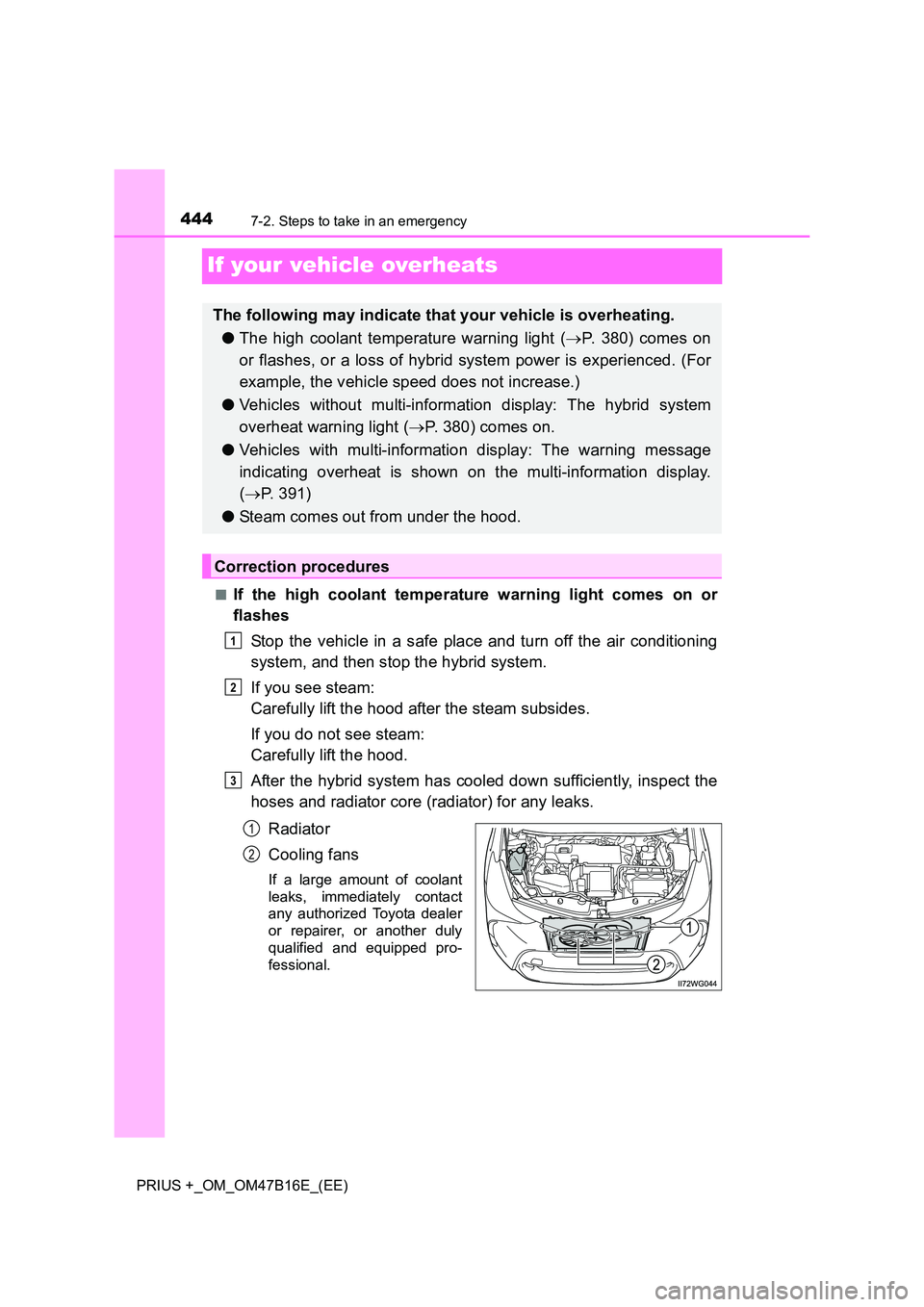
After the hybrid system has cooled down sufficiently, inspect the
hoses and radiator core (radiator) for any leaks.
Radiator
Cooling fans
If a large amount of coolant
leaks, immediately contact
any authorized Toyota dealer
or repairer, or another duly
qualified and equipped pro-
fessional.
The following may indicate that your vehicle is overheating.● The high coolant temperature warning light ( →P. 380) comes on
or flashes, or a loss of hybrid system power is experienced. (For
example, the vehicle speed does not increase.)
● Vehicles without multi-information display: The hybrid system
overheat warning light ( →P. 380) comes on.
● Vehicles with multi-information display: The warning message
indicating overheat is shown on the multi-information display.
(→ P. 391)
● Steam comes out from under the hood.
Correction procedures
1
2
3
1
2
Page 446 of 496
4467-2. Steps to take in an emergency
PRIUS +_OM_OM47B16E_(EE)■
If the hybrid system overheat warning light comes on or the
warning message indicating overheat is shown on the multi-
information display
Stop the vehicle in a safe place.
Stop the hybrid system and carefully lift the hood.
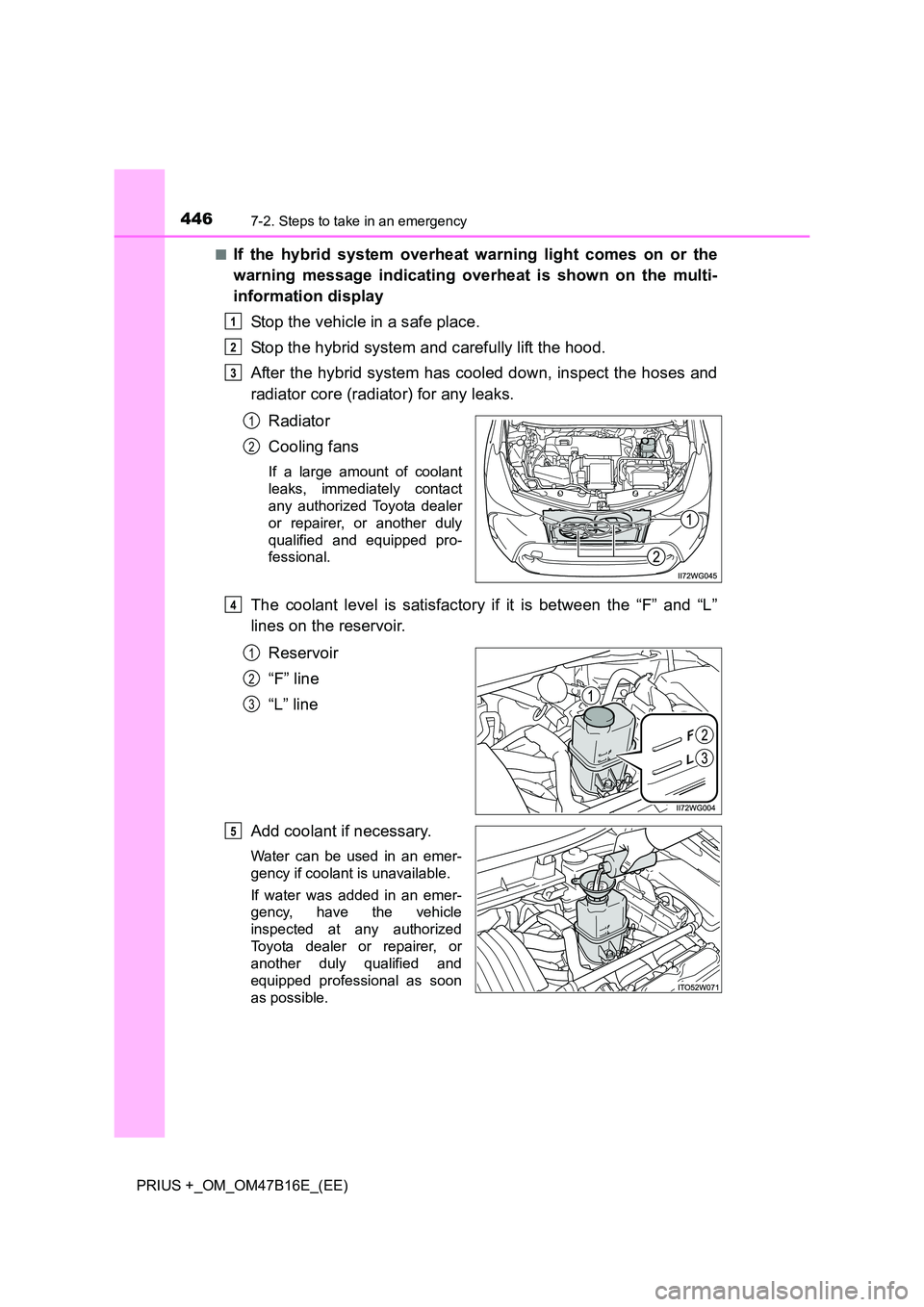
After the hybrid system has cooled down, inspect the hoses and
radiator core (radiator) for any leaks.
Radiator
Cooling fans
If a large amount of coolant
leaks, immediately contact
any authorized Toyota dealer
or repairer, or another duly
qualified and equipped pro-
fessional.
The coolant level is satisfactory if it is between the “F” and “L”
lines on the reservoir.
Reservoir
“F” line
“L” line
Add coolant if necessary.
Water can be used in an emer-
gency if coolant is unavailable.
If water was added in an emer-
gency, have the vehicle
inspected at any authorized
Toyota dealer or repairer, or
another duly qualified and
equipped professional as soon
as possible.
1
2
3
1
2
4
1
2
3
5
Page 447 of 496
4477-2. Steps to take in an emergency
PRIUS +_OM_OM47B16E_(EE)
7
When trouble arises
After stopping the hybrid system and waiting for 5 minutes or
more, start the hybrid system and check for the instrument clus-
ter or multi-information display.
If the hybrid system overheat warning light does not turn off or
the message does not disappear:
Stop the hybrid system and contact any authorized Toyota dealer
or repairer, or another duly qualified and equipped professional.
If the hybrid system overheat warning light does not come on or
the message is not displayed:
The hybrid system temperature has dropped and the vehicle may
be driven normally.
However, if the warning light comes on again frequently or the message
appears again frequently, contact any authorized Toyota dealer or
repairer, or another duly qualified and equipped professional.
WARNING
■ When inspecting under the hood of your vehicle
Observe the following precautions.
Failure to do so may result in serious injury such as burns.
●If steam is seen coming from under the hood, do not open the hood until
the steam has subsided. The engine compartment may be very hot.
● After the hybrid system has been turned off, check that the indicator on the
power switch and the “READY” indicator are off.
When the hybrid system is operating, the gasoline engine may automati-
cally start, or the cooling fan may suddenly operate even if the gasoline
engine stops. Do not touch or approach rotating parts such as the fan,
which may lead to fingers or clothing (especially a tie, a scarf or a muffler)
getting caught, resulting in serious injury.
● Do not loosen the coolant reservoir cap while the hybrid system and radia-
tor are hot.
High temperature steam or coolant could spray out.
6
Page 449 of 496
4497-2. Steps to take in an emergency
PRIUS +_OM_OM47B16E_(EE)
7
When trouble arises
If the vehicle becomes stuck
Set the parking brake and shift the shift position to P. Stop the
hybrid system.
Remove the mud, snow or sand from around the stuck tire.
Place wood, stones or some other material under the tires to help
provide traction.
Restart the hybrid system.
Shift the shift position to D or R, release the parking brake and
carefully apply the accelerator to free the vehicle.
Carry out the following procedures if the tires spin or the vehicle
becomes stuck in mud, dirt or snow:
WARNING
■ When attempting to free a stuck vehicle
If you choose to push the vehicle back and forth to free it, make sure the
surrounding area is clear to avoid striking other vehicles, objects or people.
The vehicle may also lunge forward or lunge back suddenly as it becomes
free. Use extreme caution.
■ When changing the shift position
Be careful not to change the shift position with the accelerator pedal
depressed.
Changing the shift position to any positions other than P or N may cause the
vehicle to accelerate abruptly, causing an accident and resulting in death or
serious injury.
NOTICE
■To avoid damage to the hybrid transmission and other components
●Avoid spinning the wheels and depressing the accelerator pedal more
than necessary.
● If the vehicle remains stuck even after these procedures are performed,
the vehicle may require towing to be freed.
1
2
3
4
5