ECU TOYOTA PRIUS PLUS 2017 User Guide
[x] Cancel search | Manufacturer: TOYOTA, Model Year: 2017, Model line: PRIUS PLUS, Model: TOYOTA PRIUS PLUS 2017Pages: 509, PDF Size: 27.68 MB
Page 47 of 509
471-1. For safe use
1
PRIUS +_OM_OM47B24E_(EE)
For safety and security
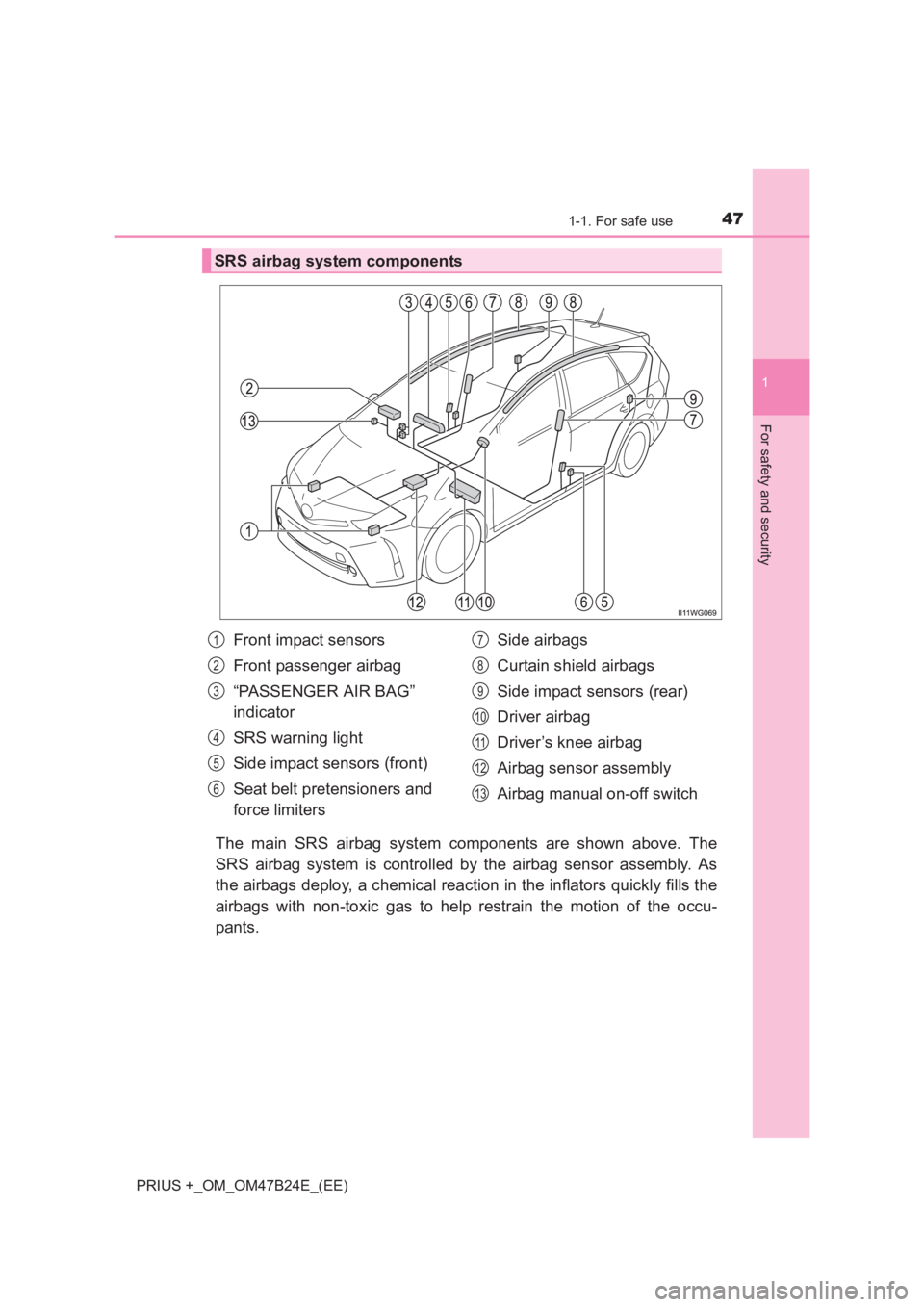
The main SRS airbag system components are shown above. The
SRS airbag system is controlled by the airbag sensor assembly. As
the airbags deploy, a chemical reaction in the inflators quickly fills the
airbags with non-toxic gas to help restrain the motion of the occu-
pants.
SRS airbag system components
Front impact sensors
Front passenger airbag
“PASSENGER AIR BAG”
indicator
SRS warning light
Side impact sensors (front)
Seat belt pretensioners and
force limitersSide airbags
Curtain shield airbags
Side impact sensors (rear)
Driver airbag
Driver’s knee airbag
Airbag sensor assembly
Airbag manual on-off switch1
2
3
4
5
6
7
8
9
10
11
12
13
Page 48 of 509
481-1. For safe use
PRIUS +_OM_OM47B24E_(EE)
WARNING
■ SRS airbag precautions
Observe the following precautions regarding the SRS airbags.
Failure to do so may cause death or serious injury.
●The driver and all passengers in the v ehicle must wear their seat belts
properly.
The SRS airbags are supplemental devices to be used with the seat belts.
● The SRS driver airbag deploys with considerable force, and can cause
death or serious injury especially if the driver is very close to the airbag.
Since the risk zone for the driver’s airbag is the first 50 - 75 mm (2 - 3 in.)
of inflation, placing yourself 250 mm ( 10 in.) from your driver airbag pro-
vides you with a clear margin of safety. This distance is measured from
the center of the steering wheel to your breastbone. If you sit less than
250 mm (10 in.) away now, you can change your driving position in sev-
eral ways:
• Move your seat to the rear as far as you can while still reaching the ped- als comfortably.
• Slightly recline the back of the seat. Although vehicle designs vary, many drivers can achieve the 250 mm
(10 in.) distance, even with the driver seat all the way forward, simply by
reclining the back of the seat somewhat. If reclining the back of your
seat makes it hard to see the road, raise yourself by using a firm, non-
slippery cushion, or raise the seat if your vehicle has that feature.
• If your steering wheel is adjustable, tilt it downward. This points the air- bag toward your chest instead of your head and neck.
The seat should be adjusted as recommended above, while still maintaining
control of the foot pedals, steering wheel, and your view of the instrument
panel controls.
● The SRS front passenger airbag also deploys with considerable force, and
can cause death or serious injury especially if the front passenger is very
close to the airbag. The front passenger seat should be as far from the air-
bag as possible with the seatback adjusted, so the front passenger sits
upright.
● Improperly seated and/or restrained infants and children can be killed or
seriously injured by a deploying airbag. An infant or child who is too small
to use a seat belt should be properly secured using a child restraint sys-
tem. Toyota strongly recommends that all infants and children be placed in
the rear seats of the vehicle and proper ly restrained. The rear seats are
safer for infants and children than the front passenger seat. ( →P. 59)
Page 49 of 509
491-1. For safe use
1
PRIUS +_OM_OM47B24E_(EE)
For safety and security
WARNING
■ SRS airbag precautions
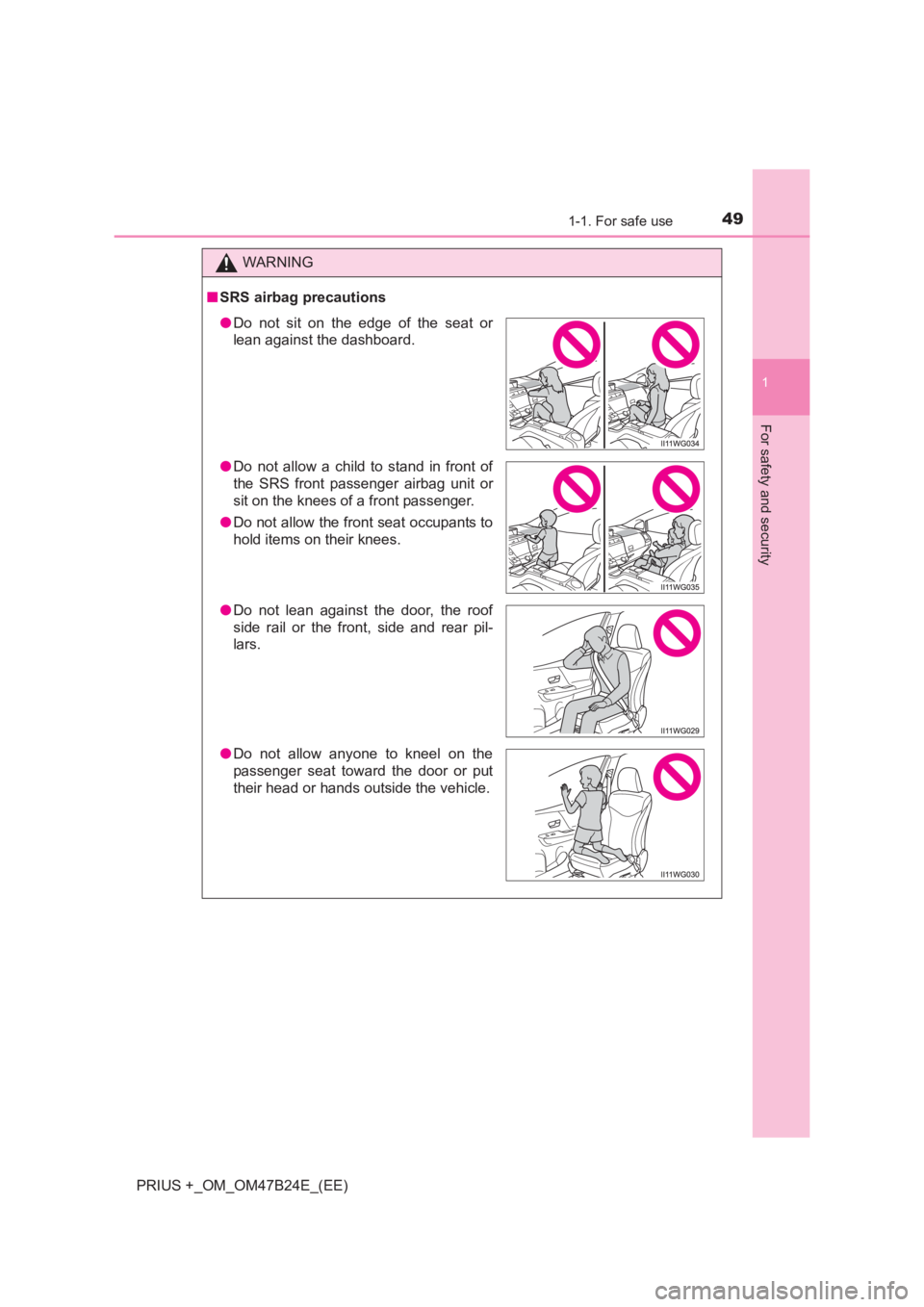
●Do not sit on the edge of the seat or
lean against the dashboard.
● Do not allow a child to stand in front of
the SRS front passenger airbag unit or
sit on the knees of a front passenger.
● Do not allow the front seat occupants to
hold items on their knees.
● Do not lean against the door, the roof
side rail or the front, side and rear pil-
lars.
● Do not allow anyone to kneel on the
passenger seat toward the door or put
their head or hands outside the vehicle.
Page 51 of 509
511-1. For safe use
1
PRIUS +_OM_OM47B24E_(EE)
For safety and security
WARNING
■ SRS airbag precautions
●If breathing becomes difficult after the SRS airbags have deployed, open a
door or window to allow fresh air in, or leave the vehicle if it is safe to do
so. Wash off any residue as soon as possible to prevent skin irritation.
● If the areas where the SRS airbags ar e stored, such as the steering wheel
pad and front and rear pillar garni shes, are damaged or cracked, have
them replaced by any authorized Toyota dealer or repairer, or another duly
qualified and equipped professional.
■ Modification and disposal of SRS airbag system components
Do not dispose of your vehicle or perform any of the following modifications
without consulting any authorized Toyota dealer or repairer, or another duly
qualified and equipped professional. The SRS airbags may malfunction or
deploy (inflate) accidentally, causing death or serious injury.
●Installation, removal, disassembly and repair of the SRS airbags
● Repairs, modifications, removal or replacement of the steering wheel,
instrument panel, dashboard, seats or seat upholstery, front, side and rear
pillars or roof side rails
● Repairs or modifications of the front fender, front bumper, or side of the
occupant compartment
● Installation of a grille guard (bull bar s, kangaroo bar, etc.), snow plows or
winches
● Modifications to the vehicle’s suspension system
● Installation of electronic devices such as mobile two-way radios (RF-trans-
mitter) and CD players
● Modifications to your vehicle for a person with a physical disability
Page 53 of 509
531-1. For safe use
1
PRIUS +_OM_OM47B24E_(EE)
For safety and security
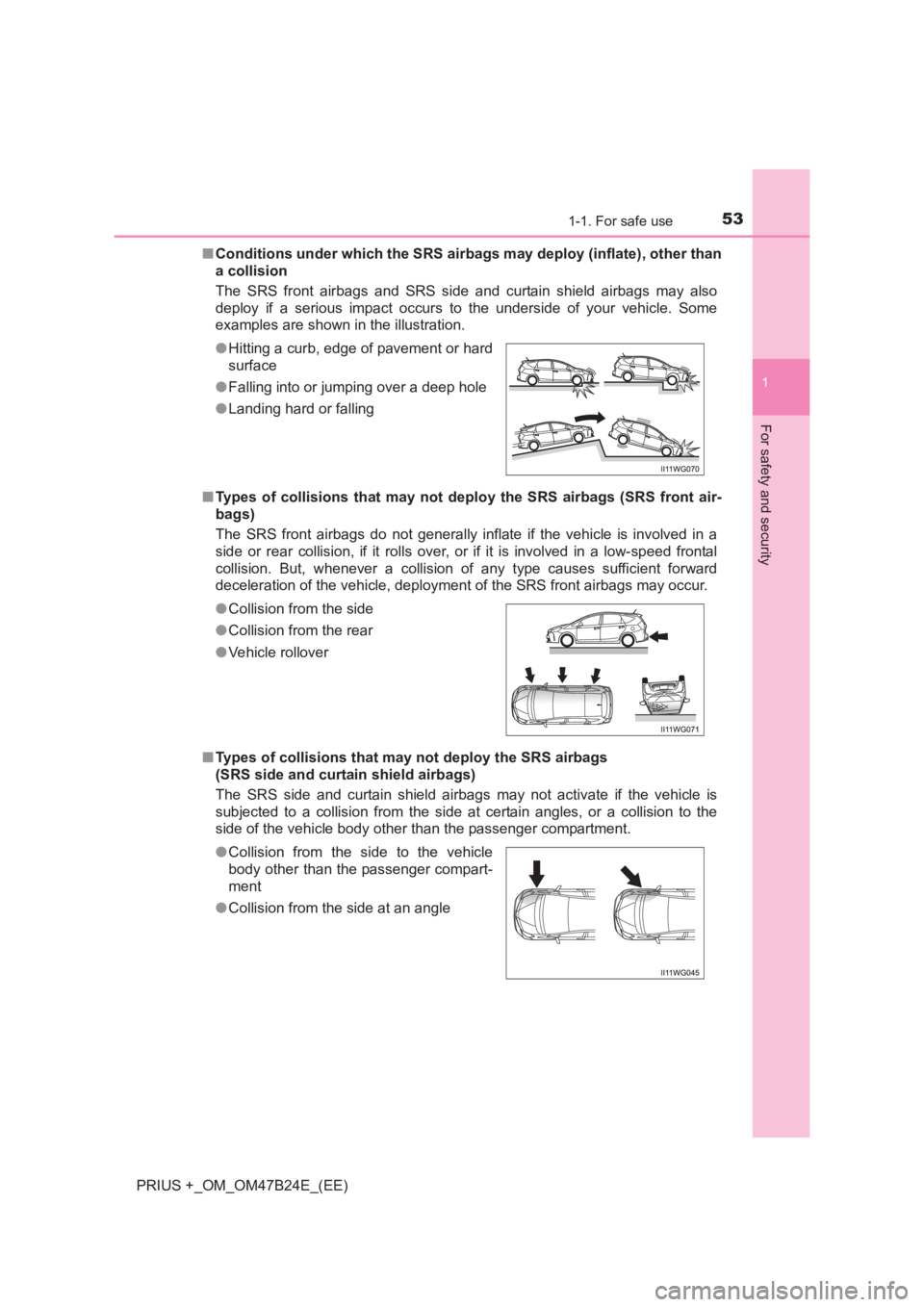
■Conditions under which the SRS airbags may deploy (inflate), other than
a collision
The SRS front airbags and SRS side and curtain shield airbags may also
deploy if a serious impact occurs to the underside of your vehicle. Some
examples are shown in the illustration.
■ Types of collisions that may not deploy the SRS airbags (SRS front air-
bags)
The SRS front airbags do not generally infl ate if the vehicle is involved in a
side or rear collision, if it rolls over, or if it is involved in a low-speed frontal
collision. But, whenever a collision of any type causes sufficient forward
deceleration of the vehicle, deployment of the SRS front airbags may occur.
■ Types of collisions that may not deploy the SRS airbags
(SRS side and curtain shield airbags)
The SRS side and curtain shield airbags may not activate if the vehicle is
subjected to a collision from the side at certain angles, or a collision to the
side of the vehicle body other than the passenger compartment. ● Hitting a curb, edge of pavement or hard
surface
● Falling into or jumping over a deep hole
● Landing hard or falling
● Collision from the side
● Collision from the rear
● Vehicle rollover
● Collision from the side to the vehicle
body other than the passenger compart-
ment
● Collision from the side at an angle
Page 55 of 509
551-1. For safe use
1
PRIUS +_OM_OM47B24E_(EE)
For safety and security
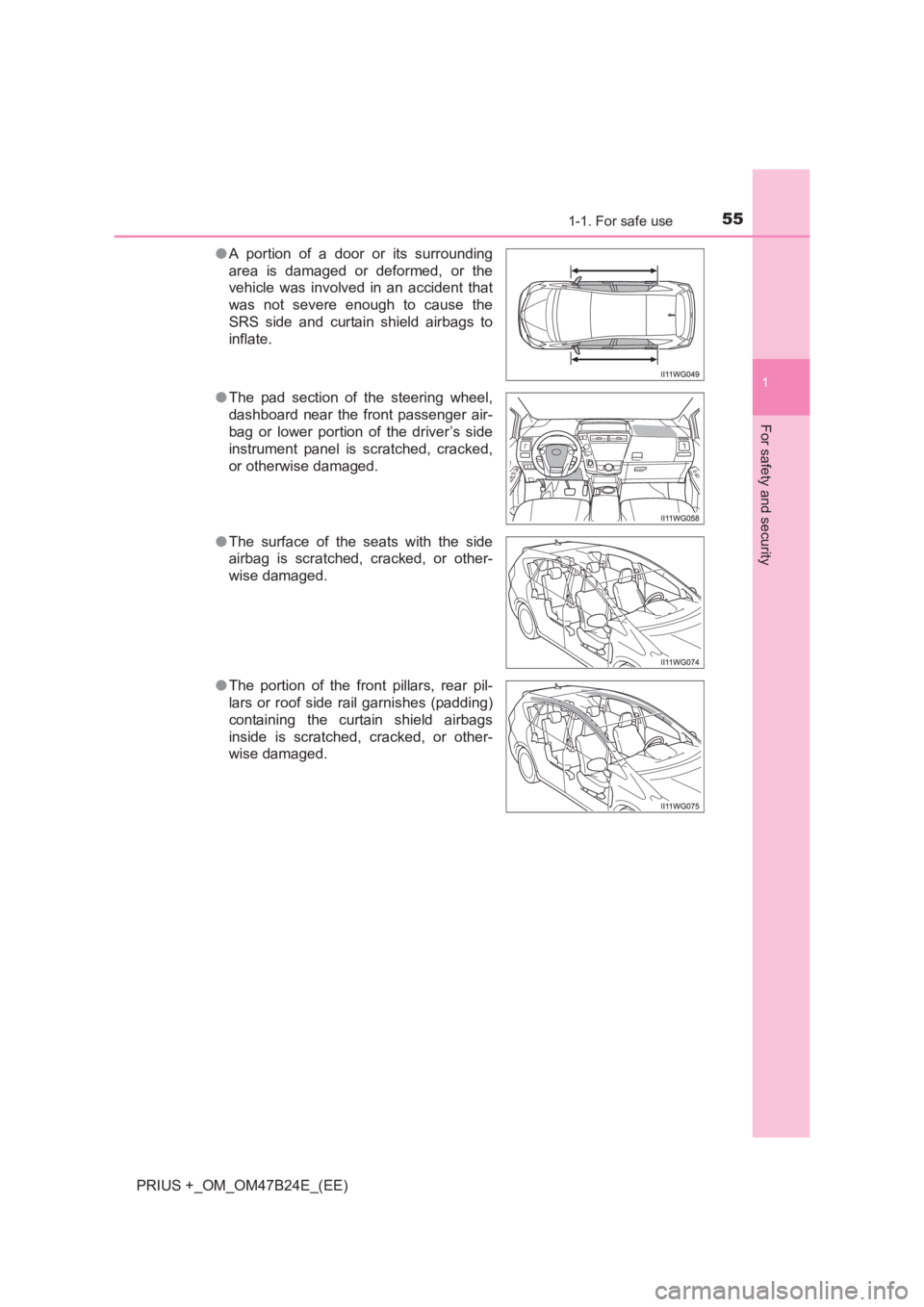
●A portion of a door or its surrounding
area is damaged or deformed, or the
vehicle was involved in an accident that
was not severe enough to cause the
SRS side and curtain shield airbags to
inflate.
● The pad section of the steering wheel,
dashboard near the front passenger air-
bag or lower portion of the driver’s side
instrument panel is scratched, cracked,
or otherwise damaged.
● The surface of the seats with the side
airbag is scratched, cracked, or other-
wise damaged.
● The portion of the front pillars, rear pil-
lars or roof side rail garnishes (padding)
containing the curtain shield airbags
inside is scratched, cracked, or other-
wise damaged.
Page 57 of 509
571-1. For safe use
1
PRIUS +_OM_OM47B24E_(EE)
For safety and security
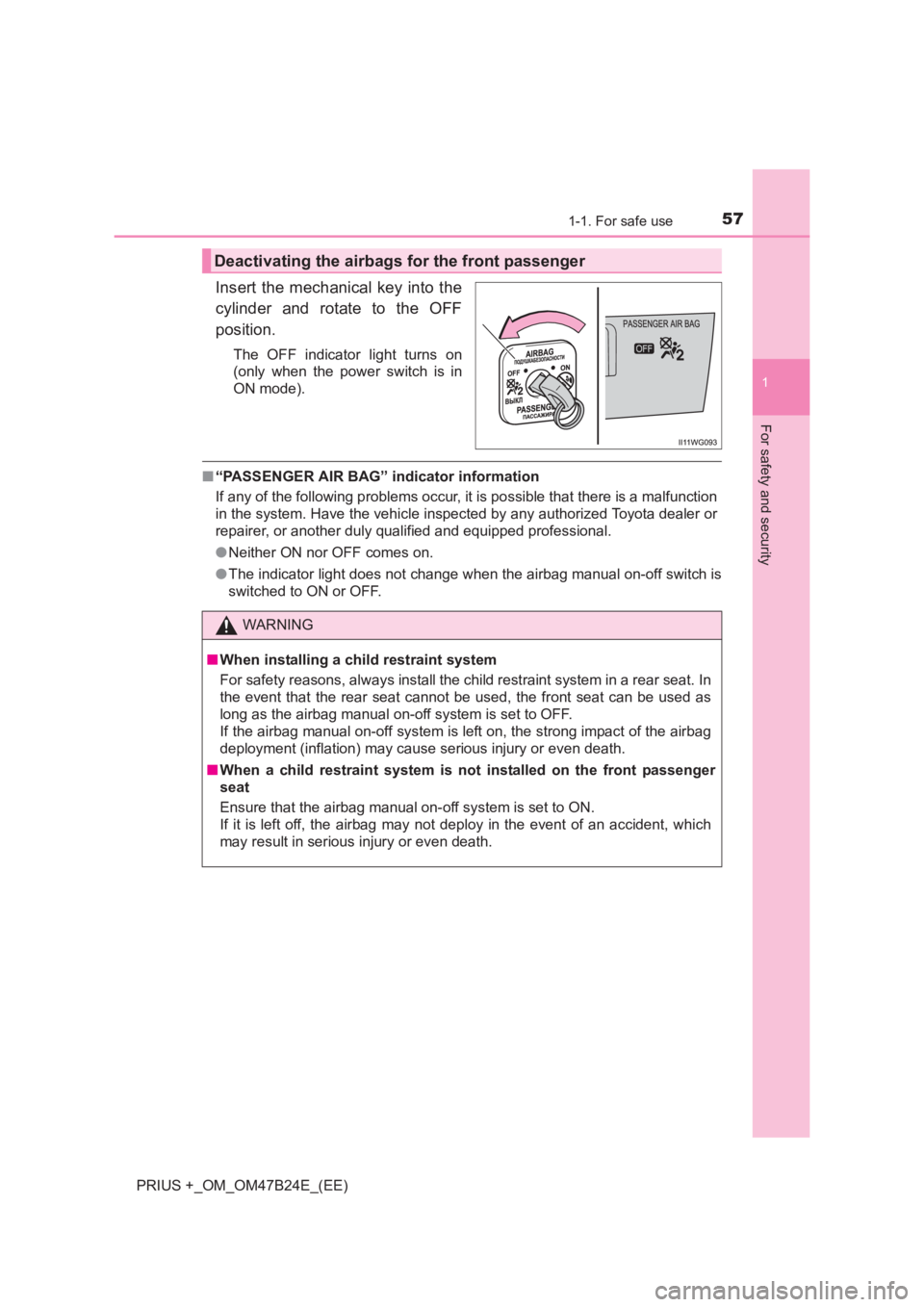
Insert the mechanical key into the
cylinder and rotate to the OFF
position.
The OFF indicator light turns on
(only when the power switch is in
ON mode).
■“PASSENGER AIR BAG” indicator information
If any of the following problems occur, it is possible that there is a malfunction
in the system. Have the vehicle inspected by any authorized Toyota dealer or
repairer, or another duly qualified and equipped professional.
●Neither ON nor OFF comes on.
● The indicator light does not change when the airbag manual on-off switch is
switched to ON or OFF.
Deactivating the airbags for the front passenger
WARNING
■ When installing a child restraint system
For safety reasons, always install the child restraint system in a rear seat. In
the event that the rear seat cannot be used, the front seat can be used as
long as the airbag manual on-off system is set to OFF.
If the airbag manual on-off system is left on, the strong impact of the airbag
deployment (inflation) may cause serious injury or even death.
■ When a child restraint system is not installed on the front passenger
seat
Ensure that the airbag manual on-off system is set to ON.
If it is left off, the airbag may not deploy in the event of an accident, which
may result in serious injury or even death.
Page 59 of 509
591-1. For safe use
1
For safety and security
PRIUS +_OM_OM47B24E_(EE)
Child restraint systems
Studies have shown that installing a child restraint system on a rear
seat is much safer than installing one to the front passenger seat.
●Choose a child restraint system that suits your vehicle and is appro-
priate to the age and size of the child.
● For installation details, follow the instructions provided with the child
restraint system.
General installation instructions are provided in this manual.
(→ P. 6 7 )
● If child restraint system regulations exist in the country where you
reside, please contact any authorized Toyota dealer or repairer, or
another duly qualified and equipped professional for the child
restraint system installation.
● Toyota recommends that you use a child restraint system which
conforms to the regulation ECE No.44.
Toyota strongly urges the use of child restraint systems.
Points to remember
Page 60 of 509
601-1. For safe use
PRIUS +_OM_OM47B24E_(EE)
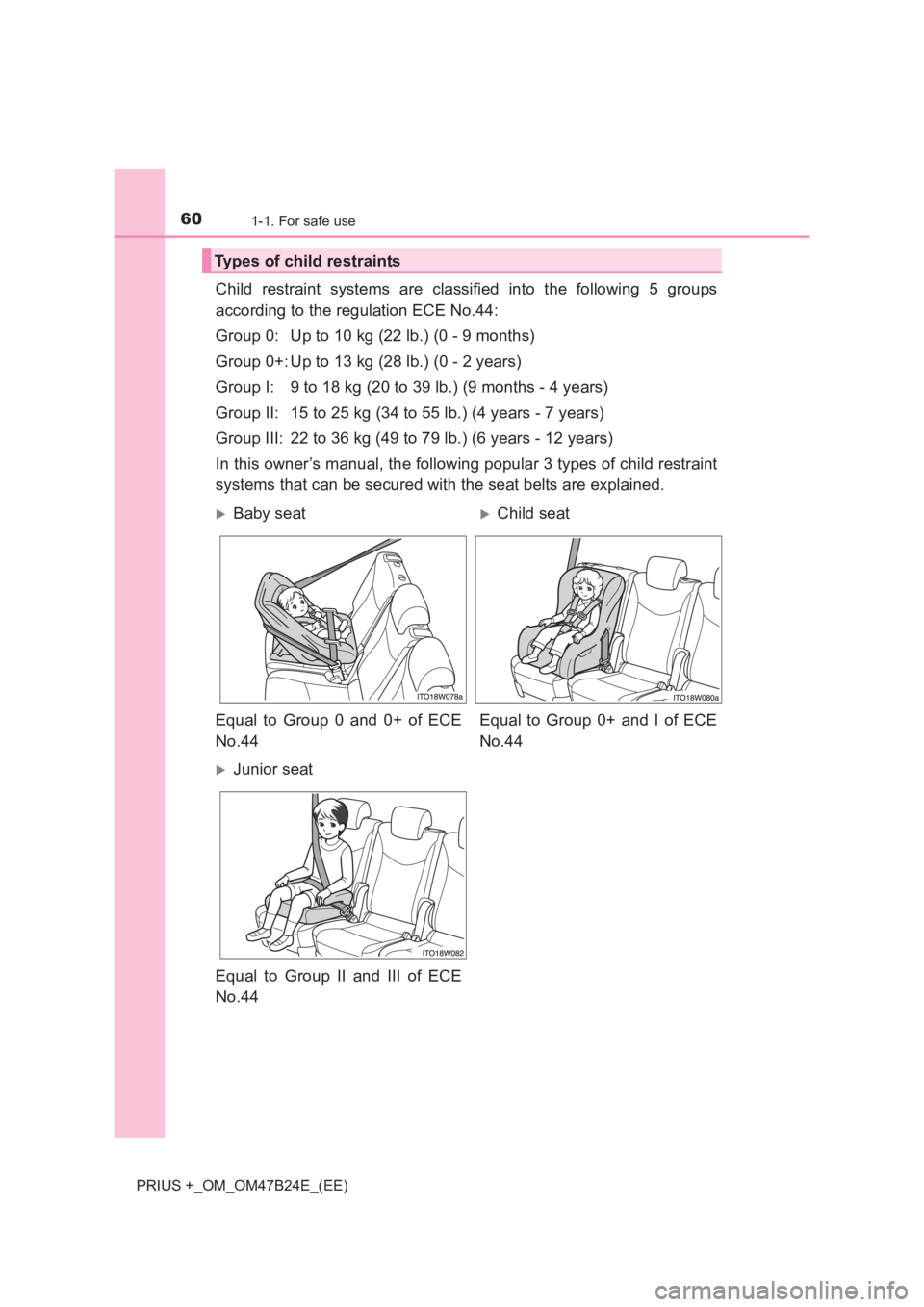
Child restraint systems are classified into the following 5 groups
according to the regulation ECE No.44:
Group 0: Up to 10 kg (22 lb.) (0 - 9 months)
Group 0+: Up to 13 kg (28 lb.) (0 - 2 years)
Group I: 9 to 18 kg (20 to 39 lb.) (9 months - 4 years)
Group II: 15 to 25 kg (34 to 55 lb.) (4 years - 7 years)
Group III: 22 to 36 kg (49 to 79 lb.) (6 years - 12 years)
In this owner’s manual, the following popular 3 types of child restraint
systems that can be secured with the seat belts are explained.
Types of child restraints
XBaby seatXChild seat
Equal to Group 0 and 0+ of ECE
No.44 Equal to Group 0+ and I of ECE
No.44
XJunior seat
Equal to Group II and III of ECE
No.44
Page 61 of 509
611-1. For safe use
1
PRIUS +_OM_OM47B24E_(EE)
For safety and security
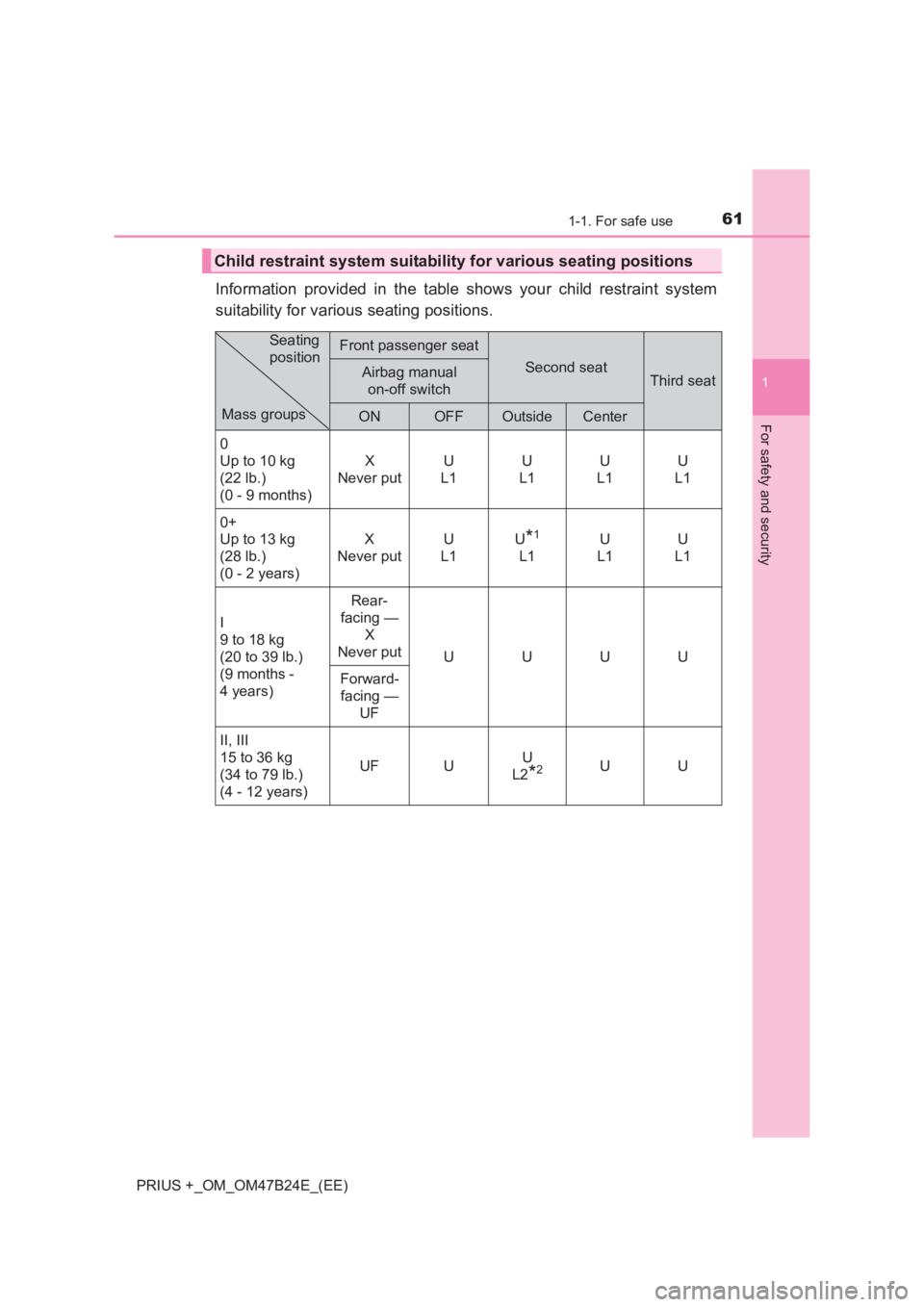
Information provided in the table shows your child restraint system
suitability for various seating positions.
Child restraint system suitability for various seating positions
Front passenger seat
Second seatThird seatAirbag manual on-off switch
ONOFFOutsideCenter
0
Up to 10 kg
(22 lb.)
(0 - 9 months) X
Never put U
L1 U
L1 U
L1 U
L1
0+
Up to 13 kg
(28 lb.)
(0 - 2 years) X
Never put U
L1 U
*1
L1 U
L1 U
L1
I
9 to 18 kg
(20 to 39 lb.)
(9 months -
4 years) Rear-
facing —
X
Never put UUUU
Forward- facing — UF
II, III
15 to 36 kg
(34 to 79 lb.)
(4 - 12 years) UF U
U
L2
*2UU
Seating
position
Mass groups