brake TOYOTA PRIUS PLUS 2017 Repair Manual
[x] Cancel search | Manufacturer: TOYOTA, Model Year: 2017, Model line: PRIUS PLUS, Model: TOYOTA PRIUS PLUS 2017Pages: 509, PDF Size: 27.68 MB
Page 338 of 509
3386-3. Do-it-yourself maintenance
PRIUS +_OM_OM47B24E_(EE)
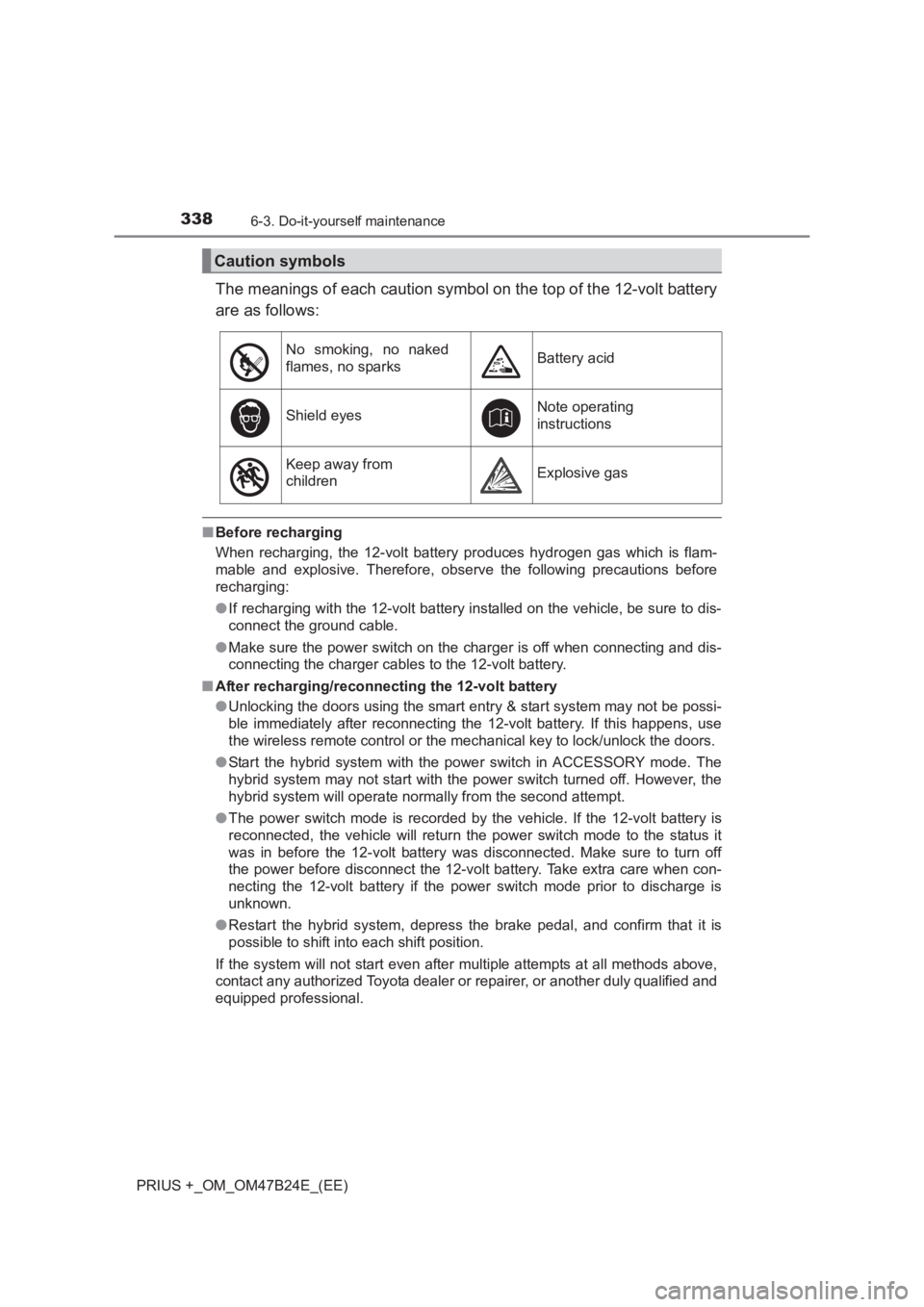
The meanings of each caution symbol on the top of the 12-volt battery
are as follows:
■Before recharging
When recharging, the 12-volt battery produces hydrogen gas which is flam-
mable and explosive. Therefore, obser ve the following precautions before
recharging:
● If recharging with the 12-volt battery installed on the vehicle, be sure to dis-
connect the ground cable.
● Make sure the power switch on the charger is off when connecting and dis-
connecting the charger cables to the 12-volt battery.
■ After recharging/reconnecting the 12-volt battery
●Unlocking the doors using the smart entry & start system may not be possi-
ble immediately after reconnecting the 12-volt battery. If this happens, use
the wireless remote control or the mechanical key to lock/unlock the doors.
● Start the hybrid system with the pow er switch in ACCESSORY mode. The
hybrid system may not start with the power switch turned off. However, the
hybrid system will operate normally from the second attempt.
● The power switch mode is recorded by the vehicle. If the 12-volt battery is
reconnected, the vehicle will return the power switch mode to the status it
was in before the 12-volt battery was disconnected. Make sure to turn off
the power before disconnect the 12-volt battery. Take extra care when con-
necting the 12-volt battery if the power switch mode prior to discharge is
unknown.
● Restart the hybrid system, depress the brake pedal, and confirm that it is
possible to shift into each shift position.
If the system will not start even after multiple attempts at all methods above,
contact any authorized Toyota dealer or repairer, or another duly qualified and
equipped professional.
Caution symbols
No smoking, no naked
flames, no sparksBattery acid
Shield eyesNote operating
instructions
Keep away from
childrenExplosive gas
Page 379 of 509
3797-1. Essential information
PRIUS +_OM_OM47B24E_(EE)
7
When trouble arises
If your vehicle has to be stopped in an
emergency
Steadily step on the brake pedal with both feet and firmly depress it.
Do not pump the brake pedal repeatedly as this will increase the effort
required to slow the vehicle.
Shift the shift position to N.
XIf the shift position is shifted to N
After slowing down, stop the vehicle in a safe place by the road.
Stop the hybrid system.
XIf the shift position cannot be shifted to N
Keep depressing the brake pedal with both feet to reduce vehicle
speed as much as possible.
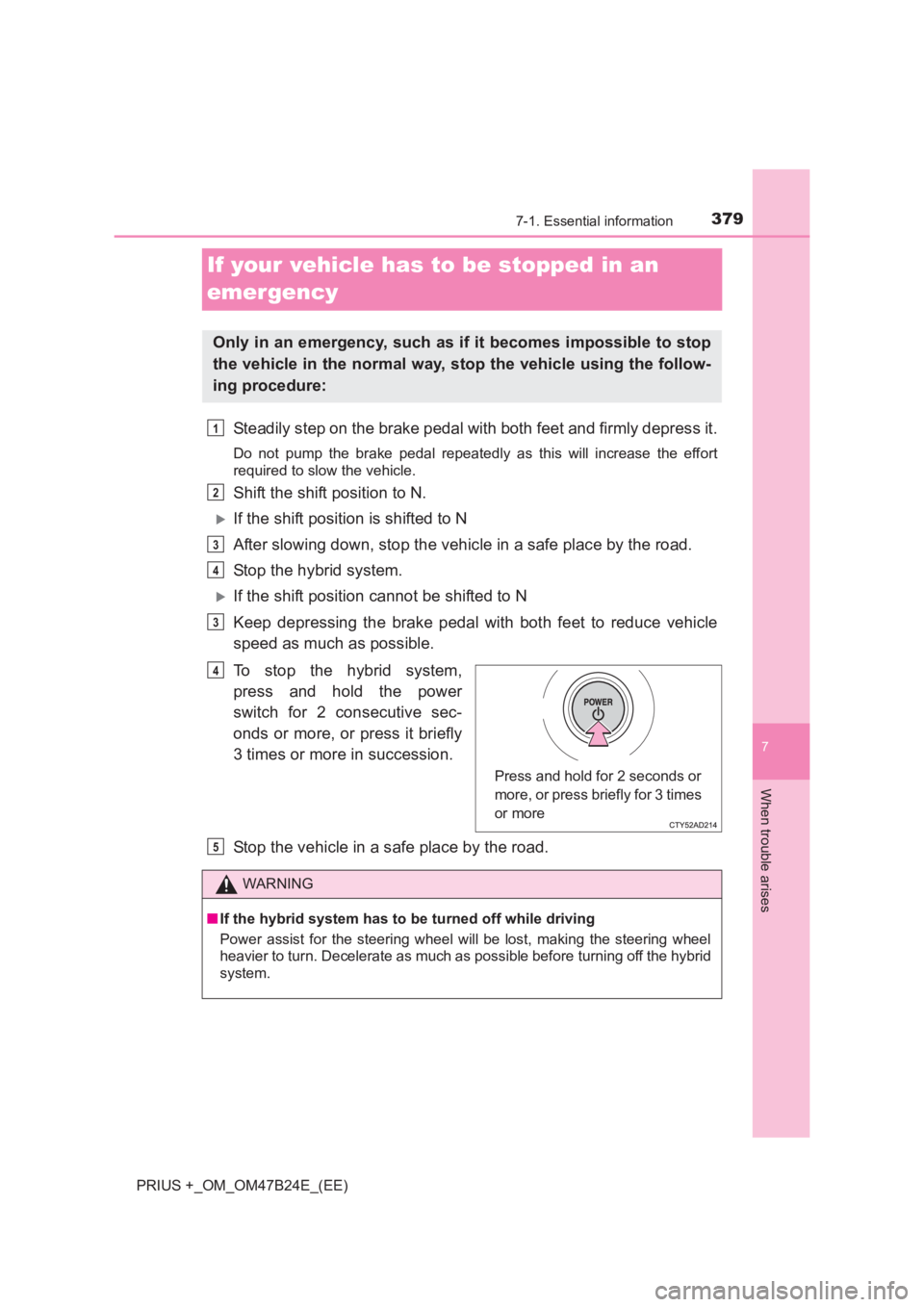
To stop the hybrid system,
press and hold the power
switch for 2 consecutive sec-
onds or more, or press it briefly
3 times or more in succession.
Stop the vehicle in a safe place by the road.
Only in an emergency, such as if it becomes impossible to stop
the vehicle in the normal way, stop the vehicle using the follow-
ing procedure:
1
2
3
4
3
Press and hold for 2 seconds or
more, or press briefly for 3 times
or more
4
WARNING
■ If the hybrid system has to be turned off while driving
Power assist for the steering wheel will be lost, making the steering wheel
heavier to turn. Decelerate as much as possible before turning off the hybrid
system.
5
Page 381 of 509
3817-2. Steps to take in an emergency
PRIUS +_OM_OM47B24E_(EE)
7
When trouble arises
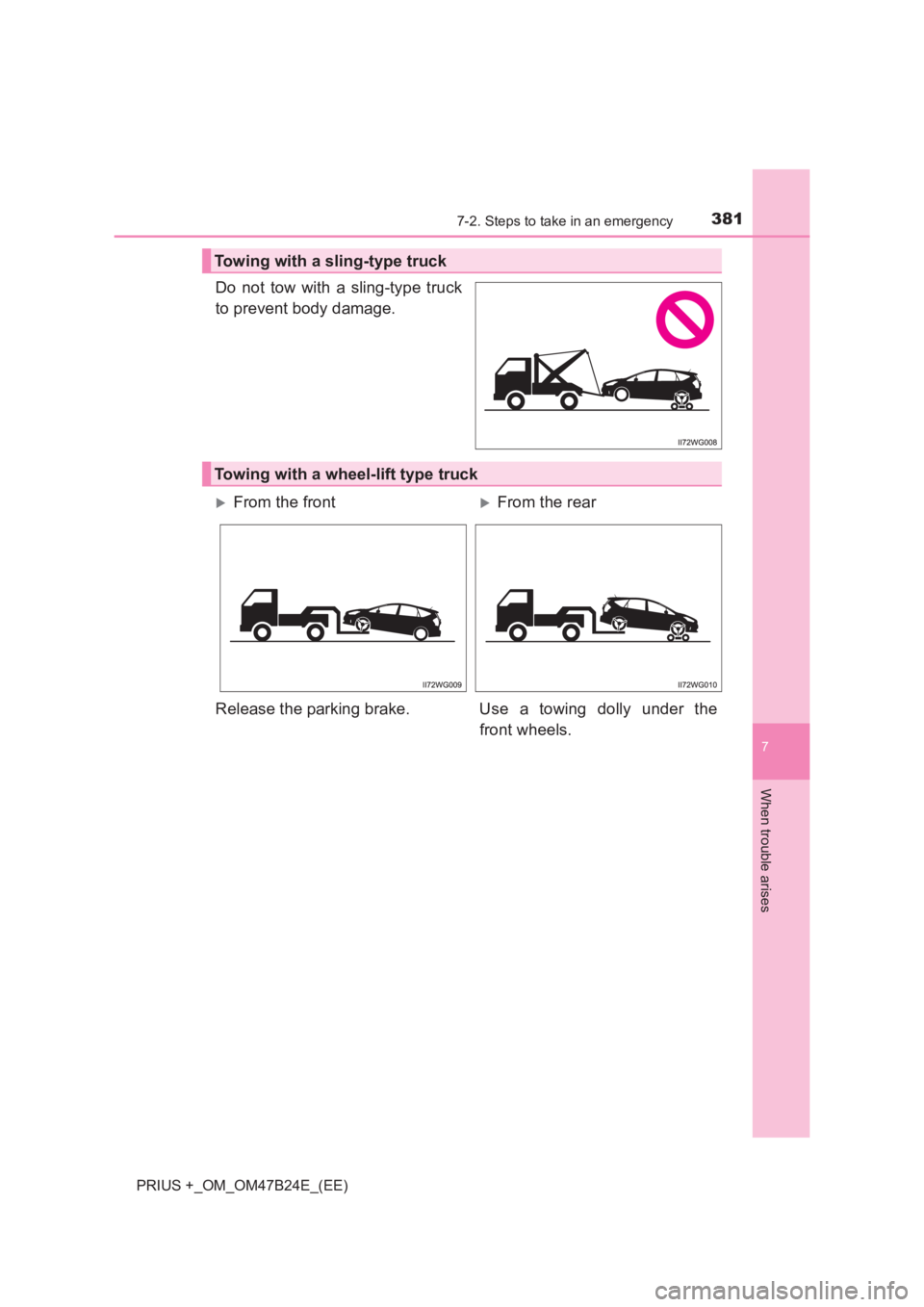
Do not tow with a sling-type truck
to prevent body damage.
Towing with a sling-type truck
Towing with a wheel-lift type truck
XFrom the frontXFrom the rear
Release the parking brake. Use a towing dolly under the front wheels.
Page 382 of 509
3827-2. Steps to take in an emergency
PRIUS +_OM_OM47B24E_(EE)
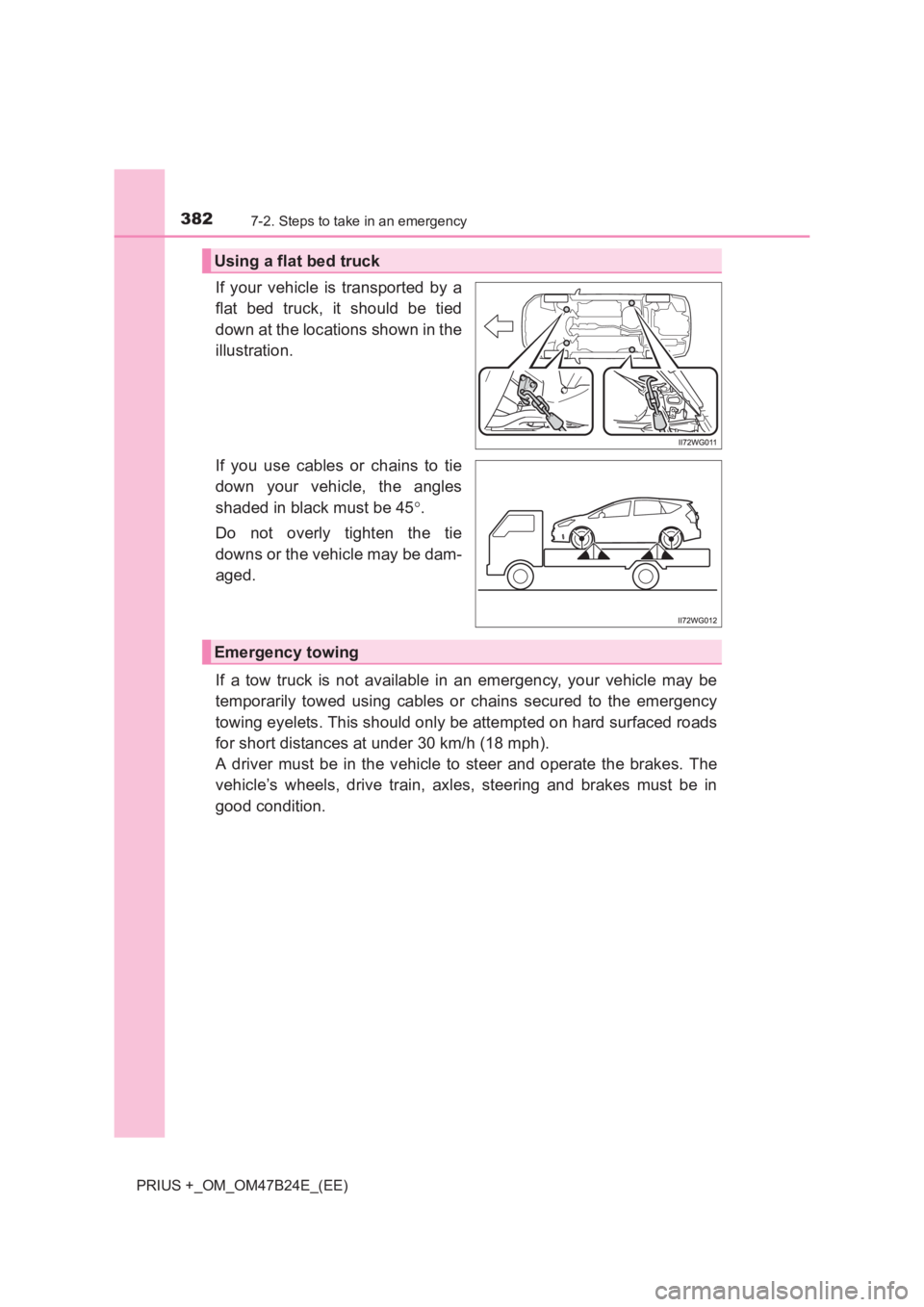
If your vehicle is transported by a
flat bed truck, it should be tied
down at the locations shown in the
illustration.
If you use cables or chains to tie
down your vehicle, the angles
shaded in black must be 45°.
Do not overly tighten the tie
downs or the vehicle may be dam-
aged.
If a tow truck is not available in an emergency, your vehicle may be
temporarily towed using cables or chains secured to the emergency
towing eyelets. This should only be attempted on hard surfaced roads
for short distances at under 30 km/h (18 mph).
A driver must be in the vehicle to steer and operate the brakes. The
vehicle’s wheels, drive train, axles, steering and brakes must be in
good condition.
Using a flat bed truck
Emergency towing
Page 383 of 509
3837-2. Steps to take in an emergency
PRIUS +_OM_OM47B24E_(EE)
7
When trouble arises
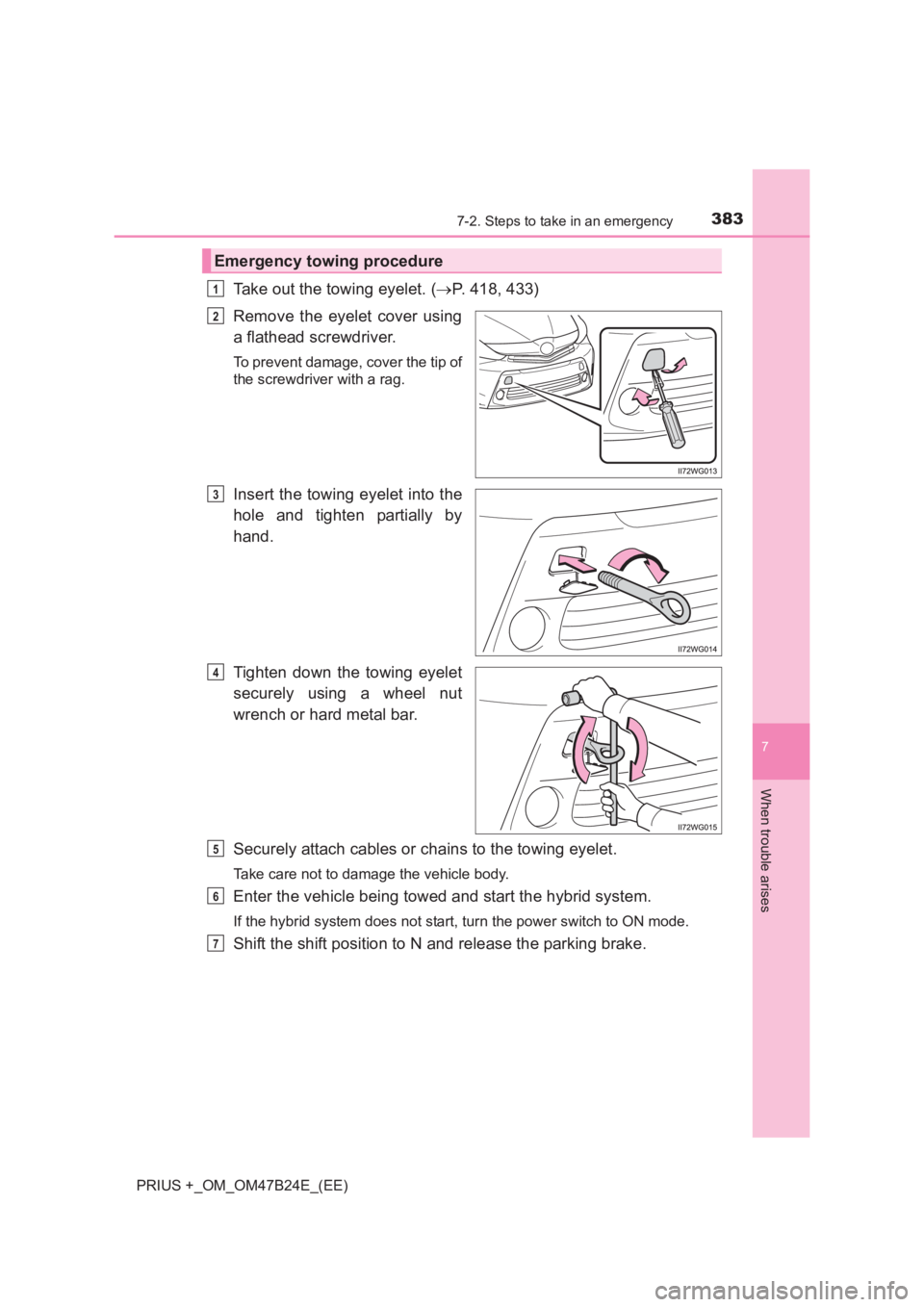
Take out the towing eyelet. (→P. 418, 433)
Remove the eyelet cover using
a flathead screwdriver.
To prevent damage, cover the tip of
the screwdriver with a rag.
Insert the towing eyelet into the
hole and tighten partially by
hand.
Tighten down the towing eyelet
securely using a wheel nut
wrench or hard metal bar.
Securely attach cables or chains to the towing eyelet.
Take care not to damage the vehicle body.
Enter the vehicle being towed and start the hybrid system.
If the hybrid system does not start, turn the power switch to ON mode.
Shift the shift position to N and release the parking brake.
Emergency towing procedure
1
2
3
4
5
6
7
Page 384 of 509
3847-2. Steps to take in an emergency
PRIUS +_OM_OM47B24E_(EE)
■While towing
If the hybrid system is off, the power assist for the brakes and steering will not
function, making steering and braking more difficult.
■ Wheel nut wrench
Wheel nut wrench is installed in luggage compartment. ( →P. 418, 433)
WARNING
Observe the following precautions.
Failure to do so may result in death or serious injury.
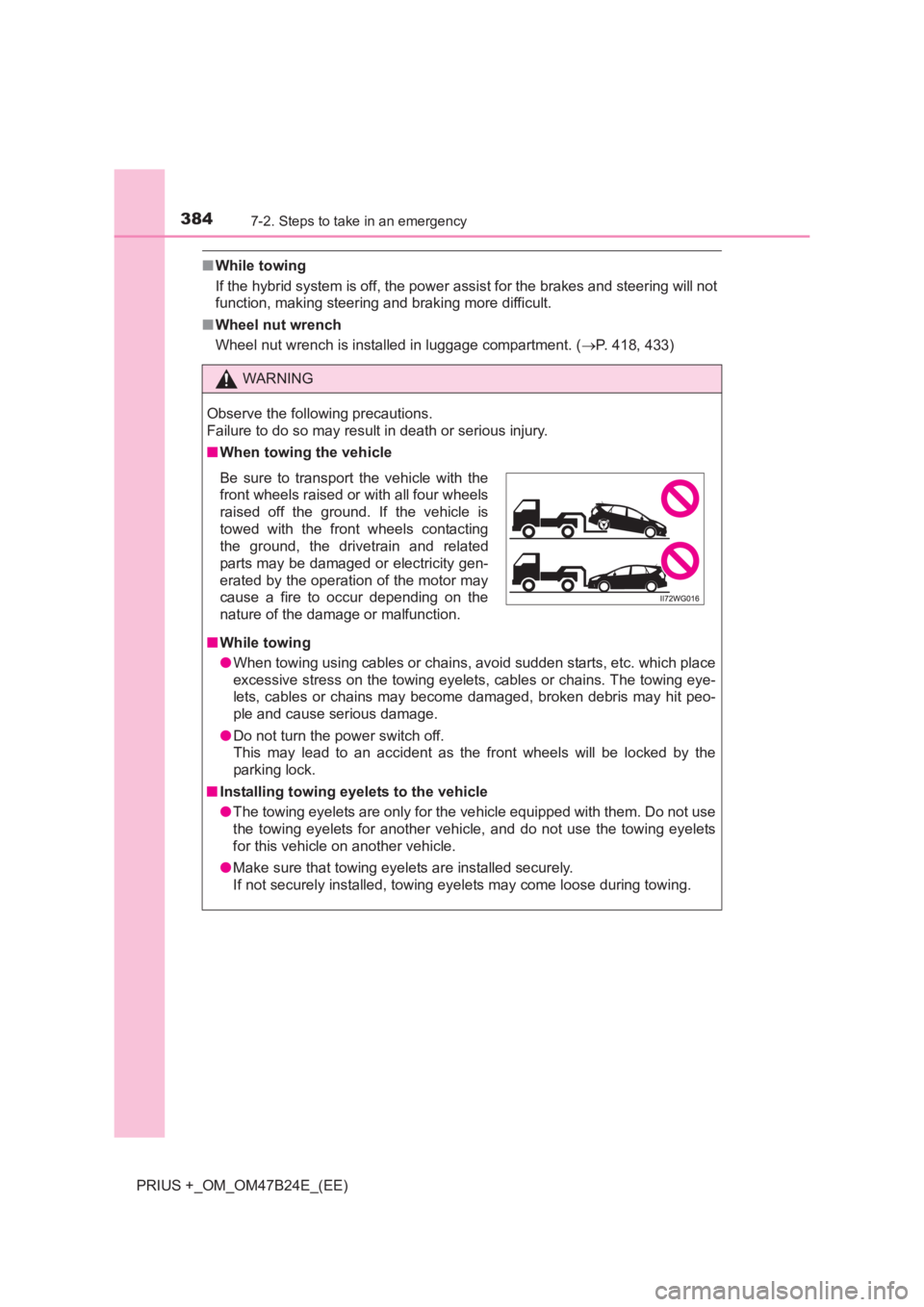
■ When towing the vehicle
■ While towing
●When towing using cables or chains, avoid sudden starts, etc. which place
excessive stress on the towing eyelets, cables or chains. The towing eye-
lets, cables or chains may become damaged, broken debris may hit peo-
ple and cause serious damage.
● Do not turn the power switch off.
This may lead to an accident as the front wheels will be locked by the
parking lock.
■ Installing towing eyelets to the vehicle
●The towing eyelets are only for the v ehicle equipped with them. Do not use
the towing eyelets for another vehicle, and do not use the towing eyelets
for this vehicle on another vehicle.
● Make sure that towing eyelets are installed securely.
If not securely installed, towing eyelets may come loose during towing.
Be sure to transport the vehicle with the
front wheels raised or with all four wheels
raised off the ground. If the vehicle is
towed with the front wheels contacting
the ground, the drivetrain and related
parts may be damaged or electricity gen-
erated by the operation of the motor may
cause a fire to occur depending on the
nature of the damage or malfunction.
Page 386 of 509
3867-2. Steps to take in an emergency
PRIUS +_OM_OM47B24E_(EE)
If you think something is wrong
●Fluid leaks under the vehicle
(Water dripping from the air conditioning after use is normal.)
● Flat-looking tires or uneven tire wear
● High coolant temperature warning light flashes or comes on
● Changes in exhaust sound
● Excessive tire squeal when cornering
● Strange noises related to the suspension system
● Pinging or other noises related to the hybrid system
● Engine missing, stumbling or running roughly
● Appreciable loss of power
● Vehicle pulls heavily to one side when braking
● Vehicle pulls heavily to one side when driving on a level road
● Loss of brake effectiveness, spongy feeling, pedal almost touches
the floor
If you notice any of the following symptoms, your vehicle proba-
bly needs adjustment or repair. Contact any authorized Toyota
dealer or repairer, or another duly qualified and equipped pro-
fessional as soon as possible.
Visible symptoms
Audible symptoms
Operational symptoms
Page 387 of 509
3877-2. Steps to take in an emergency
PRIUS +_OM_OM47B24E_(EE)
7
When trouble arises
If a war ning light tur ns on or a warning
buzzer sounds
Calmly perform the following actions if any of the warning lights
comes on or flashes. If a light comes on or flashes, but then
goes off, this does not necessarily indicate a malfunction in the
system. However, if this continues to occur, have the vehicle
inspected by any authorized Toyota dealer or repairer, or
another duly qualified and equipped professional.
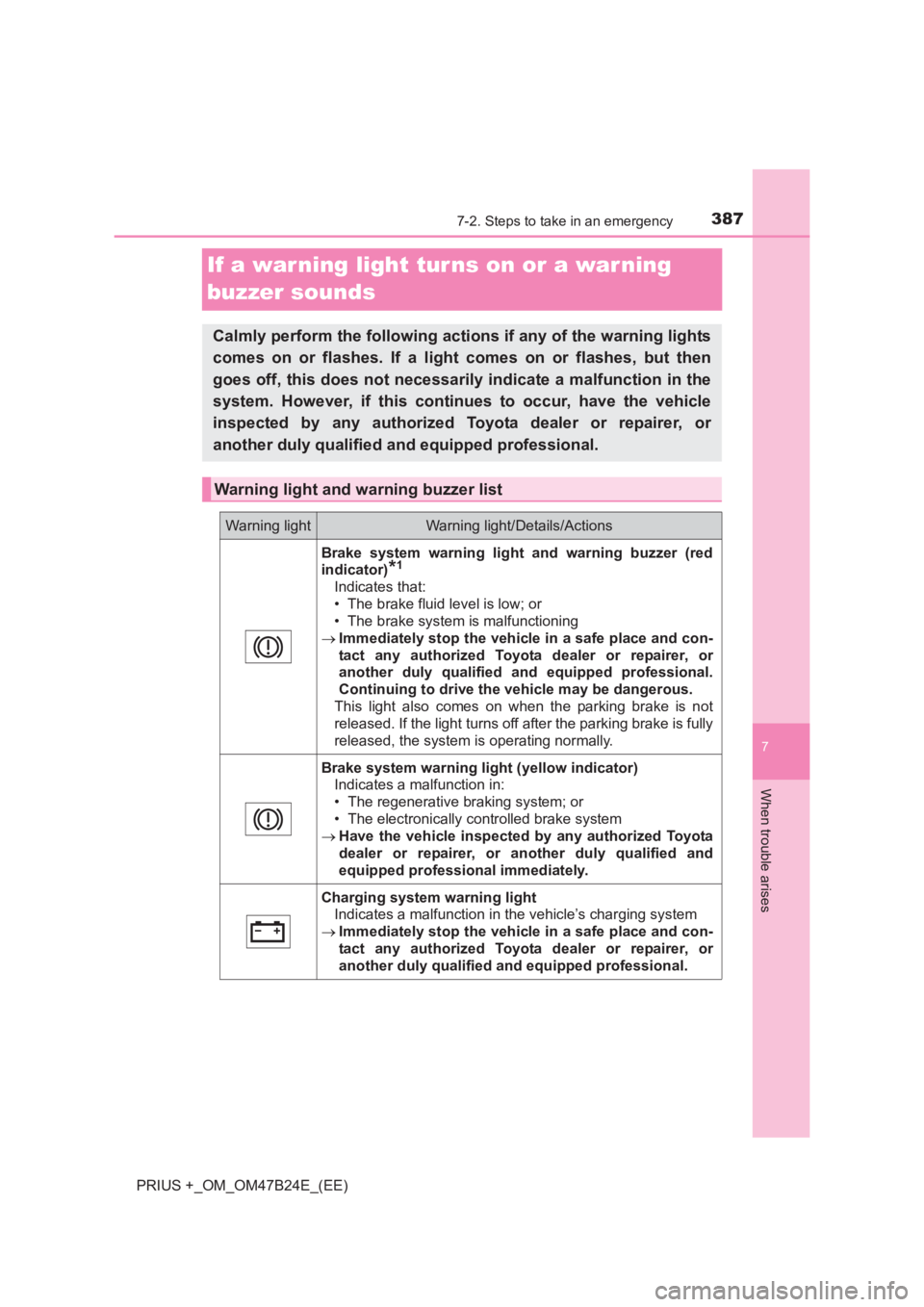
Warning light and warning buzzer list
Warning lightWarning light/Details/Actions
Brake system warning light and warning buzzer (red
indicator)
*1
Indicates that:
• The brake fluid level is low; or
• The brake system is malfunctioning
→ Immediately stop the vehicle in a safe place and con-
tact any authorized Toyota dealer or repairer, or
another duly qualified and equipped professional.
Continuing to drive the vehicle may be dangerous.
This light also comes on when the parking brake is not
released. If the light turns off after the parking brake is fully
released, the system is operating normally.
Brake system warning light (yellow indicator) Indicates a malfunction in:
• The regenerative braking system; or
• The electronically controlled brake system
→ Have the vehicle inspected by any authorized Toyota
dealer or repairer, or another duly qualified and
equipped professional immediately.
Charging system warning light Indicates a malfunction in the vehicle’s charging system
→ Immediately stop the vehicle in a safe place and con-
tact any authorized Toyota dealer or repairer, or
another duly qualified and equipped professional.
Page 388 of 509
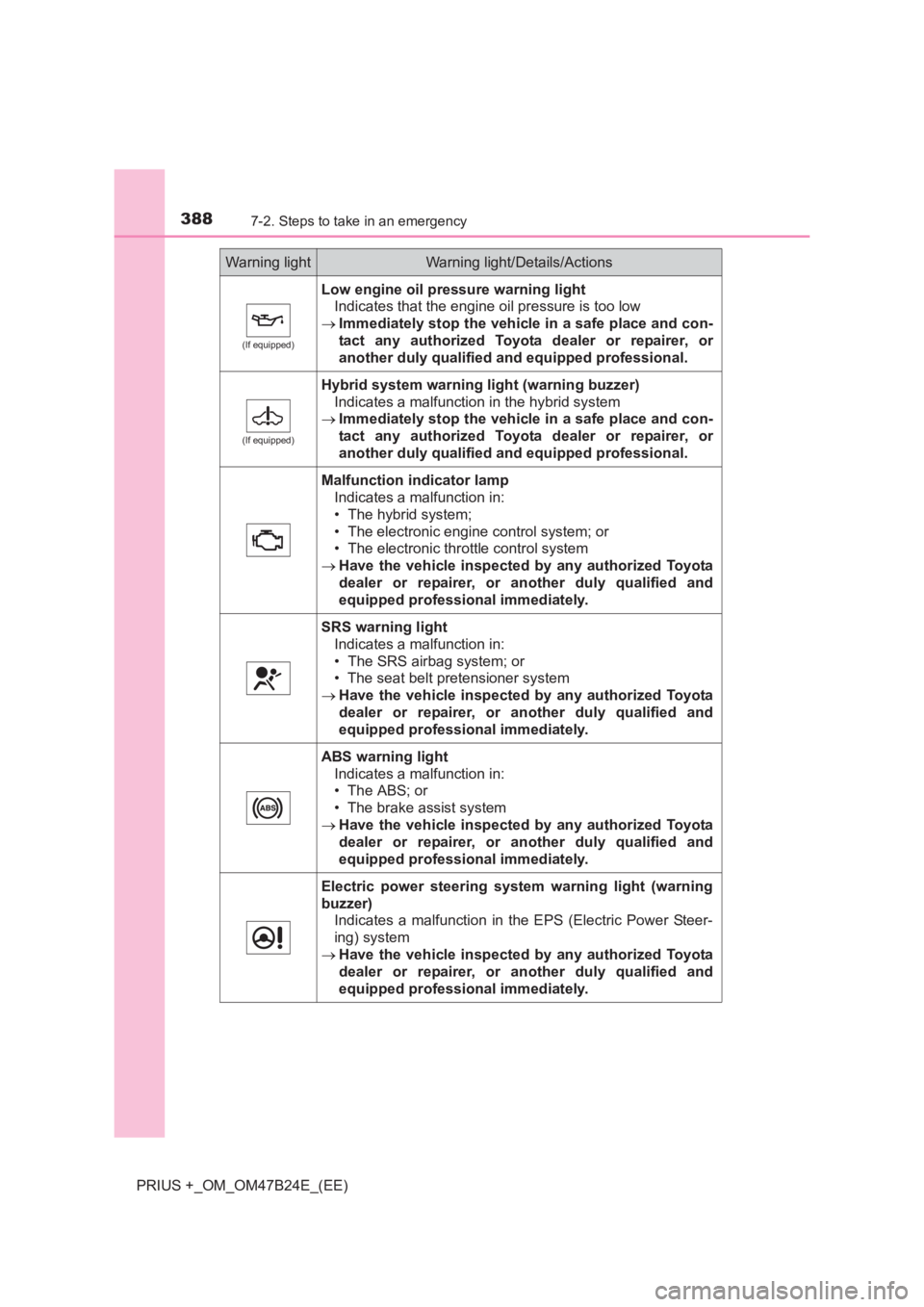
3887-2. Steps to take in an emergency
PRIUS +_OM_OM47B24E_(EE)
(If equipped)
Low engine oil pressure warning lightIndicates that the engine oil pressure is too low
→ Immediately stop the vehicle in a safe place and con-
tact any authorized Toyota dealer or repairer, or
another duly qualified and equipped professional.
(If equipped)
Hybrid system warning light (warning buzzer)
Indicates a malfunction in the hybrid system
→ Immediately stop the vehicle in a safe place and con-
tact any authorized Toyota dealer or repairer, or
another duly qualified and equipped professional.
Malfunction indicator lamp
Indicates a malfunction in:
• The hybrid system;
• The electronic engine control system; or
• The electronic throttle control system
→ Have the vehicle inspected by any authorized Toyota
dealer or repairer, or another duly qualified and
equipped professional immediately.
SRS warning light Indicates a malfunction in:
• The SRS airbag system; or
• The seat belt pretensioner system
→ Have the vehicle inspected by any authorized Toyota
dealer or repairer, or another duly qualified and
equipped professional immediately.
ABS warning light Indicates a malfunction in:
• The ABS; or
• The brake assist system
→ Have the vehicle inspected by any authorized Toyota
dealer or repairer, or another duly qualified and
equipped professional immediately.
Electric power steering system warning light (warning
buzzer) Indicates a malfunction in the EPS (Electric Power Steer-
ing) system
→ Have the vehicle inspected by any authorized Toyota
dealer or repairer, or another duly qualified and
equipped professional immediately.
Warning lightWarning light/Details/Actions
Page 389 of 509
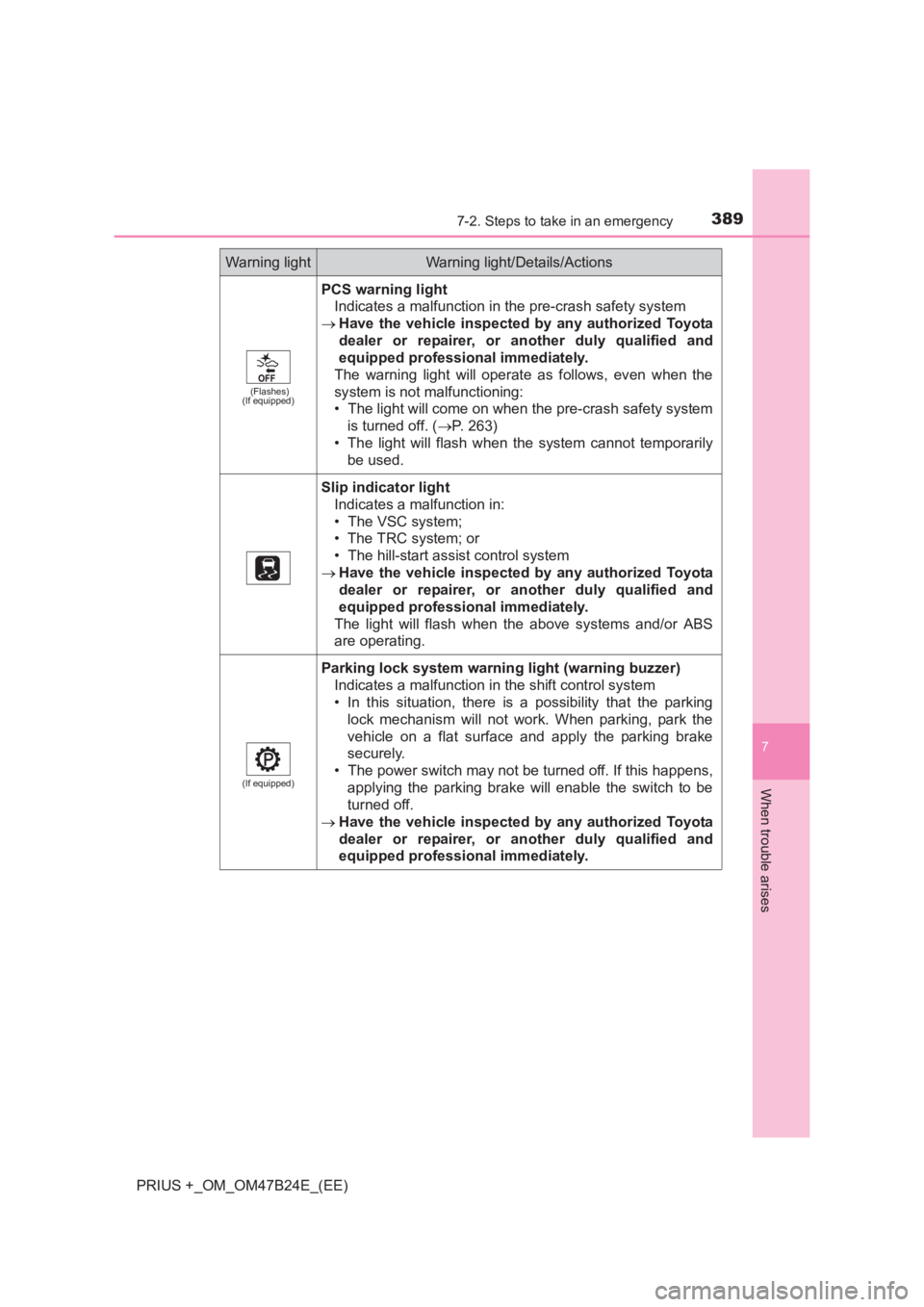
3897-2. Steps to take in an emergency
PRIUS +_OM_OM47B24E_(EE)
7
When trouble arises
(Flashes)
(If equipped)
PCS warning light
Indicates a malfunction in the pre-crash safety system
→ Have the vehicle inspected by any authorized Toyota
dealer or repairer, or another duly qualified and
equipped professional immediately.
The warning light will operate as follows, even when the
system is not malfunctioning:
• The light will come on when the pre-crash safety system is turned off. ( →P. 263)
• The light will flash when the system cannot temporarily be used.
Slip indicator light
Indicates a malfunction in:
• The VSC system;
• The TRC system; or
• The hill-start assist control system
→ Have the vehicle inspected by any authorized Toyota
dealer or repairer, or another duly qualified and
equipped professional immediately.
The light will flash when the above systems and/or ABS
are operating.
(If equipped)
Parking lock system warning light (warning buzzer) Indicates a malfunction in the shift control system
• In this situation, there is a possibility that the parkinglock mechanism will not work. When parking, park the
vehicle on a flat surface and apply the parking brake
securely.
• The power switch may not be turned off. If this happens, applying the parking brake will enable the switch to be
turned off.
→ Have the vehicle inspected by any authorized Toyota
dealer or repairer, or another duly qualified and
equipped professional immediately.
Warning lightWarning light/Details/Actions