inflation pressure TOYOTA PRIUS PRIME 2022 Owners Manual
[x] Cancel search | Manufacturer: TOYOTA, Model Year: 2022, Model line: PRIUS PRIME, Model: TOYOTA PRIUS PRIME 2022Pages: 808, PDF Size: 14.72 MB
Page 5 of 808

5
1
9 8
7
6 4 3
2
PRIUS PRIME_OM_OM47E74U_(U)
10
5
6-4. Using the other interior features
Other interior features ....... 549 • Sun visors ..................... 549
• Vanity mirrors................ 549
• Power outlets ................ 550
• USB charging ports....... 551
• Wireless charger ........... 553
• Armrest ......................... 562
• Coat hooks.................... 562
• Assist grips ................... 563
Garage door opener .......... 564 7-1. Maintenance and care
Cleaning and protecting the vehicle exterior .......... 574
Cleaning and protecting the vehicle interior ........... 579
7-2. Maintenance Maintenance requirements ................... 585
General maintenance ........ 588
Emission inspection and maintenance (I/M)
programs ......................... 591
7-3. Do-it-yourself maintenance Do-it-yourself service precautions ...................... 592
Hood .................................. 595
Positioning a floor jack....... 597
Engine compartment ......... 598
Tires................................... 612
Tire inflation pressure ........ 620
Wheels............................... 623
Replacing the tire............... 626
Air conditioning filter .......... 637
Wiper insert replacement..................... 641
Electronic key battery ........ 644
Checking and replacing fuses ................................ 647
Headlight aim..................... 650
Light bulbs ......................... 652
7Maintenance and care
Page 17 of 808
17Pictorial index
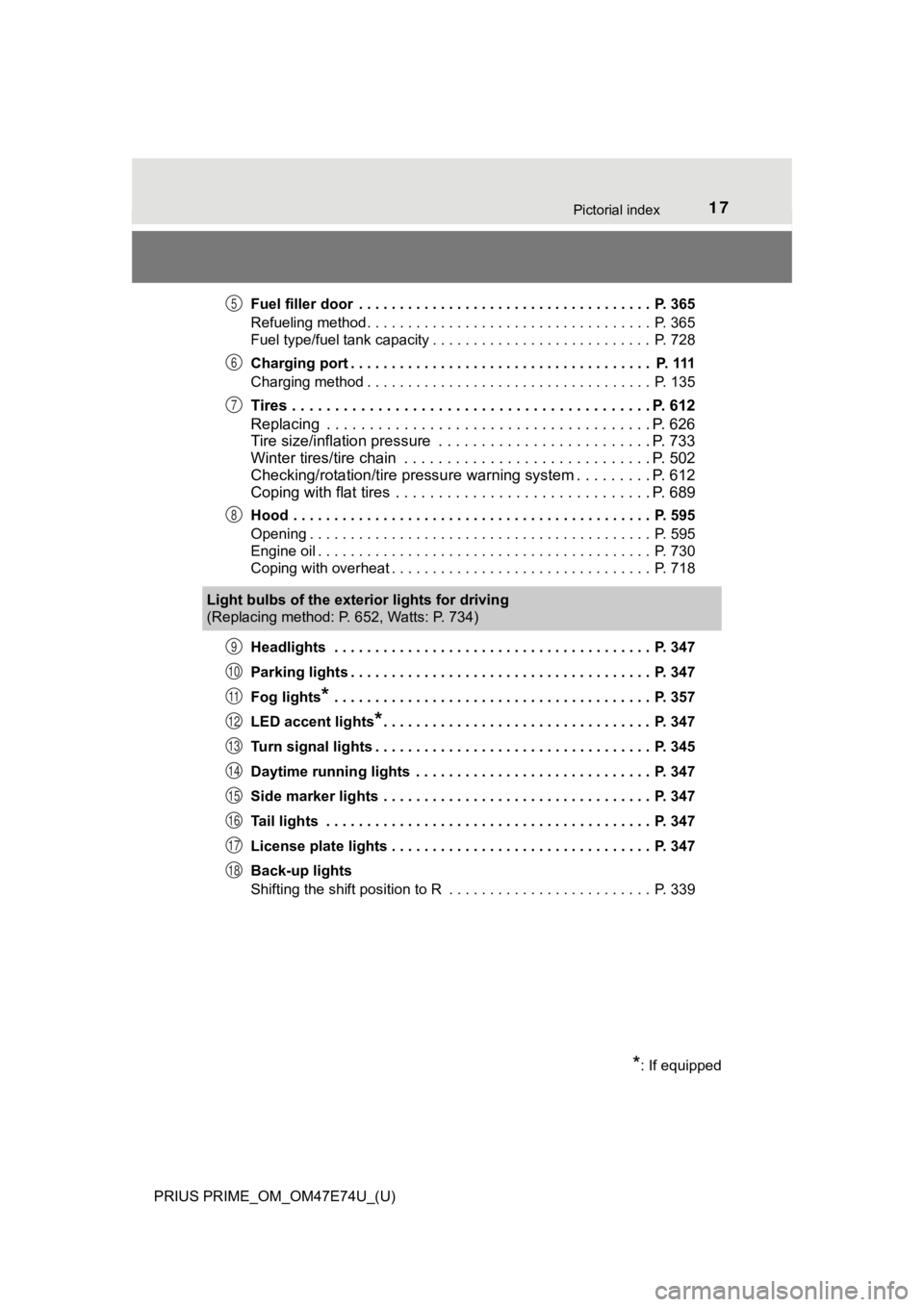
PRIUS PRIME_OM_OM47E74U_(U)Fuel filler door . . . . . . . . . . . . . . . . . . . . . . . . . . . . . . . . . . . . P. 365
Refueling method . . . . . . . . . . . . . . . . . . . . . . . . . . . . . . . . . . . P. 365
Fuel type/fuel tank capacity . . . . . . . . . . . . . . . . . . . . . . . . . . . P. 728
Charging port . . . . . . . . . . . . . . . . . . . . . . . . . . . . . . . . . . . . . P. 111
Charging method . . . . . . . . . . . . . . . . . . . . . . . . . . . . . . . . . . . P. 135
Tires . . . . . . . . . . . . . . . . . . . . . . . . . . . . .
. . . . . . . . . . . . . P. 612
Replacing . . . . . . . . . . . . . . . . . . . . . . . . . . . . . . . . . . . . . . P. 626
Tire size/inflation pressure . . . . . . . . . . . . . . . . . . . . . . . . . P. 733
Winter tires/tire chain . . . . . . . . . . . . . . . . . . . . . . . . . . . . . P. 502
Checking/rotation/tire pressur e warning system . . . . . . . . .P. 612
Coping with flat tires . . . . . . . . . . . . . . . . . . . . . . . . . . . . . . P. 689
Hood . . . . . . . . . . . . . . . . . . . . . . . . . . . . . . . . . . . . . . . . . . . . P. 595
Opening . . . . . . . . . . . . . . . . . . . . . . . . . . . . . . . . . . . . . . . . . . P. 595
Engine oil . . . . . . . . . . . . . . . . . . . . . . . . . . . . . . . . . . . . . . . . . P. 730
Coping with overheat . . . . . . . . . . . . . . . . . . . . . . . . . . . . . . . . P. 718
Headlights . . . . . . . . . . . . . . . . . . . . . . . . . . . . . . . . . . . . . . . P. 347
Parking lights . . . . . . . . . . . . . . . . . . . . . . . . . . . . . . . . . . . . . P. 347
Fog lights
* . . . . . . . . . . . . . . . . . . . . . . . . . . . . . . . . . . . . . . . P. 357
LED accent lights
*. . . . . . . . . . . . . . . . . . . . . . . . . . . . . . . . . P. 347
Turn signal lights . . . . . . . . . . . . . . . . . . . . . . . . . . . . . . . . . . P. 345
Daytime running lights . . . . . . . . . . . . . . . . . . . . . . . . . . . . . P. 347
Side marker lights . . . . . . . . . . . . . . . . . . . . . . . . . . . . . . . . . P. 347
Tail lights . . . . . . . . . . . . . . . . . . . . . . . . . . . . . . . . . . . . . . . . P. 347
License plate lights . . . . . . . . . . . . . . . . . . . . . . . . . . . . . . . . P. 347
Back-up lights
Shifting the shift position to R . . . . . . . . . . . . . . . . . . . . . . . . . P. 339
5
6
7
8
Light bulbs of the exterior lights for driving
(Replacing method: P. 652, Watts: P. 734)
*: If equipped
9
10
11
12
13
14
15
16
17
18
Page 108 of 808

108
PRIUS PRIME_OM_OM47E74U_(U)
2-1. Plug-in hybrid system
◆Air conditioning
●Turn the “A/C” switch (
*1 • *2) off when it is
not needed. Doing so can help reduce excessive electricity and
fuel consumption.
In summer: When the ambient temperature is high, use the recir-
culated air mode. Doing so will help to reduce the burden on th e
air conditioning system and reduc e electricity and fuel consump-
tion as well.
In winter: Avoid excessive and unnecessary use of the heater.
Usage of the heated steering w heel (if equipped) and seat heat-
ers is effective. ( P. 5 3 5 )
● Using the Remote Air Conditioning System ( P. 531) while the
charging cable is connected to the vehicle can reduce electrici ty
consumption immediately after st arting off by operating air condi-
tioning mainly using electricity from an external power source.
● When setting the charging schedule, selecting the start time se t-
ting mode and setting “Climate Prep” to “On” can reduce electric-
ity consumption immedi ately after starting off by operating air
conditioning before c harging is completed. ( P. 158)
*1: Vehicles with 7-inch display
*2: Vehicles with 11.6-inch display
◆Checking tire inflation pressure
Make sure to check the tire inflation pressure frequently. If t here is
improper tire inflation pressur e in the tires, the EV driving range will
become shorter, and fuel consumption when in HV mode will
increase.
Also, as snow tires can cause large amounts of friction, their use on
dry roads can lead t o increased fuel and electricity consumptio n.
◆Luggage
Carrying heavy luggage will lead to poor fuel economy. Avoid carry-
ing unnecessary luggage. Installing a large roof rack will also cause
poor fuel economy.
◆Warming up before driving
Since the gasoline engine starts up and cuts out automatically,
warming up is not necessary.
Page 389 of 808

PRIUS PRIME_OM_OM47E74U_(U)
3895-5. Using the driving support systems
5
Driving
• If the wheels are misaligned
• If a wiper blade is blocking the front camera
• The vehicle is being driven at extremely high speeds
• When driving on a hill
• If the radar sensor or front camera is misaligned
● In some situations such as the following, sufficient braking fo rce may not be
obtained, preventing the system from performing properly:
• If the braking functions cannot operate to their full extent, such as when
the brake parts are extremely cold, extremely hot, or wet
• If the vehicle is not properly maintained (brakes or tires are excessively
worn, improper tire inflation pressure, etc.)
• When the vehicle is being driven on a gravel road or other sli ppery sur-
face
■ If VSC is disabled
●If VSC is disabled ( P. 498), the pre-collision brake assist and pre-collision
braking functions are also disabled.
● The PCS warning light will turn on and “VSC Turned Off Pre-Coll ision Brake
System Unavailable” will be displayed on the multi-information display.
• If the front of the vehicle is raised or
lowered
Page 501 of 808

PRIUS PRIME_OM_OM47E74U_(U)
5015-5. Using the driving support systems
5
Driving
WARNING
■When the TRAC/VSC systems are turned off
Be especially careful and drive at a speed appropriate to the r oad condi-
tions. As these are the systems to help ensure vehicle stability and driving
force, do not turn the TRAC/VSC systems off unless necessary.
■ Replacing tires
Make sure that all tires are of the specified size, brand, trea d pattern and
total load capacity. In addition, make sure that the tires are inflated to the
recommended tire inflation pressure level.
The ABS, TRAC and VSC systems will not function correctly if different tires
are installed on the vehicle.
Contact your Toyota dealer for further information when replaci ng tires or
wheels.
■ Handling of tires and the suspension
Using tires with any kind of problem or modifying the suspensio n will affect
the driving assist systems, and may cause a system to malfunction.
Page 573 of 808

573
PRIUS PRIME_OM_OM47E74U_(U)
7Maintenance and care
7-1. Maintenance and careCleaning and protecting the vehicle exterior .......... 574
Cleaning and protecting the vehicle interior ........... 579
7-2. Maintenance Maintenance requirements ................... 585
General maintenance........ 588
Emission inspection and maintenance (I/M)
programs......................... 591
7-3. Do-it-yourself maintenance Do-it-yourself service precautions ..................... 592
Hood ................................. 595
Positioning a floor jack ...... 597
Engine compartment ......... 598
Tires .................................. 612
Tire inflation pressure ....... 620
Wheels .............................. 623
Replacing the tire .............. 626
Air conditioning filter.......... 637
Wiper insert replacement .................... 641
Electronic key battery........ 644
Checking and replacing fuses ............................... 647
Headlight aim .................... 650
Light bulbs......................... 652
Page 593 of 808
PRIUS PRIME_OM_OM47E74U_(U)
5937-3. Do-it-yourself maintenance
7
Maintenance and care
Tire inflation
pressure
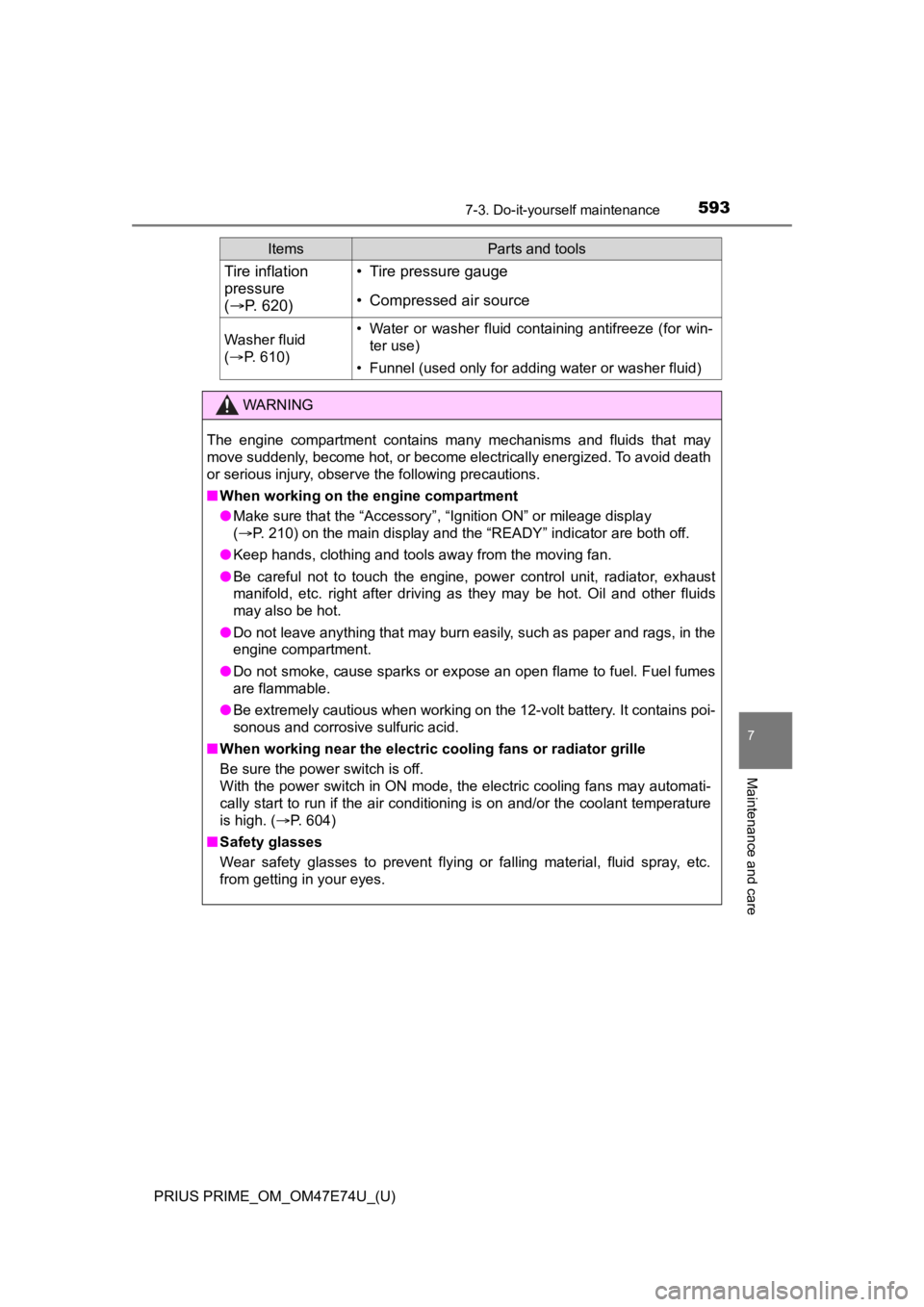
( P. 620)• Tire pressure gauge
• Compressed air source
Washer fluid
( P. 610)• Water or washer fluid containing antifreeze (for win-
ter use)
• Funnel (used only for adding water or washer fluid)
WARNING
The engine compartment contains many mechanisms and fluids that may
move suddenly, become hot, or become electrically energized. To avoid death
or serious injury, observe the following precautions.
■ When working on the engine compartment
● Make sure that the “Accessory”, “Ignition ON” or mileage display
(P. 210) on the main display and the “READY” indicator are both off.
● Keep hands, clothing and tools away from the moving fan.
● Be careful not to touch the engine, power control unit, radiato r, exhaust
manifold, etc. right after driving as they may be hot. Oil and other fluids
may also be hot.
● Do not leave anything that may burn easily, such as paper and r ags, in the
engine compartment.
● Do not smoke, cause sparks or expose an open flame to fuel. Fuel fumes
are flammable.
● Be extremely cautious when working on the 12-volt battery. It contains poi-
sonous and corrosive sulfuric acid.
■ When working near the electric cooling fans or radiator grille
Be sure the power switch is off.
With the power switch in ON mode, the electric cooling fans may automati-
cally start to run if the air conditioning is on and/or the coolant temperature
is high. (P. 604)
■ Safety glasses
Wear safety glasses to prevent flying or falling material, fluid spray, etc.
from getting in your eyes.
ItemsParts and tools
Page 613 of 808

PRIUS PRIME_OM_OM47E74U_(U)
6137-3. Do-it-yourself maintenance
7
Maintenance and care
Your vehicle is equipped with a tire pressure warning system that uses
tire pressure warning valves and transmitters to detect low tire infla-
tion pressure before serious problems arise.
If the tire pressure drops below a predetermined level, the dri ver is
warned by a warning light. ( P. 674)
◆Installing tire pressure warn ing valves and transmitters
When replacing tires or wheels, tire pressure warning valves an d
transmitters must also be installed.
When new tire pressure warning valves and transmitters are
installed, new ID codes must be registered in the tire pressure
warning computer and the tire pressure warning system must be
initialized. Have tire pressure warning valve and transmitter I D
codes registered by your Toyota dealer. ( P. 614)
◆Initializing the tire pressure warning system
■The tire pressure warning system must be initialized in the fol-
lowing circumstances:
● When rotating front and rear tires which have different tire in fla-
tion pressures
● When the tire inflation pressure is changed such as when chang-
ing traveling speed or load weight
When the tire pressure warning sy stem is initialized, the current tire
inflation pressure is set as the benchmark pressure.
Tire pressure warning system
Page 614 of 808
614
PRIUS PRIME_OM_OM47E74U_(U)
7-3. Do-it-yourself maintenance
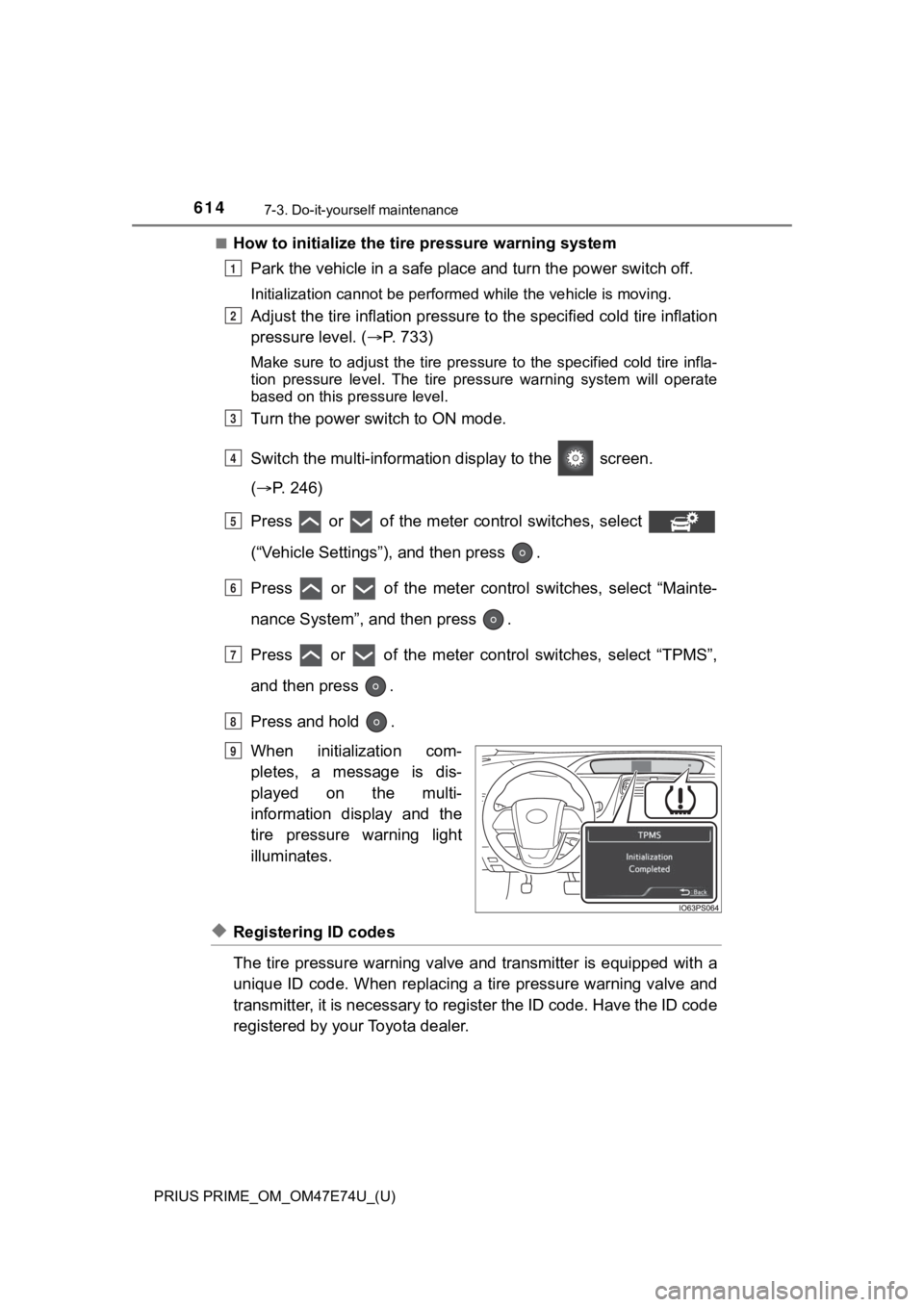
■How to initialize the tire pressure warning systemPark the vehicle in a s afe place and turn the power switch off.
Initialization cannot be perfo rmed while the vehicle is moving.
Adjust the tire inflation pressure to the specified cold tire i nflation
pressure level. ( P. 733)
Make sure to adjust the tire pre ssure to the specified cold tire infla-
tion pressure level. The tire pressure warning system will oper ate
based on this pr essure level.
Turn the power switch to ON mode.
Switch the multi-informatio n display to the screen.
( P. 246)
Press or of the meter control switches, select
(“Vehicle Settings”), and then press .
Press or of the meter control switches, select “Mainte-
nance System”, a nd then press .
Press or of the meter control switches, select “TPMS”,
and then press .
Press and hold .
When initialization com-
pletes, a message is dis-
played on the multi-
information display and the
tire pressure warning light
illuminates.
◆Registering ID codes
The tire pressure warning valve and transmitter is equipped wit h a
unique ID code. When replacing a tire pressure warning valve an d
transmitter, it is necessary to register the ID code. Have the ID code
registered by your Toyota dealer.
1
2
3
4
5
6
7
8
Until Complete
9
Page 615 of 808
PRIUS PRIME_OM_OM47E74U_(U)
6157-3. Do-it-yourself maintenance
7
Maintenance and care
■When to replace your vehicle’s tires
Tires should be replaced if:
●The treadwear indicators are showing on a tire.
●You have tire damage such as cuts, splits, cracks deep enough t o
expose the fabric, and bulges indicating internal damage.
●A tire goes flat repeatedly or c annot be properly repaired due to the size
or location of a cut or other damage.
If you are not sure, consult with your Toyota dealer.
■Replacing tires and wheels
If the ID code of the tire press ure warning valve and transmitt er is not reg-
istered, the tire pressure warni ng system will not work properly. A f t e r d r i v -
ing for about 20 minutes, the tire pressure warning light blink s for 1
minute and stays on to indi cate a system malfunction.
■Tire life
Any tire over 6 years old must be checked by a qualified techni cian even
if it has seldom or never been u sed or damage is not obvious.
■Routine tire inflation pressure checks
The tire pressure warning system does not replace routine tire inflation
pressure checks. Make sure to chec k tire inflation pressure as part of
your routine of daily vehicle checks.
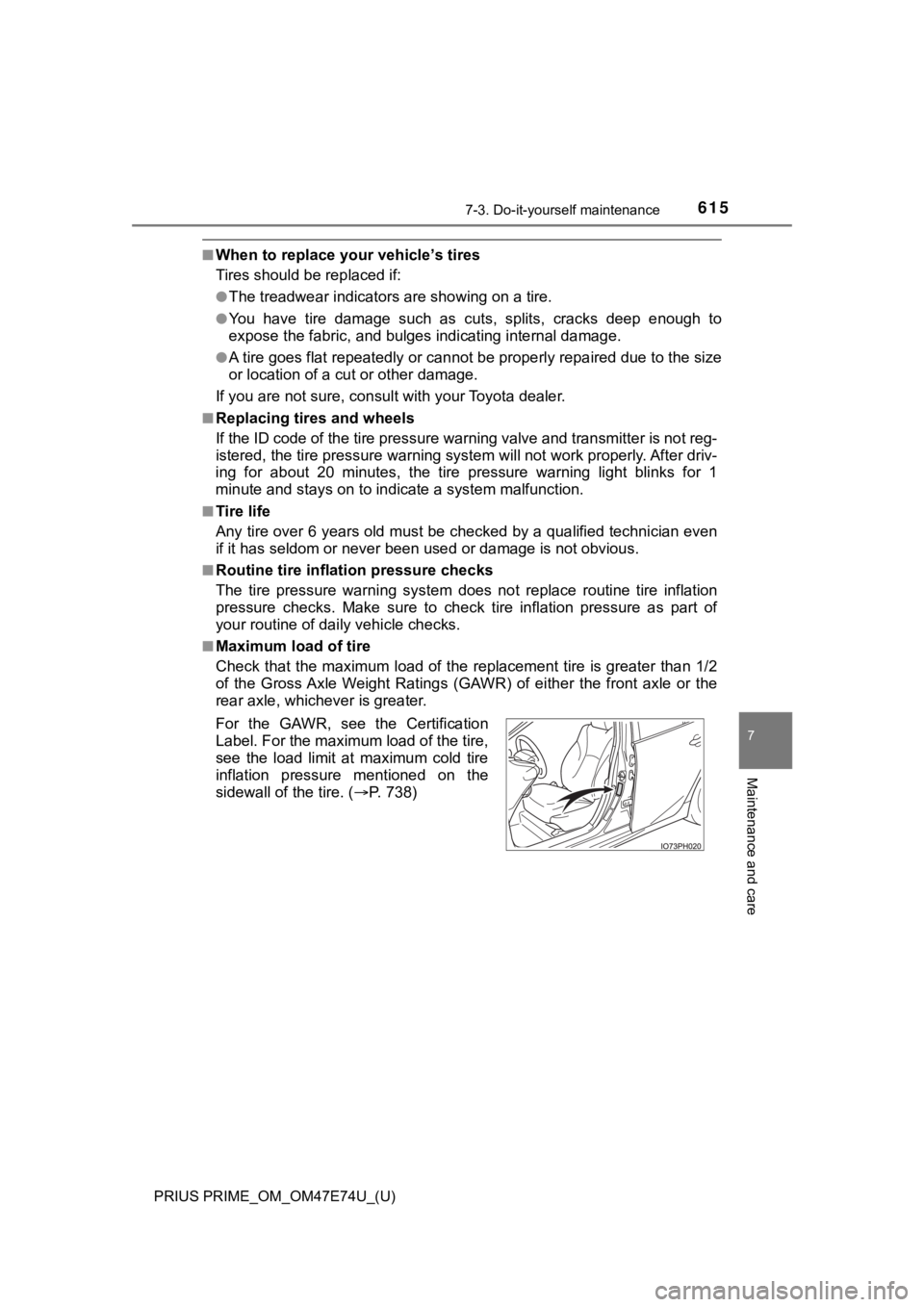
■Maximum load of tire
Check that the maximum load of t he replacement tire is greater than 1/2
of the Gross Axle Weight Ratings (GAWR) of either the front axl e or the
rear axle, whichever is greater.
For the GAWR, see the Certification
Label. For the maximum load of the tire,
see the load limit at maximum cold tire
inflation pressure mentioned on the
sidewall of the tire. ( P. 7 3 8 )