engine TOYOTA PRIUS PRIME 2023 User Guide
[x] Cancel search | Manufacturer: TOYOTA, Model Year: 2023, Model line: PRIUS PRIME, Model: TOYOTA PRIUS PRIME 2023Pages: 680, PDF Size: 14.97 MB
Page 78 of 680
782-1. Plug-in hybrid system
When the accelerator pedal is
depressed heavily, drive force
from both the gasoline engine
and the electric motor (trac-
tion motor) is used to acceler-
ate.
*: When the hybrid battery (traction
battery) requires charging or the
engine is warming up, etc., the
gasoline engine will not automati-
cally stop. ( P.79)
■When braking (regenera-
tive braking)
The electric motor (traction
motor) charges the hybrid bat-
tery (traction battery).
The EV driving range can be
extended by actively using this
regenerative braking to store
electricity in the hybrid battery
(traction battery).
Moreover, as fuel consumption
is also reduced when in HV
mode, the regenerative braking
system can be used effectively.
■Regenerative braking
●In the following situations, kinetic
energy is converted to electric
energy and deceleration force can
be obtained in conjunction with
the recharging of the hybrid bat-
tery (traction battery).
• The accelerator pedal is released while driving with the shift position
in D or B.
• The brake pedal is depressed while driving with the shift position
in D or B.
●The Regeneration Boost oper-
ates when the shift position is
shifted to B. The regenerative
braking force can be changed when the Regeneration Boost is
operating. (
P.260)
■EV driving range
●The EV driving range is displayed
on the meter. ( P.155)
●The EV driving range changes in
accordance with the charge status
of the hybrid battery (traction bat-
tery), the speed of the vehicle, etc.
●Even if there is enough charge
remaining in the hybrid battery
(traction battery), EV driving may
be canceled and both gasoline
engine and electric motor are
used depending on the situation.
( P.79)
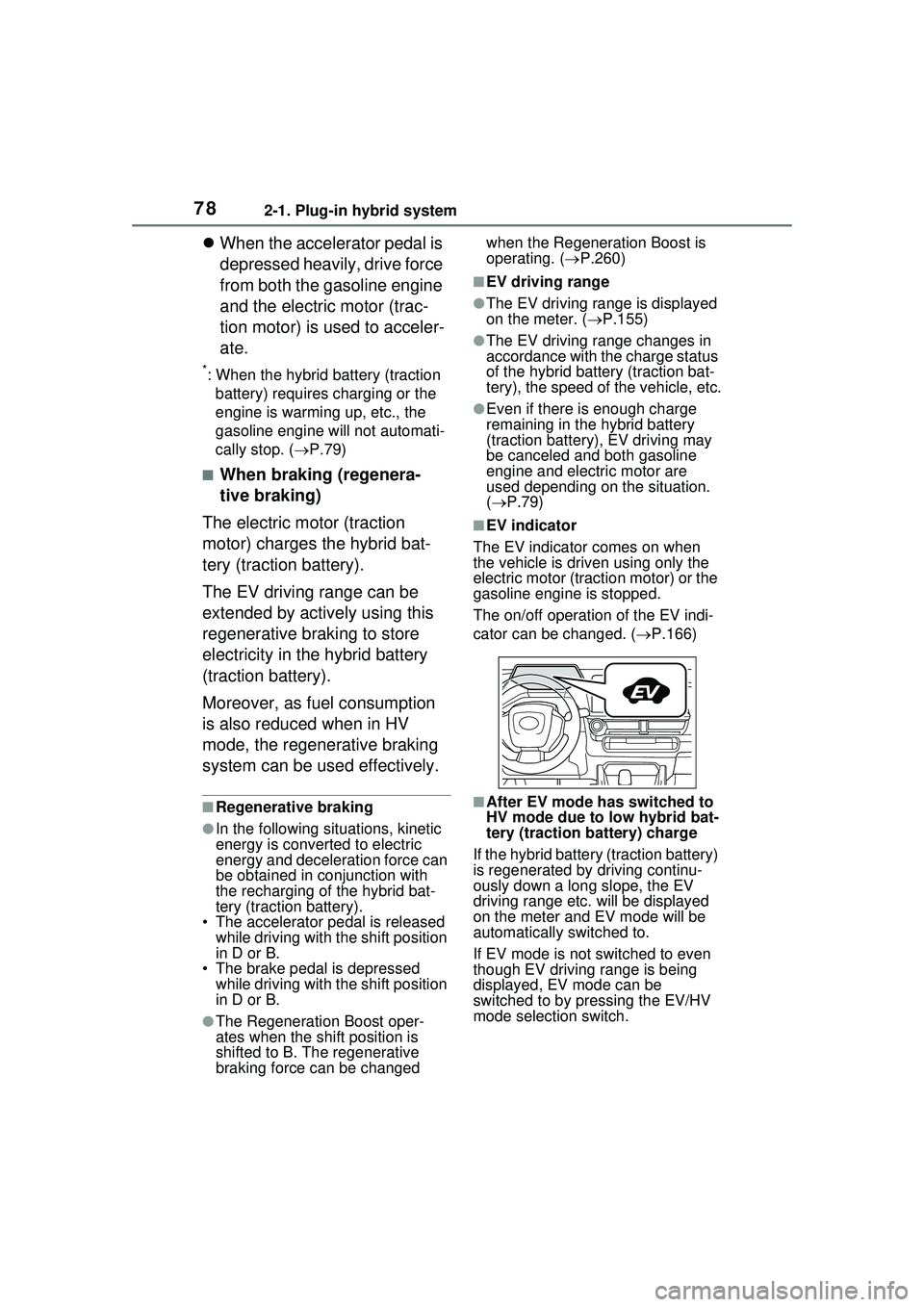
■EV indicator
The EV indicator comes on when
the vehicle is driven using only the
electric motor (traction motor) or the
gasoline engine is stopped.
The on/off operation of the EV indi-
cator can be changed. ( P.166)
■After EV mode has switched to
HV mode due to low hybrid bat-
tery (traction battery) charge
If the hybrid battery (traction battery)
is regenerated by driving continu-
ously down a long slope, the EV
driving range etc. will be displayed
on the meter an d EV mode will be
automatically switched to.
If EV mode is not switched to even
though EV driving range is being
displayed, EV mode can be
switched to by pressing the EV/HV
mode selection switch.
Page 79 of 680
792-1. Plug-in hybrid system
2
Plug-in hybrid system
■Gasoline engine operation in
EV mode or AUTO EV/HV mode
Even if there is a sufficient amount
of electricity remain ing in the hybrid
battery (traction battery) and EV
driving range ( P.155) is being dis-
played on the meter, EV driving
(driving using only the electric
motor) may be canceled and both
gasoline engine and electric motor
are used depending on the situation
(EV driving will be returned to auto-
matically after EV driving becomes
possible again).
EV driving may be canceled auto-
matically in the following circum-
stances
*1:
●When vehicle speed is more than
approximately 84 mph (135 km/h).
●When power is needed temporar-
ily, for example when the acceler-
ator pedal is depressed firmly or
when accelerating suddenly.
*2
●When the temperature of the
hybrid system is high.
The vehicle has been left in the
sun, driven on a h ill, driven at high
speeds, etc.
●When the temperature of the
hybrid system is low.
●When the heater is switched on
when the outside temperature is
below about 14°F (-10°C).
●When the windshield defogger
switch is pressed. ( P.434)
●When the system determines that
the gasoline engine needs to be
started.
*1: The gasoline engine may also
operate in circumstances other
than those listed above, depend-
ing on conditions.
*2: When driving in AUTO EV/HV mode. Even in EV mode, the gas-
oline engine may start, depend-
ing on the condition of the hybrid
battery (traction battery).
■If “Engine Started to Protect
System EV driving unavailable”
is displayed on the multi-infor-
mation display
EV driving may be canceled in order
to protect the hybrid system, etc.
In this case, perform driving with the
gasoline engine until EV driving will
be returned to automatically.
Depending on the conditions, driv-
ing that combines the use of the
gasoline engine may continue for a
short while. However, this is not a
malfunction.
■Conditions in which the gaso-
line engine may not stop
The gasoline engine starts and
stops automatically . However, it
may not stop automatically in the
following conditions
*:
●During gasoline engine warm-up
●During hybrid battery (traction bat-
tery) charging
●When the temperature of the
hybrid battery (traction battery) is
high or low
●When the windshield defogger
switch is pressed. ( P.434)
*: Depending on the circumstances,
the gasoline engine may also not
stop automatically in situations
other than those above.
■Sounds and vibrations specific
to a Plug-in Hybrid Electric
Vehicle
Because there is no engine sound
or vibration, it is easy to mistake the
Plug-in Hybrid Electric Vehicle for
being off when it is actually still run-
ning, as indicated by the “READY”
indicator being illuminated. For
safety, make sure to always shift the
shift position to P and apply the
parking brake when parked.
The following sounds or vibrations
may occur when the hybrid system
is operating and are not a malfunc-
tion.
Page 80 of 680
802-1. Plug-in hybrid system
●Motor sounds may be heard from
the engine compartment.
●Sounds may be heard from the
hybrid battery (traction battery)
when the hybrid system starts or
stops.
●Relay operating sounds such as a
snap or soft clank will be emitted
from the hybrid battery (traction
battery), under the rear seats or
under the floor, when the hybrid
system is started or stopped.
●Sounds from the hybrid system
may be heard when the back door
is open.
●Sounds may be heard from the
transmission when the gasoline
engine starts or stops, when driv-
ing at low speeds, or during idling.
●Engine sounds may be heard
when accelerating sharply.
●Sounds may be heard due to
regenerative braking when the
brake pedal is depressed or as
the accelerator pedal is released.
●Vibration may be felt when the
gasoline engine starts or stops.
●Sounds may be heard from near
the hybrid battery (traction battery)
in accordance with the operation
of the air conditioning system or
battery cooler. ( P.109)
■Maintenance, repair, recycling,
and disposal
Contact your Toyota dealer regard-
ing maintenance, repair, recycling
and disposal. Do not dispose of the
vehicle yourself.
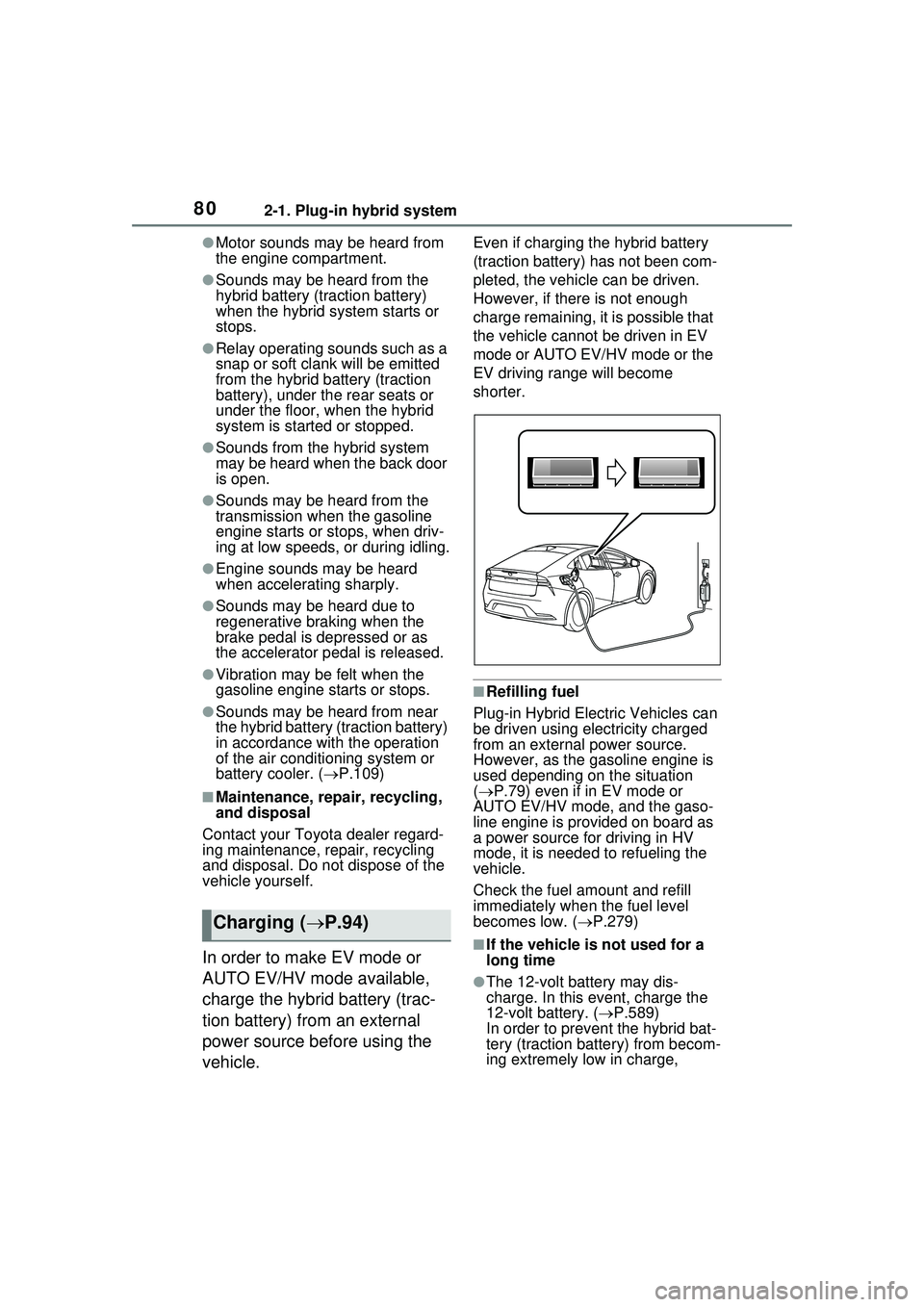
In order to make EV mode or
AUTO EV/HV mode available,
charge the hybrid battery (trac-
tion battery) from an external
power source before using the
vehicle.
Even if charging the hybrid battery
(traction battery) has not been com-
pleted, the vehicle can be driven.
However, if there is not enough
charge remaining, it is possible that
the vehicle cannot be driven in EV
mode or AUTO EV/HV mode or the
EV driving range will become
shorter.
■Refilling fuel
Plug-in Hybrid Electric Vehicles can
be driven using electricity charged
from an external power source.
However, as the gasoline engine is
used depending on the situation
( P.79) even if in EV mode or
AUTO EV/HV mode, and the gaso-
line engine is provided on board as
a power source for driving in HV
mode, it is needed to refueling the
vehicle.
Check the fuel amount and refill
immediately when the fuel level
becomes low. ( P.279)
■If the vehicle is not used for a
long time
●The 12-volt battery may dis-
charge. In this event, charge the
12-volt battery. ( P.589)
In order to prevent the hybrid bat-
tery (traction batt ery) from becom-
ing extremely low in charge,
Charging ( P.94)
Page 81 of 680
812-1. Plug-in hybrid system
2
Plug-in hybrid system
charge the hybrid battery (traction
battery) from external power
source or start the hybrid system
at least once every 2 or 3 months,
and turn the power switch off after
the gasoline engine has stopped
automatically. (If the gasoline
engine does not start up even
after approximately 10 seconds
have passed since the “READY”
indicator came on, the power
switch can be turned to off without
any further action.)
When the 12-volt battery is dis-
charged, refer to P.589, “If the 12-
volt battery is discharged” and
perform the correction procedure.
●When the vehicle is left with the
AC charging cable connected, the
electricity consumption amount of
the 12-volt battery increases due
to controls, such as the system
checking, operating. When the AC
charging cable is not needed,
remove it from the vehicle.
When driving with the gasoline
engine stopped, a sound, which
changes in accordance with the
driving speed, will be played in
order to warn people nearby of
the vehicle’s approach. The
sound will stop when the vehicle
speed exceeds approximately
22 mph (35 km/h).
■Acoustic Vehicle Alerting Sys-
tem
In the following cases, the Acoustic
Vehicle Alerting System may be dif-
ficult for surrounding people to hear.
●In very noisy areas
●In the wind or the rain
Also, as the Acoustic Vehicle Alert- ing System is installed on the front
of the vehicle, it may be more diffi-
cult to hear from the rear of the vehi-
cle compared to the front.
■When “Acoustic Vehicle Alert-
ing System Malfunction Visit
your Dealer” is displayed on the
multi-information display
The Acoustic Vehicle Alerting Sys-
tem may be malfunctioning. Have
the vehicle inspected by your
Toyota dealer immediately.
*: This function can only be used in the mainland U.S.A. It cannot be
used in other states and territo-
ries, including Alaska and Hawaii.
This system operates based on
the driving situation and traffic
information to enhance fuel
economy.
For details about Predictive effi-
cient drive, refer to “MULTIME-
DIA OWNER’S MANUAL”.
■Predictive deceleration sup-
port
When the vehicle approaches
to predictive deceleration sup-
port points registered in the
navigation system, the refer-
ence operation range ( ) of
the ECO Accelerator Guid-
ance ( P.163) on the multi-
information display will be
turned off to encourage the
driver to reduce excessive
acceleration.
Acoustic Vehicle Alerting
System
Predictive efficient drive
(vehicles with navigation
system)
*
A
Page 82 of 680
822-1. Plug-in hybrid system
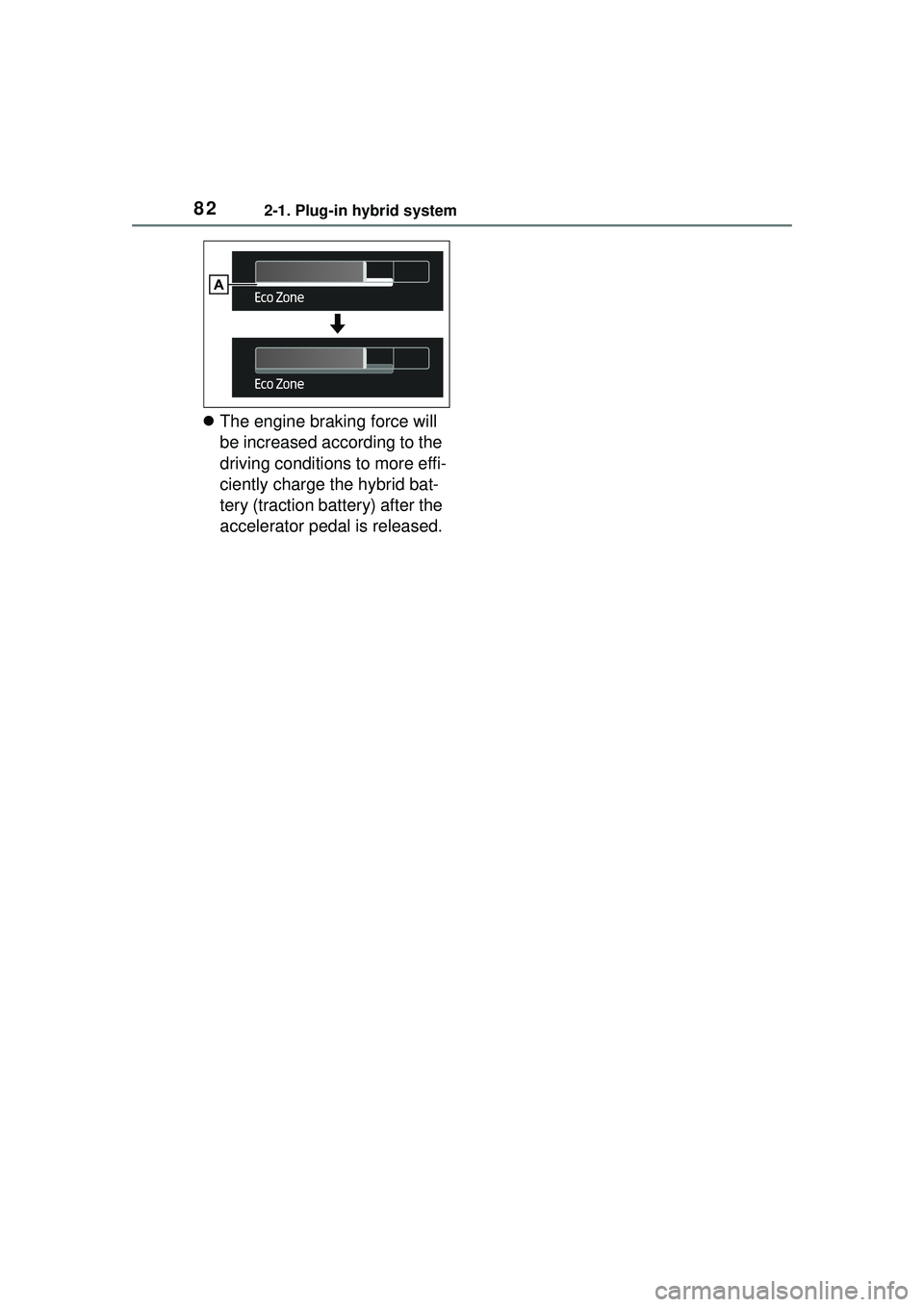
The engine braking force will
be increased according to the
driving conditions to more effi-
ciently charge the hybrid bat-
tery (traction battery) after the
accelerator pedal is released.
Page 86 of 680
862-1. Plug-in hybrid system
WARNING
●Never resell, hand over or mod-
ify the hybrid battery. To prevent
accidents, hybrid batteries that
have been removed from a dis-
posed vehicle are collected
through Toyota dealer. Do not
dispose of the battery yourself.
Unless the battery is properly
collected, the following may
occur, resulting in death or seri-
ous injury:
• The hybrid battery may be ille- gally disposed of or dumped,
and it is hazardous to the envi-
ronment or someone may touch
a high voltage part, resulting in
an electric shock.
• The hybrid battery is intended to be used exclusively with your
Hybrid Electric Vehicle. If the
hybrid battery is used outside of
your vehicle or modified in any
way, accidents such as electric
shock, heat generation, smoke
generation, an explosion and
electrolyte leakage may occur.
When reselling or handing over
your vehicle, the possibility of
an accident is extremely high
because the person receiving
the vehicle may not be aware of
these dangers.
●If your vehicle is disposed of
without the hybrid battery hav-
ing been removed, there is a
danger of serious electric shock
if high voltage parts, cables and
their connectors are touched. In
the event that your vehicle must
be disposed of, the hybrid bat-
tery must be disposed of by
your Toyota dealer or a qualified
service shop. If the hybrid bat-
tery is not disposed of properly,
it may cause electric shock that
can result in death or serious
injury.
■Caution while driving
If the vehicle under floor area
receives strong shock or impact
while driving, stop the vehicle in a
safe area and check around the
bottom of the vehicle. If there is
damage to the hybrid battery
(traction battery) or liquid leakage,
it may lead to a vehicle fire, etc.
Do not touch the vehicle and
immediately contact your Toyota
dealer.
Even if no damage can be seen
under the floor, the hybrid battery
(traction battery) may be dam-
aged. If the vehicle under floor
area receives strong shock or
impact, have the hybrid battery
(traction battery) inspected by
your Toyota dealer.
■Modifications
Do not modify the vehicle to make
the height lower.
It is easier for the hybrid battery
(traction battery) in the under floor
area to come in contact with the
ground when the vehicle is low-
ered. If the hybrid battery (traction
battery) is damaged, a vehicle fire
may occur which could lead to
death or serious injury.
NOTICE
■Notice about fuel
●For Plug-in Hybrid Electric Vehi-
cles, fuel may remain in the tank
for a long time and undergo
changes in quality depending
on the how the vehicle is used.
Refuel at least 5.3 gal. (20 L,
4.4 Imp.gal.) of fuel every 12
months (refuel a total of at least
5.3 gal. [20 L, 4.4 Imp.gal.] over
a 12-month period), as this may
affect components of the fuel
system or the gasoline engine.
Page 88 of 680
882-1. Plug-in hybrid system
Primarily using EV mode and
AUTO EV/HV mode when driv-
ing in cities and using HV mode
when driving on highways (or
freeways) can help conserve
fuel and electricity. (P.74)
When using Eco drive mode, the
torque corresponding to the
accelerator pedal depression
amount can be generated more
smoothly than it is in normal
conditions. In addition, the oper-
ation of the air conditioning sys-
tem (heating/cooling) will be
minimized, improving fuel and
electricity economy. ( P.422)
Eco-friendly driving is possible
by keeping the Hybrid System
Indicator within Eco area.
( P.158) Shift the shift position to D when
stopped at a traffic light, or driv-
ing in heavy traffic etc. Shift the
shift position to P when parking.
When using the N, there is no
positive effect on fuel consump-
tion. In the N, the gasoline
engine operates but electricity
cannot be generated. Also,
when using the air conditioning
system, etc., the hybrid battery
(traction battery) power is con-
sumed.
Drive your vehicle smoothly.
Avoid abrupt acceleration and
deceleration. Gradual accel-
eration and deceleration will
make more effective use of
the electric motor (traction
motor) without having to use
gasoline engine power.
Avoid repeated acceleration.
Repeated acceleration con-
sumes hybrid battery (trac-
tion battery) po wer, resulting
in poor fuel consumption. Bat-
tery power can be restored by
driving with the accelerator
pedal slightly released.
Make sure to operate the brakes
Plug-in Hybrid Elec-
tric Vehicle driving
tips
For economical and ecolog-
ical driving, pay attention to
the following points:
Using EV mode, AUTO
EV/HV mode and HV
mode effectively
Using Eco drive mode
Use of Hybrid System
Indicator
Changing the shift posi-
tion
Accelerator pedal/brake
pedal operation
When braking
Page 90 of 680
902-1. Plug-in hybrid system
Carrying heavy luggage will lead
to poor fuel economy. Avoid car-
rying unnecessary luggage.
Installing a large roof rack will
also cause poor fuel economy.
Since the gasoline engine starts
up and cuts out automatically,
warming up is not necessary.The value displayed on the SOC
(State of Charge) gauge
(P.155) is estimated from the
following information.
The amount of hybrid battery
(traction battery) charge cur-
rently remaining
The electricity consumption
(the estimated distance that
EV driving is possible per unit
of electrical energy) based on
the recorded value
Past air conditioning system
electricity consumption
amount
The electricity consumption var-
ies depending on how the vehi-
cle is driven. The vehicle
Luggage
Warming up before driv-
ing
EV driving range
The EV driving range dis-
played on the meter shows
the reference distance that
EV driving (driving using
only the electric motor) is
possible, and the actual dis-
tance that can be driven
may differ from that dis-
played.
Even if the EV driving range is
displayed, EV driving may be
canceled and both gasoline
engine and electric motor are
used depending on the situa-
tion. ( P.79)
Displayed value
Page 108 of 680
1082-2. Charging
■AC charging (P.116)
This is a charging method used
when charging from an AC out-
let with the AC charging cable or
charging that use an AC char-
ger.
By setting charging schedule, it is
also possible to charge at the
desired date and time. ( P.123)
■Using the hybrid battery
(traction battery) charge
mode ( P.75)
The plug-in hybrid system can
be switched to hybrid battery
(traction battery) charge mode
to charge the hybrid battery
(traction battery) using electricity
generated by gasoline engine
operation.
The maximum charge amount in
the hybrid battery (traction battery)
charge mode is approximately 80%
of the fully charged capacity for the
charging from an external power
source.
■Solar charging system (if
equipped) ( P.136)
In certain conditions, when the vehicle is parked, the hybrid bat-
tery (traction battery) can be
charged by using electricity gen-
erated by the solar panel
equipped to the roof of the vehi-
cle.
This vehicle is equipped with
several functions that are linked
with charging.
■“My Room Mode” (
P.134)
When the AC charging cable is
connected to the vehicle, electri-
cal components such as the air
conditioning system or audio
system can be used using the
external power source
*.
*: The power of the hybrid battery (traction battery) may be used
depending on the situation.
■“Battery Heater”
When the outside temperature
is low and the AC charging
cable is connected to the vehi-
cle, this function automatically
warms the hybrid battery (trac-
tion battery) until it reaches or
exceeds a certain temperature.
“Battery Heater” will operate
when the “Battery Heater” of the
“Charging Settings” on the multi-
information display is on.
( P.169)
By setting charging schedule,
“Battery Heater” operates
according to the charging
Charging methods
The following methods can
be used to charge the
hybrid battery (traction bat-
tery).
Types of charging meth-
odsCharging-linked functions
Page 150 of 680
1503-1. Instrument cluster
3-1.Instrument cluster
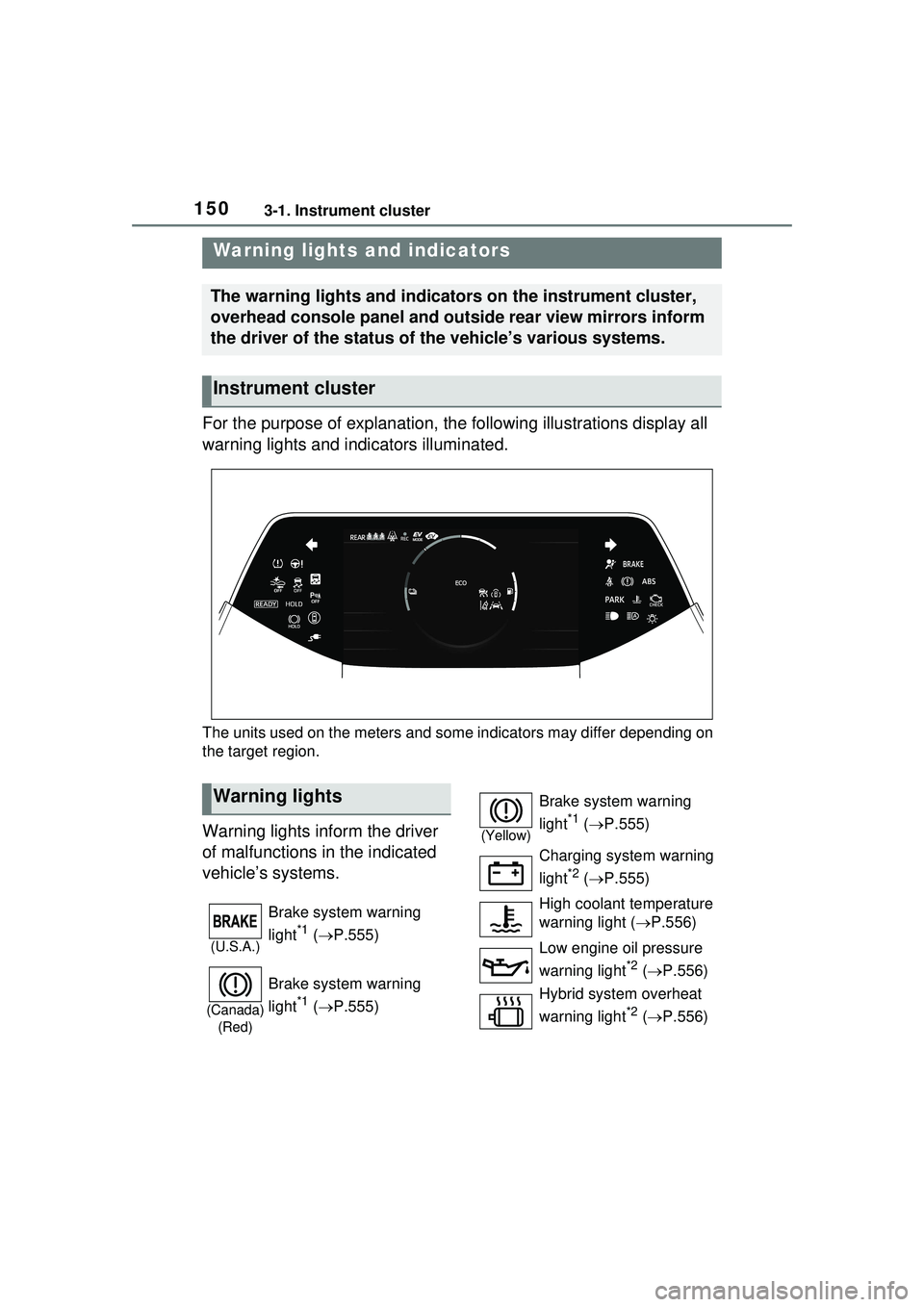
For the purpose of explanation, the following illustrations display all
warning lights and indicators illuminated.
The units used on the meters and some indicators may differ depending on
the target region.
Warning lights inform the driver
of malfunctions in the indicated
vehicle’s systems.
Warning lights and indicators
The warning lights and indicators on the instrument cluster,
overhead console panel and outside rear view mirrors inform
the driver of the status of the vehicle’s various systems.
Instrument cluster
Warning lights
(U.S.A.)
Brake system warning
light
*1 ( P.555)
(Canada)
(Red)
Brake system warning
light
*1 ( P.555)
(Yellow)
Brake system warning
light
*1 ( P.555)
Charging system warning
light
*2 ( P.555)
High coolant temperature
warning light ( P.556)
Low engine oil pressure
warning light
*2 ( P.556)
Hybrid system overheat
warning light
*2 ( P.556)