warning light TOYOTA PRIUS PRIME 2023 User Guide
[x] Cancel search | Manufacturer: TOYOTA, Model Year: 2023, Model line: PRIUS PRIME, Model: TOYOTA PRIUS PRIME 2023Pages: 680, PDF Size: 14.97 MB
Page 40 of 680
401-1. For safe use
WARNING
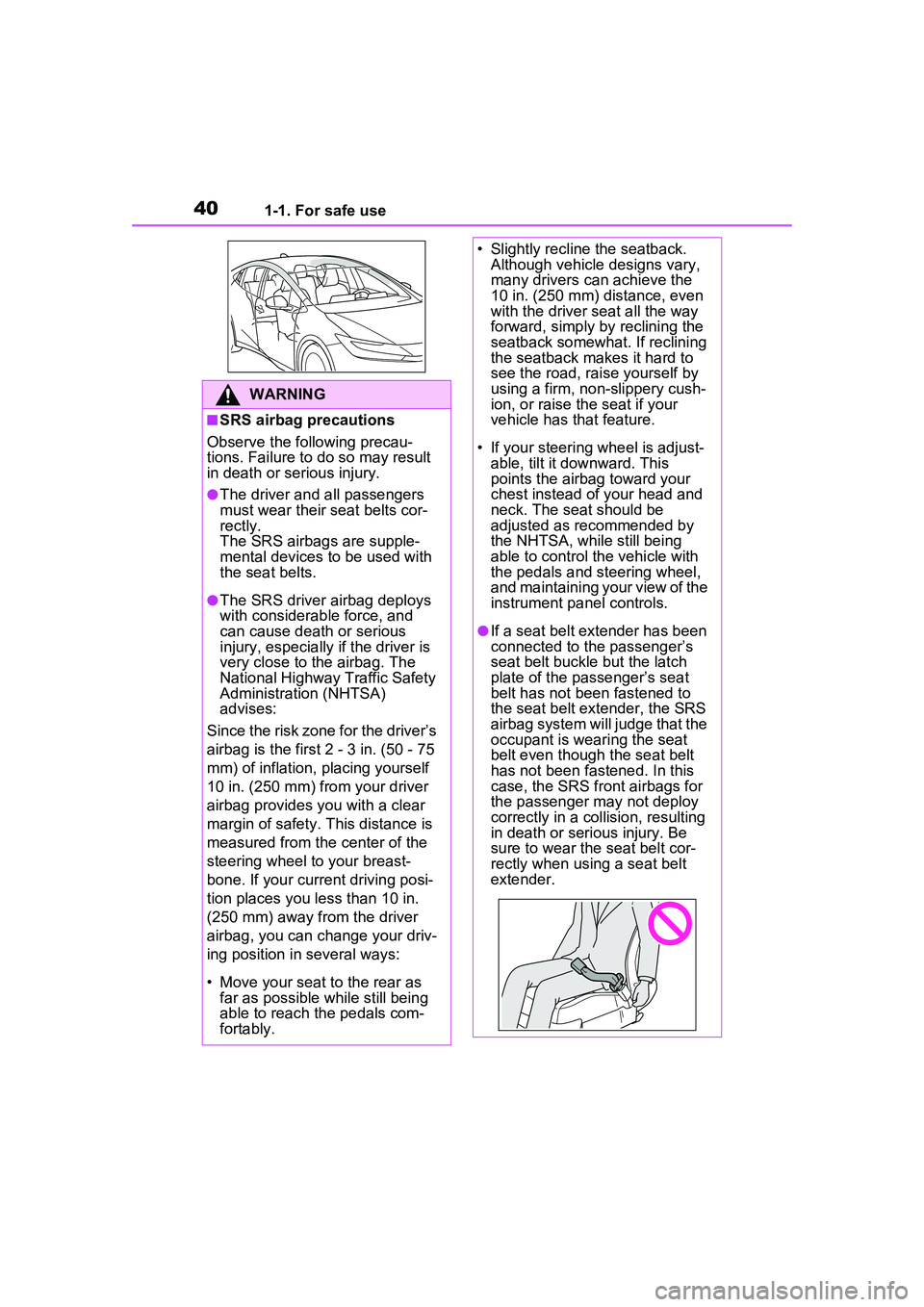
■SRS airbag precautions
Observe the following precau-
tions. Failure to do so may result
in death or serious injury.
●The driver and all passengers
must wear their seat belts cor-
rectly.
The SRS airbags are supple-
mental devices to be used with
the seat belts.
●The SRS driver airbag deploys
with considerable force, and
can cause death or serious
injury, especially if the driver is
very close to the airbag. The
National Highway Traffic Safety
Administration (NHTSA)
advises:
Since the risk zone for the driver’s
airbag is the first 2 - 3 in. (50 - 75
mm) of inflation, placing yourself
10 in. (250 mm) from your driver
airbag provides you with a clear
margin of safety. This distance is
measured from the center of the
steering wheel to your breast-
bone. If your current driving posi-
tion places you less than 10 in.
(250 mm) away from the driver
airbag, you can change your driv-
ing position in several ways:
• Move your seat to the rear as far as possible while still being
able to reach the pedals com-
fortably.
• Slightly recline the seatback. Although vehicle designs vary,
many drivers can achieve the
10 in. (250 mm) distance, even
with the driver seat all the way
forward, simply by reclining the
seatback somewhat. If reclining
the seatback makes it hard to
see the road, raise yourself by
using a firm, non-slippery cush-
ion, or raise the seat if your
vehicle has that feature.
• If your steering wheel is adjust- able, tilt it downward. This
points the airbag toward your
chest instead of your head and
neck. The seat should be
adjusted as recommended by
the NHTSA, while still being
able to control the vehicle with
the pedals and steering wheel,
and maintaining your view of the
instrument panel controls.
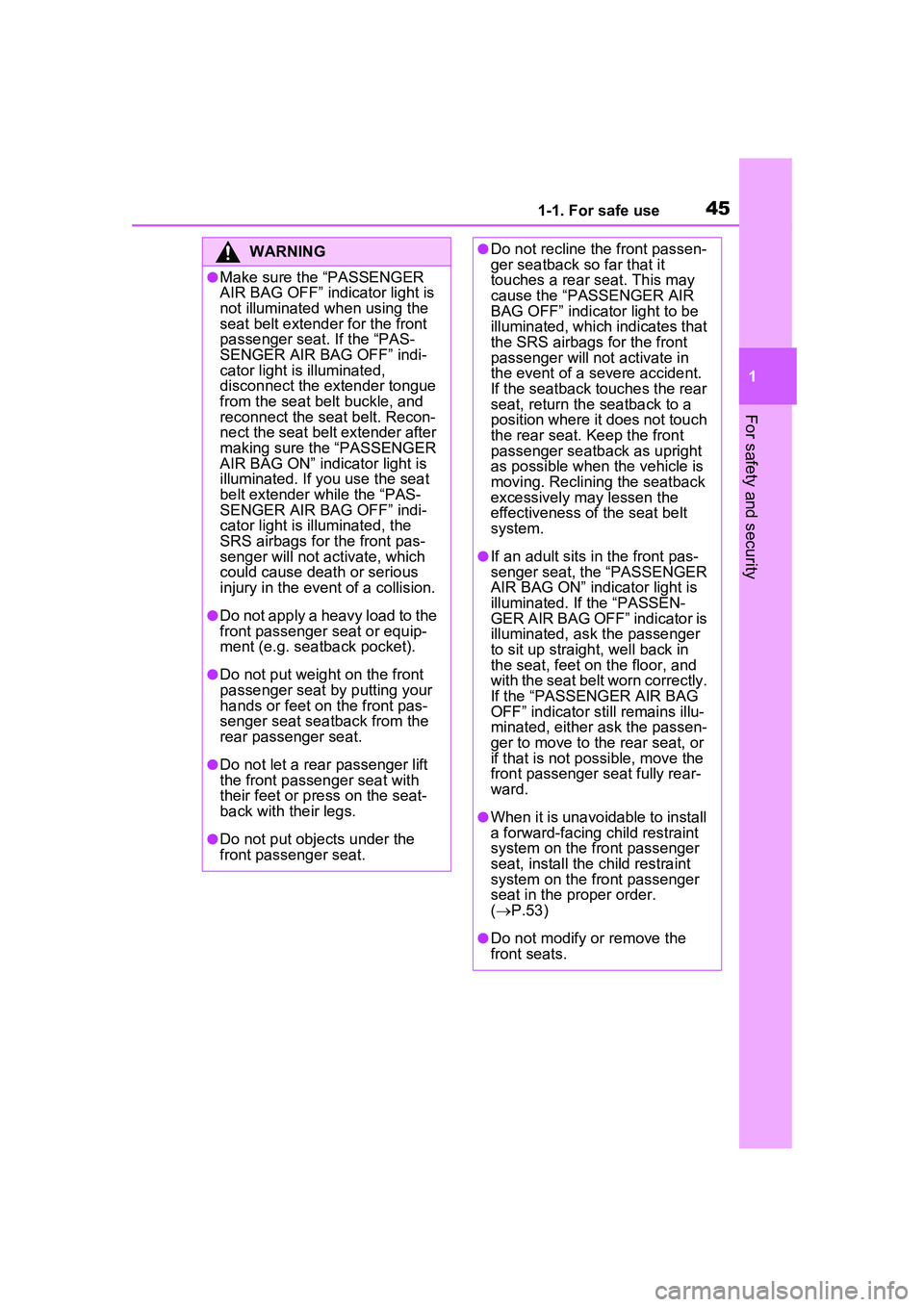
●If a seat belt extender has been
connected to the passenger’s
seat belt buckle but the latch
plate of the passenger’s seat
belt has not been fastened to
the seat belt extender, the SRS
airbag system will judge that the
occupant is wearing the seat
belt even though the seat belt
has not been fastened. In this
case, the SRS front airbags for
the passenger may not deploy
correctly in a collision, resulting
in death or serious injury. Be
sure to wear the seat belt cor-
rectly when using a seat belt
extender.
Page 44 of 680

441-1. For safe use
SRS warning light
Driver’s and front passenger’s seat belt reminder light
“PASSENGER AIR BAG OFF” indicator light
“PASSENGER AIR BAG ON” indicator light
Front passenger occupant classification system
Your vehicle is equipped with a front passenger occupant
classification system. This system detects the conditions of
the front passenger seat and activates or deactivates the fol-
lowing SRS airbags.
SRS front passenger airbag
System components
A
B
C
D
WARNING
■Front passenger occupant
classification system precau-
tions
Observe the following precautions
regarding the front passenger
occupant classification system.
Failure to do so may cause death
or serious injury.
●Wear the seat belt properly.
●Make sure the front passenger’s
seat belt plate has not been left
inserted into the buckle before
someone sits in the front pas-
senger seat.
Page 45 of 680
451-1. For safe use
1
For safety and security
WARNING
●Make sure the “PASSENGER
AIR BAG OFF” indicator light is
not illuminated when using the
seat belt extender for the front
passenger seat. If the “PAS-
SENGER AIR BAG OFF” indi-
cator light is illuminated,
disconnect the extender tongue
from the seat belt buckle, and
reconnect the seat belt. Recon-
nect the seat belt extender after
making sure the “PASSENGER
AIR BAG ON” indicator light is
illuminated. If you use the seat
belt extender while the “PAS-
SENGER AIR BAG OFF” indi-
cator light is illuminated, the
SRS airbags for the front pas-
senger will not activate, which
could cause death or serious
injury in the event of a collision.
●Do not apply a heavy load to the
front passenger seat or equip-
ment (e.g. se atback pocket).
●Do not put weight on the front
passenger seat by putting your
hands or feet on the front pas-
senger seat seatback from the
rear passenger seat.
●Do not let a rear passenger lift
the front passenger seat with
their feet or press on the seat-
back with their legs.
●Do not put objects under the
front passenger seat.
●Do not recline the front passen-
ger seatback so far that it
touches a rear seat. This may
cause the “PASSENGER AIR
BAG OFF” indicator light to be
illuminated, which indicates that
the SRS airbags for the front
passenger will not activate in
the event of a severe accident.
If the seatback touches the rear
seat, return th e seatback to a
position where it does not touch
the rear seat. Keep the front
passenger seatback as upright
as possible when the vehicle is
moving. Reclining the seatback
excessively may lessen the
effectiveness of the seat belt
system.
●If an adult sits in the front pas-
senger seat, the “PASSENGER
AIR BAG ON” indicator light is
illuminated. If the “PASSEN-
GER AIR BAG OFF” indicator is
illuminated, ask the passenger
to sit up straight, well back in
the seat, feet on the floor, and
with the seat belt worn correctly.
If the “PASSENGER AIR BAG
OFF” indicator still remains illu-
minated, either ask the passen-
ger to move to the rear seat, or
if that is not possible, move the
front passenger seat fully rear-
ward.
●When it is unavoidable to install
a forward-facing child restraint
system on the front passenger
seat, install the child restraint
system on the front passenger
seat in the proper order.
( P.53)
●Do not modify or remove the
front seats.
Page 46 of 680
461-1. For safe use
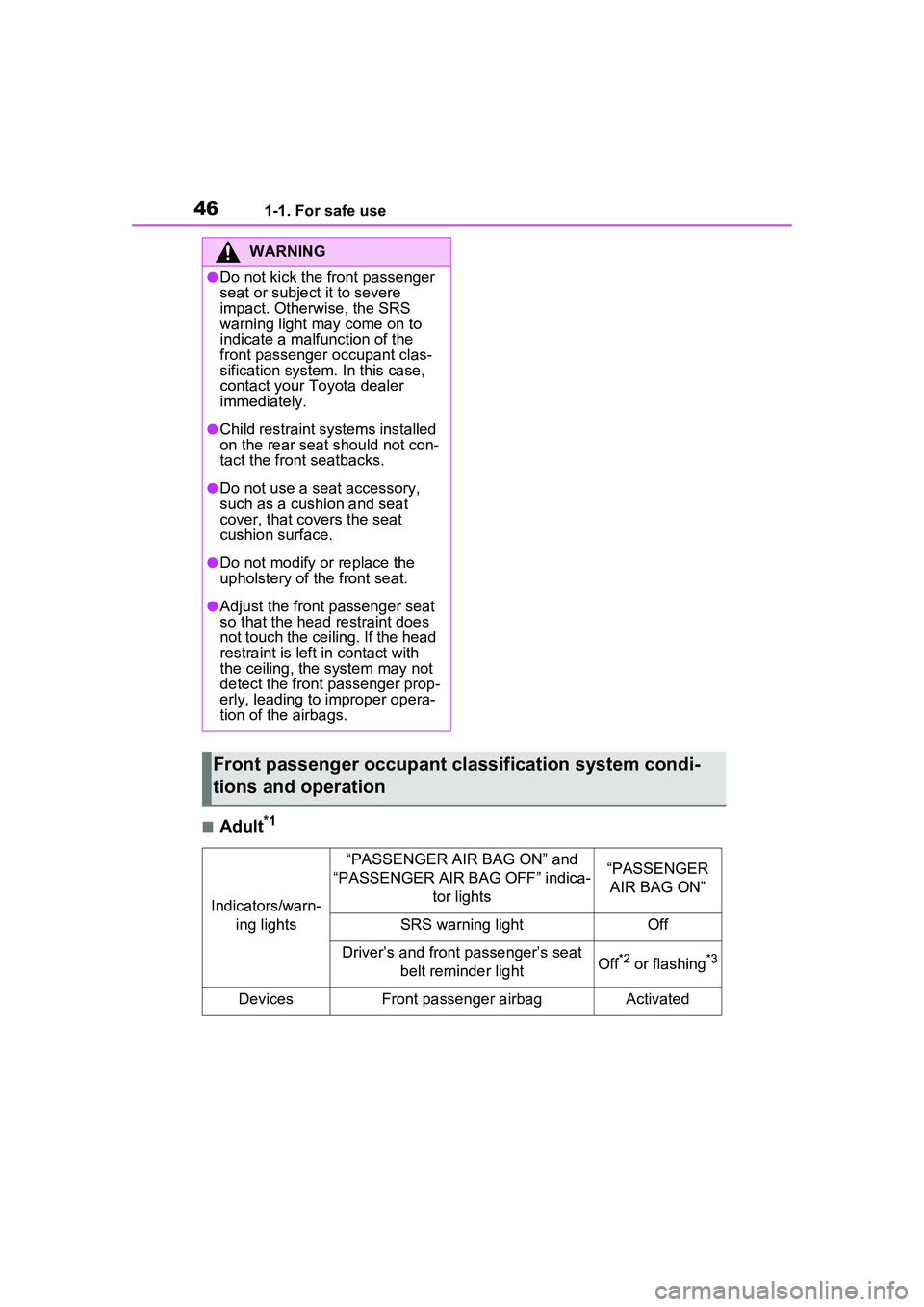
■Adult*1
WARNING
●Do not kick the front passenger
seat or subject it to severe
impact. Otherwise, the SRS
warning light may come on to
indicate a malfunction of the
front passenger occupant clas-
sification system. In this case,
contact your Toyota dealer
immediately.
●Child restraint systems installed
on the rear seat should not con-
tact the front seatbacks.
●Do not use a seat accessory,
such as a cushion and seat
cover, that covers the seat
cushion surface.
●Do not modify or replace the
upholstery of the front seat.
●Adjust the front passenger seat
so that the head restraint does
not touch the ceiling. If the head
restraint is left in contact with
the ceiling, the system may not
detect the front passenger prop-
erly, leading to improper opera-
tion of the airbags.
Front passenger occupant cl assification system condi-
tions and operation
Indicators/warn- ing lights
“PASSENGER AIR BAG ON” and
“PASSENGER AIR BAG OFF” indica- tor lights“PASSENGER AIR BAG ON”
SRS warning lightOff
Driver’s and front passenger’s seat belt reminder lightOff*2 or flashing*3
DevicesFront passenger airbagActivated
Page 47 of 680

471-1. For safe use
1
For safety and security
■Child*4
■Child restraint system with infant*5
■Unoccupied
Indicators/warn-ing lights
“PASSENGER AIR BAG ON” and
“PASSENGER AIR BAG OFF” indica- tor lights“PASSENGER
AIR BAG OFF” or “PASSENGER
AIR BAG ON”
*4
SRS warning lightOff
Driver’s and front passenger’s seat belt reminder lightOff*2 or flashing*3
DevicesFront passenger airbagDeactivated or
activated
*4
Indicators/warn- ing lights
“PASSENGER AIR BAG ON” and
“PASSENGER AIR BAG OFF” indica- tor lights“PASSENGER
AIR BAG OFF”
*6
SRS warning lightOff
Driver’s and front passenger’s seat belt reminder lightOff*2 or flashing*3
DevicesFront passenger airbagDeactivated
Indicators/warn-ing lights
“PASSENGER AIR BAG ON” and
“PASSENGER AIR BAG OFF” indica- tor lights“PASSENGER
AIR BAG OFF”
SRS warning light
OffDriver’s and front passenger’s seat belt reminder light
DevicesFront passenger airbagDeactivated
Page 48 of 680
481-1. For safe use
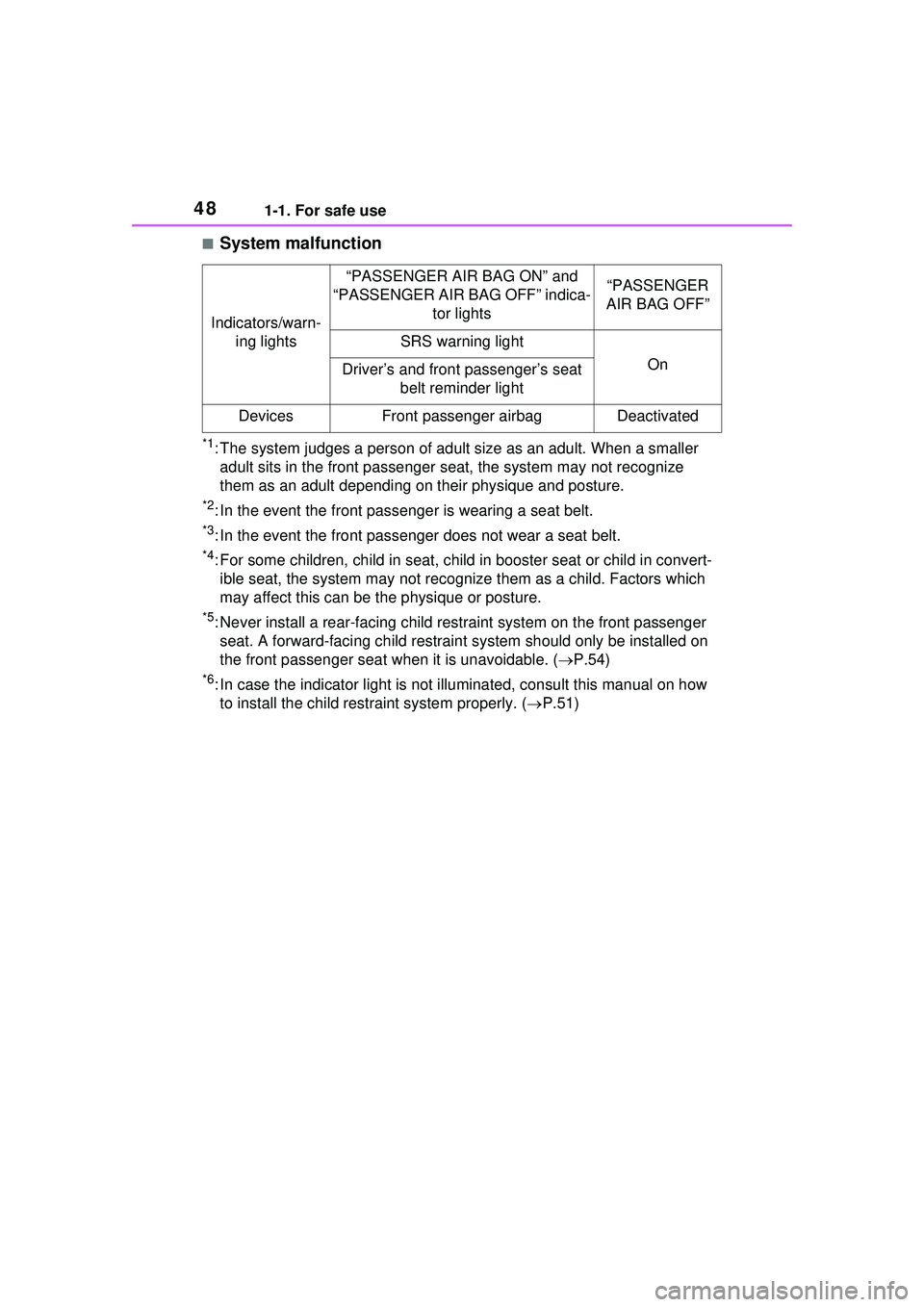
■System malfunction
*1: The system judges a person of adult size as an adult. When a smaller adult sits in the front passenger seat, the system may not recognize
them as an adult depending on their physique and posture.
*2: In the event the front passenger is wearing a seat belt.
*3: In the event the front passenger does not wear a seat belt.
*4: For some children, child in seat, child in booster seat or child in convert-
ible seat, the system may not recognize them as a child. Factors which
may affect this can be the physique or posture.
*5: Never install a rear-facing child rest raint system on the front passenger
seat. A forward-facing child restraint system should only be installed on
the front passenger seat w hen it is unavoidable. (P.54)
*6: In case the indicator light is not illu minated, consult this manual on how
to install the child restraint system properly. ( P.51)
Indicators/warn-
ing lights
“PASSENGER AIR BAG ON” and
“PASSENGER AIR BAG OFF” indica- tor lights“PASSENGER
AIR BAG OFF”
SRS warning light
OnDriver’s and front passenger’s seat belt reminder light
DevicesFront passenger airbagDeactivated
Page 49 of 680
491-1. For safe use
1
For safety and security
Exhaust gas precau-
tions
Harmful substance to the
human body is included in
exhaust gases if inhaled.
WARNING
Exhaust gases contain harmful
carbon monoxide (CO), which is
colorless and odorless. Observe
the following precautions.
Failure to do so may cause
exhaust gases to enter the vehicle
and may lead to an accident
caused by light-headedness, or
may lead to death or a serious
health hazard.
■Important points while driving
●Keep the back door closed.
●If you smell exhaust gases in
the vehicle even when the back
door is closed, open the side
windows and have the vehicle
inspected at your Toyota dealer
as soon as possible.
■When parking
●If the vehicle is in a poorly venti-
lated area or a closed area,
such as a garage, stop the
hybrid system.
●Do not leave the vehicle with
the hybrid system operating for
a long time.
If such a situation cannot be
avoided, park the vehicle in an
open space and ensure that
exhaust fumes do not enter the
vehicle interior.
●Do not leave the hybrid system
operating in an area with snow
build-up, or where it is snowing.
If snowbanks build up around
the vehicle while the hybrid sys-
tem operating, exhaust gases
may collect and enter the vehi-
cle.
■Exhaust pipe
The exhaust system needs to be
checked periodically. If there is a
hole or crack caused by corro-
sion, damage to a joint or abnor-
mal exhaust noise, be sure to
have the vehicle inspected and
repaired by your Toyota dealer.
Page 54 of 680
541-2. Child safety
■When installing a child
restraint system to a front
passenger seat
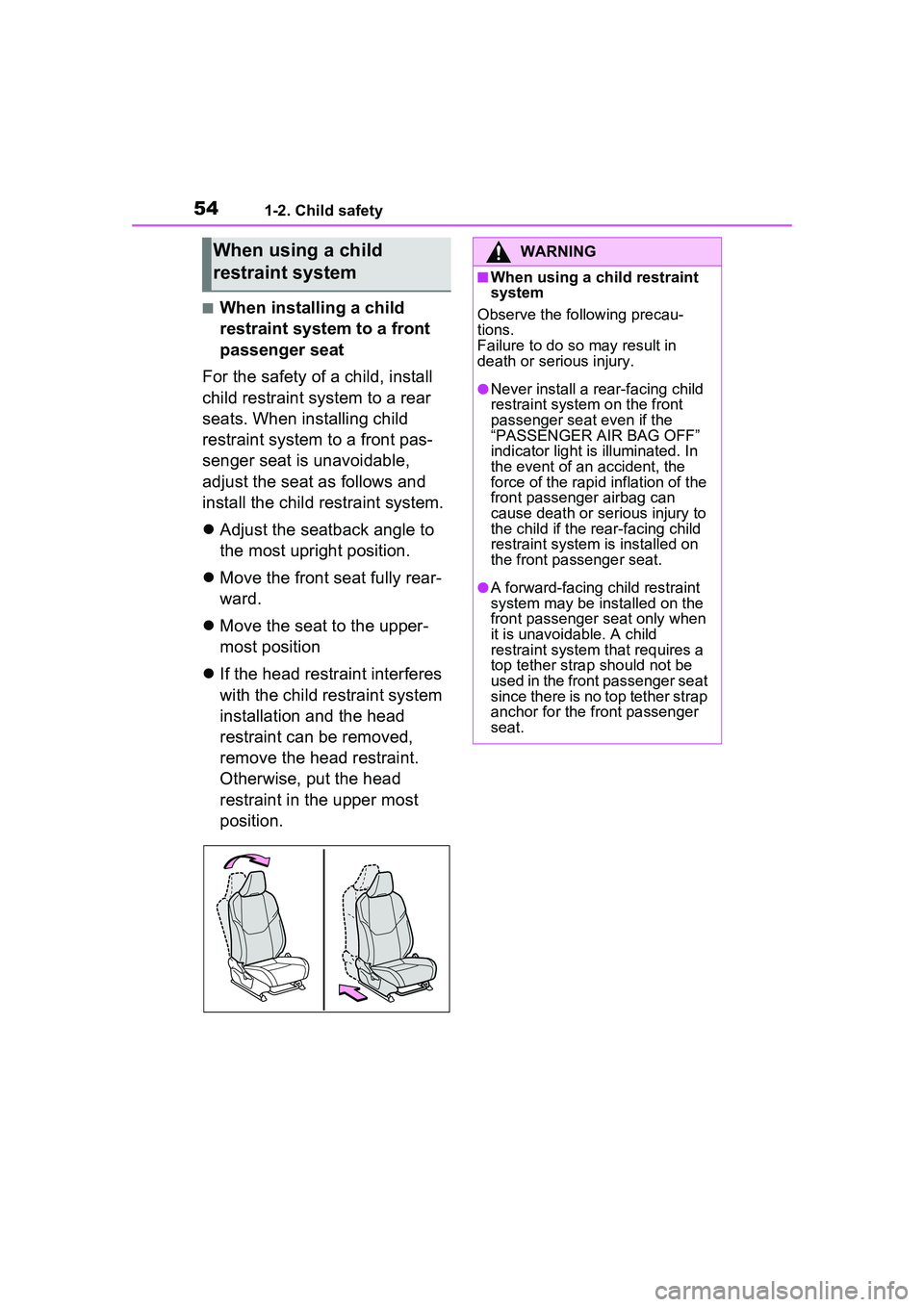
For the safety of a child, install
child restraint system to a rear
seats. When installing child
restraint system to a front pas-
senger seat is unavoidable,
adjust the seat as follows and
install the child restraint system.
Adjust the seatback angle to
the most upright position.
Move the front seat fully rear-
ward.
Move the seat to the upper-
most position
If the head restraint interferes
with the child restraint system
installation and the head
restraint can be removed,
remove the head restraint.
Otherwise, put the head
restraint in the upper most
position.
When using a child
restraint systemWARNING
■When using a child restraint
system
Observe the following precau-
tions.
Failure to do so may result in
death or serious injury.
●Never install a re ar-facing child
restraint system on the front
passenger seat even if the
“PASSENGER AIR BAG OFF”
indicator light is illuminated. In
the event of an accident, the
force of the rapid inflation of the
front passenger airbag can
cause death or serious injury to
the child if the rear-facing child
restraint system is installed on
the front passenger seat.
●A forward-facing child restraint
system may be installed on the
front passenger seat only when
it is unavoidable. A child
restraint system that requires a
top tether strap should not be
used in the front passenger seat
since there is no top tether strap
anchor for the front passenger
seat.
Page 55 of 680
551-2. Child safety
1
For safety and security
A child restraint system for a
small child or baby must itself be
properly restrained on the seat
with the lap portion of the
lap/shoulder belt.
■Installing child restraint
system using a seat belt
(child restraint lock func-
tion belt)
Install the child restraint system
in accordance to the operation
WARNING
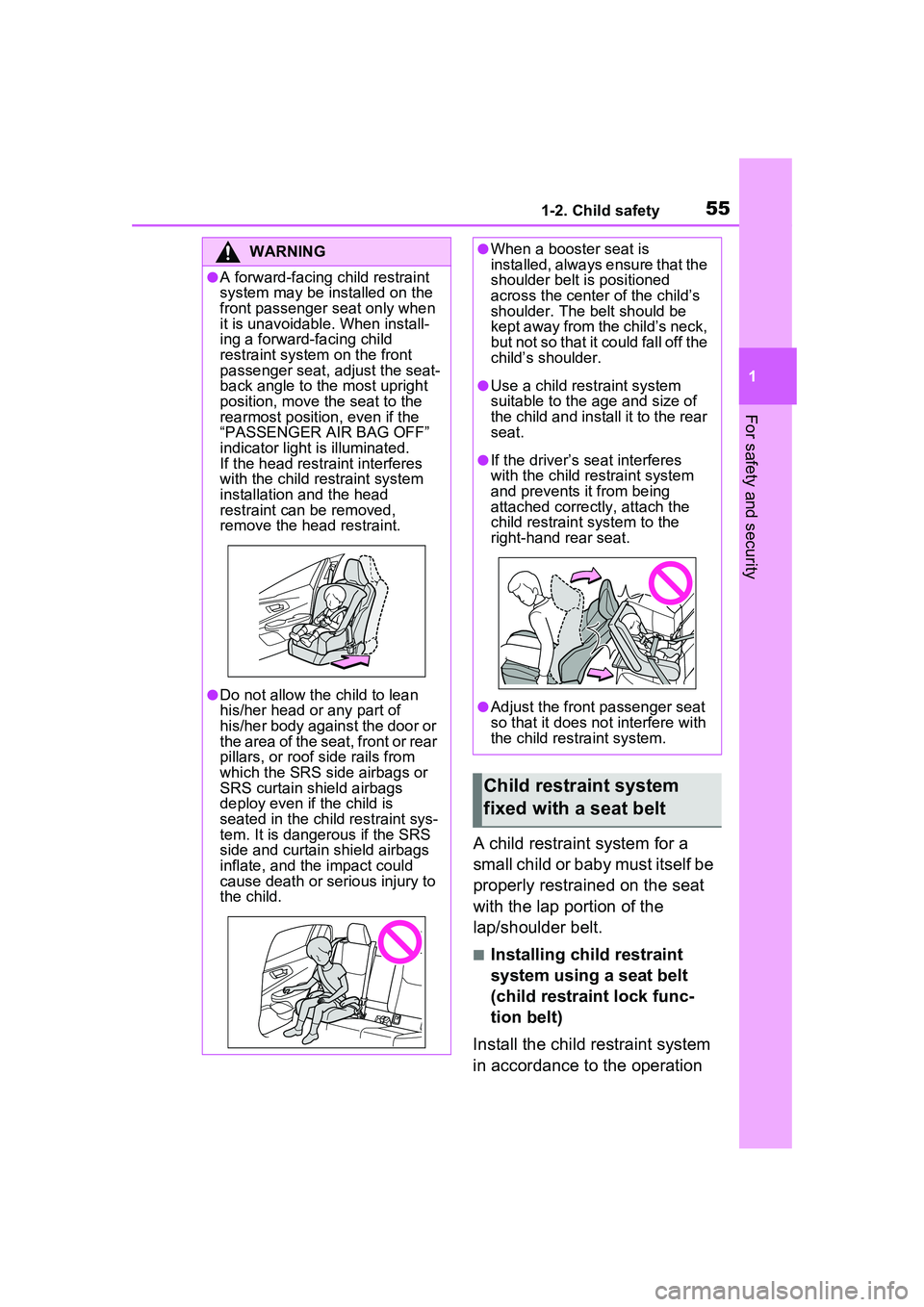
●A forward-facing child restraint
system may be installed on the
front passenger seat only when
it is unavoidable. When install-
ing a forward-facing child
restraint system on the front
passenger seat, adjust the seat-
back angle to the most upright
position, move the seat to the
rearmost position, even if the
“PASSENGER AIR BAG OFF”
indicator light is illuminated.
If the head restraint interferes
with the child restraint system
installation and the head
restraint can be removed,
remove the head restraint.
●Do not allow the child to lean
his/her head or any part of
his/her body against the door or
the area of the seat, front or rear
pillars, or roof side rails from
which the SRS side airbags or
SRS curtain shield airbags
deploy even if the child is
seated in the child restraint sys-
tem. It is dangerous if the SRS
side and curtain shield airbags
inflate, and the impact could
cause death or serious injury to
the child.
●When a booster seat is
installed, always ensure that the
shoulder belt is positioned
across the center of the child’s
shoulder. The belt should be
kept away from the child’s neck,
but not so that it could fall off the
child’s shoulder.
●Use a child restraint system
suitable to the age and size of
the child and install it to the rear
seat.
●If the driver’s seat interferes
with the child restraint system
and prevents it from being
attached correctly, attach the
child restraint system to the
right-hand rear seat.
●Adjust the front passenger seat
so that it does not interfere with
the child restraint system.
Child restraint system
fixed with a seat belt
Page 84 of 680
842-1. Plug-in hybrid system
■Running out of fuel
When the vehicle has run out of fuel
and the hybrid system cannot be
started, refuel th e vehicle with at
least enough gasoline to make the
low fuel level warning light ( P.562)
go off. If there is only a small
amount of fuel, the hybrid system
may not be able to start. (The stan-
dard amount of fuel is about 2.1 gal.
[8.0 L, 1.8 Imp.gal.], when the vehi-
cle is on a level surface. This value
may vary when the vehicle is on a
slope. Add extra fuel when the vehi-
cle is inclined.)
■Electromagnetic waves
●High voltage parts and cables on
the Plug-in Hybrid Electric Vehi-
cles incorporate electromagnetic
shielding, and therefore emit
approximately the same amount
of electromagnetic waves as con-
ventional gasoline powered vehi-
cles or home electronic
appliances.
●Your vehicle may cause sound
interference in some third party-
produced radio parts.
■Effect of magnetic forces
If objects that generate strong mag-
netic forces, such as large speak-
ers, are placed inside the luggage
compartment or installed nearby,
the generated magnetic forces may
negatively affect the hybrid system.
■Hybrid battery (traction battery)
(lithium-ion battery)
The hybrid battery (traction battery)
has a limited service life.
The hybrid battery (traction battery)
capacity (the ability to hold a
charge) reduces with time and use
in the same way as other recharge-
able batteries. The extent at which
capacity reduces changes drasti-
cally depending on the environment
(ambient temperature, etc.) and
usage conditions, such as how the
vehicle is driven and how the hybrid battery (traction battery) is charged.
This is a natural characteristic of
lithium-ion batteries, and is not a
malfunction. Also, even though the
EV driving range becomes shorter
when the hybrid battery (traction
battery) capacity reduces, vehicle
performance does not significantly
become worse.
In order to reduce the possibility of
the capacity reducing, follow the
directions listed on P.113, “Capacity
reduction of the hybrid battery (trac-
tion battery)”.
■Starting the hybrid system in an
extremely cold environment
When the hybrid battery (traction
battery) is extremely cold (below
approximately -22°F [-30°C]) under
the influence of the outside tem-
perature, it may not be possible to
start the hybrid system. In this case,
try to start the hybrid system again
after the temperature of the hybrid
battery increases due to the outside
temperature increase etc.
WARNING
■High voltage precautions
The vehicle has high voltage DC
and AC systems as well as a 12-
volt system. DC and AC high volt-
age is very dangerous and can
cause severe burns and electric
shock that may result in death or
serious injury.
●Never touch, disassemble,
remove or replace the high volt-
age parts, cables or their con-
nectors.
●The hybrid system will become
hot after starting as the system
uses high voltage. Be careful of
both the high voltage and the
high temperature, and always
obey the caution labels
attached to the vehicle.