brake TOYOTA PRIUS V 2012 Owners Manual (in English)
[x] Cancel search | Manufacturer: TOYOTA, Model Year: 2012, Model line: PRIUS V, Model: TOYOTA PRIUS V 2012Pages: 564, PDF Size: 10.45 MB
Page 3 of 564

1
2
3
4
5
6
7
3
PRIUS v_U (OM47674U)
2-1. Driving proceduresDriving the vehicle............... 162
Power (ignition) switch ........ 173
EV drive mode .................... 180
Hybrid transmission ............ 183
Turn signal lever ................. 192
Parking brake ...................... 193
Horn .................................... 194
2-2. Instrument cluster Gauges and meters ............ 195
Indicators and warning lights ................................. 206
2-3. Operating the lights and windshield wipers
Headlight switch .................. 211
Fog light switch ................... 219
Windshield wipers and washer .............................. 221
Rear window wiper and washer .............................. 226
Headlight cleaner switch ..... 228 2-4. Using other driving systems
Cruise control ..................... 229
Dynamic radar cruise control .............................. 233
Driving assist systems ........ 250
Hill-start assist control ........ 254
PCS (Pre-Collision System) ............................ 256
2-5. Driving information Cargo and luggage ............. 264
Vehicle load limits............... 270
Winter driving tips ............... 271
Trailer towing ...................... 275
Dinghy towing ..................... 276
2When driving
Page 14 of 564
14
PRIUS v_U (OM47674U)
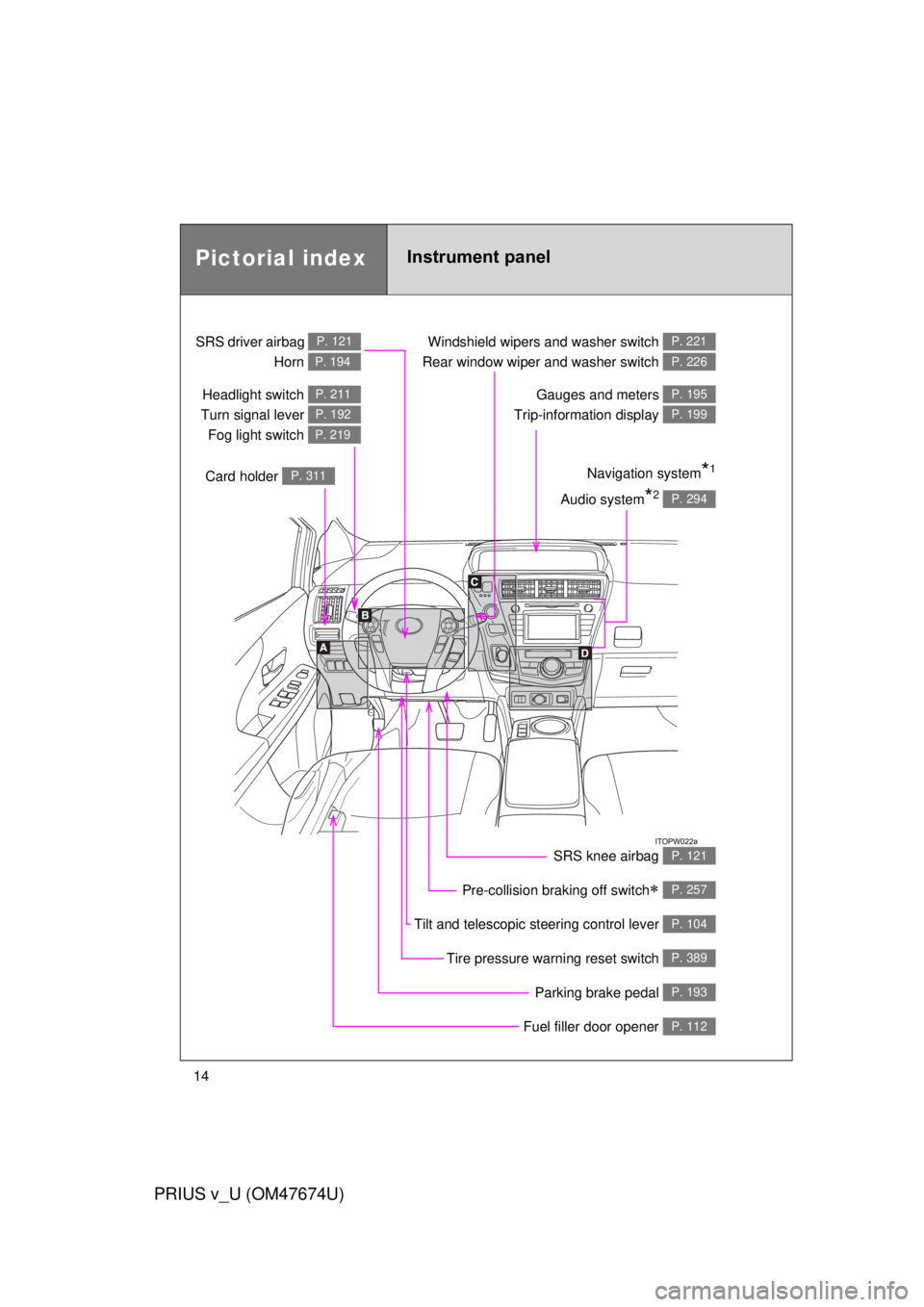
Pictorial indexInstrument panel
Headlight switch
Turn signal lever Fog light switch P. 211
P. 192
P. 219
Pre-collision braking off switch P. 257
Parking brake pedal P. 193
Fuel filler door opener P. 112
Tire pressure warning reset switch P. 389
Windshield wipers and washer switch
Rear window wiper and washer switch P. 221
P. 226
Gauges and meters
Trip-information display P. 195
P. 199
Audio system*2 P. 294
Navigation system*1
SRS driver airbag
Horn P. 121
P. 194
Card holder P. 311
Tilt and telescopic steering control lever P. 104
SRS knee airbag P. 121
Page 21 of 564

21
PRIUS v_U (OM47674U)
Installation of a mobile two-way radio system
The installation of a mobile two-way radio system in your vehicle could affect
electronic systems such as:
●Multiport fuel injection system/sequential multiport fuel injection system
● Cruise control system
● Anti-lock brake system
● SRS airbag system
● Seat belt pretensioner system
Be sure to check with your Toyota dealer for precautionary measures or spe-
cial instructions regarding installation.
High voltage parts and cables on the hybrid vehicles emit approximately the
same amount of electromagnetic waves as the conventional gasoline pow-
ered vehicles or home electronic appliances despite of their electromagnetic
shielding.
Unwanted noise may occur in the reception of the mobile two-way radio.
Scrapping of your Toyota
The SRS airbag and seat belt pretensioner devices in your Toyota contain
explosive chemicals. If the vehicle is scrapped with the airbags and seat belt
pretensioners left as they are, this may cause an accident such as fire. Be
sure to have the systems of the SRS airbag and seat belt pretensioner
removed and disposed of by a qualified service shop or by your Toyota
dealer before you scrap your vehicle.
Page 22 of 564

22
PRIUS v_U (OM47674U)
Perchlorate Material
Special handling may apply,
See www.dtsc.ca.gov/hazardouswaste/perchlorate.
Your vehicle has components that may contain perchlorate. These compo-
nents may include airbag, seat belt pretensioners, and wireless remote con-
trol batteries.
Vehicle control and operation data recording
Your Toyota is equipped with sophisticated computers that record certain
information about your vehicle’s operation, such as:
• Engine speed
• Motor speed
• Accelerator status
• Brake status
• Vehicle speed
• Shift position
The data recorded varies according to the grade level and options the vehi-
cle is equipped with. The computers do not record conversations, sound or
pictures.
●Data usage
Toyota may use the data recorded in these computers to diagnose malfunc-
tions, conduct research and development, and improve quality.
Toyota will not disclose the recorded data to a third party except:
• With the consent of the vehicle owner or with the consent of the lessee if the vehicle is leased
• In response to an official request by the police, a court of law or a govern- ment agency
• For research purposes where the data is not tied to a specific vehicle or vehicle owner
Page 23 of 564

23
PRIUS v_U (OM47674U)
●Event data recorder
Your vehicle has computers that monitor and control certain aspects of your
vehicle. These computers assist in driving and maintaining optimal vehicle
performance.
Besides storing data useful for troubleshooting, there is an event data
recorder (EDR) that records data in a crash or near crash event.
The SRS airbag sensor assembly contains the EDR. In a crash or near crash
event, this device may record the following information:
• Engine speed
• Whether the brake pedal was depressed or not
• Vehicle speed
• To what extent the accelerator pedal was depressed
• Hybrid transmission shift position
• Whether the driver and front passenger wore seat belts or not
• Driver’s seat position
• SRS airbag deployment data
• SRS airbag system diagnostic data
• Front passenger’s occupant classification
The information above is intended to be used for the purpose of improving
vehicle safety performance. Unlike general data recorders, the EDR does
not record sound data such as conversation between passengers.
● Disclosure of the EDR data
Toyota will not disclose the data recorded in an EDR to a third party except
when:
• An agreement from the vehicle’s owner (or the leasing company for a leased vehicle) is obtained
• Officially requested to by the police or other authorities
• Necessary, for use as a defense for Toyota in a lawsuit
• Ordered to by a court of law
However, if necessary, Toyota will:
• Use the data for research on Toyota vehicle safety performance
• Disclose the data to a third party for research purposes without disclosing details of the vehicle owner, and that only when deemed necessary
• Disclose summarized data cleared of vehicle identification information to a non-Toyota organization for research purposes
Page 30 of 564
30 1-1. Hybrid system
PRIUS v_U (OM47674U)
Vehicle proximity notification system
When driving with the gasoline engine stopped, a sound, which
changes in accordance with the dr iving speed, will be played in order
to warn people nearby of the vehicle’s approach. The sound will stop
when the vehicle speed exceeds a pproximately 15 mph (25 km/h).
■Regenerative braking
In the following situations, kinetic energy is converted to electric energy and
deceleration force can be obtained in conjunction with the recharging of the
hybrid battery (traction battery).
● The accelerator pedal is released while driving with the shift position in D
or B.
● The brake pedal is depressed while driving with the shift position in D or
B.
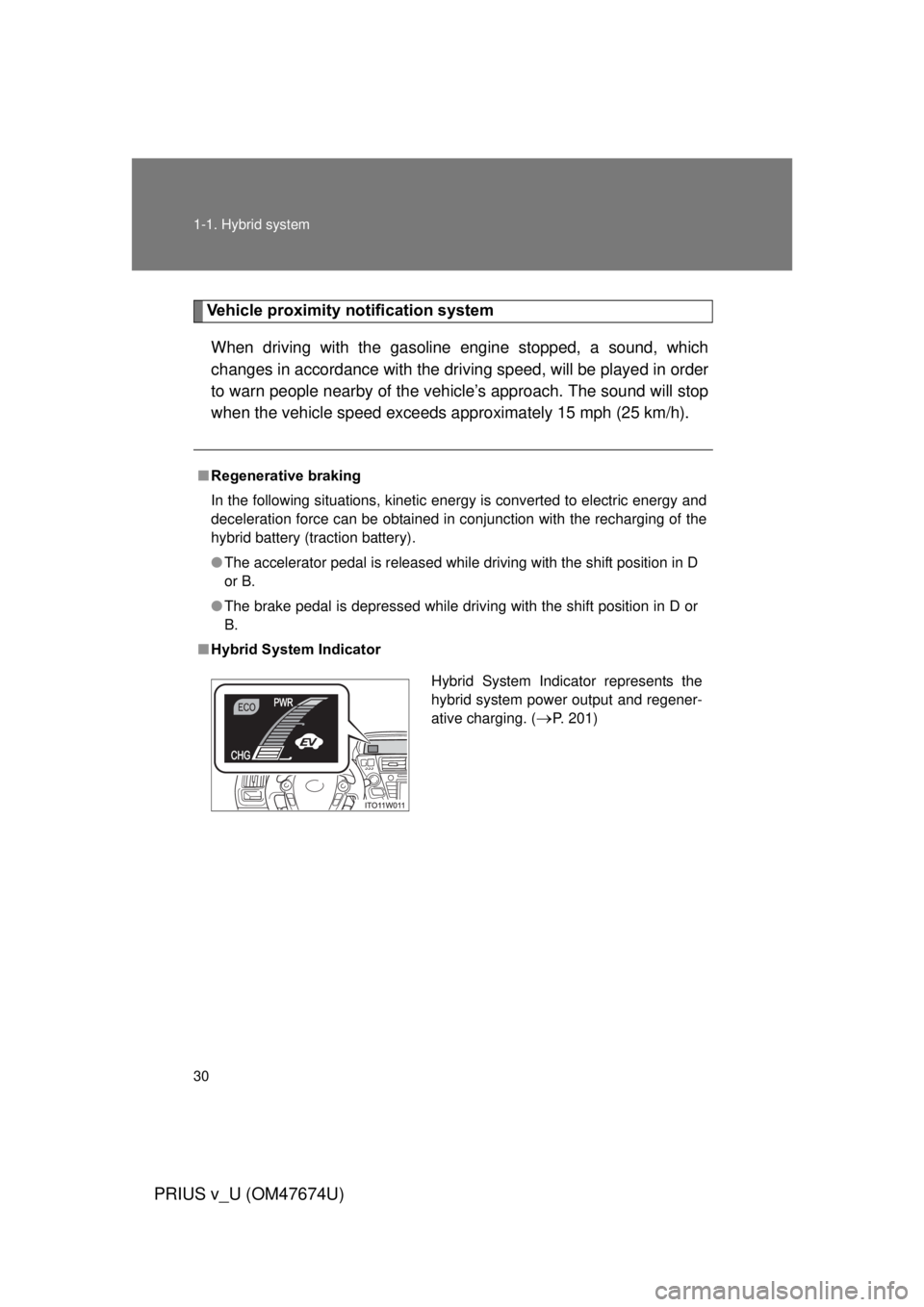
■ Hybrid System Indicator
Hybrid System Indicator represents the
hybrid system power output and regener-
ative charging. (
P. 201)
Page 32 of 564

32 1-1. Hybrid system
PRIUS v_U (OM47674U)
■Sounds and vibrations specific to a hybrid vehicle
There may be no engine sounds or vibration even though the vehicle is able
to move. For safety, apply the parking brake and make sure to shift the shift
position to P when parked.
The following sounds or vibrations may occur when the hybrid system is
operating and are not a malfunction:
● The brake system operation sound heard from the front of the vehicle
when the driver’s door is opened.
● Motor sounds may be heard from the engine compartment.
● Sounds may be heard from the hybrid battery (traction battery) when the
hybrid system starts or stops.
● Sounds may be heard from the transmission when the gasoline engine
starts or stops, when driving at low speeds, or during idling.
● Engine sounds may be heard when accelerating sharply.
● Sounds may be heard due to regenerative braking when the brake pedal
is depressed and accelerator is loosened.
● Other sounds, such as motors and mechanical noises, may be heard
from the brake system when the brake pedal is depressed.
● Vibration may be felt when the gasoline engine starts or stops.
● Cooling fan sounds may be heard from the air intake vent. (
P. 35)
● The operation sound of the air conditioning system (air conditioning com-
pressor, blower motor).
Page 38 of 564

38 1-1. Hybrid system
PRIUS v_U (OM47674U)
CAUTION
■Road accident cautions
If your vehicle is involved in an accident, observe the following precautions
to reduce the risk of death or serious injury:
● Stop the vehicle in a safe place to prevent subsequent accidents.
While depressing the brake pedal, apply the parking brake and shift the
shift position to P to stop the hybrid system. Then, slowly release the
brake pedal.
● Do not touch the high voltage parts, cables and connectors.
● If electric wires are exposed inside or outside your vehicle, an electric
shock may occur. Never touch exposed electric wires.
● If a fluid leak occurs, do not touch the fluid as it may be strong alkaline
electrolyte from the hybrid battery (traction battery). If it comes into contact
with your skin or eyes, wash it off immediately with a large amount of water
or, if possible, boric acid solution. Seek immediate medical attention.
● If a fire occurs in the hybrid vehicle, leave the vehicle as soon as possible.
Never use a fire extinguisher that is not meant for electric fires. Using even
a small amount of water may be dangerous.
● If your vehicle needs to be towed, do so with front wheels raised. If the
wheels connected to the electric motor (traction motor) are on the ground
when towing, the motor may continue to generate electricity. This may
cause an electricity leakage leading to a fire. ( P. 435)
● Carefully inspect the ground under the vehicle. If you find that liquid has
leaked onto the ground, the fuel system may have been damaged. Leave
the vehicle as soon as possible.
■ Hybrid battery (traction battery)
Your vehicle contains a sealed nicke l-metal hydride battery. If disposed of
improperly, it is hazardous to the environment and there is a risk of severe
burns and electrical shock that may result in death or serious injury.
Page 50 of 564
50
1-1. Hybrid system
PRIUS v_U (OM47674U)
Hybrid vehicle driving tips
For economical and ecological driving, pay attention to the following
points:
■ Using Eco drive mode
When using Eco drive mode, the torque corresponding to the accelera-
tor pedal depression amount can be generated more smoothly than it is
in normal conditions. In addition, the operation of the air conditioning
system (heating/cooling) will be minimized, improving the fuel econ-
omy. ( P. 185)
■Use of Hybrid System Indicator
Eco-friendly driving is possible by keeping the indicate of Hybrid Sys-
tem Indicator within Eco area or Charge area. ( P. 201)
■When braking the vehicle
Make sure to operate the brakes gently and in good time. A greater
amount of electrical energy can be retained when slowing down.
■Delays
Repeated acceleration and deceleration, as well as long waits at traffic
lights, will lead to bad fuel consumption. Check traffic reports before
leaving and avoid delays as much as possible. When encountering a
delay, gently release the brake pedal to allow the vehicle to move for-
ward slightly while avoiding overuse of the accelerator pedal. Doing so
can help control excessive gasoline consumption.
■Highway driving
Control your speed and keep at a constant speed. Also, before stop-
ping at a toll booth or similar, allow plenty of time to release the acceler-
ator and gently apply the brakes. A greater amount of electrical energy
can be retained when slowing down.
Page 82 of 564
82 1-4. Adjustable components (seats, mirrors, steering wheel)
PRIUS v_U (OM47674U)
Flattening the seatbacks
■ Before flattening the seatbacks
Stop the vehicle in a safe place.
Apply the parking brake firmly and shift the shift position to P.
(P. 186)
Slide the rear seats as far back as possible. (P. 8 5 )
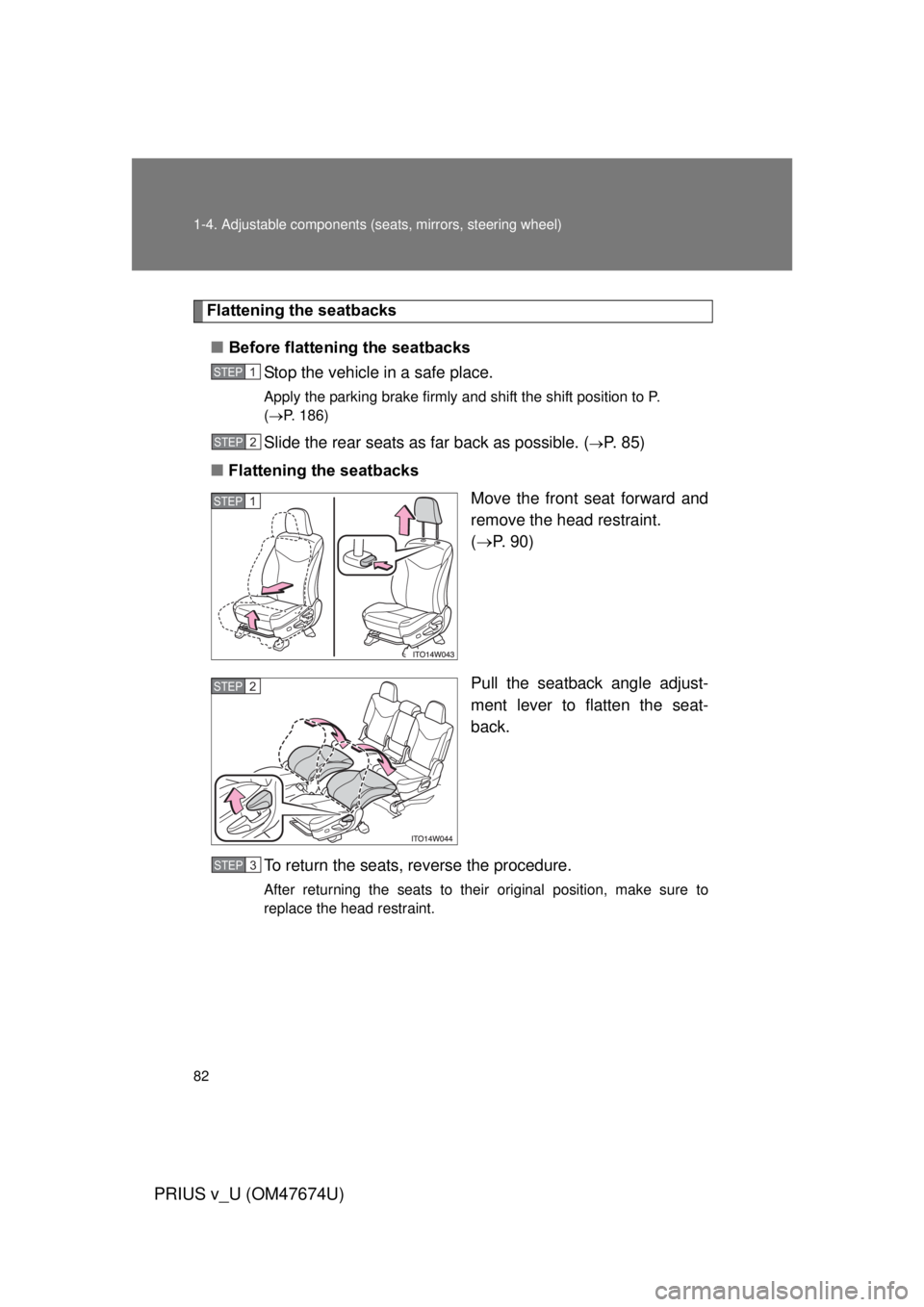
■ Flattening the seatbacks
Move the front seat forward and
remove the head restraint.
( P. 90)
Pull the seatback angle adjust-
ment lever to flatten the seat-
back.
To return the seats, reverse the procedure.
After returning the seats to their original position, make sure to
replace the head restraint.
STEP 1
STEP 2
STEP 1
STEP 2
STEP 3