check engine TOYOTA PRIUS V 2012 Owners Manual (in English)
[x] Cancel search | Manufacturer: TOYOTA, Model Year: 2012, Model line: PRIUS V, Model: TOYOTA PRIUS V 2012Pages: 564, PDF Size: 10.45 MB
Page 5 of 564

1
2
3
4
5
6
7
5
PRIUS v_U (OM47674U)
4-1. Maintenance and careCleaning and protecting the vehicle exterior............ 346
Cleaning and protecting the vehicle interior............. 350
4-2. Maintenance Maintenance requirements ..................... 353
General maintenance.......... 356
Emission inspection and maintenance (I/M)
programs........................... 360
4-3. Do-it-yourself maintenance Do-it-yourself service precautions ....................... 361
Hood ................................... 364
Positioning a floor jack ........ 367
Engine compartment ........... 370
12-volt battery ..................... 382
Tires .................................... 387
Tire inflation pressure ......... 396
Wheels ................................ 400
Air conditioning filter............ 403
Electronic key battery.......... 406
Checking and replacing fuses ................................. 408
Light bulbs........................... 419 5-1. Essential information
Emergency flashers............ 434
If your vehicle needs to be towed................................ 435
If you think something is wrong ............................... 441
5-2. Steps to take in an emergency If a warning light turns on or a warning buzzer sounds .... 442
If you have a flat tire ........... 460
If the hybrid system will not start .................................. 474
If you lose your keys........... 476
If the electronic key does not operate properly ......... 477
If the 12-volt battery is discharged........................ 479
If your vehicle overheats .... 485
If the vehicle becomes stuck ................................. 489
If your vehicle has to be stopped in an
emergency ....................... 491
4Maintenance and care5When trouble arises
Page 51 of 564
51
1-1. Hybrid system
1
Before driving
PRIUS v_U (OM47674U)
■
Air conditioning on/off
Switch the air conditioning ( ) to off when it is not needed. Doing
so can help control excessive gasoline consumption.
In summer: In high temperatures, use the recirculated air mode. Doing
so will help to reduce the burden on the air conditioner and reduce fuel
consumption as well.
In winter: Because the gasoline engine will not automatically cut out
until the gasoline engine and the interior of the vehicle are warm, it will
consume fuel. Also, fuel consumption can be improved by avoiding
overuse of the heater.
■Checking tire inflation pressure
Make sure to check the tire inflation pressure frequently. Improper tire
inflation pressure can cause poor fuel consumption.
Also, as snow tires can cause large amounts of friction, their use on dry
roads can lead to poor fuel consumption. Use a tire that is appropriate
for the season.
■Luggage
Carrying heavy luggage can lead to poor fuel consumption. Avoid car-
rying unnecessary luggage. Installing a large roof rack can also cause
poor fuel consumption.
■Warming up before driving
Since the gasoline engine starts up and cuts out automatically when
cold, warming up the engine is unnecessary. Moreover, frequently driv-
ing short distances will cause the engine to repeatedly warm up, which
can lead to poor fuel consumption.
Page 165 of 564

165
2-1. Driving procedures
PRIUS v_U (OM47674U)
2
When driving
CAUTION
■
When driving the vehicle
● Do not drive if you are unfamiliar with the location of the brake and accel-
erator pedals to avoid depressing the wrong pedal.
• Accidentally depressing the accelerator pedal instead of the brake
pedal will result in sudden acceleration that may lead to an accident
that could result in death or serious injury.
• When backing up, you may twist your body around, leading to a diffi- culty in operating the pedals. Make sure to operate the pedals properly.
• Make sure to keep a correct driving posture even when moving the vehicle only slightly. This allows you to depress the brake and acceler-
ator pedals properly.
• Depress the brake pedal using your right foot. Depressing the brake pedal using your left foot may delay response in an emergency, result-
ing in an accident.
● Because there is no engine noise when the vehicle is being driven using
the electric motor, pedestrians in the vicinity may not notice the vehicle.
Even though the vehicle is equipped with the vehicle proximity notification
system, drive with care as pedestrians in the vicinity may still not notice
the vehicle if the surrounding area is noisy.
● Do not drive the vehicle over or stop the vehicle near flammable materials.
The exhaust system and exhaust gases can be extremely hot. These hot
parts may cause a fire if there is any flammable material nearby.
● Do not let the vehicle roll backward while a forward driving position is\
selected, or roll forward while the shift position is in R.
Doing so may result in an accident or damage to the vehicle.
● If the smell of exhaust is noticed inside the vehicle, open the windows and
check that the back door is closed. Large amounts of exhaust in the vehi-
cle can cause driver drowsiness and an accident, resulting in death or a
serious health hazard. Have the vehicle inspected by your Toyota dealer
immediately.
Page 166 of 564
 166 2-1. Driving procedures
PRIUS v_U (OM47674U)
CAUTION
●Do not shift the shift position to P while the vehicle is moving.
Doing so can damage the transmission and may result in a loss of vehicle\")
166 2-1. Driving procedures
PRIUS v_U (OM47674U)
CAUTION
●Do not shift the shift position to P while the vehicle is moving.
Doing so can damage the transmission and may result in a loss of vehicle\
control.
● Do not shift the shift position to R while the vehicle is moving forward.
Doing so can damage the transmission and may result in a loss of vehicle\
control.
● Do not shift the shift position to D while the vehicle is moving backward.
Doing so can damage the transmission and may result in a loss of vehicle\
control.
● Moving the shift position to N while the vehicle is moving will disengage
the hybrid system. Engine braking is not available with the hybrid system
disengaged.
● During normal driving, do not turn off the hybrid system. Turning the hybrid
system off while driving will not cause loss of steering or braking control,
but the power assist to these systems will be lost. This will make it more
difficult to steer and brake, so you should pull over and stop the vehicle as
soon as it is safe to do so.
However, in the event of an emergency, such as if it becomes impossible
to stop the vehicle in the normal way: P. 491
● Use engine braking (shift position B) to maintain a safe speed when driv-
ing down a steep hill.
Using the brakes continuously may cause the brakes to overheat and lose
effectiveness. (P. 183)
● Do not adjust the positions of the steering wheel, the seat, or the inside or
outside rear view mirrors while driving.
Doing so may result in a loss of vehicle control that can cause accidents,
resulting in death or serious injury.
● Always check that all passengers’ arms, heads or other parts of their body
are not outside the vehicle, as this may result in death or serious injury.
Page 167 of 564

167
2-1. Driving procedures
PRIUS v_U (OM47674U)
2
When driving
CAUTION
●
Do not drive in excess of the speed limit. Even if the legal speed limit per-
mits it, do not drive over 85 mph (140 km/h) unless your vehicle has high-
speed capability tires. Driving over 85 mph (140 km/h) may result in tire
failure, loss of control and possible injury. Be sure to consult a tire dealer
to determine whether the tires on your vehicle are high-speed capability
tires or not before driving at such speeds.
■ When driving on slippery road surfaces
● Sudden braking, acceleration and steering may cause tire slippage and
reduce your ability to control the vehicle, resulting in an accident.
● Abrupt changes from shift position D to B and rapid changes in the engine
speed could cause the vehicle to skid, resulting in an accident.
● After driving through a puddle, lightly depress the brake pedal to make
sure that the brakes are functioning properly. Wet brake pads may prevent
the brakes from functioning properly. If the brakes on only one side are wet
and not functioning properly, steering control may be affected, resulting in
an accident.
■ When changing the shift position
Be careful not to change the shift position with the accelerator pedal
depressed.
Changing the shift position to any positions other than P or N may cause the
vehicle to accelerate abruptly, causing an accident and resulting in death or
serious injury.
After changing the shift position, make sure to confirm the current shift posi-
tion displayed on the shift position indicator inside the meter.
■ If you hear a squealing or scrapin g noise (brake pad wear limit indica-
tors)
Have your Toyota dealer check and replace the brake pads as soon as pos-
sible.
Rotor damage may result if the pads are not replaced when needed.
It is dangerous to drive the vehicle when the wear limits of the brake pads
and/or those of the brake discs are exceeded.
Page 168 of 564

168 2-1. Driving procedures
PRIUS v_U (OM47674U)
CAUTION
■When the vehicle is stopped
● Do not depress the accelerator pedal unnecessarily.
If the vehicle is in any shift position other than P or N, the vehicle may
accelerate suddenly and unexpectedly, causing an accident.
● Do not leave the vehicle with the hybrid system on for a long time.
If such a situation cannot be avoided, park the vehicle in an open space
and check that exhaust fumes do not enter the vehicle interior.
● In order to prevent accidents due to the vehicle rolling away, always keep
depressing the brake pedal while the “READY” indicator is on. Apply the
parking brake as necessary.
● If the vehicle is stopped on an incline, in order to prevent accidents caused
by the vehicle rolling forward or backward, always depress the brake pedal
and securely apply the parking brake as needed.
● Avoid revving or racing the engine.
Running the engine at high speed while the vehicle is stopped may cause
the exhaust system to overheat, which could result in a fire if combustible
material is nearby.
■ When the vehicle is parked
● Make sure to firmly apply the parking brake and shift the shift position to P.
Failure to do so may cause the vehicle to move, or the vehicle to acceler-
ate suddenly if the accelerator pedal is accidentally depressed. Also, when
leaving the vehicle, make sure to turn off the hybrid system and lock the
vehicle.
Sound or shuddering may not be noticed even when the hybrid vehicle is
ready to drive (when the “READY” indicator is illuminated).
Page 172 of 564

172 2-1. Driving procedures
PRIUS v_U (OM47674U)
NOTICE
■When encountering flooded roads
Do not drive on a road that has flooded after heavy rain etc. Doing so may
cause the following serious damage to the vehicle:
● Engine stalling
● Short in electrical components
● Engine damage caused by water immersion
In the event that you drive on a flooded road and the vehicle is flooded, be
sure to have your Toyota dealer check the following:
● Brake function
● Changes in quantity and quality of engine oil, transmission fluid for the
hybrid system, etc.
● Lubricant condition for the bearings and suspension joints (where possi-
ble), and the function of all joints, bearings, etc.
If the P position control system is damaged by flooding, it may not be possi-
ble to shift the shift position to P, or from P to other positions. When the shift
position cannot be changed from P to any other position, the front wheels
will lock, and you will be unable to tow the vehicle with the front wheels on
the ground, as the front wheels may be locked. In this case, transport the
vehicle with both front wheels or all four wheels lifted.
Page 174 of 564
174 2-1. Driving procedures
PRIUS v_U (OM47674U)
Check that the “READY” indicator is on.
If the “READY” indicator changes from a flashing light to a solid
light and the buzzer sounds, the hybrid system is starting nor-
mally.
The vehicle will not move when the “READY” indicator is off.
The vehicle can move when the “READY” indicator is on even if
the engine is stopped. (The gasoline engine starts or stops auto-
matically in accordance with the state of the vehicle.)
■Stopping the hybrid system
Stop the vehicle completely.
Set the parking brake. ( P. 193)
Shift the shift position to P. ( P. 186)
Check that the shift position indicator shows P. ( P. 183)
Press the “POWER” switch.
The hybrid system will stop.
Slowly release the brake pedal and check that the indicator
on the “POWER” switch is off.
STEP 4
STEP 1
STEP 2
STEP 3
STEP 4
STEP 5
Page 184 of 564
184 2-1. Driving procedures
PRIUS v_U (OM47674U)
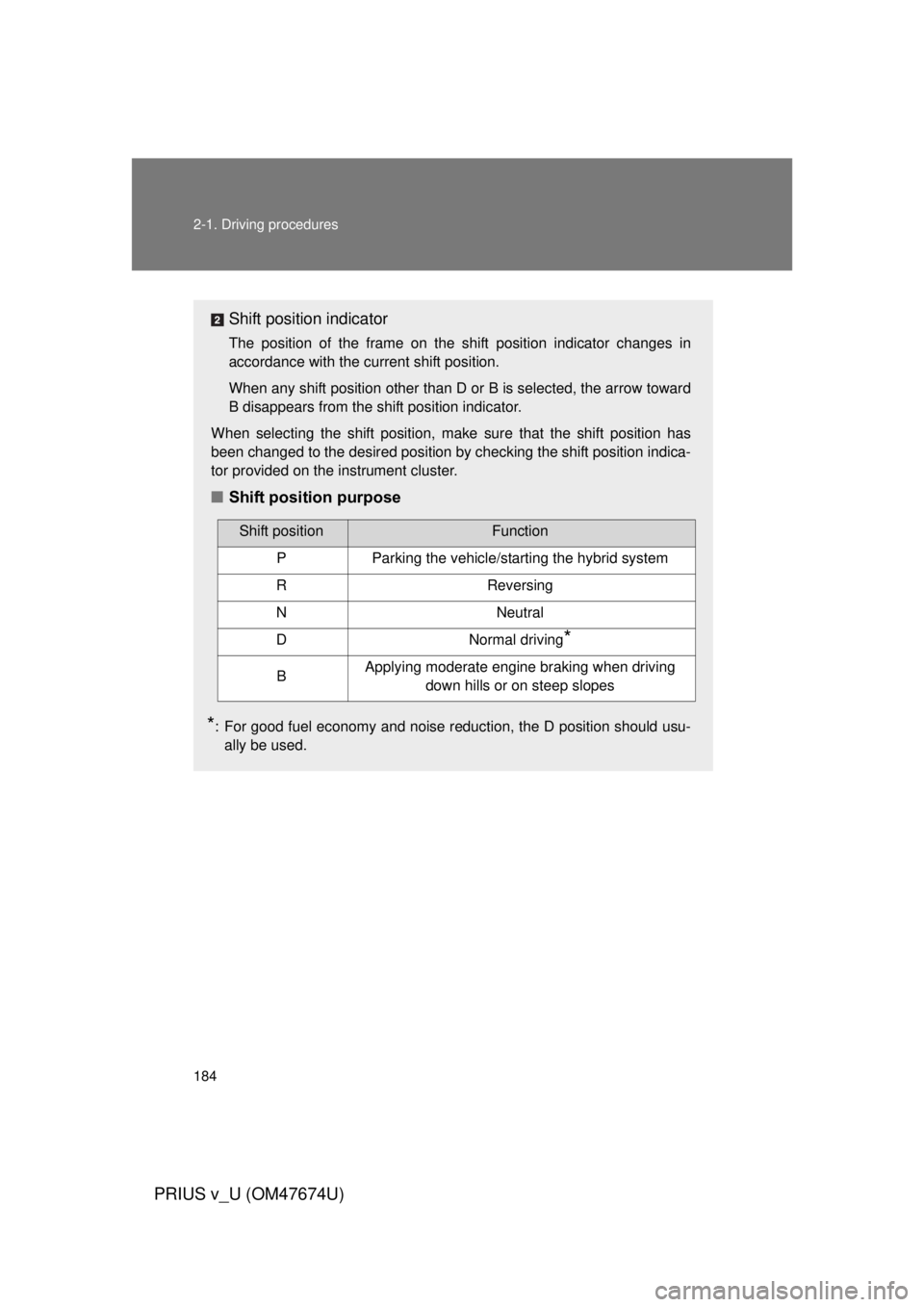
Shift position indicator
The position of the frame on the shift position indicator changes in
accordance with the current shift position.
When any shift position other than D or B is selected, the arrow toward
B disappears from the shift position indicator.
When selecting the shift position, make sure that the shift position has
been changed to the desired position by checking the shift position indica-
tor provided on the instrument cluster.
■ Shift position purpose
*: For good fuel economy and noise reduction, the D position should usu-
ally be used.
Shift positionFunction
PParking the vehicle/starting the hybrid system
RReversing
NNeutral
DNormal driving*
BApplying moderate engine braking when driving down hills or on steep slopes
Page 205 of 564

205
2-2. Instrument cluster
PRIUS v_U (OM47674U)
2
When driving
■
Engine speed
On hybrid vehicles, engine speed is precisely controlled in order to help
improve fuel efficiency and reduce exhaust emissions etc.
There are times when the engine speed that is displayed may differ even
when vehicle operation and driving conditions are the same.
■ Brightness of the instrument panel light
If the headlight switch is turned to ON while the surrounding area is dark, the
instrument panel lights will dim.
■ When disconnecting and reconnect ing 12-volt battery terminals
The average fuel consumption and cruising range will be reset.
NOTICE
■ To prevent damage to the engine and its components
The engine may be overheating if the high coolant temperature warning light
comes on or flashes. In this case, immediately stop the vehicle in a safe
place, and check the engine after it has cooled completely. ( P. 485)
■ The trip information disp lay at low temperatures
Allow the interior of the vehicle to warm up before using the liquid crystal
information display. At extremely low temperatures, the information display
monitor may respond slowly, and display changes may be delayed.