wheel TOYOTA PRIUS V 2012 Owners Manual (in English)
[x] Cancel search | Manufacturer: TOYOTA, Model Year: 2012, Model line: PRIUS V, Model: TOYOTA PRIUS V 2012Pages: 568, PDF Size: 10.53 MB
Page 474 of 568

474 5-2. Steps to take in an emergency
PRIUS v_U (OM47784U)
CAUTION
■Replacing a flat tire
●Do not touch the disc wheels or the area around the brakes immedi-
ately after the vehicle has been driven.
After the vehicle has been driven the disc wheels and the area around
the brakes will be extremely hot. Touching these areas with hands, feet
or other body parts while changing a tire, etc. may result in burns.
●Failure to follow these precautions could cause the wheel nuts to
loosen and the tire to fall off, resulting in death or serious injury.
• Have the wheel nuts tightened with a torque wrench to 76 ft•lbf (103 N•m, 10.5 kgf•m) as soon as possible after changing wheels.
• When installing a tire, only use wheel nuts that have been specifi- cally designed for that wheel.
• If there are any cracks or deformations in the bolt screws, nut threads or bolt holes of the wheel, have the vehicle inspected by
your Toyota dealer.
• When installing the wheel nuts, be sure to install the wheel nuts
with the tapered end facing inward. ( P. 403)
■After using the tools and jack
Before driving, make sure all the tools and jack are securely in place in
their storage location to reduce the po ssibility of personal injury during a
collision or sudden braking.
■When stowing the flat tire
●Make sure the rear seatbacks are in their original position.
●Secure it using a tire tie-down belt. Otherwise, the flat tire may fly out
in case of sudden braking or an a ccident, resulting in death or serious
injury.
Page 475 of 568

5
When trouble arises
475
5-2. Steps to take in an emergency
PRIUS v_U (OM47784U)
NOTICE
■Do not drive the vehicle with a flat tire
Do not continue driving with a flat tire.
Driving even a short distance with a flat tire can damage the tire and the
wheel beyond repair.
■Be careful when driving over bumps with the compact spare tire
installed on the vehicle
The vehicle becomes lower when driving with the compact spare tire
compared to when drivin
g with standard tires. Be careful when driving
over uneven road surfaces.
■Driving with tire chains and the compact spare tire
Do not fit tire chains to the compact spare tire.
Tire chains may damage the vehicle body and adversely affect driving
performance.
■When replacing the tires
When removing or fitting the wheels, tires or the tire pressure warning
valve and transmitter, contact your Toyota dealer as the tire pressure
warning valve and transmitter may be damaged if not handled correctly.
■To avoid damage to the tire pressure warning valves and transmit-
ters
When a tire is repaired with liquid sealants, the tire pressure warning
valve and transmitter may not operate properly. If a liquid sealant is
used, contact your Toyota dealer or other qualified service shop as soon
as possible. Make sure to replace the tire pressure warning valve and
transmitter when replacing the tire. ( P. 390)
Page 484 of 568

484 5-2. Steps to take in an emergency
PRIUS v_U (OM47784U)
■Starting the hybrid system when the 12-volt battery is discharged
The hybrid system cannot be started by push-starting.
■ To prevent 12-volt battery discharge
● Turn off the headlights and the audio system while the hybrid system is
off.
● Turn off any unnecessary electrical components when the vehicle is run-
ning at a low speed for an extended period, such as in heavy traffic.
■ When the 12-volt battery is removed or discharged
● The hybrid system may not start. ( P. 386)
● If the 12-volt battery is depleted with the shift position in P, it will not be
possible to shift the shift position other than P. In this case, the vehicle
cannot be towed without lifting both front wheels because the front
wheels are locked by the parking lock. ( P. 437)
● When the 12-volt battery is reconnected, start the hybrid system, depress
the brake pedal, and confirm that it is possible to shift into each shift posi-
tion.
■ Charging the 12-volt battery
The electricity stored in the 12-volt battery will discharge gradually even
when the vehicle is not in use, due to natural discharge and the draining
effects of certain electrical appliances. If the vehicle is left for a long time, the
12-volt battery may discharge, and the hybrid system may be unable to start.
(The 12-volt battery recharges automatically while the hybrid system is oper-
ating.)
Page 492 of 568

492 5-2. Steps to take in an emergency
PRIUS v_U (OM47784U)
NOTICE
■To avoid damage to the hybrid transmission and other components
● Avoid spinning the wheels and depressing the accelerator pedal more
than necessary.
● If the vehicle remains stuck even after these procedures are performed,
the vehicle may require towing to be freed.
Page 494 of 568

494 5-2. Steps to take in an emergency
PRIUS v_U (OM47784U)
CAUTION
■If the hybrid system has to be turned off while driving
Power assist for the brakes and steering wheel will be lost, making the brake
pedal harder to depress and the steering wheel heavier to turn. Decelerate
as much as possible before turning off the hybrid system.
Page 496 of 568
496
PRIUS v_U (OM47784U)
6-1. Specifications
Maintenance data (fuel, oil level, etc.)
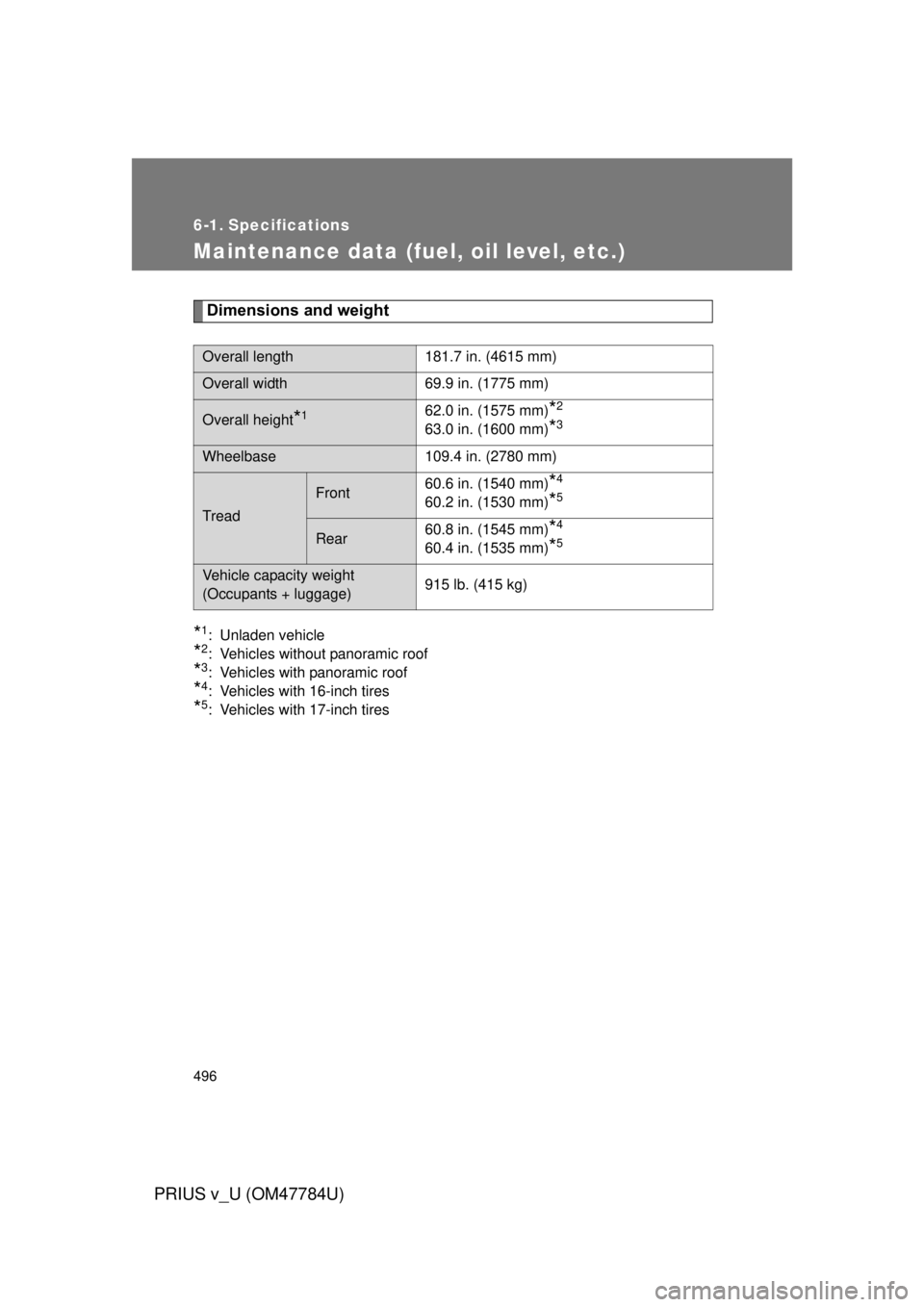
Dimensions and weight
*1: Unladen vehicle
*2: Vehicles without panoramic roof
*3: Vehicles with panoramic roof
*4: Vehicles with 16-inch tires
*5: Vehicles with 17-inch tires
Overall length181.7 in. (4615 mm)
Overall width69.9 in. (1775 mm)
Overall height*162.0 in. (1575 mm)*2
63.0 in. (1600 mm)*3
Wheelbase109.4 in. (2780 mm)
Tread
Front60.6 in. (1540 mm)*4
60.2 in. (1530 mm)*5
Rear60.8 in. (1545 mm)*4
60.4 in. (1535 mm)*5
Vehicle capacity weight
(Occupants + luggage) 915 lb. (415 kg)
Page 504 of 568
504 6-1. Specifications
PRIUS v_U (OM47784U)
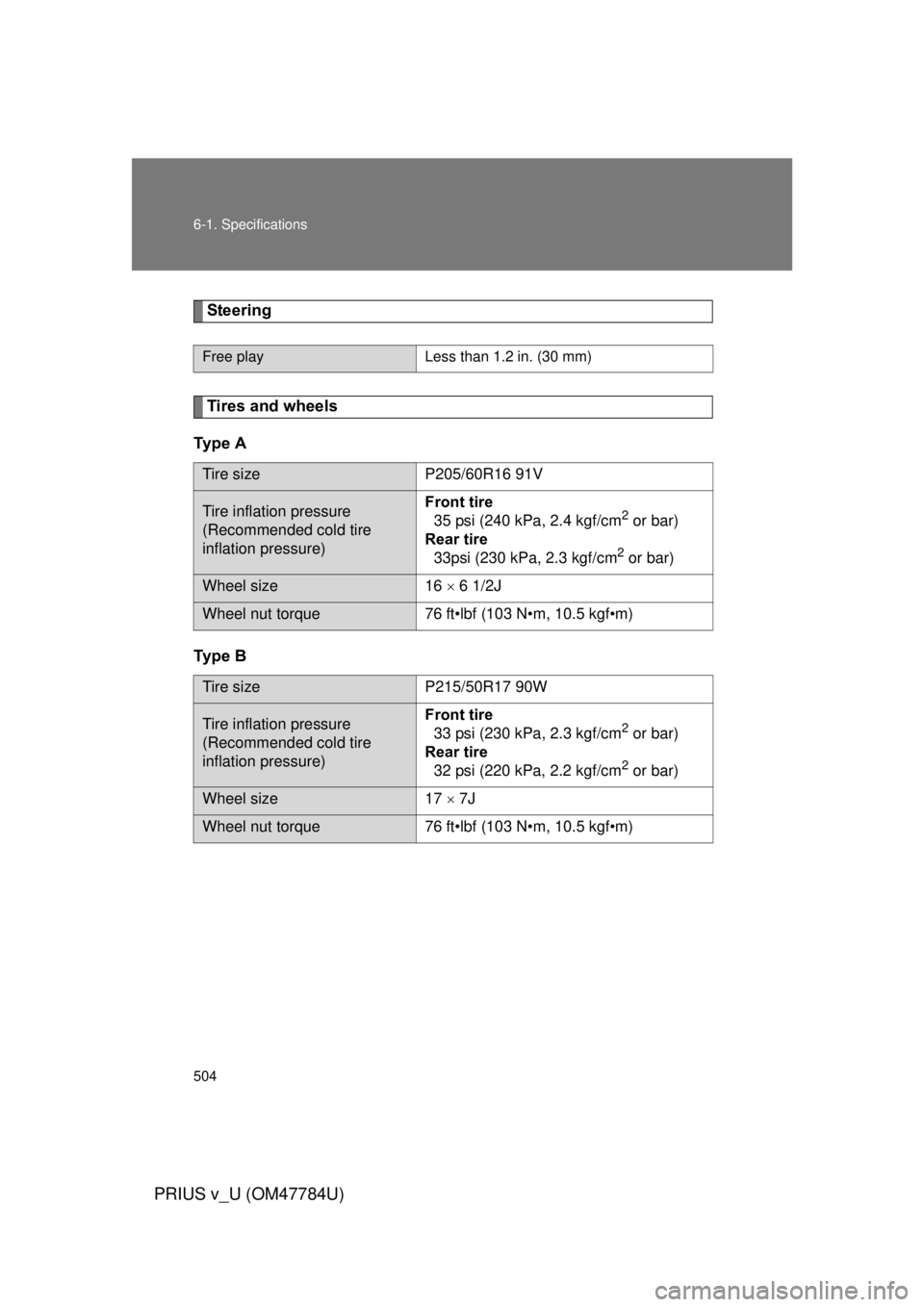
Steering
Tires and wheels
Ty p e A
Ty p e B
Free playLess than 1.2 in. (30 mm)
Tire sizeP205/60R16 91V
Tire inflation pressure
(Recommended cold tire
inflation pressure) Front tire
35 psi (240 kPa, 2.4 kgf/cm2 or bar)
Rear tire 33psi (230 kPa, 2.3 kgf/cm
2 or bar)
Wheel size 16 6 1/2J
Wheel nut torque 76 ft•lbf (103 N•m, 10.5 kgf•m)
Tire sizeP215/50R17 90W
Tire inflation pressure
(Recommended cold tire
inflation pressure) Front tire
33 psi (230 kPa, 2.3 kgf/cm2 or bar)
Rear tire 32 psi (220 kPa, 2.2 kgf/cm
2 or bar)
Wheel size 17 7J
Wheel nut torque 76 ft•lbf (103 N•m, 10.5 kgf•m)
Page 505 of 568
505
6-1. Specifications
6
Vehicle specifications
PRIUS v_U (OM47784U)
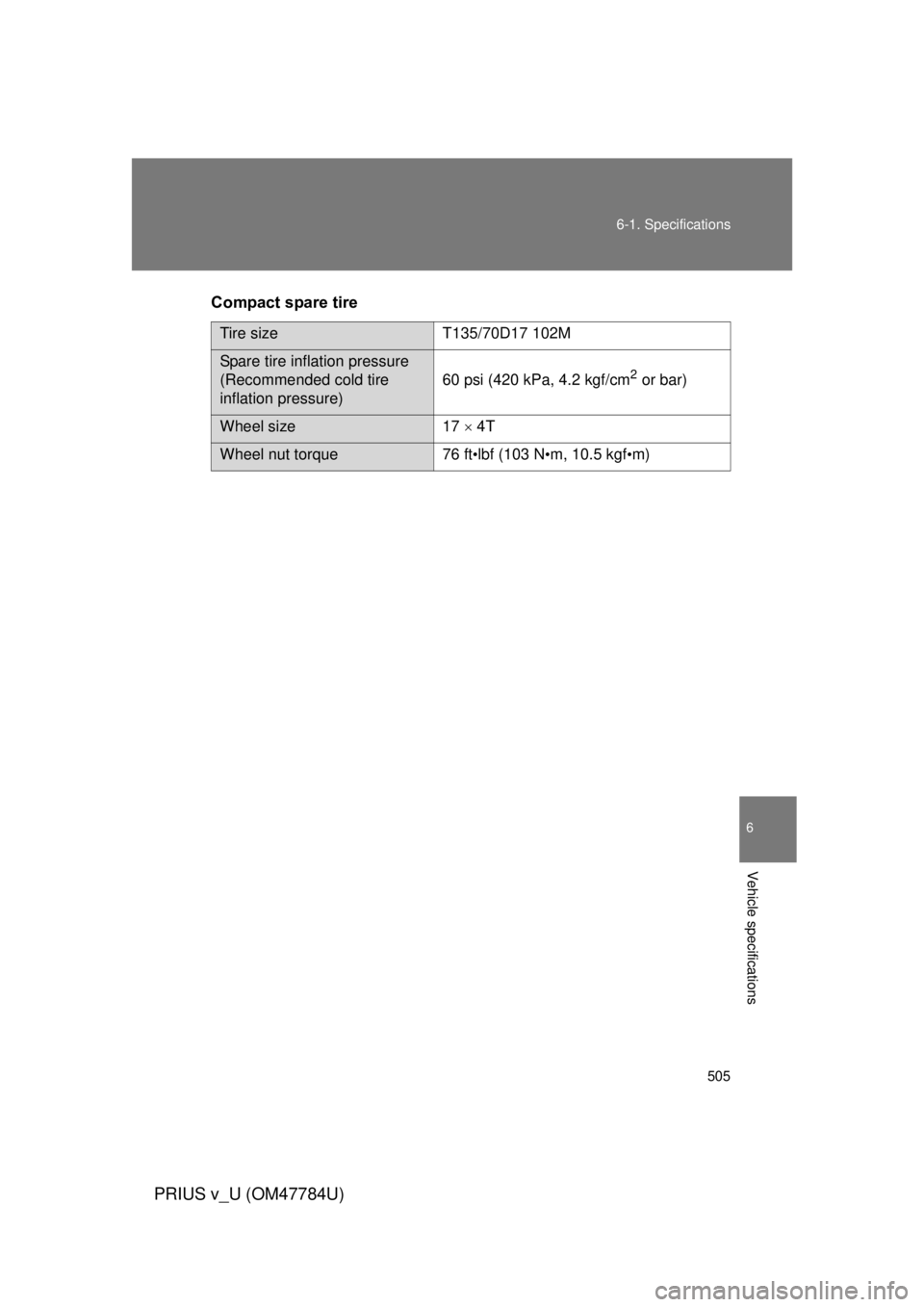
Compact spare tire
Tire sizeT135/70D17 102M
Spare tire inflation pressure
(Recommended cold tire
inflation pressure)
60 psi (420 kPa, 4.2 kgf/cm2 or bar)
Wheel size
17 4T
Wheel nut torque 76 ft•lbf (103 N•m, 10.5 kgf•m)
Page 513 of 568
513
6-1. Specifications
6
Vehicle specifications
PRIUS v_U (OM47784U)
Tire size
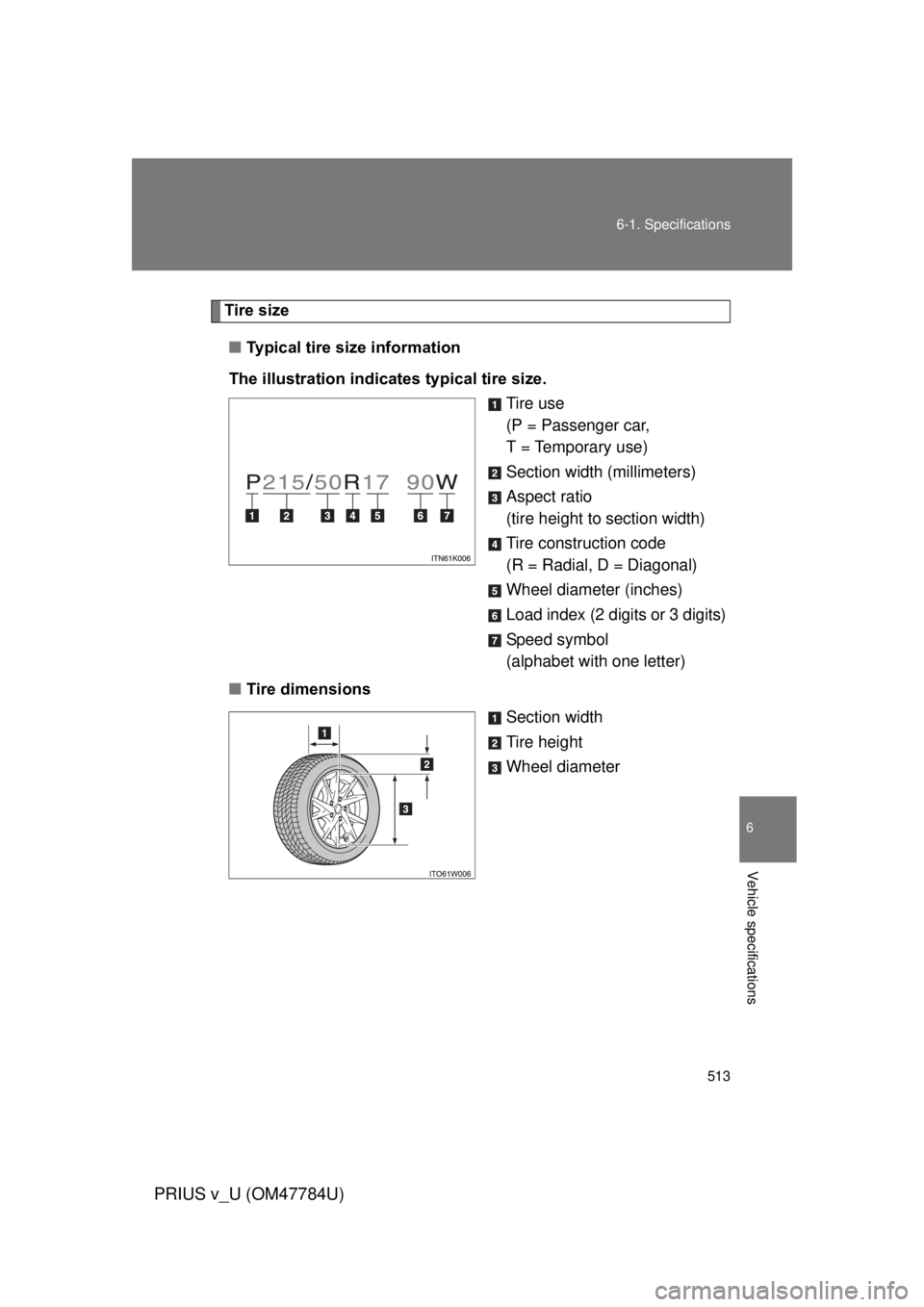
■ Typical tire size information
The illustration indicates typical tire size. Tire use
(P = Passenger car,
T = Temporary use)
Section width (millimeters)
Aspect ratio
(tire height to section width)
Tire construction code
(R = Radial, D = Diagonal)
Wheel diameter (inches)
Load index (2 digits or 3 digits)
Speed symbol
(alphabet with one letter)
■ Tire dimensions
Section width
Tire height
Wheel diameter
Page 516 of 568

516 6-1. Specifications
PRIUS v_U (OM47784U)
■Traction AA, A, B, C
The traction grades, from highest to lowest, are AA, A, B and C,
and they represent the tire’s ab ility to stop on wet pavement as
measured under controlled cond itions on specified government
test surfaces of asphalt and concrete.
A tire marked C may have poor traction performance.
Warning: The traction grade assigned to this tire is based on braking
(straight ahead) traction tests and does not include cornering (turn-
ing) traction.
■ Temperature A, B, C
The temperature grades are A (the highest), B, and C, represent-
ing the tire’s resistance to the generation of heat and its ability to
dissipate heat when tested under controlled conditions on a speci-
fied indoor laboratory test wheel.
Sustained high temperature can cause the material of the tire to
degenerate and reduce tire life, and excessive temperature can lead
to sudden tire failure.
Grade C corresponds to a level of performance which all passenger
car tires must meet under the Federal Motor Vehicle Safety Standard
No. 109.
Grades B and A represent higher levels of performance on the labo-
ratory test wheel than the minimum required by law.
Warning: The temperature grades of a tire assume that it is properly
inflated and not overloaded.
Excessive speed, underinflation, or excessive loading, either sepa-
rately or in combination, can cause heat buildup and possible tire fail-
ure.