lock TOYOTA PRIUS V 2012 (in English) User Guide
[x] Cancel search | Manufacturer: TOYOTA, Model Year: 2012, Model line: PRIUS V, Model: TOYOTA PRIUS V 2012Pages: 32, PDF Size: 2.37 MB
Page 25 of 32
OVERVIEW
FEATURES/OPERATIONS
SAFETY AND EMERGENCY FEATURES
23
om
m lity.
call
ll
and
Clock
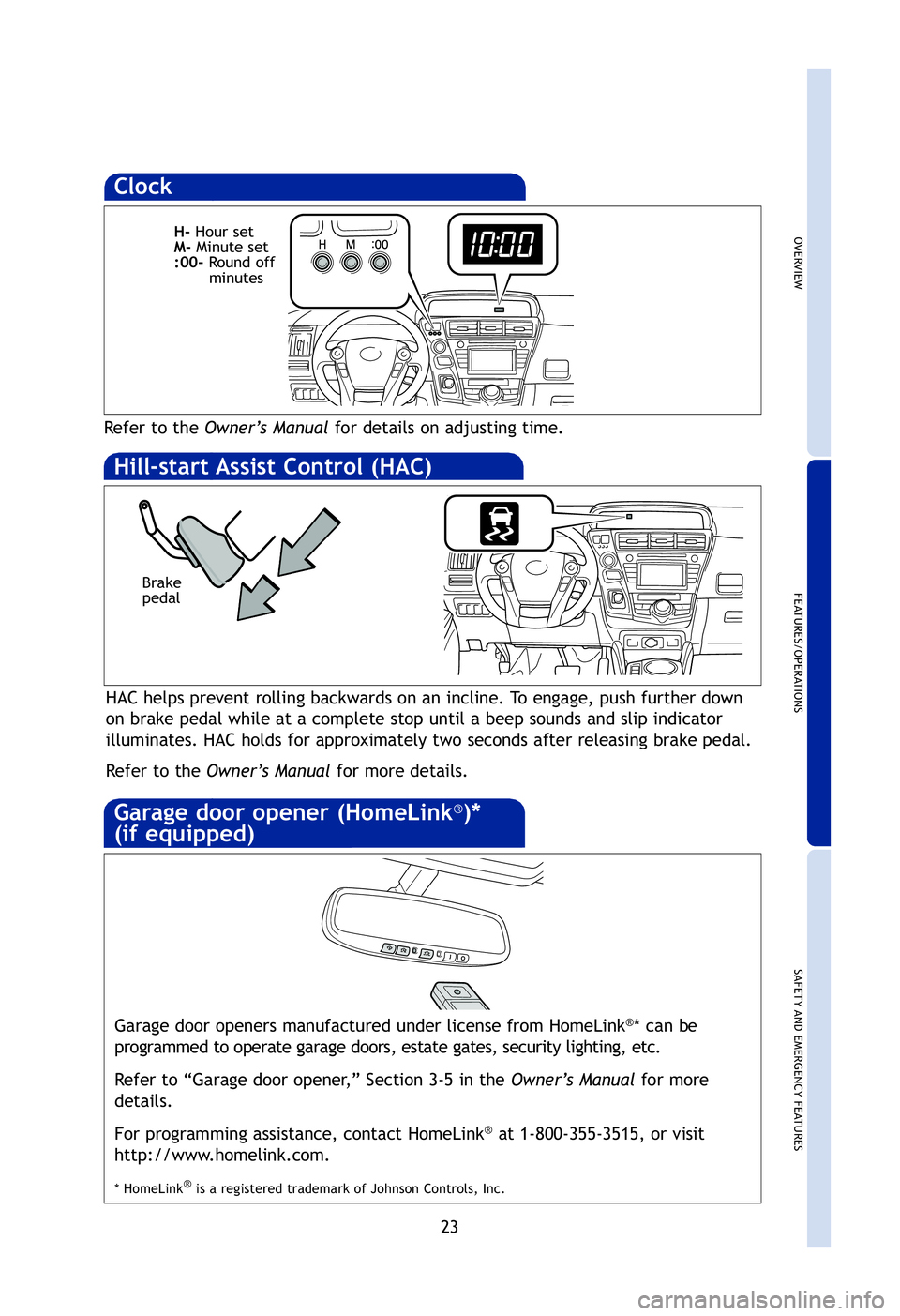
Refer to the Owner’s Manual for details on adjusting time.
H-Hour set
M- Minute set
:00- Round off
minutes
HAC helps prevent rolling backwards on an incline. To engage, push further down
on brake pedal while at a complete stop until a beep sounds and slip ind\
icator
illuminates. HAC holds for approximately two seconds after releasing bra\
ke pedal.
Refer to the Owner’s Manual for more details.
Brake
pedal
Hill-start Assist Control (HAC)
Garage door openers manufactured under license from HomeLink®* can be
programmed to operate garage doors, estate gates, security lighting, etc\
.
Refer to “Garage door opener,” Section 3-5 in the Owner’s Manualfor more
details.
For programming assistance, contact HomeLink
®at 1-800-355-3515, or visit
http://www.homelink.com.
* HomeLink®is a registered trademark of Johnson Controls, Inc.
Garage door opener (HomeLink®)*
(if equipped)
2012-Prius-v-QRG.qxd:2012-Prius-v-QRG 9/13/11 5:37 PM Page 23
Page 26 of 32
24
SAFETY AND EMERGENCY FEATURES
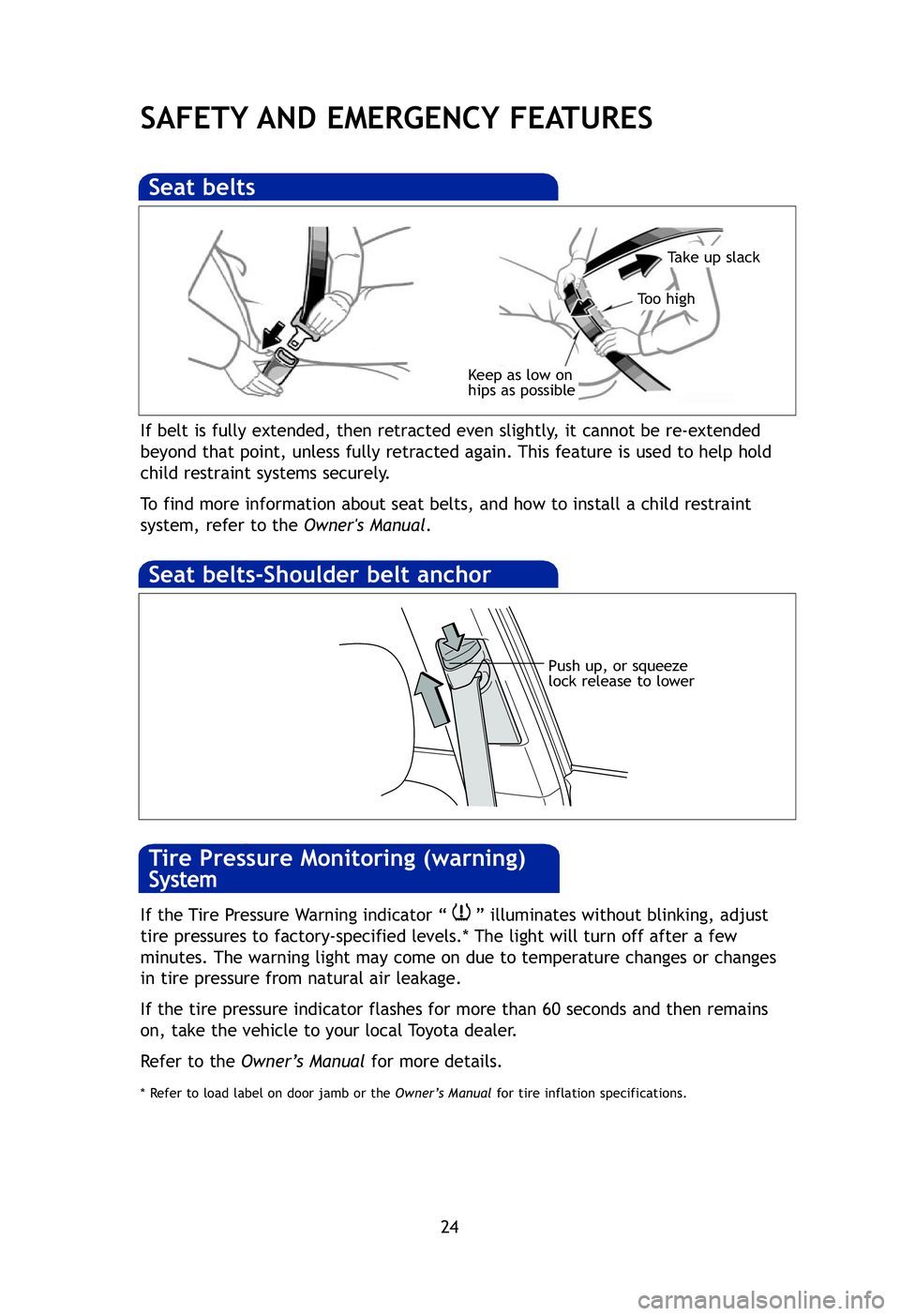
If belt is fully extended, then retracted even slightly, it cannot be re-extended
beyond that point, unless fully retracted again. This feature is used to help hold
child restraint systems securely.
To find more information about seat belts, and how to install a child res\
traint
system, refer to the Owner's Manual.
Keep as low on
hips as possible
Take up slack
Too high
Seat belts
Push up, or squeeze
lock release to lower
Seat belts-Shoulder belt anchor
Do
If the Tire Pressure Warning indicator “ ” illuminates without blinking, adjust
tire pressures to factory-specified levels.* The light will turn off after a few
minutes. The warning light may come on due to temperature changes or changes
in tire pressure from natural air leakage.
If the tire pressure indicator flashes for more than 60 seconds and then\
remains
on, take the vehicle to your local Toyota dealer.
Refer to the Owner’s Manual for more details.
* Refer to load label on door jamb or the Owner’s Manualfor tire inflation specifications.
Tire Pressure Monitoring (warning)
System
Sp
To o
Rem
Refe
Movi
Rea
Do
Lef
2012-Prius-v-QRG.qxd:2012-Prius-v-QRG 9/13/11 6:02 PM Page 24
Page 27 of 32
OVERVIEW
FEATURES/OPERATIONS
SAFETY AND EMERGENCY FEATURES
25
ld
Door locks
t
es
s
Spare tire & tools
Tool location
Removing the spare tire
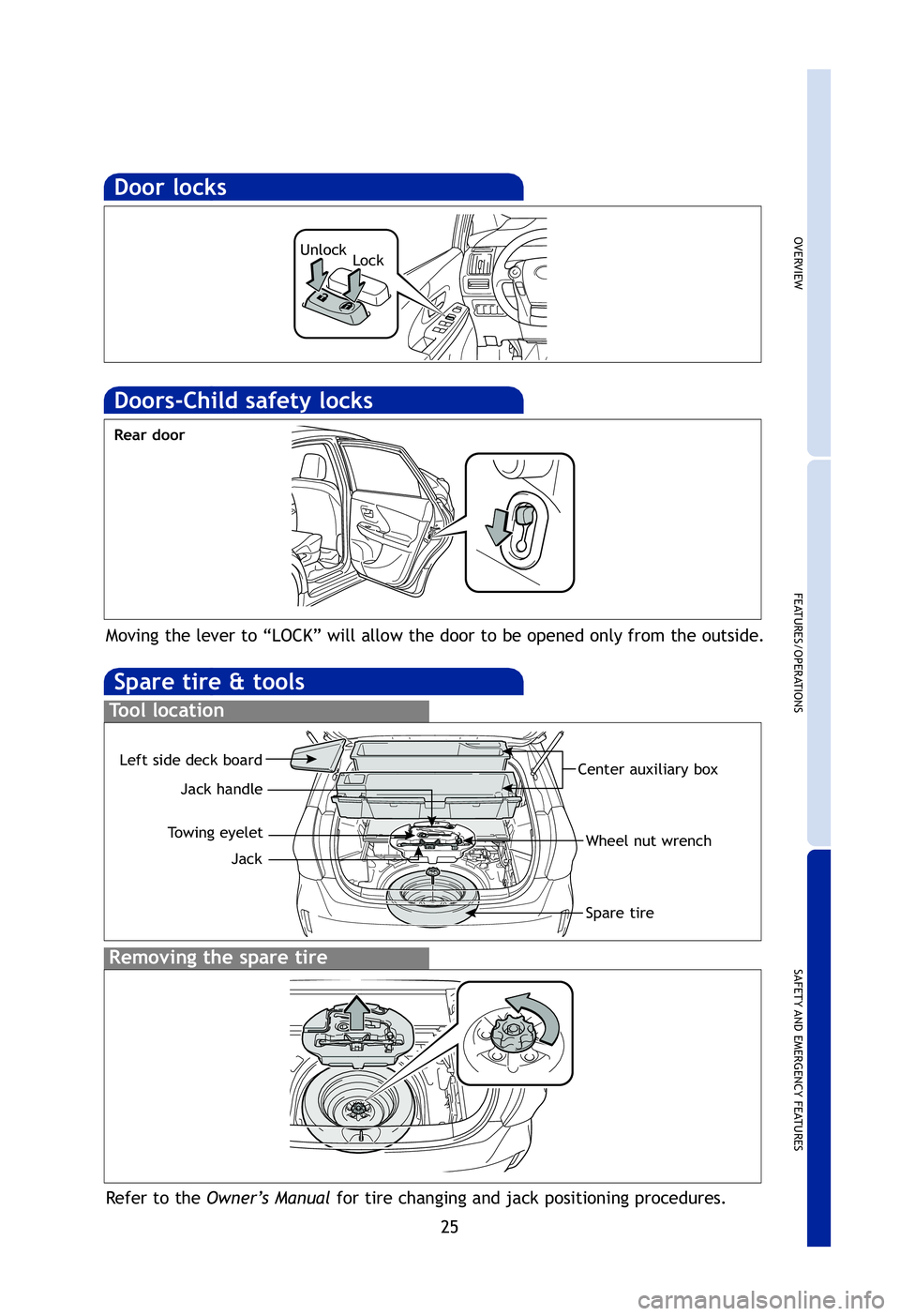
Refer to the Owner’s Manual for tire changing and jack positioning procedures.
Wheel nut wrench
Spare tire
Towing eyelet
Center auxiliary box
Moving the lever to “LOCK” will allow the door to be opened only f\
rom the outside.
Rear door
Jack
Jack handle
Doors-Child safety locks
Lock
Unlock
Left side deck board
2012-Prius-v-QRG.qxd:2012-Prius-v-QRG 9/13/11 5:39 PM Page 25
Page 28 of 32
26
Ther
has m
For s
•O
• Us
pl
• In
Flo
Smar
and
SST e
firml
SST d
allow
back
Sma
SAFETY AND EMERGENCY FEATURES
Star Safety SystemTM
VSC helps prevent loss of traction during cornering by reducing engine p\
ower and
applying brake force to selected wheels.
Toyota’s VSC monitors steering angle and the direction your vehicle is travelin\
g.
When it senses that the front or rear wheels begin to lose traction, VSC\
reduces
engine power and applies braking to selected wheels. This helps restore traction
and vehicle control.
Vehicle Stability Control (VSC)
Anti-Lock Brake System (ABS)
Brake Assist (BA)
ABS helps prevent brakes from locking up by "pulsing" brake pressure to \
each
wheel. This limits brake lockup and provides the maximum brake effectiveness fo\
r
the current road conditions.
Toyota's ABS sensors detect which wheels are locking up and limits wheel lockup b\
y
"pulsing" each wheel's brakes independently. Pulsing releases brake pressure
repeatedly for fractions of a second. This helps the tires attain the maximum
traction that the current road conditions will allow, helping you stay in control.
Brake Assist is designed to detect sudden or “panic” braking, and then a\
dd braking
pressure to decrease the vehicle’s stopping distance. When there’s only a split
second to react, Brake Assist can add additional brake pressure more quickly than
just the driver alone can. VSC helps prevent loss of traction during cornering by reducing engine p\
ower, and
Traction Control helps maintain traction on loose gravel and wet, icy, or uneven
surfaces by applying brake force to the spinning wheel(s).
Toyota’s TRAC sensors are activated when one of the drive wheels starts to slip.
TRAC limits engine output and applies the brakes to the spinning wheel. \
This
transfers power to the wheels that still have traction to help you drive\
safely.
Traction Control (TRAC)
Electronic Brake Force Distribution (EBD)
Toyota’s ABS technology has Electronic Brake-force Distribution (EBD) to help
maintain stability and balance when braking. Abrupt stops cause the vehicle to tilt
forward, reducing the braking power of the rear wheels. EBD responds to \
sudden
stops by redistributing brake force to maximize the braking effectivenes\
s of all
four wheels. All new Toyota vehicles come standard with the Star Safety System
TM, which
combines Vehicle Stability Control (VSC), Traction Control (TRAC), Anti-lock Braking
System (ABS), Electronic Brake-force Distribution (EBD), Brake Assist (BA) and Smart
Stop Technology (SST).
2012-Prius-v-QRG.qxd:2012-Prius-v-QRG 9/13/11 5:39 PM Page 26