ESP TOYOTA PRIUS V 2012 Owners Manual (in English)
[x] Cancel search | Manufacturer: TOYOTA, Model Year: 2012, Model line: PRIUS V, Model: TOYOTA PRIUS V 2012Pages: 32, PDF Size: 2.37 MB
Page 12 of 32
10
FEATURES/OPERATIONS
Tr a
* Thebra
Eco
Eco
acce
Refe
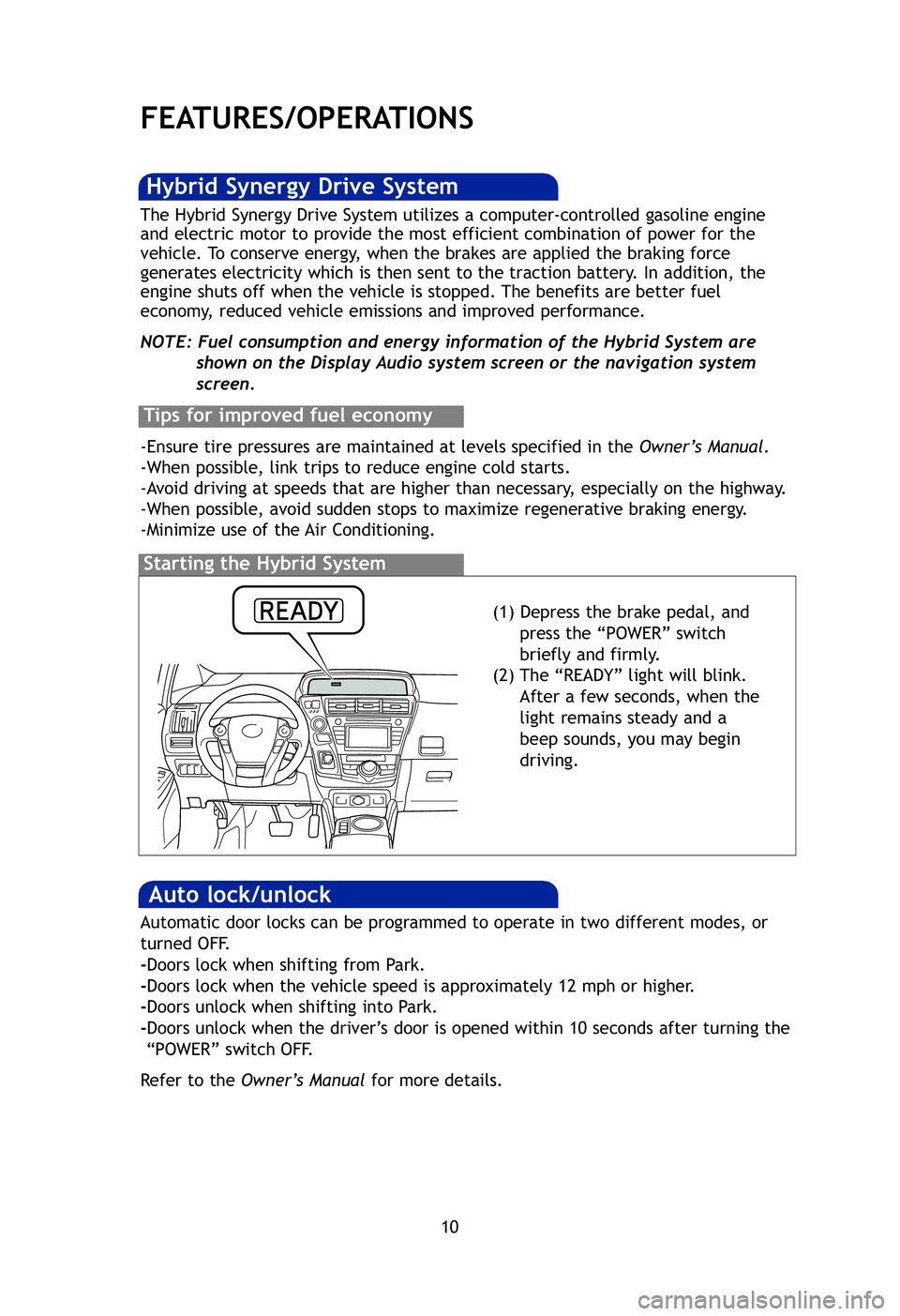
(1) Depress the brake pedal, and press the “POWER” switch
briefly and firmly.
(2) The “READY” light will blink. After a few seconds, when the
light remains steady and a
beep sounds, you may begin
driving.
Starting the Hybrid System
The Hybrid Synergy Drive System utilizes a computer-controlled gasoline \
engine
and electric motor to provide the most efficient combination of power fo\
r the
vehicle. To conserve energy, when the brakes are applied the braking force
generates electricity which is then sent to the traction battery. In addition, the
engine shuts off when the vehicle is stopped. The benefits are better fuel
economy, reduced vehicle emissions and improved performance.
NOTE: Fuel consumption and energy information of the Hybrid System are shown on the Display Audio system screen or the navigation system
screen.
Tips for improved fuel economy
-Ensure tire pressures are maintained at levels specified in the Owner’s Manual.
-When possible, link trips to reduce engine cold starts.
-Avoid driving at speeds that are higher than necessary, especially on the highway.
-When possible, avoid sudden stops to maximize regenerative braking ener\
gy.
-Minimize use of the Air Conditioning.
Hybrid Synergy Drive System
Auto lock/unlock
Automatic door locks can be programmed to operate in two different modes\
, or
turned OFF.
-Doors lock when shifting from Park.
-Doors lock when the vehicle speed is approximately 12 mph or higher.
-Doors unlock when shifting into Park.
-Doors unlock when the driver’s door is opened within 10 seconds after turning the
“POWER” switch OFF.
Refer to the Owner’s Manual for more details.
Pow
Use
mou
Refe
2012-Prius-v-QRG.qxd:2012-Prius-v-QRG 9/13/11 5:23 PM Page 10
Page 13 of 32
 OVERVIEW
FEATURES/OPERATIONS
SAFETY AND EMERGENCY FEATURES
11
Transmission
* The engine brake is the equivalent of downshifting. Shift to “B” w\
hen enginebraking is desired (i.e. downhill driving")
OVERVIEW
FEATURES/OPERATIONS
SAFETY AND EMERGENCY FEATURES
11
Transmission
* The engine brake is the equivalent of downshifting. Shift to “B” w\
hen enginebraking is desired (i.e. downhill driving, coasting to a stop, etc.).
Eco Mode
Push
Eco Mode helps achieve low fuel consumption during trips that involve fr\
equent
accelerating and braking.
Refer to the Owner’s Manual for more details.
e
e
l.
way.
Park button
Reverse
Neutral
Drive
Engine brake*
r
the
Power Mode
Use when a higher level of response is desired, such as when driving in
mountainous regions.
Refer to the Owner’s Manual for more details.
Push
2012-Prius-v-QRG.qxd:2012-Prius-v-QRG 9/13/11 6:08 PM Page 11
Page 28 of 32
26
Ther
has m
For s
•O
• Us
pl
• In
Flo
Smar
and
SST e
firml
SST d
allow
back
Sma
SAFETY AND EMERGENCY FEATURES
Star Safety SystemTM
VSC helps prevent loss of traction during cornering by reducing engine p\
ower and
applying brake force to selected wheels.
Toyota’s VSC monitors steering angle and the direction your vehicle is travelin\
g.
When it senses that the front or rear wheels begin to lose traction, VSC\
reduces
engine power and applies braking to selected wheels. This helps restore traction
and vehicle control.
Vehicle Stability Control (VSC)
Anti-Lock Brake System (ABS)
Brake Assist (BA)
ABS helps prevent brakes from locking up by "pulsing" brake pressure to \
each
wheel. This limits brake lockup and provides the maximum brake effectiveness fo\
r
the current road conditions.
Toyota's ABS sensors detect which wheels are locking up and limits wheel lockup b\
y
"pulsing" each wheel's brakes independently. Pulsing releases brake pressure
repeatedly for fractions of a second. This helps the tires attain the maximum
traction that the current road conditions will allow, helping you stay in control.
Brake Assist is designed to detect sudden or “panic” braking, and then a\
dd braking
pressure to decrease the vehicle’s stopping distance. When there’s only a split
second to react, Brake Assist can add additional brake pressure more quickly than
just the driver alone can. VSC helps prevent loss of traction during cornering by reducing engine p\
ower, and
Traction Control helps maintain traction on loose gravel and wet, icy, or uneven
surfaces by applying brake force to the spinning wheel(s).
Toyota’s TRAC sensors are activated when one of the drive wheels starts to slip.
TRAC limits engine output and applies the brakes to the spinning wheel. \
This
transfers power to the wheels that still have traction to help you drive\
safely.
Traction Control (TRAC)
Electronic Brake Force Distribution (EBD)
Toyota’s ABS technology has Electronic Brake-force Distribution (EBD) to help
maintain stability and balance when braking. Abrupt stops cause the vehicle to tilt
forward, reducing the braking power of the rear wheels. EBD responds to \
sudden
stops by redistributing brake force to maximize the braking effectivenes\
s of all
four wheels. All new Toyota vehicles come standard with the Star Safety System
TM, which
combines Vehicle Stability Control (VSC), Traction Control (TRAC), Anti-lock Braking
System (ABS), Electronic Brake-force Distribution (EBD), Brake Assist (BA) and Smart
Stop Technology (SST).
2012-Prius-v-QRG.qxd:2012-Prius-v-QRG 9/13/11 5:39 PM Page 26