fuel cap TOYOTA PRIUS V 2014 ZVW40 / 1.G Owners Manual
[x] Cancel search | Manufacturer: TOYOTA, Model Year: 2014, Model line: PRIUS V, Model: TOYOTA PRIUS V 2014 ZVW40 / 1.GPages: 568, PDF Size: 11.03 MB
Page 2 of 568

TABLE OF CONTENTSIndex
2
PRIUS v_OM_OM47840U_(U)
1-1. Hybrid systemHybrid system features ........ 30
Hybrid system precautions ... 36
Energy monitor/consumption screen ................................ 42
Hybrid vehicle driving tips .... 52
1-2. Key information Keys ..................................... 54
1-3. Opening, closing and locking the doors
Smart key system................. 57
Wireless remote control ....... 72
Side doors ............................ 74
Back door ............................. 79
1-4. Adjustable components (seats, mirrors, steering
wheel)
Front seats ........................... 84
Rear seats ............................ 88
Head restraints ..................... 93
Seat belts ............................. 95
Steering wheel ................... 107
Inside rear view mirror........ 108
Outside rear view mirrors ... 110 1-5. Opening and closing
the windows
Power windows................... 112
1-6. Refueling Opening the fuel tank cap .................................... 115
1-7. Theft deterrent system Immobilizer system ............. 119
1-8. Safety information Correct driving posture ....... 122
SRS airbags ....................... 124
Front passenger occupant classification system ......... 138
Child restraint systems ....... 144
Installing child restraints ..... 149
1Before driving
Page 29 of 568
Before driving1
29
PRIUS v_OM_OM47840U_(U)
1-1. Hybrid systemHybrid system features ...... 30
Hybrid system precautions ...................... 36
Energy monitor/ consumption screen......... 42
Hybrid vehicle driving tips ................................... 52
1-2. Key information Keys ................................... 54
1-3. Opening, closing and locking the doors
Smart key system .............. 57
Wireless remote control ..... 72
Side doors .......................... 74
Back door ........................... 79 1-4. Adjustable components
(seats, mirrors, steering
wheel)
Front seats ......................... 84
Rear seats.......................... 88
Head restraints................... 93
Seat belts ........................... 95
Steering wheel ................. 107
Inside rear view mirror ..... 108
Outside rear view mirrors ............................ 110
1-5. Opening and closing the windows
Power windows ................ 112
1-6. Refueling Opening the fuel tank cap ................................. 115
1-7. Theft deterrent system Immobilizer system .......... 119
1-8. Safety information Correct driving posture..... 122
SRS airbags ..................... 124
Front passenger occupant classification
system ........................... 138
Child restraint systems..... 144
Installing child restraints ........................ 149
Page 115 of 568
115
1
Before driving
PRIUS v_OM_OM47840U_(U)
1-6. Refueling
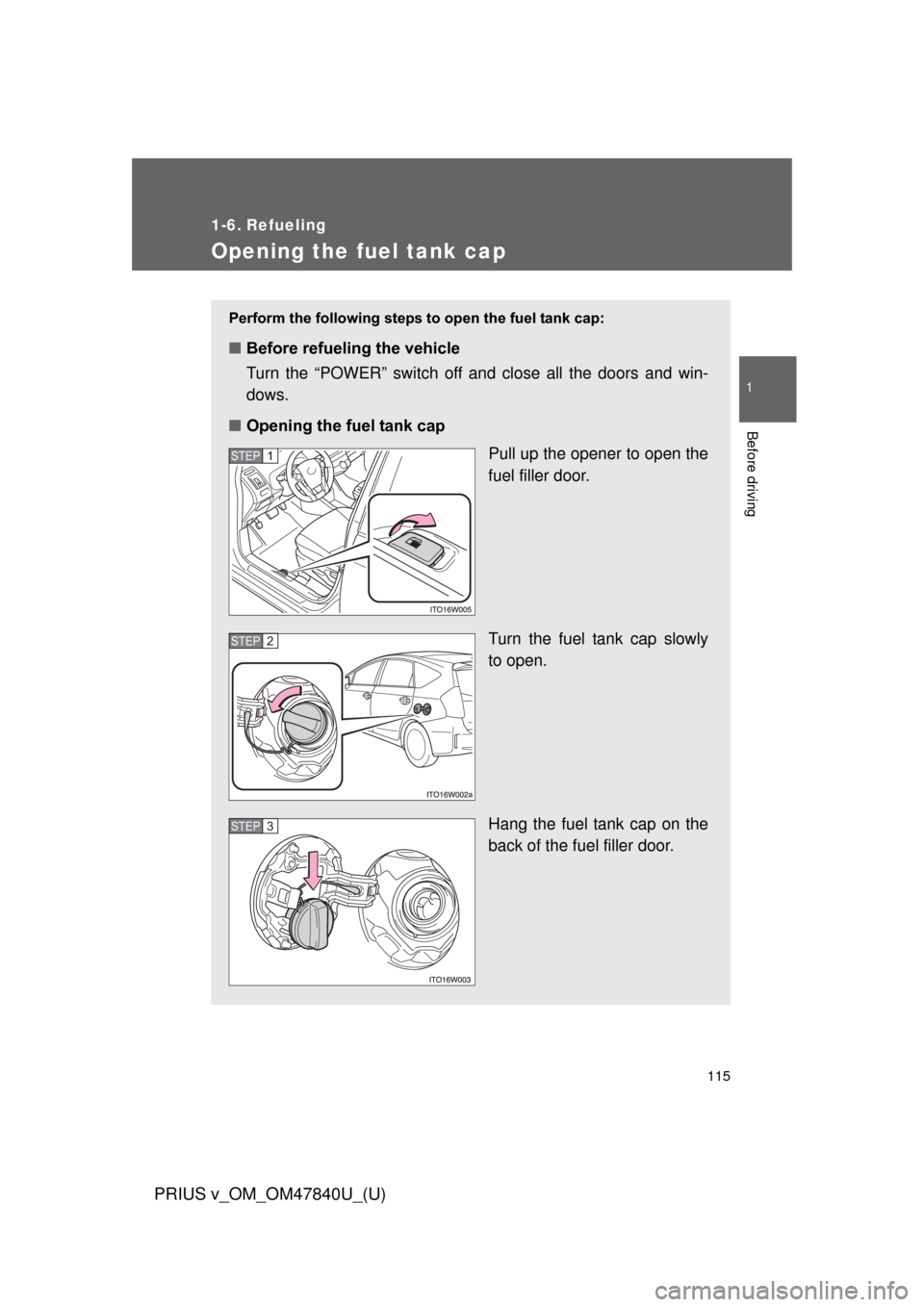
Opening the fuel tank cap
Perform the following steps to open the fuel tank cap:
■Before refueling the vehicle
Turn the “POWER” switch off and close all the doors and win-
dows.
■ Opening the fuel tank cap
Pull up the opener to open the
fuel filler door.
Turn the fuel tank cap slowly
to open.
Hang the fuel tank cap on the
back of the fuel filler door.
STEP 1
STEP 2
STEP 3
Page 116 of 568
116 1-6. Refueling
PRIUS v_OM_OM47840U_(U)
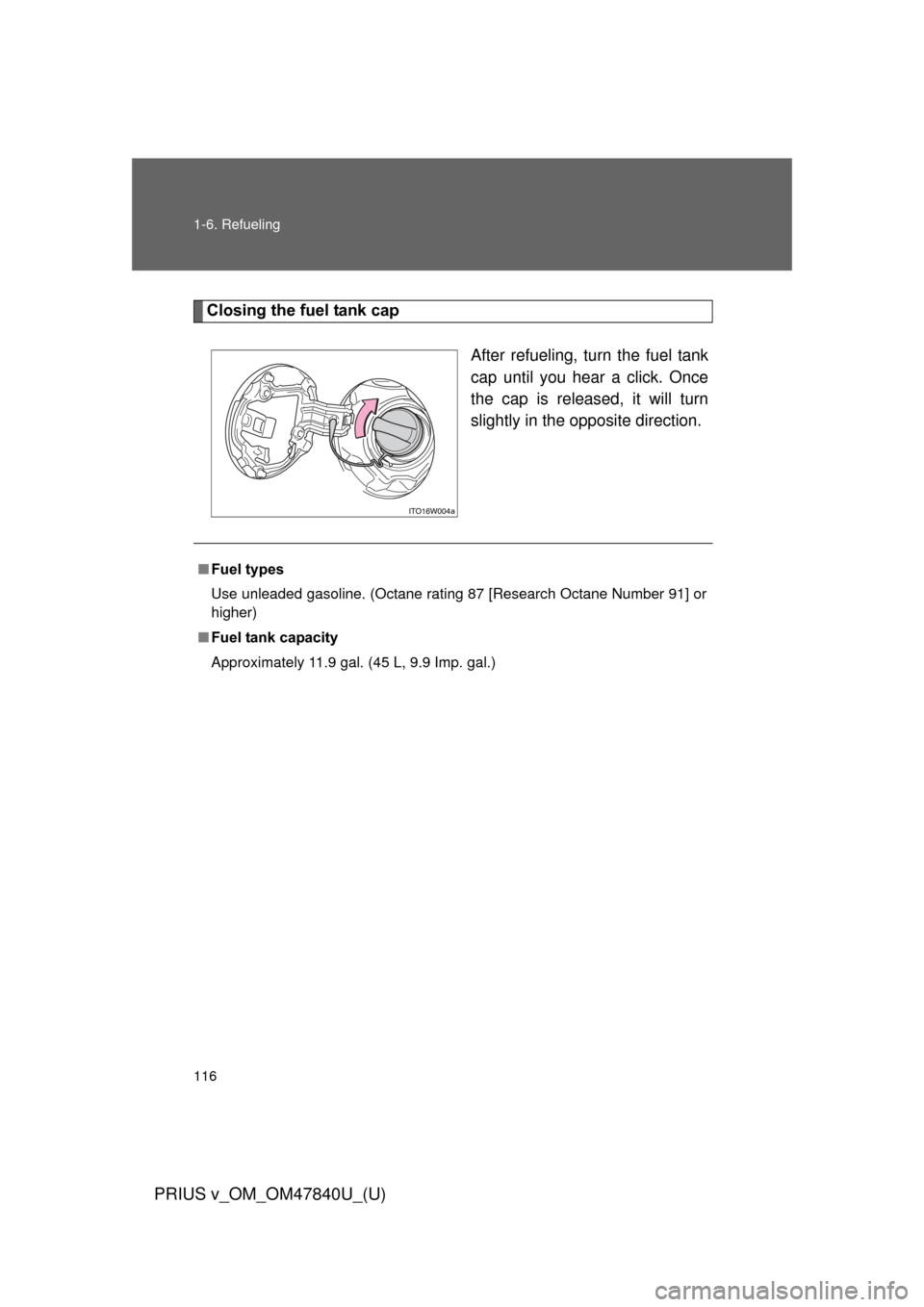
Closing the fuel tank capAfter refueling, turn the fuel tank
cap until you hear a click. Once
the cap is released, it will turn
slightly in the opposite direction.
■Fuel types
Use unleaded gasoline. (Octane rating 87 [Research Octane Number 91] or
higher)
■ Fuel tank capacity
Approximately 11.9 gal. (45 L, 9.9 Imp. gal.)
Page 117 of 568
117
1-6. Refueling
1
Before driving
PRIUS v_OM_OM47840U_(U)
CAUTION
■
When refueling the vehicle
Observe the following precautions while refueling the vehicle. Failure to do
so may result in death or serious injury.
●After exiting the vehicle and before opening the fuel filler door, touch an
unpainted metal surface to discharge any st atic electricity. It is important to
discharge static electricity before refueling because sparks resulting from
static electricity can cause fuel vapors to ignite while refueling.
● Always hold the grips on the fuel tank cap and turn it slowly to remove it.
A whooshing sound may be heard when the fuel tank cap is loosened.
Wait until the sound cannot be heard before fully removing the cap. In hot
weather, pressurized fuel may spray out of the filler neck and cause injury.
● Do not allow anyone that has not discharged static electricity from their
body to come close to an open fuel tank.
● Do not inhale vaporized fuel.
Fuel contains substances that are harmful if inhaled.
● Do not smoke while refueling the vehicle.
Doing so may cause the fuel to ignite and cause a fire.
● Do not return to the vehicle or touch any person or object that is statically
charged.
This may cause static electricity to build up, resulting in a possible ignition
hazard.
■ When refueling
Securely insert the fuel nozzle into the fuel filler neck. If fuel is added with
the nozzle slightly lifted away from the fuel filler neck, the automatic shut off
function may not operate, resulting in fuel overflowing from the tank.
■ When replacing the fuel tank cap
Do not use anything but a genuine Toyota fuel tank cap designed for your
vehicle. Doing so may cause a fire or other incident which may result in
death or serious injury.
Page 264 of 568
264
PRIUS v_OM_OM47840U_(U)
2-5. Driving information
Cargo and luggage
Take notice of the following information about storage precau-
tions, cargo capacity and load:
●Stow cargo and luggage in the luggage compartment whenever
possible.
● Be sure all items are secured in place.
● To maintain vehicle balance while driving, position luggage
evenly within the luggage compartment.
● For better fuel economy, do no t carry unnecessary weight.
Page 289 of 568
289
3-1. Using the air conditioning system
and defogger
PRIUS v_OM_OM47840U_(U)
3
Interior features
■Window defogger feature
Recirculated air mode may automatically switch to outside air mode in situa-
tions where the windows need to be defogged.
■ Micro dust and pollen filter
●In order to prevent the windshield from fogging up when the outside air is
cold, the following may occur:
• Outside air mode does not switch to recirculated air mode.
• The air conditioning system operates automatically.
• The operation cancels after 1 minute.
● In rainy weather, the windows may fog up. Press .
■ Outside temperature display
In the following situations, the correct outside temperature may not be dis-
played, or the display may take longer than normal to change.
●When stopped, or driving at low speeds (less than 16 mph [25 km/h])
● When the outside temperature has changed suddenly (at the entrance/
exit of a garage, tunnel, etc.)
■ Operation of the air conditio ning system in Eco drive mode
In the Eco drive mode, the air conditioning system is controlled as follows to
prioritize fuel efficiency:
● Engine speed and compressor operation controlled to restrict heating/
cooling capacity
● Fan speed restricted when automatic mode is selected
To improve air conditioning performance, perform the following operations:
● Adjust the fan speed
● Turn off Eco drive mode ( P. 187)
● Customize the air conditioning control of Eco drive mode. ( P. 529)
Page 362 of 568
362
4-2. Maintenance
PRIUS v_OM_OM47840U_(U)
Emission inspection and maintenance (I/M) programs
Some states have vehicle emission inspection programs which
include OBD (On Board Diagnostics) checks. The OBD system moni-
tors the operation of the emission control system.
■If the malfunction indicator lamp comes on
The OBD system determines that a problem exists somewhere
in the emission control system. Your vehicle may not pass the I/
M test and may need to be repaired. Contact your Toyota dealer
to service the vehicle.
■ Your vehicle may not pass the I/M test in the following situa-
tions:
●When the 12-volt battery is disconnected or discharged
Readiness codes that are se t during ordinary driving are
erased.
Also, depending on your driving habits, the readiness codes
may not be completely set.
● When the fuel tank cap is loose
The malfunction indicator lamp comes on indicating a tempo-
rary malfunction and your vehi cle may not pass the I/M test.
■ When the malfunction indicator lamp still remains on after
several driving trips
The error code in the OBD system will not be cleared unless the
vehicle is driven 40 or more times.
■ If your vehicle does not pass the I/M test
Contact your Toyota dealer to prepare the vehicle for re-testing.
Page 400 of 568

400 4-3. Do-it-yourself maintenance
PRIUS v_OM_OM47840U_(U)
■Tire inflation pressure check interval
You should check tire inflation pressure every two weeks, or at least
once a month.
Do not forget to check the spare.
■Effects of incorrect tire inflation pressure
Driving with incorrect tire inflation pressure ma y result in the following:
●Reduced fuel efficiency
●Reduced driving comfort and tire life
●Reduced safety
●Damage to the drive train
If a tire needs frequent inflating, have it checked by your Toyota dealer.
■Instructions for checking tire inflation pressure
When checking tire inflation pressure, observe the following:
●Check only when the tires are cold.
If your vehicle has been parked for at least 3 hours or has not been
driven for more than 1 mile or 1.5 km, you will get an accurate cold
tire inflation pressure reading.
●Always use a tire pressure gauge.
The appearance of the tire can be mi sleading. In addition, tire infla-
tion pressure that is even just a few pounds off can affect ride quality
and handling.
●Do not reduce tire inflation pressure after driving. It is normal for tire
inflation pressure to be higher after driving.
●Never exceed the vehicle capacity weight.
Passengers and luggage weight should be placed so that the vehicle
is balanced.
Page 453 of 568
5
When trouble arises
453
5-2. Steps to take in an emergency
PRIUS v_OM_OM47840U_(U)
■
Electric power steering system warning light (warning buzzer)
When the 12-volt battery charge becomes insufficient or the voltage tempo-
rarily drops, the electric power steering system warning light may come on
and the warning buzzer may sound.
■ If the malfunction indicator lamp comes on while driving
First check the following:
● Is the fuel tank empty?
If it is, fill the fuel tank immediately.
● Is the fuel tank cap loose?
If it is, tighten it securely.
The malfunction indicator lamp will go off after several driving trips.
If the malfunction indicator lamp does not go off even after several trips, con-
tact your Toyota dealer as soon as possible.
■
When the tire pressure warning light comes on
Check the tire inflation pressure and adjust to the appropriate level.
Pushing the tire pressure warning re set switch will not turn off the tire
pressure warning light.
■The tire pressure warning light may come on due to natural causes
The tire pressure warning light may come on due to natural causes such
as natural air leaks and tire inflat ion pressure changes caused by tem-
perature. In this case, adjusting the tire inflation pressure will turn off the
warning light (after a few minutes).
■When a tire is replaced with a spare tire
The compact spare tire is not equipped with a tire pressure warning
valve and transmitter. If a tire goes flat, the tire pressure warning light will
not turn off even though the flat tire has been replaced with the spare
tire. Replace the spare tire with the re paired tire and adjust the tire infla-
tion pressure. The tire pressure wa rning light will go off after a few min-
utes.