radiator TOYOTA PRIUS V 2014 ZVW40 / 1.G Owners Manual
[x] Cancel search | Manufacturer: TOYOTA, Model Year: 2014, Model line: PRIUS V, Model: TOYOTA PRIUS V 2014 ZVW40 / 1.GPages: 568, PDF Size: 11.03 MB
Page 245 of 568

245
2-4. Using other
driving systems
PRIUS v_OM_OM47840U_(U)
2
When driving
■Certification
For vehicles sold in the U.S.A.
FCC ID: HYQDNMWR005
This device complies with part 15 of the FCC Rules. Operation is subject to
the following two conditions: (1) This device may not cause harmful interfer-
ence, and (2) this device must accept any interference received, including
interference that may cause undesired operation.
FCC WARNING
Changes or modifications not expressly approved by the party responsible
for compliance could void the user’s authority to operate the equipment.
Radiofrequency radiation exposure Information:
This equipment complies with FCC radiation exposure limits set forth for an
uncontrolled environment.
This equipment should be installed and operated with minimum distance of
20 cm between the radiator (antenna) and your body.
This transmitter must not be co-located or operating in conjunction with any
other antenna or transmitter.
For vehicles sold in Canada
Operation is subject to the following two conditions: (1) this device may not
cause interference, and (2) this device must accept any interference, includ-
ing interference that may cause undesired operation of the device.
Page 261 of 568

261
2-4. Using other
driving systems
PRIUS v_OM_OM47840U_(U)
2
When driving
■Certification
For vehicles sold in the U.S.A.
FCC ID: HYQDNMWR005
This device complies with part 15 of the FCC Rules. Operation is subject to
the following two conditions: (1) This device may not cause harmful interfer-
ence, and (2) this device must accept any interference received, including
interference that may cause undesired operation.
FCC WARNING
Changes or modifications not expressly approved by the party responsible
for compliance could void the user’s authority to operate the equipment.
Radiofrequency radiation exposure Information:
This equipment complies with FCC radiation exposure limits set forth for an
uncontrolled environment.
This equipment should be installed and operated with minimum distance of
20 cm between the radiator (antenna) and your body.
This transmitter must not be co-located or operating in conjunction with any
other antenna or transmitter.
For vehicles sold in Canada
Operation is subject to the following two conditions: (1) this device may not
cause interference, and (2) this device must accept any interference, includ-
ing interference that may cause undesired operation of the device.
Page 358 of 568
358
4-2. Maintenance
PRIUS v_OM_OM47840U_(U)
General maintenance
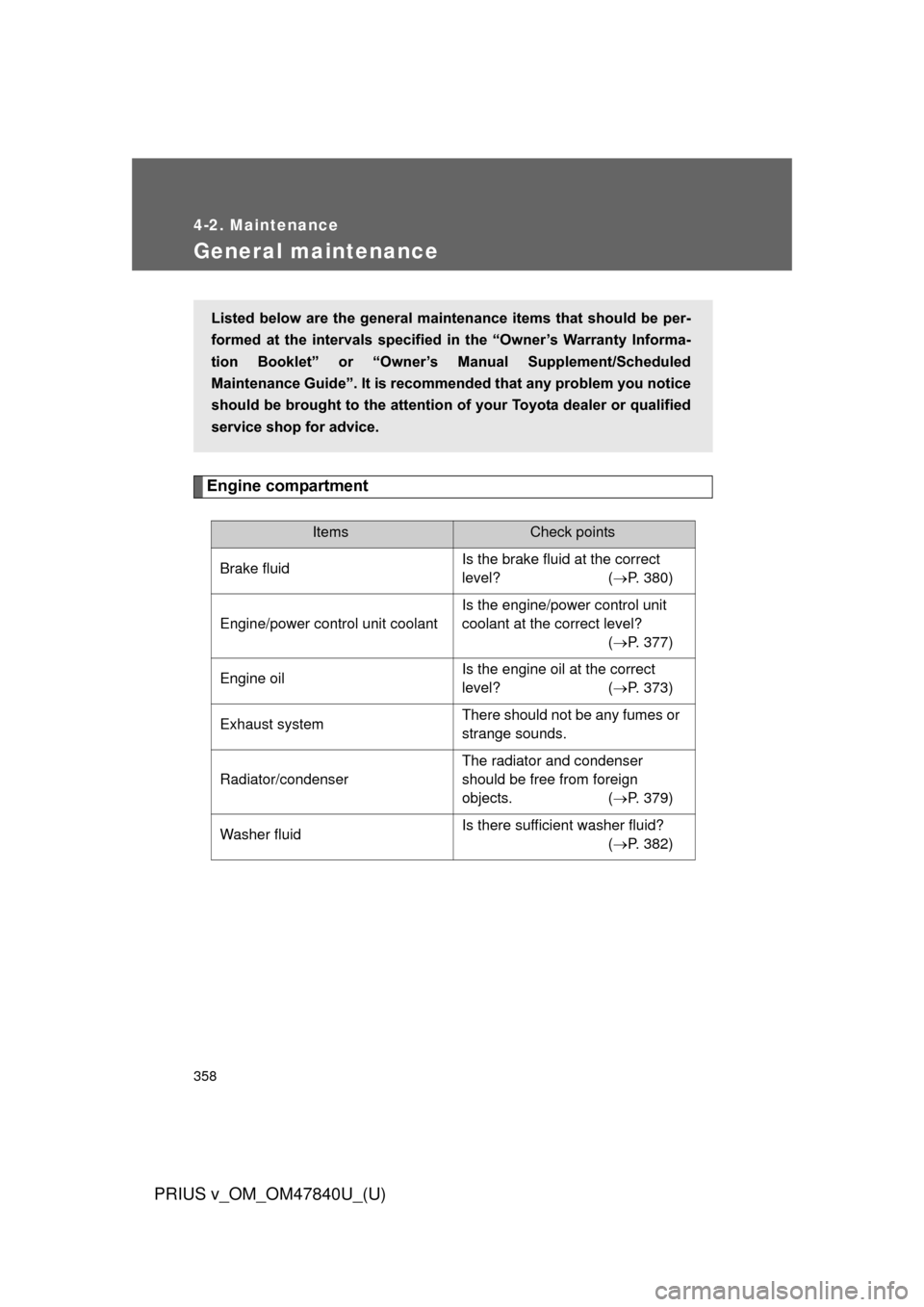
Engine compartment
ItemsCheck points
Brake fluid Is the brake fluid at the correct
level? (
P. 380)
Engine/power control unit coolant Is the engine/power control unit
coolant at the correct level?
(P. 377)
Engine oil Is the engine oil at the correct
level?
(P. 373)
Exhaust system There should not be any fumes or
strange sounds.
Radiator/condenser The radiator and condenser
should be free from foreign
objects. (
P. 379)
Washer fluid Is there sufficient washer fluid?
(P. 382)
Listed below are the general maintenance items that should be per-
formed at the intervals specified in the “Owner’s Warranty Informa-
tion Booklet” or “Owner’s Manual Supplement/Scheduled
Maintenance Guide”. It is recommended that any problem you notice
should be brought to the attention of your Toyota dealer or qualified
service shop for advice.
Page 364 of 568
364 4-3. Do-it-yourself maintenance
PRIUS v_OM_OM47840U_(U)
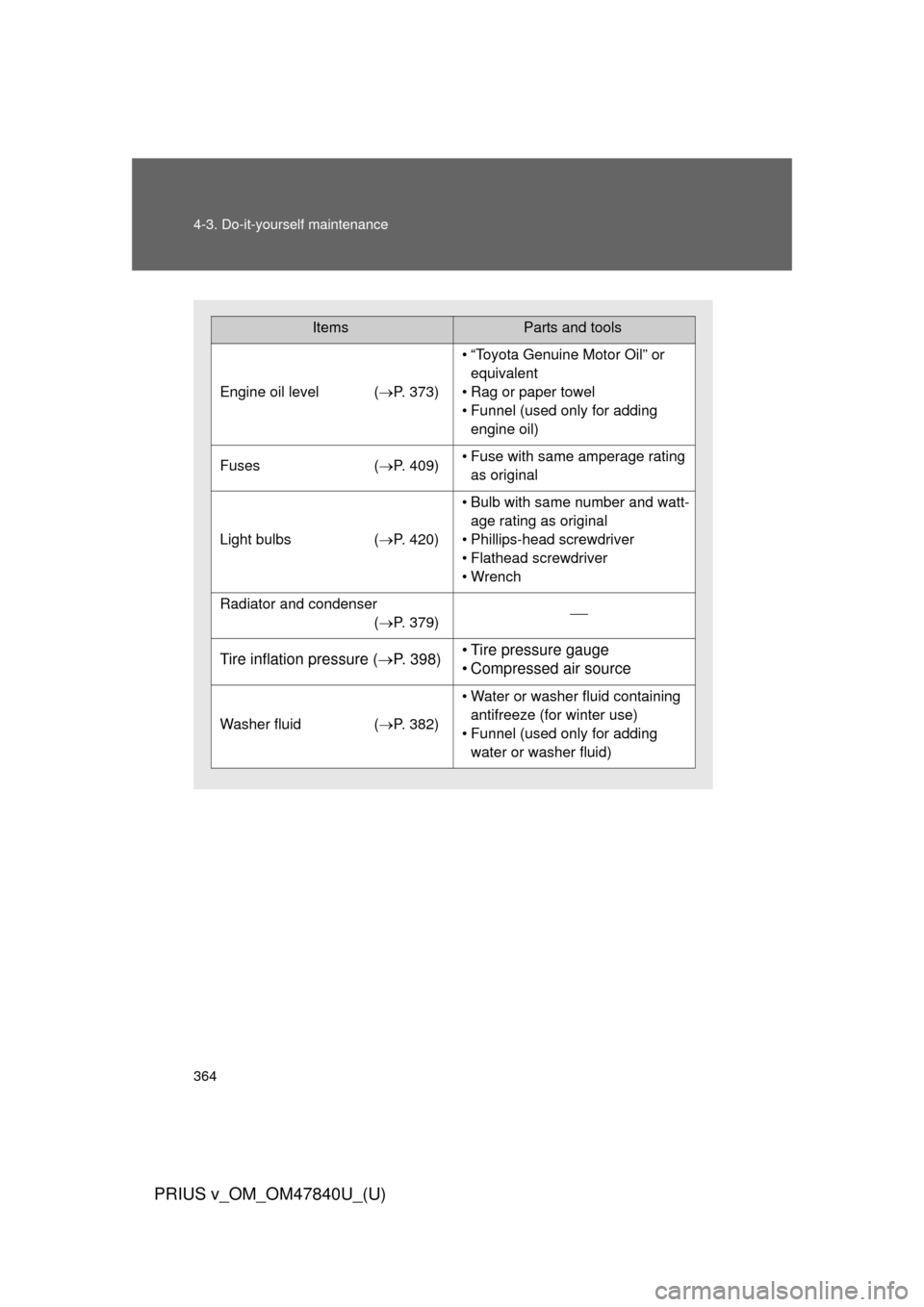
ItemsParts and tools
Engine oil level (P. 373)
• “Toyota Genuine Motor Oil” or
equivalent
• Rag or paper towel
• Funnel (used only for adding engine oil)
Fuses (P. 409)• Fuse with same amperage rating
as original
Light bulbs (P. 420)
• Bulb with same number and watt-
age rating as original
• Phillips-head screwdriver
• Flathead screwdriver
• Wrench
Radiator and condenser (P. 379)
Tire inflation pressure ( P. 398)• Tire pressure gauge
• Compressed air source
Washer fluid ( P. 382)
• Water or washer fluid containing
antifreeze (for winter use)
• Funnel (used only for adding water or washer fluid)
Page 365 of 568
365
4-3. Do-it-yourself maintenance
PRIUS v_OM_OM47840U_(U)
4
Maintenance and care
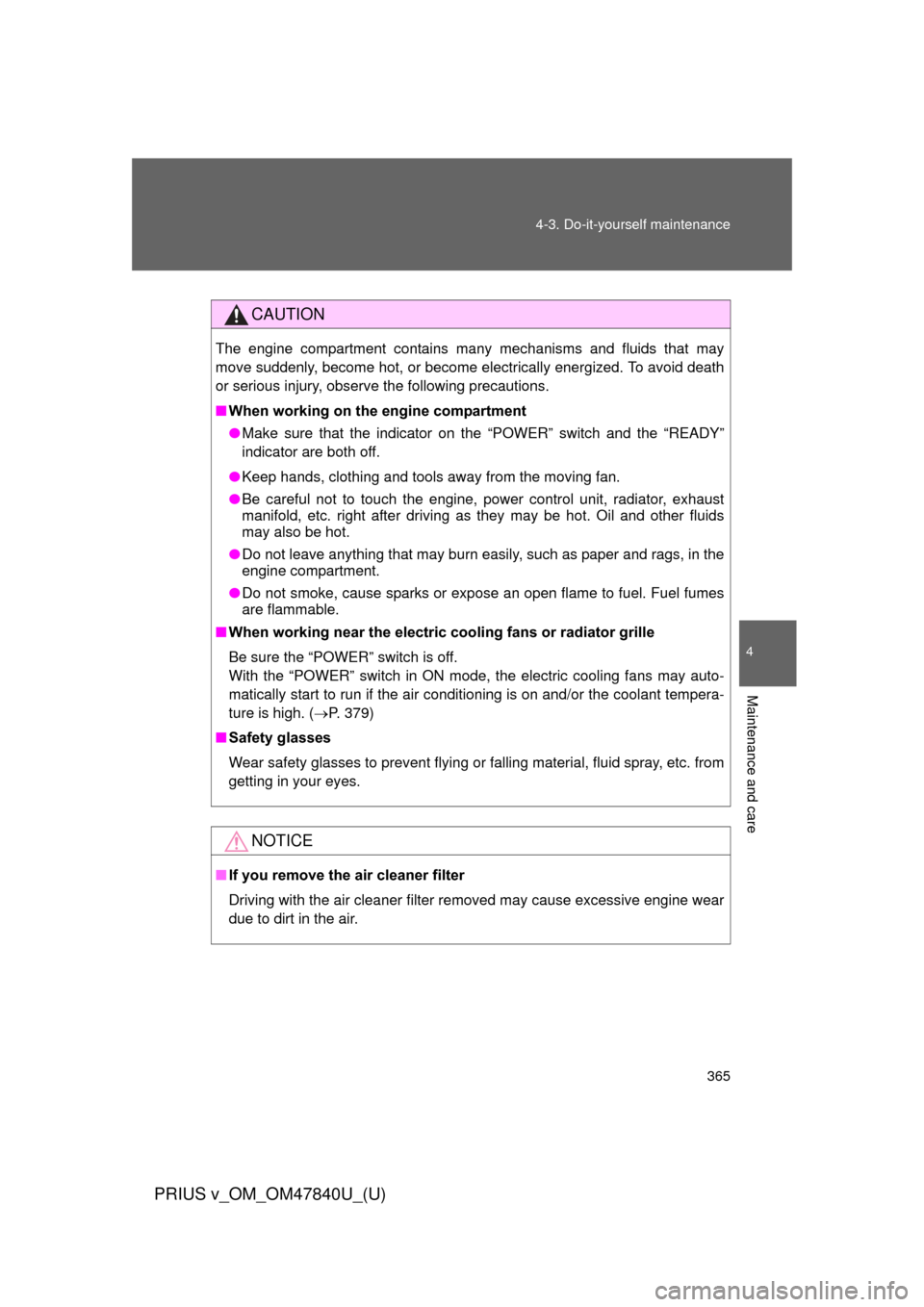
CAUTION
The engine compartment contains many mechanisms and fluids that may
move suddenly, become hot, or become electrically energized. To avoid death
or serious injury, observe the following precautions.
■
When working on the engine compartment
●Make sure that the indicator on the “POWER” switch and the “READY”
indicator are both off.
● Keep hands, clothing and tools away from the moving fan.
● Be careful not to touch the engine, power control unit, radiator, exhaust
manifold, etc. right after driving as they may be hot. Oil and other fluids
may also be hot.
● Do not leave anything that may burn easily, such as paper and rags, in the
engine compartment.
● Do not smoke, cause sparks or expose an open flame to fuel. Fuel fumes
are flammable.
■ When working near the electric c ooling fans or radiator grille
Be sure the “POWER” switch is off.
With the “POWER” switch in ON mode, the electric cooling fans may auto-
matically start to run if the air conditioning is on and/or the coolant tempera-
ture is high. ( P. 379)
■ Safety glasses
Wear safety glasses to prevent flying or falling material, fluid spray, etc. from
getting in your eyes.
NOTICE
■If you remove the air cleaner filter
Driving with the air cleaner filter removed may cause excessive engine wear
due to dirt in the air.
Page 372 of 568
372
4-3. Do-it-yourself maintenance
PRIUS v_OM_OM47840U_(U)
Engine compar tment
■12-volt battery
P. 384
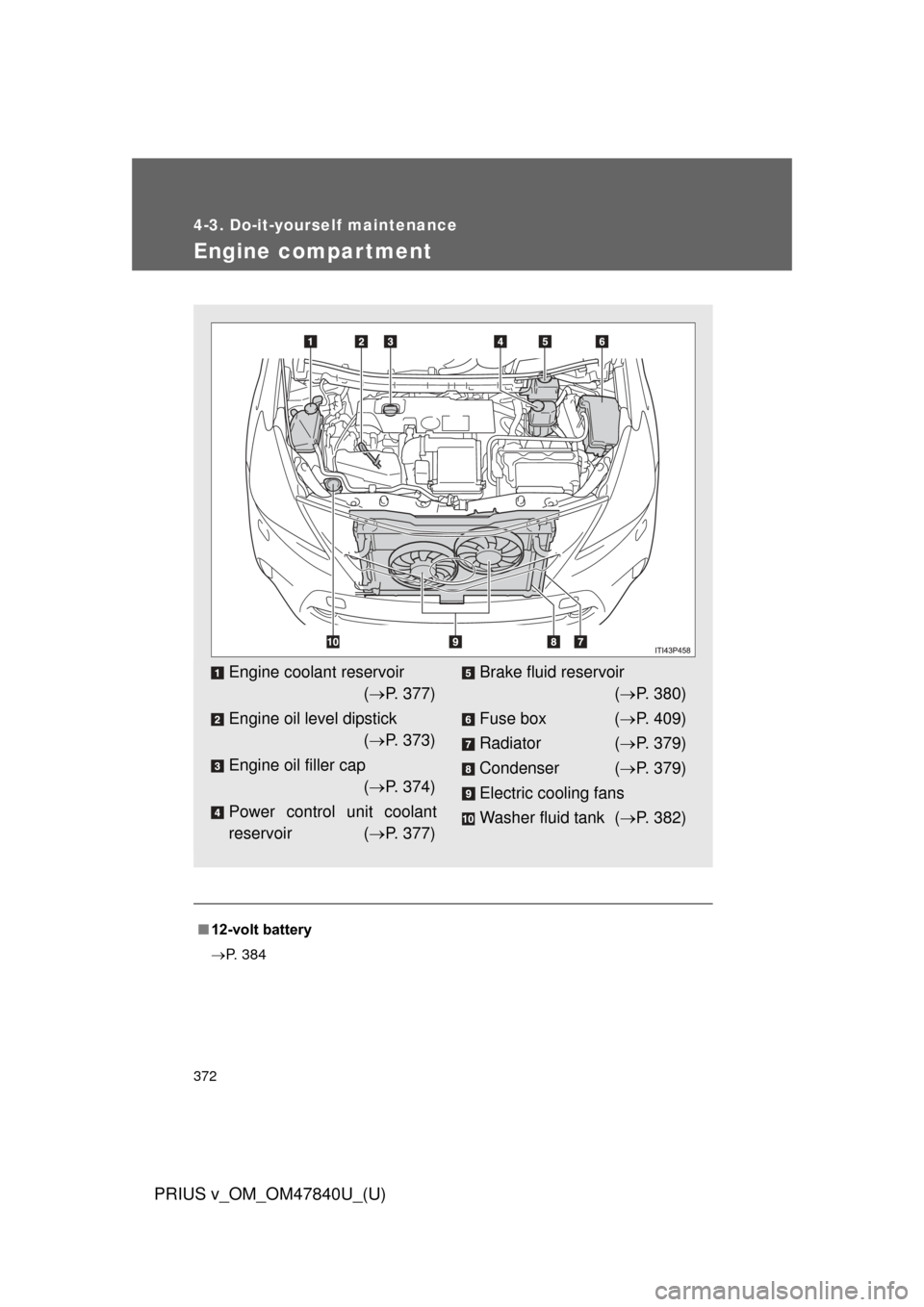
Engine coolant reservoir
( P. 377)
Engine oil level dipstick ( P. 373)
Engine oil filler cap ( P. 374)
Power control unit coolant
reservoir ( P. 377)Brake fluid reservoir
( P. 380)
Fuse box ( P. 409)
Radiator ( P. 379)
Condenser ( P. 379)
Electric cooling fans
Washer fluid tank ( P. 382)
Page 378 of 568

378 4-3. Do-it-yourself maintenance
PRIUS v_OM_OM47840U_(U)
■Coolant selection
Only use “Toyota Super Long Life Coolant” or a similar high quality ethylene
glycol based non-silicate, non-amine, non-nitrite, and non-borate coolant
with long-life hybrid organic acid technology.
U.S.A.: “Toyota Super Long Life Coolant” is a mixture of 50% cool- ant and 50% deionized water. (Minimum temperature: -31 F
[-35 C])
Canada: “Toyota Super Long Life Coolant” is a mixture of 55% cool- ant and 45% deionized water. (Minimum temperature: -44 F
[-42 C])
For more details about coolant, contact your Toyota dealer.
■ If the coolant level drops within a short time of replenishing
Visually check the radiator, hoses, engine/power control unit coolant reser-
voir caps, drain cock and water pump.
If you cannot find a leak, have your Toyota dealer test the cap and check for
leaks in the cooling system.
CAUTION
■When the hybrid system is hot
Do not remove the engine/power control unit coolant reservoir caps.
The cooling system may be under pressure and may spray hot coolant if the
cap is removed, causing serious injuries, such as burns.
Page 379 of 568

379
4-3. Do-it-yourself maintenance
PRIUS v_OM_OM47840U_(U)
4
Maintenance and care
Radiator and condenser
Check the radiator and condenser and clear away any foreign
objects.
If either of the above parts is extremely dirty or you are not sure of
their condition, have y our vehicle inspected by your Toyota dealer.
NOTICE
■When adding coolant
Coolant is neither plain water nor stra ight antifreeze. The correct mixture of
water and antifreeze must be used to provide proper lubrication, corrosion
protection and cooling. Be sure to read the antifreeze or coolant label.
■ If you spill coolant
Be sure to wash it off with water to prevent it from damaging parts or paint.
CAUTION
■When the hybrid system is hot
Do not touch the radiator or condenser as they may be hot and cause seri-
ous injuries, such as burns.
Page 487 of 568
5
When trouble arises
487
5-2. Steps to take in an emergency
PRIUS v_OM_OM47840U_(U)
If your vehicle overheats
Correction procedures■ If the high coolant temperatur e warning light comes on or
flashes
Stop the vehicle in a safe place and turn off the air condition-
ing system, and then stop the hybrid system.
If you see steam: Carefully lift the hood after the steam subsides.
If you do not see steam: Carefully lift the hood.
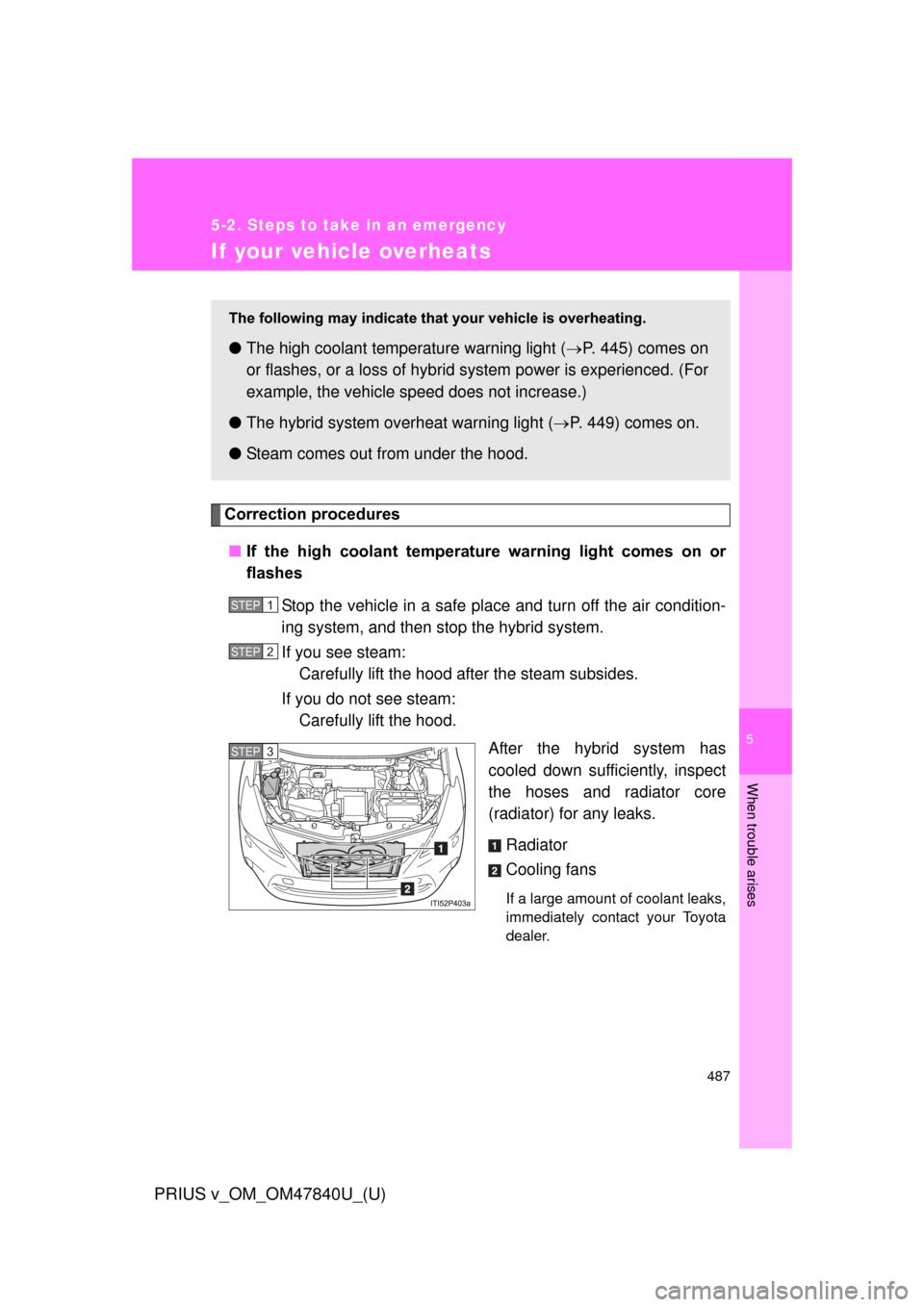
After the hybrid system has
cooled down sufficiently, inspect
the hoses and radiator core
(radiator) for any leaks.
Radiator
Cooling fans
If a large amount of coolant leaks,
immediately contact your Toyota
dealer.
The following may indicate that your vehicle is overheating.
●The high coolant temperature warning light ( P. 445) comes on
or flashes, or a loss of hybrid system power is experienced. (For
example, the vehicle s peed does not increase.)
● The hybrid system overheat warning light ( P. 449) comes on.
● Steam comes out from under the hood.
STEP 1
STEP 2
STEP 3
Page 488 of 568
488 5-2. Steps to take in an emergency
PRIUS v_OM_OM47840U_(U)
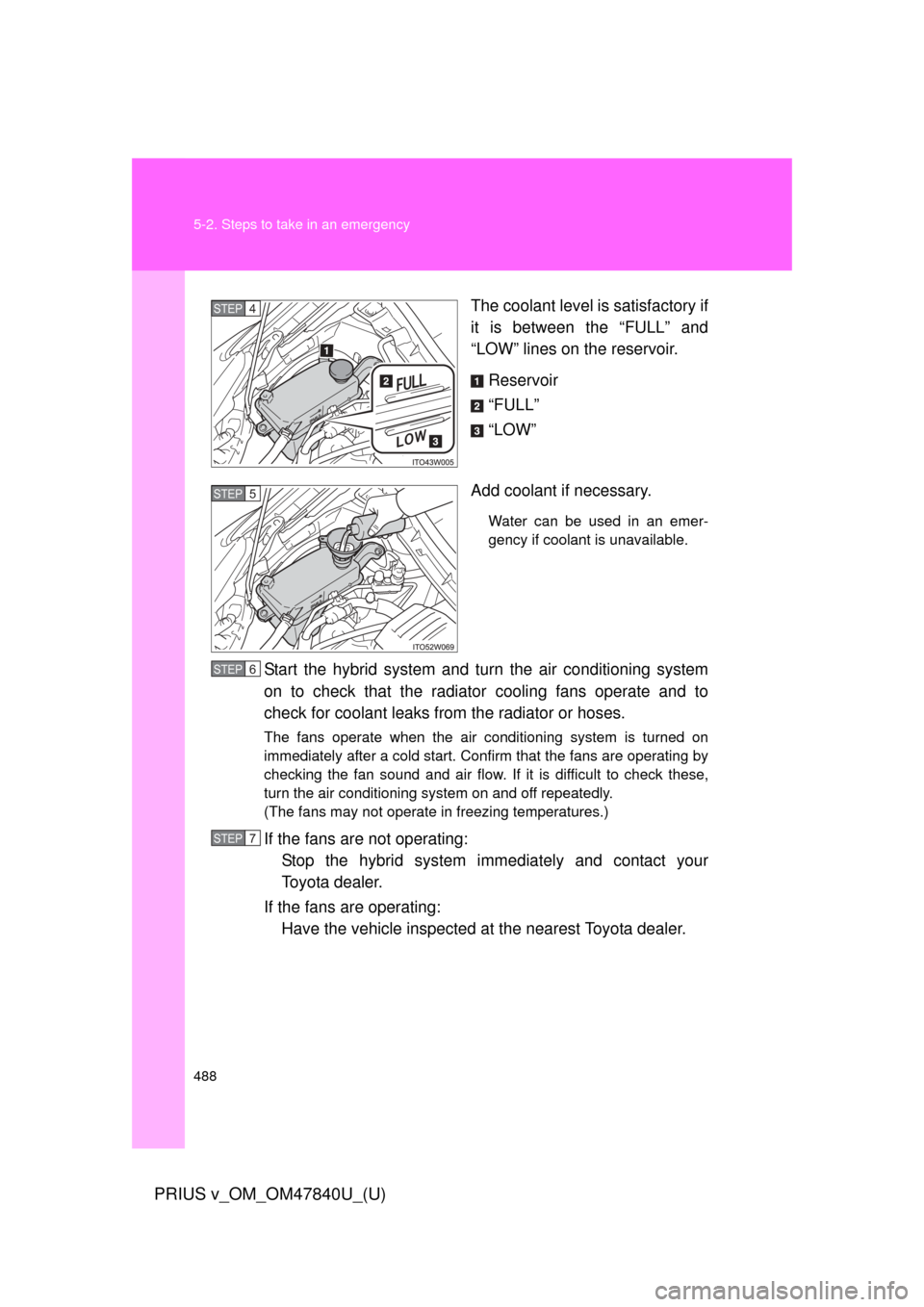
The coolant level is satisfactory if
it is between the “FULL” and
“LOW” lines on the reservoir.Reservoir
“FULL”
“LOW”
Add coolant if necessary.
Water can be used in an emer-
gency if coolant is unavailable.
Start the hybrid system and turn the air conditioning system
on to check that the radiator cooling fans operate and to
check for coolant leaks from the radiator or hoses.
The fans operate when the air conditioning system is turned on
immediately after a cold start. Confirm that the fans are operating by
checking the fan sound and air flow. If it is difficult to check these,
turn the air conditioning system on and off repeatedly.
(The fans may not operate in freezing temperatures.)
If the fans are not operating: Stop the hybrid system im mediately and contact your
Toyota dealer.
If the fans are operating: Have the vehicle inspected at the nearest Toyota dealer.
STEP 4
STEP 5
STEP 6
STEP7