belt TOYOTA PRIUS V 2018 Service Manual
[x] Cancel search | Manufacturer: TOYOTA, Model Year: 2018, Model line: PRIUS V, Model: TOYOTA PRIUS V 2018Pages: 607, PDF Size: 41.96 MB
Page 73 of 607
711-1. For safe use
PRIUS v_OM_OM47B78U_(U)
1
For safety and security
■Laws and regulations pertaining to anchors
The LATCH system conforms to FMVSS225 or CMVSS210.2.
Child restraint systems conforming to FMVSS213 or CMVSS213 specifica-
tions can be used.
This vehicle is designed to conform to the SAE J1819.
WARNING
■When installing a booster seat
To prevent the belt from going into ALR lock mode, do not fully extend the
shoulder belt. ALR mode causes the belt to tighten only. This could cause
injury or discomfort to the child. ( P. 3 6 )
■ When installing a child restraint system
Follow the directions given in the child restraint system installation manual
and fix the child restraint system securely in place.
If the child restraint system is not correctly fixed in place, the child or other
passengers may be seriously injured or even killed in the event of sudden
braking, sudden swerving or an accident.
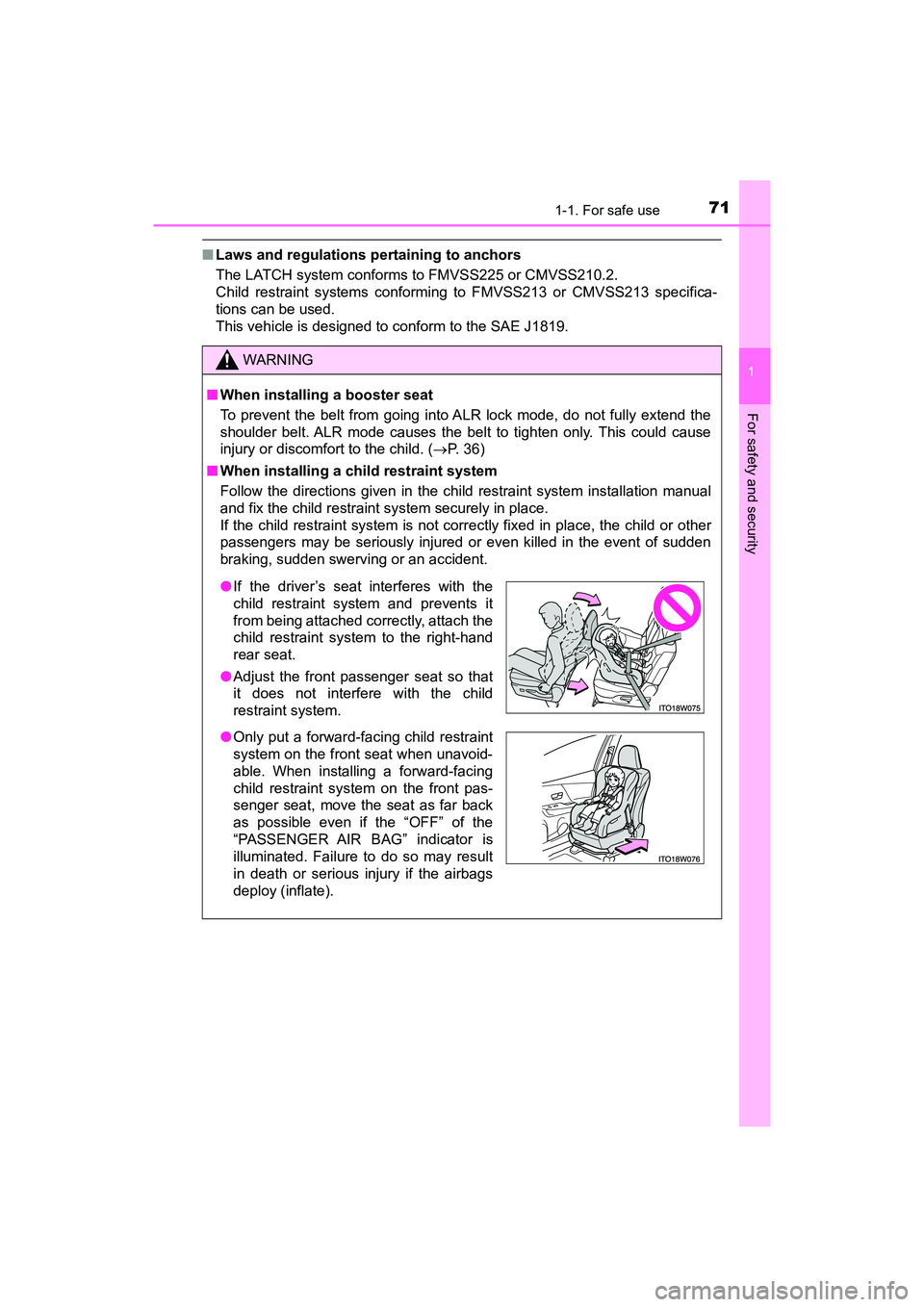
● If the driver’s seat interferes with the
child restraint system and prevents it
from being attached correctly, attach the
child restraint system to the right-hand
rear seat.
● Adjust the front passenger seat so that
it does not interfere with the child
restraint system.
● Only put a forward-facing child restraint
system on the front seat when unavoid-
able. When installing a forward-facing
child restraint system on the front pas-
senger seat, move the seat as far back
as possible even if the “OFF” of the
“PASSENGER AIR BAG” indicator is
illuminated. Failure to do so may result
in death or serious injury if the airbags
deploy (inflate).
Page 74 of 607
721-1. For safe use
PRIUS v_OM_OM47B78U_(U)
WARNING
■When installing a child restraint system
● When installing a child restraint system in the rear center seat, adjust both
seat cushions to the same position and align both seatbacks at the same
angle. The seatbacks must be adjusted to the same angle. Otherwise, the
child restraint system cannot be securely restrained and this may cause
death or serious injuries in the event of sudden braking, sudden swerving
or an accident.
● When using the LATCH system, move the seat as far back as possible
and adjust the seatback as upright as possible.
● When a booster seat is installed, always ensure that the shoulder belt is
positioned across the center of the child’s shoulder. The belt should be
kept away from the child’s neck, but not so that it could fall off the child’s
shoulder. Failing to do so may result in death or serious injury in the event
of sudden braking, sudden swerving or an accident.
● Ensure that the belt and plate are securely locked and the seat belt is not
twisted.
● Shake the child restraint system left and right, and forward and backward
to ensure that it has been securely installed.
● After securing a child restraint system, never adjust the seat.
● Follow all installation instructions provided by the child restraint system
manufacturer.
● When securing some types of child restraint systems in rear seat, it may
not be possible to properly use the seat belts in positions next to the child
restraint without interfering with it or affecting seat belt effectiveness. Be
sure your seat belt fits snugly across your shoulder and low on your hips. If
it does not, or if it interferes with the child restraint, move to a different
position. Failure to do so may result in death or serious injury.
■ Do not use a seat belt extender
If a seat belt extender is used when installing a child restraint system, the
seat belt will not securely hold the child restraint system, which could cause
death or serious injury to the child or other passengers in the event of sud-
den braking, sudden swerving or an accident.
■ To correctly attach a child restraint system to the anchors
When using the LATCH anchors, be sure that there are no foreign objects
around the anchors and that the seat belt is not caught behind the child
restraint system. Make sure the child restraint system is securely attached,
or it may cause death or serious inju ry to the child or other passengers in
the event of a sudden stop, sudden swerve or accident.
Page 89 of 607
PRIUS v_OM_OM47B78U_(U)
872. Instrument cluster
2
Instrument cluster
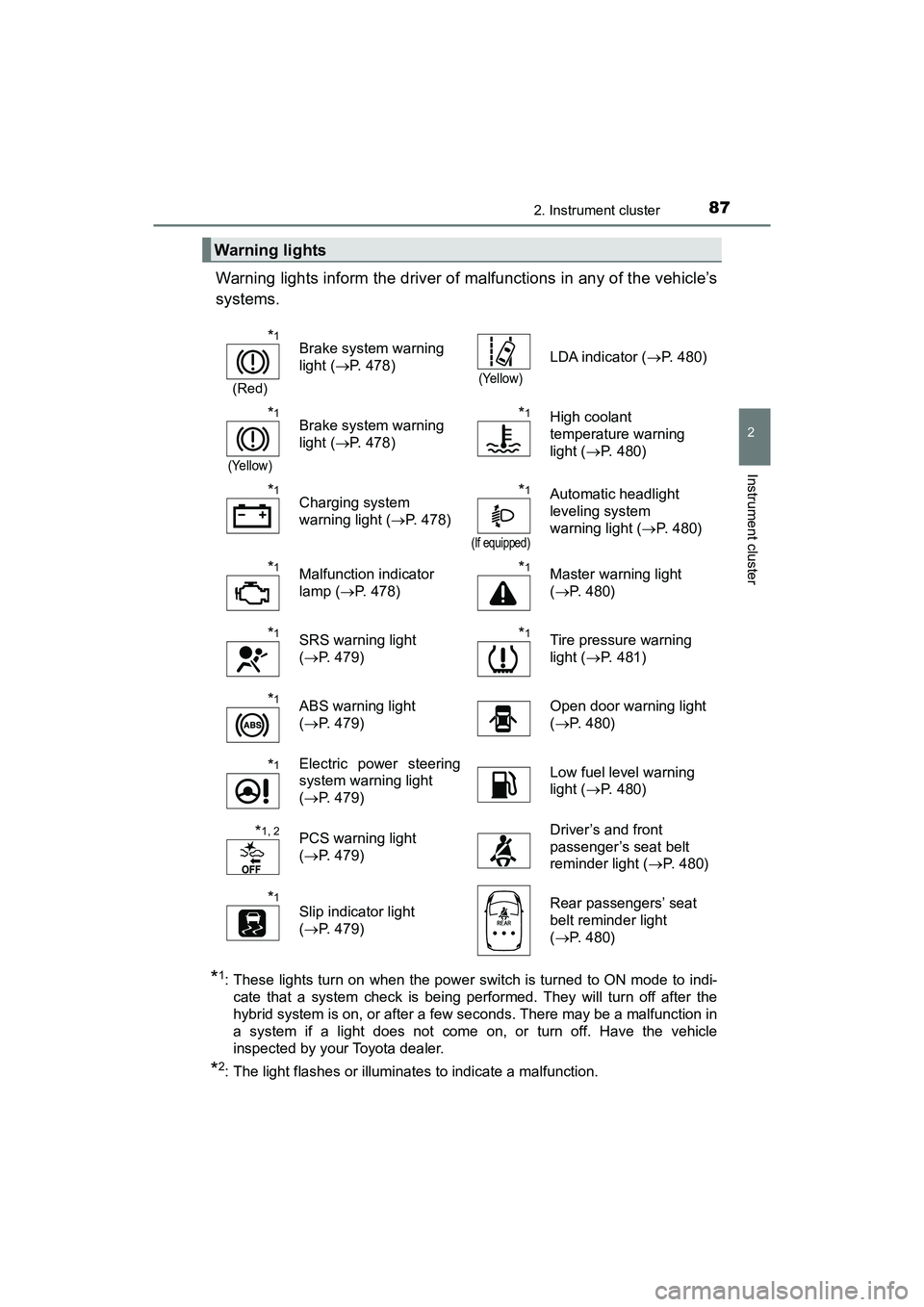
Warning lights inform the driver of malfunctions in any of the vehicle’s
systems.
*1: These lights turn on when the power switch is turned to ON mode to indi-cate that a system check is being performed. They will turn off after the
hybrid system is on, or after a few seconds. There may be a malfunction in
a system if a light does not come on, or turn off. Have the vehicle
inspected by your Toyota dealer.
*2: The light flashes or illuminates to indicate a malfunction.
Warning lights
*1
(Red)
Brake system warning
light ( P. 478)
(Yellow)
LDA indicator ( P. 480)
*1
(Yellow)
Brake system warning
light (P. 478)*1High coolant
temperature warning
light ( P. 480)
*1Charging system
warning light ( P. 478)*1
(If equipped)
Automatic headlight
leveling system
warning light ( P. 480)
*1Malfunction indicator
lamp (P. 478)*1Master warning light
(P. 480)
*1SRS warning light
(P. 479)*1Tire pressure warning
light ( P. 481)
*1ABS warning light
(P. 479) Open door warning light
(
P. 480)
*1Electric power steering
system warning light
(P. 479) Low fuel level warning
light (
P. 480)
*1, 2PCS warning light
(P. 479) Driver’s and front
passenger’s seat belt
reminder light (
P. 480)
*1Slip indicator light
(P. 479) Rear passengers’ seat
belt reminder light
(
P. 480)
Page 135 of 607
PRIUS v_OM_OM47B78U_(U)
1333-3. Adjusting the seats
3
Operation of each component
WARNING
■When adjusting the seat position
●Take care when adjusting the seat position to ensure that other passen-
gers are not injured by the moving seat.
● Do not put your hands under the seat or near the moving parts to avoid
injury.
Fingers or hands may become jammed in the seat mechanism.
■ Seat adjustment
●To reduce the risk of sliding under the lap belt during a collision, do not
recline the seat more than necessary.
If the seat is too reclined, the lap belt may slide past the hips and apply
restraint forces directly to the abdomen, or your neck may contact the
shoulder belt, increasing the risk of death or serious injury in the event of
an accident.
Adjustments should not be made while driving as the seat may unexpect-
edly move and cause the driver to lose control of the vehicle.
● Manual seats: After adjusting the seat, make sure that the seat is locked in
position.
● When returning the seats to their upright positions, be careful not to catch
the seat belts.
■ Flattening the seats
Observe the following precautions. Failure to do so may result in death or
serious injury.
●Do not flatten the seats while driving.
● In a flat place, apply the parking brake firmly and shift the shift position to
P.
● Do not flatten the seats if they are occupied.
● Be careful not to get feet or hands caught in the moving parts or joints of
the seats while flattening.
● Do not allow children to flatten the seats.
● Do not drive with passengers sitting on the flattened seatback or in the lug-
gage compartment.
● Do not drive with luggage or passengers on the flattened seats.
● Do not allow children to enter the luggage compartment.
● After flattening, gently rock the seats to ensure they are firmly in place.
● Make sure that the seat belts are not caught in the gaps between the
seats.
Page 137 of 607
135
PRIUS v_OM_OM47B78U_(U)
3-3. Adjusting the seats
3
Operation of each component
Rear seats
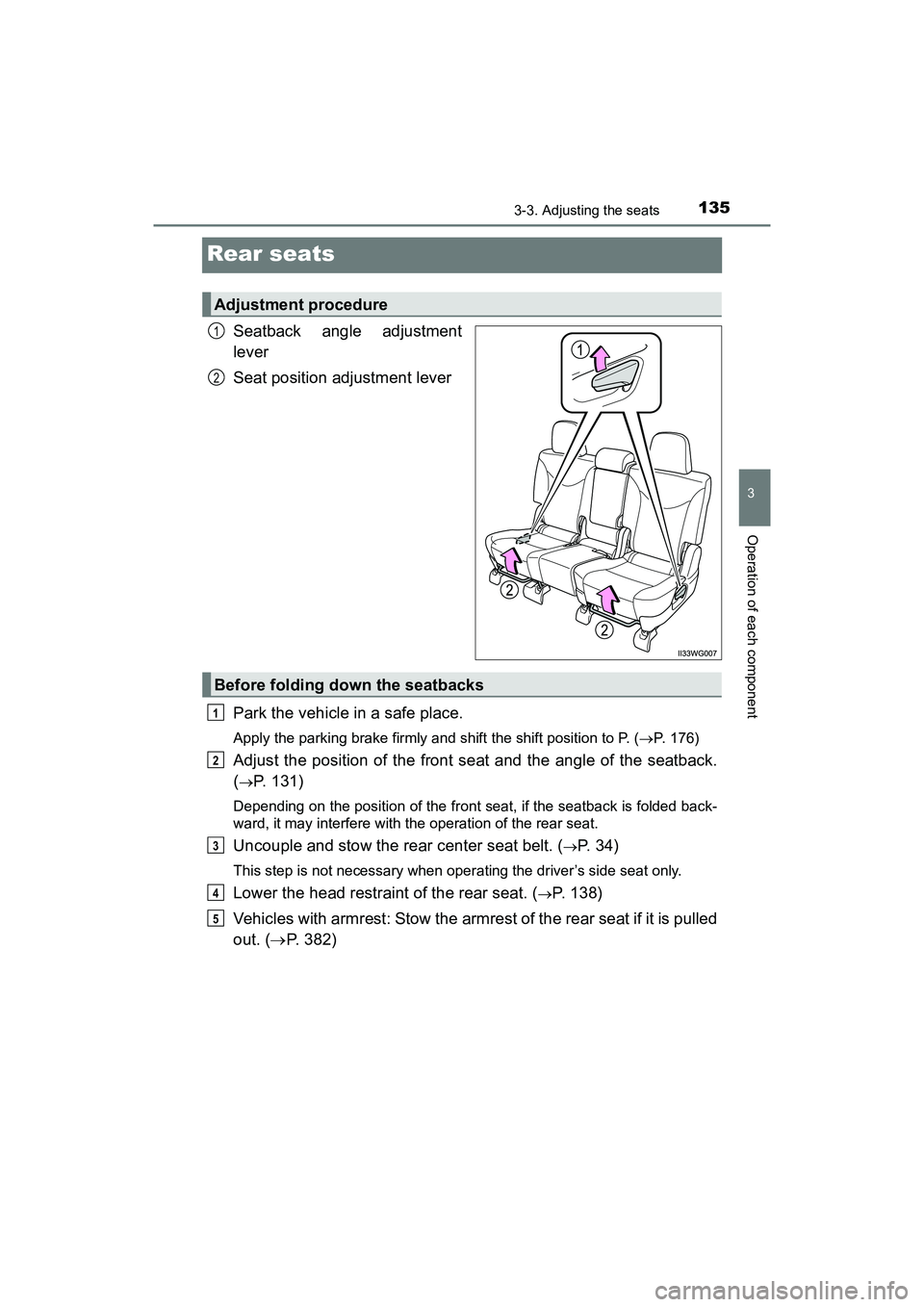
Seatback angle adjustment
lever
Seat position adjustment lever
Park the vehicle in a safe place.
Apply the parking brake firmly and shift the shift position to P. (P. 176)
Adjust the position of the front seat and the angle of the seatback.
(
P. 131)
Depending on the position of the front seat, if the seatback is folded back-
ward, it may interfere with the operation of the rear seat.
Uncouple and stow the rear center seat belt. (P. 3 4 )
This step is not necessary when operating the driver’s side seat only.
Lower the head restraint of the rear seat. (P. 138)
Vehicles with armrest: Stow the armrest of the rear seat if it is pulled
out. ( P. 382)
Adjustment procedure
1
2
Before folding down the seatbacks
1
2
3
4
5
Page 138 of 607
136
PRIUS v_OM_OM47B78U_(U)
3-3. Adjusting the seats
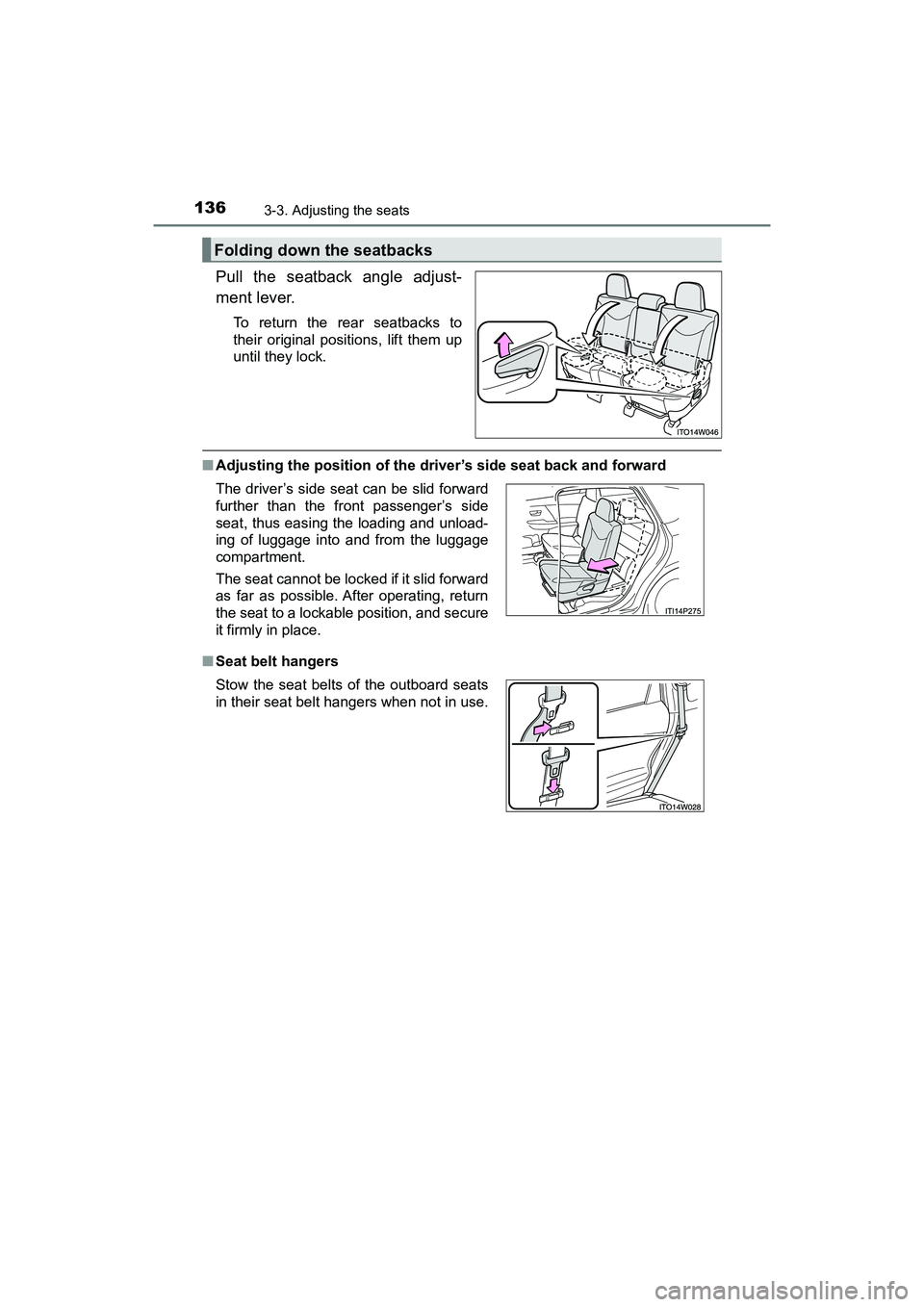
Pull the seatback angle adjust-
ment lever.
To return the rear seatbacks to
their original positions, lift them up
until they lock.
■Adjusting the position of the driver’s side seat back and forward
■ Seat belt hangers
Folding down the seatbacks
The driver’s side seat can be slid forward
further than the front passenger’s side
seat, thus easing the loading and unload-
ing of luggage into and from the luggage
compartment.
The seat cannot be locked if it slid forward
as far as possible. After operating, return
the seat to a lockable position, and secure
it firmly in place.
Stow the seat belts of the outboard seats
in their seat belt hangers when not in use.
Page 139 of 607
PRIUS v_OM_OM47B78U_(U)
1373-3. Adjusting the seats
3
Operation of each component
WARNING
■When folding the seatbacks down
Observe the following precautions. Failure to do so may result in death or
serious injury.
●Do not fold the seatbacks down while driving.
● Stop the vehicle on level ground, apply the parking brake firmly and shift
the shift position to P.
● Do not allow anyone to sit on a folded seatback or in the luggage compart-
ment while driving.
● Do not allow children to enter the luggage compartment.
● Do not operate the rear seat if it is occupied.
● Be careful not to get feet or hands caught in the moving parts or joints of
the seats during operation.
● Do not allow children to operate the seat.
● After operation, rock the seat gently to ensure that it is firmly in place.
■ Reclining adjustment
●To reduce the risk of sliding under the lap belt during a collision, do not
recline the seat more than necessary.
If the seat is too reclined, the lap belt may slide past the hips and apply
restraint forces directly to the abdomen, or your neck may contact the
shoulder belt, increasing the risk of death or serious injury in the event of
an accident.
Adjustments should not be made while driving as the seat may unexpect-
edly move and cause the driver to lose control of the vehicle.
● After adjusting the seat, make sure that the seat is locked in position.
■ After returning the seatback to the upright position
Observe the following precautions. Failure to do so may result in death or
serious injury.
●Make sure that the seatback is securely locked in position by lightly push-
ing it back and forth.
● Check that the seat belts are not twisted or caught in the seatback.
● Re-couple the rear center seat belt if it has been uncoupled. ( P. 33)
● If the seat belt has been stowed using the seat belt hanger, check that the
seat belt has been removed from the hanger. ( P. 136)
Page 165 of 607
PRIUS v_OM_OM47B78U_(U)
1634-1. Before driving
4
Driving
WARNING
■Things that must not be carried in the luggage compartment
The following things may cause a fire if loaded in the luggage compart-
ment:
●Receptacles containing gasoline
●Aerosol cans
■Storage precautions
Observe the following precautions.
Failure to do so may prevent the pedals from being depressed properly,
may block the driver’s vision, or may result in items hitting the driver or
passengers, possibly causing an accident.
●Stow cargo and luggage in the luggage compartment whenever possi-
ble.
●Do not stack cargo and luggage in the luggage compartment higher
than the seatbacks.
●When you fold down the rear seats, long items should not be placed
directly behind the front seats.
●Never allow anyone to ride in the luggage compartment. It is not
designed for passengers. They should ride in their seats with their seat
belts properly fastened.
●Do not place cargo or luggage in or on the following locations.
• At the feet of the driver
• On the front passenger or rear seats (when stacking items)
• On the luggage cover
• On the instrument panel
• On the dashboard
●Secure all items in the occupant compartment.
■Capacity and distribution
●Do not exceed the maximum axle weight rating or the total vehicle
weight rating.
●Even if the total load of occupant’s weight and the cargo load is less
than the total load capacity, do not apply the load unevenly. Improper
loading may cause deterioration of steering or braking control which
may cause death or serious injury.
Page 401 of 607
PRIUS v_OM_OM47B78U_(U)
3997-1. Maintenance and care
7
Maintenance and care
●Remove dirt and dust using a vacuum cleaner.
● Wipe it off with a soft cloth dampened with neutral detergent diluted
to approximately 1%.
● Wring out any excess water from the cloth and thoroughly wipe off
remaining traces of detergent and water.
■Caring for leather areas
Toyota recommends cleaning the interior of the vehicle at least twice a year to
maintain the quality of the vehicle’s interior.
■ Shampooing the carpets
There are several commercial foaming-type cleaners available. Use a sponge
or brush to apply the foam. Rub in overlapping circles. Do not use water.
Wipe dirty surfaces and let them dry. Excellent results are obtained by keep-
ing the carpet as dry as possible.
■ Seat belts
Clean with mild soap and lukewarm water using a cloth or sponge. Also
check the belts periodically for excessive wear, fraying or cuts.
Cleaning the synthetic leather areas
WARNING
■Water in the vehicle
●Do not splash or spill liquid in the vehicle, such as on the floor, in the
hybrid battery (traction battery) air intake vent, and in the luggage com-
partment.
Doing so may cause the hybrid battery (traction battery), electrical compo-
nents, etc. to malfunction or catch fire.
● Do not get any of the SRS components or wiring in the vehicle interior wet.
(P. 4 3 )
An electrical malfunction may cause the airbags to deploy or not function
properly, resulting in death or serious injury.
■ Cleaning the interior (especially instrument panel)
Do not use polish wax or polish cleaner . The instrument panel may reflect
off the windshield, obstructing the driver’s view and leading to an accident,
resulting in death or serious injury.
Page 406 of 607
404
PRIUS v_OM_OM47B78U_(U)
7-2. Maintenance
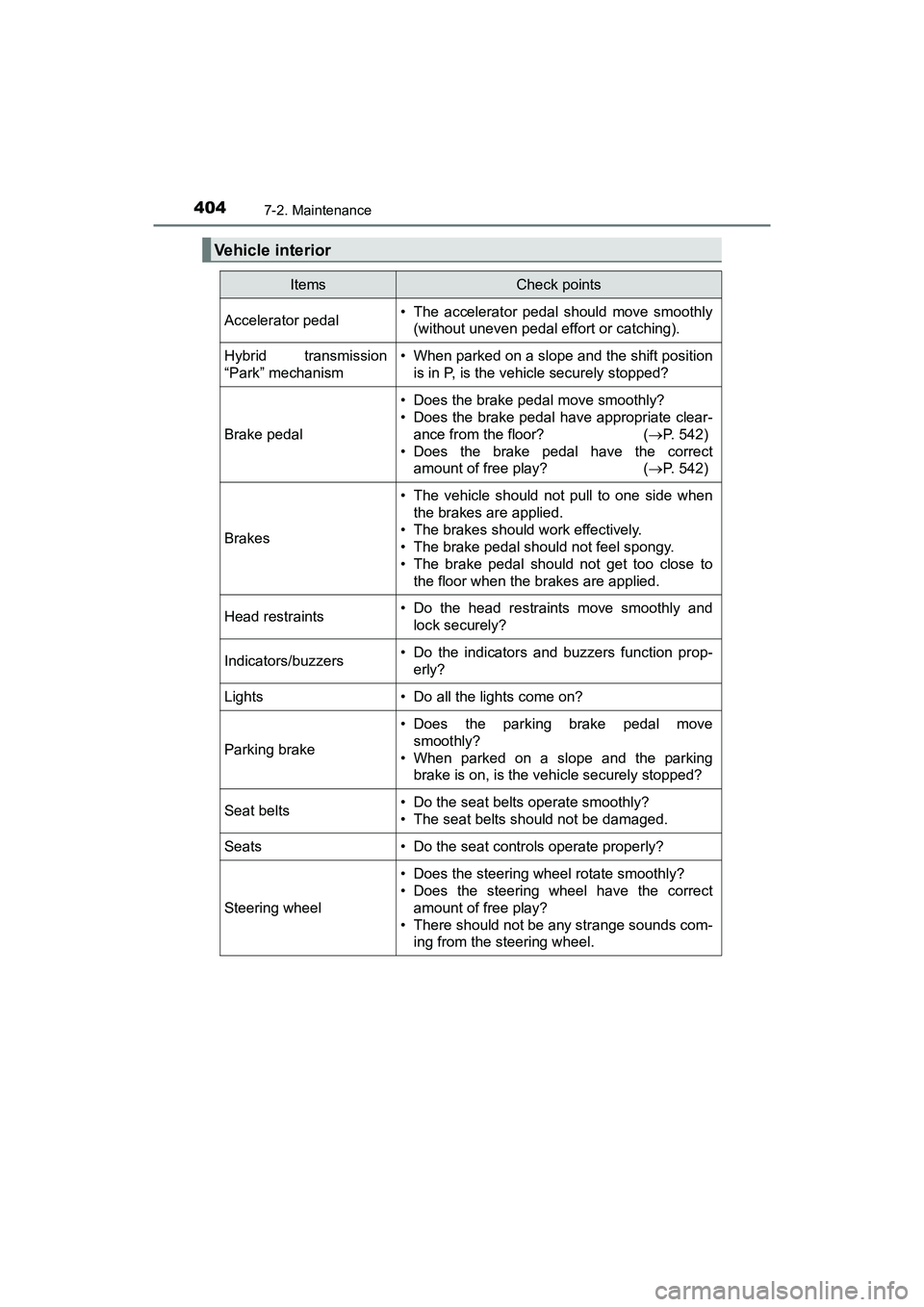
Vehicle interior
ItemsCheck points
Accelerator pedal• The accelerator pedal should move smoothly(without uneven pedal effort or catching).
Hybrid transmission
“Park” mechanism• When parked on a slope and the shift position
is in P, is the vehicle securely stopped?
Brake pedal
• Does the brake pedal move smoothly?
• Does the brake pedal have appropriate clear-ance from the floor? ( P. 542)
• Does the brake pedal have the correct amount of free play? ( P. 542)
Brakes
• The vehicle should not pull to one side when
the brakes are applied.
• The brakes should work effectively.
• The brake pedal should not feel spongy.
• The brake pedal should not get too close to the floor when the brakes are applied.
Head restraints• Do the head restraints move smoothly andlock securely?
Indicators/buzzers• Do the indicators and buzzers function prop-erly?
Lights• Do all the lights come on?
Parking brake
• Does the parking brake pedal movesmoothly?
• When parked on a slope and the parking brake is on, is the vehicle securely stopped?
Seat belts• Do the seat belts operate smoothly?
• The seat belts should not be damaged.
Seats• Do the seat controls operate properly?
Steering wheel
• Does the steering wheel rotate smoothly?
• Does the steering wheel have the correct
amount of free play?
• There should not be any strange sounds com- ing from the steering wheel.