fuel cap TOYOTA PRIUS V 2018 Owners Manual
[x] Cancel search | Manufacturer: TOYOTA, Model Year: 2018, Model line: PRIUS V, Model: TOYOTA PRIUS V 2018Pages: 607, PDF Size: 41.96 MB
Page 5 of 607

3
1
9 8
7
6 4 3
2
PRIUS v_OM_OM47B78U_(U)
10
5
3-4. Adjusting the steering wheel and mirrors
Steering wheel .................. 140
Inside rear view mirror....... 142
Outside rear view mirrors ............................. 144
3-5. Opening and closing the windows
Power windows ................. 146
4-1. Before driving Driving the vehicle ............. 150
Cargo and luggage............ 161
Vehicle load limits ............. 165
Trailer towing..................... 166
Dinghy towing.................... 167
4-2. Driving procedures Power (ignition) switch ...... 168
EV drive mode................... 173
Hybrid transmission........... 175
Turn signal lever................ 180
Parking brake .................... 181 4-3. Operating the lights
and wipers
Headlight switch ................ 182
Automatic High Beam ........ 185
Fog light switch .................. 191
Windshield wipers and washer ............................. 192
Rear window wiper and washer ............................. 194
4-4. Refueling Opening the fuel tank cap................................... 195
4-5. Using the driving support systems
Toyota Safety Sense P ...... 198
PCS (Pre-Collision System) ........................... 205
LDA (Lane Departure Alert with steering control) ....... 217
Dynamic radar cruise control.............................. 227
Rear view monitor system ............................. 241
Driving mode select switch .............................. 251
Driving assist systems ....... 252
4-6. Driving tips Hybrid vehicle driving tips ................................... 259
Winter driving tips .............. 262
4Driving
Page 19 of 607
17Pictorial index
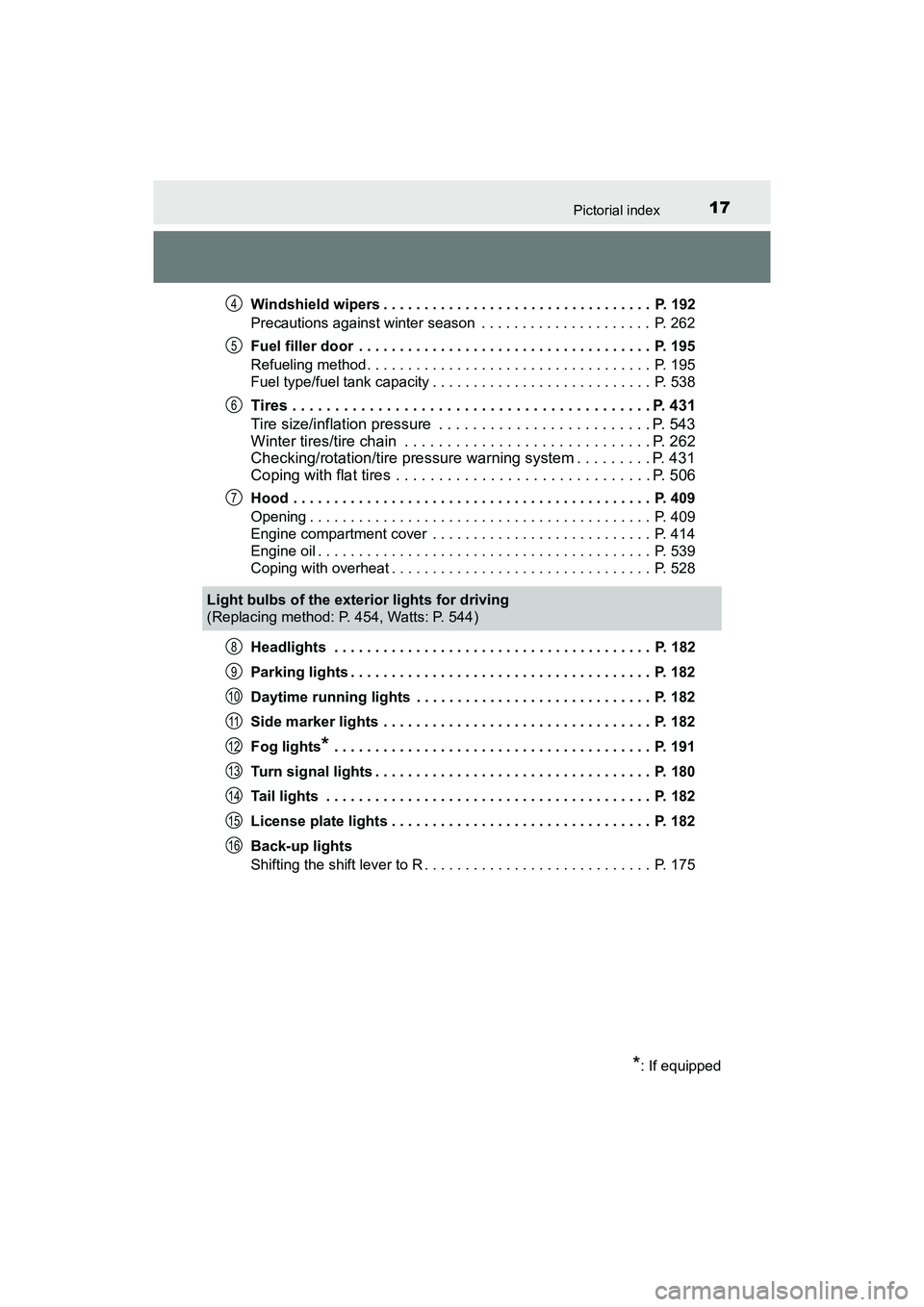
PRIUS v_OM_OM47B78U_(U)Windshield wipers . . . . . . . . . . . . . . . . . . . . . . . . . . . . . . . . . P. 192
Precautions against winter season . . . . . . . . . . . . . . . . . . . . . P. 262
Fuel filler door . . . . . . . . . . . . . . . . . . . . . . . . . . . . . . . . . . . . P. 195
Refueling method . . . . . . . . . . . . . . . . . . . . . . . . . . . . . . . . . . . P. 195
Fuel type/fuel tank capacity . . . . . . . . . . . . . . . . . . . . . . . . . . . P. 538
Tires . . . . . . . . . . . . . . . . . . . . . . . . . . . . . . . . . . . . . . . . . . P. 431
Tire size/inflation pressure . . . . . . . . . . . . . . . . . . . . . . . . . P. 543
Winter tires/tire chain . . . . . . . . . . . . . . . . . . . . . . . . . . . . . P. 262
Checking/rotation/tire pressure warning system . . . . . . . . . P. 431
Coping with flat tires . . . . . . . . . . . . . . . . . . . . . . . . . . . . . . P. 506
Hood . . . . . . . . . . . . . . . . . . . . . . . . . . . . . . . . . . . .\
. . . . . . . . P. 409
Opening . . . . . . . . . . . . . . . . . . . . . . . . . . . . . . . . . . . . . . . . . . P. 409
Engine compartment cover . . . . . . . . . . . . . . . . . . . . . . . . . . . P. 414
Engine oil . . . . . . . . . . . . . . . . . . . . . . . . . . . . . . . . . . . . . . . . . P. 539
Coping with overheat . . . . . . . . . . . . . . . . . . . . . . . . . . . . . . . . P. 528
Headlights . . . . . . . . . . . . . . . . . . . . . . . . . . . . . . . . . . . . . . . P. 182
Parking lights . . . . . . . . . . . . . . . . . . . . . . . . . . . . . . . . . . . . . P. 182
Daytime running lights . . . . . . . . . . . . . . . . . . . . . . . . . . . . . P. 182
Side marker lights . . . . . . . . . . . . . . . . . . . . . . . . . . . . . . . . . P. 182
Fog lights
* . . . . . . . . . . . . . . . . . . . . . . . . . . . . . . . . . . . . . . . P. 191
Turn signal lights . . . . . . . . . . . . . . . . . . . . . . . . . . . . . . . . . . P. 180
Tail lights . . . . . . . . . . . . . . . . . . . . . . . . . . . . . . . . . . . . . . . . P. 182
License plate lights . . . . . . . . . . . . . . . . . . . . . . . . . . . . . . . . P. 182
Back-up lights
Shifting the shift lever to R . . . . . . . . . . . . . . . . . . . . . . . . . . . . P. 175
4
5
6
7
Light bulbs of the exterior lights for driving
(Replacing method: P. 454, Watts: P. 544)
*: If equipped
8
9
10
11
12
13
14
15
16
Page 151 of 607

149
PRIUS v_OM_OM47B78U_(U)
4Driving
4-1. Before drivingDriving the vehicle ............. 150
Cargo and luggage ........... 161
Vehicle load limits ............. 165
Trailer towing..................... 166
Dinghy towing ................... 167
4-2. Driving procedures Power (ignition) switch ...... 168
EV drive mode .................. 173
Hybrid transmission........... 175
Turn signal lever................ 180
Parking brake .................... 181 4-3. Operating the lights
and wipers
Headlight switch ................ 182
Automatic High Beam ....... 185
Fog light switch ................. 191
Windshield wipers and washer ............................ 192
Rear window wiper and washer ............................ 194
4-4. Refueling Opening the fuel tank cap .................................. 195
4-5. Using the driving support systems
Toyota Safety Sense P ..... 198
PCS (Pre-Collision System) ........................... 205
LDA (Lane Departure Alert with steering control) ....... 217
Dynamic radar cruise control ............................. 227
Rear view monitor system ............................ 241
Driving mode select switch .............................. 251
Driving assist systems ...... 252
4-6. Driving tips Hybrid vehicle driving tips .................................. 259
Winter driving tips ............. 262
Page 153 of 607
PRIUS v_OM_OM47B78U_(U)
1514-1. Before driving
4
Driving
Firmly set the parking brake with the brake pedal depressed, and
then shift the shift position to D.
Release the brake pedal and gently depress the accelerator pedal.
Release the parking brake.
■When starting off on a uphill
The hill-start assist control will activate. ( P. 253)
■ For fuel-efficient driving
Keep in mind that hybrid vehicles are similar to conventional vehicles, and it
is necessary to refrain from activities such as sudden acceleration. ( P. 259)
■ Driving in the rain
●Drive carefully when it is raining, because visibility will be reduced, the win-
dows may become fogged-up, and the road will be slippery.
● Drive carefully when it starts to rain, because the road surface will be espe-
cially slippery.
● Refrain from high speeds when driving on an expressway in the rain,
because there may be a layer of water between the tires and the road sur-
face, preventing the steering and brakes from operating properly.
■ Restraining the hybrid system ou tput (Brake Override System)
● When the accelerator and brake pedals are depressed at the same time, the
hybrid system output may be restrained.
● A warning message is displayed on the multi-information display while the
system is operating. ( P. 492)
■ Restraining sudden start (Drive-Start Control)
●When the following unusual operation is performed, the hybrid system out-
put may be restrained.
• When the shift position is shifted from R to D/B, D/B to R, N to R, P to D/
B, P to R with the accelerator pedal depressed, a warning message
appears on the multi-information display. ( P. 489)
• When the accelerator pedal is depressed too much while the vehicle is in reverse.
● While Drive-Start Control is being activated, your vehicle may have trou-
ble escaping from the mud or fresh snow. In such case, deactivate TRAC
( P. 254) to cancel Drive Start Control so that the vehicle may become
able to escape from the mud or fresh snow.
■ Breaking in your new Toyota
To extend the life of the vehicle, observing the following precautions is recom-
mended:
●For the first 200 miles (300 km):
Avoid sudden stops.
● For the first 1000 miles (1600 km):
Starting off on a uphill
1
2
3
Page 197 of 607
195
PRIUS v_OM_OM47B78U_(U)
4-4. Refueling
4
Driving
Opening the fuel tank cap
●Turn the power switch off and ensure that all the door and windows
are closed.
● Confirm the type of fuel. ( P. 545)
■Fuel types
P. 545
■ Fuel tank opening for unleaded gasoline
To help prevent incorrect fueling, your vehicle has a fuel tank opening that
only accommodates the special nozzle on unleaded fuel pumps.
Perform the following steps to open the fuel tank cap.
Before refueling the vehicle
WARNING
■When refueling the vehicle
Observe the following precautions while refueling the vehicle. Failure to do
so may result in death or serious injury.
●After exiting the vehicle and before opening the fuel door, touch an
unpainted metal surface to discharge any static electricity. It is important to
discharge static electricity before refueling because sparks resulting from
static electricity can cause fuel vapors to ignite while refueling.
● Always hold the grips on the fuel tank cap and turn it slowly to remove it.
A whooshing sound may be heard when the fuel tank cap is loosened.
Wait until the sound cannot be heard before fully removing the cap. In hot
weather, pressurized fuel may spray out of the filler neck and cause injury.
● Do not allow anyone that has not discharged static electricity from their
body to come close to an open fuel tank.
● Do not inhale vaporized fuel.
Fuel contains substances that are harmful if inhaled.
● Do not smoke while refueling the vehicle.
Doing so may cause the fuel to ignite and cause a fire.
● Do not return to the vehicle or touch any person or object that is statically
charged.
This may cause static electricity to build up, resulting in a possible ignition
hazard.
Page 198 of 607
196
PRIUS v_OM_OM47B78U_(U)
4-4. Refueling
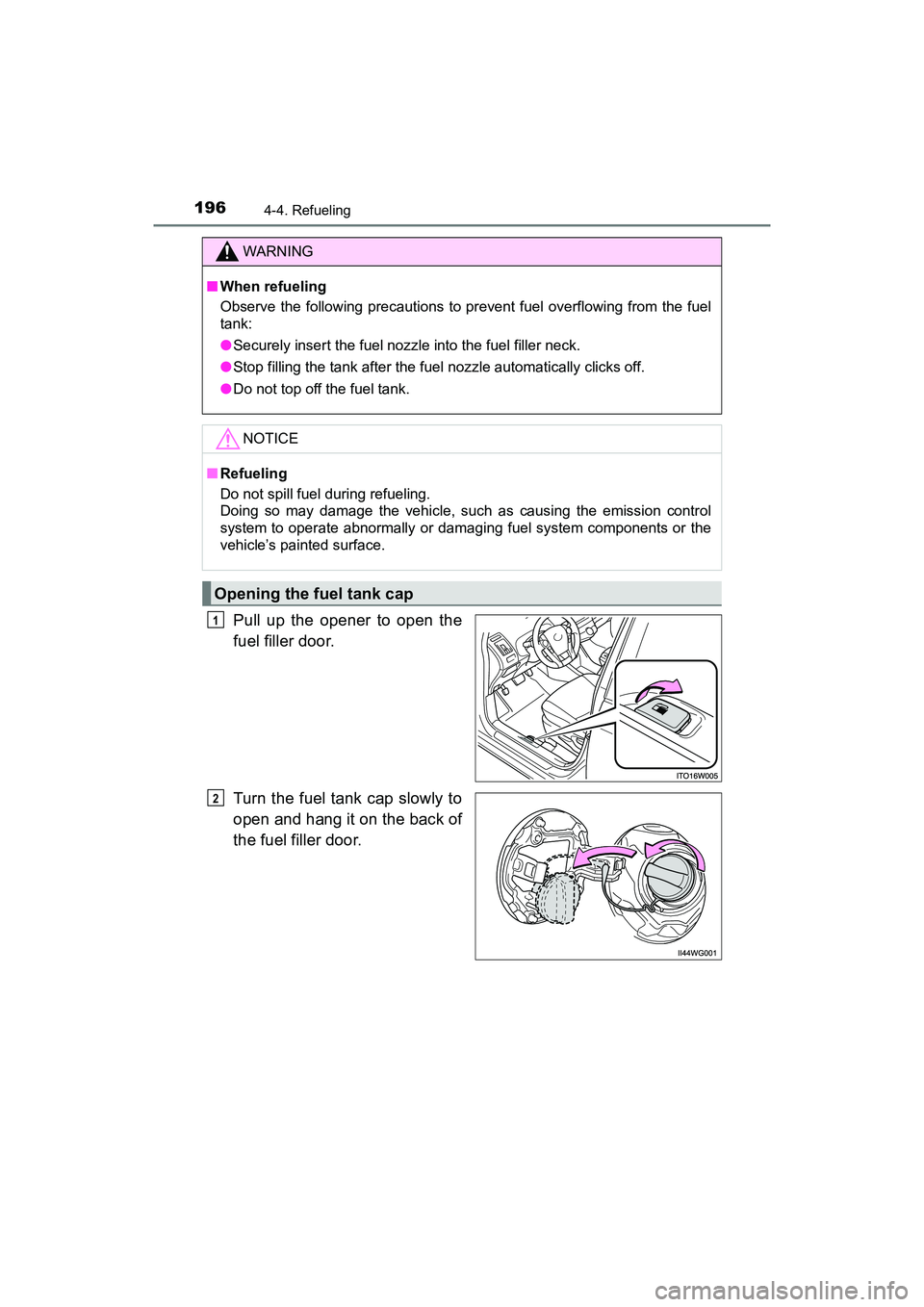
Pull up the opener to open the
fuel filler door.
Turn the fuel tank cap slowly to
open and hang it on the back of
the fuel filler door.
WARNING
■When refueling
Observe the following precautions to prevent fuel overflowing from the fuel
tank:
●Securely insert the fuel nozzle into the fuel filler neck.
● Stop filling the tank after the fuel nozzle automatically clicks off.
● Do not top off the fuel tank.
NOTICE
■Refueling
Do not spill fuel during refueling.
Doing so may damage the vehicle, such as causing the emission control
system to operate abnormally or damaging fuel system components or the
vehicle’s painted surface.
Opening the fuel tank cap
1
2
Page 199 of 607
PRIUS v_OM_OM47B78U_(U)
1974-4. Refueling
4
Driving
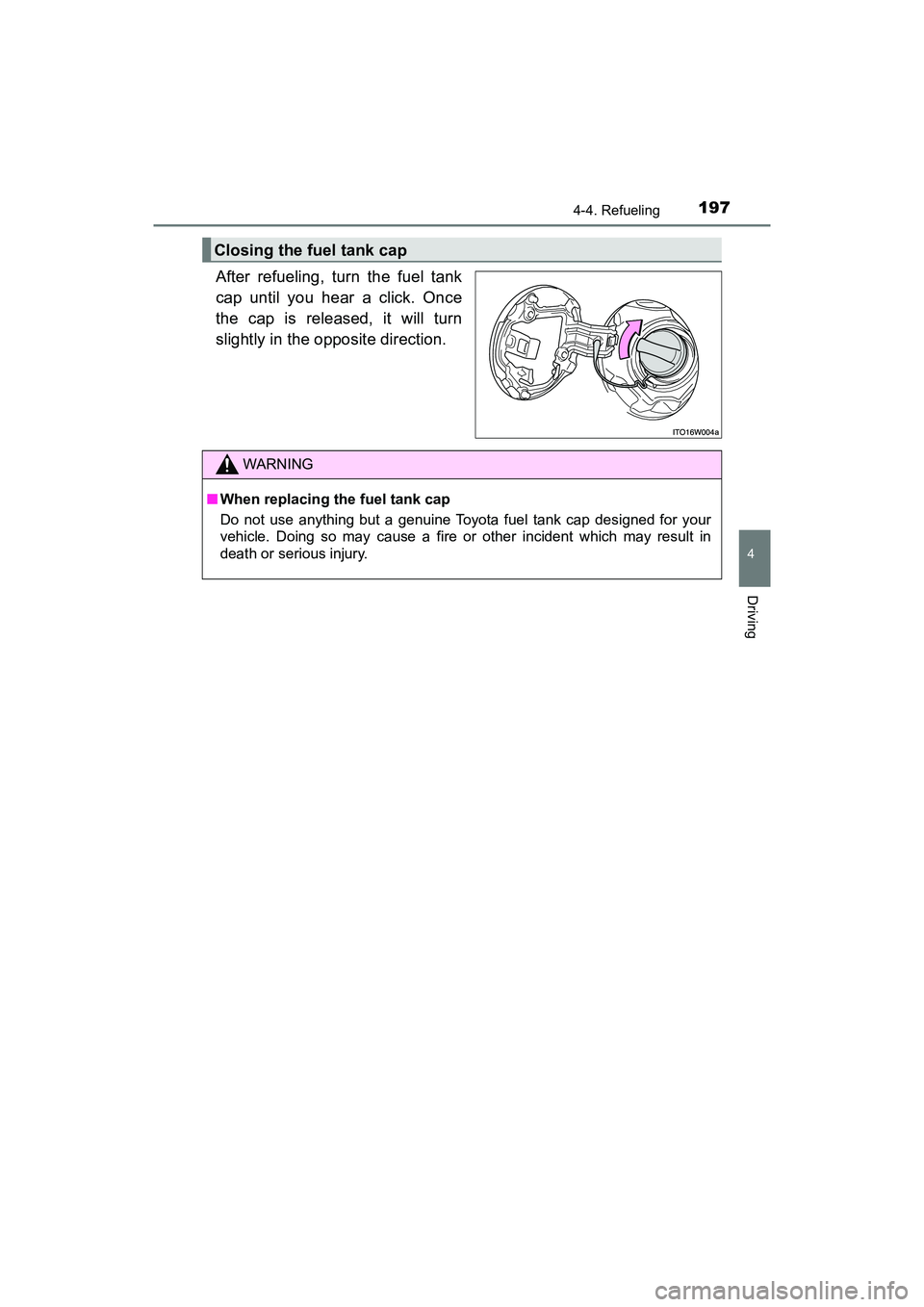
After refueling, turn the fuel tank
cap until you hear a click. Once
the cap is released, it will turn
slightly in the opposite direction.
Closing the fuel tank cap
WARNING
■When replacing the fuel tank cap
Do not use anything but a genuine Toyota fuel tank cap designed for your
vehicle. Doing so may cause a fire or other incident which may result in
death or serious injury.
Page 279 of 607
277
PRIUS v_OM_OM47B78U_(U)
5-2. Setup
5
Audio system
General settings
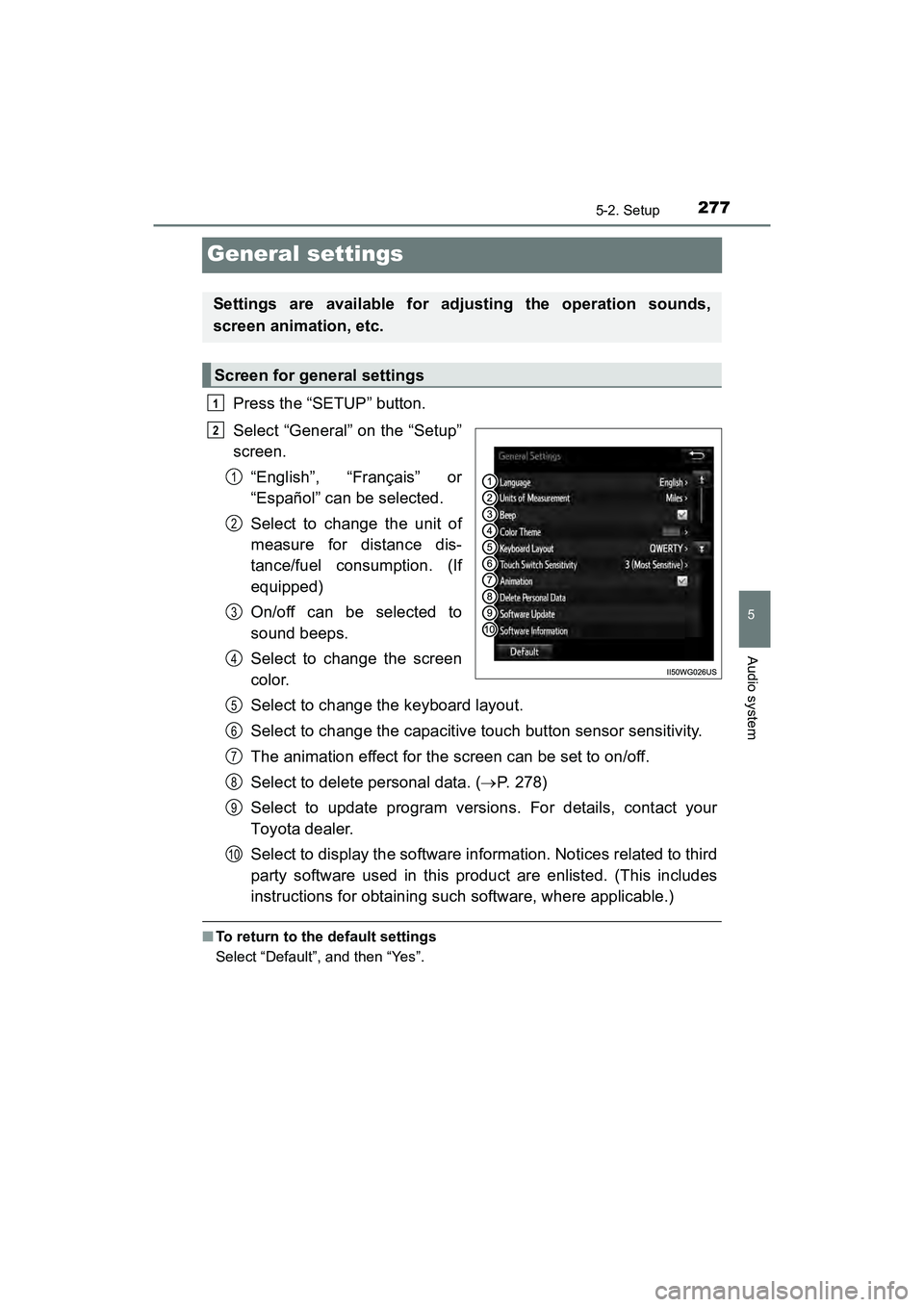
Press the “SETUP” button.
Select “General” on the “Setup”
screen.“English”, “Français” or
“Español” can be selected.
Select to change the unit of
measure for distance dis-
tance/fuel consumption. (If
equipped)
On/off can be selected to
sound beeps.
Select to change the screen
color.
Select to change the keyboard layout.
Select to change the capacitive touch button sensor sensitivity.
The animation effect for the screen can be set to on/off.
Select to delete personal data. ( P. 278)
Select to update program versions. For details, contact your
Toyota dealer.
Select to display the software information. Notices related to third
party software used in this product are enlisted. (This includes
instructions for obtaining such software, where applicable.)
■ To return to the default settings
Select “Default”, and then “Yes”.
Settings are available for adjusting the operation sounds,
screen animation, etc.
Screen for general settings
1
2
1
2
3
4
5
6
7
8
9
10
Page 367 of 607
PRIUS v_OM_OM47B78U_(U)
3656-1. Using the air conditioning system and defogger
6
Interior features
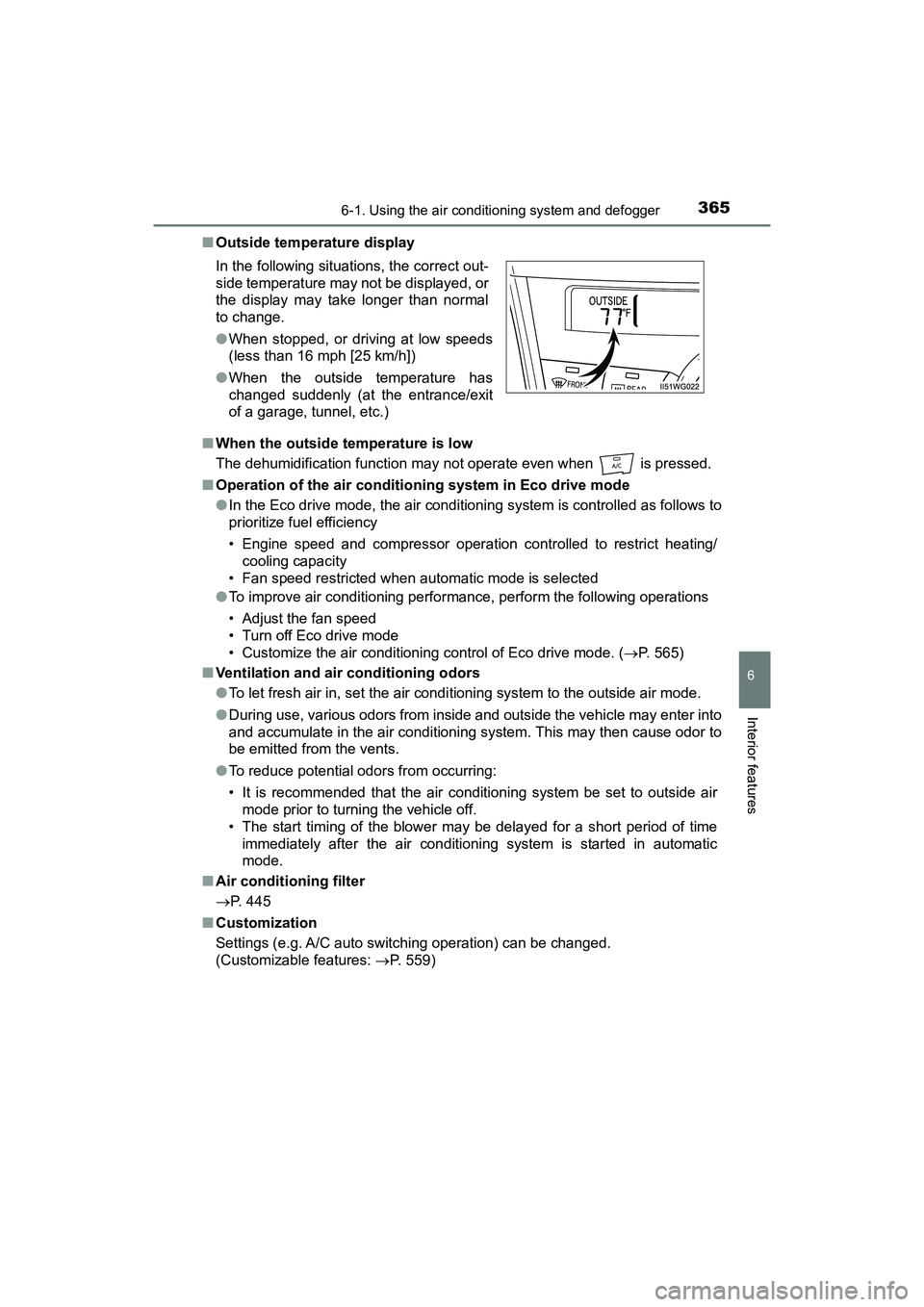
■Outside temperature display
■ When the outside temperature is low
The dehumidification function may not operate even when is pressed.
■ Operation of the air conditio ning system in Eco drive mode
● In the Eco drive mode, the air conditioning system is controlled as follows to
prioritize fuel efficiency
• Engine speed and compressor operation controlled to restrict heating/
cooling capacity
• Fan speed restricted when automatic mode is selected
● To improve air conditioning performance, perform the following operations
• Adjust the fan speed
• Turn off Eco drive mode
• Customize the air conditioning control of Eco drive mode. ( P. 565)
■ Ventilation and air conditioning odors
●To let fresh air in, set the air condi tioning system to the outside air mode.
● During use, various odors from inside and outside the vehicle may enter into
and accumulate in the air conditioning system. This may then cause odor to
be emitted from the vents.
● To reduce potential odors from occurring:
• It is recommended that the air conditioning system be set to outside air
mode prior to turning the vehicle off.
• The start timing of the blower may be delayed for a short period of time immediately after the air conditioning system is started in automatic
mode.
■ Air conditioning filter
P. 445
■ Customization
Settings (e.g. A/C auto switching operation) can be changed.
(Customizable features: P. 559)
In the following situations, the correct out-
side temperature may not be displayed, or
the display may take longer than normal
to change.
●
When stopped, or driving at low speeds
(less than 16 mph [25 km/h])
● When the outside temperature has
changed suddenly (at the entrance/exit
of a garage, tunnel, etc.)
Page 408 of 607
406
PRIUS v_OM_OM47B78U_(U)
7-2. Maintenance
Emission inspection and maintenance (I/M)
programs
The OBD system determines that a problem exists somewhere in the
emission control system. Your vehicle may not pass the I/M test and
may need to be repaired. Contact your Toyota dealer to service the
vehicle.
●When the 12-volt battery is disconnected or discharged
Readiness codes that are set during ordinary driving are erased.
Also, depending on your driving habits, the readiness codes may
not be completely set.
● When the fuel tank cap is loose
The malfunction indicator lamp comes on indicating a temporary
malfunction and your vehicle may not pass the I/M test.
The error code in the OBD system will not be cleared unless the vehi-
cle is driven 40 or more times.
Contact your Toyota dealer to prepare the vehicle for re-testing.
Some states have vehicle emission inspection programs which
include OBD (On Board Diagnostics) checks. The OBD system
monitors the operation of the emission control system.
If the malfunction indicator lamp comes on
Your vehicle may not pass the I/M test in the following situations:
When the malfunction indicator lamp still remains on after sev-
eral driving trips
If your vehicle does not pass the I/M test