brake TOYOTA PROACE 2016 User Guide
[x] Cancel search | Manufacturer: TOYOTA, Model Year: 2016, Model line: PROACE, Model: TOYOTA PROACE 2016Pages: 516, PDF Size: 91.65 MB
Page 162 of 516
162
Anti-lock braking system
(ABS) and electronic brake
force distribution (EBFD)
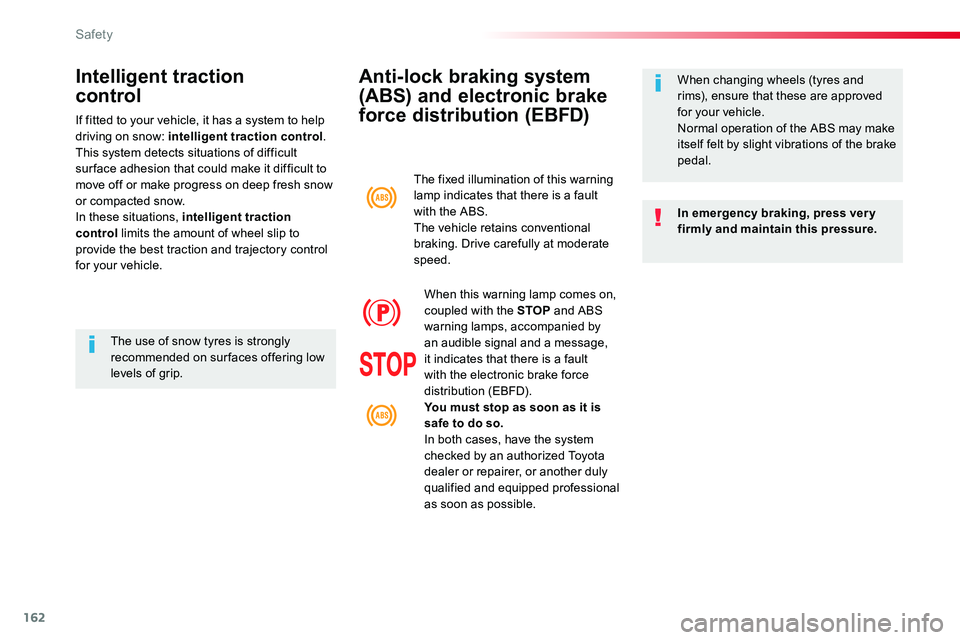
In emergency braking, press ver y firmly and maintain this pressure.
When changing wheels (tyres and rims), ensure that these are approved for your vehicle.Normal operation of the ABS may make itself felt by slight vibrations of the brake pedal.
The fixed illumination of this warning lamp indicates that there is a fault with the ABS.The vehicle retains conventional braking. Drive carefully at moderate speed.
When this warning lamp comes on, coupled with the STOP and ABS warning lamps, accompanied by an audible signal and a message, it indicates that there is a fault with the electronic brake force distribution (EBFD).You must stop as soon as it is safe to do so.In both cases, have the system checked by an authorized Toyota dealer or repairer, or another duly qualified and equipped professional as soon as possible.
Intelligent traction
control
If fitted to your vehicle, it has a system to help driving on snow: intelligent traction control.This system detects situations of difficult sur face adhesion that could make it difficult to move off or make progress on deep fresh snow or compacted snow.In these situations, intelligent traction control limits the amount of wheel slip to provide the best traction and trajectory control for your vehicle.
The use of snow tyres is strongly recommended on sur faces offering low levels of grip.
Safety
Page 163 of 516
163
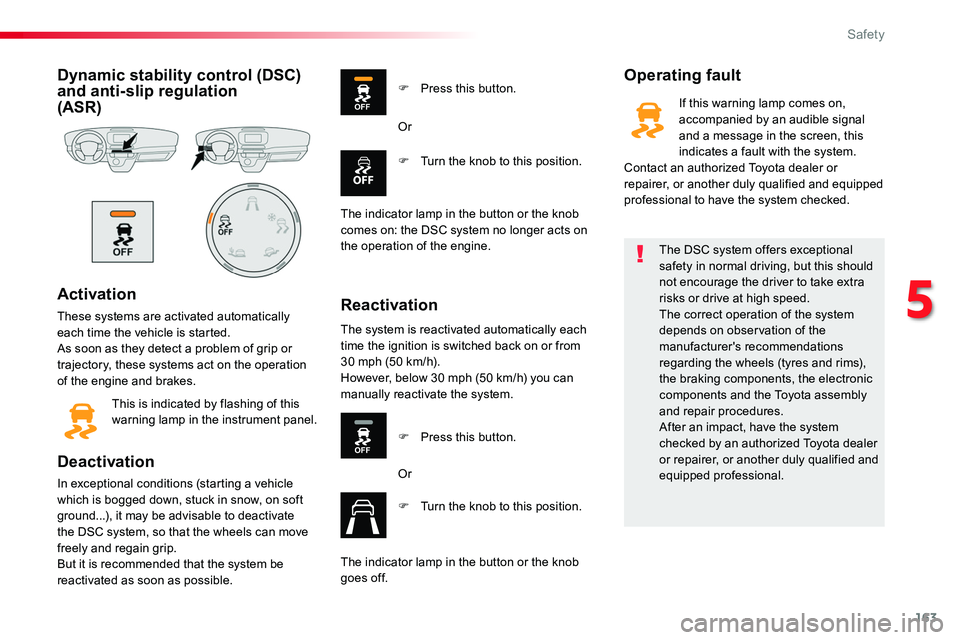
Dynamic stability control (DSC) and anti-slip regulation (ASR)
Activation
These systems are activated automatically each time the vehicle is started.As soon as they detect a problem of grip or trajectory, these systems act on the operation of the engine and brakes.
This is indicated by flashing of this warning lamp in the instrument panel.
Deactivation
In exceptional conditions (starting a vehicle which is bogged down, stuck in snow, on soft ground...), it may be advisable to deactivate the DSC system, so that the wheels can move freely and regain grip.But it is recommended that the system be reactivated as soon as possible.
Operating fault
Reactivation
F Press this button.
F Turn the knob to this position.
Or
The indicator lamp in the button or the knob
comes on: the DSC system no longer acts on the operation of the engine.
The system is reactivated automatically each time the ignition is switched back on or from 30 mph (50 km/h).However, below 30 mph (50 km/h) you can manually reactivate the system.
F Press this button.
Or
F Turn the knob to this position.
The indicator lamp in the button or the knob goes off.
The DSC system offers exceptional safety in normal driving, but this should not encourage the driver to take extra risks or drive at high speed.The correct operation of the system depends on observation of the manufacturer's recommendations regarding the wheels (tyres and rims), the braking components, the electronic components and the Toyota assembly and repair procedures.After an impact, have the system checked by an authorized Toyota dealer or repairer, or another duly qualified and equipped professional.
If this warning lamp comes on, accompanied by an audible signal and a message in the screen, this indicates a fault with the system.Contact an authorized Toyota dealer or repairer, or another duly qualified and equipped professional to have the system checked.
5
Safety
Page 196 of 516
196
Driving recommendations
Observe the driving regulations and remain vigilant whatever the traffic conditions.Pay close attention to the traffic and keep your hands on the wheel so that you are ready to react at any time to any eventuality.On a long journey, a break every two hours is strongly recommended.In difficult weather, drive smoothly, anticipate
the need to brake and increase the distance from other vehicles.
Never drive with the parking brake applied - Risk of overheating and damage to the braking system!Risk of fire!As the exhaust system of your vehicle is very hot, even several minutes after switching off the engine, do not park or run the engine over areas where inflammable substances and materials are present: grass, leaves, etc.
Never leave a vehicle unsupervised with the engine running. If you have to leave your vehicle with the engine running, apply the parking brake and put the gearbox into neutral or position N or P, depending on the type of gearbox.
Driving on flooded roads
We strongly advise against driving on flooded
roads, as this could cause serious damage to the engine or gearbox, as well as to the electrical systems of your vehicle.
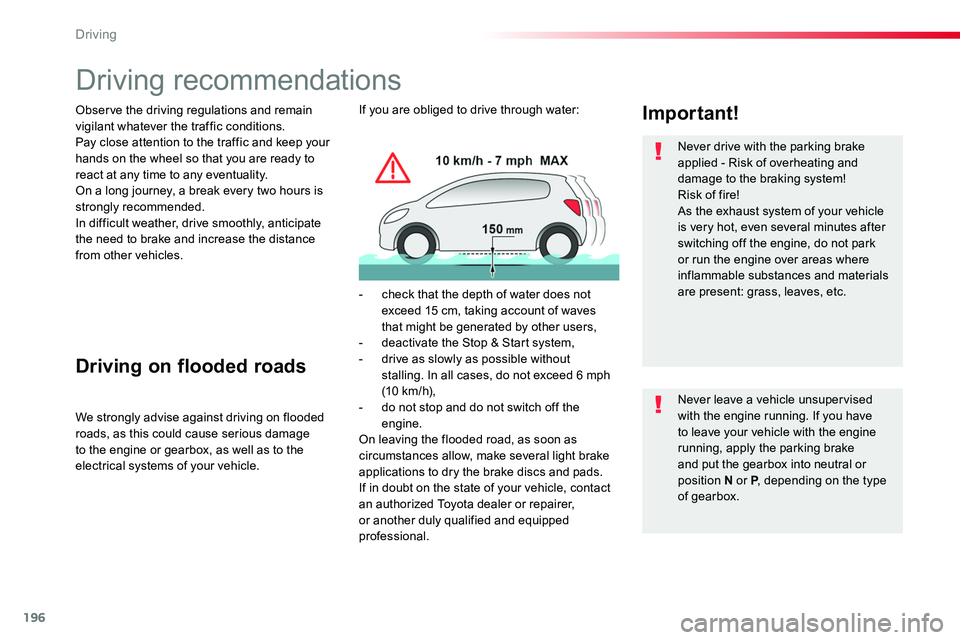
Important!If you are obliged to drive through water:
- check that the depth of water does not exceed 15 cm, taking account of waves that might be generated by other users,- deactivate the Stop & Start system,- drive as slowly as possible without stalling. In all cases, do not exceed 6 mph (10 km/h),- do not stop and do not switch off the engine.On leaving the flooded road, as soon as circumstances allow, make several light brake applications to dry the brake discs and pads.If in doubt on the state of your vehicle, contact an authorized Toyota dealer or repairer, or another duly qualified and equipped professional.
Driving
Page 197 of 516
197
To assure the durability of your vehicle and your safety, remember that certain precautions, described hereafter, should be taken when driving your vehicle:
Load the vehicle correctly
With a load carried, the vehicle must remain within the maximum authorised weight, the Gross Vehicle Weight.To avoid upsetting the balance of the vehicle, the load should be centred and the heaviest part placed on the floor in front of the rear wheels.
Manoeuve cautiously, at
low speed
The dimensions of your vehicle differ from those of a light vehicle, in width, in height, as well as in length, and some obstacles will be more difficult to notice.Manoeuvre slowly.Before turning, check that there are no obstacles at mid-height along the sides.Before reversing, check that there are no obstacles, particularly at high level behind the vehicle.Be aware of the external dimensions, if ladders are fitted.
It is inadvisable to place heavy loads on a roof rack.Loading the roof rack also requires you not to exceed the maximum load on the roof rack anchorages. Observe the maximum authorised weight, available from Toyota dealers.Loads must be securely lashed down.Cargo that is not properly secured inside the vehicle can adversely affect the handling of the vehicle and create the risk of accident.If your vehicle is fitted with a drop-side back, the height and width of the load must remain within the overall dimensions of the vehicle.
Drive the vehicle in a
prudent and efficient way
Take corners gently.Anticipate the need to brake as the stopping distance is increased, particularly on wet or icy roads.Be aware of the effect of side winds on the vehicle.Effective eco-driving saves fuel; accelerate progressively, anticipate the need to slow down and adapt your speed to suit the situation.Indicate changes of direction well in advance
so that you are seen by other road users.
Take care
The tyres must be inflated to at least the pressures indicated on the label, even over-inflated by 0.2 to 0.3 bar for long journeys.After ensuring that no obstacle might prevent closing, guide the movement of the door at the right speed until it closes.
6
Driving
Page 198 of 516
198
When towing
Distribution of loads
F Distribute the load in the trailer so that the heaviest items are as close as possible to the axle and the nose weight approaches the maximum permitted without exceeding it.Air density decreases with altitude, thus reducing engine performance. Above 1 000 metres, the maximum towed load must be reduced by 10 % for every 1 000 metres of altitude.
Side wind
F Take into account the increased sensitivity to side wind.
Cooling
Towing a trailer on a slope increases the temperature of the coolant.As the fan is electrically controlled, its cooling capacity is not dependent on the engine speed.F To lower the engine speed, reduce your speed.The maximum towed load on a long incline depends on the gradient and the ambient temperature.In all cases, keep a check on the coolant temperature.
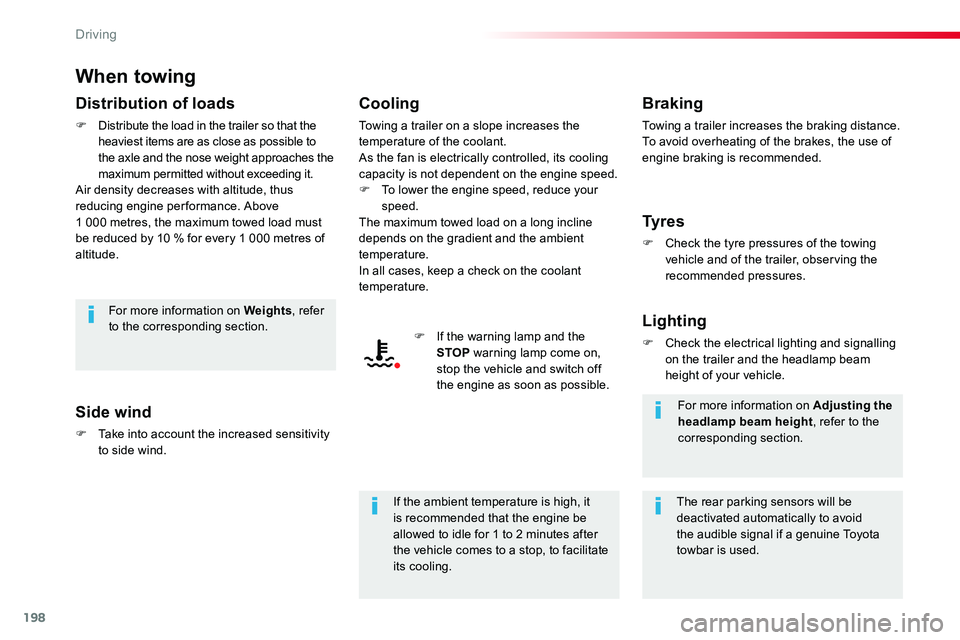
F If the warning lamp and the STOP warning lamp come on, stop the vehicle and switch off the engine as soon as possible.
Braking
Towing a trailer increases the braking distance.To avoid overheating of the brakes, the use of engine braking is recommended.
Ty r e s
F Check the tyre pressures of the towing vehicle and of the trailer, observing the recommended pressures.
Lighting
F Check the electrical lighting and signalling on the trailer and the headlamp beam height of your vehicle.
For more information on Weights, refer to the corresponding section.
The rear parking sensors will be deactivated automatically to avoid the audible signal if a genuine Toyota towbar is used.
If the ambient temperature is high, it is recommended that the engine be allowed to idle for 1 to 2 minutes after the vehicle comes to a stop, to facilitate its cooling.
For more information on Adjusting the headlamp beam height, refer to the corresponding section.
Driving
Page 199 of 516
199
Starting-switching off the engine, manual key, remote control
Ignition switch
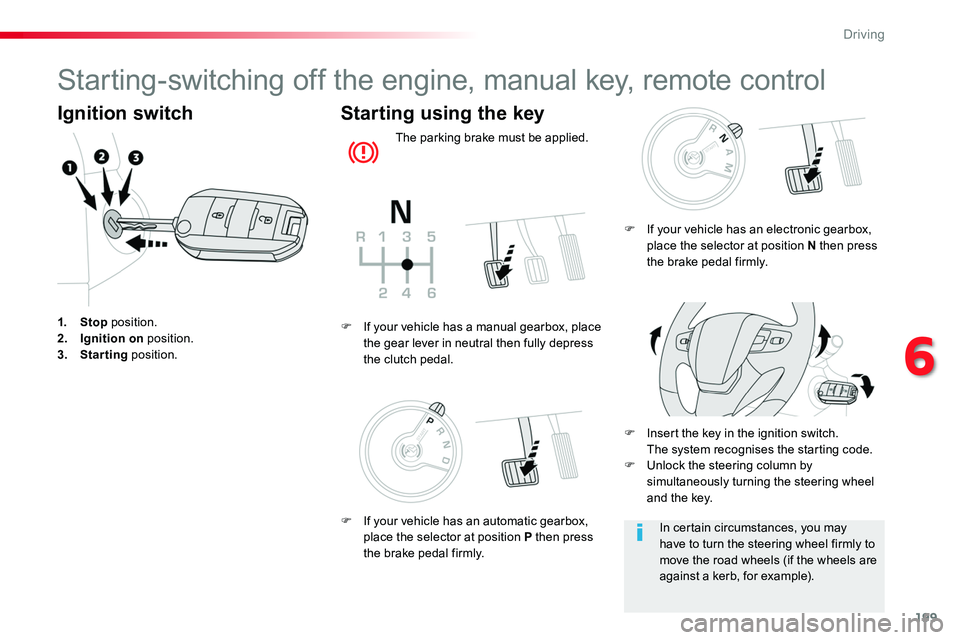
1. Stop position.2. Ignition on position.3. Starting position.
Starting using the key
The parking brake must be applied.
F Insert the key in the ignition switch. The system recognises the starting code.F Unlock the steering column by simultaneously turning the steering wheel and the key.
F If your vehicle has a manual gearbox, place the gear lever in neutral then fully depress the clutch pedal.
In certain circumstances, you may have to turn the steering wheel firmly to move the road wheels (if the wheels are against a kerb, for example).
F If your vehicle has an electronic gearbox, place the selector at position N then press the brake pedal firmly.
F If your vehicle has an automatic gearbox, place the selector at position P then press the brake pedal firmly.
6
Driving
Page 201 of 516
201
Avoid attaching heavy objects to the key, which would weigh down on its blade in the ignition switch and could cause a malfunction.
Switching off the engine leads to a loss of braking assistance.
Key left in the "Ignition on" position
If the key has been left in the ignition switch at position 2 (Ignition on), the ignition will be switched off automatically after one hour.To switch the ignition back on, turn the key to position 1 (Stop), then back to position 2 (Ignition on).Never switch off the ignition until the vehicle has been brought to a complete stop.
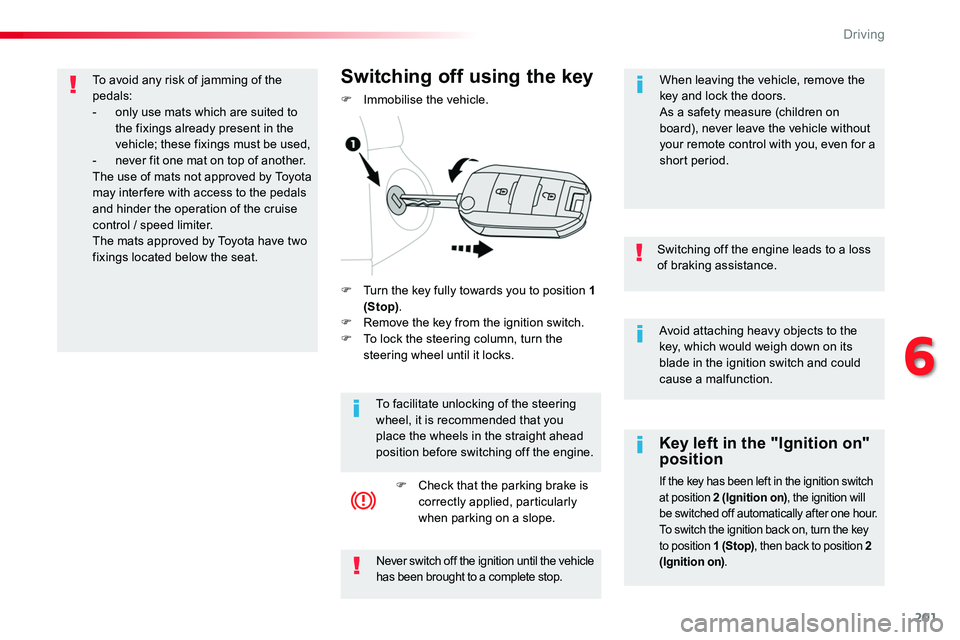
F Turn the key fully towards you to position 1 (Stop).F Remove the key from the ignition switch.F To lock the steering column, turn the steering wheel until it locks.
Switching off using the key
F Immobilise the vehicle.
To facilitate unlocking of the steering wheel, it is recommended that you place the wheels in the straight ahead position before switching off the engine.
F Check that the parking brake is correctly applied, particularly when parking on a slope.
When leaving the vehicle, remove the key and lock the doors.As a safety measure (children on board), never leave the vehicle without your remote control with you, even for a short period.
To avoid any risk of jamming of the pedals:- only use mats which are suited to the fixings already present in the vehicle; these fixings must be used,- never fit one mat on top of another.The use of mats not approved by Toyota may inter fere with access to the pedals and hinder the operation of the cruise
control / speed limiter.The mats approved by Toyota have two fixings located below the seat.
6
Driving
Page 202 of 516
202
For Diesel vehicles, in sub-zero temperatures the engine will not start until the pre-heater warning lamp has gone off.If this warning lamp comes on after pressing the "START/STOP" button, press down on the brake or clutch pedal until the warning lamp goes off, without pressing the "START/STOP" button again, until the engine starts and runs.
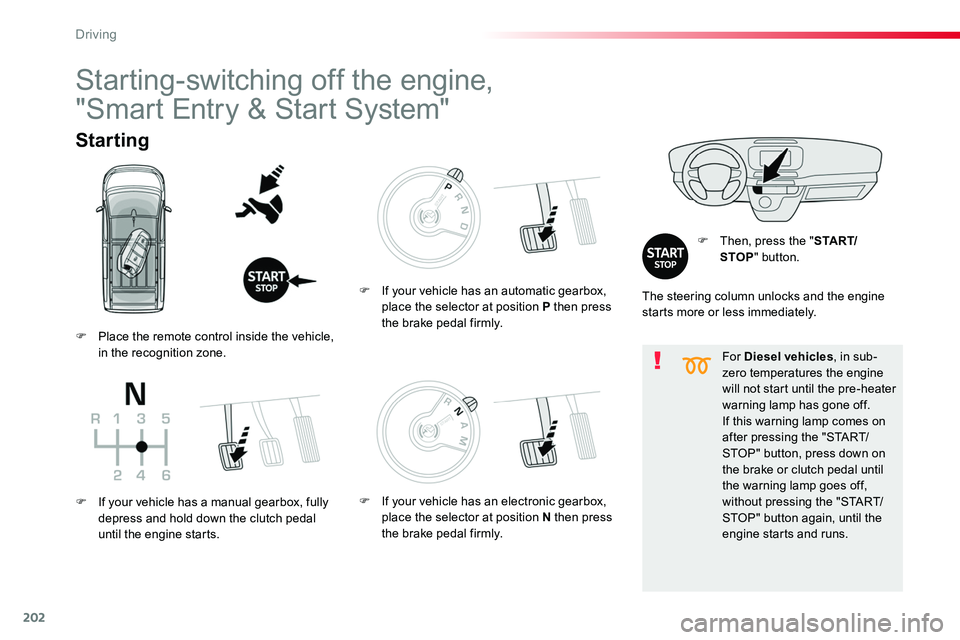
Starting
F Then, press the "S TA R T/STOP" button.
Starting-switching off the engine,
"Smart Entry & Start System"
The steering column unlocks and the engine starts more or less immediately.
F Place the remote control inside the vehicle, in the recognition zone.
F If your vehicle has a manual gearbox, fully depress and hold down the clutch pedal until the engine starts.
F If your vehicle has an automatic gearbox, place the selector at position P then press the brake pedal firmly.
F If your vehicle has an electronic gearbox, place the selector at position N then press the brake pedal firmly.
Driving
Page 204 of 516
204
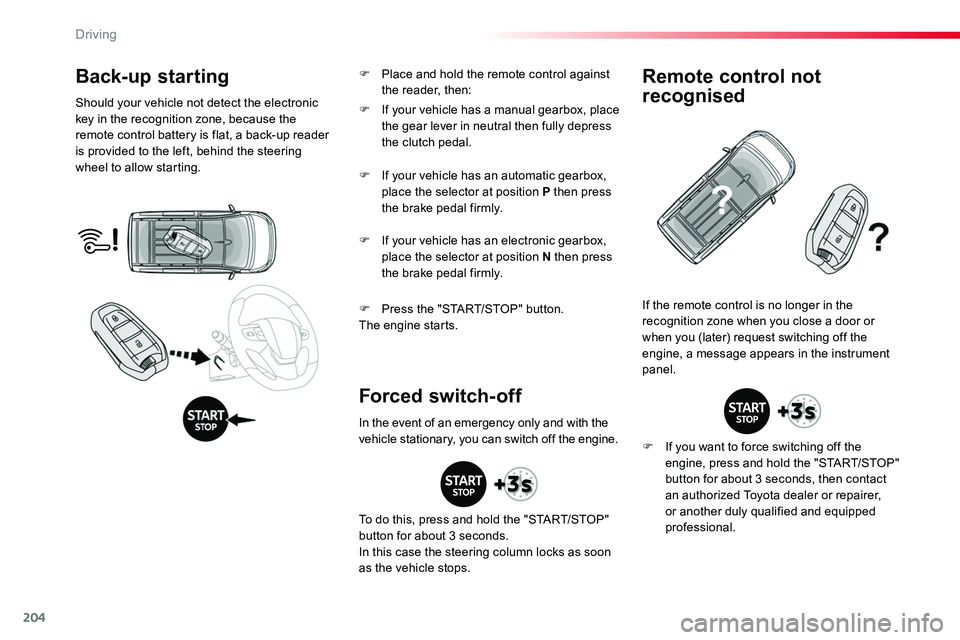
Back-up starting
Should your vehicle not detect the electronic key in the recognition zone, because the remote control battery is flat, a back-up reader is provided to the left, behind the steering wheel to allow starting.
F Press the "START/STOP" button.The engine starts.
If the remote control is no longer in the recognition zone when you close a door or when you (later) request switching off the engine, a message appears in the instrument panel.
Forced switch-off
Remote control not
recognised
F If you want to force switching off the engine, press and hold the "START/STOP" button for about 3 seconds, then contact an authorized Toyota dealer or repairer, or another duly qualified and equipped professional.
F If your vehicle has a manual gearbox, place the gear lever in neutral then fully depress the clutch pedal.
F If your vehicle has an automatic gearbox, place the selector at position P then press the brake pedal firmly.
F If your vehicle has an electronic gearbox, place the selector at position N then press the brake pedal firmly.
In the event of an emergency only and with the vehicle stationary, you can switch off the engine.
To do this, press and hold the "START/STOP" button for about 3 seconds.In this case the steering column locks as soon as the vehicle stops.
F Place and hold the remote control against the reader, then:
Driving
Page 205 of 516
205
Parking brake
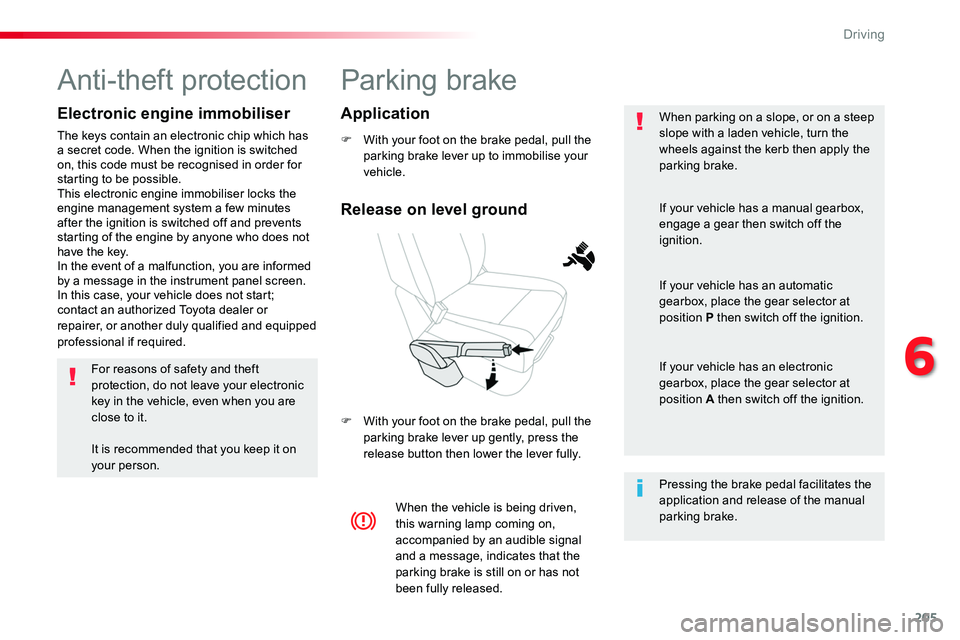
F With your foot on the brake pedal, pull the parking brake lever up to immobilise your vehicle.
F With your foot on the brake pedal, pull the parking brake lever up gently, press the release button then lower the lever fully.
When parking on a slope, or on a steep slope with a laden vehicle, turn the wheels against the kerb then apply the parking brake.
When the vehicle is being driven, this warning lamp coming on, accompanied by an audible signal and a message, indicates that the parking brake is still on or has not
been fully released.
Pressing the brake pedal facilitates the application and release of the manual parking brake.
If your vehicle has a manual gearbox,
engage a gear then switch off the ignition.
If your vehicle has an automatic gearbox, place the gear selector at position P then switch off the ignition.
If your vehicle has an electronic gearbox, place the gear selector at position A then switch off the ignition.
Release on level ground
Application
Anti-theft protection
Electronic engine immobiliser
The keys contain an electronic chip which has a secret code. When the ignition is switched on, this code must be recognised in order for starting to be possible.This electronic engine immobiliser locks the engine management system a few minutes after the ignition is switched off and prevents starting of the engine by anyone who does not have the key.In the event of a malfunction, you are informed by a message in the instrument panel screen.In this case, your vehicle does not start; contact an authorized Toyota dealer or repairer, or another duly qualified and equipped professional if required.
For reasons of safety and theft protection, do not leave your electronic key in the vehicle, even when you are close to it.
It is recommended that you keep it on your person.
6
Driving