light TOYOTA PROACE 2016 User Guide
[x] Cancel search | Manufacturer: TOYOTA, Model Year: 2016, Model line: PROACE, Model: TOYOTA PROACE 2016Pages: 516, PDF Size: 91.65 MB
Page 45 of 516
45
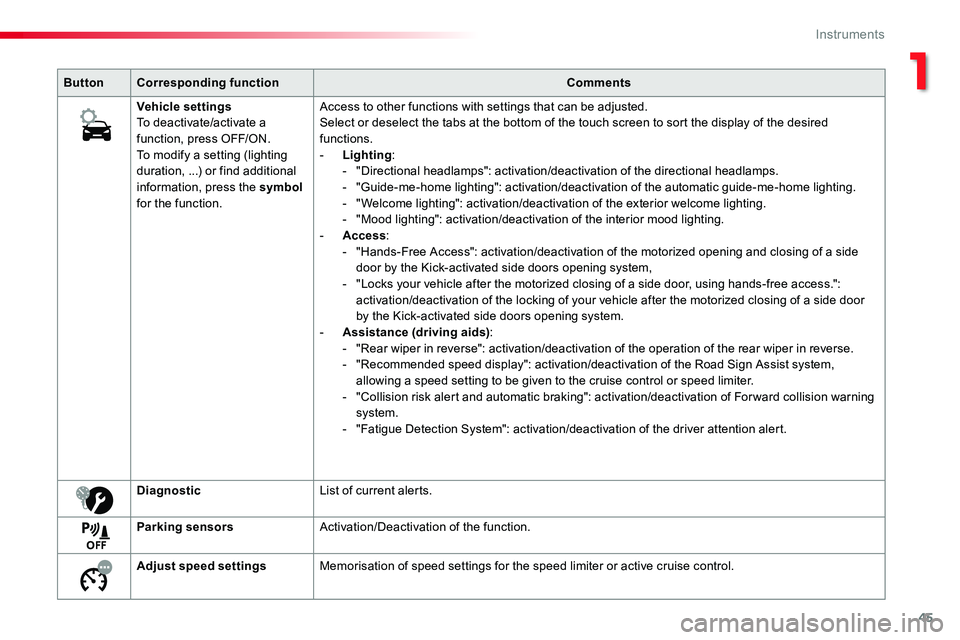
ButtonCorresponding functionComments
Vehicle settingsTo deactivate/activate a function, press OFF/ON.To modify a setting (lighting duration, ...) or find additional information, press the symbol for the function.
Access to other functions with settings that can be adjusted.Select or deselect the tabs at the bottom of the touch screen to sort the display of the desired functions.- Lighting:- "Directional headlamps": activation/deactivation of the directional headlamps.- "Guide-me-home lighting": activation/deactivation of the automatic guide-me-home lighting.- "Welcome lighting": activation/deactivation of the exterior welcome lighting.- "Mood lighting": activation/deactivation of the interior mood lighting.- Access:- "Hands-Free Access": activation/deactivation of the motorized opening and closing of a side door by the Kick-activated side doors opening system,- "Locks your vehicle after the motorized closing of a side door, using hands-free access.": activation/deactivation of the locking of your vehicle after the motorized closing of a side door by the Kick-activated side doors opening system.- Assistance (driving aids):- "Rear wiper in reverse": activation/deactivation of the operation of the rear wiper in reverse.- "Recommended speed display": activation/deactivation of the Road Sign Assist system, allowing a speed setting to be given to the cruise control or speed limiter.- "Collision risk alert and automatic braking": activation/deactivation of For ward collision warning system.- "Fatigue Detection System": activation/deactivation of the driver attention alert.
DiagnosticList of current alerts.
Parking sensorsActivation/Deactivation of the function.
Adjust speed settingsMemorisation of speed settings for the speed limiter or active cruise control.
1
Instruments
Page 52 of 516
52
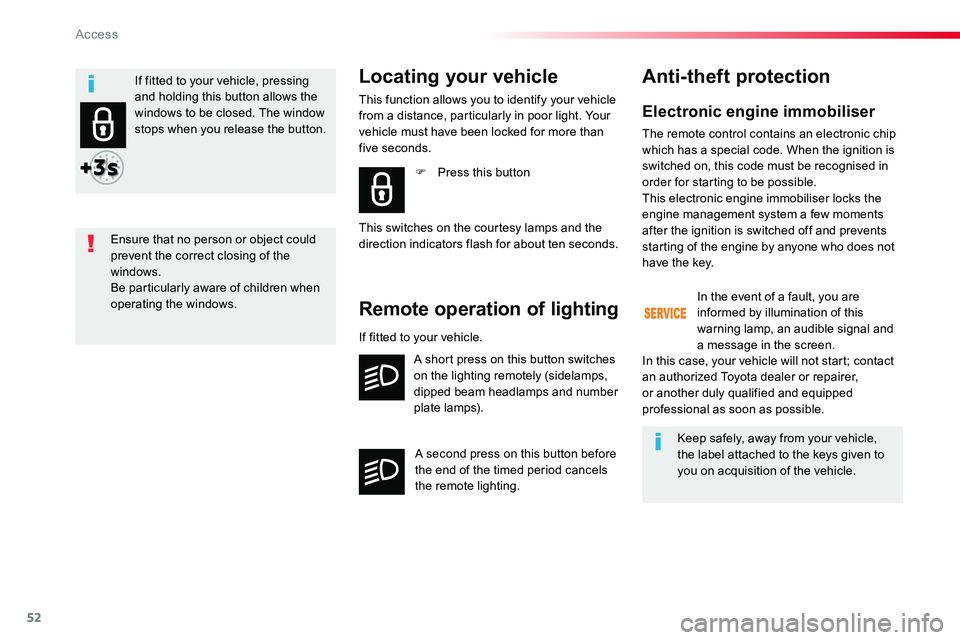
Electronic engine immobiliser
The remote control contains an electronic chip which has a special code. When the ignition is switched on, this code must be recognised in order for starting to be possible.This electronic engine immobiliser locks the engine management system a few moments after the ignition is switched off and prevents starting of the engine by anyone who does not have the key.
F Press this button
Locating your vehicle
This function allows you to identify your vehicle from a distance, particularly in poor light. Your vehicle must have been locked for more than five seconds.
This switches on the courtesy lamps and the direction indicators flash for about ten seconds.
Remote operation of lighting
A short press on this button switches on the lighting remotely (sidelamps, dipped beam headlamps and number plate lamps).
A second press on this button before the end of the timed period cancels the remote lighting.
Anti-theft protection
In the event of a fault, you are informed by illumination of this warning lamp, an audible signal and a message in the screen.
Keep safely, away from your vehicle, the label attached to the keys given to you on acquisition of the vehicle.
In this case, your vehicle will not start; contact an authorized Toyota dealer or repairer, or another duly qualified and equipped professional as soon as possible.
If fitted to your vehicle.
Ensure that no person or object could prevent the correct closing of the windows.Be particularly aware of children when operating the windows.
If fitted to your vehicle, pressing and holding this button allows the windows to be closed. The window stops when you release the button.
Access
Page 54 of 516
54
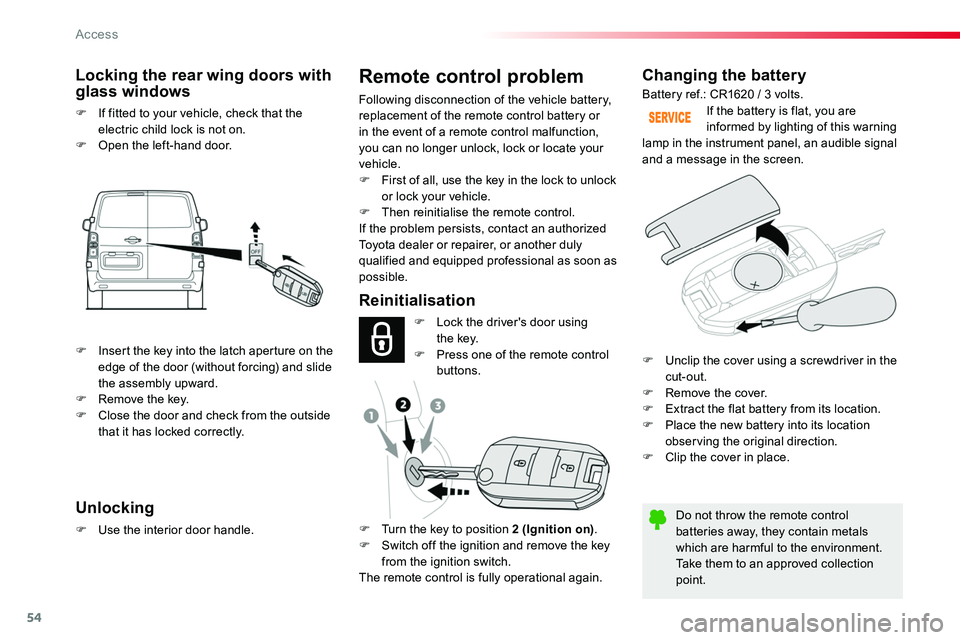
Changing the battery
Do not throw the remote control batteries away, they contain metals which are harmful to the environment.Take them to an approved collection point.
If the battery is flat, you are informed by lighting of this warning lamp in the instrument panel, an audible signal and a message in the screen.
Reinitialisation
Locking the rear wing doors with glass windows
F If fitted to your vehicle, check that the electric child lock is not on.F Open the left-hand door.
Battery ref.: CR1620 / 3 volts.
F Lock the driver's door using t h e key.F Press one of the remote control buttons.
F Turn the key to position 2 (Ignition on).
F Switch off the ignition and remove the key from the ignition switch.The remote control is fully operational again.
Unlocking
F Use the interior door handle.
Remote control problem
Following disconnection of the vehicle battery, replacement of the remote control battery or in the event of a remote control malfunction, you can no longer unlock, lock or locate your vehicle.F First of all, use the key in the lock to unlock or lock your vehicle.F Then reinitialise the remote control.If the problem persists, contact an authorized Toyota dealer or repairer, or another duly qualified and equipped professional as soon as possible.
F Unclip the cover using a screwdriver in the cut-out.F Remove the cover.F Extract the flat battery from its location.F Place the new battery into its location observing the original direction.F Clip the cover in place.
F Insert the key into the latch aperture on the edge of the door (without forcing) and slide the assembly upward.F Remove the key.F Close the door and check from the outside that it has locked correctly.
Access
Page 67 of 516
67
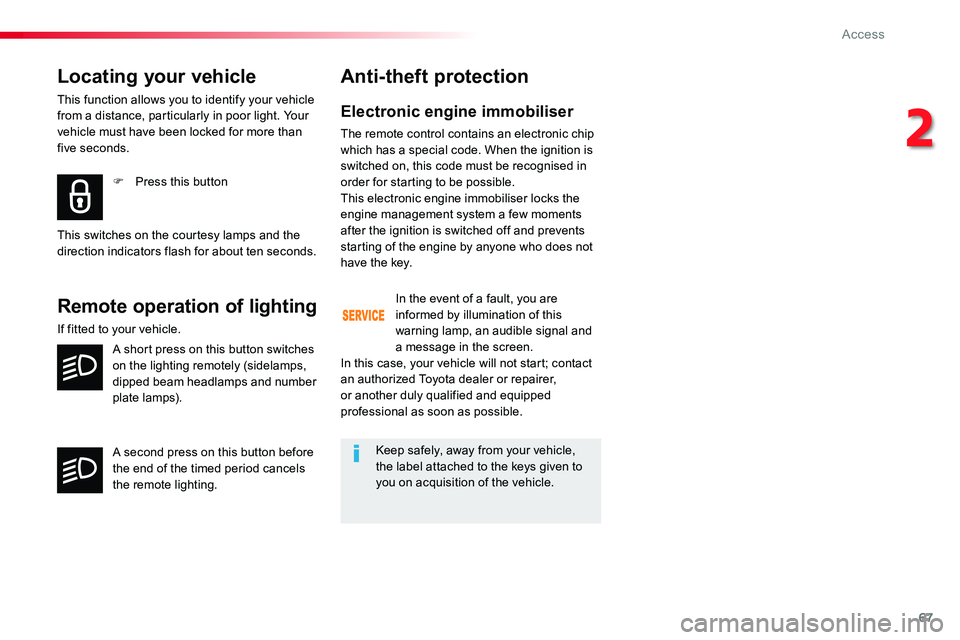
Locating your vehicle
This function allows you to identify your vehicle from a distance, particularly in poor light. Your vehicle must have been locked for more than five seconds.
F Press this button
This switches on the courtesy lamps and the direction indicators flash for about ten seconds.
Remote operation of lighting
If fitted to your vehicle.
A short press on this button switches on the lighting remotely (sidelamps, dipped beam headlamps and number plate lamps).
A second press on this button before the end of the timed period cancels the remote lighting.
Anti-theft protection
Electronic engine immobiliser
The remote control contains an electronic chip which has a special code. When the ignition is switched on, this code must be recognised in order for starting to be possible.This electronic engine immobiliser locks the engine management system a few moments
after the ignition is switched off and prevents starting of the engine by anyone who does not have the key.
In the event of a fault, you are informed by illumination of this warning lamp, an audible signal and a message in the screen.In this case, your vehicle will not start; contact an authorized Toyota dealer or repairer, or another duly qualified and equipped professional as soon as possible.
Keep safely, away from your vehicle, the label attached to the keys given to you on acquisition of the vehicle.
2
Access
Page 125 of 516
125
Temperature
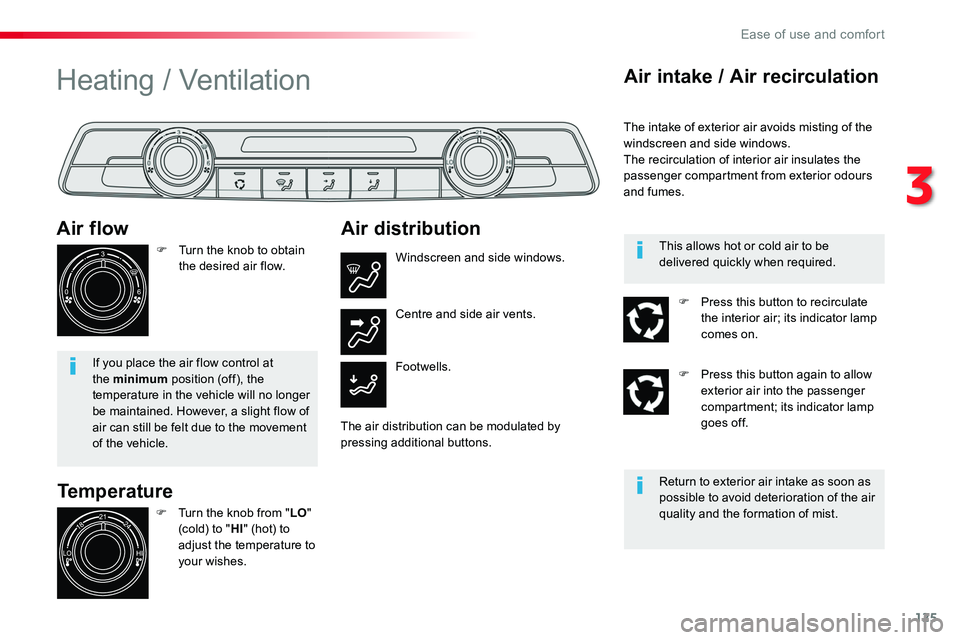
Air flow
F Turn the knob to obtain the desired air flow.
If you place the air flow control at the minimum position (off), the temperature in the vehicle will no longer be maintained. However, a slight flow of air can still be felt due to the movement of the vehicle.
Heating / Ventilation
F Turn the knob from "LO" (cold) to "HI" (hot) to
adjust the temperature to your wishes.
Air distribution
Windscreen and side windows.
Footwells.
Centre and side air vents.
The air distribution can be modulated by pressing additional buttons.
Air intake / Air recirculation
The intake of exterior air avoids misting of the windscreen and side windows.The recirculation of interior air insulates the passenger compartment from exterior odours and fumes.
Return to exterior air intake as soon as possible to avoid deterioration of the air quality and the formation of mist.
This allows hot or cold air to be delivered quickly when required.
F Press this button to recirculate the interior air; its indicator lamp comes on.
F Press this button again to allow exterior air into the passenger compartment; its indicator lamp goes off.
3
Ease of use and comfort
Page 126 of 516
126
The air conditioning system only operates with the engine running.
Manual air conditioning
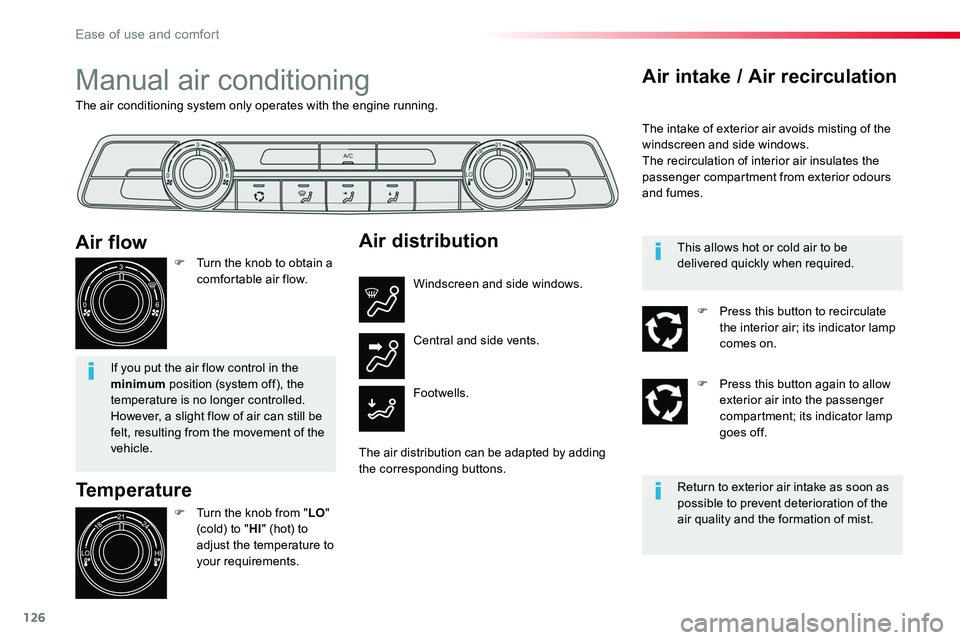
Temperature
F Turn the knob from "LO" (cold) to "HI" (hot) to
adjust the temperature to your requirements.
Air flow
F Turn the knob to obtain a comfortable air flow.
If you put the air flow control in the minimum position (system off), the temperature is no longer controlled. However, a slight flow of air can still be
felt, resulting from the movement of the vehicle.
Air distribution
Windscreen and side windows.
Footwells.
Central and side vents.
The air distribution can be adapted by adding the corresponding buttons.
Air intake / Air recirculation
The intake of exterior air avoids misting of the windscreen and side windows.The recirculation of interior air insulates the passenger compartment from exterior odours and fumes.
Return to exterior air intake as soon as possible to prevent deterioration of the air quality and the formation of mist.
This allows hot or cold air to be delivered quickly when required.
F Press this button to recirculate the interior air; its indicator lamp comes on.
F Press this button again to allow exterior air into the passenger compartment; its indicator lamp goes off.
Ease of use and comfort
Page 131 of 516
131
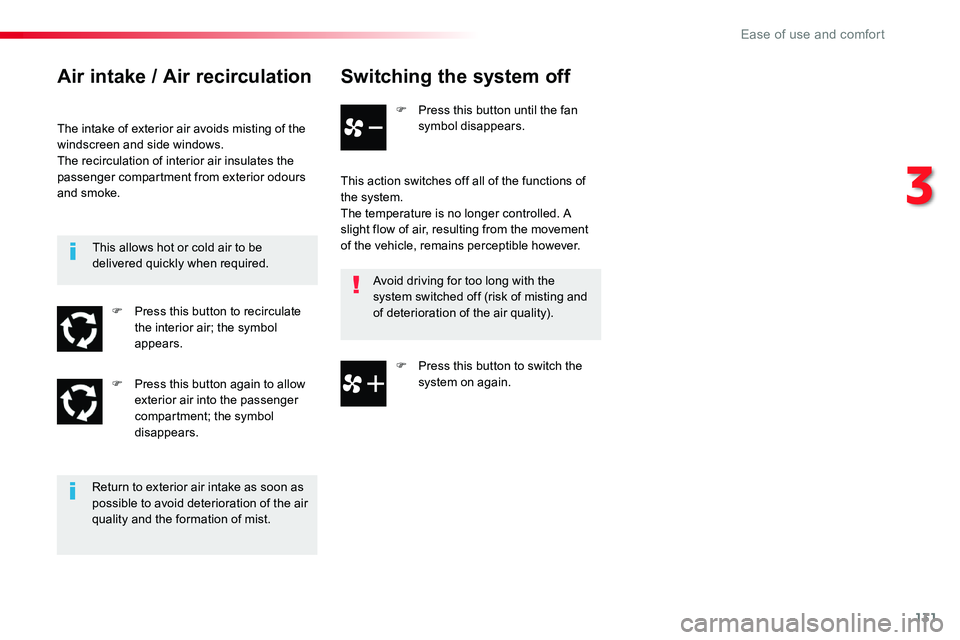
Switching the system off
F Press this button until the fan symbol disappears.
This action switches off all of the functions of the system.The temperature is no longer controlled. A slight flow of air, resulting from the movement of the vehicle, remains perceptible however.
Avoid driving for too long with the system switched off (risk of misting and of deterioration of the air quality).
Air intake / Air recirculation
The intake of exterior air avoids misting of the windscreen and side windows.The recirculation of interior air insulates the passenger compartment from exterior odours and smoke.
Return to exterior air intake as soon as possible to avoid deterioration of the air quality and the formation of mist.
This allows hot or cold air to be delivered quickly when required.
F Press this button to recirculate the interior air; the symbol appears.
F Press this button again to allow exterior air into the passenger compartment; the symbol disappears.
F Press this button to switch the system on again.
3
Ease of use and comfort
Page 135 of 516
135
In order for these systems to be fully effective, follow the operation and maintenance guidelines below:F To obtain an even air distribution, take care not to obstruct the exterior air intake grilles located at the base of the windscreen, the nozzles, the vents and the air outlets, as well as the air extractor located at the rear.F Do not cover the sunshine sensor, located at the top of the windscreen; this is used for regulation of the air conditioning system.F Operate the air conditioning system for at least 5 to 10 minutes, once or twice a month to keep it in per fect working order.F Ensure that the passenger compartment filter is in good condition and have the filter elements replaced regularly. We recommend the use of a combined passenger compartment filter. Thanks to its special active additive, it contributes to the purification of the air breathed by the occupants and the cleanliness of the passenger compartment (reduction of allergic symptoms, bad odours and greasy deposits).F To ensure correct operation of the air conditioning system, you are also advised to have it checked regularly as recommended in the maintenance and warranty guide.F If the system does not produce cold air, switch it off and contact an authorized Toyota dealer or repairer, or another duly qualified and equipped professional.
Recommendations for heating, ventilation and air conditioning
If after an extended stop in sunshine, the interior temperature is very high, first ventilate the passenger compartment for a few moments.Put the air flow control at a setting high enough to quickly change the air in the passenger compartment.
The air conditioning system does not contain chlorine and does not present any danger to the ozone layer.
The condensation created by the air conditioning results in a discharge of water under the vehicle which is perfectly normal.
When towing the maximum load on a steep gradient in high temperatures, switching off the air conditioning increases the available engine power and so improves the towing ability.
Stop & Start
The heating and air conditioning systems only work when the engine is running.To maintain a comfortable temperature in the passenger compartment, you can temporarily deactivate the Stop & Start system.
For more information on Stop & Star t, refer to the corresponding section.
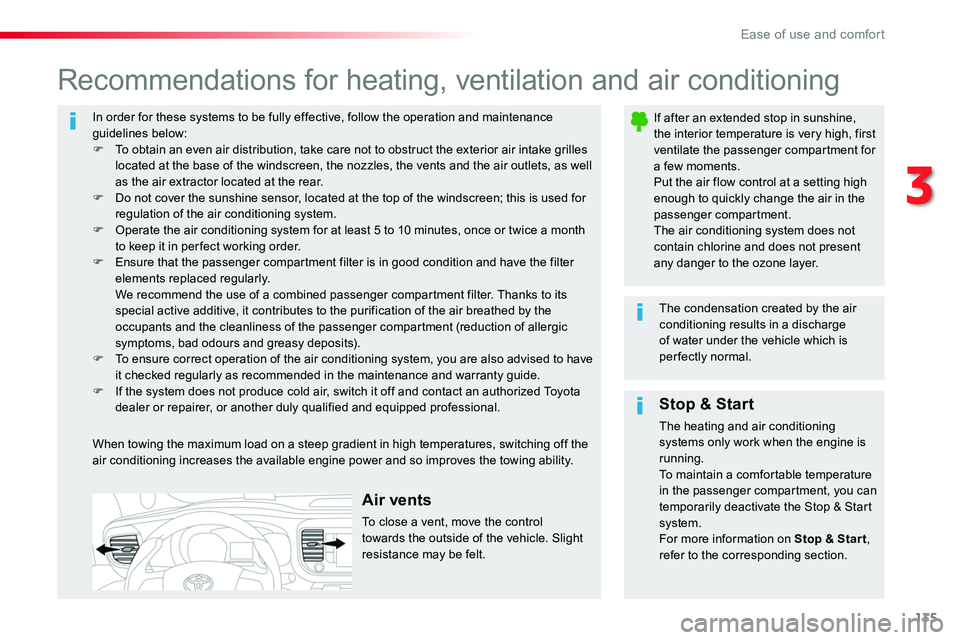
Air vents
To close a vent, move the control towards the outside of the vehicle. Slight resistance may be felt.
3
Ease of use and comfort
Page 143 of 516
143
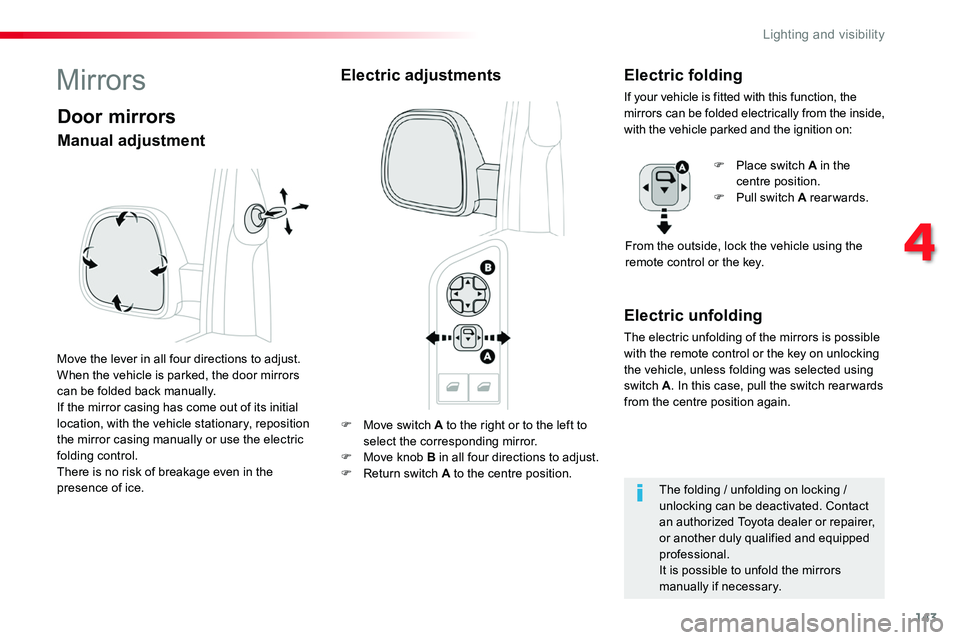
F Move switch A to the right or to the left to
select the corresponding mirror.F Move knob B in all four directions to adjust.F Return switch A to the centre position.
Electric unfolding
The electric unfolding of the mirrors is possible with the remote control or the key on unlocking the vehicle, unless folding was selected using switch A. In this case, pull the switch rear wards from the centre position again.
MirrorsElectric adjustmentsElectric folding
If your vehicle is fitted with this function, the mirrors can be folded electrically from the inside, with the vehicle parked and the ignition on:
F Place switch A in the centre position.F Pull switch A rearwards.
From the outside, lock the vehicle using the remote control or the key.
The folding / unfolding on locking / unlocking can be deactivated. Contact an authorized Toyota dealer or repairer, or another duly qualified and equipped professional.It is possible to unfold the mirrors manually if necessary.
Door mirrors
Move the lever in all four directions to adjust.When the vehicle is parked, the door mirrors can be folded back manually.If the mirror casing has come out of its initial location, with the vehicle stationary, reposition the mirror casing manually or use the electric folding control.There is no risk of breakage even in the presence of ice.
Manual adjustment
4
Lighting and visibility
Page 144 of 516
144
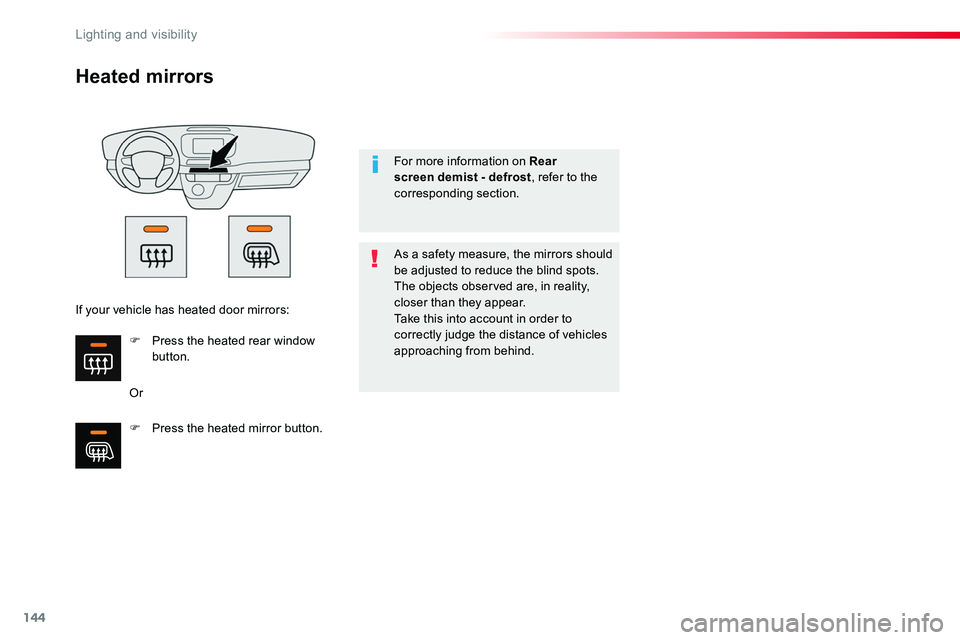
Heated mirrors
Or
As a safety measure, the mirrors should be adjusted to reduce the blind spots.The objects observed are, in reality, closer than they appear.Take this into account in order to correctly judge the distance of vehicles approaching from behind.
For more information on Rear screen demist - defrost, refer to the corresponding section.
F Press the heated rear window button.
F Press the heated mirror button.
If your vehicle has heated door mirrors:
Lighting and visibility