child lock TOYOTA PROACE VERSO 2016 User Guide
[x] Cancel search | Manufacturer: TOYOTA, Model Year: 2016, Model line: PROACE VERSO, Model: TOYOTA PROACE VERSO 2016Pages: 504, PDF Size: 81.64 MB
Page 57 of 504
57
Ensure that no one might prevent the correct operation of the windows.Be particularly aware of children when operating the windows.
If fitted to your vehicle, pressing and holding the locking controls allows the windows to be opened. The
window stops when you release the button.
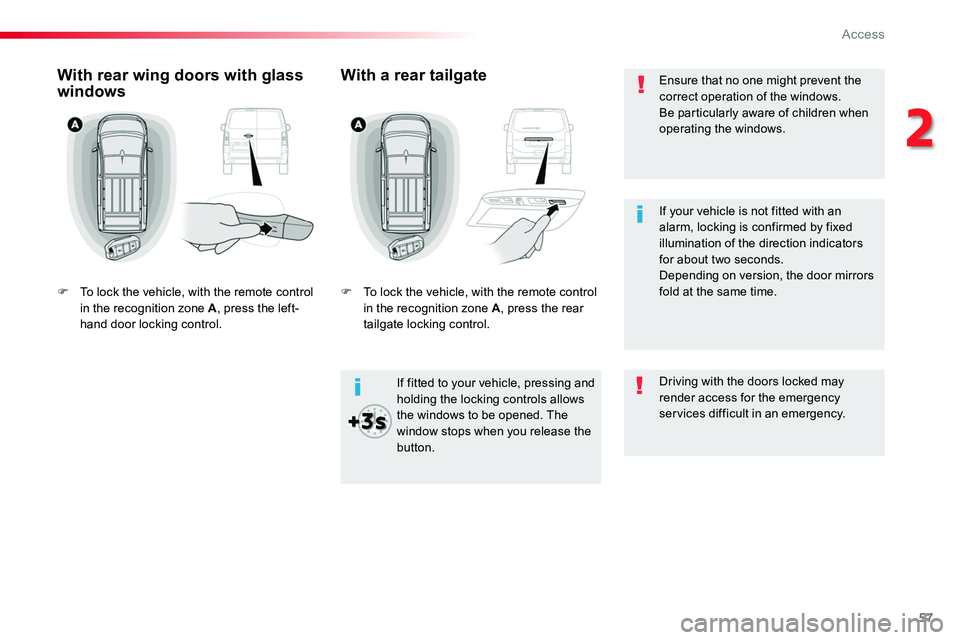
With rear wing doors with glass windows
F To lock the vehicle, with the remote control in the recognition zone A, press the left-hand door locking control.
With a rear tailgate
F To lock the vehicle, with the remote control in the recognition zone A, press the rear tailgate locking control.
Driving with the doors locked may render access for the emergency services difficult in an emergency.
If your vehicle is not fitted with an alarm, locking is confirmed by fixed illumination of the direction indicators for about two seconds.Depending on version, the door mirrors fold at the same time.
2
Access
Page 61 of 504
61
For more information on the child lock, refer to the corresponding section.
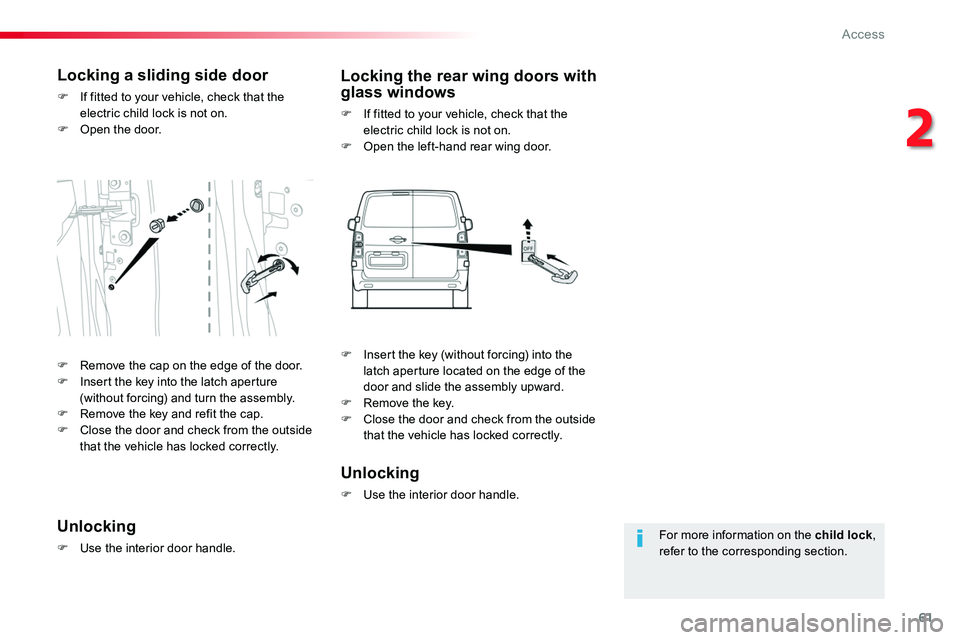
Locking a sliding side door
F If fitted to your vehicle, check that the electric child lock is not on.F Open the door.
Locking the rear wing doors with glass windows
F If fitted to your vehicle, check that the electric child lock is not on.F Open the left-hand rear wing door.
Unlocking
F Use the interior door handle.
Unlocking
F Use the interior door handle.
F Remove the cap on the edge of the door.F Insert the key into the latch aperture (without forcing) and turn the assembly.F Remove the key and refit the cap.F Close the door and check from the outside that the vehicle has locked correctly.
F Insert the key (without forcing) into the latch aperture located on the edge of the door and slide the assembly upward.F Remove the key.F Close the door and check from the outside that the vehicle has locked correctly.
2
Access
Page 63 of 504
63
Lost keys, remote control
Visit an authorized Toyota dealer or repairer, or another duly qualified and equipped professional with the vehicle's registration certificate, your personal identification documents and if possible, the label bearing the key code.The an authorized Toyota dealer or repairer, or another duly qualified and equipped professional will be able to retrieve the key code and the transponder code required to order a new key.
Locking the vehicle
Driving with the doors locked may make access to the passenger compartment by the emergency services more difficult in an emergency.As a safety precaution (with children on board), remove the key from the ignition or take the remote control with you when leaving the vehicle, even for a short time.
When purchasing a second-hand vehicle
Have the key codes memorised by an authorized Toyota dealer or repairer, or another duly qualified and equipped professional, to ensure that the keys in your possession are the only ones which can start the vehicle.
Electrical interference
The Smart Entry & Start System remote control may not operate if close to certain electronic devices: telephone, laptop computer, strong magnetic fields, ...
Accumulations (water, dust, grime, salt...) on the inner sur face of the door handle may affect detection.If cleaning the inner sur face of the door handle using a cloth does not restore detection, contact an authorized Toyota dealer or repairer, or another duly qualified and equipped professional.A sudden splash of water (stream of water, high pressure jet washer, …) may be identified by the system as the desire to open the vehicle.
Remote control
The high frequency remote control is a sensitive system; do not operate it while it is in your pocket as there is a possibility that it may unlock the vehicle, without you being aware of it.Do not repeatedly press the buttons of your remote control out of range and out of sight of your vehicle. You run the risk of stopping it from working and the remote control would have to be reinitialised.The remote control does not operate when the key is in the ignition, even when the ignition is switched off.
Anti-theft protection
Do not make any modifications to the electronic engine immobiliser system; this could cause malfunctions.Do not forget to turn the steering to engage the steering lock.
2
Access
Page 66 of 504
66
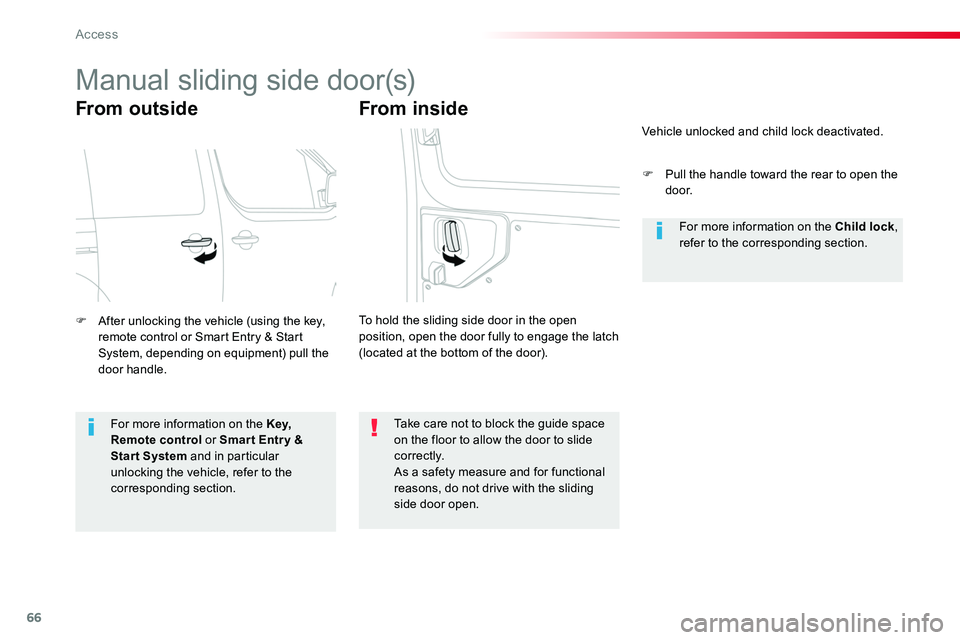
Manual sliding side door(s)
From outside
F After unlocking the vehicle (using the key, remote control or Smart Entry & Start System, depending on equipment) pull the door handle.
Take care not to block the guide space
on the floor to allow the door to slide c o r r e c t l y.As a safety measure and for functional reasons, do not drive with the sliding side door open.
For more information on the Key, Remote control or Smar t Entr y & Start System and in particular unlocking the vehicle, refer to the corresponding section.
For more information on the Child lock, refer to the corresponding section.
F Pull the handle toward the rear to open the d o o r.
Vehicle unlocked and child lock deactivated.
From inside
To hold the sliding side door in the open position, open the door fully to engage the latch (located at the bottom of the door).
Access
Page 68 of 504

68
Electric sliding side door(s)
The exterior and interior door handles and the interior buttons allow the electrically powered movement of the door to be started.Opening and closing of the doors is accompanied by an audible signal.
The remote controls buttons are not active with the ignition switched on.
Opening
From outside
Using the remote control
F Press this button again to reverse the movement of the door.
Using the handle
F Pull the handle toward the rear to start the electrically powered opening of the door.
Using the handle
Vehicle unlocked and child lock deactivated.
From inside
F Door unlocked, pull and release the handle to start the electrically powered opening of the door.F Pull the handle again to reverse the movement of the door.
F Door unlocked, press and hold this button until the corresponding sliding side door has opened.
Access
Page 69 of 504
69
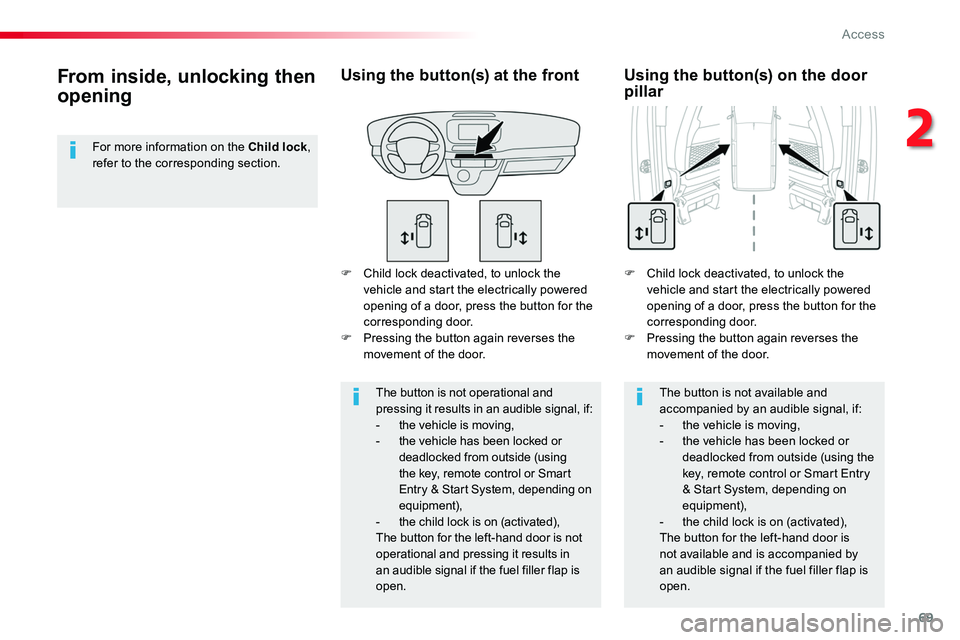
F Child lock deactivated, to unlock the vehicle and start the electrically powered opening of a door, press the button for the corresponding door.F Pressing the button again reverses the movement of the door.
The button is not operational and pressing it results in an audible signal, if:- the vehicle is moving,- the vehicle has been locked or deadlocked from outside (using the key, remote control or Smart Entry & Start System, depending on equipment),- the child lock is on (activated),
The button for the left-hand door is not operational and pressing it results in an audible signal if the fuel filler flap is open.
The button is not available and accompanied by an audible signal, if:- the vehicle is moving,- the vehicle has been locked or deadlocked from outside (using the key, remote control or Smart Entry & Start System, depending on equipment),- the child lock is on (activated),
The button for the left-hand door is not available and is accompanied by an audible signal if the fuel filler flap is open.
Using the button(s) at the frontFrom inside, unlocking then
opening
Using the button(s) on the door pillar
F Child lock deactivated, to unlock the vehicle and start the electrically powered opening of a door, press the button for the corresponding door.F Pressing the button again reverses the movement of the door.
For more information on the Child lock, refer to the corresponding section.
2
Access
Page 72 of 504
72
General recommendationsBefore any opening or closing and during any movement of the doors, ensure that no person, animal or object is protruding through the window frame or might prevent the intended manoeuvre, either inside or outside the vehicle.
If this advice is not followed, injuries or damage may occur if a person or an object is trapped or caught.Electric closing and opening of the doors is not possible above 2 mph (3 km/h):- If you set off with the door(s) open, you must slow down to below 2 mph (3 km/h) in order to close the d o o r (s).- Any attempt to open a door electrically using the interior handle while driving, results in only being possible to open the door manually.- This situation is accompanied by the audible warning, illumination of the "door open" warning lamp and the message in the multifunction screen. To release the door and be able to operate it again, it is necessary to stop the vehicle.
Manual or electric sliding side door(s)
The electric controls are inhibited in the event of an impact. Manual opening and closing remain possible.
While starting the engine, the movement of a door is interrupted and restored once the engine is running.
Depending on the engine, in Stop mode of Stop & Start, if the door is closed and you initiate opening of the door, the door opens partially and stops. When the
engine changes automatically to Start mode, the door continues its movement.
The doors must only be operated when the vehicle is stationary.For your safety and for that of your passengers, as well as for correct operation of the doors, you are strongly advised not to drive with a door open.Always check that it is safe to operate the door and in particular, be sure not to leave children or animals near the door controls without supervision.The audible warning, illumination of the "door open" warning lamp and the message in the multifunction screen are there to remind you. Contact an authorized Toyota dealer or repairer, or another duly qualified and equipped professional to deactivate these warnings.Lock your vehicle when using an automatic car wash.
Access
Page 78 of 504
78
Ensure that no person or object could prevent the correct opening or closing of the doors.Be aware of children when operating the doors.
If "Hands-free access self-locking" is selected in the vehicle menu and after closing the door, check that your vehicle has locked correctly.This is because locking will not take place:- if the ignition is on,- if one of the doors or the rear tailgate is open,
- if a "Smart Entry & Start System" remote control is inside the vehicle.If a number of gestures with your foot have no effect, wait a few seconds before starting again.The system is automatically deactivated in heavy rain or with accumulations of snow.If the system fails to work, check that the remote control is not exposed to a source of electromagnetic interference (smar tphone, ...).Operation may be affected if using a prosthetic leg.This system may not work correctly if your vehicle is fitted with a towbar.
The sliding door may open or close erratically if:- your vehicle is fitted with a towbar,- you attach or detach a trailer,- you fit or remove a bicycle carrier,- you load or unload bicycles on a bicycle carrier,- you remove or raise something behind the vehicle,
- an animal approaches the bumper,- you wash your vehicle,- a service is being carried out on your vehicle,- you change a wheel.To avoid unwanted operation, keep the key away from the vehicle or deactivate the function in the vehicle configuration menu.
Access
Page 80 of 504
80
If the child lock is on (activated), the handle is inoperative.
For more information on the Child lock, refer to the corresponding section.
From inside
Opening
Closing
Vehicle locked and child lock off (deactivated).
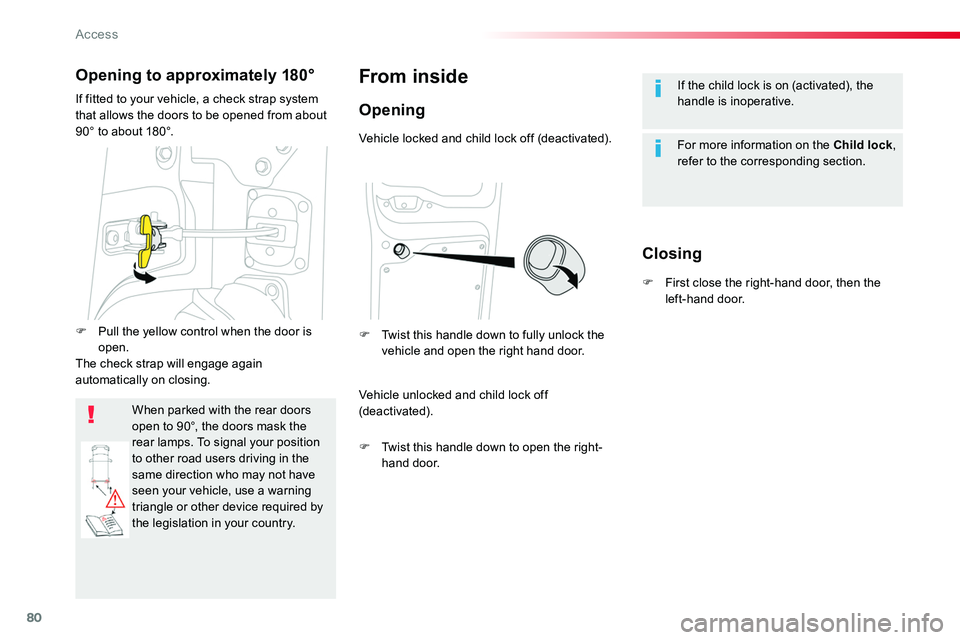
F Twist this handle down to fully unlock the vehicle and open the right hand door.
If fitted to your vehicle, a check strap system that allows the doors to be opened from about 90° to about 180°.
When parked with the rear doors open to 90°, the doors mask the rear lamps. To signal your position to other road users driving in the same direction who may not have seen your vehicle, use a warning triangle or other device required by the legislation in your country.
Opening to approximately 180°
F Pull the yellow control when the door is open.The check strap will engage again automatically on closing.
F First close the right-hand door, then the left-hand door.
Vehicle unlocked and child lock off (deactivated).
F Twist this handle down to open the right-hand door.
Access
Page 117 of 504
117
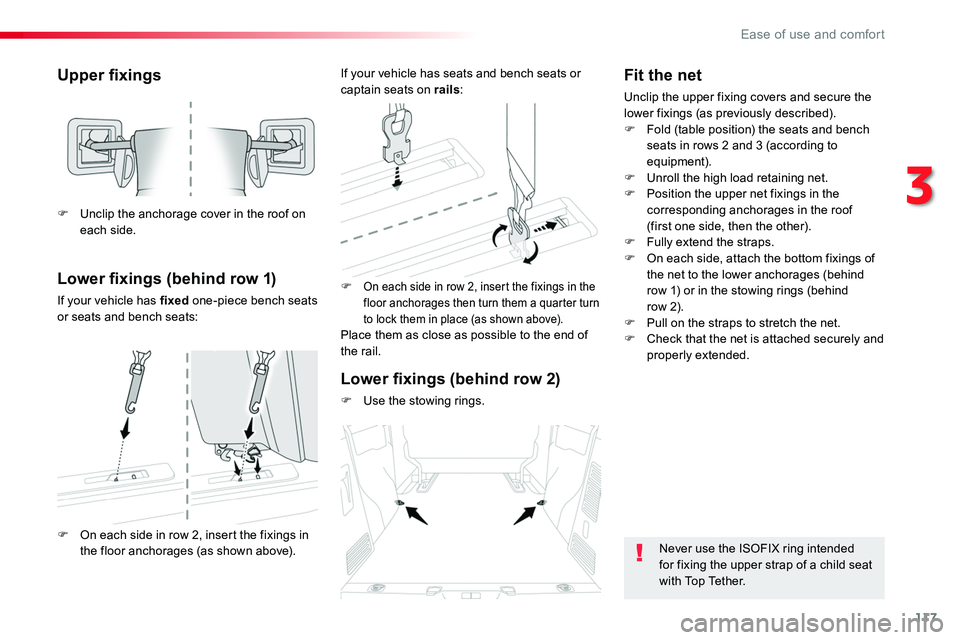
Upper fixings
Lower fixings (behind row 1)
If your vehicle has fixed one-piece bench seats or seats and bench seats:
F On each side in row 2, insert the fixings in the floor anchorages then turn them a quarter turn to lock them in place (as shown above).Place them as close as possible to the end of the rail.
F Unclip the anchorage cover in the roof on
each side.
F On each side in row 2, insert the fixings in the floor anchorages (as shown above).
If your vehicle has seats and bench seats or captain seats on rails:
Lower fixings (behind row 2)
F Use the stowing rings.
Fit the net
Unclip the upper fixing covers and secure the lower fixings (as previously described).F Fold (table position) the seats and bench seats in rows 2 and 3 (according to equipment).F Unroll the high load retaining net.F Position the upper net fixings in the corresponding anchorages in the roof (first one side, then the other).F Fully extend the straps.F On each side, attach the bottom fixings of the net to the lower anchorages (behind row 1) or in the stowing rings (behind row 2).F Pull on the straps to stretch the net.F Check that the net is attached securely and properly extended.
Never use the ISOFIX ring intended for fixing the upper strap of a child seat with Top Tether.
3
Ease of use and comfort