tow TOYOTA PROACE VERSO 2016 User Guide
[x] Cancel search | Manufacturer: TOYOTA, Model Year: 2016, Model line: PROACE VERSO, Model: TOYOTA PROACE VERSO 2016Pages: 504, PDF Size: 81.64 MB
Page 84 of 504
84
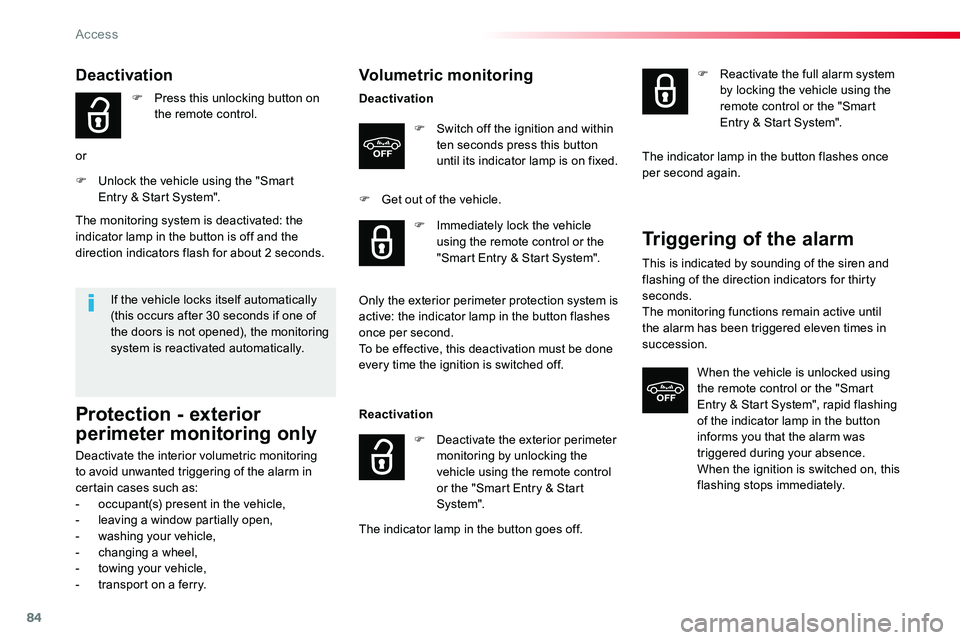
Volumetric monitoring
Deactivation
F Switch off the ignition and within ten seconds press this button until its indicator lamp is on fixed.
F Get out of the vehicle.
Reactivation
The indicator lamp in the button goes off.
F Immediately lock the vehicle using the remote control or the "Smart Entry & Start System".
Only the exterior perimeter protection system is active: the indicator lamp in the button flashes once per second.To be effective, this deactivation must be done every time the ignition is switched off.
F Deactivate the exterior perimeter monitoring by unlocking the vehicle using the remote control or the "Smart Entry & Start System".
F Reactivate the full alarm system by locking the vehicle using the remote control or the "Smart Entry & Start System".
The indicator lamp in the button flashes once per second again.
Triggering of the alarm
This is indicated by sounding of the siren and flashing of the direction indicators for thirty seconds.The monitoring functions remain active until the alarm has been triggered eleven times in succession.
When the vehicle is unlocked using the remote control or the "Smart Entry & Start System", rapid flashing of the indicator lamp in the button informs you that the alarm was triggered during your absence.When the ignition is switched on, this flashing stops immediately.
Deactivation
F Press this unlocking button on the remote control.
or
F Unlock the vehicle using the "Smart Entry & Start System".
If the vehicle locks itself automatically (this occurs after 30 seconds if one of the doors is not opened), the monitoring system is reactivated automatically.
The monitoring system is deactivated: the indicator lamp in the button is off and the direction indicators flash for about 2 seconds.
Protection - exterior
perimeter monitoring only
Deactivate the interior volumetric monitoring to avoid unwanted triggering of the alarm in certain cases such as:- occupant(s) present in the vehicle,- leaving a window partially open,- washing your vehicle,- changing a wheel,- towing your vehicle,- transport on a ferry.
Access
Page 96 of 504
96
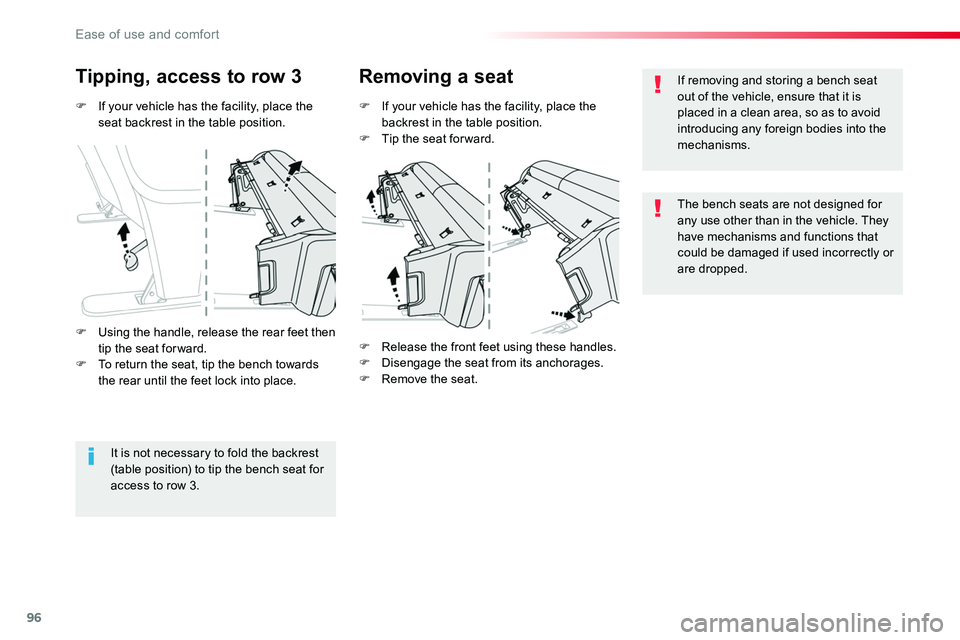
F If your vehicle has the facility, place the seat backrest in the table position.
Tipping, access to row 3Removing a seat
F If your vehicle has the facility, place the backrest in the table position.F Tip the seat for ward.
F Using the handle, release the rear feet then tip the seat for ward.F To return the seat, tip the bench towards the rear until the feet lock into place.
It is not necessary to fold the backrest (table position) to tip the bench seat for access to row 3.
F Release the front feet using these handles.F Disengage the seat from its anchorages.F Remove the seat.
If removing and storing a bench seat out of the vehicle, ensure that it is placed in a clean area, so as to avoid introducing any foreign bodies into the mechanisms.
The bench seats are not designed for any use other than in the vehicle. They have mechanisms and functions that could be damaged if used incorrectly or are dropped.
Ease of use and comfort
Page 97 of 504
97
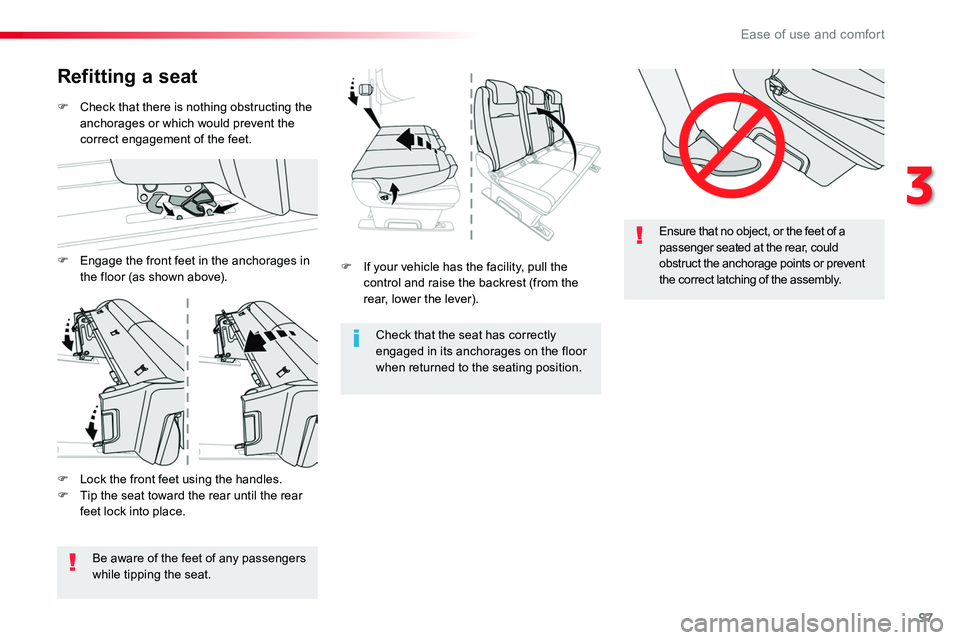
Ensure that no object, or the feet of a passenger seated at the rear, could obstruct the anchorage points or prevent the correct latching of the assembly.F If your vehicle has the facility, pull the control and raise the backrest (from the rear, lower the lever).
Check that the seat has correctly engaged in its anchorages on the floor when returned to the seating position.
Refitting a seat
F Engage the front feet in the anchorages in the floor (as shown above).
F Check that there is nothing obstructing the anchorages or which would prevent the correct engagement of the feet.
F Lock the front feet using the handles.F Tip the seat toward the rear until the rear feet lock into place.
Be aware of the feet of any passengers while tipping the seat.
3
Ease of use and comfort
Page 100 of 504
100
Check that the seat has locked into place on the floor when returning it to the seating position.
Ensure that no object, or the feet of a passenger seated at the rear, could obstruct the anchorage points or prevent the correct latching of the assembly.
Refitting a seat
(example of an individual seat)
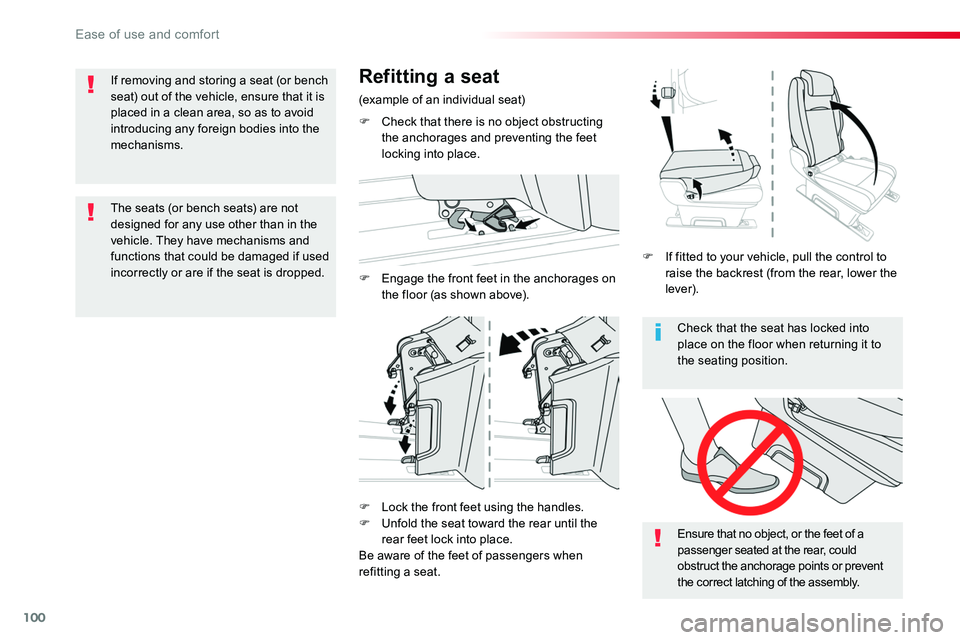
F Check that there is no object obstructing the anchorages and preventing the feet locking into place.
F Engage the front feet in the anchorages on the floor (as shown above).
F Lock the front feet using the handles.F Unfold the seat toward the rear until the rear feet lock into place.Be aware of the feet of passengers when refitting a seat.
F If fitted to your vehicle, pull the control to raise the backrest (from the rear, lower the lever).
If removing and storing a seat (or bench seat) out of the vehicle, ensure that it is placed in a clean area, so as to avoid introducing any foreign bodies into the mechanisms.
The seats (or bench seats) are not designed for any use other than in the vehicle. They have mechanisms and functions that could be damaged if used incorrectly or are if the seat is dropped.
Ease of use and comfort
Page 111 of 504
111
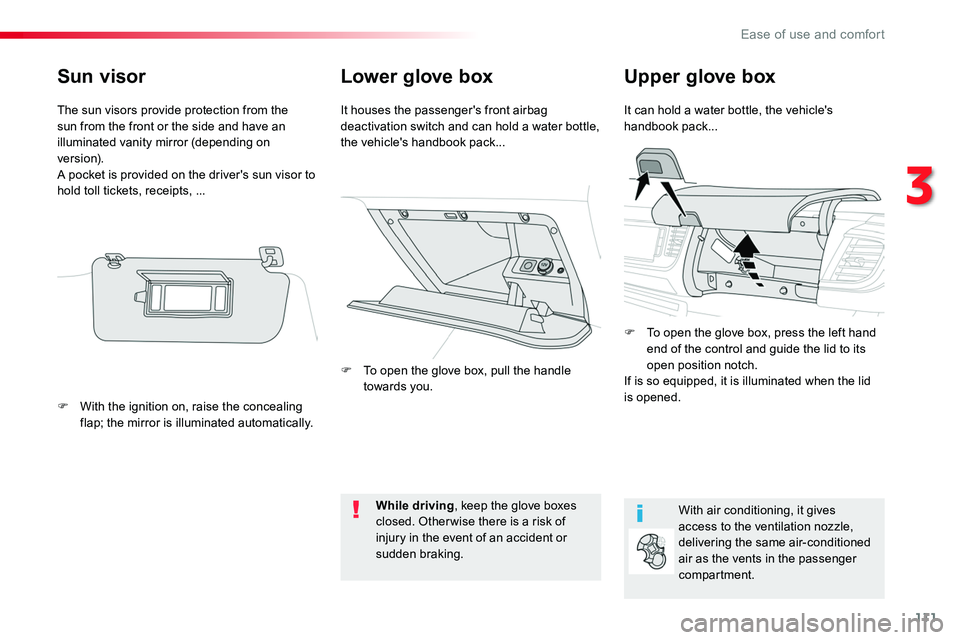
Lower glove boxUpper glove box
It can hold a water bottle, the vehicle's handbook pack...It houses the passenger's front airbag deactivation switch and can hold a water bottle, the vehicle's handbook pack...
With air conditioning, it gives access to the ventilation nozzle, delivering the same air-conditioned air as the vents in the passenger compartment.
While driving, keep the glove boxes closed. Otherwise there is a risk of injury in the event of an accident or sudden braking.
Sun visor
The sun visors provide protection from the sun from the front or the side and have an illuminated vanity mirror (depending on ve r s i o n).A pocket is provided on the driver's sun visor to hold toll tickets, receipts, ...
F With the ignition on, raise the concealing flap; the mirror is illuminated automatically.
F To open the glove box, pull the handle towards you.
F To open the glove box, press the left hand end of the control and guide the lid to its open position notch.If is so equipped, it is illuminated when the lid is opened.
3
Ease of use and comfort
Page 112 of 504
112
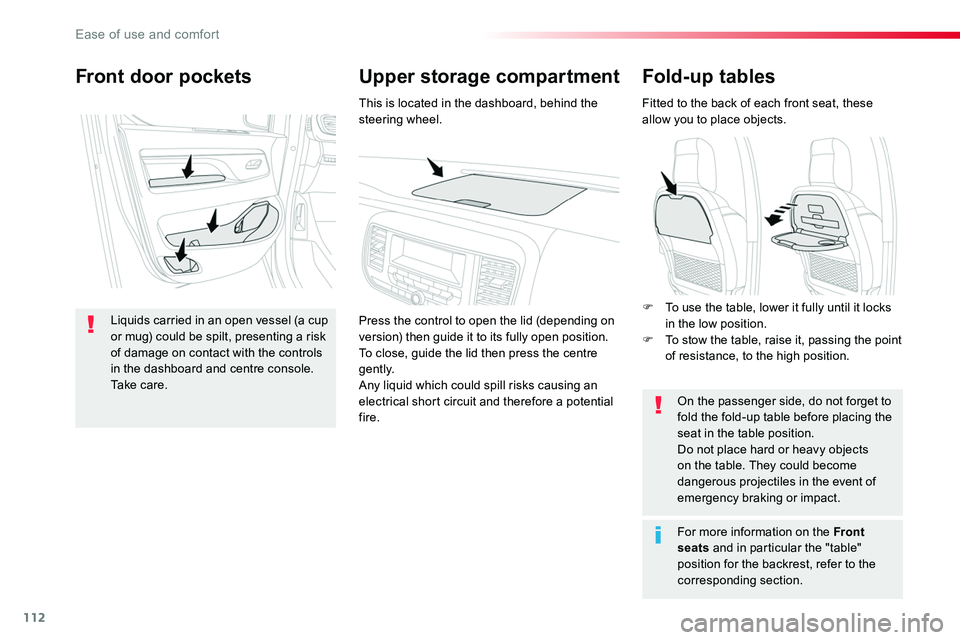
Fold-up tables
Fitted to the back of each front seat, these allow you to place objects.
On the passenger side, do not forget to fold the fold-up table before placing the seat in the table position.Do not place hard or heavy objects on the table. They could become dangerous projectiles in the event of emergency braking or impact.
For more information on the Front
seats and in particular the "table" position for the backrest, refer to the corresponding section.
Upper storage compartmentFront door pockets
Liquids carried in an open vessel (a cup or mug) could be spilt, presenting a risk of damage on contact with the controls in the dashboard and centre console. Ta k e c a r e .
This is located in the dashboard, behind the steering wheel.
Press the control to open the lid (depending on version) then guide it to its fully open position.To close, guide the lid then press the centre g e nt l y.Any liquid which could spill risks causing an electrical short circuit and therefore a potential fire.
F To use the table, lower it fully until it locks in the low position.F To stow the table, raise it, passing the point of resistance, to the high position.
Ease of use and comfort
Page 116 of 504
116
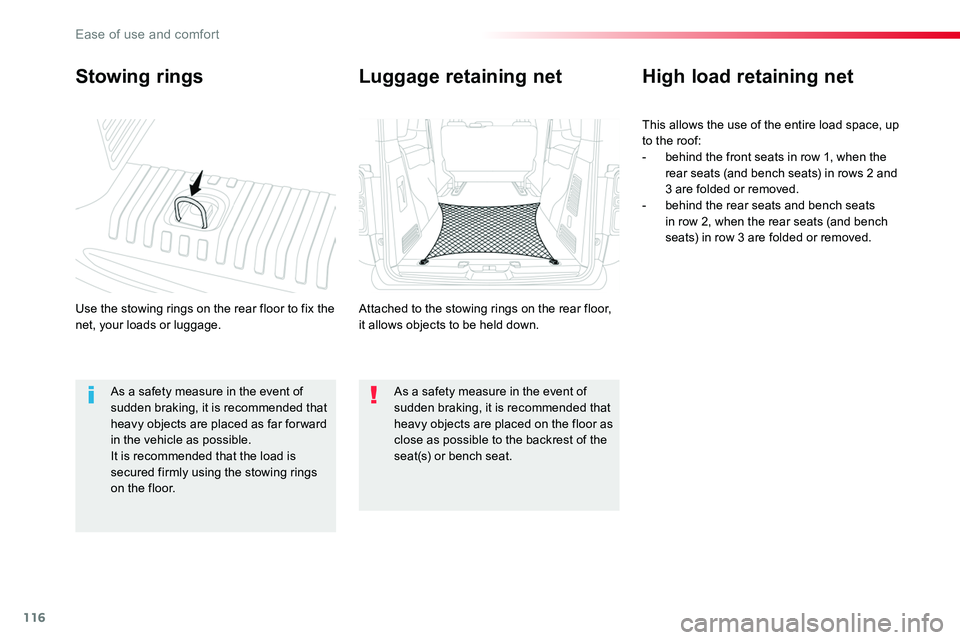
Stowing rings
Use the stowing rings on the rear floor to fix the net, your loads or luggage.
High load retaining net
This allows the use of the entire load space, up to the roof:- behind the front seats in row 1, when the rear seats (and bench seats) in rows 2 and 3 are folded or removed.- behind the rear seats and bench seats in row 2, when the rear seats (and bench seats) in row 3 are folded or removed.
Luggage retaining net
Attached to the stowing rings on the rear floor, it allows objects to be held down.
As a safety measure in the event of sudden braking, it is recommended that heavy objects are placed as far for ward in the vehicle as possible.It is recommended that the load is secured firmly using the stowing rings on the floor.
As a safety measure in the event of sudden braking, it is recommended that heavy objects are placed on the floor as close as possible to the backrest of the seat(s) or bench seat.
Ease of use and comfort
Page 117 of 504
117
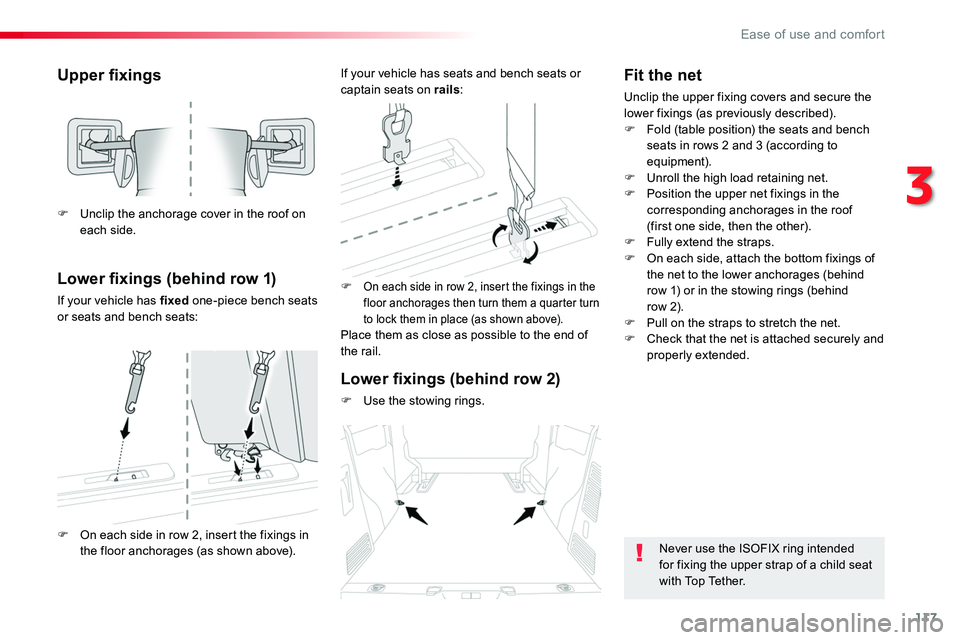
Upper fixings
Lower fixings (behind row 1)
If your vehicle has fixed one-piece bench seats or seats and bench seats:
F On each side in row 2, insert the fixings in the floor anchorages then turn them a quarter turn to lock them in place (as shown above).Place them as close as possible to the end of the rail.
F Unclip the anchorage cover in the roof on
each side.
F On each side in row 2, insert the fixings in the floor anchorages (as shown above).
If your vehicle has seats and bench seats or captain seats on rails:
Lower fixings (behind row 2)
F Use the stowing rings.
Fit the net
Unclip the upper fixing covers and secure the lower fixings (as previously described).F Fold (table position) the seats and bench seats in rows 2 and 3 (according to equipment).F Unroll the high load retaining net.F Position the upper net fixings in the corresponding anchorages in the roof (first one side, then the other).F Fully extend the straps.F On each side, attach the bottom fixings of the net to the lower anchorages (behind row 1) or in the stowing rings (behind row 2).F Pull on the straps to stretch the net.F Check that the net is attached securely and properly extended.
Never use the ISOFIX ring intended for fixing the upper strap of a child seat with Top Tether.
3
Ease of use and comfort
Page 122 of 504
122
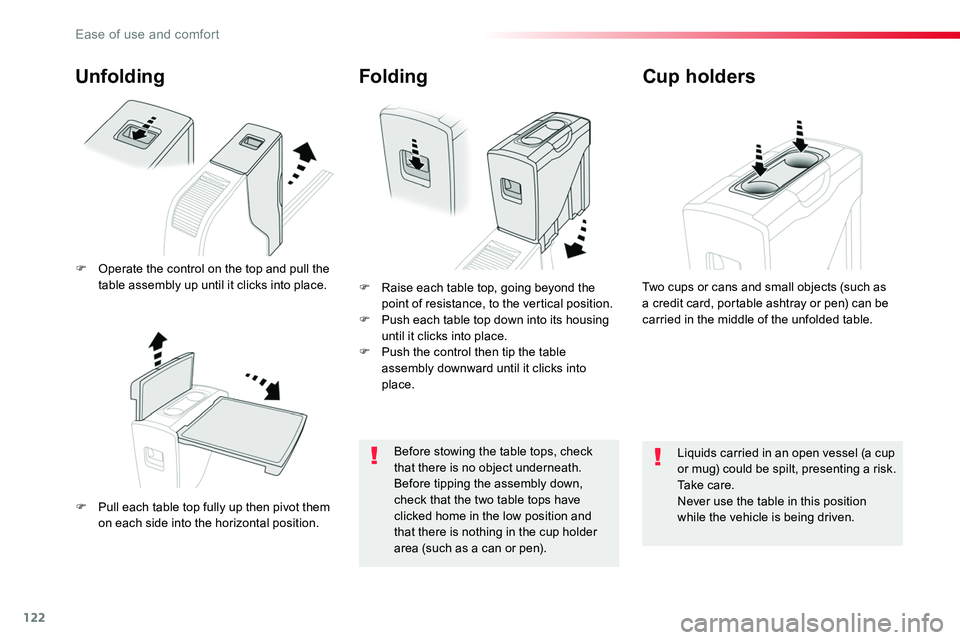
Unfolding
F Pull each table top fully up then pivot them on each side into the horizontal position.
F Raise each table top, going beyond the point of resistance, to the vertical position.F Push each table top down into its housing until it clicks into place.F Push the control then tip the table assembly downward until it clicks into place.
Folding
Before stowing the table tops, check that there is no object underneath. Before tipping the assembly down, check that the two table tops have clicked home in the low position and that there is nothing in the cup holder area (such as a can or pen).
F Operate the control on the top and pull the table assembly up until it clicks into place.
Cup holders
Liquids carried in an open vessel (a cup or mug) could be spilt, presenting a risk. Ta k e c a r e .Never use the table in this position while the vehicle is being driven.
Two cups or cans and small objects (such as a credit card, portable ashtray or pen) can be carried in the middle of the unfolded table.
Ease of use and comfort
Page 124 of 504
124
Take care of passengers' feet when manoeuvring the assembly.
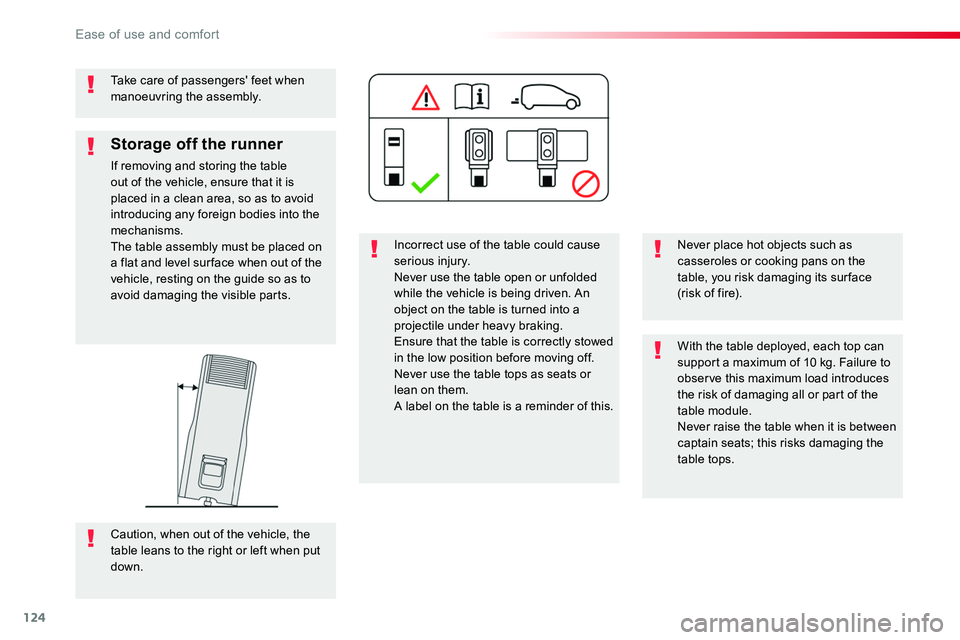
Incorrect use of the table could cause serious injury.Never use the table open or unfolded while the vehicle is being driven. An object on the table is turned into a projectile under heavy braking.Ensure that the table is correctly stowed in the low position before moving off.Never use the table tops as seats or lean on them.A label on the table is a reminder of this.
Never place hot objects such as casseroles or cooking pans on the table, you risk damaging its surface (risk of fire).
With the table deployed, each top can support a maximum of 10 kg. Failure to observe this maximum load introduces the risk of damaging all or part of the table module.Never raise the table when it is between captain seats; this risks damaging the table tops.
Storage off the runner
If removing and storing the table out of the vehicle, ensure that it is placed in a clean area, so as to avoid introducing any foreign bodies into the mechanisms.The table assembly must be placed on a flat and level sur face when out of the vehicle, resting on the guide so as to avoid damaging the visible parts.
Caution, when out of the vehicle, the table leans to the right or left when put down.
Ease of use and comfort