towing TOYOTA PROACE VERSO 2016 User Guide
[x] Cancel search | Manufacturer: TOYOTA, Model Year: 2016, Model line: PROACE VERSO, Model: TOYOTA PROACE VERSO 2016Pages: 504, PDF Size: 81.64 MB
Page 231 of 504
231
Exceeding the programmed
speed
If the programmed speed is exceeded, the displayed speed flashes.Once the vehicle returns to the programmed speed, the display becomes steady again.
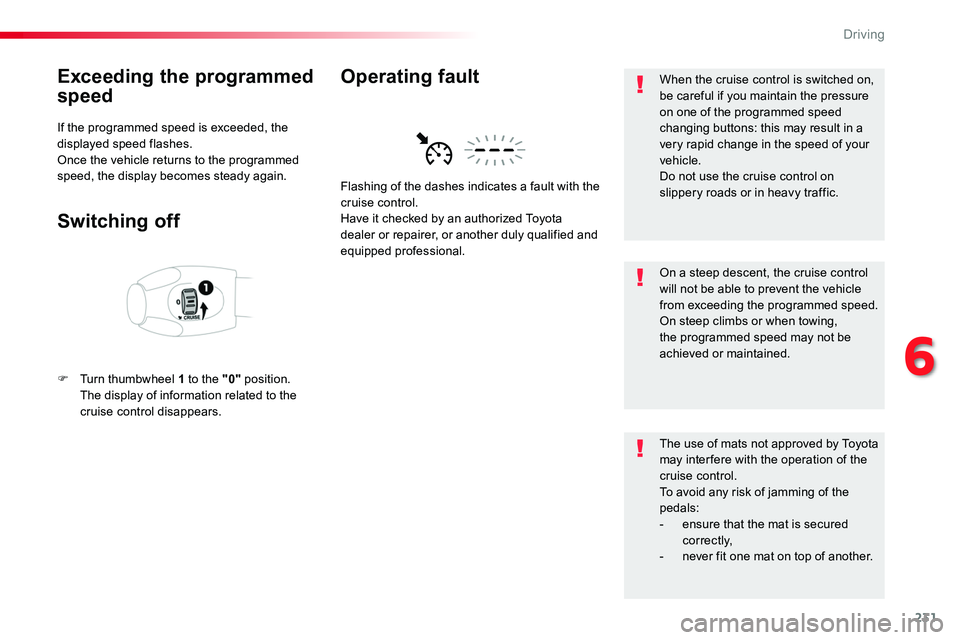
Switching off
F Turn thumbwheel 1 to the "0" position. The display of information related to the cruise control disappears.
Flashing of the dashes indicates a fault with the cruise control.Have it checked by an authorized Toyota
dealer or repairer, or another duly qualified and equipped professional.
Operating faultWhen the cruise control is switched on, be careful if you maintain the pressure on one of the programmed speed changing buttons: this may result in a very rapid change in the speed of your vehicle.Do not use the cruise control on slippery roads or in heavy traffic.
On a steep descent, the cruise control will not be able to prevent the vehicle from exceeding the programmed speed.On steep climbs or when towing, the programmed speed may not be achieved or maintained.
The use of mats not approved by Toyota may inter fere with the operation of the cruise control.To avoid any risk of jamming of the pedals:- ensure that the mat is secured c o r r e c t l y,- never fit one mat on top of another.
6
Driving
Page 238 of 504
238
In the event of a fault with the adaptive cruise control, you are alerted by an audible signal and display of the message message "Driving aid functions fault".Have the system checked by an authorized Toyota dealer or repairer, or another duly qualified and equipped professional.
Operating faultThe adaptive cruise control operates by day and at night, in fog or moderate rainfall.
When the cruise control is working, take care if making a maintained press on one of the cruise control programmed speed modification buttons: this can lead to a very quick change in the speed of your vehicle.Do not use the adaptive cruise control on slippery sur faces or in heavy traffic.
When descending a steep hill, the cruise control may not be able to prevent the vehicle from exceeding the programmed speed.When ascending a steep hill or when towing, it might not be possible to achieve or maintain the programmed speed.
The use of mats not approved by Toyota may inter fere with the operation of the adaptive cruise control.To avoid any risk of jamming the pedals:- ensure that mats are secured c o r r e c t l y,- never fit one mat on top of another.It is recommended that you always keep
your feet close to the pedals.
If the difference between the programmed speed setting and the speed of the vehicle in front is too great, the speed cannot be adjusted: the cruise control is automatically deactivated.
The system does not act on the braking system, but works only with engine braking.The regulation range is limited: there will no longer be any adjustment of speed if the difference between the programmed speed setting and the speed of the vehicle in front becomes too high.
The adaptive cruise control cannot in any circumstances replace the observation of speed limits, nor the need for the vigilance on the part of the driver.
Driving
Page 240 of 504
240
The Autonomous emergency braking system does not operate:- if the front bumper is damaged,- if the system has been triggered in the last 10 seconds,- if the electronic stability control system has a fault.
Limits of operation
It is recommended that the system be deactivated in the vehicle configuration menu in the following cases:- if the windscreen has impact damage close to the detection camera,- when towing a trailer or caravan,- when a load on the roof rack extends beyond the windscreen (for example: long objects),- when the vehicle is being towed, with the engine running,- when a "space-saver" type spare wheel is fitted (if your vehicle has one),- when on a rolling road for a service in a workshop,- when in an automatic car wash,- if the brake lamps are not working.
Following an impact, the system is automatically disabled; contact an authorized Toyota dealer or repairer, or another duly qualified and equipped professional to have the system checked.
Forward collision warning
Depending on the degree of risk of collision detected by the system and the alert threshold chosen, different levels of alert can be triggered and displayed in the instrument panel or the head-up display.
This level of alert is based on the inter-vehicle time between your vehicle and the vehicle ahead.
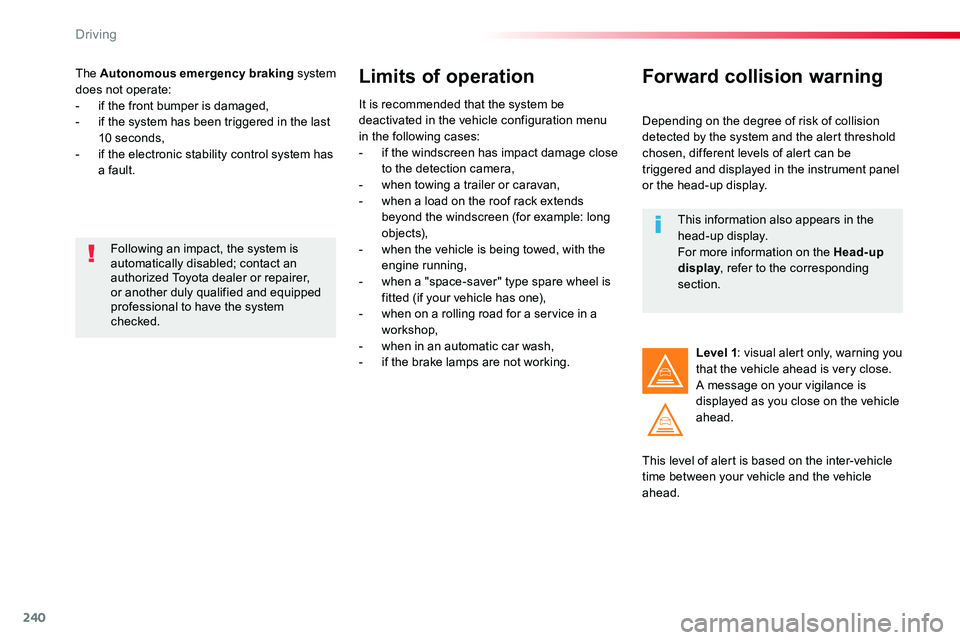
Level 1: visual alert only, warning you that the vehicle ahead is very close.A message on your vigilance is displayed as you close on the vehicle ahead.
This information also appears in the head-up display.For more information on the Head-up display, refer to the corresponding section.
Driving
Page 251 of 504
251
Operating fault
Have it checked by an authorized Toyota dealer or repairer, or another duly qualified and equipped professional.
The system may suffer temporary interference in certain weather conditions (rain, hail...).In particular, driving on a wet sur face or moving from a dry area to a wet area can cause false alerts (for example, the presence of a fog of water droplets in the blind spot angle is interpreted as a vehicle).In bad or wintry weather, ensure that the sensors are not covered by mud, ice or snow.Take care not to cover the warning zone in the door mirrors or the detection zones on the front and rear bumpers with adhesive labels or other objects; they may hamper the correct operation of the system.
Depending on your vehicle's equipment:
With the touch screen
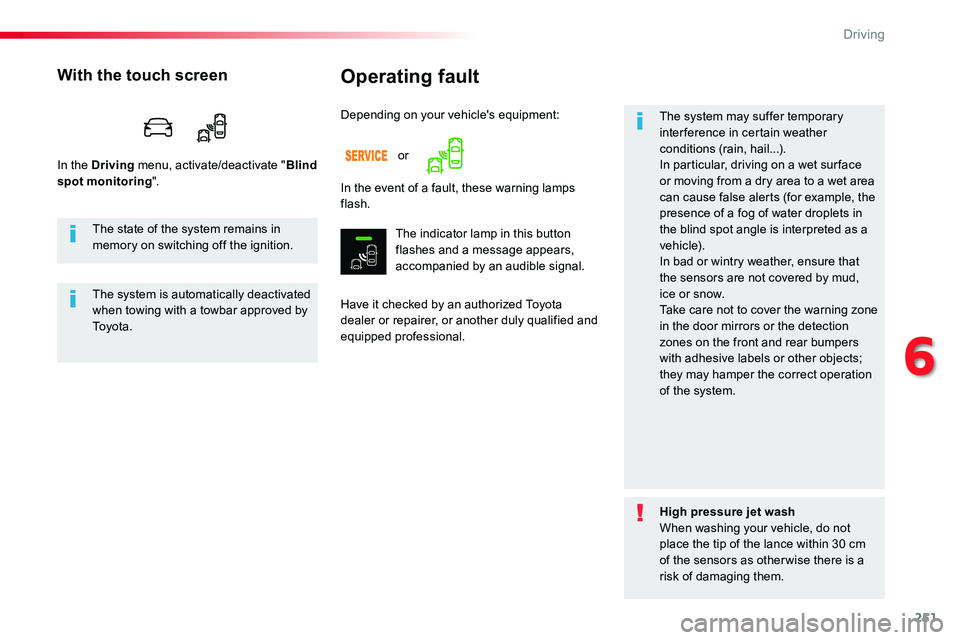
In the Driving menu, activate/deactivate "Blind spot monitoring".In the event of a fault, these warning lamps flash.
The indicator lamp in this button flashes and a message appears, accompanied by an audible signal.
The state of the system remains in memory on switching off the ignition.
The system is automatically deactivated when towing with a towbar approved by To y o t a .
High pressure jet washWhen washing your vehicle, do not place the tip of the lance within 30 cm of the sensors as otherwise there is a risk of damaging them.
or
6
Driving
Page 257 of 504
257
Activation
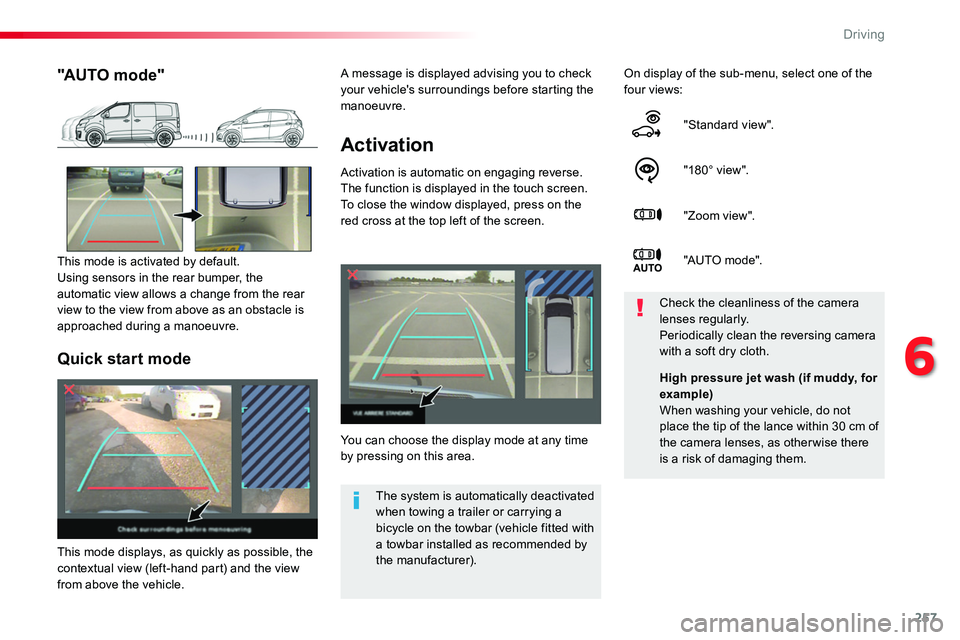
Activation is automatic on engaging reverse.The function is displayed in the touch screen. To close the window displayed, press on the red cross at the top left of the screen.
On display of the sub-menu, select one of the four views:
"Standard view".
"180° view".
"Zoom view".
"AUTO mo de".
You can choose the display mode at any time by pressing on this area.
Check the cleanliness of the camera lenses regularly.Periodically clean the reversing camera with a soft dry cloth.
"AUTO mode"
This mode is activated by default.Using sensors in the rear bumper, the automatic view allows a change from the rear view to the view from above as an obstacle is approached during a manoeuvre.
The system is automatically deactivated when towing a trailer or carrying a bicycle on the towbar (vehicle fitted with a towbar installed as recommended by the manufacturer).
Quick start mode
This mode displays, as quickly as possible, the contextual view (left-hand part) and the view from above the vehicle.
High pressure jet wash (if muddy, for example)When washing your vehicle, do not place the tip of the lance within 30 cm of the camera lenses, as otherwise there is a risk of damaging them.
A message is displayed advising you to check your vehicle's surroundings before starting the manoeuvre.
6
Driving
Page 265 of 504
265
Towing a trailer
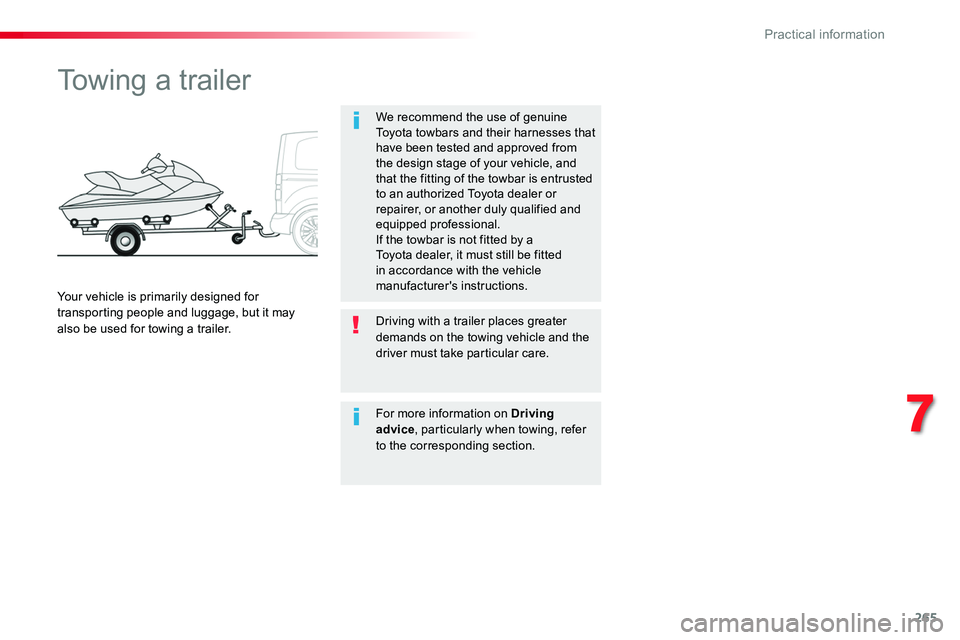
We recommend the use of genuine Toyota towbars and their harnesses that have been tested and approved from the design stage of your vehicle, and that the fitting of the towbar is entrusted to an authorized Toyota dealer or repairer, or another duly qualified and equipped professional.If the towbar is not fitted by a Toyota dealer, it must still be fitted in accordance with the vehicle manufacturer's instructions.Your vehicle is primarily designed for transporting people and luggage, but it may also be used for towing a trailer.Driving with a trailer places greater demands on the towing vehicle and the driver must take particular care.
For more information on Driving advice, particularly when towing, refer to the corresponding section.
7
Practical information
Page 282 of 504
282
Warning triangle (stowing)
Before leaving your vehicle to set up and install the triangle, switch on the hazard warning lamps and put on your
high visibility vest.
This safety equipment should be used in addition to the hazard warning lamps.Its presence in the vehicle is mandatory.
Placing the triangle in the
road
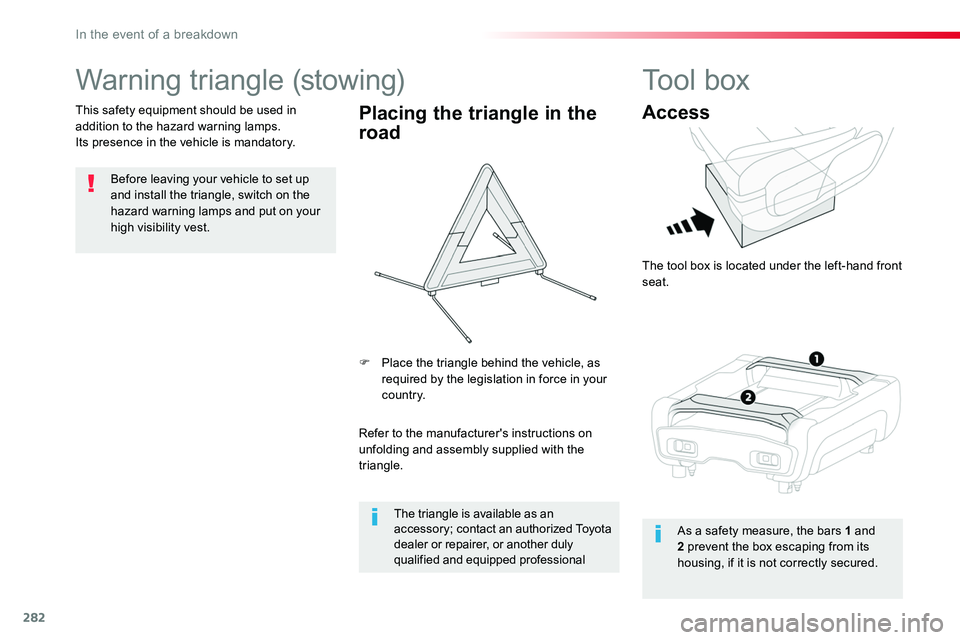
Refer to the manufacturer's instructions on unfolding and assembly supplied with the triangle.
F Place the triangle behind the vehicle, as required by the legislation in force in your c o unt r y.
The triangle is available as an accessory; contact an authorized Toyota dealer or repairer, or another duly qualified and equipped professional
Tool box
Access
The tool box is located under the left-hand front seat.
As a safety measure, the bars 1 and
2 prevent the box escaping from its housing, if it is not correctly secured.
In the event of a breakdown
Page 283 of 504
283
Stowing
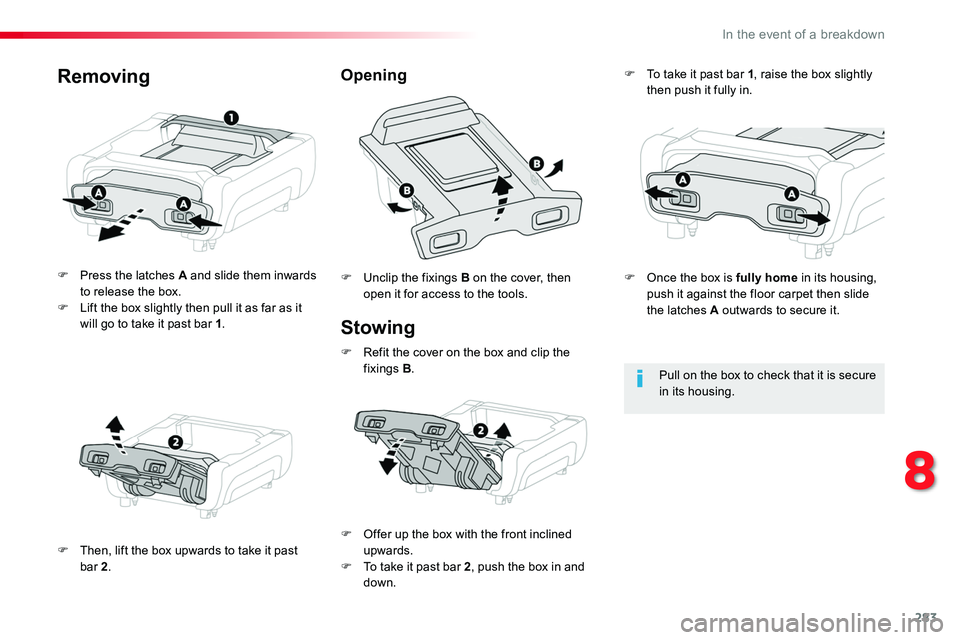
F Press the latches A and slide them inwards to release the box.F Lift the box slightly then pull it as far as it will go to take it past bar 1.
F Then, lift the box upwards to take it past bar 2.
F Unclip the fixings B on the cover, then open it for access to the tools.
OpeningRemoving
Pull on the box to check that it is secure in its housing.
F Offer up the box with the front inclined upwards.F To take it past bar 2, push the box in and down.
F To take it past bar 1, raise the box slightly then push it fully in.
F Refit the cover on the box and clip the fixings B.
F Once the box is fully home in its housing, push it against the floor carpet then slide the latches A outwards to secure it.
8
In the event of a breakdown
Page 284 of 504
284
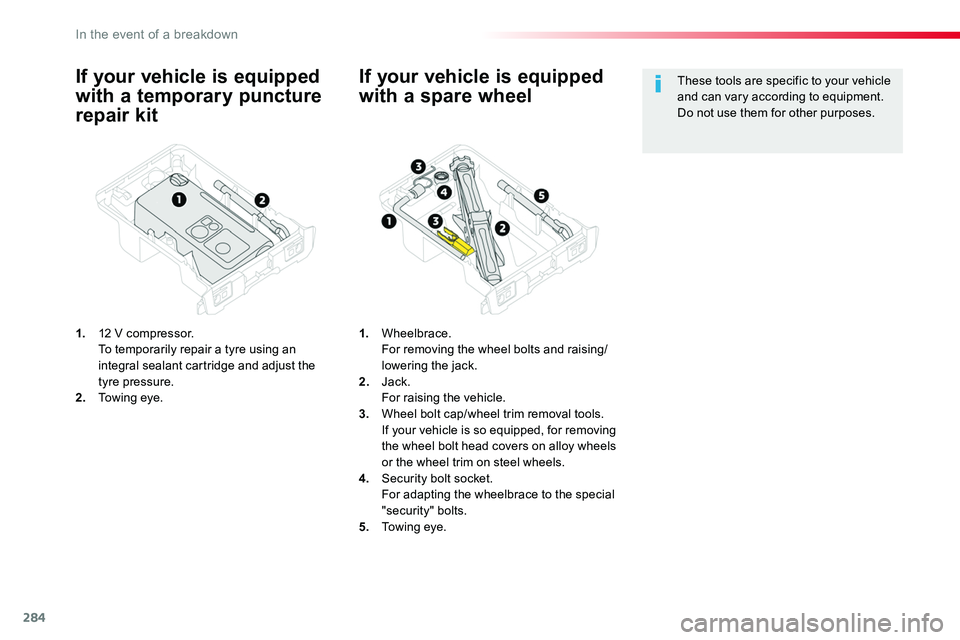
If your vehicle is equipped
with a temporary puncture
repair kit
1. 12 V compressor. To temporarily repair a tyre using an integral sealant cartridge and adjust the tyre pressure.2. Towing eye.
If your vehicle is equipped
with a spare wheel
1. Wheelbrace. For removing the wheel bolts and raising/lowering the jack.2. Jack. For raising the vehicle.3. Wheel bolt cap/wheel trim removal tools. If your vehicle is so equipped, for removing the wheel bolt head covers on alloy wheels or the wheel trim on steel wheels.4. Security bolt socket. For adapting the wheelbrace to the special "security" bolts.5. Towing eye.
These tools are specific to your vehicle and can vary according to equipment. Do not use them for other purposes.
In the event of a breakdown
Page 285 of 504
285
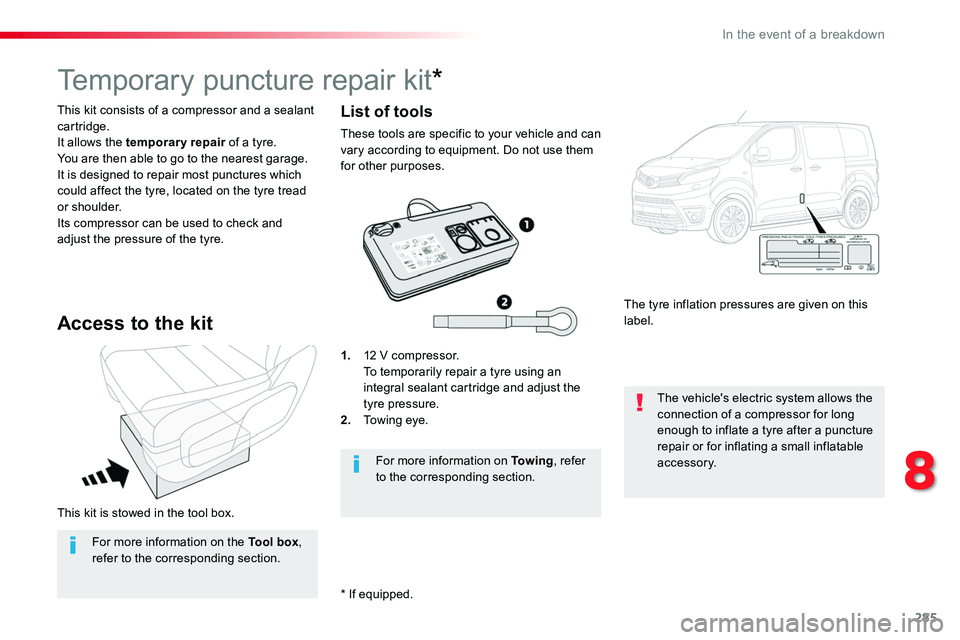
This kit is stowed in the tool box.
This kit consists of a compressor and a sealant cartridge.It allows the temporary repair of a tyre.You are then able to go to the nearest garage.It is designed to repair most punctures which could affect the tyre, located on the tyre tread or shoulder.Its compressor can be used to check and adjust the pressure of the tyre.
Temporary puncture repair kit*
Access to the kit
1. 12 V compressor. To temporarily repair a tyre using an integral sealant cartridge and adjust the tyre pressure.2. Towing eye.
The tyre inflation pressures are given on this label.
The vehicle's electric system allows the connection of a compressor for long
enough to inflate a tyre after a puncture repair or for inflating a small inflatable accessory.For more information on To w i n g, refer to the corresponding section.
List of tools
These tools are specific to your vehicle and can vary according to equipment. Do not use them for other purposes.
For more information on the Tool box, refer to the corresponding section.
* If equipped.
8
In the event of a breakdown