instrument panel TOYOTA RAV4 1996 Service Repair Manual
[x] Cancel search | Manufacturer: TOYOTA, Model Year: 1996, Model line: RAV4, Model: TOYOTA RAV4 1996Pages: 1632, PDF Size: 41.64 MB
Page 6 of 1632
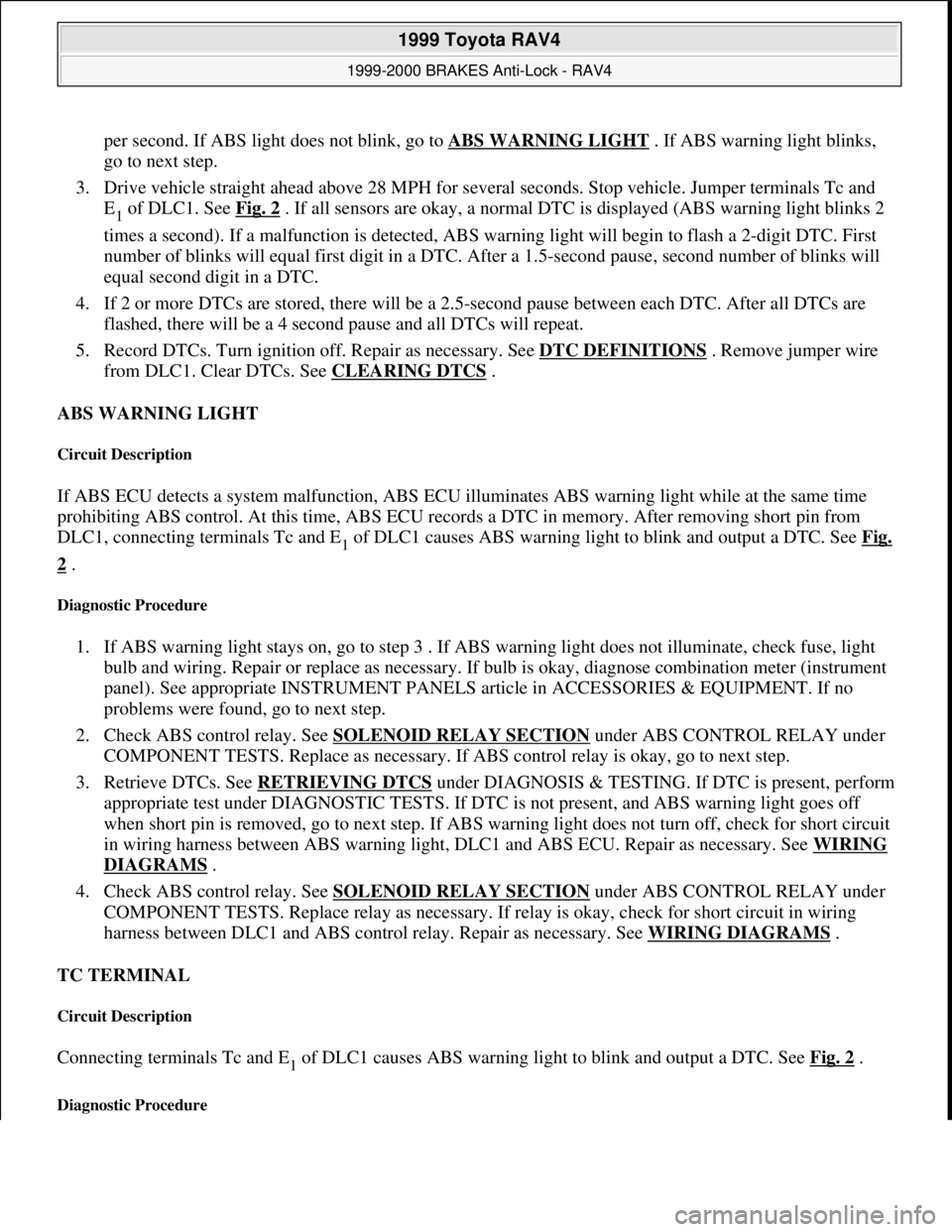
per second. If ABS light does not blink, go to ABS WARNING LIGHT. If ABS warning light blinks,
go to next step.
3. Drive vehicle straight ahead above 28 MPH for several seconds. Stop vehicle. Jumper terminals Tc and
E
1 of DLC1. See Fig. 2 . If all sensors are okay, a normal DTC is displayed (ABS warning light blinks 2
times a second). If a malfunction is detected, ABS warning light will begin to flash a 2-digit DTC. First
number of blinks will equal first digit in a DTC. After a 1.5-second pause, second number of blinks will
equal second digit in a DTC.
4. If 2 or more DTCs are stored, there will be a 2.5-second pause between each DTC. After all DTCs are
flashed, there will be a 4 second pause and all DTCs will repeat.
5. Record DTCs. Turn ignition off. Repair as necessary. See DTC DEFINITIONS
. Remove jumper wire
from DLC1. Clear DTCs. See CLEARING DTCS
.
ABS WARNING LIGHT
Circuit Description
If ABS ECU detects a system malfunction, ABS ECU illuminates ABS warning light while at the same time
prohibiting ABS control. At this time, ABS ECU records a DTC in memory. After removing short pin from
DLC1, connecting terminals Tc and E
1 of DLC1 causes ABS warning light to blink and output a DTC. See Fig.
2 .
Diagnostic Procedure
1. If ABS warning light stays on, go to step 3 . If ABS warning light does not illuminate, check fuse, light
bulb and wiring. Repair or replace as necessary. If bulb is okay, diagnose combination meter (instrument
panel). See appropriate INSTRUMENT PANELS article in ACCESSORIES & EQUIPMENT. If no
problems were found, go to next step.
2. Check ABS control relay. See SOLENOID RELAY SECTION
under ABS CONTROL RELAY under
COMPONENT TESTS. Replace as necessary. If ABS control relay is okay, go to next step.
3. Retrieve DTCs. See RETRIEVING DTCS
under DIAGNOSIS & TESTING. If DTC is present, perform
appropriate test under DIAGNOSTIC TESTS. If DTC is not present, and ABS warning light goes off
when short pin is removed, go to next step. If ABS warning light does not turn off, check for short circuit
in wiring harness between ABS warning light, DLC1 and ABS ECU. Repair as necessary. See WIRING
DIAGRAMS .
4. Check ABS control relay. See SOLENOID RELAY SECTION
under ABS CONTROL RELAY under
COMPONENT TESTS. Replace relay as necessary. If relay is okay, check for short circuit in wiring
harness between DLC1 and ABS control relay. Repair as necessary. See WIRING DIAGRAMS
.
TC TERMINAL
Circuit Description
Connecting terminals Tc and E1 of DLC1 causes ABS warning light to blink and output a DTC. See Fig. 2 .
Diagnostic Procedure
1999 Toyota RAV4
1999-2000 BRAKES Anti-Lock - RAV4
Microsoft
Sunday, November 22, 2009 10:06:17 AMPage 6 © 2005 Mitchell Repair Information Company, LLC.
Page 10 of 1632
wiring harness between ABS control relay and DLC1. Repair or replace as necessary. See WIRING
DIAGRAMS .
2. If ABS warning light is on, go to next step. If ABS warning light is off, check for open or short circuit in
wiring harness between ECU-IG fuse and ABS ECU. Repair as necessary. See WIRING DIAGRAMS
.
3. Start engine and check charging system voltage. If voltage is 10-16 volts, go to next step. If voltage is not
10-16 volts, diagnose charging system. Repair as necessary.
4. Turn ignition off. Disconnect appropriate ABS ECU connector supporting IG1 terminal. See Fig. 3
. Turn
ignition switch to ON position. Ensure ABS warning light turns off. If light turns off, replace ABS ECU.
If light does not turn off, check for short circuit in wiring harness between combination meter (instrument
panel) and ABS ECU, or between combination meter and DLC1. Repair as necessary. See WIRING
DIAGRAMS .
DIAGNOSTIC TESTS
DTC 11 & DTC 12: ABS CONTROL (SOLENOID) RELAY CIRCUIT
Circuit Description
This relay supplies power to each ABS solenoid. After ignition switch is turned to ON position, if initial check
is okay, this relay turns on. If malfunction occurs in ABS control relay circuit, ABS ECU cuts off current to
ABS control relay and prohibits ABS control.
DTC Detecting Condition
Detection of following conditions may set DTC 11 or DTC 12 if condition occurs for .2 seconds or more:
If voltage at ABS control relay connector terminal A9-1 is less than 1.5 volts and voltage at connector
terminal A9-5 is zero volts, DTC 11 may set.
If voltage at ABS control relay connector terminal A9-1 is 10-14 volts and voltage at connector terminal
A9-5 is 10-14 volts, DTC 12 may set.
Diagnostic Procedure
1. Disconnect ABS control relay 6-pin connector A9, located in engine compartment at front of vehicle. See
Fig. 1
. Measure voltage between connector terminals A9-2 and A9-6. See Fig. 4 . If voltage is 10-14
volts, go to next step. If voltage is not 10-14 volts, repair wiring harness between ground, battery and
ABS control relay.
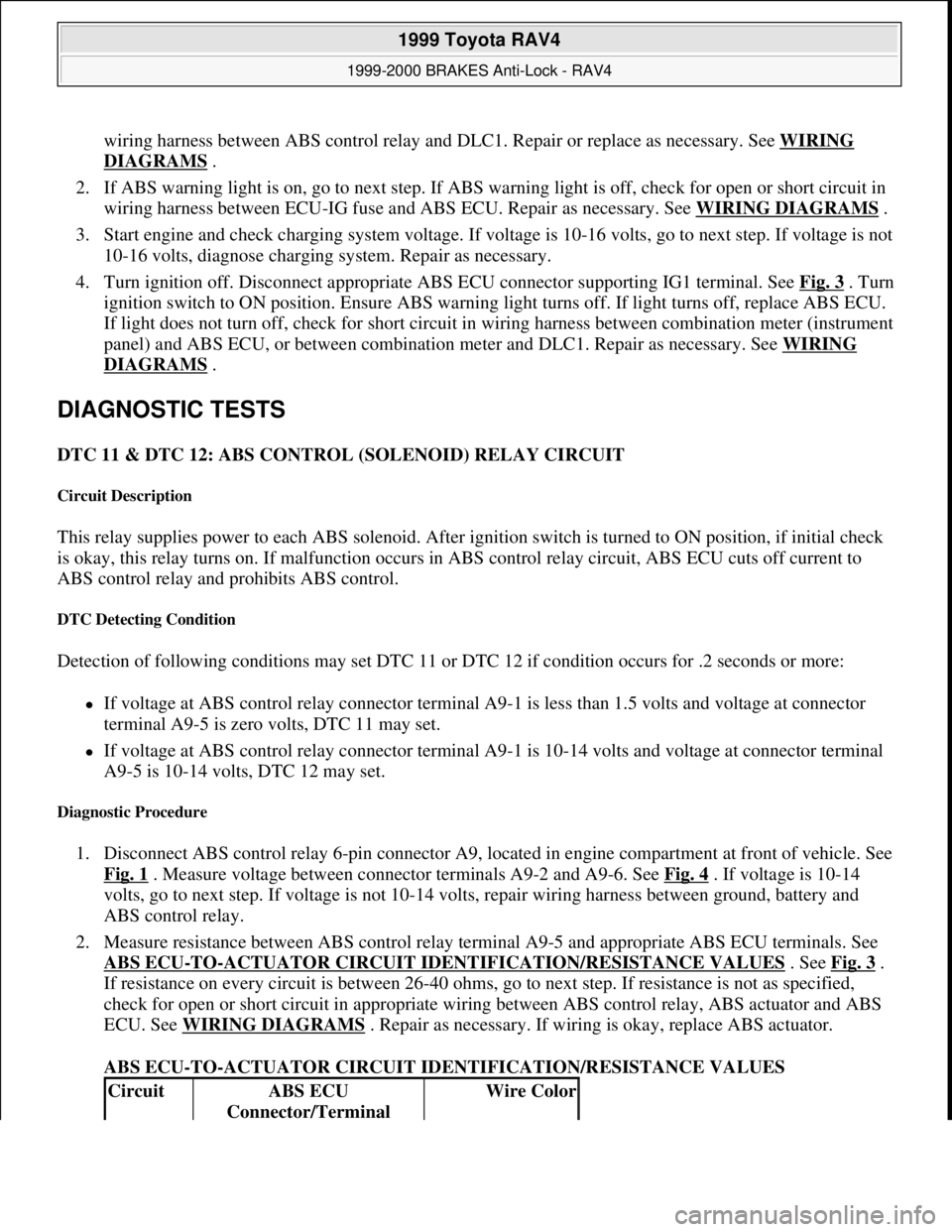
2. Measure resistance between ABS control relay terminal A9-5 and appropriate ABS ECU terminals. See
ABS ECU
-TO-ACTUATOR CIRCUIT IDENTIFICATION/RESISTANCE VALUES . See Fig. 3 .
If resistance on every circuit is between 26-40 ohms, go to next step. If resistance is not as specified,
check for open or short circuit in appropriate wiring between ABS control relay, ABS actuator and ABS
ECU. See WIRING DIAGRAMS
. Repair as necessary. If wiring is okay, replace ABS actuator.
ABS ECU-TO-ACTUATOR CIRCUIT IDENTIFICATION/RESISTANCE VALUES
CircuitABS ECU
Connector/TerminalWire Color
1999 Toyota RAV4
1999-2000 BRAKES Anti-Lock - RAV4
Microsoft
Sunday, November 22, 2009 10:06:17 AMPage 10 © 2005 Mitchell Repair Information Company, LLC.
Page 17 of 1632
DTC Detecting Condition
Detection of the following condition may set DTC 41:
At vehicle speed of about 2 MPH or more, if voltage at ABS ECU terminal IG1 is less than 9.5 volts for
10 seconds or more, DTC 41 may set.
Diagnostic Procedure
1. Check charging system voltage. If voltage is 10-14 volts, system is okay. Go to next step. If voltage is not
10-14 volts, repair charging system. Ensure system fuses are okay.
2. Turn ignition off. Remove ABS ECU. Do not disconnect electrical connectors. Turn ignition switch to
ON position. Measure voltage between terminals IG1 and GND at ABS ECU harness connector. See Fig.
3 . If voltage is 10-14 volts, turn ignition off. Condition may be intermittent. Check ABS ECU connectors
for poor connection or damage. Repair as necessary. If connectors are okay, replace ABS ECU. If voltage
is not as specified, go to next step.
3. Measure resistance between ground and GND terminals at ABS ECU harness connector. See Fig. 3
. If
resistance is one ohm or less, go to next step. If resistance is more than one ohm, repair ground circuit
wiring. See WIRING DIAGRAMS
.
4. Remove ECU-IG fuse from instrument panel junction block. If fuse is blown, check for short circuit in all
wiring harnesses and components connected to ECU-IG fuse (ECM, A/C, cruise control, deceleration
sensor, combination meter, sun roof, shift lock, transmission pattern select switch). See WIRING
DIAGRAMS . Repair as necessary. If fuse is not blown, check for open circuit in wiring harness between
battery and ABS ECU. Repair as necessary.
DTC 43 & DTC 45: DECELERATION SENSOR MALFUNCTION (4WD MODELS ONLY)
DTC Detecting Conditions
Detection of the following conditions may set DTCs 43 or 45:
On 2-door models, if output voltage from deceleration sensor does not change for 16 consecutive times or
more when vehicle speed is decreased from 19 MPH to zero MPH, DTC 43 will set.
On 4-door models, after battery cables are connected, if input from deceleration sensor does not change at
one cycle (zero MPH to 19 MPH or more, then back to zero) for 16 consecutive times, DTC 43 will set.
When brake pedal is not depressed at vehicle speed of 3 MPH or more, and forward and backward force
(force of more than 0.4 "G") is detected for 30 seconds or more, DTC 43 will set.
On 2-door models, at vehicle speed of 19 MPH or more, if deceleration sensor output and vehicle
acceleration from wheel speed remains abnormally different for one minute or more, DTC 45 will set.
Diagnostic Procedure
1. Check deceleration sensor. See DECELERATION SENSOR CHECK under COMPONENT TESTS.
Replace sensor as necessary. If sensor is okay, go to next step.
2. Check for open or short circuit in wiring harness between deceleration sensor and ABS ECU. See
WIRING DIAGRAMS
. Repair as necessary. If wiring harness is okay, replace ABS ECU.
1999 Toyota RAV4
1999-2000 BRAKES Anti-Lock - RAV4
Microsoft
Sunday, November 22, 2009 10:06:17 AMPage 17 © 2005 Mitchell Repair Information Company, LLC.
Page 30 of 1632
against knuckle when bolt is tightened. Tighten wheel speed sensor and brake components to
specification. See TORQUE SPECIFICATIONS
.
ADJUSTMENTS
BRAKE BOOSTER PUSH ROD
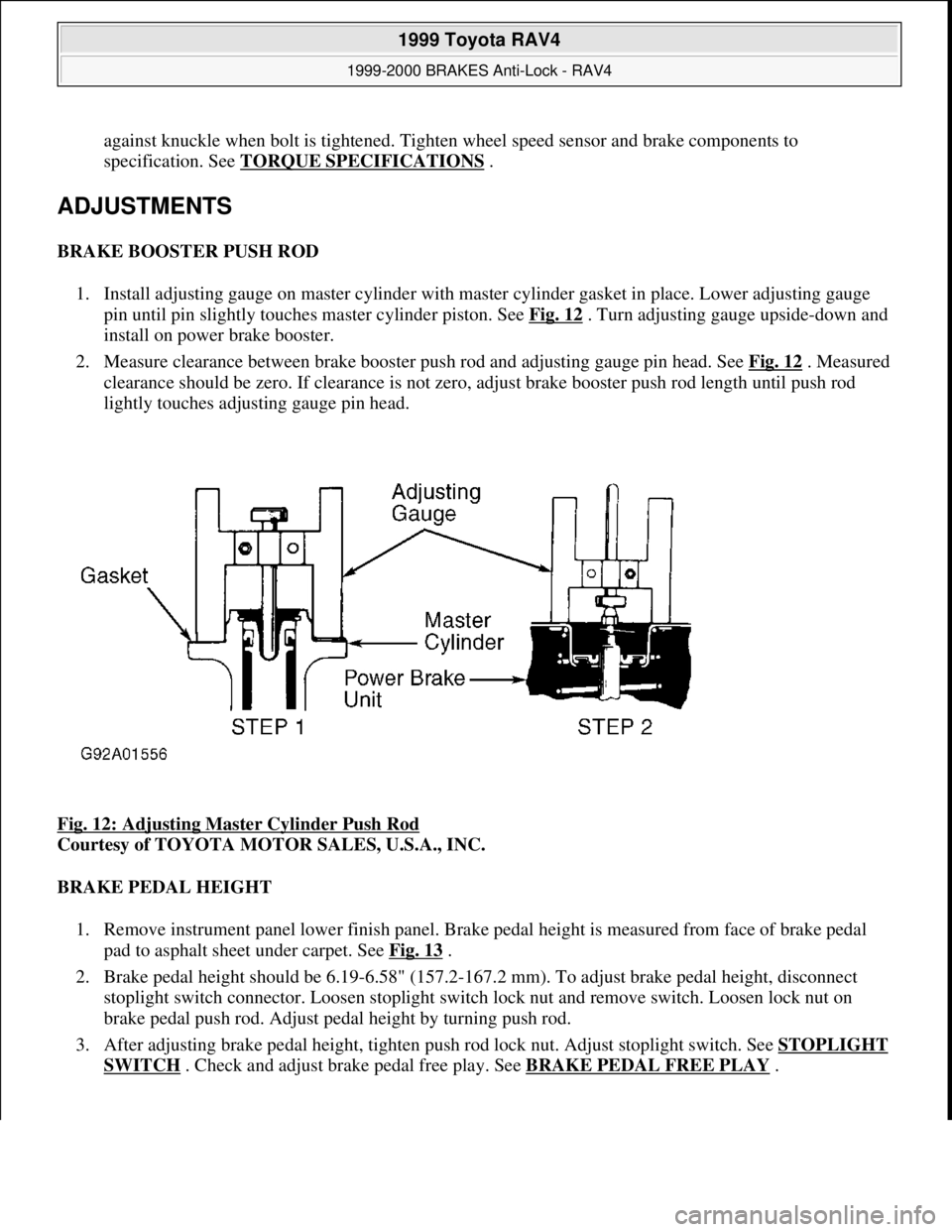
1. Install adjusting gauge on master cylinder with master cylinder gasket in place. Lower adjusting gauge
pin until pin slightly touches master cylinder piston. See Fig. 12
. Turn adjusting gauge upside-down and
install on power brake booster.
2. Measure clearance between brake booster push rod and adjusting gauge pin head. See Fig. 12
. Measured
clearance should be zero. If clearance is not zero, adjust brake booster push rod length until push rod
lightly touches adjusting gauge pin head.
Fig. 12: Adjusting Master Cylinder Push Rod
Courtesy of TOYOTA MOTOR SALES, U.S.A., INC.
BRAKE PEDAL HEIGHT
1. Remove instrument panel lower finish panel. Brake pedal height is measured from face of brake pedal
pad to asphalt sheet under carpet. See Fig. 13
.
2. Brake pedal height should be 6.19-6.58" (157.2-167.2 mm). To adjust brake pedal height, disconnect
stoplight switch connector. Loosen stoplight switch lock nut and remove switch. Loosen lock nut on
brake pedal push rod. Adjust pedal height by turning push rod.
3. After adjusting brake pedal height, tighten push rod lock nut. Adjust stoplight switch. See STOPLIGHT
SWITCH . Check and adjust brake pedal free play. See BRAKE PEDAL FREE PLAY.
1999 Toyota RAV4
1999-2000 BRAKES Anti-Lock - RAV4
Microsoft
Sunday, November 22, 2009 10:06:17 AMPage 30 © 2005 Mitchell Repair Information Company, LLC.
Page 31 of 1632
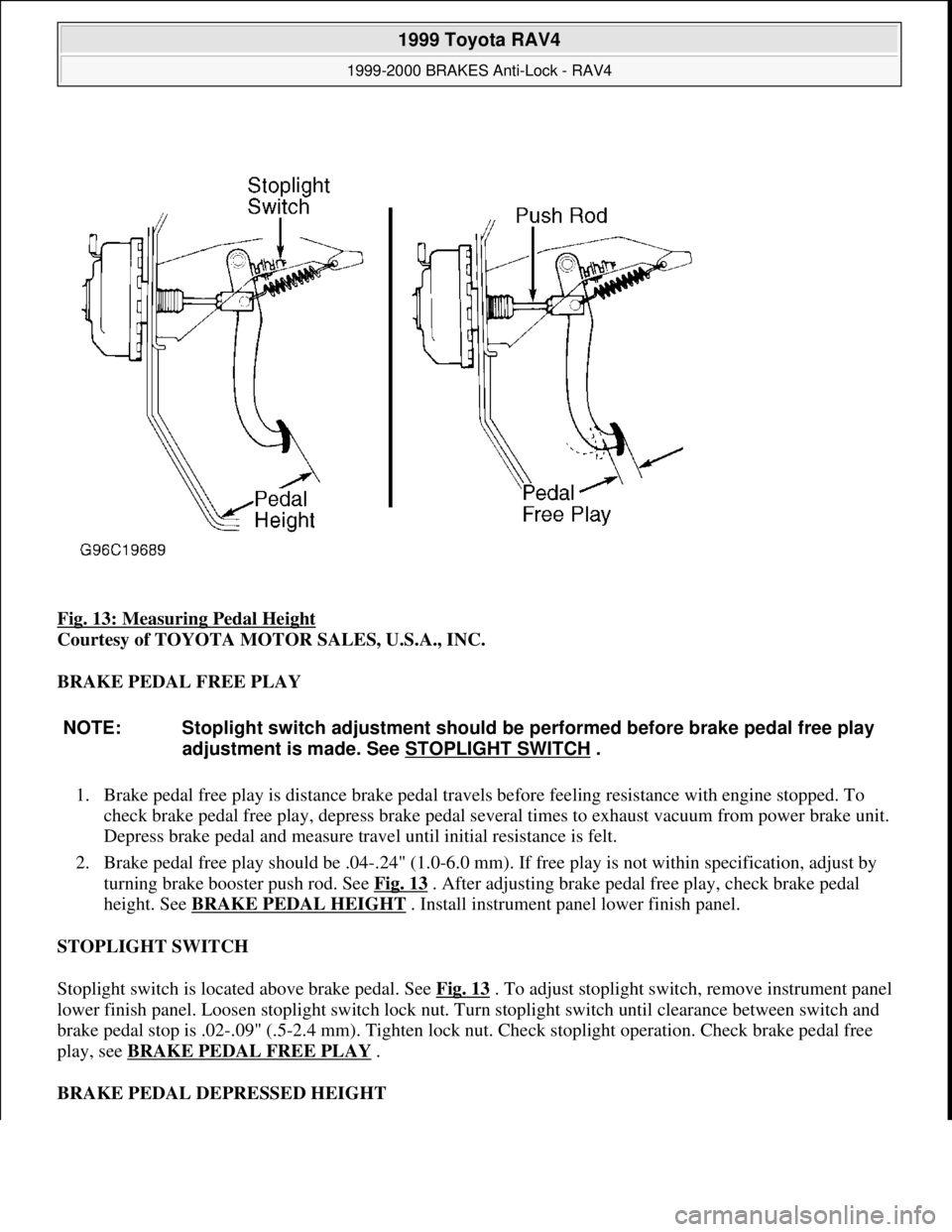
Fig. 13: Measuring Pedal Height
Courtesy of TOYOTA MOTOR SALES, U.S.A., INC.
BRAKE PEDAL FREE PLAY
1. Brake pedal free play is distance brake pedal travels before feeling resistance with engine stopped. To
check brake pedal free play, depress brake pedal several times to exhaust vacuum from power brake unit.
Depress brake pedal and measure travel until initial resistance is felt.
2. Brake pedal free play should be .04-.24" (1.0-6.0 mm). If free play is not within specification, adjust by
turning brake booster push rod. See Fig. 13
. After adjusting brake pedal free play, check brake pedal
height. See BRAKE PEDAL HEIGHT
. Install instrument panel lower finish panel.
STOPLIGHT SWITCH
Stoplight switch is located above brake pedal. See Fig. 13
. To adjust stoplight switch, remove instrument panel
lower finish panel. Loosen stoplight switch lock nut. Turn stoplight switch until clearance between switch and
brake pedal stop is .02-.09" (.5-2.4 mm). Tighten lock nut. Check stoplight operation. Check brake pedal free
play, see BRAKE PEDAL FREE PLAY .
BRAKE PEDAL DEPRESSED HEIGHT
NOTE: Stoplight switch adjustment should be performed before brake pedal free play
adjustment is made. See STOPLIGHT SWITCH
.
1999 Toyota RAV4
1999-2000 BRAKES Anti-Lock - RAV4
Microsoft
Sunday, November 22, 2009 10:06:17 AMPage 31 © 2005 Mitchell Repair Information Company, LLC.
Page 46 of 1632
Removal
1. Before proceeding, follow air bag service precautions. See SERVICE PRECAUTIONS . Ensure front
wheels are in a straight-ahead position. Turn ignition switch to LOCK position. Disconnect and shield
negative battery cable. Wait at least 90 seconds before working on system.
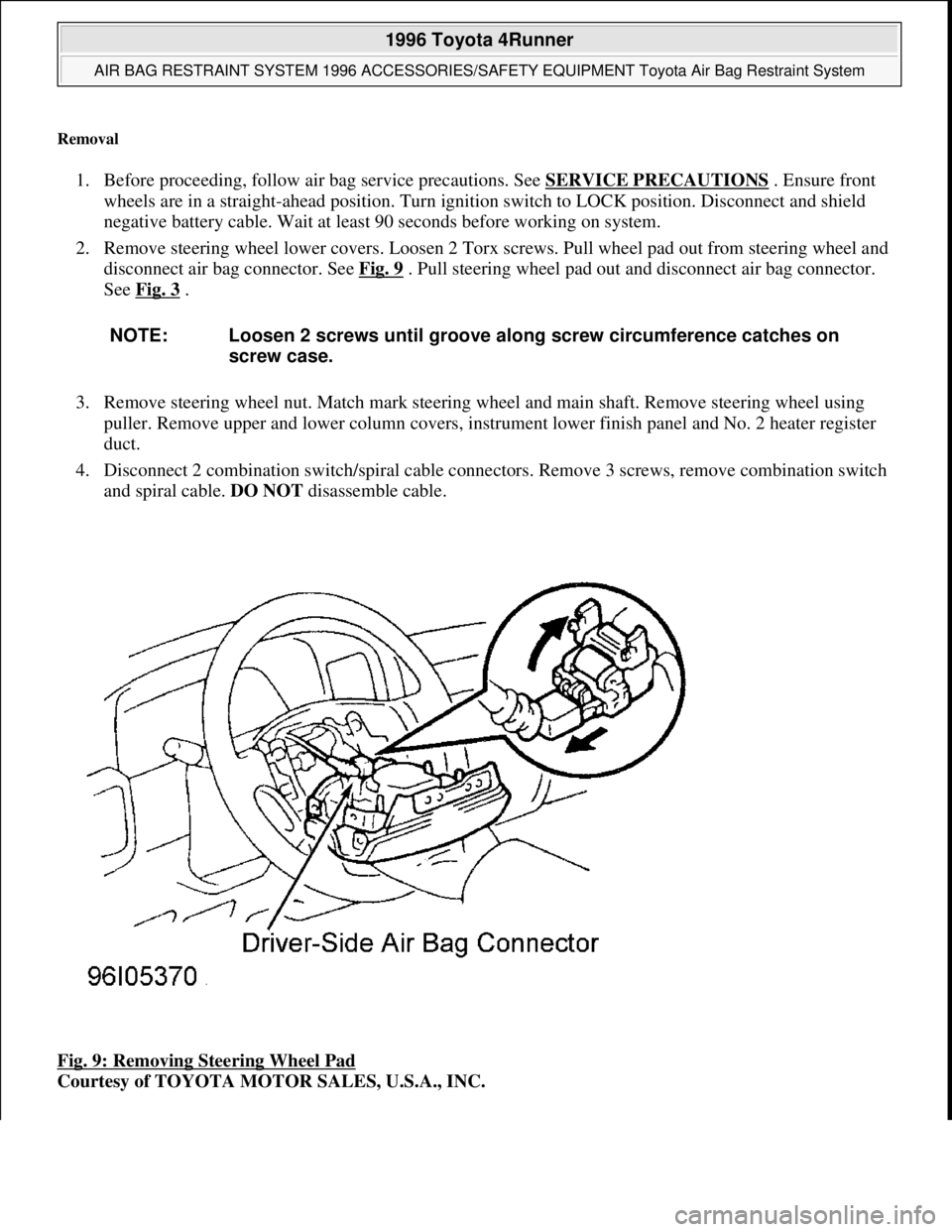
2. Remove steering wheel lower covers. Loosen 2 Torx screws. Pull wheel pad out from steering wheel and
disconnect air bag connector. See Fig. 9
. Pull steering wheel pad out and disconnect air bag connector.
See Fig. 3
.
3. Remove steering wheel nut. Match mark steering wheel and main shaft. Remove steering wheel using
puller. Remove upper and lower column covers, instrument lower finish panel and No. 2 heater register
duct.
4. Disconnect 2 combination switch/spiral cable connectors. Remove 3 screws, remove combination switch
and spiral cable. DO NOT disassemble cable.
Fig. 9: Removing Steering Wheel Pad
Courtesy of TOYOTA MOTOR SALES, U.S.A., INC. NOTE: Loosen 2 screws until groove along screw circumference catches on
screw case.
1996 Toyota 4Runner
AIR BAG RESTRAINT SYSTEM 1996 ACCESSORIES/SAFETY EQUIPMENT Toyota Air Bag Restraint System
Microsoft
Tuesday, August 18, 2009 7:33:32 PMPage 12 © 2005 Mitchell Repair Information Company, LLC.
Page 47 of 1632
Installation
To install, reverse removal procedure. Ensure spiral cable is properly aligned. See SPIRAL CABLE under
ADJUSTMENTS. Connect air bag connector. Tighten 2 Torx screws to specification. See TORQUE
SPECIFICATIONS . Install steering wheel side covers. Perform SYSTEM OPERATION CHECK .
PASSENGER-SIDE AIR BAG
Removal & Installation
1. Before proceeding, follow air bag service precautions. See SERVICE PRECAUTIONS . Turn ignition
switch to LOCK position. Disconnect and shield negative battery cable. Wait at least 90 seconds before
working on system.
2. Disable SRS. See DISABLING & ACTIVATING AIR BAG SYSTEM
. Remove instrument panel.
Remove the 2 bolts securing passenger-side air bag. See Fig. 10
. Remove air bag. Remove 3 bolts and
pry up the 5 air bag door clips and remove the air bag door. See Fig. 11
.
3. To install, reverse removal procedure. Tighten passenger-side air bag bolts to specification. See
TORQUE SPECIFICATIONS
. Activate SRS. See DISABLING & ACTIVATING AIR BAG
SYSTEM . Check air bag warning light to ensure system is functioning properly. See SYSTEM
OPERATION CHECK . WARNING:During installation, if spiral cable mating mark is not properly aligned,
steering wheel may not turn completely, or flat cable inside spiral cable
may be severed, disabling SRS system.
1996 Toyota 4Runner
AIR BAG RESTRAINT SYSTEM 1996 ACCESSORIES/SAFETY EQUIPMENT Toyota Air Bag Restraint System
Microsoft
Tuesday, August 18, 2009 7:33:32 PMPage 13 © 2005 Mitchell Repair Information Company, LLC.
Page 49 of 1632
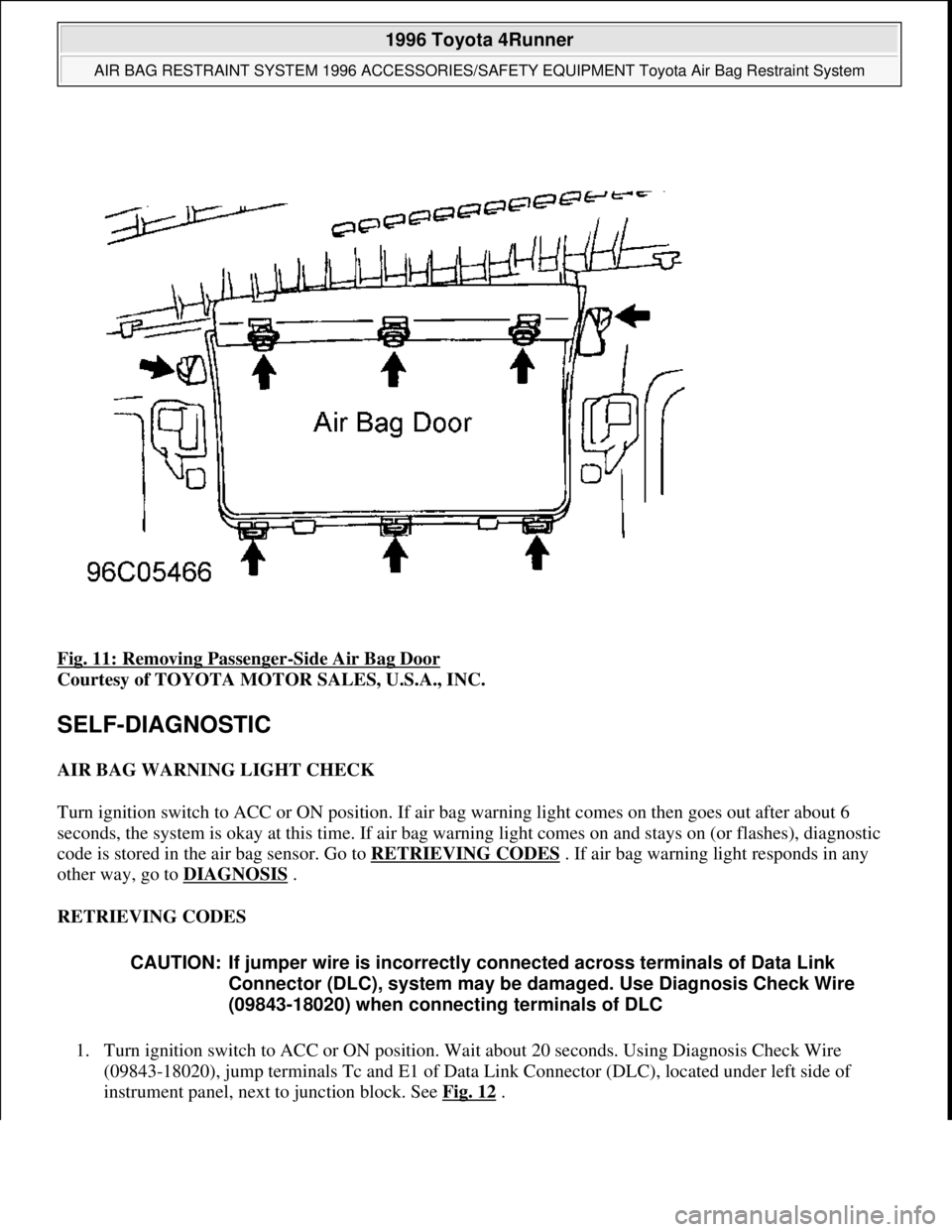
Fig. 11: Removing Passenger-Side Air Bag Door
Courtesy of TOYOTA MOTOR SALES, U.S.A., INC.
SELF-DIAGNOSTIC
AIR BAG WARNING LIGHT CHECK
Turn ignition switch to ACC or ON position. If air bag warning light comes on then goes out after about 6
seconds, the system is okay at this time. If air bag warning light comes on and stays on (or flashes), diagnostic
code is stored in the air bag sensor. Go to RETRIEVING CODES
. If air bag warning light responds in any
other way, go to DIAGNOSIS
.
RETRIEVING CODES
1. Turn ignition switch to ACC or ON position. Wait about 20 seconds. Using Diagnosis Check Wire
(09843-18020), jump terminals Tc and E1 of Data Link Connector (DLC), located under left side of
instrument panel, next to junction block. See Fig. 12
.
CAUTION: If jumper wire is incorrectly connected across terminals of Data Link
Connector (DLC), system may be damaged. Use Diagnosis Check Wire
(09843-18020) when connecting terminals of DLC
1996 Toyota 4Runner
AIR BAG RESTRAINT SYSTEM 1996 ACCESSORIES/SAFETY EQUIPMENT Toyota Air Bag Restraint System
Microsoft
Tuesday, August 18, 2009 7:33:32 PMPage 15 © 2005 Mitchell Repair Information Company, LLC.
Page 60 of 1632
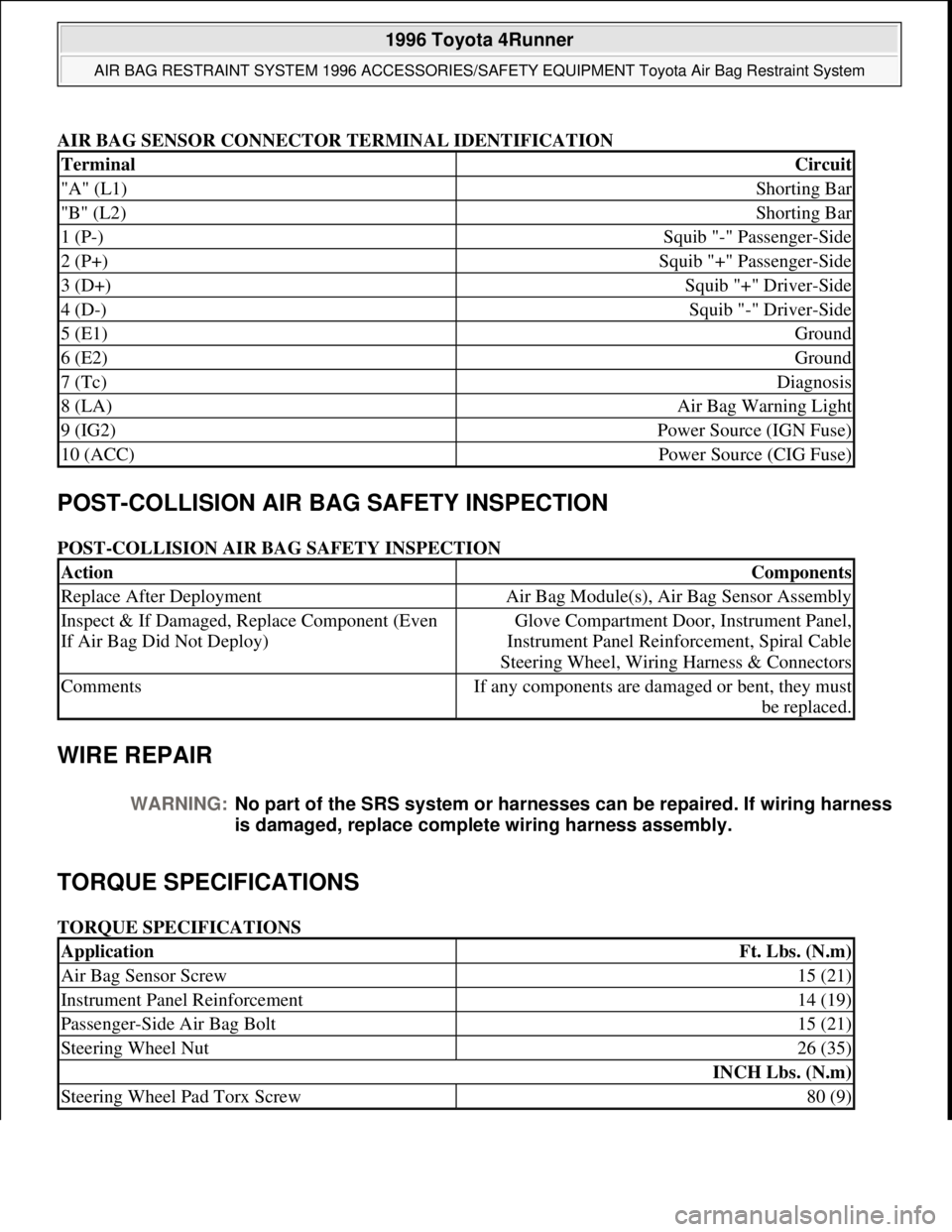
AIR BAG SENSOR CONNECTOR TERMINAL IDENTIFICATION
POST-COLLISION AIR BAG SAFETY INSPECTION
POST-COLLISION AIR BAG SAFETY INSPECTION
WIRE REPAIR
TORQUE SPECIFICATIONS
TORQUE SPECIFICATIONS
TerminalCircuit
"A" (L1)Shorting Bar
"B" (L2)Shorting Bar
1 (P-)Squib "-" Passenger-Side
2 (P+)Squib "+" Passenger-Side
3 (D+)Squib "+" Driver-Side
4 (D-)Squib "-" Driver-Side
5 (E1)Ground
6 (E2)Ground
7 (Tc)Diagnosis
8 (LA)Air Bag Warning Light
9 (IG2)Power Source (IGN Fuse)
10 (ACC)Power Source (CIG Fuse)
ActionComponents
Replace After DeploymentAir Bag Module(s), Air Bag Sensor Assembly
Inspect & If Damaged, Replace Component (Even
If Air Bag Did Not Deploy)Glove Compartment Door, Instrument Panel,
Instrument Panel Reinforcement, Spiral Cable
Steering Wheel, Wiring Harness & Connectors
CommentsIf any components are damaged or bent, they must
be replaced.
WARNING:No part of the SRS system or harnesses can be repaired. If wiring harness
is damaged, replace complete wiring harness assembly.
ApplicationFt. Lbs. (N.m)
Air Bag Sensor Screw15 (21)
Instrument Panel Reinforcement14 (19)
Passenger-Side Air Bag Bolt15 (21)
Steering Wheel Nut26 (35)
INCH Lbs. (N.m)
Steering Wheel Pad Torx Screw80 (9)
1996 Toyota 4Runner
AIR BAG RESTRAINT SYSTEM 1996 ACCESSORIES/SAFETY EQUIPMENT Toyota Air Bag Restraint System
Microsoft
Tuesday, August 18, 2009 7:33:32 PMPage 26 © 2005 Mitchell Repair Information Company, LLC.
Page 65 of 1632
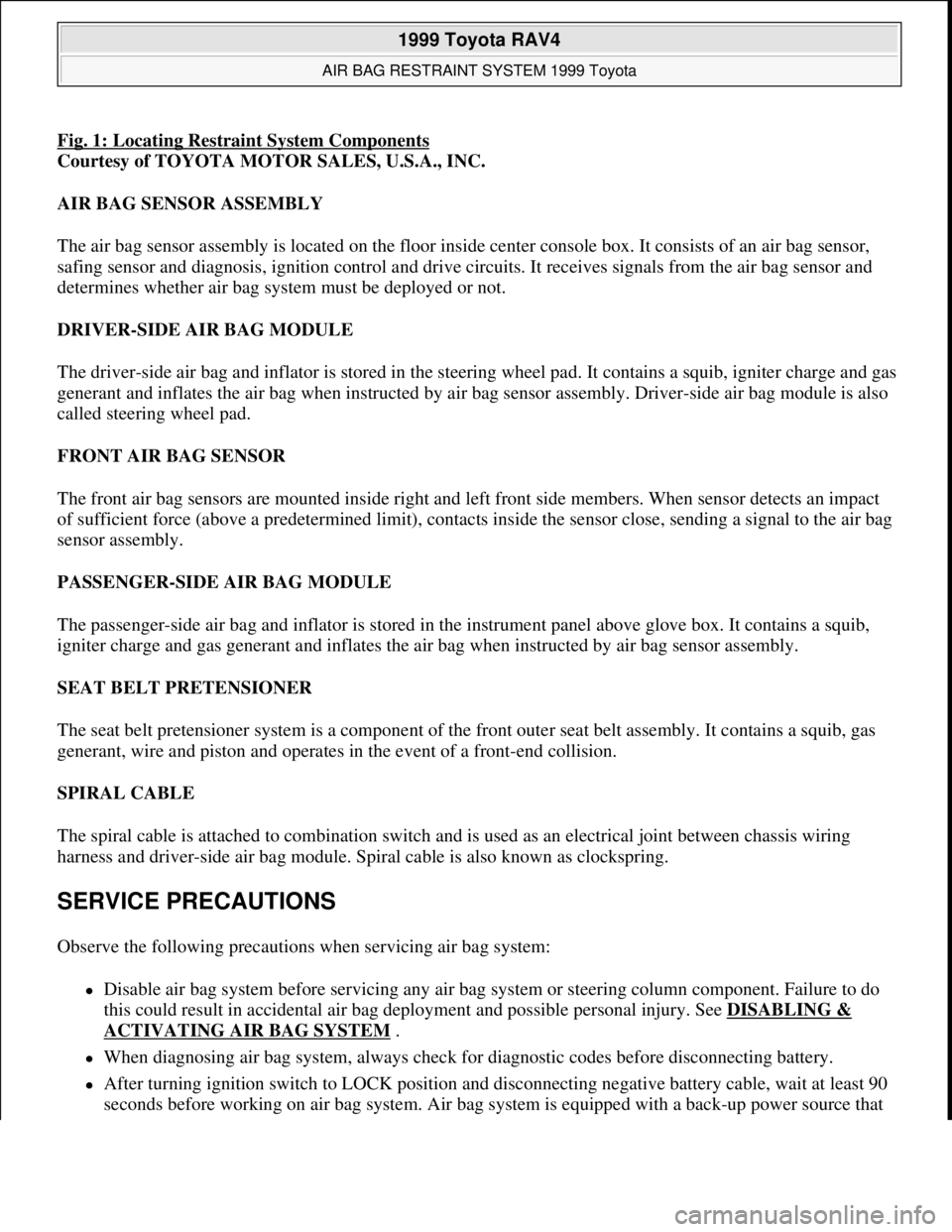
Fig. 1: Locating Restraint System Components
Courtesy of TOYOTA MOTOR SALES, U.S.A., INC.
AIR BAG SENSOR ASSEMBLY
The air bag sensor assembly is located on the floor inside center console box. It consists of an air bag sensor,
safing sensor and diagnosis, ignition control and drive circuits. It receives signals from the air bag sensor and
determines whether air bag system must be deployed or not.
DRIVER-SIDE AIR BAG MODULE
The driver-side air bag and inflator is stored in the steering wheel pad. It contains a squib, igniter charge and gas
generant and inflates the air bag when instructed by air bag sensor assembly. Driver-side air bag module is also
called steering wheel pad.
FRONT AIR BAG SENSOR
The front air bag sensors are mounted inside right and left front side members. When sensor detects an impact
of sufficient force (above a predetermined limit), contacts inside the sensor close, sending a signal to the air bag
sensor assembly.
PASSENGER-SIDE AIR BAG MODULE
The passenger-side air bag and inflator is stored in the instrument panel above glove box. It contains a squib,
igniter charge and gas generant and inflates the air bag when instructed by air bag sensor assembly.
SEAT BELT PRETENSIONER
The seat belt pretensioner system is a component of the front outer seat belt assembly. It contains a squib, gas
generant, wire and piston and operates in the event of a front-end collision.
SPIRAL CABLE
The spiral cable is attached to combination switch and is used as an electrical joint between chassis wiring
harness and driver-side air bag module. Spiral cable is also known as clockspring.
SERVICE PRECAUTIONS
Observe the following precautions when servicing air bag system:
Disable air bag system before servicing any air bag system or steering column component. Failure to do
this could result in accidental air bag deployment and possible personal injury. See DISABLING &
ACTIVATING AIR BAG SYSTEM .
When diagnosing air bag system, always check for diagnostic codes before disconnecting battery.
After turning ignition switch to LOCK position and disconnecting negative battery cable, wait at least 90
seconds before workin
g on air bag system. Air bag system is equipped with a back-up power source that
1999 Toyota RAV4
AIR BAG RESTRAINT SYSTEM 1999 Toyota
Microsoft
Sunday, November 22, 2009 10:33:22 AMPage 2 © 2005 Mitchell Repair Information Company, LLC.