automatic transmission TOYOTA RAV4 1997 Owner's Manual
[x] Cancel search | Manufacturer: TOYOTA, Model Year: 1997, Model line: RAV4, Model: TOYOTA RAV4 1997Pages: 198, PDF Size: 2.59 MB
Page 145 of 198
145
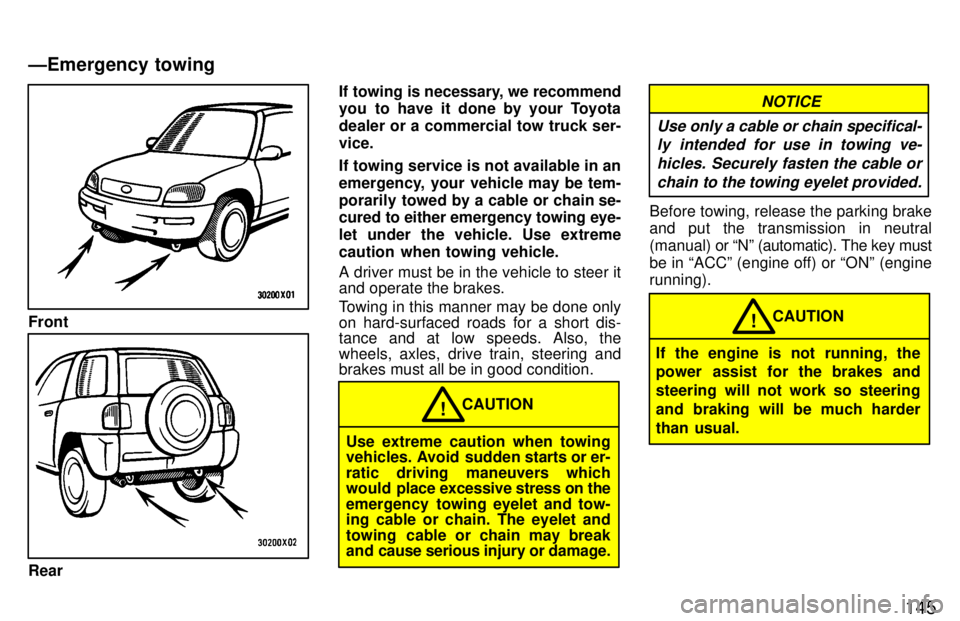
Front
RearIf towing is necessary, we recommend
you to have it done by your Toyota
dealer or a commercial tow truck ser-vice.
If towing service is not available in an
emergency, your vehicle may be tem-
porarily towed by a cable or chain se-
cured to either emergency towing eye-
let under the vehicle. Use extreme
caution when towing vehicle. A driver must be in the vehicle to steer it and operate the brakes.
Towing in this manner may be done only
on hard-surfaced roads for a short dis-
tance and at low speeds. Also, the
wheels, axles, drive train, steering and brakes must all be in good condition.
CAUTION!
Use extreme caution when towing
vehicles. Avoid sudden starts or er- ratic driving maneuvers which
would place excessive stress on the
emergency towing eyelet and tow-ing cable or chain. The eyelet and
towing cable or chain may break
and cause serious injury or damage.
NOTICE
Use only a cable or chain specifical- ly intended for use in towing ve-
hicles. Securely fasten the cable orchain to the towing eyelet provided.
Before towing, release the parking brake
and put the transmission in neutral
(manual) or Nº (automatic). The key must
be in ACCº (engine off) or ONº (engine running).
CAUTION!
If the engine is not running, the
power assist for the brakes and
steering will not work so steering
and braking will be much harder
than usual.
ÐEmergency towing
Page 147 of 198

147
If you cannot shift the selector lever
out of Pº position to other positions
even though the brake pedal is de-pressed, use the shift lock override
button as follows:
1. Turn the ignition key to LOCKºposition. Make sure the parking brake is set.
2. Pry up the cover with a flat-bladed screwdriver or equivalent.3. Insert the screwdriver or equivalent
into the hole to push down the shift
lock override button. You can shift
out of Pº position only while push-
ing the button.
4. Shift into Nº position.
5. Insert the cover.
6. Start the engine. For your safety, keep the brake pedal depressed.
Be sure to have the system checked by
your Toyota dealer as soon as possible. Many Toyota dealers can make a new
key if you can give them the key num-
ber. See the suggestion given in Keysº in Chapter 1-2.
If your keys are locked in the vehicle and
you cannot get a duplicate, many Toyota
dealers
can still open the door for you, us-
ing their special tools. If you must break a
window to get in, we suggest breaking the
smallest side window because it is the least expensive to replace. Be extremely cautious to avoid cuts from the glass.
If you cannot shift automatic transmission selector lever
If you lose your keys
Page 156 of 198

158Automatic transmission Parkº
mech-
anism
Check the lock release button of the se-
lector lever for proper and smooth opera-
tion. On a safe incline, check that your ve-
hicle is held securely with the selector lever in ºPº position and all brakes re- leased.
IN THE ENGINE COMPARTMENT Items listed below should be checked
from time to time , e.g. each time when
refueling.
Washer fluid
Make sure there is sufficient fluid in the
tank. See Chapter 7-3 for additional infor-
mation.
Engine coolant level Make sure the coolant level is between
the ºFULLº and ºLOWº lines on the see-
through reservoir when the engine is cold.
See Chapter 7-2 for additional informa-tion.
Battery electrolyte level Make sure the electrolyte level of all bat-
tery cells is between upper and lower level
lines on the case. Add only distilled water
when replenishing. See Chapter 7-3 for
additional information. Brake fluid level
Make sure the brake fluid level is correct. See Chapter 7-2 for additional informa-tion.
Engine oil level
Check the l
evel on the dipstick with the en-
gine turned off and the vehicle parked on
a level spot. See Chapter 7-2 for addition-
al information. Power steering fluid level Check the level through the reservoir. The
level should be in the HOTº or COLDº
range depending on the fluid t emperature.
See Chapter 7-2 for additional informa- tion.
Exhaust system
If you notice any change in the sound of
the exhaust or smell exhaust fumes, have the cause located and corrected immedi-
ately. (See engine exhaust cautions in
Part 2.) Be on the alert for changes in perfor-
mance, sounds, and visual tip-offs
that in-
dicate service is needed. Some important
clues are as follows: Engine missing, stumbling, or pinging
Appreciable loss of power
Strange engine noises
A leak under the vehicle (however, wa-
ter dripping from the air conditioning
after use is normal.)
Change in exhaust sound (This may
indicate a dangerous carbon monox-
ide leak. Drive with the windows open
and have the exhaust system checked
immediately.)
Flat-looking tire; excessive tire squeal
when cornering; uneven tire wear
Vehicle pulls to one side when drivingstraight on a level road
Strange noises related to suspensionmovement
Loss of brake effectiveness; spongy
feeling brake or clutch pedal; pedal al-
most touches floor; vehicle pulls to one
side when braking
Engine coolant temperature continual-
ly higher than normal
Does your vehicle need repairing?
Page 162 of 198
165
Be sure that the ignition is off if
you work near the electric cooling
fans or radiator grille. With the
ignition on, the electric cooling
fans will automatically start to run
if the engine coolant temperature
is high and/or the air conditioning
is on.
Use eye protection whenever you
work on or under you vehicle
where you may be exposed to fly-
ing or falling material, fluid spray,etc.
Used engine oil contains poten-
tially harmful contaminants which
may cause skin disorders such as
inflammation or skin cancer, so
care should be taken to avoid pro-
longed and repeated contact with
it. To remove used engine oil from
your skin, wash thoroughly with
soap and water.
Do not leave used oil within the reach of children.Dispose of used oil and filter only
in a safe and acceptable manner.
Do not dispose of used oil and fil-
ter in household trash, in sewers
or onto the ground. Call your deal- er or a service station for informa-
tion concerning recycling or dis- posal.
Remember that battery and igni- tion cable carry high currents or
voltages. Be careful of accidental-
ly causing a short circuit.
Add only demineralized or dis- tilled water to fill the radiator. And
if you spill some of the coolant, be sure to wash it off with water to
prevent it from damaging theparts or paint.
Do not allow dirt or anything elseto fall through the spark plug
holes.
Do not pry the outer electrode of aspark plug against the center elec-
trode.
Use only spark plugs of the speci- fied type. Using other types will
cause engine damage, loss of per-
formance or radio noise.
NOTICE
Do not overfill automatic trans-
mission fluid and transfer oil or
the transmission and transfercould be damaged.
Do not drive with the air cleaner fil-
ter removed, or excessive enginewear could result. Also backfiringcould cause a fire in the engine
compartment.
Be careful not to scratch the glasssurface with the wiper frame.
When closing the engine hood,
check to see that you have not for-
gotten any tools, rags, etc.
Page 163 of 198

166Here is a list of parts and tools you will
need on performing do-it-yourself main-
tenance. Remember all Toyota parts are
designed in metric sizes, so your tools
must be metric. Checking the engine oil level Parts (if level is low):
Engine oil API SH, Energy-Conserv-
ing IIº multigrade or ILSAC multigrade
having viscosity proper for your cli-mate
Tools: Rag or paper towel
Funnel (only for adding oil)
Checking the engine coolant level Parts (if level is low): Ethylene-glycol antifreeze
Demineralized or distilled water
Tools: Funnel (only for adding coolant)
Checking brake fluid Parts (if level is low): SAE J1703 or FMVSS No. 116 DOT 3 brake fluid Tools:
Rag or paper towel
Funnel (only for adding fluid)
Checking power steering fluid Parts (if level is low): Automatic transmission fluid DEX- RON [
-II or III
Tools: Rag or paper towel
Funnel (only for adding fluid)
Checking battery condition Non-maintenance batteriesÐ
Tools: Warm water
Baking soda
Grease
Conventional wrench (for terminal clamp bolts)
Maintenance type batteriesÐ Parts (if level is low): Distilled water Tools:
Warm water
Baking soda
Grease
Conventional wrench (for terminal clamp bolts)
Coin (for vent plugs)
Funnel (only for adding distilled water)
Checking and replacing fuses Parts (if replacement is necessary): Fuse with same amperage rating as original
Tools: Screwdriver (for driver's side instru-
ment lower panel nut)
Conventional wrench (for passenger's
side kick panel nut)
Adding washer fluid Parts: Water
Washer fluid containing antifreeze (for winter use)
Parts and tools
Page 168 of 198
172line. This brings the fluid to the correct
level when you put the cover back on.
Use only newly opened brake fluid. Once
opened, brake fluid absorbs moisture
from the air, and excess moisture can cause a dangerous loss of braking.
CAUTION!
Take care when filling the reservoir
because brake fluid can harm your
eyes and damage painted surfaces.
If fluid gets in your eyes, flush your
eyes with clean water.
If you spill the fluid, be sure to wash it off with water to prevent it from
damaging the parts or paint.
NOTICE
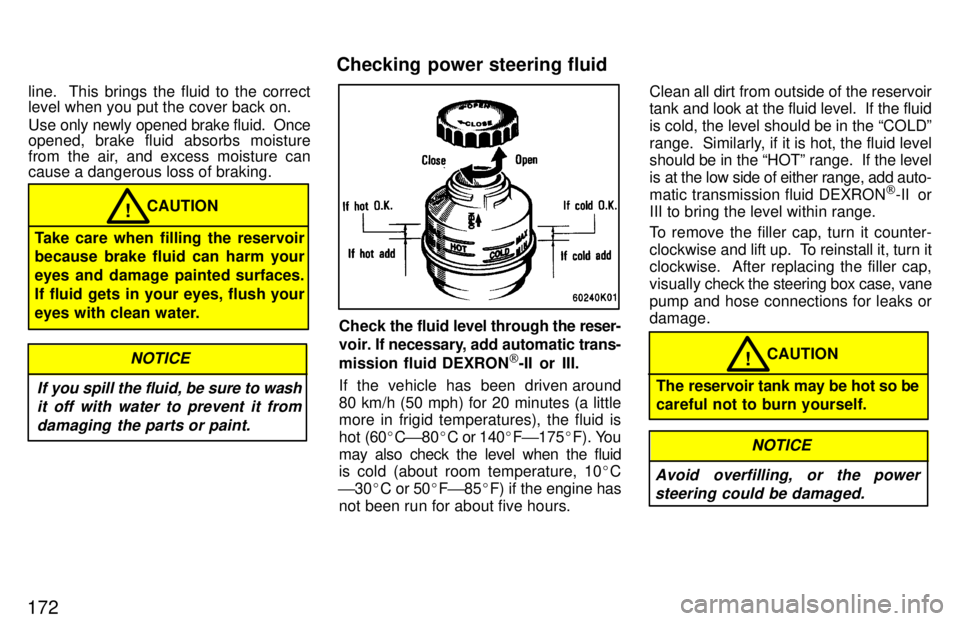
Check the fluid level through the reser-
voir. If necessary, add automatic trans-
mission fluid DEXRON [
-II or III.
If the vehicle has been driven around
80 km/h (50 mph) for 20 minutes (a little more in frigid temperatures), the fluid is
hot (60 C ' 80 C or 140 F ' 175 F). You
may also check the level when the fluid is cold (about room temperature, 10 C
' 30 C or 50 F ' 85 F) if the engine has
not been run for about five hours. Clean all dirt from outside of the reservoirtank and look at the fluid level. If the fluid is cold, the level should be in the COLDº
range. Similarly, if it is hot, the fluid level
should be in the HOTº range. If the level
is at the low side of either range, add auto-
matic transmission fluid DEXRON
[
-II or
III to bring the level within range.
To remove the filler cap, turn it counter-
clockwise and lift up. To reinstall it, turn it
clockwise. After replacing the filler cap,
visually check the steering box case, vane
pump and hose connections for leaks or damage.
CAUTION!
The reservoir tank may be hot so be
careful not to burn yourself.
Avoid overfilling, or the power steering could be damaged.
NOTICE
Checking power steering fluid
Page 192 of 198

196
Oil grade:
API SH, Energy-Conserving IIº mul-
tigrade engine oil or ILSAC multigrade en-
gine oil is recommended. Recommended oil viscosity (SAE):
COOLING SYSTEM
Total capacity, L (qt., Imp., qt.):
Manual Transmission 8.0 (8.5, 7.0)
Automatic transmission
7.7 (8.1, 6.8) Coolant type:
With ethylene-glycol antifreeze (Do not use alcohol type.)
BATTERY Open voltage* at 20 C (68 F):
12.6 '12.8 V Fully charged
12.2 '12.4 V Half charged
11.8 '12.0 V Discharged
*: Voltage that is checked 20 minutes after
the key is removed with all the lights
turned off Charging rates: 5 A max.
CLUTCH
Pedal freeplay, mm (in.):
5' 15 (0.2 '0.6)
Fluid type: SAE J1703 or FMVSS No. 116 DOT 3
MANUAL TRANSAXLE
Oil capacity, L (qt., Imp. qt.): Two-wheel drive models 3.9 (4.1, 3.4)
Four-wheel drive models
5.0 (5.3, 4.4) Oil type:
Two-wheel drive models
Multipurpose gear oil API GL-4 or GL-5
Four-wheel drive models
Multipurpose gear oil API GL-5
Recommended oil viscosity:
SAE 75W-90
AUTOMATIC TRANSAXLE Fluid capacity (drain and refill), L (qt., Imp. qt.): Two-wheel drive models Up to 3.3 (3.5, 2.9)
Four-wheel drive models Up to 7.0 (7.4, 6.2)
Fluid type:
Two-wheel drive models Automatic transmission fluid D-II or DEXRON [
III (DEX
RON [
II)
Four-wheel drive models Toyota automatic transaxle
fluid Type T or equivalent
Page 193 of 198

197
TRANSFER
(four-wheel drive models with an au-
tomatic transaxle)
Oil capacity, L (qt., Imp. qt.):
0.7 (0.7, 0.6)
Oil type:
Multipurpose gear oil API GL-5
Recommended oil viscosity: SAE 75W-90
REAR DIFFERENTIAL (four-wheel drive models)
Oil capacity, L (qt., Imp. qt.): 0.9 (1.0, 0.8)
Oil type: Hypoid gear oil API GL-5
Recommended oil viscosity:
Above -18 C (0 F)
SAE 90
Below -18 C (0 F)
SAE 80W or 80W-90 BRAKES Minimum pedal clearance when de- pressed with the pressure of 490 N (50
kgf, 110 lbf) with the engine running, mm (in.):
75 (3.0)
Pedal freeplay, mm (in.): 1' 6 (0.04 '0.24)
Pad wear limit, in. (mm): 1.0 (0.04)
Lining wear limit, in. (mm):
1.0 (0.04)
Parking brake adjustment when pulledwith the force of 196 N (20 kgf, 44 lbf): 5' 8 clicks
Fluid type: SAE J1703 or FMVSS No. 116 DOT 3
STEERING Wheel freeplay: Less than 30 mm (1.2 in.)
Power steering fluid type: Automatic transmission fluid DEXRON [
II or III
Page 195 of 198

199
Engine compartment (U.S.A.) Fuses (type A) 1 AM2 20A: Multiport fuel injection sys-
tem/sequential multiport fuel injection
system, charging system
2 DOME 15A: Personal lights, open door
warning light, clock 3 EFI 15A: Multiport fuel injection sys-
tem/sequential multiport fuel injection system 4 HAZ-HORN 15A: Emergency flashers,
horns
5 ALT-S 5A: Charging system
6 SPARE 15A: Spare fuse
7 SPARE 7.5A: Spare fuseEngine compartment (Canada) 8 H-LP LH 15A: Left-hand headlight
9 H-LP RH 15A: Right-hand headlight
10 DRL 7.5A: Daytime running light sys-
tem
11 H-LP LH-L 10A: Left-hand headlight
(low beam)
12 H-LP RH-L 10A: Right hand head-
light (low beam)
13 H-LP LH-H 10A: Left-hand headlight
(high beam)
14 H-LP RH-H 10A: Right-hand healight
(high beam)Engine compartment
15 TAIL 10A: Tail lights, parking lights, li-
cense plate lights, interior lights
16 GAUGE 10A: Gauges and meters,
service reminder indicators (except dis-
charge and open door warning lights),
back-up lights, air conditioning system,
power windows, rear window defogger,
center differential lock system, electroni-
cally controlled automatic transmission system
17 TURN 7.5A: Turn signal lights
18 CIG & RAD 15A: Cigarette lighter,
clock, car audio system, power rear view mirrors
Fuses
Page 196 of 198

200
Instrument panel
19 DEF-I/UP 7.5A: Multiport fuel injec-
tion system/sequential multiport fuel in-
jection system
20 IGN 7.5A: Multiport fuel injection sys-
tem/sequential multiport fuel injection
system, discharge warning light
21 ECU-IG, 7.5A: Anti-lock brake sys-
tem, electronically controlled automatic transmission system
22 WIPER 20A: Windshield wipers and
washer, rear wiper and washer23 SRS 7.5A: SRS airbag system
24 OBD 7.5A: On-board diagnosis sys-
tem
25 STOP 10A: Stop lightsInstrument panel
26 A/C 7.5A: Air conditioning system
Fuses (type B)
27 MAIN No. 1 30A: Starting system,
headlights
28 RDI FAN 30A: Electric cooling fan
29 CDS FAN 30A: Electric cooling fan
30 POWER 30A: Power windows, power
door lock system 31 DEF 30A: Rear window defogger
32 AM1 40A: CIG & RADº, WIPERº,
GAUGEº, ECU-IGº, TURNº and TAILº fusesPassenger 's side kick panel Fuses (type C)
33 Main 80A: AM2º, HAZ-HORNº,
EFIº, DOMEº, RADIOº and ALT-Sº fuses
34 ALT 100A: Tail lights, ABSº, RADIOº,
HTRº, AM1º, POWERº, STOPº and
DEFº fuses 35 HTR 50A: Air conditioning system
36 ABS 60A: Anti-lock brake system