belt TOYOTA RAV4 1997 Service Manual
[x] Cancel search | Manufacturer: TOYOTA, Model Year: 1997, Model line: RAV4, Model: TOYOTA RAV4 1997Pages: 198, PDF Size: 2.59 MB
Page 135 of 198
135
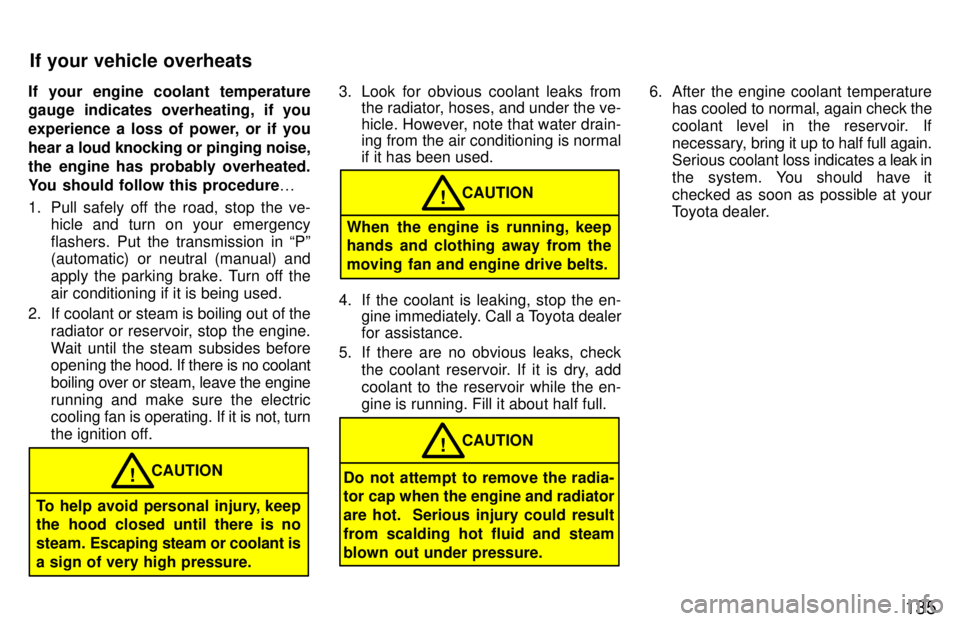
If your engine coolant temperature
gauge indicates overheating, if you
experience a loss of power, or if you
hear a
loud knocking or pinging noise,
the engine has probably overheated.
You should follow this procedure 0
1. Pull safely off the road, stop the ve- hicle and turn on your emergency
flashers. Put the transmission in Pº
(automatic) or neutral (manual) and
apply the parking brake. Turn off the
air conditioning if it is being used.
2. If coolant or steam is boiling out of the radiator or reservoir, stop the engine.
Wait until the steam subsides before
opening the hood. If there is no coolant
boiling over or steam, leave the engine
running and make sure the electric
cooling fan is operating. If it is not, turn
the ignition off.
To help avoid personal injury, keep
the hood closed until there is no steam. Escaping steam or coolant is
a sign of very high pressure. CAUTION
! 3. Look for obvious coolant leaks from
the radiator, hoses, and under the ve-
hicle. However, note that water drain- ing from the air conditioning is normal if it has been used.
When the engine is running, keep
hands and clothing away from the
moving fan and engine drive belts. CAUTION
!
4. If the coolant is leaking, stop the en- gine immediately. Call a Toyota dealer
for assistance.
5. If there are no obvious leaks, check the coolant reservoir. If it is dry, add
coolant to the reservoir while the en-
gine is running. Fill it about half full.
Do not attempt to remove the radia-
tor cap when the engine and radiator
are hot. Serious injury could result
from scalding hot fluid and steam
blown out under pressure. CAUTION
! 6. After the engine coolant temperature
has cooled to normal, again check the
coolant level in the reservoir. If
necessary, bring it up to half full again.
Serious coolant loss indicates a leak in
the system. You should have it
checked as soon as possible at your
Toyota dealer.
If your vehicle overheats
Page 151 of 198
152
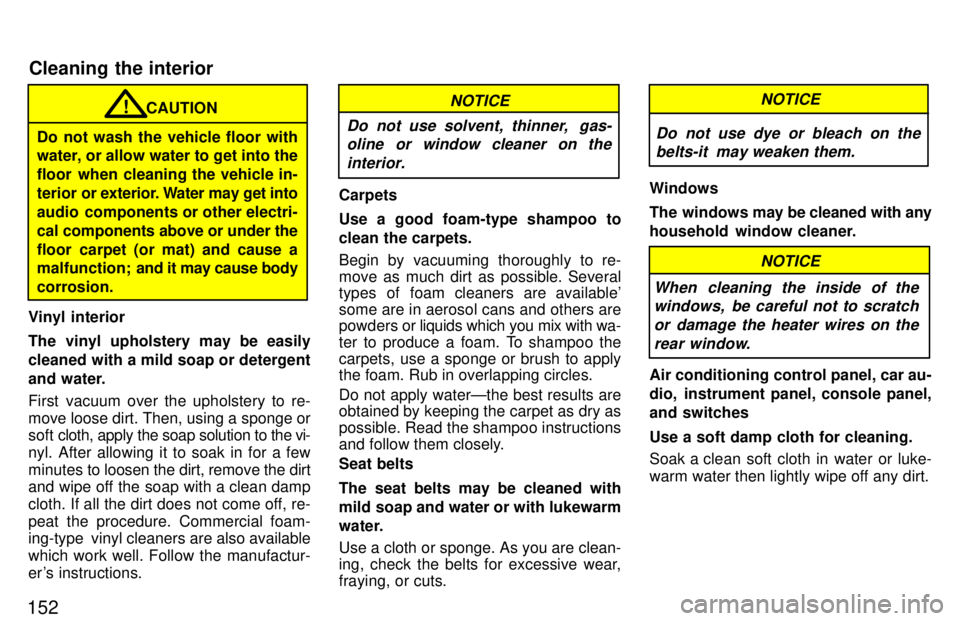
CAUTION!
Do not wash the vehicle floor with
water, or allow water to get into the
floor when cleaning the vehicle in-
terior or exterior. Water may get into
audio components or other electri-
cal components above or under the
floor carpet (or mat) and cause a
malfunction; and it may cause body
corrosion.
Vinyl interior
The vinyl upholstery may be easily
cleaned with a mild soap or detergent
and water.
First vacuum over the upholstery to re-
move loose dirt. Then, using a sponge or
soft cloth, apply the soap solution to the vi-
nyl. After allowing it to soak in for a few
minutes to loosen the dirt, remove the dirt
and wipe off the soap with a clean damp
cloth. If all the dirt does not come off, re-
peat the procedure. Commercial foam-
ing-type vinyl cleaners are also available
which work well. Follow the manufactur-
er's instructions.
Do not use solvent, thinner, gas-
oline or window cleaner on the
interior.
NOTICE
Carpets
Use a good foam-type shampoo to
clean the carpets.
Begin by vacuuming thoroughly to re-
move as much dirt as possible. Several
types of foam cleaners are available' some are in aerosol cans and others are
powders or liquids which you mix with wa-
ter to produce a foam. To shampoo the
carpets, use a sponge or brush to apply the foam. Rub in overlapping circles. Do not apply waterÐthe best results are obtained by keeping the carpet as dry as possible. Read the shampoo instructions
and follow them closely. Seat belts
The seat belts may be cleaned with
mild soap and water or with lukewarm
water.
Use a cloth or sponge. As you are clean-
ing, check the belts for excessive wear,
fraying, or cuts.
Do not use dye or bleach on the
belts-it may weaken them.
NOTICE
Windows
The windows may be cleaned with any
household window cleaner.
When cleaning the inside of the
windows, be careful not to scratch
or damage the heater wires on therear window.
NOTICE
Air conditioning control panel, car au-
dio, instrument panel, console panel,
and switches Use a soft damp cloth for cleaning.
Soak a clean soft cloth in water or luke-
warm water then lightly wipe off any dirt.
Cleaning the interior
Page 155 of 198

157
Tire surface and wheel nuts Check the tires carefully
for cuts, damage
or excessive wear. See Chapter 7-2 for
additional information. When checking the tires, make sure no nuts are missing,
and check the nuts for looseness. T ighten
them if necessary.
Tire rotation
Rotate the tires every 12000 km (7500
miles). See Chapter 7-2 for additional in-formation.
Fluid leaks Check underneath for leaking fuel, oil, wa-
ter or other fluid after the vehicle has been
parked for a while. If you smell fuel fumes
or notice any leak, have the cause found
and corrected immediately. Doors and engine hood Check that all doors and back door oper-
ate smoothly and all latches lock securely. Make sure the engine hood secondary latch secures the hood from opening
when the primary latch is released. INSIDE THE VEHICLE Items listed below should be checked
regularly, e.g. while performing peri-
odic services, cleaning the vehicle,etc. Lights Make sure the headlights, stop lights, tail lights, turn signal lights, and other lights are all working. Check headlight aim. Service reminder indicators and
warn-
ing buzzers Check that all service reminder indicators
and warning buzzers function properly. Steering wheel
Check that it has the specified freeplay.
Be alert for changes in steering condition,such as hard steering or strange noise. Seats Check that all seat controls such as seat
adjusters, seatback recliner, etc. operate
smoothly and that all latches lock securely
in any position. For folding-up rear
seat-backs, check that the latches lock
securely. Seat belts
Check that the seat belt system such as
buckles, retractors and anchors operate
properly
and smoothly. Make sure the belt
webbing is not cut, frayed, worn or dam-aged. Accelerator pedal Check the pedal for smooth operation and
uneven pedal effort or catching. Clutch pedal Check the pedal for smooth operation. Brake pedal Check the pedal for smooth operation and
that the pedal has the proper clearance. Check the brake booster function. Brakes
At a safe place, check that the brakes do not pull to one side when applied. Parking brake Check that the lever has the proper travel and that, on a safe incline, your vehicle is
held securely with only the parking brake applied.
Page 161 of 198
164
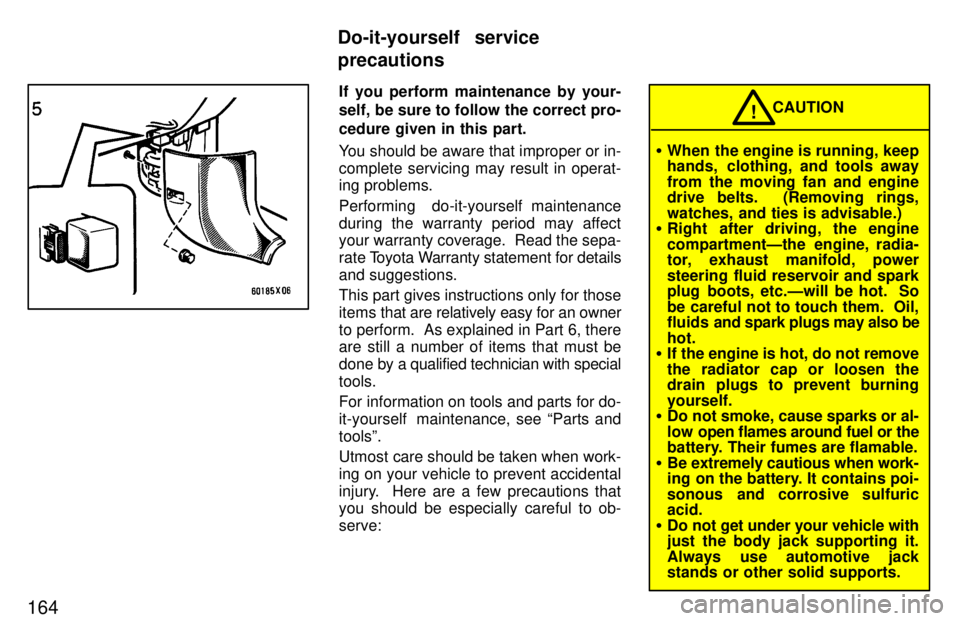
If you perform maintenance by your-
self, be sure to follow the correct pro- cedure given in this part.
You should be aware that improper or in- complete servicing may result in operat-
ing problems.
Performing do-it-yourself maintenance
during the warranty period may affect
your warranty coverage. Read the sepa-
rate Toyota Warranty statement for details
and suggestions.
This part gives instructions only for those
items that are relatively easy for an owner
to perform. As explained in Part 6, there
are still a number of items that must be
done by a qualified technician with special
tools.
For information on tools and parts for do-
it-yourself maintenance, see Parts andtoolsº.
Utmost care should be taken when work-
ing on your vehicle to prevent accidental
injury. Here are a few precautions that
you should be especially careful to ob- serve:
When the engine is running, keep
hands, clothing, and tools away
from the moving fan and engine
drive belts. (Removing rings,
watches, and ties is advisable.)
Right after driving, the engine
compartmentÐthe engine, radia-
tor, exhaust manifold, power
steering fluid reservoir and spark
plug boots, etc.Ðwill be hot. So
be careful not to touch them. Oil,
fluids and spark plugs may also be
hot.
If the engine is hot, do not remove
the radiator cap or loosen the
drain plugs to prevent burning yourself.
Do not smoke, cause sparks or al-
low open flames around fuel or the
battery. Their fumes are flamable.
Be extremely cautious when work-
ing on the battery. It contains poi-
sonous and corrosive sulfuric acid.
Do not get under your vehicle with
just the body jack supporting it.
Always use automotive jack
stands or other solid supports. CAUTION
!
Do-it-yourself service precautions
Page 171 of 198
175
CAUTION!
Do not mix radial, bias belted, or
bias-ply tires on your vehicle. It
can cause dangerous handling
characteristics, resulting in loss of control.
Do not use tire or wheels other than
the manufacturer's recommended size.
Do not use tires of different brands,
sizes and constructions. This may
damage the drive system.
NOTICE
Never use second-hand tires on your
Toyota. Using tires whose previous history is un- known is a risk.
Toyota recommends all four tires, or at
least both of the front or rear tires be
replaced at a time as a set.
See If you have a flat tireº in Part 4 for tire
change procedure. When a tire is replaced, the wheel
should always be balanced.
An unbalanced wheel may affect vehicle
handling and tire life. Wheels can get out
of balance with regular use and should
therefore be balanced occasionally.
When replacing a tubeless tire, the air
valve should also be replaced with a
new one.
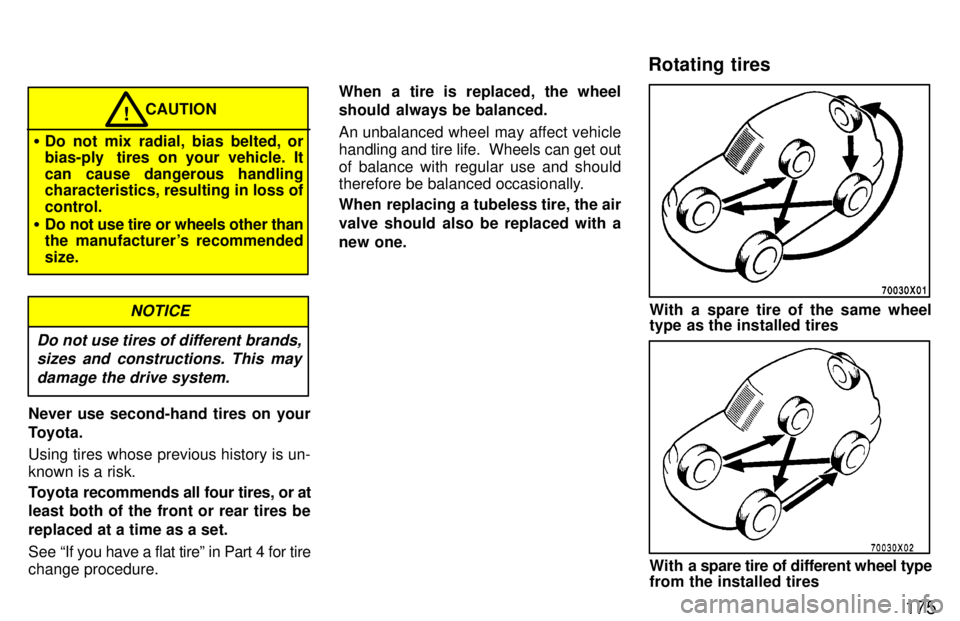
With a spare tire of the same wheel
type as the installed tires
With a spare tire of different wheel type
from the installed tires
Rotating tires
Page 191 of 198

195
Model:
3S-FE
Type: 4 cylinder in line, 4 cycle, gasoline
Bore and stroke, mm (in.):
86.0 X 86.0 (3.39 X 3.39)
Displacement, cm 3
(cu. in):
1998 (121.9) Fuel type:
unleaded gasoline, Research Octane Number 91 (Octane rating 87) or higher
Fuel tank capacity, L (gal., Imp. gal.):
58 (15.3, 12.8) ENGINE
Valve clearance (engine cold), mm (in.)
Intake 0.19 '0.29 (0.007 '0.011)
Exhaust 0.28 '0.38 (0.011 '0.015)
Spark plug type: NIPPONDENSO PK20R11
NGK BKR6EP-1 1
Spark plug gap, mm (in.): 1.1 (0.043)
Drive belt tension measured with Bor-
oughs drive belt tension gauge No.
BT-33-73F (used belt), Ibf: Generator belt 95 + 20
Air conditioning
compressor belt 66 - 99 Power steering
pump belt 80 + 20
ENGINE LUBRICATION Oil capacity (drain and refill), L (qt., Imp. qt.): With filter
4.1 (4.3, 3.6)
Without filter 3.9 (4.1, 3.4)
Engine Fuel Service specifications