wheel size TOYOTA RAV4 1997 Owners Manual
[x] Cancel search | Manufacturer: TOYOTA, Model Year: 1997, Model line: RAV4, Model: TOYOTA RAV4 1997Pages: 198, PDF Size: 2.59 MB
Page 43 of 198

42
This SRS airbag system has a service re-
minder indicator to inform the driver of op-
erating problems. If either of the following
conditions occurs, this indicates a mal-
function of the airbags. Contact your To-
yota dealer as soon as possible to service
the vehicle. The light does not come on when the
ignition key is turned to the ACCº or
ONº position, or remains on.
The light comes on while driving.In the following cases, contact your Toyo-
ta dealer as soon as possible: The SRS airbags have been inflated.
The front part of the vehicle (shaded in the illustration) was involved in an ac-
cident not of the extent to cause the
SRS airbags to inflate
The pad section of the steering wheel
or front passenger airbag cover
(shaded in the illustration) is
scratched, cracked, or otherwise dam-
aged. Toyota strongly urges the use of child
restraint systems for children small
enough to use them.
The laws of all fifty states in the U.S.A.
and Canada now require the use of a child
restraint system.
Your vehicle conforms to SAEJ1819.
If a child is too large for a child restraint
system,
the child should sit in the rear seat
and must be restrained using the vehicle's
seat belt. See Seat beltsº for details.CAUTION!
For effective protection in automo-
bile accidents and sudden stops,
children must be properly re-
strained using a seat belt or child
restraint system depending on the
age and size of the child. Holding
a child in your arms is not a substi-
tute for a child restraint system. In
an accident, the child can be
crushed against the windshield, or
between you and the vehicle's in-
terior.
Child restraintÐ ÐChild restraint precautions
Page 44 of 198

42
This SRS airbag system has a service re-
minder indicator to inform the driver of op-
erating problems. If either of the following
conditions occurs, this indicates a mal-
function of the airbags. Contact your To-
yota dealer as soon as possible to service
the vehicle. The light does not come on when the
ignition key is turned to the ACCº or
ONº position, or remains on.
The light comes on while driving.In the following cases, contact your Toyo-
ta dealer as soon as possible: The SRS airbags have been inflated.
The front part of the vehicle (shaded in the illustration) was involved in an ac-
cident not of the extent to cause the
SRS airbags to inflate
The pad section of the steering wheel
or front passenger airbag cover
(shaded in the illustration) is
scratched, cracked, or otherwise dam-
aged. Toyota strongly urges the use of child
restraint systems for children small
enough to use them.
The laws of all fifty states in the U.S.A.
and Canada now require the use of a child
restraint system.
Your vehicle conforms to SAEJ1819.
If a child is too large for a child restraint
system,
the child should sit in the rear seat
and must be restrained using the vehicle's
seat belt. See Seat beltsº for details.CAUTION!
For effective protection in automo-
bile accidents and sudden stops,
children must be properly re-
strained using a seat belt or child
restraint system depending on the
age and size of the child. Holding
a child in your arms is not a substi-
tute for a child restraint system. In
an accident, the child can be
crushed against the windshield, or
between you and the vehicle's in-
terior.
Child restraintÐ ÐChild restraint precautions
Page 61 of 198
59
On the luggage compartment floor
a. Using the illustration as a guide, run your fingers across the luggage compart-
ment floor itself to locate the position of the bolts underneath. b. Remove the bolt.
c. Insert a 10 mm (0.4 in.) spacer and tighten down the anchor bracket for your
child restraint system with a bolt. Torque
the bolt to 16.5-24.7 N
Vm (1.68-2.52 kgr-
V m, 12.2-18.2 ft Vlbf).
To comply with Canada Motor Vehicle
Safety Standards, vehicles sold in Cana-
da are provided with a bracket set in the
glovebox, designed for use with any of the
2 anchor locations shown in the illustra- tion.
If your child restraint system does not pro-
vide any of the necessary parts, ask your
Toyota dealer. (See -Child restraint sys- temº.)
If you remove the anchor brackets when
the child restraint system is necessary no
longer, replace the bolts in the holes to
prevent entry of exhaust emissions, water
or dirt.
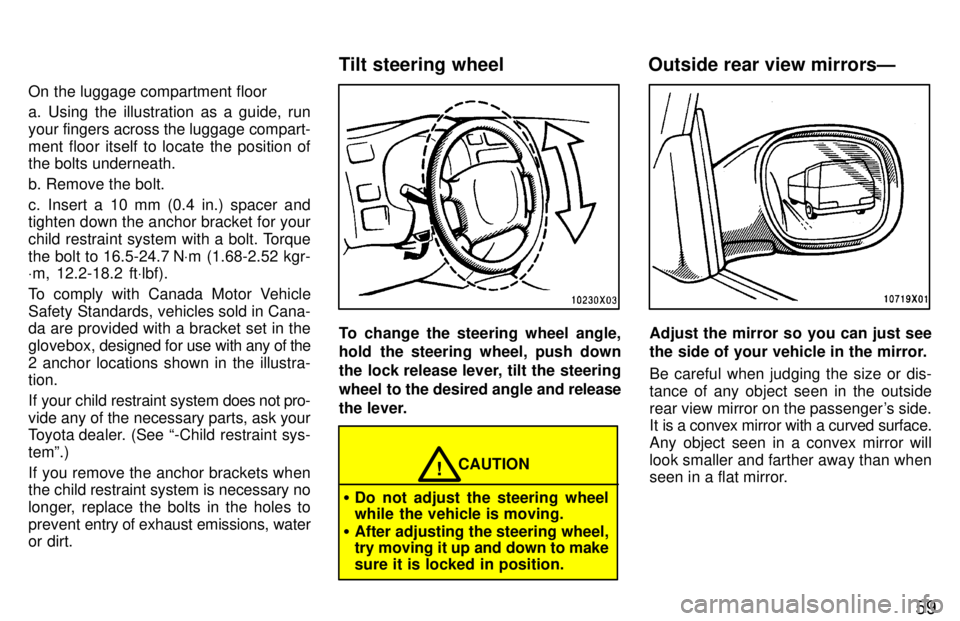
To change the steering wheel angle,
hold the steering wheel, push down
the lock release lever, tilt the steering
wheel to the desired angle and release
the lever.
CAUTION!
Do not adjust the steering wheel
while the vehicle is moving.
After adjusting the steering wheel,try moving it up and down to make sure it is locked in position.
Adjust the mirror so you can just see
the side of your vehicle in the mirror. Be careful when judging the size or dis- tance of any object seen in the outside
rear view mirror on the passenger's side.
It is a convex mirror with a curved surface.
Any object seen in a convex mirror will
look smaller and farther away than when
seen in a flat mirror.
Tilt steering wheel Outside rear view mirrorsÐ
Page 62 of 198
59
On the luggage compartment floor
a. Using the illustration as a guide, run your fingers across the luggage compart-
ment floor itself to locate the position of the bolts underneath. b. Remove the bolt.
c. Insert a 10 mm (0.4 in.) spacer and tighten down the anchor bracket for your
child restraint system with a bolt. Torque
the bolt to 16.5-24.7 N
Vm (1.68-2.52 kgr-
V m, 12.2-18.2 ft Vlbf).
To comply with Canada Motor Vehicle
Safety Standards, vehicles sold in Cana-
da are provided with a bracket set in the
glovebox, designed for use with any of the
2 anchor locations shown in the illustra- tion.
If your child restraint system does not pro-
vide any of the necessary parts, ask your
Toyota dealer. (See -Child restraint sys- temº.)
If you remove the anchor brackets when
the child restraint system is necessary no
longer, replace the bolts in the holes to
prevent entry of exhaust emissions, water
or dirt.
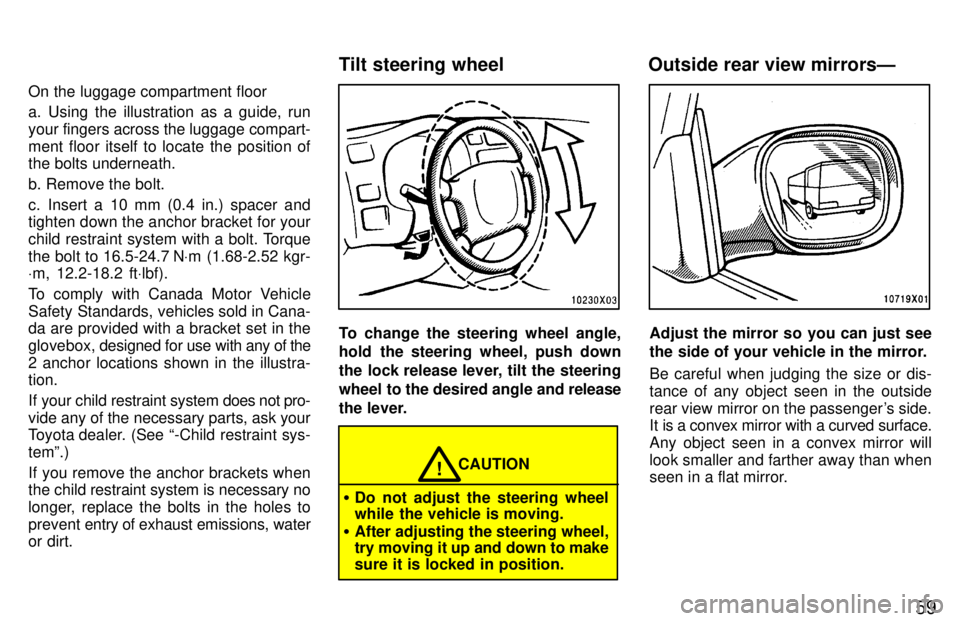
To change the steering wheel angle,
hold the steering wheel, push down
the lock release lever, tilt the steering
wheel to the desired angle and release
the lever.
CAUTION!
Do not adjust the steering wheel
while the vehicle is moving.
After adjusting the steering wheel,try moving it up and down to make sure it is locked in position.
Adjust the mirror so you can just see
the side of your vehicle in the mirror. Be careful when judging the size or dis- tance of any object seen in the outside
rear view mirror on the passenger's side.
It is a convex mirror with a curved surface.
Any object seen in a convex mirror will
look smaller and farther away than when
seen in a flat mirror.
Tilt steering wheel Outside rear view mirrorsÐ
Page 117 of 198

11 6Some Toyotas are equipped with a limit-
ed-slip differential. If one rear wheel be-
gins to spin, the limited-slip differential is
designed to aid traction by automatically
transmitting driving force to the other rear
wheel. If you are not sure whether your
vehicle is equipped
with one, you can ask
your Toyota dealer.
CAUTION!
Do not start or run the engine while
your vehicle is supported by a jack.
The vehicle could be driven off the jack and could pose a danger or re-
sult in serious injury.
Use only a spare tire of the same
size, construction and load capacity
as the original tires on your Toyota because damage to the limited-slip differential could possibly occurwith another tire type.
NOTICE
The vehicle identification number
(VIN) is the legal identifier for your ve- hicle. This number is on the left top of
the instrument panel, and can be seen
through the windshield from outside.
This is the primary identification number
for your T oyota. It is used in registering the
ownership of your vehicle.2-door models
4-door models
Limited-slip differential
(four-wheel drive models only)
Your Toyota's identificationÐ
ÐVehicle identification number
Page 119 of 198
11 8
CAUTION!
Do not modify the suspension/
chassis with lift kits, spacers,
springs, etc. It can cause danger-
ous handling characteristics, re-
sulting in loss of control. Determine what kind of tires your ve-
hicle is originally equipped with.
1. Summer tires
Summer tires are high-speed capability
tires best suited to highway driving under dry conditions. Since
summer tires do not have the same
traction performance as snow tires, sum-
mer tires are inadequate for driving on
snow-covered or icy roads. For driving on
snow-covered or icy roads, we recom-
mend using snow tires. If installing snow tires, be sure to replace all four tires.
2. All season tires
All season tires are designed to provide
better traction in snow and to be adequate
for driving in most winter conditions, as
well as for use all year round.
All season tires, however, do not have ad-
equate traction performance compared
with snow tires in heavy or loose snow.
Also, all season tires fall short in accelera-
tion and handling performance compared with summer tires in highway driving.CAUTION!
Do not mix summer and all sea-
son tires on your vehicle as this
can cause dangerous handling
characteristics, resulting in loss
of control.
Do not use tire other than the
manufacturer 's designated tires,
and never mix tires or wheels of
the sizes different from the origi- nals.
Suspension and chassis Types of tires
Page 149 of 198

150
High pressure water or steam is effec-
tive for cleaning the vehicle's under-
side and wheel housings. Pay particu-
lar attention to these areas as it is
difficult to see all the mud and dirt. It
will do more harm than good to simply
wet the mud and debris without remov-
ing them. The lower edge of doors,
rocker panels and frame members
have drain holes which should not be
allowed to clog with dirt as trapped wa-
ter in these areas can cause corrosion.
Wash the underside of the vehicle
thoroughly when winter is over.
See Washing and waxing your Toyotaº
for more tips.
Check the condition of your vehicle's
paint and trim. If you find any chips or
scratches in the paint, touch them up im- mediately to prevent corrosion from start- ing. If the chips or scratches have gone
through the bare metal, have a qualified
bodyshop make the repair. Check the interior of your vehicle.
Wa-
ter and dirt can accumulate under the floor
mats and could cause corrosion. Occa-
sionally check under the mats to make sure the area is dry. Be particularly careful
when transporting chemicals, cleansers,
fertilizers, salt, etc; these should be trans-
ported in proper containers. If a spill or
leak should occur, immediately clean and dry the area.
Use mud shields on your wheels. If you
drive on salted or gravel roads, mud
shields help protect your vehicle. Full- size shields, which come as near to the
ground as possible, are the best. We rec-
ommend that the fittings and the area
where the shields are installed be treated
to resist corrosion. Your Toyota dealer will
be happy to assist in supplying and instal-
ling the shields if they are recommended for your area. Keep your vehicle in a well ventilated garage or a roofed place. Do not park
your vehicle in a damp, poorly venti-
lated garage. If you wash your vehicle in
the garage, or if you drive it in covered with
water or snow, your garage may be so damp it will cause corrosion. Even if your
garage is heated, a wet vehicle can cor-
rode if the ventilation is poor. Washing your Toyota Keep your vehicle clean by regular washing.
The following cases may cause weak- ness to the paint or corrosion to the body
and parts. Wash your vehicle as soon as possible.
When driving in a coastal area
When driving on a road sprinkled with antifreeze
When having stuck of coal tar, tree
sap, bird droppings and carcasses of
an insect
When driving in the areas where there
are a lot of smoke, soot, dust, iron dust
and chemical substance
When the vehicle becomes remark-
ably dirty with dust and mud
Hand-washing your Toyota
Work in the shade and wait until the ve-
hicle body is not hot to the touch.
CAUTION!
When cleaning under floor or chas-
sis, be careful not to injure your hands.
Washing and waxing your
Toyota
Page 169 of 198

173
2-door models
4-door modelsKeep your tire pressures at the proper level.
The recommended cold tire pressures,
tire size and the vehicle capacity weight
are also given in Part 8. They are also on the tire pressure label shown.
You should check the tire pressures every two weeks, or at least once a month. And
do not forget the spare!
Incorrect tire pressure can reduce tire
life and make your vehicle less safe todrive.
Low tire pressure results in excessive
wear, poor handling, reduced fuel econo-
my, and the possibility of blowouts from
overheated tires. Also, low tire pressure
can cause poor sealing of the tread bead.
If the tire pressure is excessively low,
there is the possibility of wheel deforma- tion and/or tire separation.
High tire pressure produces a harsh ride,
handling problems, excessive wear at thecenter of the tire tread, and a greater
pos-
sibility of tire damage from road hazards.
If a tire frequently needs refilling, have it
checked by your Toyota dealer.
The following instructions for check-
ing tire pressure should be observed:
The pressure should be checked
only when the tires are cold. If your
vehicle has been parked for at least 3 hours and has not been driven formore than 1.5 km or 1 mile since, you
will get an accurate cold tire pressurereading.
Always use a tire pressure gauge.
The appearance of a tire can be mis-
leading. Besides, tire pressure that
are even just a few pounds off can de-
grade handling and ride.
Take special care when adding air
to the compact spare tire. The
smaller tire size can gain pressure
very quickly. Add compressed air insmall quantities and check the pres- sure often until it reaches the specified
pressure.
Do not bleed or reduce tire pres- sure after driving. It is normal for the
tire pressure to be higher after driving.
Never exceed the vehicle capacity weight. The passenger and luggage
weight should be located so that the
vehicle is balanced.
Checking tire pressure
Page 171 of 198

175
CAUTION!
Do not mix radial, bias belted, or
bias-ply tires on your vehicle. It
can cause dangerous handling
characteristics, resulting in loss of control.
Do not use tire or wheels other than
the manufacturer's recommended size.
Do not use tires of different brands,
sizes and constructions. This may
damage the drive system.
NOTICE
Never use second-hand tires on your
Toyota. Using tires whose previous history is un- known is a risk.
Toyota recommends all four tires, or at
least both of the front or rear tires be
replaced at a time as a set.
See If you have a flat tireº in Part 4 for tire
change procedure. When a tire is replaced, the wheel
should always be balanced.
An unbalanced wheel may affect vehicle
handling and tire life. Wheels can get out
of balance with regular use and should
therefore be balanced occasionally.
When replacing a tubeless tire, the air
valve should also be replaced with a
new one.
With a spare tire of the same wheel
type as the installed tires
With a spare tire of different wheel type
from the installed tires
Rotating tires
Page 172 of 198
176To equalize tire wear and help extend
tire life, Toyota recommends that you
rotate your tires every 12000 km (7500
miles).
However, the most appropriate
timing for tire rotation may vary ac-
cording to your driving habits and
road surface conditions.
See If you have a flat tireº in Part 4 for tire
change procedure. When rotating tires, check for even wear
and damage. Abnormal wear is usually
caused by incorrect tire pressure, improp-
er wheel alignment, out-of-balance
wheels, or severe braking. WHEN TO USE SNOW TIRES OR CHAINS
Snow tires or chains are recom-
mended when driving on snow or ice.
On wet or dry roads, conventional tires
provide better traction than snow tires. SNOW TIRE SELECTION
If you need snow tires, select tires of
the same size, construction and loadcapacity as the original tires on your
Toyota. Make sure all the snow tires
are the same brand.
Do not install studded tires without first checking local regulations for possible re- strictions.
NOTICE
Do not use tires of different brands, sizes and constructions. This may
damage the drive system.
SNOW TIRE INSTALLATION
Snow tires should be installed on all wheels. Installing snow tires on the front wheels
only can lead to an excessive difference
in road grip capability between the front
and rear tires which would cause loss of
vehicle control.
When storing removed tires, you should
store them in a cool dry place.
Mark the direction of rotation and be sure to install them in the same direction whenreplacing.
CAUTION!
Do not drive with the snow tires in- correctly inflated.
Never drive over 120 km/h (75
mph) with any type of snow tires.
TIRE CHAIN SELECTION Use tire chains of the correct size.
Two-wheel drive models:
Use only genuine Toyota tire chains or
equivalent for use on the RAV4.
Installing snow tires and chains