ECO mode TOYOTA RAV4 1998 User Guide
[x] Cancel search | Manufacturer: TOYOTA, Model Year: 1998, Model line: RAV4, Model: TOYOTA RAV4 1998Pages: 227, PDF Size: 3.9 MB
Page 156 of 227

'98 Rav4U
156
Getting more kilometers/mileage from a
liter/gallon of fuel is easyÐjust take it
easy. It will help make your vehicle last
longer, too. Here are some specific tips
on how to save money on both fuel and
repairs:
Keep your tires inflated at the cor-
rect pressure. Underinflation causes
tire wear and wastes fuel. See Chapter
7- 2 for instructions.
Do not carry unneeded weight in
your vehicle. Excess weight puts a
heavier load on the engine, causing
greater fuel consumption.
Avoid lengthy warm- up idling. Once
the engine is running smoothly, begin
drivingÐbut gently. Remember, howev-
er, that on cold winter days this may
take a little longer.
Accelerate slowly and smoothly.
Avoid jackrabbit starts. Get into high
gear as quickly as possible.
Avoid long engine idling. If you have
a long wait and you are not in traffic,
it is better to turn off the engine and
start again later.
Avoid engine lug or overrevving. Use
a gear position suitable for the road on
which you are travelling.
Avoid continuous speeding up and
slowing down. Stop- and- go driving
wastes fuel.
Avoid unnecessary stopping and
braking. Maintain a steady pace. Try
to time the traffic signals so you only
need to stop as little as possible or
take advantage of through streets to
avoid traffic lights. Keep a proper dis-
tance from other vehicles to avoid sud-
den braking. This will also reduce wear
on your brakes.
Avoid heavy traffic or traffic jams
whenever possible.
Do not rest your foot on the clutch
or brake pedal. This causes needless
wear, overheating and poor fuel econo-
my.
Maintain a moderate speed on high-ways. The faster you drive, the greater
the fuel consumption. By reducing your
speed, you will cut down on fuel con-
sumption.
Keep the front wheels in proper
alignment. Avoid hitting the curb and
slow down on rough roads. Improper
alignment not only causes faster tire
wear but also puts an extra load on
the engine, which, in turn, wastes fuel.
Keep the bottom of your vehicle free
from mud, etc. This not only lessens
weight but also helps prevent corro-
sion.
Keep your vehicle tuned- up and in
top shape. A dirty air cleaner, improp-
er valve clearance, dirty plugs, dirty oil
and grease, brakes not adjusted, etc.
all lower engine performance and con-
tribute to poor fuel economy. For longer
life of all parts and lower operating
costs, keep all maintenance work on
schedule, and if you often drive under
severe conditions, see that your vehicle
receives more frequent maintenance
(For scheduled maintenance informa-
tion, please refer to the separate ºOwn-
er 's Manual Supplement/Maintenance
Scheduleº).
CAUTION
Never turn off the engine to coast
down hills. Your power steering and
brake booster will not function with-
out the engine running. Also, the
emission control system operates
properly only when the engine is run-
ning.
How to save fuel and make
your vehicle last longer, too
Page 170 of 227

'98 Rav4U
170
(a) Towing with wheel lift type truck ÐFrom front
ÐFrom rear
(b) Using flat bed truck
Two- wheel drive models(a) Towing with wheel lift type truck ÐFrom front
ÐFrom rear
(b) Using flat bed truck
Four- wheel drive models If towing is necessary, we recommend
you to have it done by your Toyota
dealer or a commercial tow truck ser-
vice. In consultation with them, have
your vehicle towed using either (a) or
(b).
Only when you cannot receive a towing
service from a Toyota dealer or com-
mercial tow truck service, tow your ve-
hicle carefully in accordance with the
instructions given in ºÐEmergency tow-
ingº in this part.
Proper equipment will help ensure that
your vehicle is not damaged while being
towed. Commercial operators are generally
aware of the state/provincial and local
laws pertaining to towing.
Your vehicle can be damaged if it is
towed incorrectly. Although most operators
know the correct procedure, it is possible
to make a mistake. To avoid damage to
your vehicle, make sure the following few
precautions are observed. If necessary,
show this page to the tow truck driver.
If your vehicle needs to be
towedÐ
Page 171 of 227
'98 Rav4.U171
TOWING PRECAUTIONS:
Use a safety chain system for all towing,
and abide by the state/provincial and local
laws. The wheels and axle on the ground
must be in good condition. If they are
damaged, use a towing dolly.
Two- wheel drive modelsÐ
(a) Towing with wheel lift type truck
From frontÐ
Release the parking brake.
NOTICE
When lifting wheels, take care to en-
sure adequate ground clearance fortowing at the opposite end of the
raised vehicle. Otherwise, the bumper
and/or underbody of the towed vehiclewill be damaged during towing.
From rearÐ
Manual transmission:
We recommend using a towing dolly
under the front wheels. If you do not
use a towing dolly, place the ignition
key in the ºACCº position and put the
transmission in neutral.
NOTICE
Do not tow with the key removed or
in the ºLOCKº position when towingfrom the rear without a towing dolly. The steering lock mechanism is not
strong enough to hold the frontwheels straight.
Automatic transmission:
Use a towing dolly under the front
wheels.
NOTICE
Never tow a vehicle with an automatic
transmission from the rear with thefront wheels on the ground, as this
may cause serious damage to the
transmission.
(b) Using flat bed truck
Four- wheel drive modelsÐ
(a) Towing with wheel lift type truck
Use a towing dolly under the wheels not
lifted by the truck.
(b) Using flat bed truck
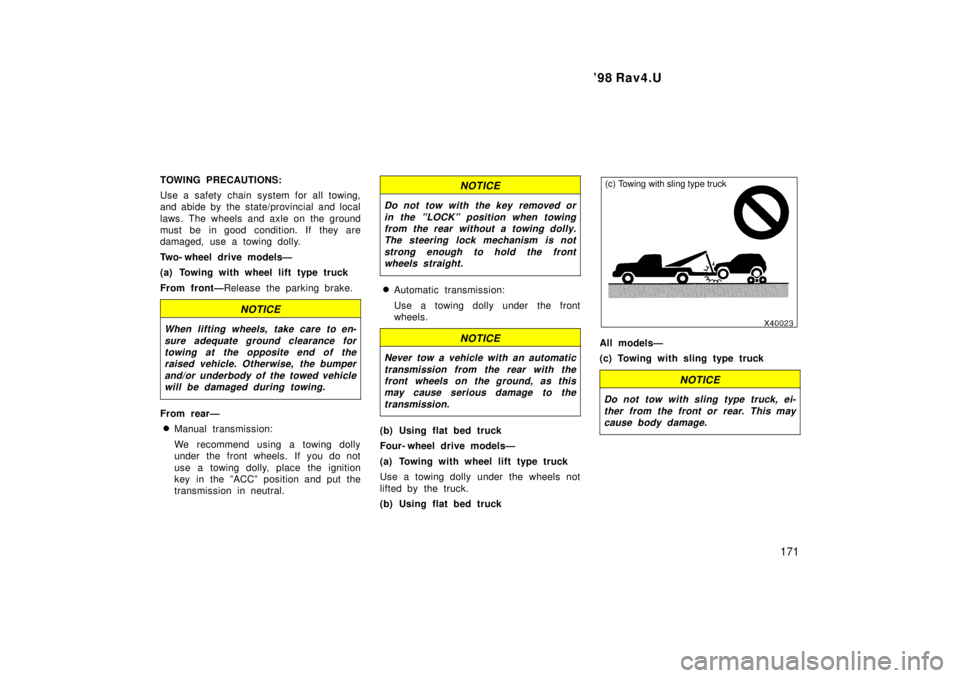
(c) Towing with sling type truck
All modelsÐ
(c) Towing with sling type truck
NOTICE
Do not tow with sling type truck, ei- ther from the front or rear. This maycause body damage.
Page 179 of 227
'98 Rav4.U179
Automatic car wash
Hardtop models may be washed in an
automatic car wash, but remember that
the paint can be scratched by some type
of brushes, unfiltered washing water, or
the washing process itself. Scratching re-
duces paint durability and gloss, especially
on darker colors. The manager of the car
wash should be able to advise you wheth-
er the process is safe for the paint on
your vehicle.
NOTICE
To prevent damage to the antenna,
make sure it is retracted beforedriving your Toyota through an au- tomatic car wash.
Soft- top modelsÐDo not run soft-top models through automatic car washes or possible damage to the
soft- top may result.
Waxing your Toyota
Polishing and waxing is recommended
to maintain the original beauty of your
Toyota's finish.
Once a month or if the vehicle does not
repel water well, apply wax.
1. Always wash and dry the vehicle be- fore you begin waxing, even if you are
using a combined cleaner and wax.
2. Use a good quality polish and wax. If the finish has become extremely weath-
ered, use a car- cleaning polish, fol-
lowed by a separate wax. Carefully fol-
low the manufacturer 's instructions and
precautions. Be sure to polish and wax
the chrome trim as well as the paint.
3. Wax the vehicle again when water does not bead but remains on the sur-
face in large patches.
NOTICE
Always remove the plastic bumpers if
your vehicle is re- painted and placedin a high heat paint waxing booth. High temperatures could damage the
bumpers.
Soft- top
Wash using mild soap suds, lukewarm wa-
ter and a sponge.
NOTICE
Do not use harsh or abrasive cleanersor bleaching agents on the top mate-rial or damage may result.
If further cleaning is required after using
soap and water, a mild foaming cleaner
can be used. First, rinse the top. then use
a mild foaming cleaner on the entire top.
Scrub with a small soft bristle handbrush.
Add water as needed until the cleaner
gets soapy. Use a cloth or sponge to
remove dirt so it will not be ground into
the top. Be careful to keep any cleaner
from drying on the body paint as it may
cause streaks.
After the top has been cleaned, rinse ve-
hicle with clean water to remove all traces
of cleaner.
After cleaning, always make sure the top
is completely dry before you lower it. Low-
ering the top while wet or damp may
cause interior water damage, water stains
or mildew of the top material.
Page 201 of 227
'98 Rav4.U201
To equalize tire wear and help extend
tire life, Toyota recommends that you
rotate your tires approximately every
12000 km (7500 miles). However, the
most appropriate timing for tire rotation
may vary according to your driving hab-
its and road surface conditions.
See ºIf you have a flat tireº in Part 4 for
tire change procedure.
When rotating tires, check for uneven wear
and damage. Abnormal wear is usually
caused by incorrect tire pressure, improper
wheel alignment, out- of- balance wheels, or
severe braking.
WHEN TO USE SNOW TIRES OR
CHAINS
Snow tires or chains are recommended
when driving on snow or ice.
On wet or dry roads, conventional tires pro-
vide better traction than snow tires.
SNOW TIRE SELECTION
If you need snow tires, select tires of
the same size, construction and load
capacity as the original tires on your
Toyota. Make sure all the snow tires are
the same brand.
Do not install studded tires without first
checking local regulations for possible re-
strictions.
NOTICE
Do not use tires of different brands,
sizes and constructions. This maydamage the drive system.
SNOW TIRE INSTALLATION
Snow tires should be installed on all
wheels. Installing snow tires on the front w
heels only
can lead to an excessive difference in road
grip capab ility between the front and rear
tires which could cause loss of vehicle con-
trol.
When storing removed tires, you should
store them in a cool dry place.
Mark the direction of rotation and be sure
to install them in the same direction when
replacing.
CAUTION
Do not drive with the snow tires in-
correctly inflated.
Never drive over 120 km/h (75 mph)
with any type of snow tires.
TIRE CHAIN SELECTION
Use tire chains of the correct size.
Two- wheel drive models:
Use only genuine Toyota tire chains or equiv-
alent for use on the RAV4.
Installing snow tires and
chains
Page 202 of 227
'98 Rav4U
202
NOTICE
If the wrong combination of tire and chain is used, the chains could dam-age the vehicle body.
* RAV4 genuine tire chains
(Part No. 08329- 42801)
Laws about using tire chains vary ac-
cording to locality and type of road, so
always check your local laws before
you install tire chains.
CHAIN INSTALLATION
Four- wheel drive models:
Install the chains on the rear tires as
tightly as possible. Do not use tire
chains on the front tires. Retighten
chains after driving 0.5Ð1.0 km
(1/4Ð1/2 mile).
Two- wheel drive models:
Install the chains on the front tires as
tightly as possible. Do not use tire
chains on the rear tires. Retighten
chains after driving 0.5Ð1.0 km
(1/4Ð1/2 mile). When installing chains on your tires, care-
fully follow the instructions of the chain
manufacturer.
If wheel covers are used, they will be
scratched by the chain band, so remove the
covers before putting on the chains.CAUTION
Do not exceed 50 km/h (30 mph) or
the chain manufacturer 's recom-
mended speed limit, whichever is
lower.
Drive carefully avoiding bumps,
holes, and sharp turns, which may
cause the vehicle to bounce.
Avoid sharp turns or locked- wheel
braking, as use of chains may ad-
versely affect vehicle handling.
Replacing wheels
WHEN TO REPLACE YOUR WHEELS
If you have wheel damage such as
bending, cracks or heavy corrosion, the
wheel should be replaced.
If you fail to replace damaged wheels, the
tire may slip off the wheel or they may cause
loss of handling control.
WHEEL SELECTION
When replacing wheels, care should be
taken to ensure that the wheels are re-
placed by ones with the same load ca-
pacity, diameter, rim width, and offset.
Correct replacement wheels are available at
your Toyota dealer.
A wheel of a different brand, size and type
may adversely affect handling, wheel and
bearing life, brake cooling, speedometer/
odometer calibration, stopping ab ility, head-
light aim, bumper height, vehicle ground
clearance, and tire or snow chain clearance
to the body and chassis.
Page 219 of 227
'98 Rav4.U219
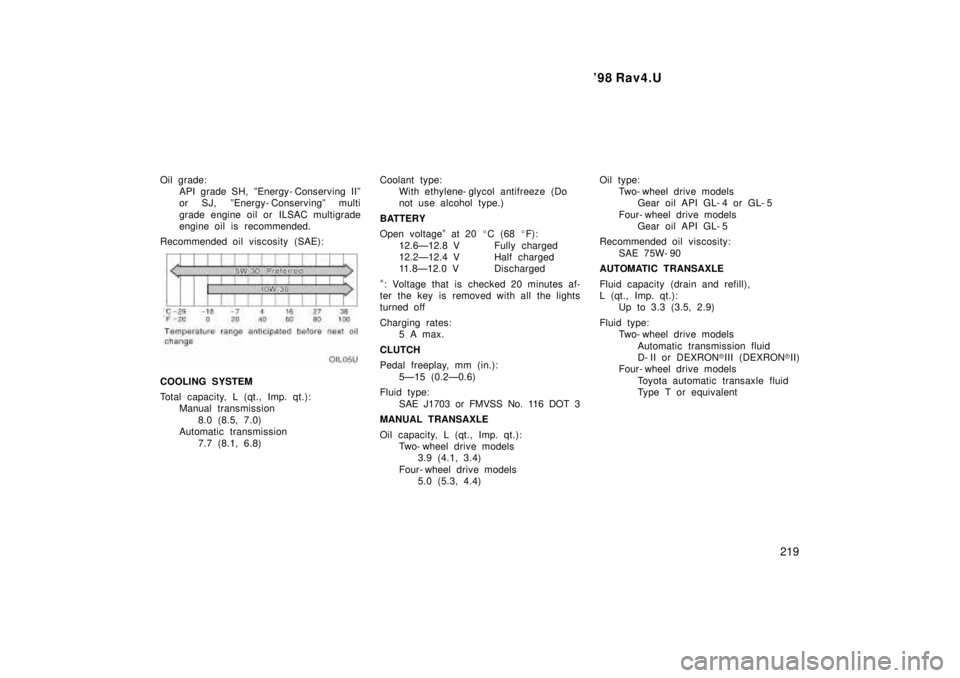
Oil grade:
API grade SH, ºEnergy- Conserving IIº
or SJ, ºEnergy- Conservingº multi
grade engine oil or ILSAC multigrade
engine oil is recommended.
Recommended oil viscosity (SAE):
COOLING SYSTEM
Total capacity, L (qt., Imp. qt.): Manual transmission
8.0 (8.5, 7.0)
Automatic transmission
7.7 (8.1, 6.8) Coolant type:
With ethylene- glycol antifreeze (Do
not use alcohol type.)
BATTERY
Open voltage *
at 20 C (68 F):
12.6Ð12.8 V Fully charged
12.2Ð12.4 V Half charged
11.8Ð12.0 V Discharged
* : Voltage that is checked 20 minutes af-
ter the key is removed with all the lights
turned off
Charging rates: 5 A max.
CLUTCH
Pedal freeplay, mm (in.): 5Ð15 (0.2Ð0.6)
Fluid type: SAE J1703 or FMVSS No. 116 DOT 3
MANUAL TRANSAXLE
Oil capacity, L (qt., Imp. qt.): Two- wheel drive models
3.9 (4.1, 3.4)
Four- wheel drive models 5.0 (5.3, 4.4) Oil type:
Two- wheel drive models
Gear oil API GL- 4 or GL- 5
Four- wheel drive models Gear oil API GL- 5
Recommended oil viscosity: SAE 75W- 90
AUTOMATIC TRANSAXLE
Fluid capacity (drain and ref ill),
L (qt., Imp. qt.): Up to 3.3 (3.5, 2.9)
Fluid type: Two- wheel drive models
Automatic transmission fluid
D- II or DEXRON III (DEXRON II)
Four- wheel drive models
Toyota automatic transaxle fluid
Type T or equivalent
Page 220 of 227

'98 Rav4U
220
TRANSFER
(four- wheel drive models with an auto-
matic transaxle)
Oil capacity, L (qt., Imp. qt.):
0.7 (0.7, 0.6)
Oil type: Gear oil API GL- 5
Recommended oil viscosity: SAE 75W- 90
REAR DIFFERENTIAL
(four- wheel drive models)
Oil capacity, L (qt., Imp. qt.): 0.9 (1.0, 0.8)
Oil type: Hypoid gear oil API GL- 5
Recommended oil viscosity: Above -18 5C (0 5F)
SAE 90
Below -18 5C (0 5F)
SAE 80W or 80W- 90 BRAKES
Minimum pedal clearance when depressed
with the pressure of 490 N (50 kgf, 110
lbf) with the engine running, mm (in.):
75 (3.0)
Pedal freeplay, mm (in.): 1Ð6 (0.04Ð0.24)
Pad wear limit, in. (mm): 1.0 (0.04)
Lining wear limit, in. (mm): 1.0 (0.04)
Parking brake adjustment when pulled with
the force of 196 N (20 kgf, 44 lbf): 5Ð8 clicks
Fluid type: SAE J1703 or FMVSS No. 116 DOT 3
STEERING
Wheel freeplay: Less than 30 mm (1.2 in.)
Power steering fluid type: Automatic transmission fluid DEXRON II or III