electric TOYOTA RAV4 1998 User Guide
[x] Cancel search | Manufacturer: TOYOTA, Model Year: 1998, Model line: RAV4, Model: TOYOTA RAV4 1998Pages: 227, PDF Size: 3.9 MB
Page 159 of 227
'98 Rav4.U159
(b) Starting a flooded engine
If the engine will not start, your engine
may be flooded because of repeated
cranking.
If this happens, turn the key to ºSTARTº
with the accelerator pedal held down.
Keep the key and accelerator pedal so for
15 seconds and release them. Then try
starting the engine with your foot off the
accelerator pedal.
If the engine does not start after 15 se-
conds of cranking, release the key, wait
a few minutes and try again.
If the engine still will not start, it needs
adjustment or repair. Call a Toyota dealer
or qualified repair shop for assistance.
NOTICE
Do not crank for more than 30 se-
conds at a time. This may overheatthe starter and wiring systems.
(c) Jump starting
To avoid serious personal injury and
damage to your vehicle which might re-
sult from battery explosion, acid burns,
electrical burns, or damaged electronic
components, these instructions must be
followed precisely.
If you are unsure about how to follow this
procedure, we strongly recommend that
you seek the help of a competent me-
chanic or towing service.
CAUTION
Batteries contain sulfuric acid
which is poisonous and corrosive.
Wear protective safety glasses when
jump starting, and avoid spilling
acid on your skin, clothing, or ve-
hicle.
If you should accidentally get acid
on yourself or in your eyes, remove
any contaminated clothing and flush
the affected area with water im-
mediately. Then get immediate medi-
cal attention. If possible, continue
to apply water with a sponge or
cloth while en route to the medical
office.
The gas normally produced by a
battery will explode if a flame or
spark is brought near. Use only
standardized jumper cables and do
not smoke or light a match while
jump starting.
NOTICE
The battery used for boosting must
be 12 V. Do not jump start unless youare sure that the booster battery is correct.
Page 162 of 227
'98 Rav4U
162
If your vehicle overheats
If your engine coolant temperature
gauge indicates overheating, if you ex-
perience a loss of power, or if you hear
a loud knocking or pinging noise, the
engine has probably overheated. You
should follow this procedure...
1. Pull safely off the road, stop the ve- hicle and turn on your emergency
flashers. Put the transmission in ºPº
(automatic) or neutral (manual) and ap-
ply the parking brake. Turn off the air
conditioning if it is being used.
2. If coolant or steam is boiling out of the radiator or reservoir, stop the engine.
Wait until the steam subsides before
opening the hood. If there is no coolant
boiling over or steam, leave the engine
running and make sure the electric
cooling fan is operating. If it is not,
turn the ignition off.
CAUTION
To help avoid personal injury, keep
the hood closed until there is no
steam. Escaping steam or coolant is
a sign of very high pressure.
3. Look for obvious coolant leaks from the radiator, hoses, and under the vehicle.
However, note that water draining from
the air conditioning is normal if it has
been used.
CAUTION
When the engine is running, keep
hands and clothing away from the
moving fan and engine drive belts.
4. If the coolant is leaking, stop the en-gine immediately. Call a Toyota dealer
for assistance.
5. If there are no obvious leaks, check the coolant reservoir. If it is dry, add
coolant to the reservoir while the en-
gine is running. Fill it about half full.
CAUTION
Do not attempt to remove the radiator
cap when the engine and radiator are
hot. Serious injury could result from
scalding hot fluid and steam blown
out under pressure.
6. After the engine coolant temperaturehas cooled to normal, again check the
coolant level in the reservoir. If neces-
sary, bring it up to half full again. Seri-
ous coolant loss indicates a leak in the
system. You s hould have it checked as
soon as possible at your Toyota dealer.
Page 180 of 227
'98 Rav4U
180
Cleaning the interior
CAUTION
Do not wash the vehicle floor with
water, or allow water to get onto the
floor when cleaning the vehicle interi-
or or exterior. Water may get into au-
dio components or other electrical
components above or under the floor
carpet (or mat) and cause a malfunc-
tion; and it may cause body corro-
sion.
Vinyl interior
The vinyl upholstery may be easily
cleaned with a mild soap or detergent
and water.
First vacuum over the upholstery to re-
move loose dirt. Then, using a sponge or
soft cloth, apply the soap solution to the
vinyl. After allowing it to soak in for a few
minutes to loosen the dirt, remove the dirt
and wipe off the soap with a clean damp
cloth. If all the dirt do not come off, re-
peat the procedure. Commercial foaming-
type vinyl cleaners are also available
which work well. Follow the manufacturer 's
instructions.
NOTICE
Do not use solvent, thinner, gasoline
or window cleaner on the interior.
Carpets
Use a good foam- type shampoo to
clean the carpets.
Begin by vacuuming thoroughly to remove
as much dirt as possible. Several types of
foam cleaners are available; some are in
aerosol cans and others are powders or
liquids which you mix with water to pro-
duce a foam. To shampoo the carpets,
use a sponge or brush to apply the foam.
Rub in overlapping circles.
Do not apply waterÐthe best results are
obtained by keeping the carpet as dry as
possible. Read the shampoo instructions
and follow them closely.
Seat belts
The seat belts may be cleaned with
mild soap and water or with lukewarm
water.
Use a cloth or sponge. As you are clean-
ing, check the belts for excessive wear,
fraying, or cuts.
NOTICE
Do not use dye or bleach on thebelts
Ðit may weaken them.
Do not use the belts until they be-come dry.
Windows
The windows may be cleaned with any
household window cleaner.
NOTICE
When cleaning the inside of the win-
dows, be careful not to scratch ordamage the heater wires on the rear window.
Air conditioning control panel, car au-
dio, instrument panel, console panel,
and switches
Use a soft damp cloth for cleaning.
Soak a clean soft cloth in water or luke-
warm water then lightly wipe off dirt.
Page 189 of 227

'98 Rav4.U189
Engine compartment overview
1. Windshield washer, rear window washerfluid tank
2. Battery
3. Fuse blocks
4. Engine oil filler cap
5. Brake fluid reservoir
6. Engine coolant reservoir
7. Electric cooling fans
8. Engine oil level dipstick
9. Power steering fluid reservoir
10. Windshield washer fluid level dipstick
Page 192 of 227
'98 Rav4U
192
Be sure that the ignition is off if
you work near the electric cooling
fans or radiator grille. With the
ignition on, the electric cooling fans
will automatically start to run if the
engine coolant temperature is high
and/or the air conditioning is on.
Use eye protection whenever you
work on or under your vehicle
where you may be exposed to flying
or falling material, fluid spray, etc.
Used engine oil contains potentially
harmful contaminants which may
cause skin disorders such as in-
flammation or skin cancer, so care
should be taken to avoid prolonged
and repeated contact with it. To re-
move used engine oil from your
skin, wash thoroughly with soap
and water.
Do not leave used oil within the
reach of children.Dispose of used oil and filter only
in a safe and acceptable manner.
Do not dispose of used oil and fil-
ter in household trash, in sewers or
onto the ground. Call your dealer or
a service station for information
concerning recycling or disposal.
NOTICE
Remember that battery and ignition
cable carry high currents or volt-ages. Be careful of accidentallycausing a short circuit.
Add only demineralized or distilled water to fill the radiator. And if youspill some of the coolant, be sure
to wash it off with water to preventit from damaging the parts or paint.
Do not allow dirt or anything elseto fall through the spark plug holes.
Do not pry the outer electrode of a
spark plug against the center elec-trode.
Use only spark plugs of the speci-fied type. Using other types will
cause engine damage, loss of per-
formance or radio noise.
Do not reuse platinum- tipped spark
plugs by cleaning or regapping.
Do not overfill automatic transmis-sion fluid and transfer oil, or the
transmission and transfer could bedamaged.
Do not drive with the air cleaner filter removed, or excessive engine
wear could result. Also backfiring
could cause a fire in the enginecompartment.
Be careful not to scratch the glass
surface with the wiper frame.
When closing the engine hood,check to see that you have not for-gotten any tools, rags, etc.
Page 204 of 227
'98 Rav4U
204
Part 7
DO- IT- YOURSELF
MAINTENANCEÐ
Chapter 7- 3
Electrical components
Checking battery condition
Battery recharging precautions
Checking and replacing fuses
Adding washer fluid
Replacing light bulbs
CAUTION
BATTERY PRECAUTIONS
The battery produces flammable and
explosive hydrogen gas.
Do not cause a spark from the bat-
tery with tools.
Do not smoke or light a match near
the battery.
The electrolyte contains poisonous
and corrosive sulfuric acid. Avoid contact with eyes, skin or
clothes.
Never ingest electrolyte.
Wear protective safety glasses when
working near the battery.
Keep children away from the bat-
tery.
EMERGENCY MEASURES If electrolyte gets in your eyes,
flush your eyes with clean water
immediately and get immediate
medical attention. If possible, con-
tinue to apply water with a sponge
or cloth while en route to the medi-
cal office.
If electrolyte gets on your skin,
thoroughly wash the contact area. If
you feel pain or burning, get medi-
cal attention immediately.
If electrolyte gets on your clothes,
there is a possibility of its soaking
through to your skin, so immediate-
ly take off the exposed clothing and
follow the procedure above, if nec-
essary.
If you happen to swallow electro-
lyte, drink a large quantity of water
or milk. Follow with milk of magne-
sia, beaten raw egg or vegetable
oil. Then go immediately for emer-
gency help.
Checking battery c onditionÐ
ÐPrecautions
Page 206 of 227
'98 Rav4U
206
Battery recharging precautions
During recharging, the battery is pro-
ducing hydrogen gas.
Therefore, before recharging:
1. If recharging with the battery installed on the vehicle, be sure to disconnect
the ground cable.
2. Be sure the power switch on the re- charger is off when connecting the
charger cables to the battery and when
disconnecting them.
CAUTION
Always charge the battery in an un-
confined area. Do not charge the
battery in a garage or closed room
where there is not sufficient ventila-
tion.
Only do a slow charge (5A or less).
Charging at a quicker rate is dan-
gerous. The battery may explode,
causing personal injuries.
NOTICE
Never recharge the battery while the
engine is running. Also, be sure allaccessories are turned off.
Checking and replacing fuses
Type A
Type B
Type C Good Blown Good Good
BlownBlown
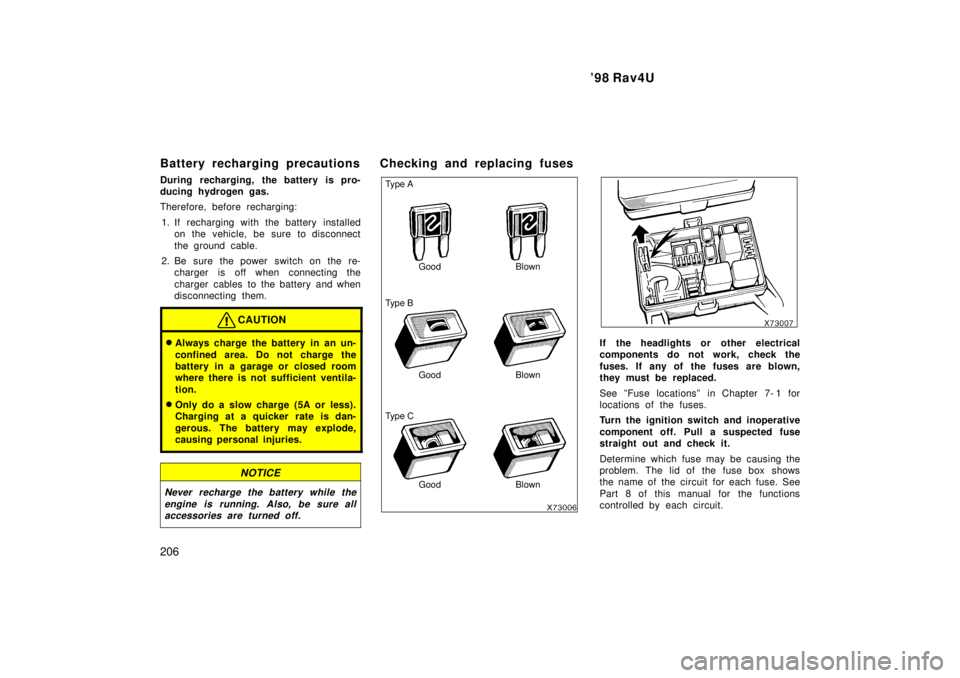
If the headlights or other electrical
components do not work, check the
fuses. If any of the fuses are blown,
they must be replaced.
See ºFuse locationsº in Chapter 7- 1 for
locations of the fuses.
Turn the ignition switch and inoperative
component off. Pull a suspected fuse
straight out and check it.
Determine which fuse may be causing the
problem. The lid of the fuse box shows
the name of the circuit for each fuse. See
Part 8 of this manual for the functions
controlled by each circuit.
Page 207 of 227
'98 Rav4.U207
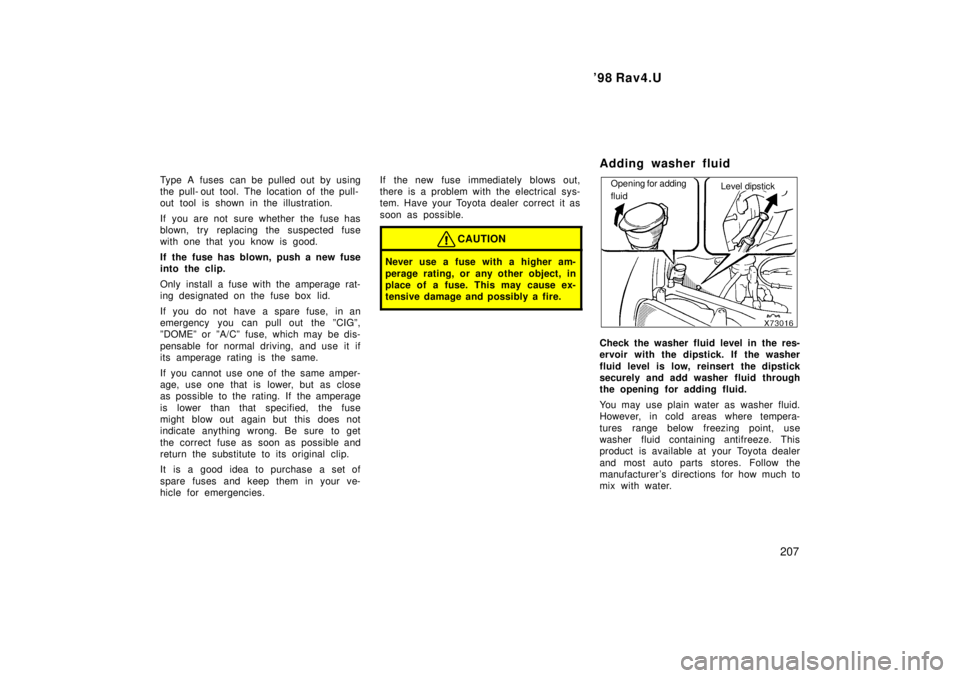
Type A fuses can be pulled out by using
the pull- out tool. The location of the pull-
out tool is shown in the illustration.
If you are not sure whether the fuse has
blown, try replacing the suspected fuse
with one that you know is good.
If the fuse has blown, push a new fuse
into the clip.
Only install a fuse with the amperage rat-
ing designated on the fuse box lid.
If you do not have a spare fuse, in an
emergency you can pull out the ºCIGº,
ºDOMEº or ºA/Cº fuse, which may be dis-
pensable for normal driving, and use it if
its amperage rating is the same.
If you cannot use one of the same amper-
age, use one that is lower, but as close
as possible to the rating. If the amperage
is lower than that specified, the fuse
might blow out again but this does not
indicate anything wrong. Be sure to get
the correct fuse as soon as possible and
return the substitute to its original clip.
It is a good idea to purchase a set of
spare fuses and keep them in your ve-
hicle for emergencies.
If the new fuse immediately blows out,
there is a problem with the electrical sys-
tem. Have your Toyota dealer correct it as
soon as possible.
CAUTION
Never use a fuse with a higher am-
perage rating, or any other object, in
place of a fuse. This may cause ex-
tensive damage and possibly a fire.
Adding washer fluid
Opening
for adding
fluidLevel dipstick
Check the washer fluid level in the res-
ervoir with the dipstick. If the washer
fluid level is low, reinsert the dipstick
securely and add washer fluid through
the opening for adding fluid.
You may use plain water as washer fluid.
However, in cold areas where tempera-
tures range below freezing point, use
washer fluid containing antifreeze. This
product is available at your Toyota dealer
and most auto parts stores. Follow the
manufacturer 's directions for how much to
mix with water.
Page 223 of 227

'98 Rav4.U223
Instrument panel
20. ECU- IG 10 A: Electronically controlled
automatic transmission system, rear
window defogger, center differential
lock system, electric moon roof, multi-
port fuel injection system/sequential
multiport fuel injection system, electric
cooling fan, anti- lock brake system,
cruise control system
21. TURN & GAUGE 10 A: Turn signal
lights, gauges and meters, back- up
lights, service reminder indicators, air
conditioning system, daytime running
light systemInstrument panel
22. STOP 10 A: stoplights, high mounted
stoplight, electronically controlled auto-
matic transmission system, anti- lock
brake system
23. TAIL 15 A: Gauges and meters, emer-
gency flashers, cigarette lighter, center
differential lock system, clock, rear win-
dow defogger, air conditioning system,
electronically controlled automatic
transmission system, car audio system,
tail lights, license plate lights, parking
lights, instrument panel light control,
side marker lights
24. OBD 10 A: On- board diagnosis system
25. SRS- B 10 A: SRS airbag warning lightPassenger's side kick panel
26. HORN 10 A: Horn
27. DEFOG 20 A: Rear window defogger
28. AM1 10 A: ºCIGº, ºPWR OUTLETº,
ºSRS- ACCº, ºWIPERº, ºECU- IGº and
ºTURN & GAUGEº fuses
29. A/C 10 A: Air conditioning system
Fuses (type B)
30. MAIN No.1 40 A: Starting system, ºH-
LP (RH)º, ºH- LP (LH)º, ºH- LP RH- Hº,
ºH- LP LH- Hº, ºH- LP RH- Lº and ºH- LP
LH- Lº fuses
31. CDS FAN 30 A: Electric cooling fans
32. RDI FAN 30 A: Electric cooling fans
Page 224 of 227

'98 Rav4U
224
33. PWR 30 A:
Power door lock system,
electric moon roof, power windows
Fuses (type C)
34. ABS 50 A: Anti- lock brake system
35. MAIN 80 A: ºIGNº, ºHAZº, ºDOMEº,
ºALT- Sº, ºMAIN No.1º, ºAM2º and ºEFIº
fuses
36. ALT 100 A: ºHTRº, ºABSº, ºRDI FANº,
ºCDS FANº, ºCIGº, ºSRS- ACCº, ºWIP-
ERº, ºECU- IGº, ºTURN & GAUGEº,
ºDEFOGº, ºTAILº, ºSTOPº, ºHORNº,
ºOBDº, ºSRS- Bº, ºPWR OUTLETº,
ºPWRº and ºAM1º fuses
37. HTR 50 A: Air conditioning system,
ºA/Cº fuse