ECU TOYOTA RAV4 1999 Service Manual
[x] Cancel search | Manufacturer: TOYOTA, Model Year: 1999, Model line: RAV4, Model: TOYOTA RAV4 1999Pages: 226, PDF Size: 3.89 MB
Page 184 of 226

'99 Rav4.U
184
Automatic transmission ºParkº mecha-
nism
Check the lock release button of the se-
lector lever for proper and smooth opera-
tion. On a safe incline, check that your
vehicle is held securely with the selector
lever in ºPº position and all brakes re-
leased.
IN THE ENGINE COMPARTMENT
Items listed below should be checked
from time to time, e.g. each time when
refueling.
Washer fluid
Make sure there is sufficient fluid in the
tank. See Chapter 7- 3 for additional in-
formation.
Engine coolant level
Make sure the coolant level is between
the ºFULLº and ºLOWº lines on the see-
through reservoir when the engine is cold.
See Chapter 7- 2 for additional information.
Battery electrolyte level
Make sure the electrolyte level of all bat-
tery cells is between upper and lower lev-
el lines on the case. Add only distilled
water when replenishing. See Chapter 7- 3
for additional information.
Brake fluid level
Make sure the brake fluid level is correct.
See Chapter 7- 2 for additional information.
Engine oil level
Check the level on the dipstick with the
engine turned off and the vehicle parked
on a level spot. See Chapter 7- 2 for addi-
tional information.
Power steering fluid level
Check the level through the reservoir. The
level should be in the ºHOTº or ºCOLDº
range depending on the fluid temperature.
See Chapter 7- 2 for additional information.
Exhaust system
If you notice any change in the sound of
the exhaust or smell exhaust fumes, have
the cause located and corrected immedi-
ately. (See engine exhaust cautions in
Part 2.)
Be on the alert for changes in perfor-
mance, sounds, and visual tip- offs that
indicate service is needed. Some impor-
tant clues are as follows:
Engine missing, stumbling, or pinging
Appreciable loss of power
Strange engine noises
A leak under the vehicle (however, wa-
ter dripping from the air conditioning
after use is normal.)
Change in exhaust sound (This may
indicate a dangerous carbon monoxide
leak. Drive with the windows open and
have the exhaust system checked im-
mediately.)
Flat- looking tire; excessive tire squeal
when cornering; uneven tire wear
Vehicle pulls to one side when driving
straight on a level road
Strange noises related to suspension
movement
Loss of brake effectiveness; spongy
feeling brake or clutch pedal; pedal al-
most touches floor; vehicle pulls to one
side when braking
Engine coolant temperature continually
higher than normal
Does your vehicle need
repairing?
Page 206 of 226
'99 Rav4.U
206
Type A fuses can be pulled out by using
the pull- out tool. The location of the pull-
out tool is shown in the illustration.
If you are not sure whether the fuse has
blown, try replacing the suspected fuse
with one that you know is good.
If the fuse has blown, push a new fuse
into the clip.
Only install a fuse with the amperage rat-
ing designated on the fuse box lid.
If you do not have a spare fuse, in an
emergency you can pull out the ºCIGº,
ºDOMEº or ºA/Cº fuse, which may be dis-
pensable for normal driving, and use it if
its amperage rating is the same.
If you cannot use one of the same amper-
age, use one that is lower, but as close
as possible to the rating. If the amperage
is lower than that specified, the fuse
might blow out again but this does not
indicate anything wrong. Be sure to get
the correct fuse as soon as possible and
return the substitute to its original clip.
It is a good idea to purchase a set of
spare fuses and keep them in your ve-
hicle for emergencies.
If the new fuse immediately blows out,
there is a problem with the electrical sys-
tem. Have your Toyota dealer correct it as
soon as possible.
CAUTION
Never use a fuse with a higher am-
perage rating, or any other object, in
place of a fuse. This may cause ex-
tensive damage and possibly a fire.
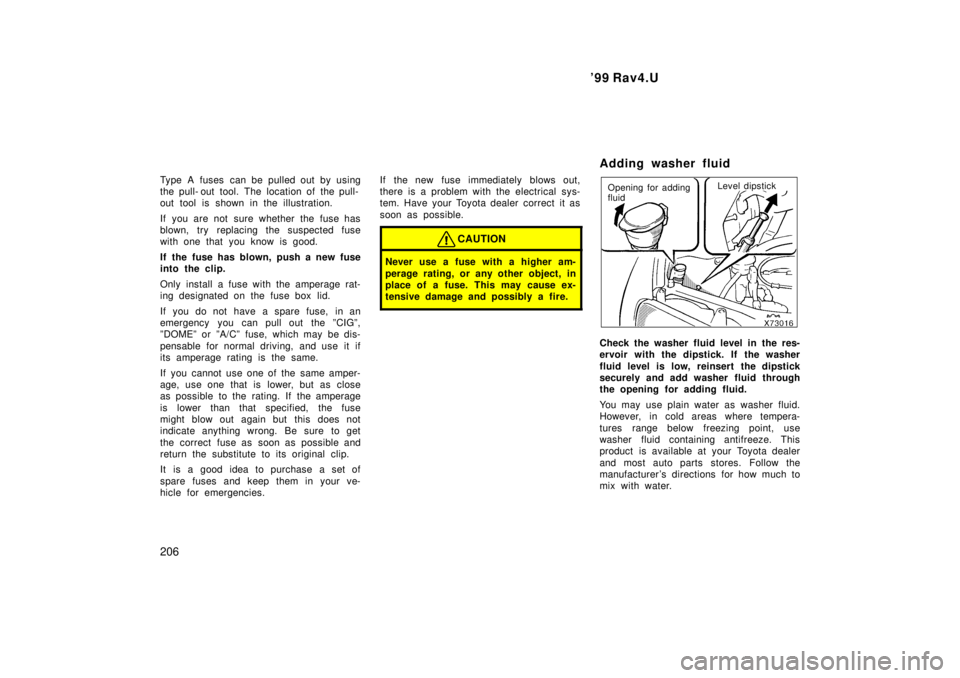
Adding washer fluid
Opening for adding
fluid
Level dipstick
Check the washer fluid level in the res-
ervoir with the dipstick. If the washer
fluid level is low, reinsert the dipstick
securely and add washer fluid through
the opening for adding fluid.
You may use plain water as washer fluid.
However, in cold areas where tempera-
tures range below freezing point, use
washer fluid containing antifreeze. This
product is available at your Toyota dealer
and most auto parts stores. Follow the
manufacturer 's directions for how much to
mix with water.
Page 222 of 226

'99 Rav4.U
222
Instrument panel
20. ECU- IG 10 A: Electronically controlled
automatic transmission system, rear
window defogger, center differential
lock system, electric moon roof, multi-
port fuel injection system/sequential
multiport fuel injection system, electric
cooling fan, anti- lock brake system,
cruise control system
21. TURN & GAUGE 10 A: Turn signal
lights, gauges and meters, back- up
lights, service reminder indicators, air
conditioning system, daytime running
light systemInstrument panel
22. STOP 10 A: stoplights, high mounted
stoplight, electronically controlled auto-
matic transmission system, anti- lock
brake system
23. TAIL 15 A: Gauges and meters, emer-
gency flashers, cigarette lighter, center
differential lock system, clock, rear win-
dow defogger, air conditioning system,
electronically controlled automatic
transmission system, car audio system,
tail lights, license plate lights, parking
lights, instrument panel light control,
side marker lights
24. OBD 10 A: On- board diagnosis system
25. SRS- B 10 A: SRS airbag warning lightPassenger's side kick panel
26. HORN 10 A: Horn
27. DEFOG 20 A: Rear window defogger
28. AM1 10 A: ºCIGº, ºPWR OUTLETº,
ºSRS- ACCº, ºWIPERº, ºECU- IGº and
ºTURN & GAUGEº fuses
29. A/C 10 A: Air conditioning system
Fuses (type B)
30. MAIN No.1 40 A: Starting system, ºH-
LP (RH)º, ºH- LP (LH)º, ºH- LP RH- Hº,
ºH- LP LH- Hº, ºH- LP RH- Lº and ºH- LP
LH- Lº fuses
31. CDS FAN 30 A: Electric cooling fans
32. RDI FAN 30 A: Electric cooling fans
Page 223 of 226

'99 Rav4.U223
33. PWR 30 A:
Power door lock system,
electric moon roof, power windows
Fuses (type C)
34. ABS 50 A: Anti- lock brake system
35. MAIN 80 A: ºIGNº, ºHAZº, ºDOMEº,
ºALT- Sº, ºMAIN No.1º, ºAM2º and ºEFIº
fuses
36. ALT 100 A: ºHTRº, ºABSº, ºRDI FANº,
ºCDS FANº, ºCIGº, ºSRS- ACCº,
ºWIPERº, ºECU- IGº, ºTURN &
GAUGEº, ºDEFOGº, ºTAILº, ºSTOPº,
ºHORNº, ºOBDº, ºSRS- Bº, ºPWR
OUTLETº, ºPWRº and ºAM1º fuses
37. HTR 50 A: Air conditioning system,
ºA/Cº fuse