fuel tank capacity TOYOTA RAV4 1999 Owners Manual
[x] Cancel search | Manufacturer: TOYOTA, Model Year: 1999, Model line: RAV4, Model: TOYOTA RAV4 1999Pages: 226, PDF Size: 3.89 MB
Page 134 of 226

'99 Rav4.U
134
GASOLINES CONTAINING MMT
Some gasolines contain an octane- en-
hancing additive called MMT (methylcy-
clopentadienyl manganese tricarbonyl).
Toyota does not recommend the use of
gasolines that contain MMT. If fuels con-
taining MMT are used, your emission con-
trol system may be adversely affected.
The Malfunction Indicator Lamp on the in-
strument cluster may come on. If this hap-
pens, contact your Toyota dealer for ser-
vice.
GASOLINES CONTAINING ALCOHOL
If you use gasohol in your Toyota, be
sure that it is unleaded, has an octane
rating no lower than 87 and does not
contain more than 10% ethanol.
Gasohol is a mixture of gasoline and etha-
nol.
Toyota does not recommend the use of
gasolines containing methanol. If you use
gasoline containing methanol, use only
gasoline meeting the requirements above
and also containing less than 5 % metha-
nol with cosolvents and corrosion inhibi-
tors for methanol.
GASOLINES QUALITY
In a very few cases, you may experience
driveability problems caused by the partic-
ular gasoline that you are using. If you
continue to have unacceptable driveability,
try changing gasoline brands. If that does
not rectify your problem, then consult your
Toyota dealer.
NOTICE
Do not use gasohol other than
stated above. It will cause fuel sys-tem damage or vehicle performanceproblems.
If driveab ility problems occur ( poor
hot starting, vaporizing, engine knock, etc.), discontinue the use.
Take care not to spill gasohol dur-
ing refueling. Gasohol may cause
paint damage.
FUEL TANK CAPACITY
58 L (15.3 gal., 12.8 Imp. gal.) Operation in foreign countries
If you plan to drive your Toyota in
another country...
First,
comply with the vehicle registration
laws.
Second, confirm the availability of the cor-
rect fuel (unleaded and minimum octane
number).
Page 197 of 226
'99 Rav4.U197
Clean all dirt from outside of the reservoir
tank and look at the fluid level. If the fluid
is cold, the level should be in the ºCOLDº
range. Similarly, if it is hot, the fluid level
should be in the ºHOTº range. If the level
is at the low side of either range, add auto-
matic transmission fluid DEXRON
II or III
to bring the level within the range.
To remove the filler cap, turn it c ounterclock-
wise and lift up. To reinstall it, turn it clock-
wise. After replacing the filler cap, visually
check the steering box case, vane pump and
hose connections for leaks or damage.
CAUTION
The reservoir tank may be hot so be
careful not to burn yourself.
NOTICE
Avoid overfilling, or the power steer-
ing could be damaged.
Checking tire pressure
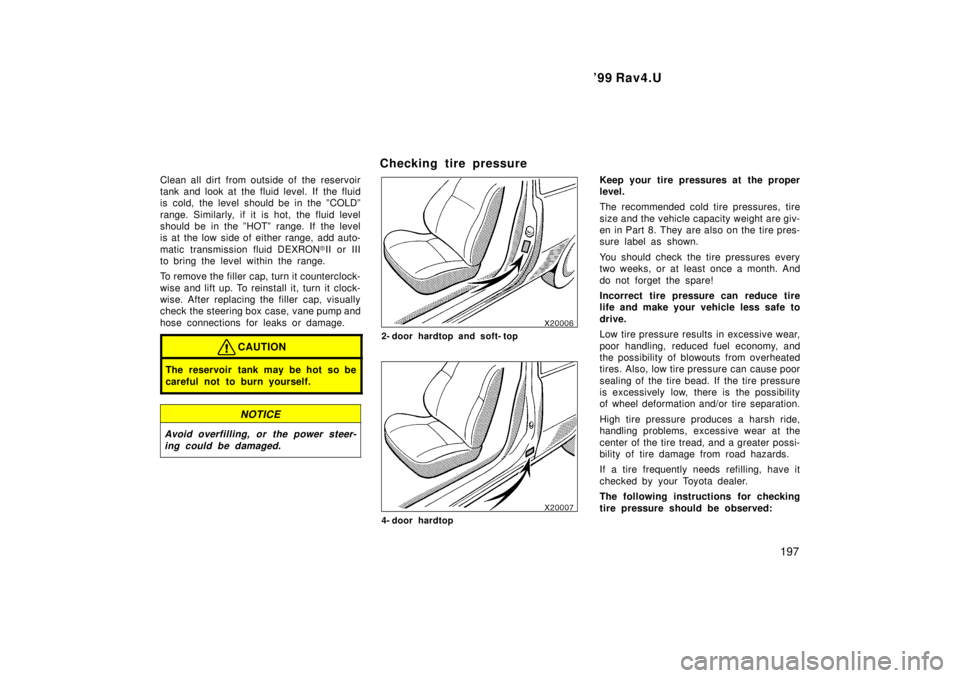
2- door hardtop and soft- top
4- door hardtop Keep your tire pressures at the proper
level.
The recommended cold tire pressures, tire
size and the vehicle capacity weight are giv-
en in Part 8. They are also on the tire pres-
sure label as shown.
You should check the tire pressures every
two weeks, or at least once a month. And
do not forget the spare!
Incorrect tire pressure can reduce tire
life and make your vehicle less safe to
drive.
Low tire pressure results in excessive wear,
poor handling, reduced fuel economy, and
the possibility of blowouts from over
heated
tires. Also, low tire pressure can cause poor
sealing of the tire bead. If the tire pressure
is excessively low, there is the possibility
of wheel deformation and/or tire separation.
High tire pressure produces a harsh ride,
handling problems, excessive wear at the
center of the tire tread, and a greater possi-
bility of tire damage from road hazards.
If a tire frequently needs ref illing, have it
checked by your Toyota dealer.
The following instructions for checking
tire pressure should be observed:
Page 217 of 226
'99 Rav4.U217
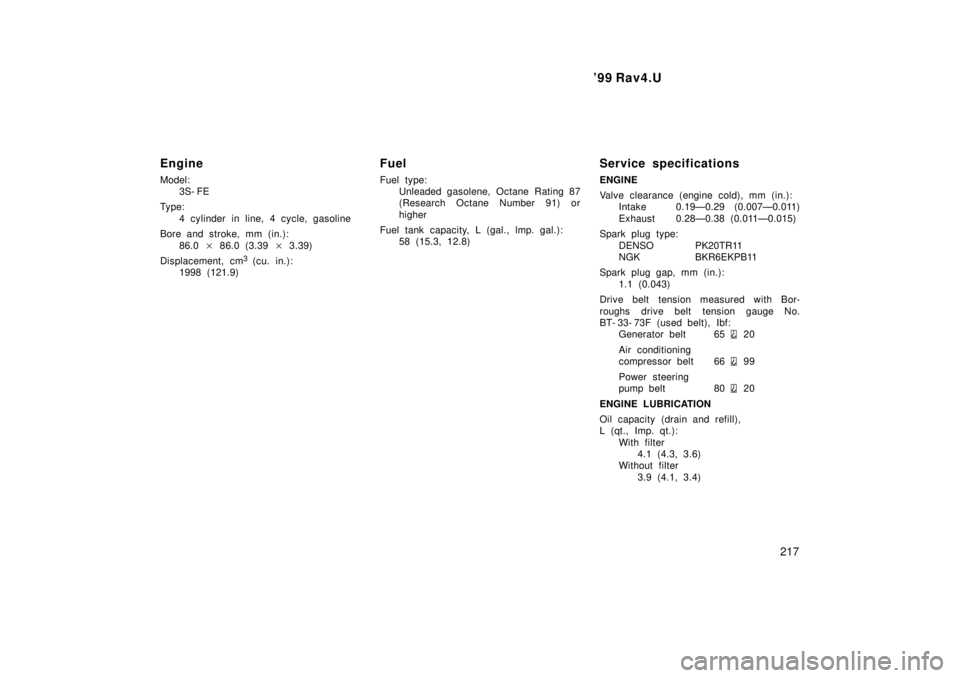
Engine
Model:
3S- FE
Type: 4 cylinder in line, 4 cycle, gasoline
Bore and stroke, mm (in.): 86.0 86.0 (3.39 3.39)
Displacement, cm 3
(cu. in.):
1998 (121.9) Fuel
Fuel type:
Unleaded gasolene, Octane Rating 87
(Research Octane Number 91) or
higher
Fuel tank capacity, L (gal., lmp. gal.): 58 (15.3, 12.8) Service specifications
ENGINE
Valve clearance (engine cold), mm (in.):
Intake 0.19Ð0.29 (0.007Ð0.011)
Exhaust 0.28Ð0.38 (0.011Ð0.015)
Spark plug type: DENSO PK20TR11
NGK BKR6EKPB11
Spark plug gap, mm (in.): 1.1 (0.043)
Drive belt tension measured with Bor-
roughs drive belt tension gauge No.
BT- 33- 73F (used belt), Ibf: Generator belt 65
20
Air conditioning
compressor belt 66
99
Power steering
pump belt 80
20
ENGINE LUBRICATION
Oil capacity (drain and ref ill),
L (qt., Imp. qt.):
With filter4.1 (4.3, 3.6)
Without filter
3.9 (4.1, 3.4)