washer fluid TOYOTA RAV4 1999 Owners Manual
[x] Cancel search | Manufacturer: TOYOTA, Model Year: 1999, Model line: RAV4, Model: TOYOTA RAV4 1999Pages: 226, PDF Size: 3.89 MB
Page 5 of 226

'99 Rav4.U5
Indicator symbols on the instrument panel
Brake system warning light
*
1
Discharge warning light *
1
Low oil pressure warning light *
1
Malfunction indicator lamp *
1
Headlight high beam indicator light
SRS airbag warning light
*
1
Turn signal indicator lights
Seat belt reminder light
*
1
Open door warning light*
1
Low fuel level warning light *
1 Automatic transmission fluid temperature warning
light
*
1
Anti-lock brake system warning light
*
1
(type A)
(type B)
(type A)
(type B) (type A)
(type B)
Low windshield washer fluid level warning light
*
1
Page 80 of 226

'99 Rav4.U
80
Personal light (with moon roof)
To turn on the personal light, push the
switch. To turn the light off, slightly
push the switch on the opposite side.
The personal light switch has the following
positions:
ºONºÐKeeps the light on all the time.
ºDOORºÐTurns the light on when either
front door is opened. The light goes off
when both front doors are closed.The personal lights operate separately
with each outer switch.
To turn on the light, push the switch on
your side. To turn the light off, push the
switch once again.
The center switch has the following posi-
tions:
ºDOORºÐTurns both lights on when either
front door is opened. The light goes off
when both front doors are closed.
ºOFFºÐThe lights are off unless you oper-
ate either outer switch.
Windshield wipers and washerTo turn on the windshield wipers, move
the lever to the desired setting.
The key must be in the ºONº position.
Lever position
Speed setting
Position 1Intermittent
Position 2Slow
Position 3Fast
To squirt washer fluid, pull the lever
toward you and release it.
If the windshield wipers are off, they will
operate a couple of times after the washer
squirts.
Personal lights
(without moon roof)
Page 81 of 226
'99 Rav4.U81
For instructions on adding washer fluid,
see ºAdding washer fluidº in Chapter 7- 3.
In freezing weather, warm the windshield
with the defroster before using the washer.
This will help prevent the washer fluid
from freezing on your windshield, which
can block your vision.
NOTICE
Do not operate the wipers if the wind-
shield is dry. It may scratch theglass.
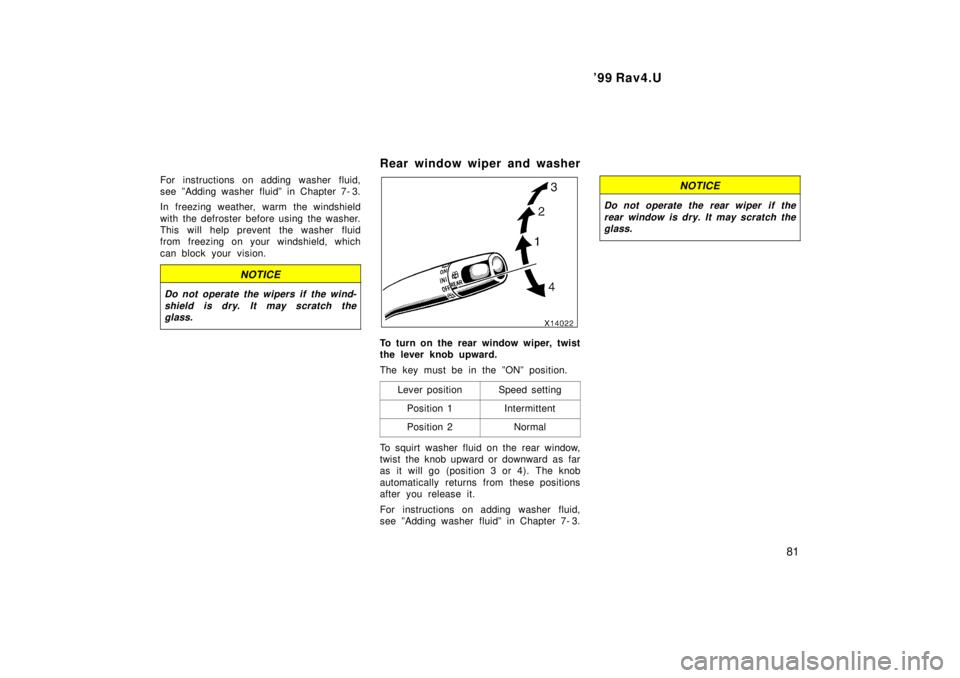
Rear window wiper and washer
To turn on the rear window wiper, twist
the lever knob upward.
The key must be in the ºONº position.
Lever position
Speed setting
Position 1Intermittent
Position 2Normal
To squirt washer fluid on the rear window,
twist the knob upward or downward as far
as it will go (position 3 or 4). The knob
automatically returns from these positions
after you release it.
For instructions on adding washer fluid,
see ºAdding washer fluidº in Chapter 7- 3.
NOTICE
Do not operate the rear wiper if therear window is dry. It may scratch theglass.
Page 86 of 226

'99 Rav4.U
86
(g) Take vehicle to Toyota dealer.
(type A)
(type B)
(f) Fill up tank.
(e) Take vehicle to
Toyota dealer.
(type A)
(type B)
If the indicator or
buzzer comes on... Do this.
(m) Remove key.
(i) Stop and check.
(j) Take vehicle to
Toyota dealer
immediately.
(l) Turn off light. Light reminder
buzzer
Key reminder
buzzer
(h) Close all side
doors, back door
(hardtop) and
tailgate (soft- top).
(k) Add washer fluid.If the indicator or
buzzer comes on...
Do this.
(a) Brake System Warning Light
This light has the following functions:
Parking brake reminder
If this light is on, make sure the parking
brake is fully released. The light should
go off.
Low brake fluid level warning
If this light comes on and stays on while
you are driving, slowdown and pull off the
road. Then stop the vehicle carefully. Re-
member that stopping distance and pedal
effort may be increased. There maybe a
problem somewhere in the brake system.
Check the fluid level of the see- through
reservoir.
To make sure the parking brake has not
caused the warning light to come on,
check to see that the parking brake is
fully released.
If the brake fluid level is low...
At a safe place, test your brakes by start-
ing and stopping.
If you judge that the brakes still work
adequately, drive cautiously to your
nearest dealer or shop for repairs.
If the brakes are not working, have the
vehicle towed in for repairs. (For tow-
ing information, see Part 4.)
Page 88 of 226
'99 Rav4.U
88
(f) Low Fuel Level Warning Light
This light comes on when the fuel level
in the tank becomes nearly empty. Fill up
the tank as soon as possible.
On inclines or curves, due to the move-
ment of fuel in the tank, the low fuel level
warning light may come on earlier than
usual.
(g) ºABSº Warning Light
This light warns that there is a problem
somewhere in your anti- lock brake sys-
tem.
If the light comes on while you are driv-
ing, have your vehicle checked by your
Toyota dealer as soon as possible.
The light will come on when the ignition
key is turned to the ºONº position. After
a few seconds, the light will go off.
When the ºABSº warning light is on (and
the brake system warning light is off), the
brake system operates conventionally but
anti- lock brake system is not assisting
brake performance so that the wheels can
lock- up during sudden braking or braking
on slippery road surfaces.
(h) Open Door Warning Light
This light remains on until all the doors,
back door (hardtop) and tailgate (soft- top)
are completely closed.
(i) Automatic Transmission Fluid Tem-
perature Warning Light (four- wheel
drive models)
This light warns that the automatic trans-
mission fluid temperature is too high.
If this light comes on while you are driv-
ing, slow down and pull off the road. Stop
the vehicle at a safe place and put the
selector lever in ºPº. With the engine id-
ling, wait until the light goes off. If the
light goes off, you can start the vehicle
again. If the light does not go off, call a
Toyota dealer or qualified repair shop for
assistance.
NOTICE
Continued driving with the warning light on may damage the automatictransmission.
(j) SRS Airbag Warning Light
This light will come on when the igni-
tion key is turned to the ºACCº or
ºONº position. After about 6 seconds,
the light will go off. This means the
system of the airbag and front seat belt
pretensioners are operating properly.
The warning light system monitors the air-
bag sensor assembly, front airbag sen-
sors, seat belt pretensioner assemblies,
inflators, warning light, interconnecting wir-
ing and power sources.
If either of the following conditions occurs,
this indicates a malfunction somewhere in
the parts monitored by the warning light
system. Contact your Toyota dealer as
soon as possible to service the vehicle.
The light does not come on when the
ignition key is turned to the ºACCº or
ºONº position or remains on.
The light comes on or flashes while
driving.
(k) Low Windshield Washer Fluid Level Warning Light (Canada)
The light warns that the windshield washer
fluid level is too low. Add washer fluid at
your earliest opportunity. (For instructions,
see ºAdding washer fluidº in Chapter 7- 3.)
Page 89 of 226

'99 Rav4.U89
(l) Light Reminder Buzzer
This buzzer will sound if the headlight
switch is left on and the driver's door is
opened with the key removed from the
ignition switch.
(m) Key Reminder Buzzer
This buzzer reminds you to remove the
key when you open the driver 's door with
the ignition key in the ºACCº or ºLOCKº
position.
CHECKING SERVICE REMINDER INDICA-
TORS (except the low fuel level warning
light and low windshield washer fluid
level warning light)
1. Apply the parking brake.
2. Open one of the doors or tailgate (soft- top).
The open door warning light should
come on.
3. Close the door or tailgate (soft- top). The open door warning light should go
off.
4. Turn the ignition key to ºACCº. The SRS airbag warning light should
come on. It goes off after about 6 se-
conds. 5. Turn the ignition key to ºONº, but do
not start the engine.
All the service reminder indicators ex-
cept the open door warning light, SRS
airbag warning light and automatic
transmission fluid temperature warning
light should come on. The ºABSº warn-
ing light goes off after a few seconds.
6. Turn the ignition key to ºSTARTº. The automatic transmission fluid tempera-
ture warning light should come on.
If any service reminder indicator or warn-
ing buzzer does not function as described
above, either the bulb is burned out or the
circuit is in need of repair. Have it
checked by your Toyota dealer as soon as
possible.
Page 149 of 226
'99 Rav4.U149
Winter driving tips
Make sure you have a proper freeze
protection of engine coolant.
Your coolant must contain ethylene- glycol
type coolant for a proper corrosion
protection of aluminum components. Use
ºToyota Long Life Coolantº or equivalent.
See Chapter 7- 2 for details about coolant
type selection.
NOTICE
Do not use alcohol type antifreeze or
plain water alone.
When it is extremely cold, we recommend
to use 60% solution for your Toyota, to
provide protection down to about -50 5C
(- 58 5F). Do not use more than 70% solu-
tion for better coolant performance.
Check the condition of the battery and
cables.
Cold temperatures reduce the capacity of
any battery, so it must be in top shape
to provide enough power for winter start-
ing. Chapter 7- 3 tells you how to visually
inspect the battery. Your Toyota dealer
and most service stations will be pleased
to check the level of charge. Make sure the engine oil viscosity is
suitable for the cold weather.
See Chapter 7- 2 for recommended viscos-
ity. Leaving a heavy summer oil in your
vehicle during winter months may cause
harder starting. If you are not sure about
which oil to use, call your Toyota dealer±
he will be pleased to help.
Keep the door locks from freezing.
Squirt lock de- icer or glycerine into the
locks to keep them from freezing. To open
a frozen lock, try heating the key before
inserting it.
Use a washer fluid containing an anti-
freeze solution.
This product is available at your Toyota
dealer and most auto parts stores. Follow
the manufacturer 's directions for how
much to mix with water.
NOTICE
Do not use engine antifreeze or any
other substitute because it may dam-age your vehicle's paint.
Do not use your parking brake when
there is a possibility it could freeze.
When parking, put the transmission into
ºPº (automatic) or into first or reverse
(manual) and block the rear wheels. Do
not use the parking brake, or snow or
water accumulated in and around the
parking brake mechanism may freeze,
making it hard to release.
Keep ice and snow from accumulating
under the fenders.
Ice and snow built up under your fenders
can make steering difficult. During bad
winter driving, stop and check under the
fenders occasionally.
Depending on where you are driving,
we recommend you carry some emer-
gency equipment.
Some of the things you might put in the
vehicle are tire chains, window scraper,
bag of sand or salt, flares, small shovel,
jumper cables, etc.
Page 184 of 226

'99 Rav4.U
184
Automatic transmission ºParkº mecha-
nism
Check the lock release button of the se-
lector lever for proper and smooth opera-
tion. On a safe incline, check that your
vehicle is held securely with the selector
lever in ºPº position and all brakes re-
leased.
IN THE ENGINE COMPARTMENT
Items listed below should be checked
from time to time, e.g. each time when
refueling.
Washer fluid
Make sure there is sufficient fluid in the
tank. See Chapter 7- 3 for additional in-
formation.
Engine coolant level
Make sure the coolant level is between
the ºFULLº and ºLOWº lines on the see-
through reservoir when the engine is cold.
See Chapter 7- 2 for additional information.
Battery electrolyte level
Make sure the electrolyte level of all bat-
tery cells is between upper and lower lev-
el lines on the case. Add only distilled
water when replenishing. See Chapter 7- 3
for additional information.
Brake fluid level
Make sure the brake fluid level is correct.
See Chapter 7- 2 for additional information.
Engine oil level
Check the level on the dipstick with the
engine turned off and the vehicle parked
on a level spot. See Chapter 7- 2 for addi-
tional information.
Power steering fluid level
Check the level through the reservoir. The
level should be in the ºHOTº or ºCOLDº
range depending on the fluid temperature.
See Chapter 7- 2 for additional information.
Exhaust system
If you notice any change in the sound of
the exhaust or smell exhaust fumes, have
the cause located and corrected immedi-
ately. (See engine exhaust cautions in
Part 2.)
Be on the alert for changes in perfor-
mance, sounds, and visual tip- offs that
indicate service is needed. Some impor-
tant clues are as follows:
Engine missing, stumbling, or pinging
Appreciable loss of power
Strange engine noises
A leak under the vehicle (however, wa-
ter dripping from the air conditioning
after use is normal.)
Change in exhaust sound (This may
indicate a dangerous carbon monoxide
leak. Drive with the windows open and
have the exhaust system checked im-
mediately.)
Flat- looking tire; excessive tire squeal
when cornering; uneven tire wear
Vehicle pulls to one side when driving
straight on a level road
Strange noises related to suspension
movement
Loss of brake effectiveness; spongy
feeling brake or clutch pedal; pedal al-
most touches floor; vehicle pulls to one
side when braking
Engine coolant temperature continually
higher than normal
Does your vehicle need
repairing?
Page 188 of 226

'99 Rav4.U
188
Engine compartment overview
1. Windshield and rear window washerfluid tank
2. Battery
3. Fuse blocks
4. Engine oil filler cap
5. Brake fluid reservoir
6. Engine coolant reservoir
7. Electric cooling fans
8. Engine oil level dipstick
9. Power steering fluid reservoir
10. Windshield washer fluid level dipstick
Page 192 of 226

'99 Rav4.U
192
Parts and tools
Here is a list of parts and tools you will
need on performing do- it- yourself mainte-
nance. Remember all Toyota parts are de-
signed in metric sizes, so your tools must
be metric.
Checking the engine oil level
Parts (if level is low):
Engine oil API grade SJ,
ºEnergy- Conservingº or ILSAC
multigrade having viscosity proper for
your climate
Tools: Rag or paper towel
Funnel (only for adding oil)
Checking the engine coolant level
Parts (if level is low): ºToyota Long Life Coolantº or equiva-
lent
See Chapter 7- 2 for details about cool-
ant type selection.
Demineralized or distilled water
Tools:
Funnel (only for adding coolant)
Checking brake fluid
Parts (if level is low): SAE J1703 or FMVSS No.116 DOT 3
brake fluid Tools:
Rag or paper towel
Funnel (only for adding fluid)
Checking power steering fluid
Parts (if level is low): Automatic transmission fluid DEXRON II
or III
Tools: Rag or paper towel
Funnel (only for adding fluid)
Checking battery condition
Tools:
Warm water
Baking soda
Grease
Conventional wrench (for terminal
clamp bolts)
Checking and replacing fuses
Parts (if replacement is necessary): Fuse with same amperage rating as
original Tools:
Screwdriver (for driver's side instru-
ment lower panel nut)
Conventional wrench (for passenger 's
side kick panel nut)
Adding washer fluid
Parts: Water
Washer fluid containing antifreeze
(for winter use)
Tools:
Funnel
Replacing light bulbs
Parts: Bulb with same number and wattage
rating as original (See charts in ºRe-
placing light bulbsº in Chapter 7- 3.)
Tools:
Screwdriver