catalytic converter TOYOTA RAV4 2006 Service Repair Manual
[x] Cancel search | Manufacturer: TOYOTA, Model Year: 2006, Model line: RAV4, Model: TOYOTA RAV4 2006Pages: 2000, PDF Size: 45.84 MB
Page 1 of 2000

ENGINE - 2AZ-FE ENGINE EG-4
FEATURES OF 2AZ-FE ENGINE
The 2AZ-FE engine has achieved the following performance through the use of the items listed below.
(1) High performance and reliability
(2) Low noise and vibration
(3) Lightweight and compact design
(4) Good serviceability
(5) Clean emission and fuel economy
Section
Item(1)(2)(3)(4)(5)
Engine
A cylinder block made of aluminum alloy along with a
magnesium alloy die-cast cylinder head cover is used.
Engine
ProperA taper squish shape is used for the combustion chamber.p
A resin gear balance shaft is used.
Vl
A timing chain and chain tensioner are used.
Va l v e
MechanismThe shim-less type valve lifters are used.MechanismThe VVT-i system is used.
A chacoal filter is used in the air cleaner cap.
Intake andIntake manifold made of plastic is used.Intake and
ExhaustThe linkless-type throttle body is used.
SystemA thin-wall ceramic TWC (Three-Way Catalytic converter)
is used.
The fuel returnless system is used.
Fuel
System
Quick connectors are used to connect the fuel hose with the
fuel pipe.
System12-hole type fuel injectors with high atomizing performance
are used.
Ignition
SystemIridium-tipped spark plugs are used.
Charging
SystemThe segment conductor type generator is used.
Starting
SystemPS (Planetary reduction-Segment conductor motor) type
starter is used.
The ETCS-i is used.
Engine
Control
The DIS (Direct Ignition System) makes ignition timing
adjustment unnecessary.
Control
SystemThe non-contact type sensor is used in the throttle position
sensor.
The planar type air-fuel ratio sensor is used.
Page 17 of 2000

ENGINE - 2AZ-FE ENGINE
01NEG37Y
Mesh Type Gasket
01NEG38Y
TWC EG-20
4. Intake Manifold
The intake manifold has been made of plastic to reduce the weight and the amount of heat transferred from
the cylinder head. As a result, it has become possible to reduce the intake air temperature and improve the
intake volumetric efficiency.
A mesh type gasket is used, in order to reduce the intake noise.
5. Exhaust Manifold
A stainless steel exhaust manifold is used for improving the warm-up of TWC (Three-Way Catalytic
converter) and for weight reduction.
Page 67 of 2000

ENGINE - 2GR-FE ENGINEEG-71
FEATURES OF 2GR-FE ENGINE
The 2GR-FE engine has achieved the following performance through the use of the items listed below.
(1) High performance and reliability
(2) Low noise and vibration
(3) Lightweight and compact design
(4) Good serviceability
(5) Clean emission and fuel economy
Item
(1)(2)(3)(4)(5)
A steel laminate type cylinder head gasket is used.
An upright intake port is used.
EngineA taper squish shape is used for combustion chamber.Engine
ProperA cylinder block made of aluminum alloy is used.Proper
The skirt portion of the piston is applied with resin to
reduce friction.
An oil pan No. 1 made of aluminum alloy is used.
The Dual VVT-i (Variable Valve Timing-intelligent)
system is used.
Va l v e
Mh i
Hydraulic lash adjusters are used.
MechanismTiming chains and chain tensioners are used.
Roller rocker arms are used.
Lubrication
SystemAn oil filter with a replaceable element is used.
Cooling SystemThe TOYOTA Genuine SLLC (Super Long Life Coolant)Cooling SystemThe TOYOTA Genuine SLLC (Super Long Life Coolant)
is used for the engine coolant.
The linkless-type throttle body is used.
Intake andThe intake air chamber made of plastic is used.Intake and
Exhaust
S
A stainless steel exhaust manifold is used.
SystemAn ultra thin-wall, high-cell density ceramic type TWC
(Three-Way Catalytic converter) is used.
The fuel delivery pipe made of plastic is used.
Fuel SystemA compact 12-hole type injector is used.Fuel SystemQuick connectors are used to connect the fuel hose with
the fuel pipe.
Ignition System
The DIS (Direct Ignition System) makes ignition timing
adjustment unnecessary.
Ignition System
The long-reach type spark plugs are used.
(Continued)
Page 89 of 2000

ENGINE - 2GR-FE ENGINE
01MEG14Y
TWC
Right Bank Exhaust
ManifoldTWC
Left Bank Exhaust
ManifoldUltra
Thin-Wall
01MEG16Y
Exhaust Front PipeExhaust Center PipeTailpipe
Sub Muffler
Ball Joint
Main Muffler
TWC
Ball Joint
Spring
Bolt
Gasket Ball JointEG-93
6. Exhaust Manifold
A stainless steel exhaust manifold with an integrated TWC (Three-Way Catalytic converter) is used for
warm-up of the TWC and for weight reduction.
An ultra thin-wall, high-cell density, ceramic type TWC is used. This TWC is incorporated on each of the
right and left banks.
This TWC improves exhaust emissions by optimizing the cells density and the wall thickness.
7. Exhaust Pipe
The exhaust pipe is made of stainless steel for improved rust resistance.
A thin-wall, ceramic type TWC is used.
Ball joints are used at two places: one at the exhaust center pipe joint, and the other between the exhaust
center pipe and the tailpipe. As a result, a simple construction and reliability are realized.
Page 221 of 2000

INTRODUCTION – TERMSIN–49
IN
IAT Intake Air Temperature Intake or Inlet Air Temperature
ICM Ignition Control Module -
IFI Indirect Fuel Injection Indirect Injection (IDL)
IFS Inertia Fuel-Shutoff -
ISC Idle Speed Control -
KS Knock Sensor Knock Sensor
MAF Mass Airflow Air Flow Meter
MAP Manifold Absolute Pressure Manifold Pressure Intake Vacuum
MC Mixture ControlElectric Bleed Air Control Valve (EBCV)
Mixture Control Valve (MCV)
Electric Air Control Valve (EACV)
MDP Manifold Differential Pressure -
MFI Multiport Fuel Injection Electronic Fuel Injection (EFI)
MIL Malfunction Indicator Lamp Check Engine Lamp
MST Manifold Surface Temperature -
MVZ Manifold Vacuum Zone -
NVRAM Non-Volatile Random Access Memory -
O2S Oxygen Sensor Oxygen Sensor, O2 Sensor (O2S)
OBD On-Board Diagnostic On-Board Diagnostic System (OBD)
OC Oxidation Catalytic Converter Oxidation Catalyst Converter (OC), CCo
OL Open Loop Open Loop
PAIR Pulsed Secondary Air Injection Air Suction (AS)
PCM Powertrain Control Module -
PNP Park/Neutral Position -
PROM Programmable Read Only Memory -
PSP Power Steering Pressure -
PTOX Periodic Trap OxidizerDiesel Particulate Filter (DPF)
Diesel Particulate Trap (DPT)
RAM Random Access Memory Random Access Memory (RAM)
RM Relay Module -
ROM Read Only Memory Read Only Memory (ROM)
RPM Engine Speed Engine Speed
SC Supercharger Supercharger
SCB Supercharger Bypass E-ABV
SFI Sequential Multiport Fuel Injection Electronic Fuel Injection (EFI), Sequential Injection
SPL Smoke Puff Limiter -
SRI Service Reminder Indicator -
SRT System Readiness Test -
ST Scan Tool -
TB Throttle Body Throttle Body
TBI Throttle Body Fuel InjectionSingle Point Injection
Central Fuel Injection (Ci)
TC Turbocharger Turbocharger
TCC Torque Converter Clutch Torque Converter
TCM Transmission Control Module Transmission ECU, ECT ECU
TP Throttle Position Throttle Position
TR Transmission Range -
TVV Thermal Vacuum ValveBimetallic Vacuum Switching Valve (BVSV)
Thermostatic Vacuum Switching Valve (TVSV) SAE
ABBREVIATIONSSAE TERMS TOYOTA TERMS ( )-ABBREVIATIONS
Page 222 of 2000

IN–50INTRODUCTION – TERMS
IN
TWC Three-Way Catalytic ConverterThree-Way Catalytic (TWC)
Manifold Converter
CCRO
TWC+OC Three-Way + Oxidation Catalytic Converter CCR + CCo
VAF Volume Airflow Air Flow Meter
VR Voltage Regulator Voltage Regulator
VSS Vehicle Speed Sensor Vehicle Speed Sensor
WOT Wide Open Throttle Full Throttle
WU-OC Warm Up Oxidation Catalytic Converter -
WU-TWC Warm Up Three-Way Catalytic Converter -SAE
ABBREVIATIONSSAE TERMS TOYOTA TERMS ( )-ABBREVIATIONS
Page 1951 of 2000

2AZ-FE ENGINE CONTROL SYSTEM – SFI SYSTEMES–63
ES
P0352 Ignition Coil "B"
Primary / Secondary
Circuit- Same as DTC
P0351Comes on DTC storedES-183
P0353 Ignition Coil "C"
Primary / Secondary
Circuit- Same as DTC
P0351Comes on DTC storedES-183
P0354 Ignition Coil "D"
Primary / Secondary
Circuit- Same as DTC
P0351Comes on DTC storedES-183
P0420 Catalyst System
Efficiency Below
Threshold (Bank 1)- Front exhaust pipe
(with Three-Way
Catalytic Converter)
- Gas leakage from
exhaust system
- A/F sensor (sensor
1)
- HO2 sensor (sensor
2)Comes on DTC storedES-191
P043E Evaporative Emission
System Reference
Orifice Clog Up- Canister pump
module (Reference
orifice, leak detection
pump, vent valve)
- Connector/wire
harness (Canister
pump module - ECM)
- EVAP system hose
(pipe from air inlet
port to canister pump
module, canister
filter, fuel tank vent
hose)
- ECMComes on DTC storedES-198
P043F Evaporative Emission
System Reference
Orifice High Flow- Same as DTC
P043EComes on DTC storedES-198
P0441 Evaporative Emission
Control System
Incorrect Purge Flow- Purge VSV
- Connector/wire
harness (Purge VSV
- ECM)
- Canister pump
module
- Leakage from EVAP
system
- Leakage from EVAP
line (Purge VSV -
Intake manifold)
- ECMComes on DTC storedES-203
P0450 Evaporative Emission
Control System
Pressure Sensor /
Switch- Canister pump
module
- EVAP system hose
(pipe from air inlet
port to canister pump
module, canister
filter, fuel tank vent
hose)
- ECMComes on DTC storedES-210 DTC No. Detection Item Trouble Areas MIL Memory See page
Page 1969 of 2000
2AZ-FE ENGINE CONTROL SYSTEM – SFI SYSTEMES–81
ES
HINT:
• Although the DTC titles say oxygen sensor, these DTCs relate to the Air-Fuel Ratio (A/F) sensor.
• Sensor 1 refers to the sensor mounted in front of the Three-Way Catalytic Converter (TWC) and
located near the engine assembly.
DESCRIPTION
Refer to DTC P2195 (see page ES-292).
HINT:
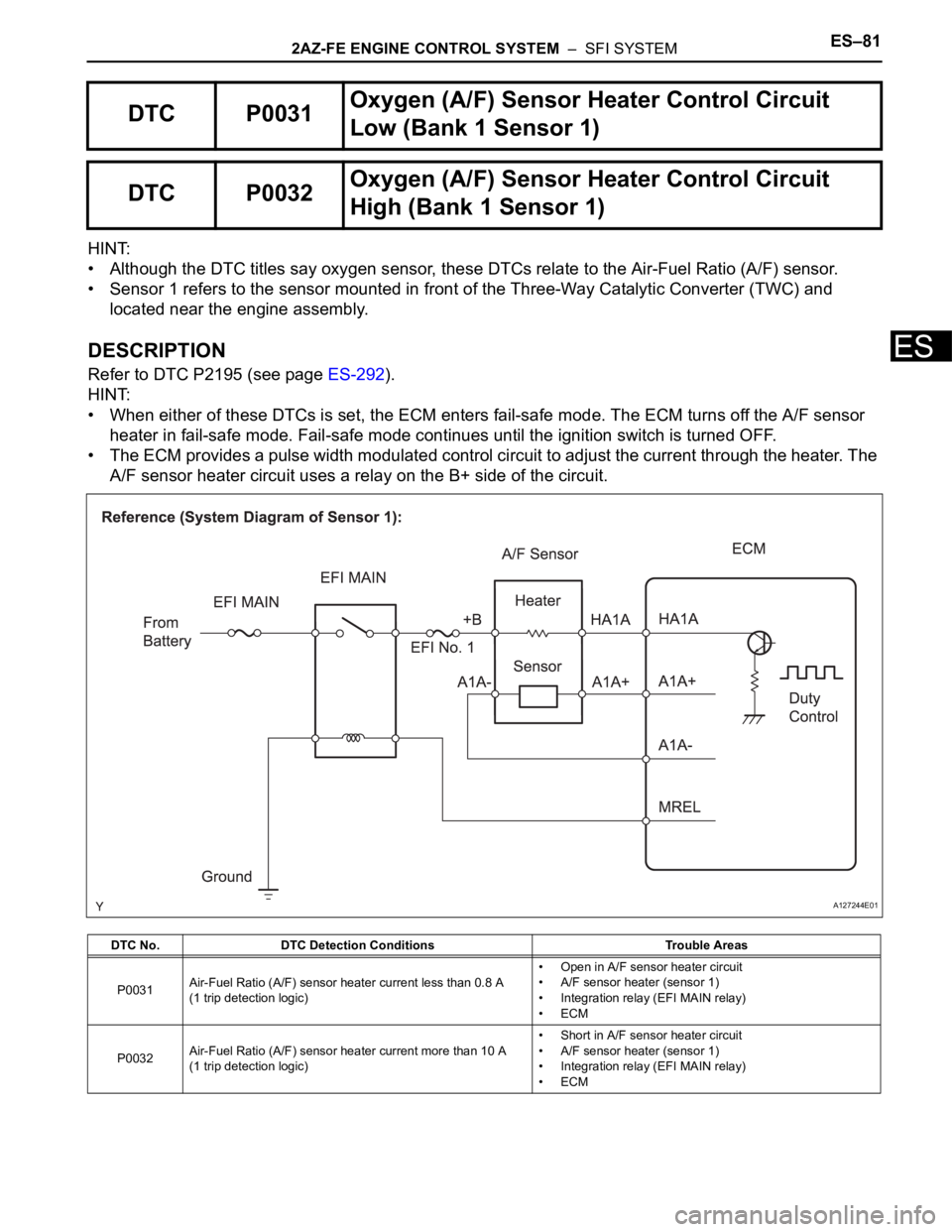
• When either of these DTCs is set, the ECM enters fail-safe mode. The ECM turns off the A/F sensor
heater in fail-safe mode. Fail-safe mode continues until the ignition switch is turned OFF.
• The ECM provides a pulse width modulated control circuit to adjust the current through the heater. The
A/F sensor heater circuit uses a relay on the B+ side of the circuit.
DTC P0031Oxygen (A/F) Sensor Heater Control Circuit
Low (Bank 1 Sensor 1)
DTC P0032Oxygen (A/F) Sensor Heater Control Circuit
High (Bank 1 Sensor 1)
DTC No. DTC Detection Conditions Trouble Areas
P0031Air-Fuel Ratio (A/F) sensor heater current less than 0.8 A
(1 trip detection logic)• Open in A/F sensor heater circuit
• A/F sensor heater (sensor 1)
• Integration relay (EFI MAIN relay)
•ECM
P0032Air-Fuel Ratio (A/F) sensor heater current more than 10 A
(1 trip detection logic)• Short in A/F sensor heater circuit
• A/F sensor heater (sensor 1)
• Integration relay (EFI MAIN relay)
•ECM
A127244E01
Page 1970 of 2000

ES–822AZ-FE ENGINE CONTROL SYSTEM – SFI SYSTEM
ES
MONITOR DESCRIPTION
The ECM uses information from the Air-Fuel Ratio (A/F) sensor to regulate the air-fuel ratio and keep it
close to the stoichiometric level. This maximizes the ability of the Three-Way Catalytic Converter (TWC) to
purify the exhaust gases.
The A/F sensor detects oxygen levels in the exhaust gas and transmits the information to the ECM. The
inner surface of the sensor element is exposed to the outside air. The outer surface of the sensor element
is exposed to the exhaust gas. The sensor element is made of platinum coated zirconia and includes an
integrated heating element.
The zirconia element generates a small voltage when there is a large difference in the oxygen
concentrations between the exhaust gas and outside air. The platinum coating amplifies this voltage
generation.
The A/F sensor is more efficient when heated. When the exhaust gas temperature is low, the sensor
cannot generate useful voltage signals without supplementary heating. The ECM regulates the
supplementary heating using a duty-cycle approach to adjust the average current in the sensor heater
element. If the heater current is outside the normal range, the signal transmitted by the A/F sensor
becomes inaccurate, as a result, the ECM is unable to regulate air-fuel ratio properly.
When the current in the A/F sensor heater is outside the normal operating range, the ECM interprets this
as a malfunction in the sensor heater and sets a DTC.
Example:
The ECM sets DTC P0032 when the current in the A/F sensor heater is more than 10 A. Conversely,
when the heater current is less than 0.8 A, DTC P0031 is set.
MONITOR STRATEGY
TYPICAL ENABLING CONDITIONS
All:
P0031:
P0032:
TYPICAL MALFUNCTION THRESHOLDS
P0031:
P0032:
Related DTCsP0031: A/F sensor heater open/short (Low electrical current)
P0032: A/F sensor heater open/short (High electrical current)
Required Sensors/Components (Main) A/F sensor heater
Required Sensors/Components (Related) -
Frequency of Operation Continuous
Duration 10 seconds
MIL Operation Immediate
Sequence of Operation None
Monitor runs whenever following DTCs not present None
Battery voltage 10.5 V or more
A/F sensor heater duty-cycle ratio 50 % or more
Time after engine start 10 seconds or more
Time after engine start 10 seconds or more
A/F sensor heater current Less than 0.8 A
A/F sensor heater current More than 10 A
Page 1977 of 2000
2AZ-FE ENGINE CONTROL SYSTEM – SFI SYSTEMES–89
ES
TYPICAL MALFUNCTION THRESHOLDS
P0037:
P0038:
P0141 (Heater performance monitor check):
COMPONENT OPERATING RANGE
WIRING DIAGRAM
Refer to DTC P0136 (see page ES-136).
CONFIRMATION DRIVING PATTERN
These DTCs are detected when the engine idles for 110 seconds or more.
INSPECTION PROCEDURE
HINT:
Sensor 2 refers to the sensor mounted behind the Three-Way Catalytic Converter (TWC) and located far
from the engine assembly.
Read freeze frame data using the intelligent tester. Freeze frame data records the engine condition when
malfunctions are detected. When troubleshooting, freeze frame data can help determine if the vehicle was
moving or stationary, if the engine was warmed up or not, if the air-fuel ratio was lean or rich, and other
data from the time the malfunction occurred.
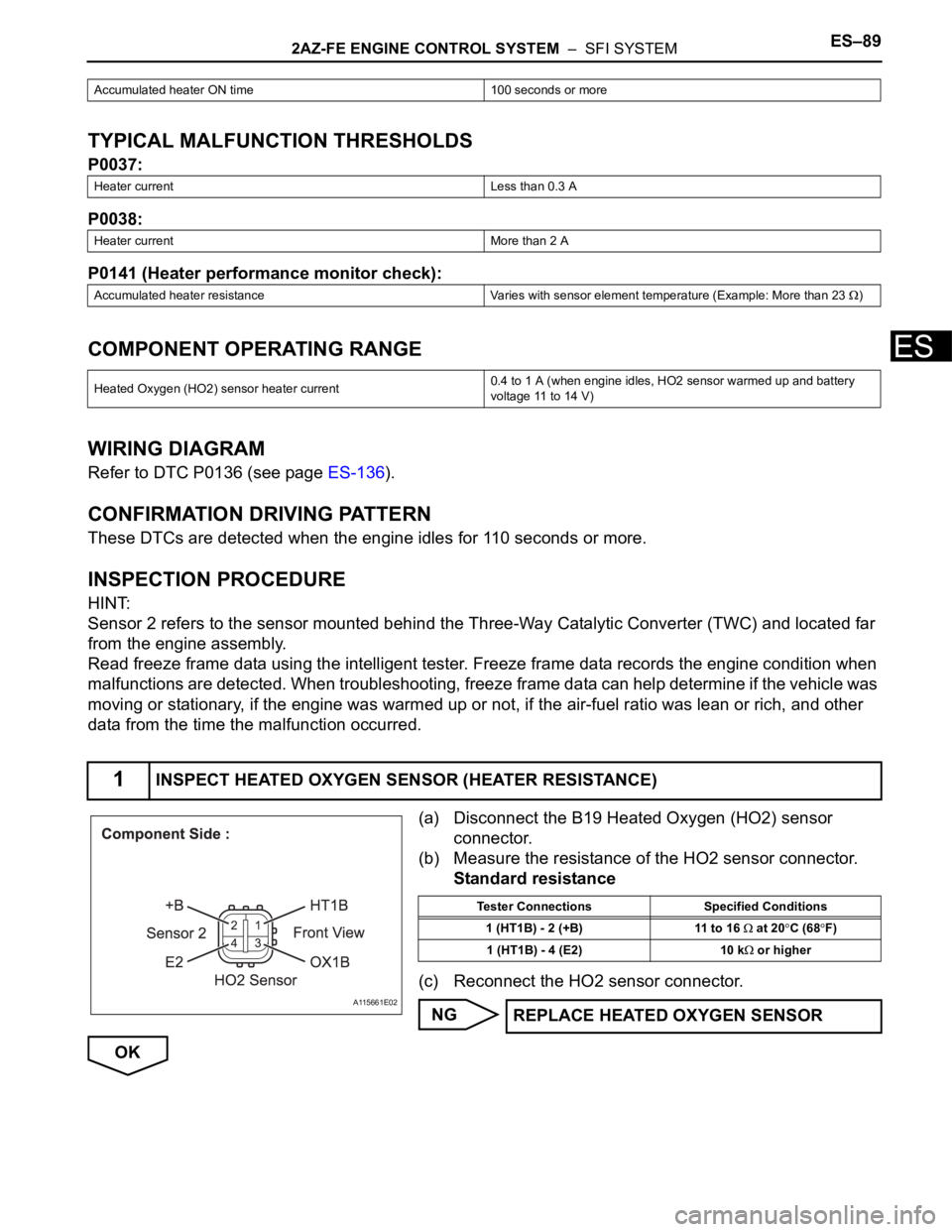
(a) Disconnect the B19 Heated Oxygen (HO2) sensor
connector.
(b) Measure the resistance of the HO2 sensor connector.
Standard resistance
(c) Reconnect the HO2 sensor connector.
NG
OK
Accumulated heater ON time 100 seconds or more
Heater current Less than 0.3 A
Heater current More than 2 A
Accumulated heater resistance Varies with sensor element temperature (Example: More than 23
)
Heated Oxygen (HO2) sensor heater current0.4 to 1 A (when engine idles, HO2 sensor warmed up and battery
voltage 11 to 14 V)
1INSPECT HEATED OXYGEN SENSOR (HEATER RESISTANCE)
A115661E02
Tester Connections Specified Conditions
1 (HT1B) - 2 (+B) 11 to 16
at 20C (68F)
1 (HT1B) - 4 (E2) 10 k
or higher
REPLACE HEATED OXYGEN SENSOR