wiring TOYOTA RAV4 2006 Service Repair Manual
[x] Cancel search | Manufacturer: TOYOTA, Model Year: 2006, Model line: RAV4, Model: TOYOTA RAV4 2006Pages: 2000, PDF Size: 45.84 MB
Page 23 of 2000

ENGINE - 2AZ-FE ENGINE
01NEG45Y
RegulatorB
M
IG
RLO
L
Ignition Switch
To Discharge
Wa r n i n g L i g h t
Generator
ECM
281EG13
281EG12
Coil SpringPulley
Helical Coil Type One-way Clutch EG-26
Wiring Diagram
2. Generator Pulley
A helical coil type one-way clutch is used on the generator pulley in order to reduce the load that acts on
the auxiliary equipment belt.
The pulley mounting nut and the generator pulley have been integrated to achieve a compact construction.
Page 49 of 2000

ENGINE - 2AZ-FE ENGINE
01NEG09Y
01NEG10Y
Air
Conditioning
ECU
Engine Coolant
Temperature SensorFANL
ECM
FA N HCooling Fan
Relay No.3
Cooling Fan
Motor No.2
Cooling Fan
Relay No.1
Cooling Fan
Motor No.1
Low Speed (Series Connection)
High Speed (Parallel Connection) Air
Conditioning
ECU
Engine Coolant
Temperature SensorFA N L
ECM
FA N HCooling Fan
Relay No.3
Cooling Fan
Motor No.2
Cooling Fan
Relay No.1
Cooling Fan
Relay No.2
Cooling Fan
Motor No.1 : CAN
Cooling Fan
Relay No.2
EG-52
8. Cooling Fan Control
On the models with air conditioning, the ECM controls the operation of the cooling fan in two speeds (Low
and High) based on the engine coolant temperature sensor signal and the air conditioning ECU signal. This
control is accomplished by operating the 2 fan motors in 2 stages through low speed (series connection) and
high speed (parallel connection).
Wiring Diagram
Cooling Fan Operation
Air Conditioning ConditionEngine Coolant Temperature C (F)
A / C CompressorRefrigerant Pressure94 (201.2) or lower95.5 (203.9) or higher
OFF1.2 MPa (12.5 kgf / cm2, 178 psi) or lowerOFFHigh
ON1.2 MPa (12.5 kgf / cm2, 178 psi) or lowerLowHighON1.2 MPa (12.5 kgf / cm2, 178 psi) or higherHighHigh
Page 94 of 2000

ENGINE - 2GR-FE ENGINE
01NEG63Y
01MEG36Y
Generator
Stator
RotorRegulator
EB
IG
M
RLOL
Ignition Switch
ECM
Towing Package Models and Models with RSES
Other Models Generator
Rectifier
Stator
Rotor
ERegulatorB
IG
M
RLOL
Ignition Switch
ECM
Discharge
Warning Light
Discharge
Warning Light
EG-98
CHARGING SYSTEM
1. General
A compact and lightweight segment conductor type generator is used. For details of the segment conductor
type generator, see page EG-25.
Specification
ModelTowing PackageWith RSES*Others
Ty p eSC2SE0
Rated Voltage12 V12 V
Output Rated150 A100 A
*: Rear Seat Entertainment System
Wiring Diagram
Page 108 of 2000

ENGINE - 2GR-FE ENGINE
271EG160
Timing Rotor
Intake VVT
Sensor
VC
VV1+
VV1 -ECM
Intake VVT Sensor (Bank 1) EG-112
2) MRE Type VVT Sensor
The MRE type VVT sensor consists of an MRE, a magnet and a sensor. The direction of the magnetic
field changes due to the different shapes (protruded and non-protruded portions) of the timing rotor,
which passes by the sensor. As a result, the resistance of the MRE changes, and the output voltage to
the ECM changes to Hi or Lo. The ECM detects the camshaft position based on this output voltage.
The differences between the MRE type VVT sensor and the pick-up coil type VVT sensor used on
the conventional models are as follows.
ItemSensor TypeItemMREPick-up Coil
Signal OutputConstant digital output starts from
low engine speeds.Analog output changes with the
engine speed.
Camshaft Position
Detection
Detection is made by comparing
the NE signals with the Hi / Lo
output switch timing due to the
protruded / non-protruded portions
of the timing rotor, or made based
on the number of the input NE
signals during Hi / Lo outputs.
Detection is made by comparing
the NE signals with the change of
waveform that is output when the
protruded portion of the timing
rotor passes.
Wiring Diagram
Page 125 of 2000

ENGINE - 2GR-FE ENGINE
01MEG21Y
01MEG22Y
Engine Coolant Temperature
Sensor
Crankshaft Position Sensor
Combination Meter
Vehicle Speed SignalECM
CAN
Air Conditioning ECUCooling
Fan
ECUFan Motor
No. 1
Fan Motor
No. 2
Except Towing Package Models
Towing Package Models Engine Coolant Temperature
Sensor
Crankshaft Position Sensor
Combination Meter
Vehicle Speed SignalECM
CAN
Air Conditioning ECUCooling
Fan
ECU
No. 1
Cooling
Fan
ECU
No. 2Fan Motor
No. 1
Fan Motor
No. 2EG-129
12. Cooling Fan Control System
General
A cooling fan control system is used. To achieve an optimal fan speed in accordance with the engine coolant
temperature, vehicle speed, engine speed, and air conditioning operating conditions, the ECM calculates
the proper fan speed and sends the signals to the front controller. By receiving the signals from the ECM,
the front controller sends proper fan speed control signals to the cooling fan ECU.
Upon receiving the signals from the front controller, the cooling fan ECU actuates the fan motors.
Wiring Diagram
Page 201 of 2000
EM–262GR-FE ENGINE MECHANICAL – ENGINE ASSEMBLY
EM
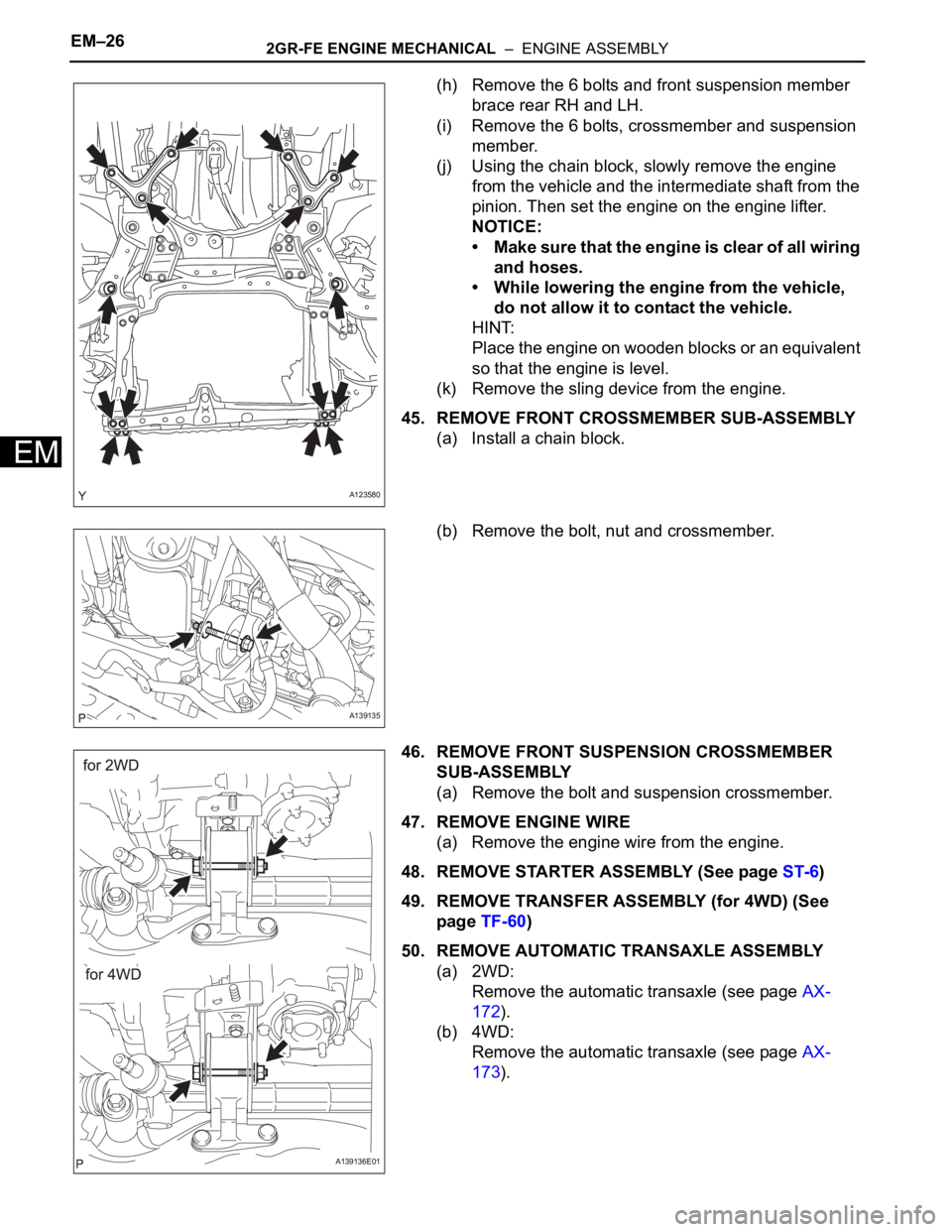
(h) Remove the 6 bolts and front suspension member
brace rear RH and LH.
(i) Remove the 6 bolts, crossmember and suspension
member.
(j) Using the chain block, slowly remove the engine
from the vehicle and the intermediate shaft from the
pinion. Then set the engine on the engine lifter.
NOTICE:
• Make sure that the engine is clear of all wiring
and hoses.
• While lowering the engine from the vehicle,
do not allow it to contact the vehicle.
HINT:
Place the engine on wooden blocks or an equivalent
so that the engine is level.
(k) Remove the sling device from the engine.
45. REMOVE FRONT CROSSMEMBER SUB-ASSEMBLY
(a) Install a chain block.
(b) Remove the bolt, nut and crossmember.
46. REMOVE FRONT SUSPENSION CROSSMEMBER
SUB-ASSEMBLY
(a) Remove the bolt and suspension crossmember.
47. REMOVE ENGINE WIRE
(a) Remove the engine wire from the engine.
48. REMOVE STARTER ASSEMBLY (See page ST-6)
49. REMOVE TRANSFER ASSEMBLY (for 4WD) (See
page TF-60)
50. REMOVE AUTOMATIC TRANSAXLE ASSEMBLY
(a) 2WD:
Remove the automatic transaxle (see page AX-
172).
(b) 4WD:
Remove the automatic transaxle (see page AX-
173).
A123580
A139135
A139136E01
Page 213 of 2000
2GR-FE FUEL – FUEL SYSTEMFU–7
FU
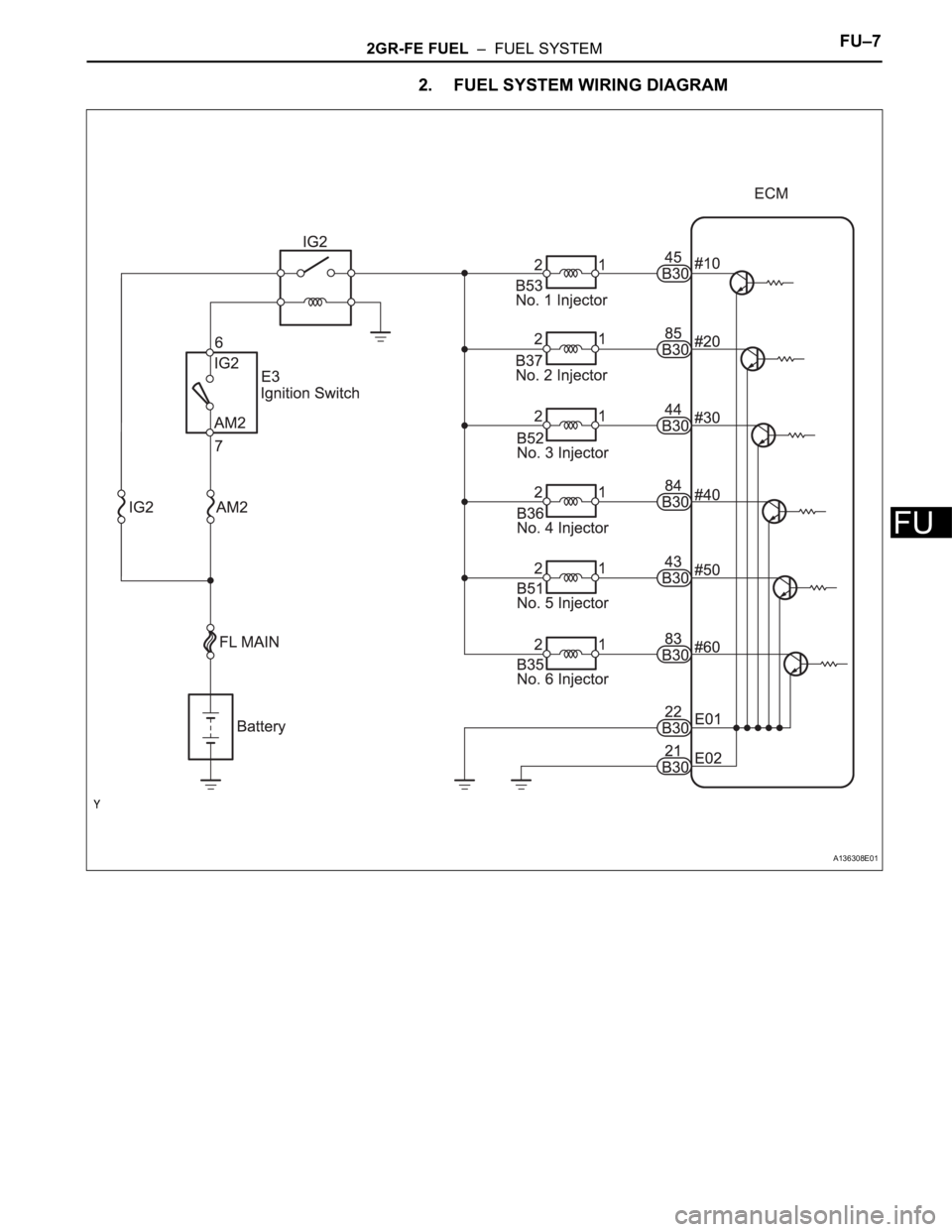
2. FUEL SYSTEM WIRING DIAGRAM
A136308E01
Page 214 of 2000
FU–82GR-FE FUEL – FUEL SYSTEM
FU
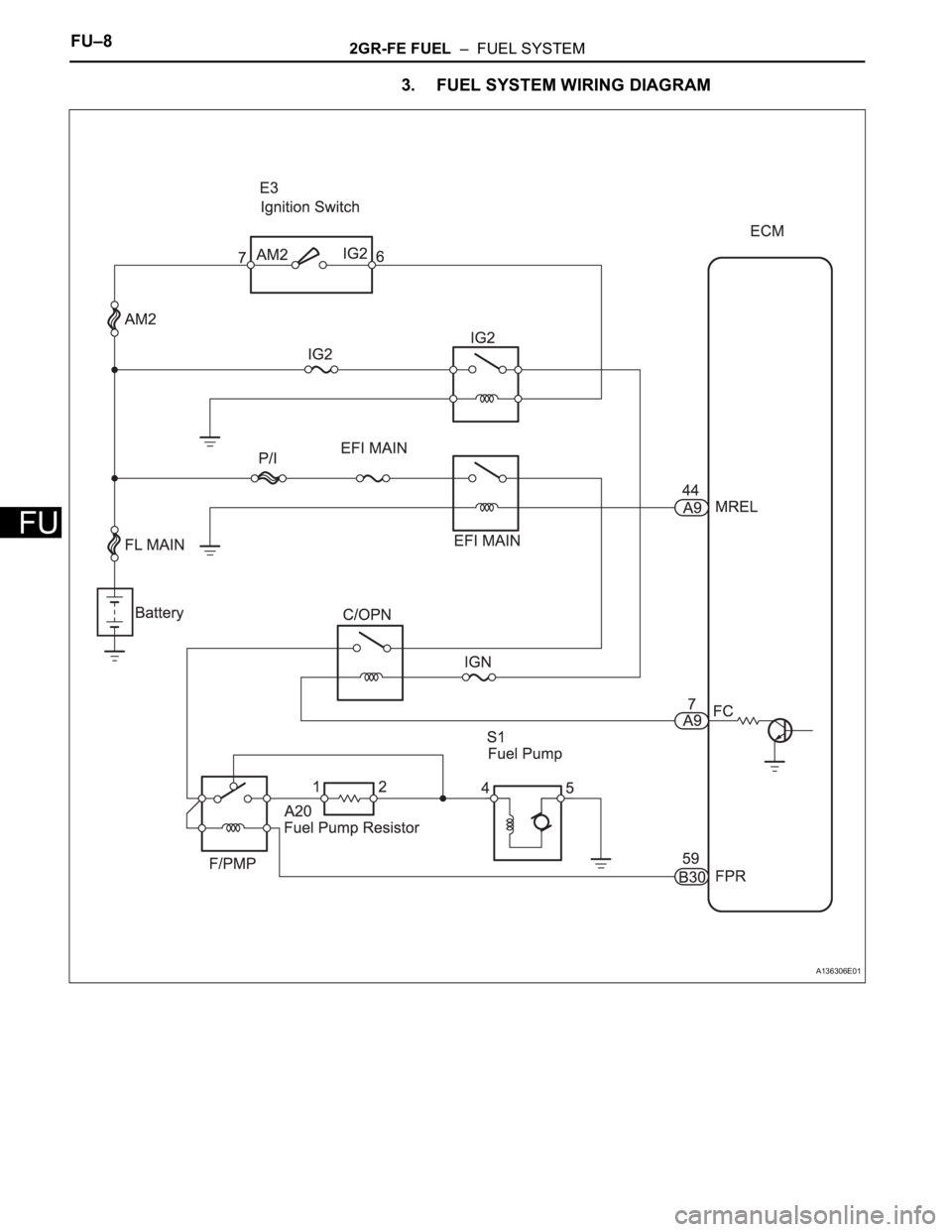
3. FUEL SYSTEM WIRING DIAGRAM
A136306E01
Page 216 of 2000
INTRODUCTION – HOW TO TROUBLESHOOT ECU CONTROLLED SYSTEMSIN–39
IN
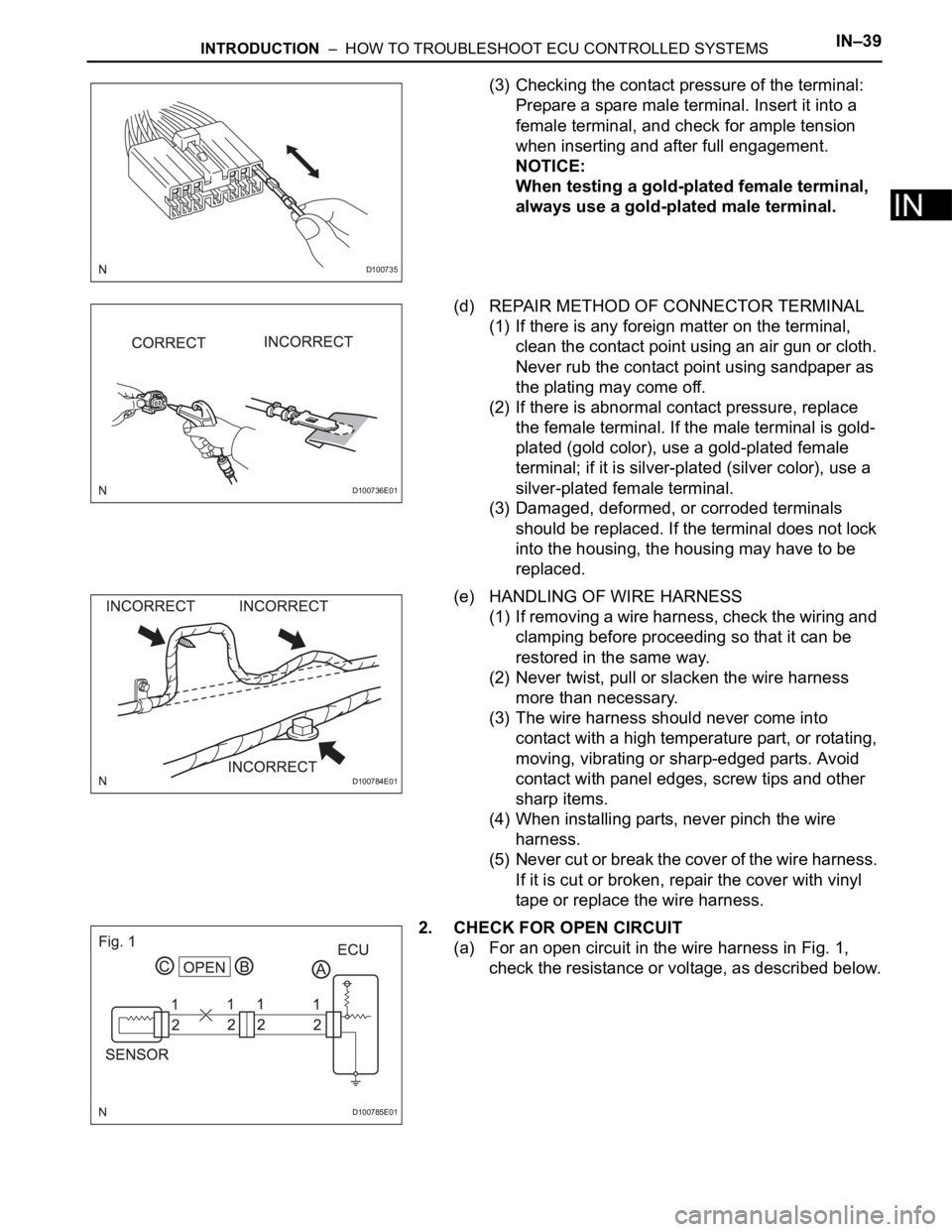
(3) Checking the contact pressure of the terminal:
Prepare a spare male terminal. Insert it into a
female terminal, and check for ample tension
when inserting and after full engagement.
NOTICE:
When testing a gold-plated female terminal,
always use a gold-plated male terminal.
(d) REPAIR METHOD OF CONNECTOR TERMINAL
(1) If there is any foreign matter on the terminal,
clean the contact point using an air gun or cloth.
Never rub the contact point using sandpaper as
the plating may come off.
(2) If there is abnormal contact pressure, replace
the female terminal. If the male terminal is gold-
plated (gold color), use a gold-plated female
terminal; if it is silver-plated (silver color), use a
silver-plated female terminal.
(3) Damaged, deformed, or corroded terminals
should be replaced. If the terminal does not lock
into the housing, the housing may have to be
replaced.
(e) HANDLING OF WIRE HARNESS
(1) If removing a wire harness, check the wiring and
clamping before proceeding so that it can be
restored in the same way.
(2) Never twist, pull or slacken the wire harness
more than necessary.
(3) The wire harness should never come into
contact with a high temperature part, or rotating,
moving, vibrating or sharp-edged parts. Avoid
contact with panel edges, screw tips and other
sharp items.
(4) When installing parts, never pinch the wire
harness.
(5) Ne ver c ut or break th e c ov er of t he w ir e har ness .
If it is cut or broken, repair the cover with vinyl
tape or replace the wire harness.
2. CHECK FOR OPEN CIRCUIT
(a) For an open circuit in the wire harness in Fig. 1,
check the resistance or voltage, as described below.
D100735
D100736E01
D100784E01
D100785E01
Page 340 of 2000
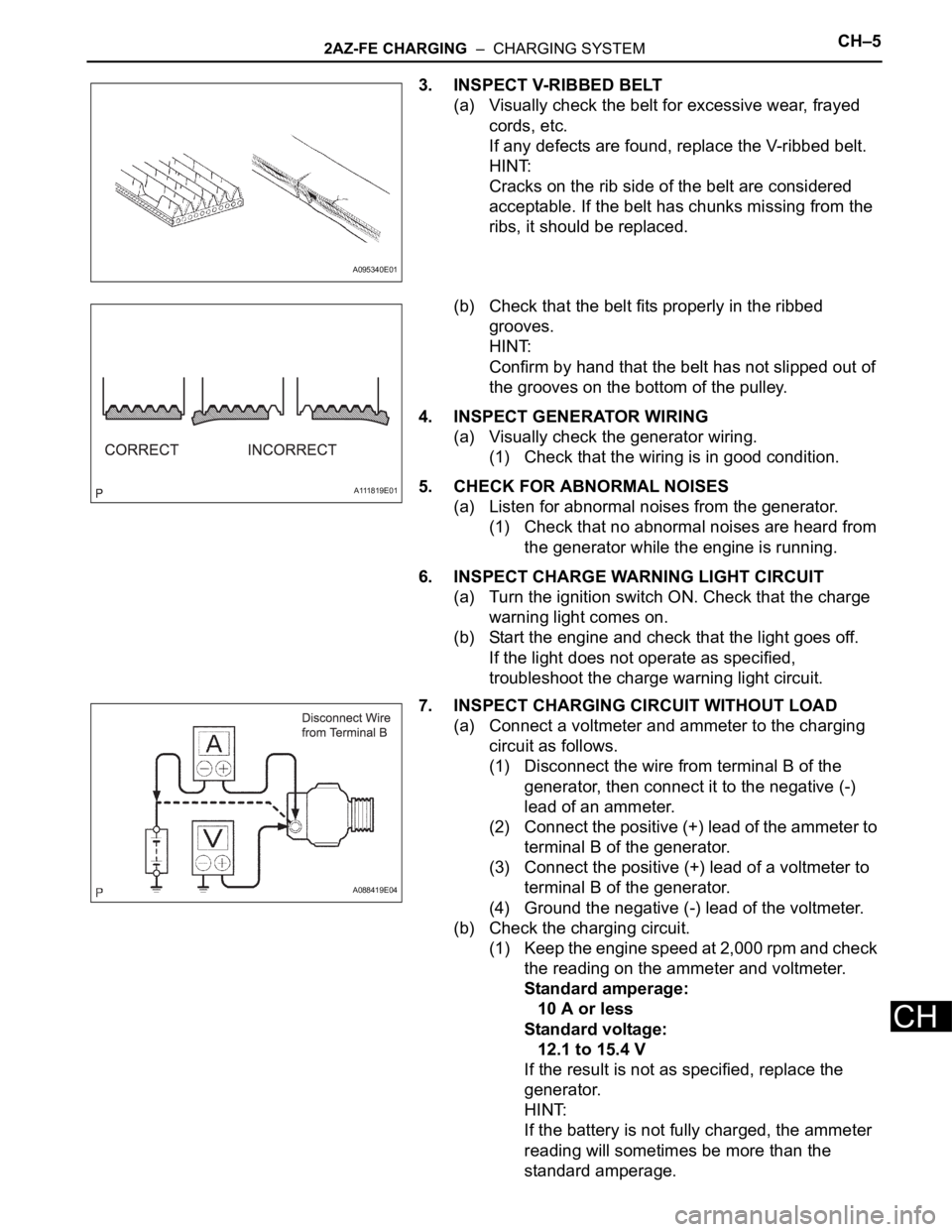
2AZ-FE CHARGING – CHARGING SYSTEMCH–5
CH
3. INSPECT V-RIBBED BELT
(a) Visually check the belt for excessive wear, frayed
cords, etc.
If any defects are found, replace the V-ribbed belt.
HINT:
Cracks on the rib side of the belt are considered
acceptable. If the belt has chunks missing from the
ribs, it should be replaced.
(b) Check that the belt fits properly in the ribbed
grooves.
HINT:
Confirm by hand that the belt has not slipped out of
the grooves on the bottom of the pulley.
4. INSPECT GENERATOR WIRING
(a) Visually check the generator wiring.
(1) Check that the wiring is in good condition.
5. CHECK FOR ABNORMAL NOISES
(a) Listen for abnormal noises from the generator.
(1) Check that no abnormal noises are heard from
the generator while the engine is running.
6. INSPECT CHARGE WARNING LIGHT CIRCUIT
(a) Turn the ignition switch ON. Check that the charge
warning light comes on.
(b) Start the engine and check that the light goes off.
If the light does not operate as specified,
troubleshoot the charge warning light circuit.
7. INSPECT CHARGING CIRCUIT WITHOUT LOAD
(a) Connect a voltmeter and ammeter to the charging
circuit as follows.
(1) Disconnect the wire from terminal B of the
generator, then connect it to the negative (-)
lead of an ammeter.
(2) Connect the positive (+) lead of the ammeter to
terminal B of the generator.
(3) Connect the positive (+) lead of a voltmeter to
terminal B of the generator.
(4) Ground the negative (-) lead of the voltmeter.
(b) Check the charging circuit.
(1) Keep the engine speed at 2,000 rpm and check
the reading on the ammeter and voltmeter.
Standard amperage:
10 A or less
Standard voltage:
12.1 to 15.4 V
If the result is not as specified, replace the
generator.
HINT:
If the battery is not fully charged, the ammeter
reading will sometimes be more than the
standard amperage.
A095340E01
A111819E01
A088419E04