turn signal TOYOTA RAV4 2011 XA30 / 3.G User Guide
[x] Cancel search | Manufacturer: TOYOTA, Model Year: 2011, Model line: RAV4, Model: TOYOTA RAV4 2011 XA30 / 3.GPages: 536, PDF Size: 9.52 MB
Page 250 of 536
250 3-2. Using the audio system
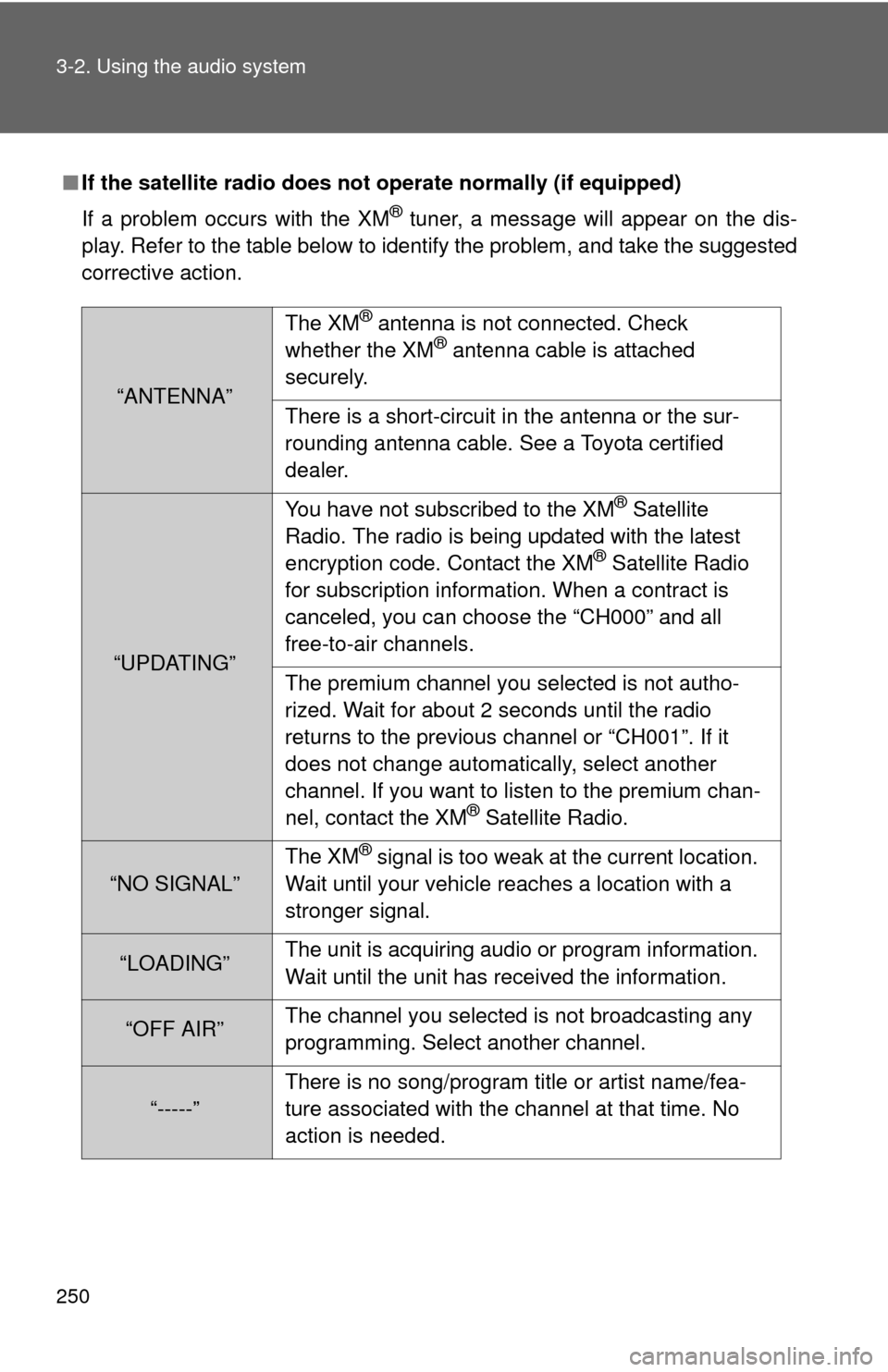
■If the satellite radio does not operate normally (if equipped)
If a problem occurs with the XM
® tuner, a message will appear on the dis-
play. Refer to the table below to identify the problem, and take the suggested
corrective action.
“ANTENNA” The XM
® antenna is not connected. Check
whether the XM® antenna cable is attached
securely.
There is a short-circuit in the antenna or the sur-
rounding antenna cable. See a Toyota certified
dealer.
“UPDATING” You have not subscribed to the XM
® Satellite
Radio. The radio is being updated with the latest
encryption code. Contact the XM
® Satellite Radio
for subscription information. When a contract is
canceled, you can choose the “CH000” and all
free-to-air channels.
The premium channel you selected is not autho-
rized. Wait for about 2 seconds until the radio
returns to the previous channel or “CH001”. If it
does not change automatically, select another
channel. If you want to listen to the premium chan-
nel, contact the XM
® Satellite Radio.
“NO SIGNAL” The XM
® signal is too weak at the current location.
Wait until your vehicle reaches a location with a
stronger signal.
“LOADING” The unit is acquiring audio or program information.
Wait until the unit has received the information.
“OFF AIR”The channel you selected is not broadcasting any
programming. Select another channel.
“-----”There is no song/program title or artist name/fea-
ture associated with the channel at that time. No
action is needed.
Page 404 of 536
404
4-3. Do-it-yourself maintenance
Light bulbs
You may replace the following bulbs yourself. The difficulty level of
replacement varies depending on the bulb. If necessary bulb
replacement seems difficult to perfor m, contact your Toyota dealer.
For more information about replacing other light bulbs, contact your
Toyota dealer.
■ Preparing a light bulb for replacement
Check the wattage of the light bulb being replaced. ( P. 485)
■ Removing the engine compartment cover
P. 360
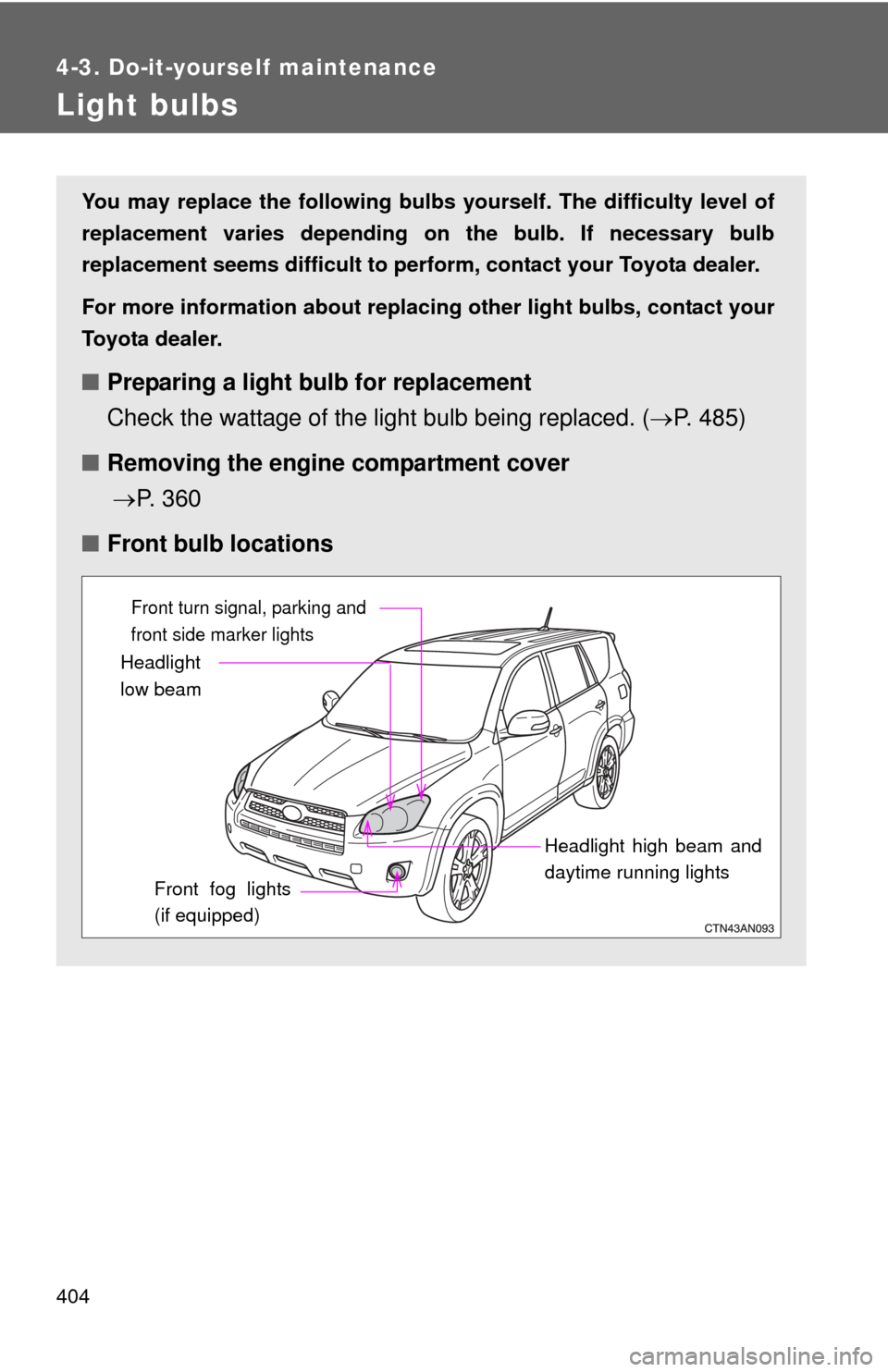
■ Front bulb locations
Headlight
low beam
Front turn signal, parking and
front side marker lights
Headlight high beam and
daytime running lights
Front fog lights
(if equipped)
Page 405 of 536
405
4-3. Do-it-yourself maintenance
4
Maintenance and care
■
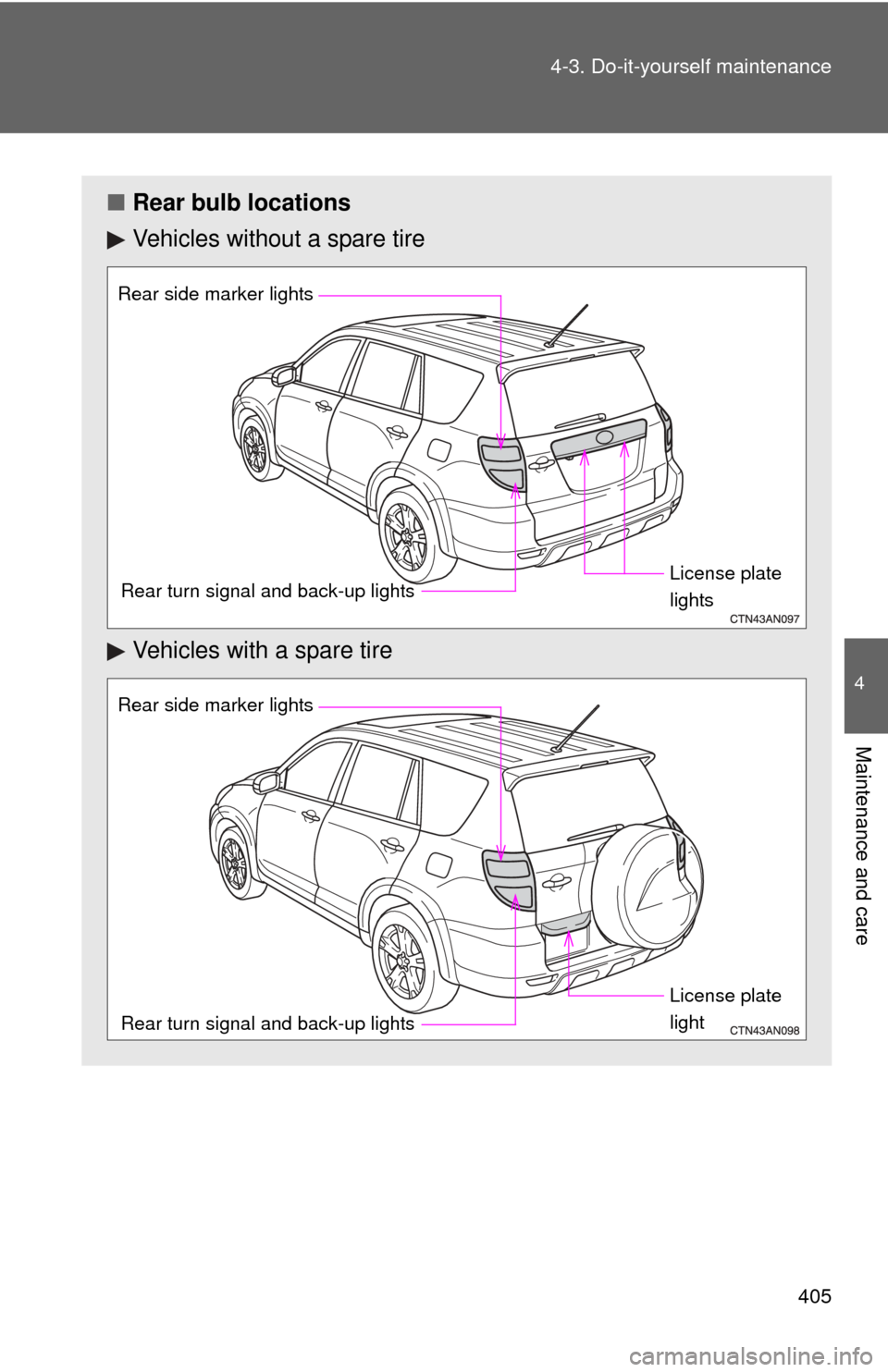
Rear bulb locations
Vehicles without a spare tire
Vehicles with a spare tire
Rear turn signal and back-up lightsLicense plate
lights
Rear side marker lights
Rear turn signal and back-up lights
License plate
light
Rear side marker lights
Page 407 of 536
407
4-3. Do-it-yourself maintenance
4
Maintenance and care
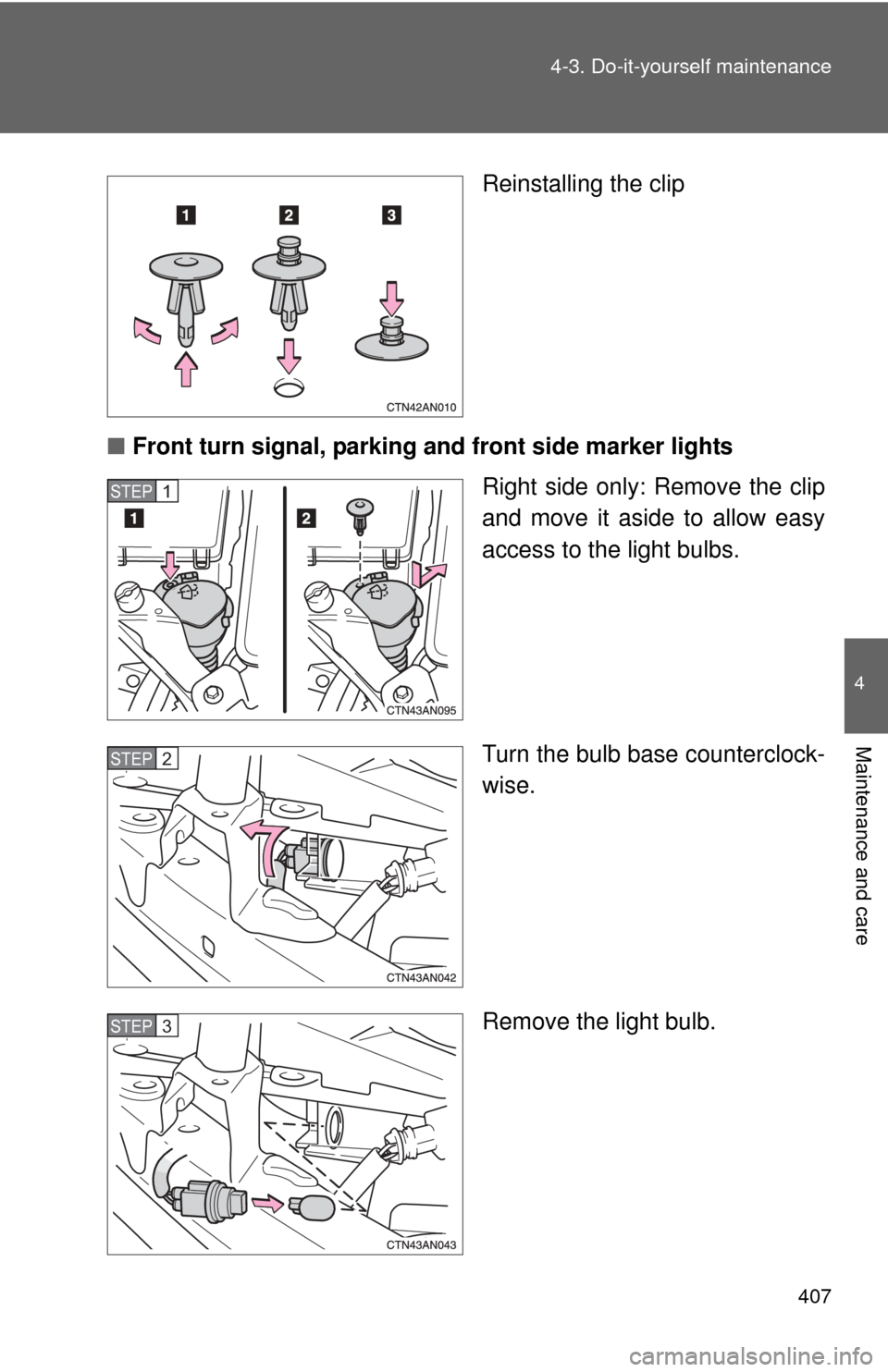
Reinstalling the clip
■ Front turn signal, parking a nd front side marker lights
Right side only: Remove the clip
and move it aside to allow easy
access to the light bulbs.
Turn the bulb base counterclock-
wise.
Remove the light bulb.
STEP 1
STEP 2
STEP 3
Page 409 of 536
409
4-3. Do-it-yourself maintenance
4
Maintenance and care
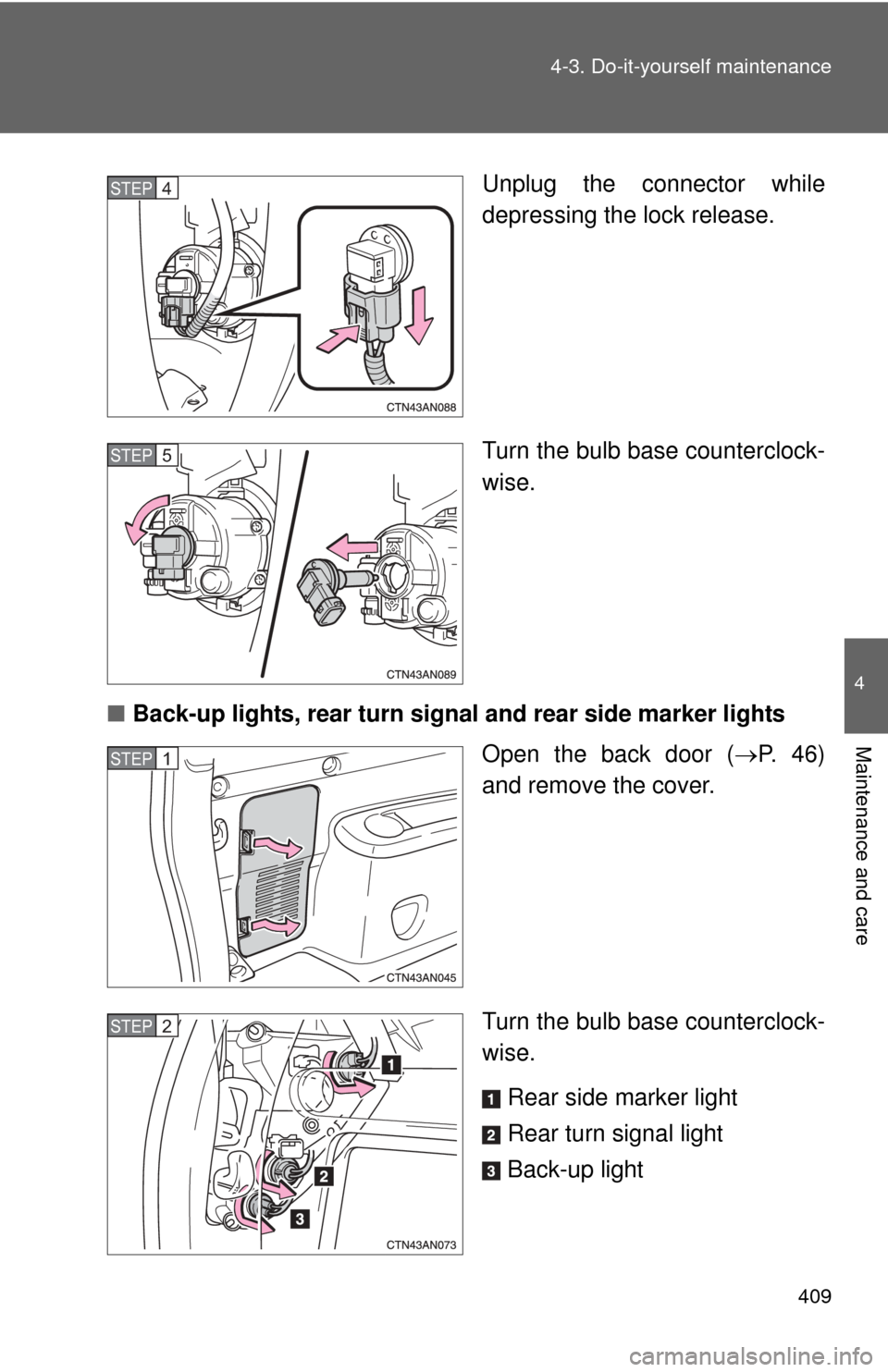
Unplug the connector while
depressing the lock release.
Turn the bulb base counterclock-
wise.
■ Back-up lights, rear turn signal and rear side marker lights
Open the back door (P. 46)
and remove the cover.
Turn the bulb base counterclock-
wise.
Rear side marker light
Rear turn signal light
Back-up lightSTEP 4
STEP 5
STEP 1
STEP 2
Page 410 of 536
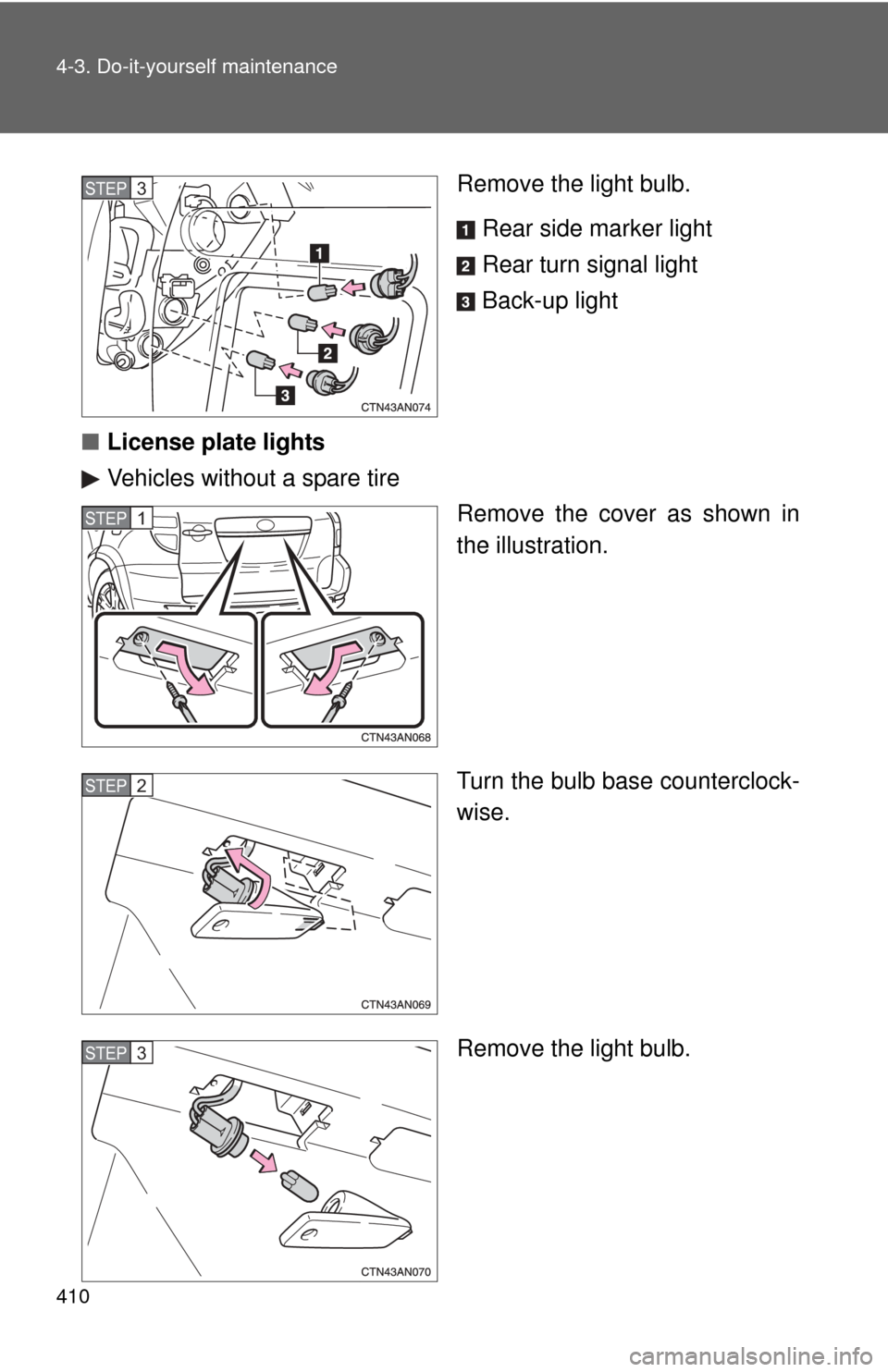
410 4-3. Do-it-yourself maintenance
Remove the light bulb.Rear side marker light
Rear turn signal light
Back-up light
■ License plate lights
Vehicles without a spare tire
Remove the cover as shown in
the illustration.
Turn the bulb base counterclock-
wise.
Remove the light bulb.STEP 3
STEP 1
STEP 2
STEP 3
Page 411 of 536
411
4-3. Do-it-yourself maintenance
4
Maintenance and care
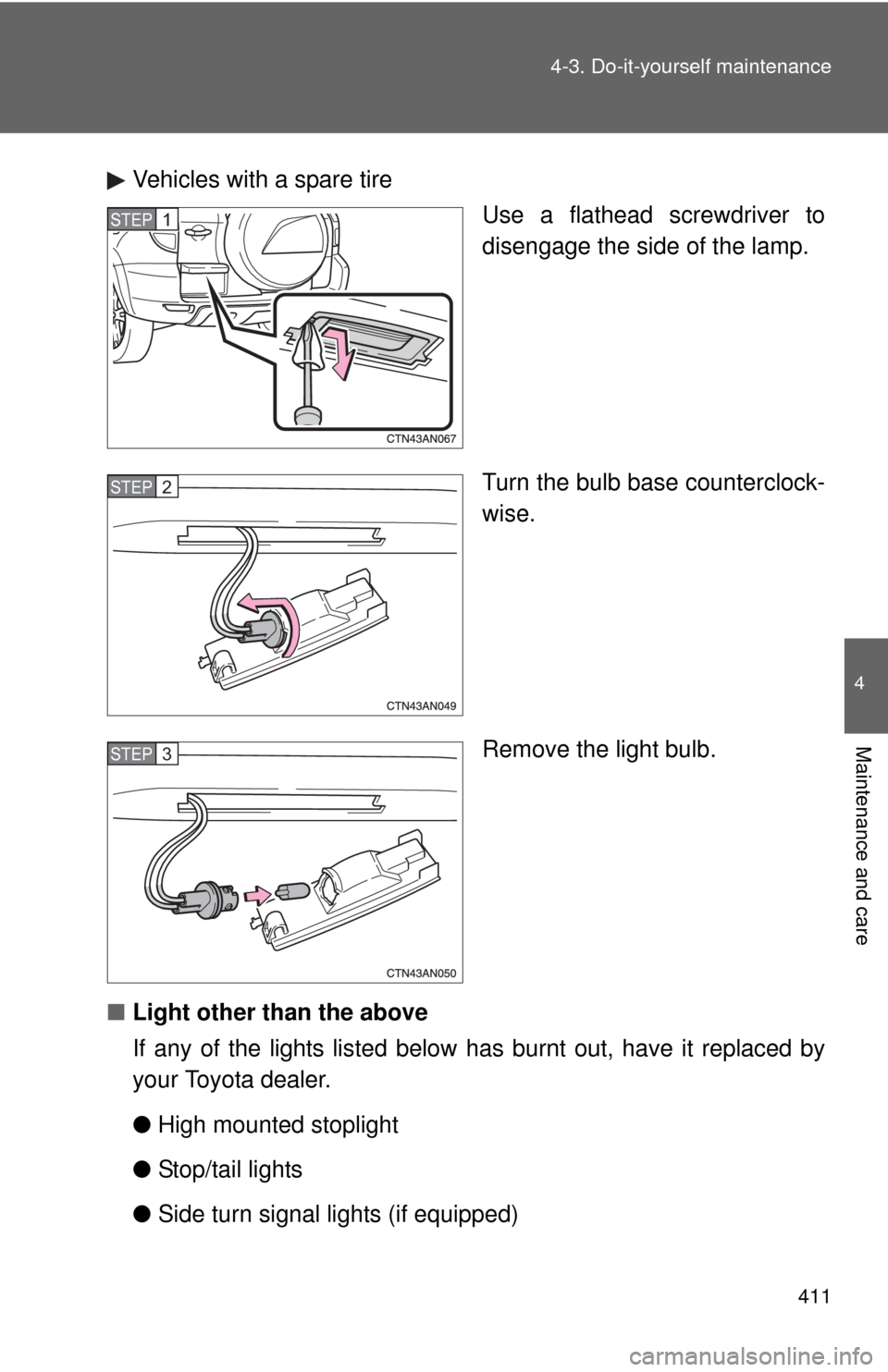
Vehicles with a spare tire
Use a flathead screwdriver to
disengage the side of the lamp.
Turn the bulb base counterclock-
wise.
Remove the light bulb.
■ Light other than the above
If any of the lights listed below has burnt out, have it replaced by
your Toyota dealer.
● High mounted stoplight
● Stop/tail lights
● Side turn signal lights (if equipped)
STEP 1
STEP 2
STEP 3
Page 412 of 536
412 4-3. Do-it-yourself maintenance
■Condensation build-up on th e inside of the lens
Contact your Toyota dealer for more information in the following situations.
Temporary condensation build-up on the inside of the headlight lens does
not indicate a malfunction.
● Large drops of water are built up on the inside of the lens.
● Water has built up inside the headlight.
■ LED side turn signal lights (if equipped), stop/tail lights and high
mounted stoplight
The side turn signal lights, stop/tail lights and high mounted stoplight con-
sists of a number of LEDs. If any of the LEDs burn out, take your vehicle to
your Toyota dealer to have the light replaced.
CAUTION
■Replacing light bulbs
●Turn off the lights. Do not attempt to replace the bulb immediately after
turning off the lights.
The bulbs become very hot and may cause burns.
● Do not touch the glass portion of the light bulb with bare hands. Hold the
bulb by the plastic or metal portion.
If the bulb is scratched or dropped it may blow out or crack.
● Fully install light bulbs and any parts used to secure them. Failing to do so
may result in heat damage, fire, or water entering the headlight unit. This
may damage the headlights or cause condensation to build up on the lens.
■ To prevent damage or fire
Make sure bulbs are fully seated and locked.
Page 414 of 536
414
5-1. Essential information
Emergency flashers
NOTICE
■To prevent battery discharge
Do not leave the emergency flashers on longer than necessary when the
engine is not running.
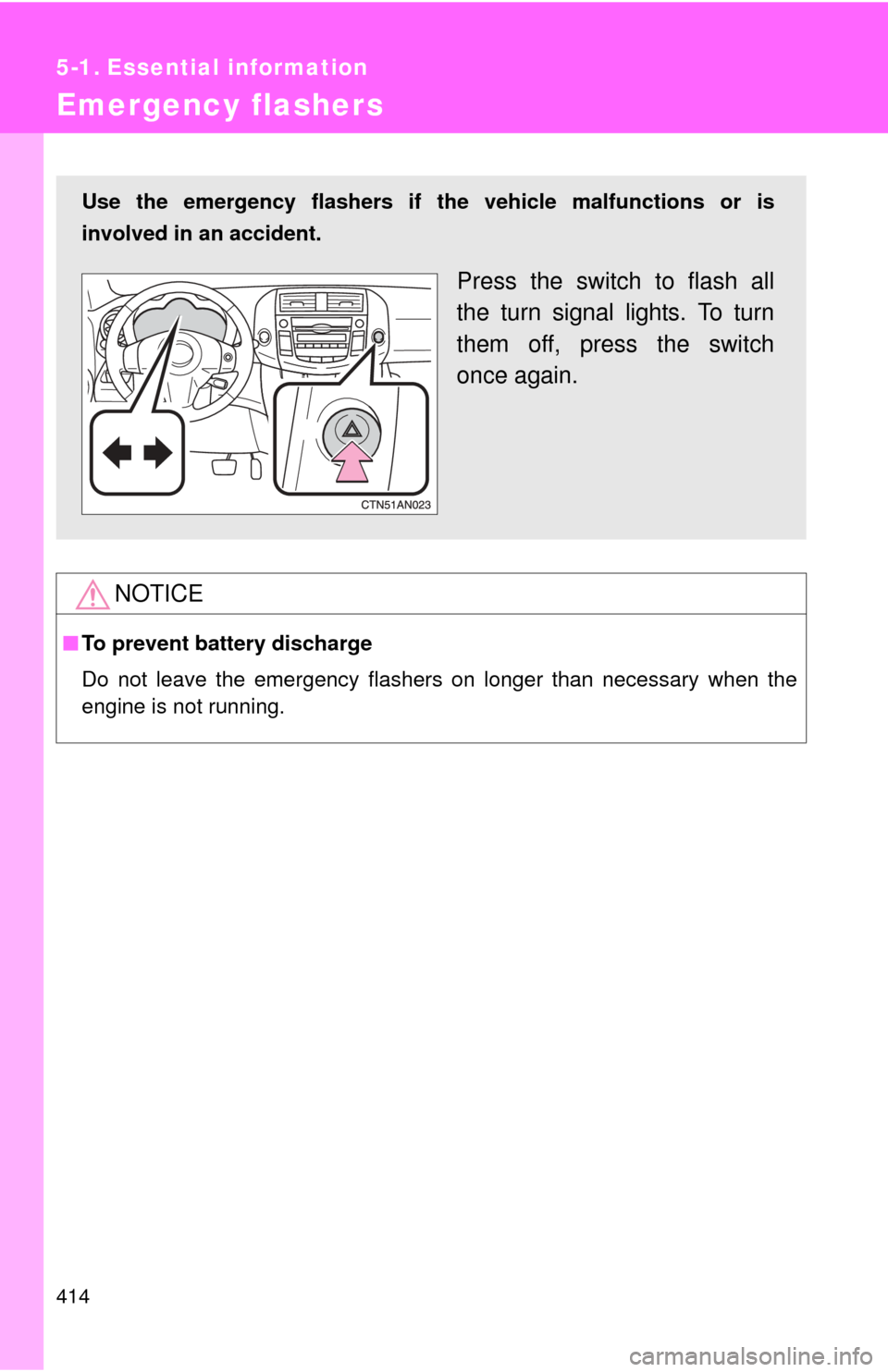
Use the emergency flashers if th e vehicle malfunctions or is
involved in an accident.
Press the switch to flash all
the turn signal lights. To turn
them off, press the switch
once again.
Page 434 of 536
434 5-2. Steps to take in an emergency
■If the tire pressure warning system is inoperative
The tire pressure warning system will be disabled in the following condi-
tions:
(When the condition becomes normal, the system will work properly.)
●If tires not equipped with tire pressure warning valves and transmit-
ters are used.
●If the ID code on the tire pressure warning valves and transmitters is
not registered in the tire pressure warning computer.
●If the tire inflation pressure is 73 psi (500 kPa, 5.1 kgf/cm2 or bar) or
higher.
The tire pressure warning system may be disabled in the following condi-
tions:
(When the condition becomes normal, the system will work properly.)
●If electronic devices or facilities using similar radio wave frequencies
are nearby.
●If a radio set at similar frequencies is in use in the vehicle.
●If a window tint that affects the radio wave signals is installed.
●If there is a lot of snow or ice on the vehicle, in particular around the
wheels or wheel housings.
●If non-genuine Toyota wheels are used. (Even if you use Toyota
wheels, the tire pressu re warning system may not work properly with
some types of tires.)
●If tire chains are used.
●If the spare tire is in a location subject to poor radio wave signal
reception.
●If a large metallic object which can interfere with signal reception is
put in the luggage compartment.
■If the tire pressure warning light comes on after blinking for 1
minute frequently
If the tire pressure warning light comes on after flashing for 1 minute fre-
quently when the “ENGINE START STOP” switch or the engine switch is
turned ON, have it checked by your Toyota dealer.