engine TOYOTA RAV4 2012 XA30 / 3.G Owners Manual
[x] Cancel search | Manufacturer: TOYOTA, Model Year: 2012, Model line: RAV4, Model: TOYOTA RAV4 2012 XA30 / 3.GPages: 544, PDF Size: 10.25 MB
Page 477 of 544
5
When trouble arises
477
5-2. Steps to take in an emergency
■
Overheating
If you observe the following, your vehicle may be overheating.
●The engine coolant temperature gauge enters the red zone or a loss of
power is experienced.
● Steam is coming from under the hood.
CAUTION
■To prevent an accident or injury when inspecting under the hood of
your vehicle
●If steam is seen coming from under the hood, do not open the hood until
the steam has subsided. The engine compartment may be very hot, caus-
ing serious injury such as burns.
● Keep hands and clothing away from the fan and other belts while the
engine is running.
● Do not loosen the coolant reservoir cap while the engine and radiator are
hot.
Serious injury, such as burns, may result from hot coolant and steam
released under pressure.
NOTICE
■When adding engine coolant
Wait until the engine has cooled down before adding engine coolant.
When adding coolant, do so slowly. Adding cool coolant to a hot engine too
quickly can cause damage to the engine.
Have the vehicle chec ked at the nearest Toyota dealer as soon as
possible.
Page 478 of 544
478
5-2. Steps to take in an emergency
If the vehicle becomes stuck
CAUTION
■When attempting to free a stuck vehicle
If you choose to rock the vehicle back and forth to free it, make sure the sur-
rounding area is clear, to avoid striki ng other vehicles, objects or persons.
The vehicle may also lunge forward or lunge back suddenly as it becomes
free. Use extreme caution.
■ When shifting the shift lever
Be careful not to shift the shift lever with the accelerator pedal depressed.
This may lead to unexpected rapid acceleration of the vehicle that may
cause an accident and result in death or serious injury.
Carry out the following procedures if the tires spin or the vehicle
becomes stuck in mud, dirt, or snow.
Stop the engine. Set the parking brake and put the shift
lever in P.
Remove the mud, snow, or sand from around the stuck tire.
Place wood, stones or some other material to help provide
traction under the tires.
Restart the engine.
4WD models: Activate four-wheel drive lock mode. ( P. 203)
Shift the shift lever to the D or R position, release the park-
ing brake and carefully depress the accelerator pedal to
free the vehicle.
Turn off TRAC and/or VSC if these functions are hampering your
attempts to free the vehicle. ( P. 193)
STEP 1
STEP 2
STEP 3
STEP 4
STEP 5
STEP 6
Page 479 of 544
5
When trouble arises
479
5-2. Steps to take in an emergency
NOTICE
■
To avoid damaging the transmission and other components
●Avoid spinning the wheels and do not rev the engine.
● If the vehicle remains stuck after trying these procedures, the vehicle may
require towing to be freed.
Page 480 of 544
480
5-2. Steps to take in an emergency
If your vehicle has to be stopped in an emergency
Only in an emergency, such as if it becomes impossible to stop the
vehicle in the normal way, stop the vehicle using the following pro-
cedure:
Steadily step on the brake pedal with both feet and firmly
depress it.
Do not pump the brake pedal repeatedly as this will increase the
effort required to slow the vehicle.
Shift the shift lever to N.
If the shift lever is shifted to N After slowing down, stop the vehi cle in a safe place by the
road.
Stop the engine.
If the shift lever cannot be shifted to N Keep depressing the brake pedal with both feet to reduce
vehicle speed as much as possible.
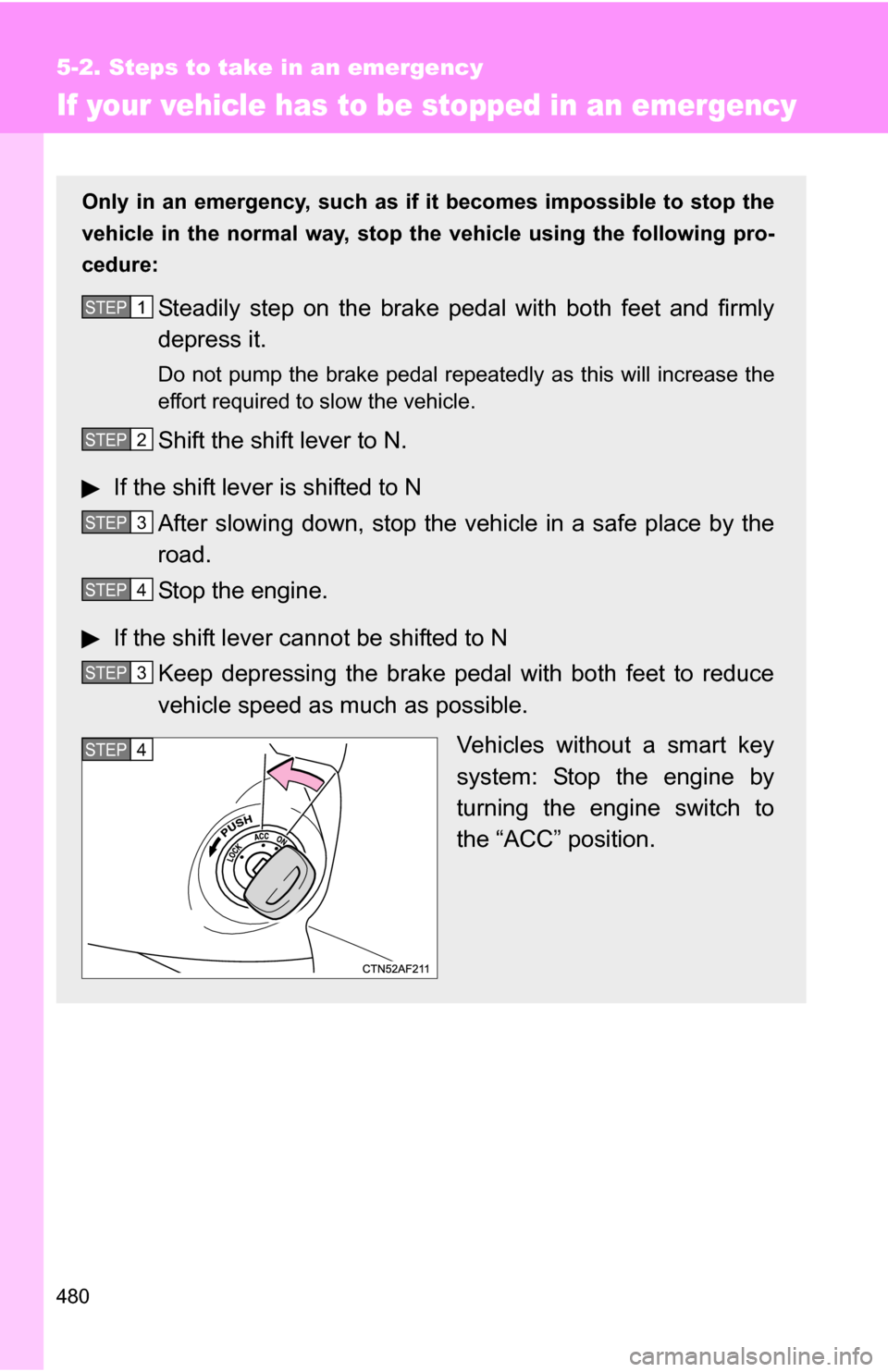
Vehicles without a smart key
system: Stop the engine by
turning the engine switch to
the “ACC” position.
STEP 1
STEP 2
STEP 3
STEP 4
STEP 3
STEP 4
Page 481 of 544
5
When trouble arises
481
5-2. Steps to take in an emergency
CAUTION
■
If the engine has to be turned off while driving
●Power assist for the brakes and steering wheel will be lost, making the
brake pedal harder to depress and the steering wheel heavier to turn.
Decelerate as much as possible before turning off the engine.
● Vehicles without a smart key system: Never attempt to remove the key, as
doing so will lock the steering wheel.
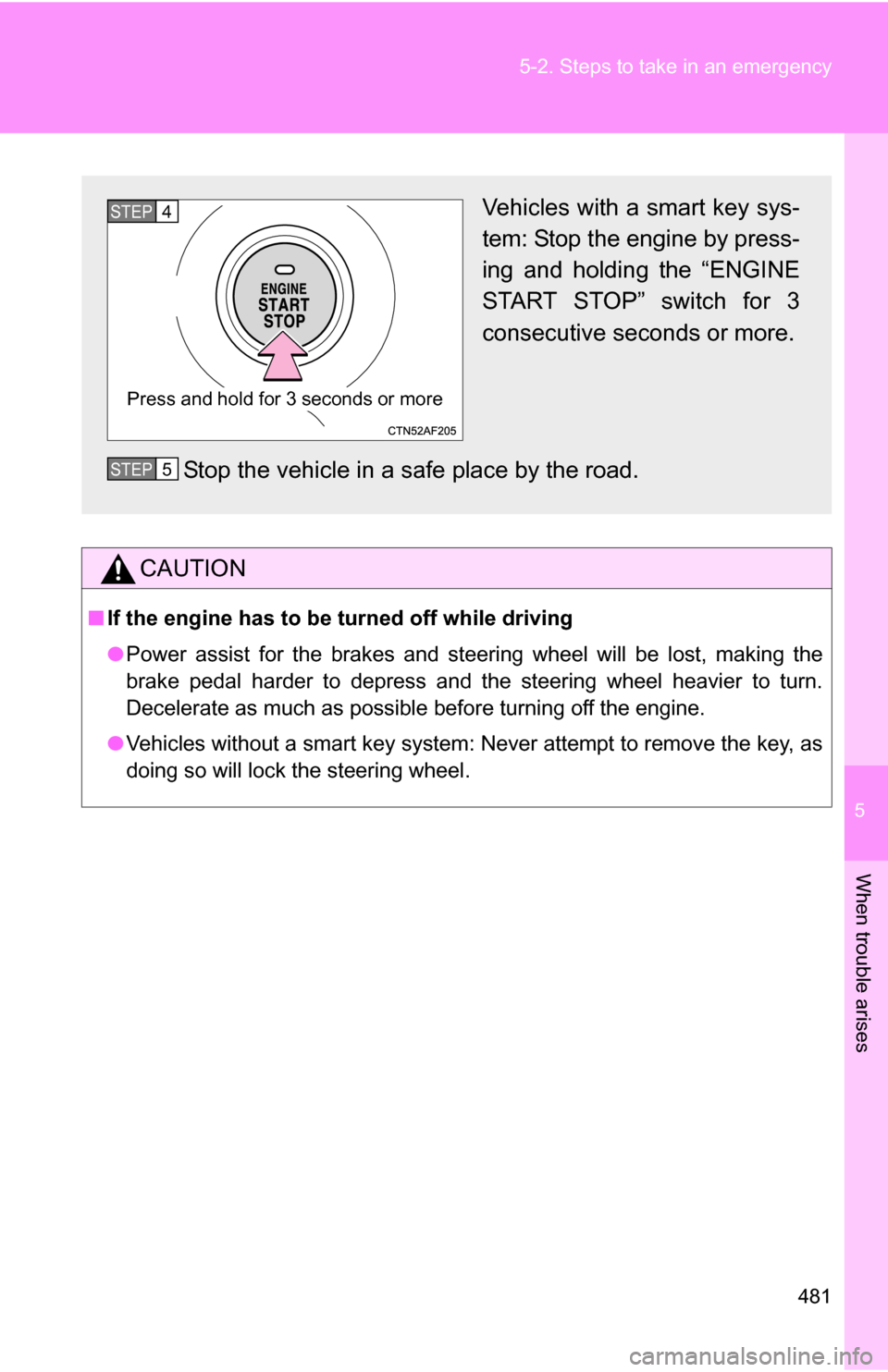
Vehicles with a smart key sys-
tem: Stop the engine by press-
ing and holding the “ENGINE
START STOP” switch for 3
consecutive seconds or more.
Stop the vehicle in a safe place by the road.
Press and hold for 3 seconds or more
STEP 4
STEP 5
Page 485 of 544
485
6-1. Specifications
6
Vehicle specifications
*1: Without spare tire
*2: 215/70R16 tires
*3: 225/65R17 tires
*4: 235/55R18 tires
*5: With spare tire cover
*6: Unladen vehicle
*7: With third seats
*8: With towing package
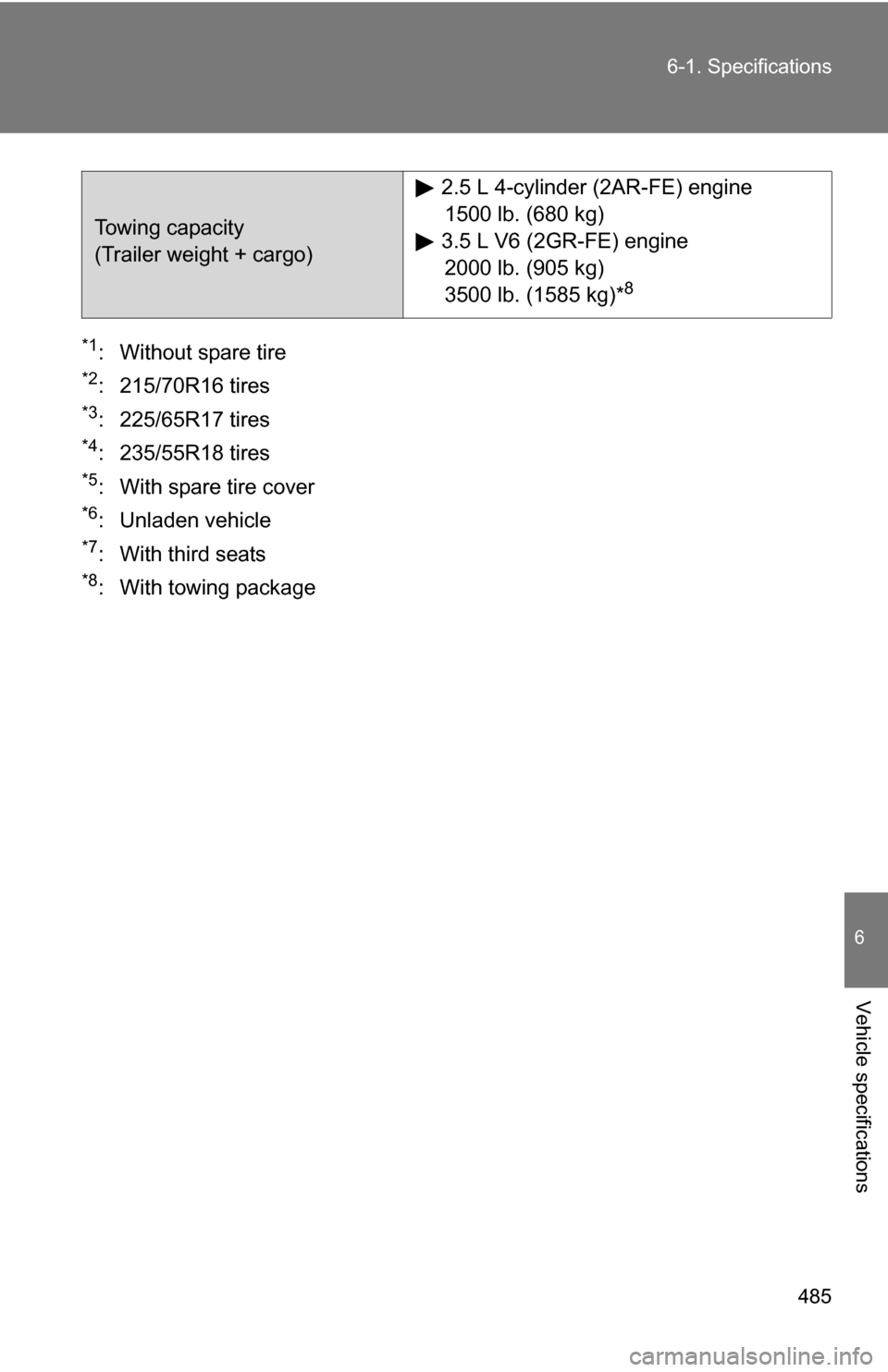
Towing capacity
(Trailer weight + cargo)
2.5 L 4-cylinder (2AR-FE) engine
1500 lb. (680 kg)
3.5 L V6 (2GR-FE) engine 2000 lb. (905 kg)
3500 lb. (1585 kg)*
8
Page 487 of 544
487
6-1. Specifications
6
Vehicle specifications
■
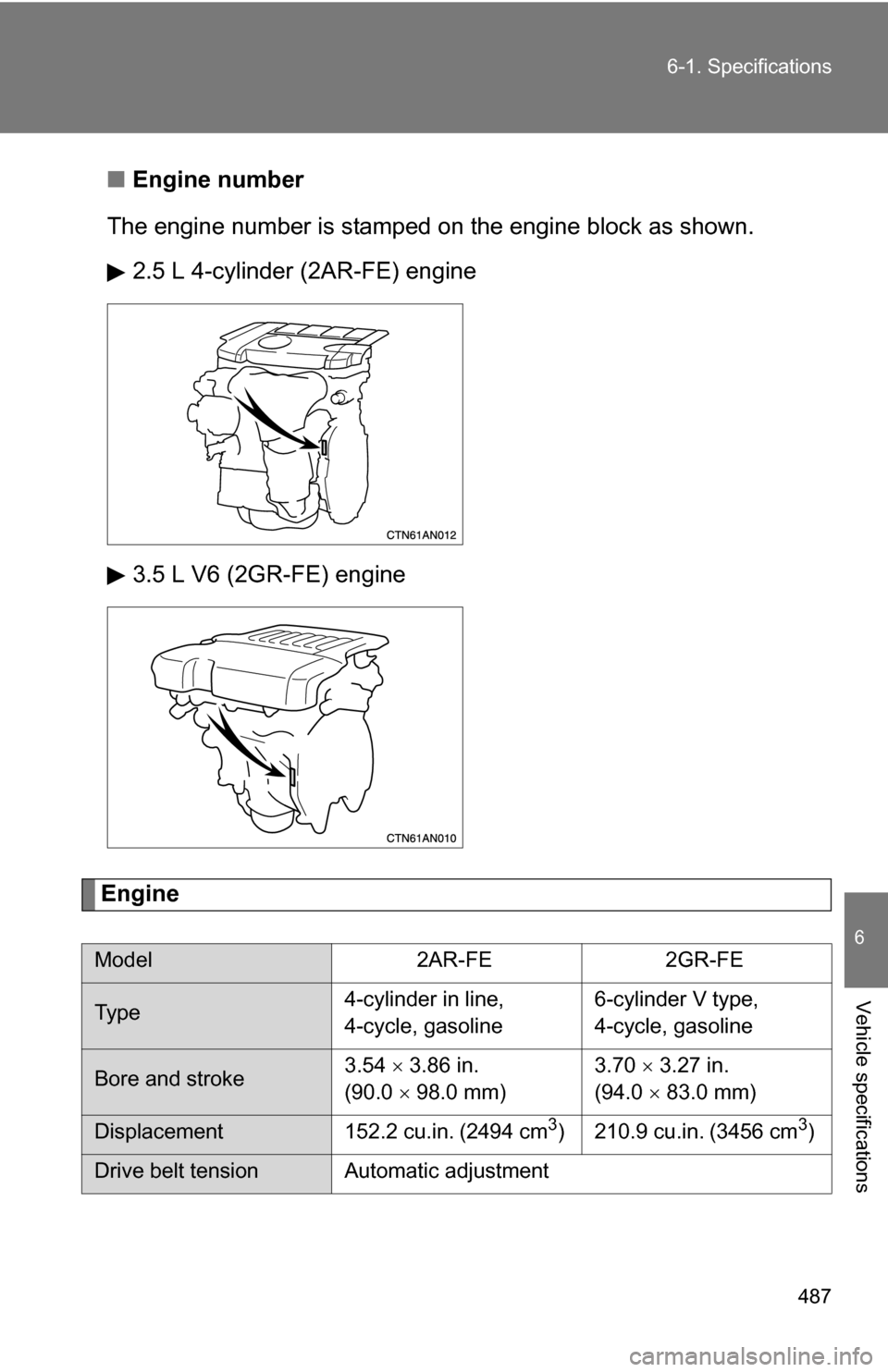
Engine number
The engine number is stamped on the engine bl ock as shown.
2.5 L 4-cylinder (2AR-FE) engine
3.5 L V6 (2GR-FE) engine
Engine
Model 2AR-FE2GR-FE
Ty p e 4-cylinder in line,
4-cycle, gasoline6-cylinder V type,
4-cycle, gasoline
Bore and stroke
3.54
3.86 in.
(90.0 98.0 mm) 3.70
3.27 in.
(94.0 83.0 mm)
Displacement 152.2 cu.in. (2494 cm3) 210.9 cu.in. (3456 cm3)
Drive belt tension Automatic adjustment
Page 488 of 544
488 6-1. Specifications
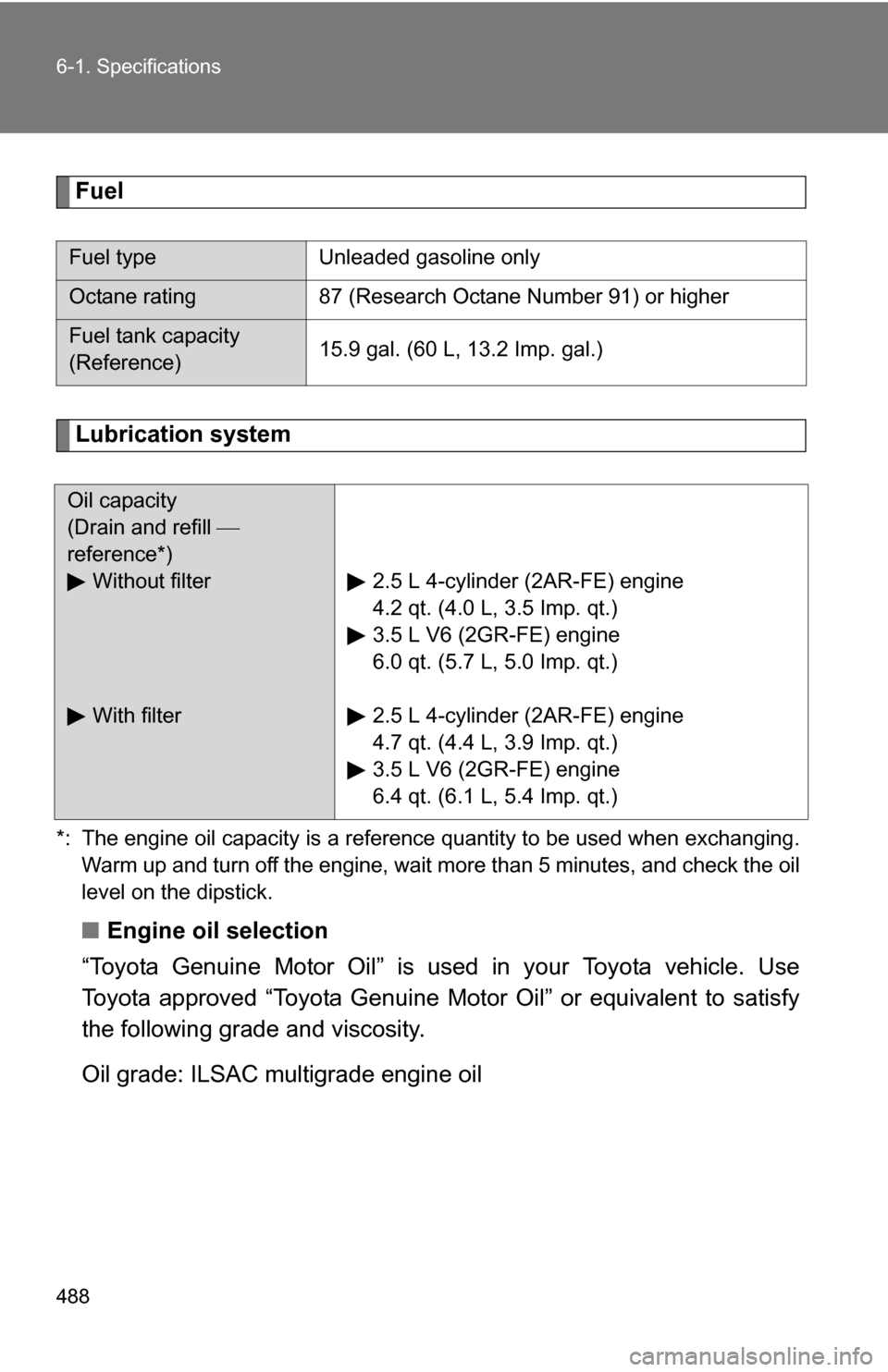
Fuel
Lubrication system
*: The engine oil capacity is a reference quantity to be used when exchanging.Warm up and turn off the engine, wait more than 5 minutes, and check the oil
level on the dipstick.
■Engine oil selection
“Toyota Genuine Motor Oil” is used in your Toyota vehicle. Use
Toyota approved “Toyota Genuine Motor Oil” or equivalent to satisfy
the following grade and viscosity.
Oil grade: ILSAC multigrade engine oil
Fuel type Unleaded gasoline only
Octane rating 87 (Research Octane Number 91) or higher
Fuel tank capacity
(Reference) 15.9 gal. (60 L, 13.2 Imp. gal.)
Oil capacity
(Drain and refill
reference*) Without filter
With filter 2.5 L 4-cylinder (2AR-FE) engine
4.2 qt. (4.0 L, 3.5 Imp. qt.)
3.5 L V6 (2GR-FE) engine
6.0 qt. (5.7 L, 5.0 Imp. qt.)
2.5 L 4-cylinder (2AR-FE) engine
4.7 qt. (4.4 L, 3.9 Imp. qt.)
3.5 L V6 (2GR-FE) engine
6.4 qt. (6.1 L, 5.4 Imp. qt.)
Page 489 of 544
489
6-1. Specifications
6
Vehicle specifications
Recommended viscosity:
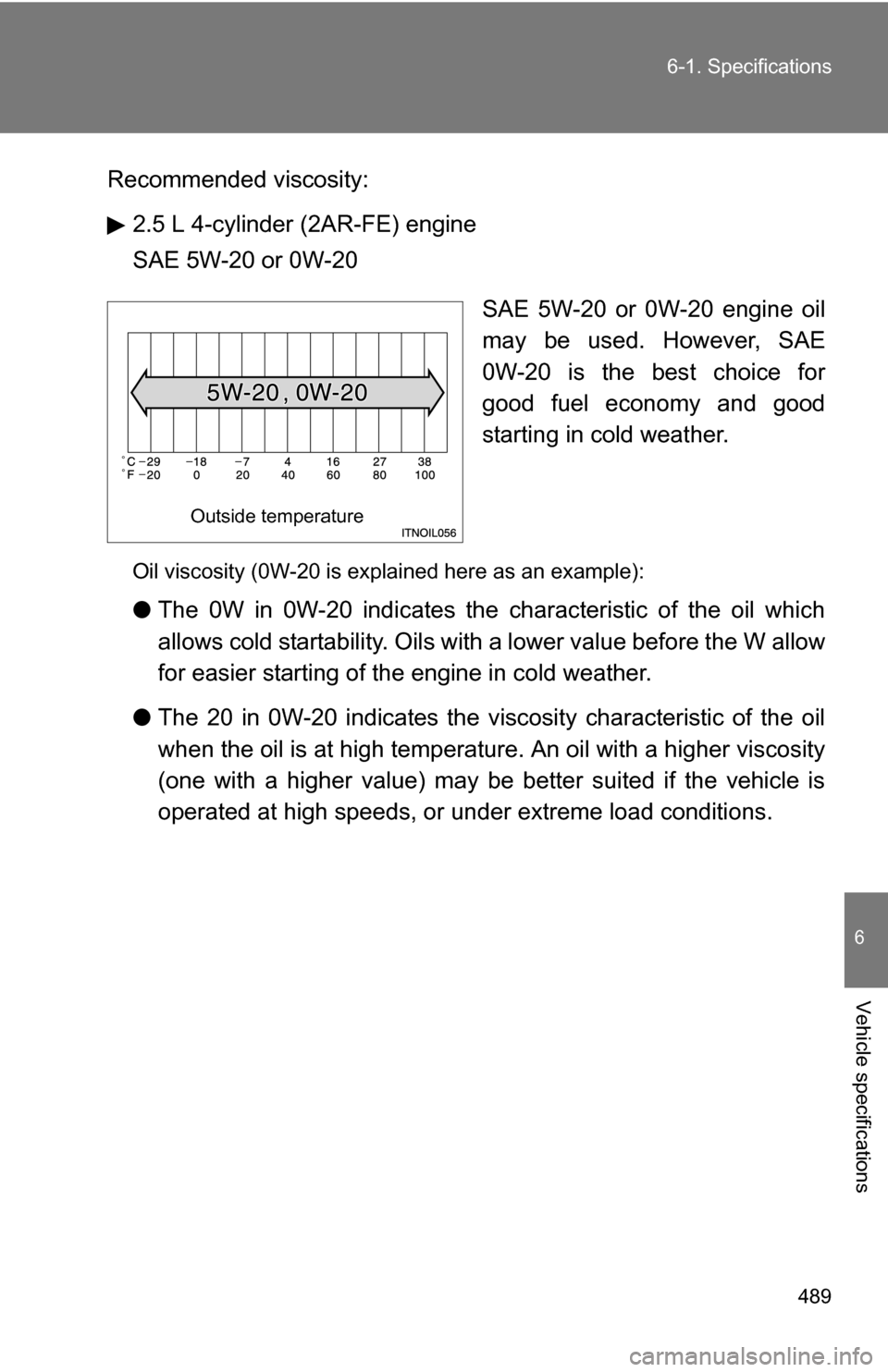
2.5 L 4-cylinder (2AR-FE) engine
SAE 5W-20 or 0W-20
SAE 5W-20 or 0W-20 engine oil
may be used. However, SAE
0W-20 is the best choice for
good fuel economy and good
starting in cold weather.
Oil viscosity (0W-20 is explained here as an example):
●The 0W in 0W-20 indicates the characteristic of the oil which
allows cold startability. Oils with a lower value before the W allow
for easier starting of the engine in cold weather.
● The 20 in 0W-20 indicates the visc osity characteristic of the oil
when the oil is at high temperatur e. An oil with a higher viscosity
(one with a higher value) may be better suited if the vehicle is
operated at high speeds, or under extreme load conditions.
Outside temperature
Page 490 of 544
490 6-1. Specifications
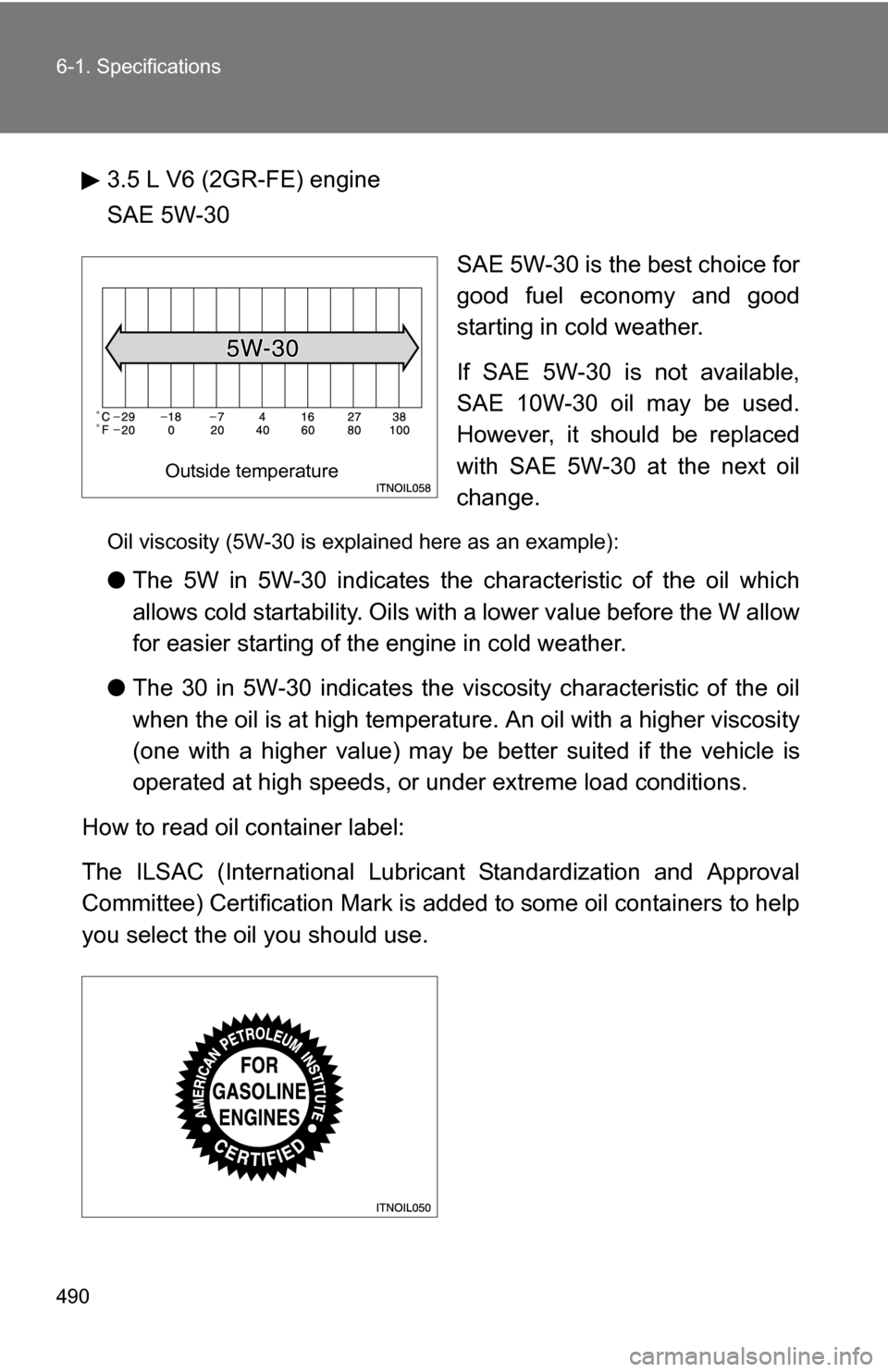
3.5 L V6 (2GR-FE) engine
SAE 5W-30SAE 5W-30 is the best choice for
good fuel economy and good
starting in cold weather.
If SAE 5W-30 is not available,
SAE 10W-30 oil may be used.
However, it should be replaced
with SAE 5W-30 at the next oil
change.
Oil viscosity (5W-30 is explained here as an example):
●The 5W in 5W-30 indicates the characteristic of the oil which
allows cold startability. Oils with a lower value before the W allow
for easier starting of the engine in cold weather.
● The 30 in 5W-30 indicates the viscosity characteristic of the oil
when the oil is at high temperatur e. An oil with a higher viscosity
(one with a higher value) may be better suited if the vehicle is
operated at high speeds, or under extreme load conditions.
How to read oil container label:
The ILSAC (International Lubricant Standardization and Approval
Committee) Certification Mark is added to some oil containers to help
you select the oil you should use.
Outside temperature